THE SIX CRATES HIDDEN IN THE MOUNTAINS: A 27-YEAR-OLD SECRET THAT DESTROYED THREE MEN
PART 1 — THE MEN WHO LEFT ME TO DIE
THREE MEN ABANDONED ME IN THE MOUNTAINS WITH NO FOOD, NO MONEY, AND NO WAY BACK. But when I discovered a freight wagon that had vanished twenty-seven years earlier, I found six crates of forgotten valuables—and a name that connected the mystery to my own family.
“Check the stream,” Rafael Sebrián told me. “See if there’s enough water for the animals.”
I looked at the three men standing beside the caravan.
“Should I take anything?”
“Just your canteen. We won’t be long.”
I believed him.
That was my first mistake.
My name is Clara Montalvo. I was twenty-three years old, and for the previous six days, I had been keeping accounts for Rafael and his two companions as they traveled through the mountains of northern Spain.
I wasn’t wealthy. I wasn’t traveling for adventure.
My mother, Teresa, was waiting for me near Astorga, and every coin I earned mattered. I had promised her I would return with enough money to help us through the coming months.
I kept the accounts carefully, recorded every purchase, and made sure nobody could accuse me of losing a single coin.
My father had taught me to be that way.
Joaquín Montalvo had carried mail between mountain villages for more than twenty years. When I was little, he sometimes took me along on his mule, teaching me to recognize trails, streams, rocks, and distant landmarks.
“Don’t learn only the path, Clara. Learn what lies beside it. A path can disappear. The land doesn’t.”
He had been dead for four years.
But I still remembered every word.
That afternoon, I took my half-filled canteen and followed the narrow trail between the rocks.
I expected to be gone twenty minutes.
Perhaps thirty.
But when I returned less than forty minutes later, the entire caravan had disappeared.
No mule.
No blanket.
No travel bag.
No account notebook.
Only three sets of wagon tracks cutting through the dirt, leading west toward the mountain folds.
I stood motionless.
At first, I thought they had moved to another clearing.
I called Rafael’s name.
Nothing.
I climbed a nearby rock and searched the surrounding slopes.
Nothing.
Then I understood.
They had deliberately left me behind.
I could have screamed. I could have chased the tracks.
But three men traveling with animals, food, and a head start had a considerable advantage over one young woman with an emptying canteen.
The wind was growing stronger, and the sky had begun turning gray.
I remembered my father’s lessons.
There was an old shepherd’s route somewhere southeast of the trail. He had mentioned a narrow gully that might lead to water.
I didn’t know whether I could find it.
But standing there waiting for men who had stolen everything from me wasn’t going to save my life.
So I turned away from their tracks.
And walked.
The descent was brutal.
Heather tore at my skirt, loose stones rolled beneath my boots, and the wind slipped through my thin jacket.
Twice, I stopped to remove pebbles from my shoes.
By late afternoon, my canteen was empty.
My throat hurt, and every step seemed heavier than the last.
Then I heard something.
A faint sound beneath the wind.
Water.
I followed it between moss-covered rocks until I found a narrow stream.
I dropped to my knees and drank slowly, then refilled my canteen.
For a moment, I wanted to cry.
I was alone in the mountains, abandoned by people I had trusted, with no idea whether I would ever see my mother again.
But I had survived the first day.
That night, I found a half-collapsed stone wall that offered some protection from the wind. I ate half my remaining bread and wrapped myself in what little clothing I had.
Sleep was impossible.
Every sound made me turn my head.
Branches cracked.
Stones shifted.
The mountain seemed to move around me.
I kept thinking about the stolen account notebook.
Why had they taken it?
It contained six days of expenses, nothing particularly valuable.
Unless there was something in those accounts they didn’t want me examining.
I tried to push the thought away.
The next morning, dark rain clouds gathered above the ridge.
I knew I needed better shelter before the weather worsened.
I followed the slope carefully, pushing through dry brush and stepping around loose rocks.
Then something pale appeared beneath the vegetation.
At first, I thought it was a large stone.
But when I climbed closer, I stopped breathing.
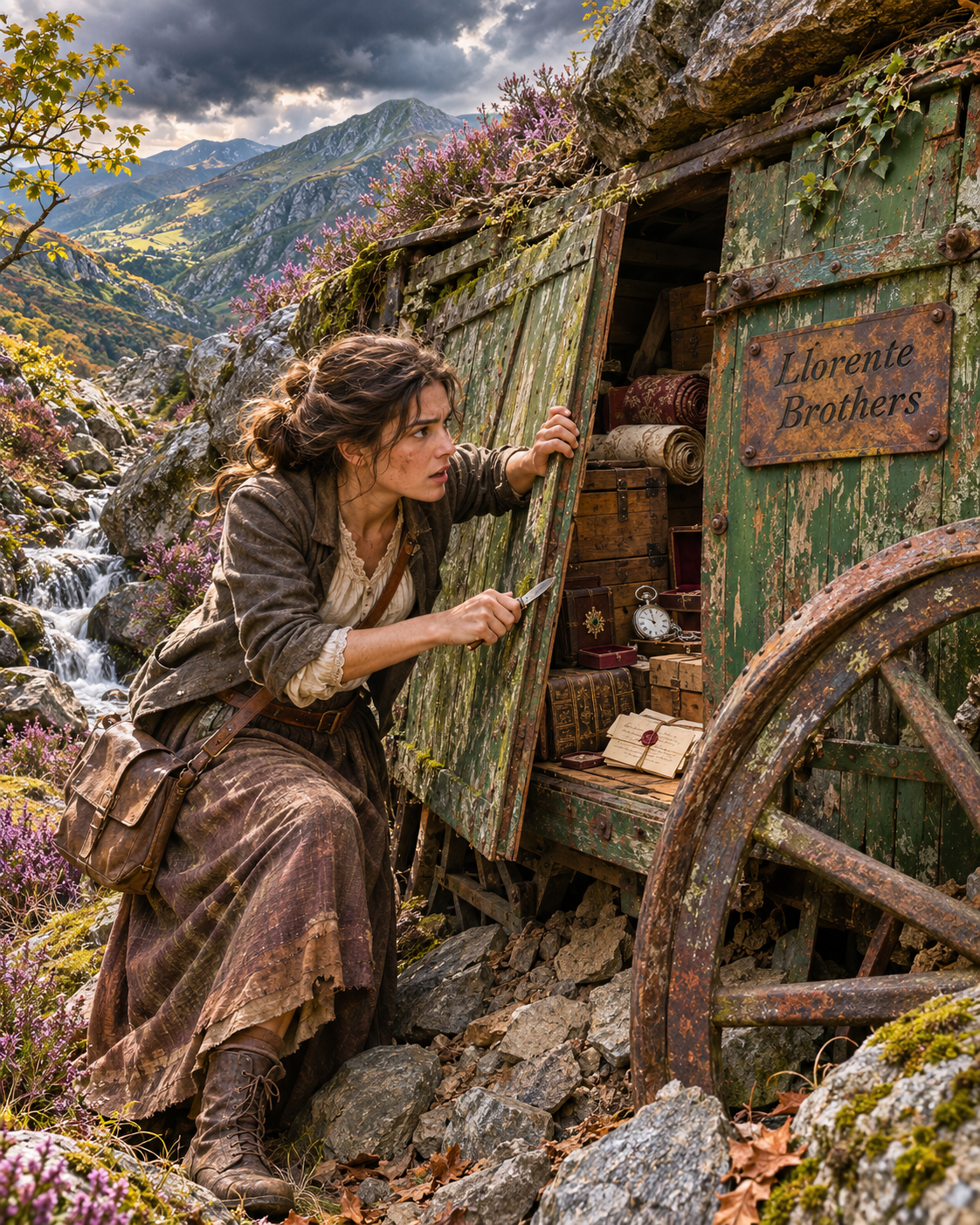
It was a wagon.
An enormous old freight wagon with high iron-rimmed wheels, half-buried between rocks.
It wasn’t a passenger carriage.
Its wooden box was broad and completely enclosed, with traces of faded green paint beneath years of dust.
One front wheel had broken.
A small landslide had buried part of the roof, and the back of the wagon rested against a natural stone wall.
From the trail above, it would have been almost impossible to see.
I circled it slowly.
Then I noticed a rusty metal plate attached to the door.
I brushed away the dirt.
Two words remained visible.
LLorente Brothers.
I stared at the inscription.
I remembered hearing that name years earlier at the inn where I worked.
A traveler had told a story about a trading house from Salamanca that transported watches, fine fabrics, jewelry, and valuable merchandise between towns.
One of its wagons had disappeared.
Twenty-seven years earlier.
Nobody had ever found it.
Could this possibly be the same wagon?
My heart began racing.
I examined the wheels, the damaged roof, and the surrounding ground.
There were no recent footprints.
No fresh tracks.
Nothing suggesting anyone had visited the place in years.
The rear lock had rusted almost completely through.
I pulled out my father’s old pocketknife.
It was one of the few things I had managed to keep.
I slipped the blade between the metal and the wooden frame, carefully working the latch.
It resisted.
I tried again.
The rusty mechanism finally gave way.
The wagon door creaked open.
A wave of stale air escaped.
Inside, the darkness was thick, but when my eyes adjusted, I could make out several large wooden crates.
I counted them.
Six.
Six crates had been left inside a wagon missing for twenty-seven years.
I climbed inside.
The first crate contained precision instruments packed in hardened grease: compasses, measuring gauges, and drawing tools.
The second held rolls of fabric. Some had deteriorated, but others were still wrapped in protective waxed coverings.
Then I opened the third.
My hands stopped moving.
Inside were dozens of small cases.
I opened the first.
A silver pocket watch.
The second contained a brooch decorated with green stones.
The third held a pair of gold earrings.
Each case had a small paper tag attached, marked with a handwritten number.
I slowly closed the lid.
These weren’t random belongings.
Someone had carefully catalogued every item.
Someone had expected this cargo to reach its destination.
But why had the wagon disappeared?
And why had nobody returned for it?
I searched the remaining crates and found a narrow box containing several old account books.
On the first page, faded ink revealed the full name of the trading house.
Llorente Brothers, Salamanca.
I turned several pages.
There were dates, numbered shipments, and carefully recorded merchandise.
Then I noticed something unusual.
The records seemed to stop abruptly.
There was no final delivery entry.
No explanation.
Just an unfinished account.
I felt a chill that had nothing to do with the mountain air.
I searched beneath the front bench, hoping to find another document that might explain what happened.
My fingers brushed against something wedged behind a loose wooden board.
It was a leather wallet.
I pulled it free.
Inside were several folded letters, their edges yellowed with age.
The oldest one carried a date from twenty-seven years earlier.
I unfolded it carefully.
The handwriting was elegant, but the ink had faded.
At the bottom was a signature.
Vicente Llorente.
I stared at the name.
Something about it felt strangely familiar.
Not from the inn.
Not from the stories about the missing wagon.
From somewhere much closer.
From my own family’s past.
Outside, the first raindrops began tapping against the wagon roof.
I stood surrounded by forgotten valuables, six sealed crates, and documents that might explain a disappearance nobody had solved in nearly three decades.
Then I turned the letter over.
And saw another name written beneath Vicente’s signature.
A name I had heard my father mention only once—and had never understood why.
PART 2 — THE LIST OF THE FORGOTTEN
The first letter inside was dated twenty-seven years earlier—and if you want to know what it revealed, find Part 2 in the first comment.
Vicente Llorente wrote that the wagon carried more than the trading house’s merchandise. Families in Salamanca and León had entrusted the company with jewelry, savings, and documents—items to repair, sell, or deliver to relatives. The wagon also carried money gathered after a fire destroyed several homes in a small town.
Clara looked at the numbered cases again. The cargo wasn’t a forgotten fortune. It belonged to people who might have spent twenty-seven years believing it was gone.
The next letter said Vicente had heard that men were following the route. He planned to take a little-used pass and wait until the danger had passed.
The last note was unfinished.
The axle has given way. Bartolomé has gone for help. If he doesn’t return by nightfall, I will try—
Nothing followed.
Clara could have taken a watch, a jewel, or a handful of coins. No one would have known. Instead, she closed the books and left the crates untouched.
She drew a map from the stream to the gully, the split rock, and the wagon’s hiding place. Then she took one letter, an account book, and a small empty case stamped with the company name. She shut the door and wedged a sturdy branch through the handles.
By late afternoon, she found a stone shepherd’s house. Andrés and Pilar listened as she explained what she had found. Andrés turned the empty case in his hands.
“My father used to speak of that wagon,” he said. “He said it carried money from half the world.”
The following morning, Andrés accompanied Clara to a village with a Civil Guard post. Sergeant Tomás Roldán listened, examined the letter, and stopped writing when Clara mentioned the men who had abandoned her.
“Rafael Sebrián,” he said quietly. “That name has appeared before.”
Two days later, an official expedition set out for the mountain, with Clara guiding them. They found the wagon exactly where she had left it. After hours of inventory, the officers opened the reinforced chest.
Inside were coins, sealed envelopes, property deeds, receipts, and a list of names.
Tomás unfolded the list. His face changed.
One of the names belonged to a family whose descendants had arrived that morning—and they were already waiting at the station.
PART 3 — THE NAME THAT MY FATHER HAD BURIED
I watched Sergeant Tomás Roldán read the list for a second time.
His expression had changed from professional curiosity to something close to disbelief.
“What is it?” I asked.
He turned the paper toward me.
There, written in faded brown ink, was a name I knew better than any other.
Teresa Montalvo — Astorga.
My mother’s name.
Beside it were several descriptions:
One silver medal.
Two gold rings.
A small leather purse containing family savings.
An original property deed.
I felt my knees weaken.
“My mother?” I whispered.
Tomás nodded.
“We sent a message to Astorga yesterday after finding this name. She arrived this morning with a woman from the village.”
I didn’t wait for him to finish.
I ran toward the station entrance.
And there she was.
My mother stood near the wooden bench, wearing the same dark brown shawl she had worn when I left home six days earlier.
The moment she saw me, she covered her mouth.
“Clara!”
I threw my arms around her.
For several seconds, neither of us spoke.
She held me so tightly that I could barely breathe.
“I thought I’d lost you,” she whispered. “They told me you had disappeared in the mountains.”
“I came back, Mama. I’m here.”
She touched my face, my shoulders, and my hands as if she needed to make certain I was real.
Then her expression changed when she noticed the letter I was carrying.
“Where did you find that?”
I showed her the signature.
Vicente Llorente.
Then I turned the paper over.
The second name was still visible.
Bartolomé Montalvo.
My mother went completely still.
For a long moment, she stared at the handwriting.
Then she sat down.
“Your father never wanted you to know,” she said quietly.
I looked at her.
“Know what?”
“Bartolomé was your father’s older brother. Your uncle.”
I felt as if the floor had shifted beneath me.
I remembered that name.
Years earlier, when I was perhaps ten, my father had been sitting beside the fireplace after receiving a letter from an old friend.
He had thought I was asleep.
I remembered hearing him say:
“Bartolomé never betrayed anyone. I wish I had found him before it was too late.”
I had never understood those words.
Now I did.
My mother continued.
“Twenty-seven years ago, Bartolomé worked as a driver for the Llorente Brothers. He was an honest man. He had taken the job to support the family after your grandfather became ill.”
She wiped her eyes.
“When the wagon disappeared, people began accusing him of stealing the cargo. Your father refused to believe it. He spent years asking questions, visiting villages, and searching old mountain routes.”
“Why didn’t he tell me?”
“Because he had no proof. And because the people who accused Bartolomé had powerful friends. Your father feared that speaking openly would put us in danger.”
I looked down at the letter.
“Then Bartolomé really did go for help?”
My mother nodded.
“That was what your father believed. He said his brother would never have abandoned Vicente or the families whose property he carried.”
At that moment, Tomás approached us carrying another document.
“Señora Montalvo, there is something else you need to see.”
He placed a second ledger on the table.
Unlike the first, this one had been wrapped in oilskin and hidden beneath a false bottom in the reinforced chest.
Its pages contained a different kind of record.
Payments.
Names.
Dates.
And one name appeared repeatedly.
Esteban Sebrián.
I recognized the surname immediately.
Rafael.
Tomás pointed to an entry dated two days before the wagon disappeared.
“Payment to Esteban Sebrián and two associates for information concerning the Llorente shipment.”
Another entry recorded a payment for a replacement axle pin.
A third contained a short sentence:
The route will be blocked before the pass. The driver must not reach Salamanca.
My stomach tightened.
“Someone planned the disappearance.”
“More than that,” Tomás replied. “Someone deliberately arranged it.”
He turned another page.
There was a handwritten statement signed by Vicente Llorente.
It explained that Esteban Sebrián had discovered the shipment’s value and planned to steal it. He had recruited men to sabotage the wagon and intercept the driver.
But Bartolomé had discovered the plan.
He warned Vicente and helped hide the cargo when the axle broke. He then left to find help, carrying a small portion of the evidence.
He never returned.
The final lines were heartbreaking.
If Bartolomé does not return, do not let anyone call him a thief. He risked everything to protect these families. If the truth survives, let his family know that he died an honest man.
My mother began crying.
I couldn’t speak.
For twenty-seven years, our family had carried the shadow of a man who had disappeared under suspicion.
And now the truth was finally written in front of us.
But Tomás wasn’t finished.
He placed another paper beside the ledger.
It was a list of recent purchases.
Rope.
Iron wedges.
Oilcloth.
A small mountain map.
And a payment to a local guide.
The handwriting was unmistakable.
It belonged to Rafael.
Tomás looked at me.
“Your account notebook may be more important than you realize. Do you remember anything unusual during those six days?”
I thought carefully.
Then I remembered.
Rafael had asked me several questions about my father’s old routes.
He had also asked whether I knew the location of a particular stream and a narrow gully.
At the time, I had thought he was simply planning our journey.
But now I understood.
He had been searching for the missing wagon.
He had used me because he knew my father had spent his life traveling through those mountains.
“He knew about the wagon,” I said.
Tomás nodded.
“And he needed you to find it.”
“He abandoned me because he thought I would die before I could tell anyone.”
For a moment, nobody spoke.
Then a sound came from outside.
Wheels.
Several horses.
Tomás turned toward the entrance.
Through the station window, I saw three men approaching.
Rafael Sebrián was in front.
His companions followed him.
He dismounted slowly, looked toward the station, and smiled when he saw me.
It wasn’t the smile of a man surprised to find someone alive.
It was the smile of someone who had expected to finish a job.
He stepped inside.
“Clara,” he said calmly. “There you are.”
I didn’t answer.
He looked at the documents on the table.
Then his smile disappeared.
“What exactly have you told these officers?”
Tomás stood up.
“That is a question we were about to ask you, Señor Sebrián.”
Rafael glanced toward the door.
His two companions had stopped behind him.
For the first time since I had met him, he looked uncertain.
Then he said something that made my blood run cold.
“You have no idea whose property you’re dealing with. My grandfather died trying to recover what belonged to our family.”
Tomás slowly closed the ledger.
“Then perhaps you can explain why your grandfather’s name appears beside payments for a robbery.”
Rafael said nothing.
And I knew the final battle was about to begin.
PART 4 — THE PRICE OF BETRAYAL
Rafael took one step backward.
For a moment, I thought he might run.
Instead, he straightened his coat and forced a laugh.
“This is ridiculous. My grandfather was a businessman. He helped transport goods throughout the region. Those records prove nothing.”
Tomás remained calm.
“Then you won’t mind answering a few questions.”
“I have nothing to answer.”
“Interesting. Because we have a missing freight wagon, six crates of valuable property, an account book documenting your grandfather’s payments, and a young woman you abandoned in the mountains.”
Rafael’s face hardened.
“You cannot prove I abandoned her deliberately.”
I finally spoke.
“You told me to check the stream. You took my belongings, my money, and my account book. You left without telling me where you were going.”
He turned toward me.
“You should have stayed quiet, Clara.”
Those words were enough.
Tomás signaled to the two officers standing near the back room.
They stepped forward.
Rafael’s companions exchanged nervous glances.
One of them, a broad-shouldered man named Mateo, suddenly spoke.
“I’m not going to prison for this.”
Rafael turned sharply.
“Shut your mouth.”
Mateo looked at Tomás.
“Everything she said is true. Rafael planned it. He told us to leave her near the stream and continue west. We were supposed to return after dark, find the wagon, and take whatever we could carry.”
The other man, Luis, lowered his head.
“I didn’t know he intended to leave her without food. He said we’d come back for her.”
I looked at him.
“You knew I had no money. You knew I had no way to reach the nearest village.”
Luis couldn’t meet my eyes.
Mateo continued.
“Rafael had been looking for that wagon for months. His grandfather left him an old map and several notes. He knew the cargo had never been recovered.”
Tomás asked, “And why did you need Clara?”
Mateo swallowed.
“Because Rafael learned that her father had traveled those mountains for years. He believed she knew the old routes.”
I felt sick.
The six days of kindness had been nothing but an act.
Every question.
Every friendly conversation.
Every promise of payment.
All of it had been designed to use me.
Rafael suddenly lunged toward the table.
He reached for the original ledger.
But Tomás was faster.
The sergeant caught his wrist, twisted his arm behind his back, and pushed him against the wall.
One of the officers secured his other hand.
“Rafael Sebrián,” Tomás said firmly, “you are under arrest.”
Rafael struggled.
“You can’t do this! Those goods belong to my family!”
“No,” Tomás replied. “They belong to the families who entrusted them to the Llorente Brothers twenty-seven years ago.”
Rafael was dragged outside.
His two companions were also taken into custody.
As he passed me, he stopped struggling long enough to whisper:
“You’ve ruined everything.”
I looked directly at him.
“No, Rafael. You ruined yourself.”
The investigation lasted several weeks.
Officers searched Rafael’s residence and discovered his grandfather’s private papers, an old mountain map, and several letters discussing the missing wagon.
They also recovered my stolen account notebook.
I opened it with trembling fingers.
The pages were still there.
Every purchase.
Every payment.
Every expense.
But now I noticed something I hadn’t recognized before.
On the final page, Rafael had written several calculations in his own hand.
The estimated value of the six crates.
The cost of hiring two men.
The price of transporting the recovered goods.
And beneath those figures was one sentence:
The girl must not return to Astorga.
I closed the notebook.
That single sentence confirmed everything.
The trial began before the end of the season.
Mateo and Luis testified against Rafael. They admitted their roles in abandoning me and helping him plan the theft.
The recovered documents proved that Esteban Sebrián had organized the original robbery twenty-seven years earlier.
Rafael had inherited his grandfather’s unfinished scheme and intended to complete it.
But the most important evidence was Vicente Llorente’s letter.
It cleared Bartolomé Montalvo’s name.
It proved that he had tried to save the cargo and protect the families who had trusted him.
Rafael was convicted of attempted robbery, conspiracy, abandonment, and other related crimes. He received a lengthy prison sentence.
His companions were also convicted and punished for their involvement.
The Sebrián family’s reputation, once protected by wealth and influence, collapsed.
No one in the region could pretend they had been innocent anymore.
But the greatest moment for me came several weeks later.
The authorities had finished examining the cargo.
The six crates contained property belonging to dozens of families.
Some items were returned to elderly people who had spent decades mourning their disappearance.
Others went to children and grandchildren who had never even known such things existed.
There were tears in the station that day.
An old woman held a silver brooch against her chest and whispered that it had belonged to her mother.
A man from León recognized a pocket watch his father had described countless times.
Another family recovered documents proving ownership of a small piece of land that had been disputed for years.
And then Tomás called my mother and me forward.
He placed a small cedar box on the table.
Inside were two gold rings, a silver medal, a leather purse containing the family’s savings, and an original property deed.
My mother recognized the medal immediately.
She picked it up with shaking fingers.
“My mother wore this,” she whispered.
The deed belonged to a small orchard outside Astorga that my grandmother had purchased before the wagon disappeared.
For years, my family had believed the papers were lost forever. Without them, we had been unable to prove the original ownership of the property.
Now the document had been recovered, and the official records confirmed that the land had never been legally transferred away from our family.
My mother began to cry.
Not because of the money.
Because something that had belonged to her mother had finally come home.
Then Tomás handed me another envelope.
It was addressed to:
Joaquín Montalvo’s family.
Inside was a final letter from Vicente Llorente.
It had been written shortly before the wagon disappeared.
To the family of Bartolomé Montalvo,
Your son and brother is an honest man. If this letter reaches you, know that he did everything in his power to protect the cargo and the families who trusted us.
He went for help because he believed he could save us all.
If I do not survive, please do not let his name be forgotten.
He was a better man than those who hunted us.
With gratitude,
Vicente Llorente.
My mother held the letter against her chest.
For the first time in twenty-seven years, the Montalvo family had the truth.
Bartolomé had not stolen anything.
He had not betrayed anyone.
He had done what an honorable man was supposed to do.
And although we would never know exactly where his final journey had ended, his name was finally cleared.
A month later, we returned to the orchard.
The old property was smaller than I remembered from my mother’s childhood stories. Its stone walls needed repairs, the trees had grown wild, and the little farmhouse had a damaged roof.
But it was ours.
My mother stood beneath an old apple tree and looked across the land.
“Your father would have been happy,” she said.
I took her hand.
“He would have been proud of you, too.”
We used part of the recovered savings to repair the farmhouse and restore the orchard. The rest gave my mother enough security to live without worrying about every coin.
As for me, I no longer needed to travel with strangers through dangerous mountains.
The Llorente family, grateful that I had helped recover the cargo, offered me a position managing the records and assisting with the return of the remaining property.
I accepted.
For the first time in my life, I had work that mattered, a home I could return to, and a future that didn’t depend on trusting men like Rafael Sebrián.
And Andrés, the shepherd who had helped me reach the village, remained close to our family.
He visited often, helped repair the orchard walls, and always brought fresh bread for my mother.
One evening, as the sun disappeared behind the mountains, he stood beside me beneath the apple trees.
“Do you still think about that day?” he asked.
“The day they left me?”
He nodded.
“Sometimes.”
“And what do you think about?”
I looked toward the distant mountains.
“I think about how close I came to giving up.”
Then I smiled.
“But I also think about what my father taught me.”
“What was that?”
I looked at the old pocketknife resting in my hand.
“Never learn only the path. Learn what lies beside it.”
And for the first time, I understood the full meaning of his words.
The mountain had taken twenty-seven years to reveal its secret.
Three men had believed they could leave me there, erase the truth, and steal what belonged to others.
They were wrong.
The six crates had returned to the families who deserved them.
My mother’s tears had finally turned into happiness.
My father’s family name had been cleared.
And the men who had built their fortunes on lies had lost everything they had tried to protect.
Sometimes justice takes years.
Sometimes it takes an entire generation.
But the truth has a way of finding its path home.
And that day, beneath the quiet mountains of northern Spain, it finally found ours.
THE END.
If Clara’s story touched your heart, please come back and leave a LIKE, SHARE this story with your friends and family, and COMMENT below:
Do you believe that justice always finds its way, no matter how many years it takes?
Your support helps us bring more emotional, suspenseful stories to life. Thank you for reading!