“LOSING 333 FEET EVERY SECOND”: NEW 3D RECONSTRUCTION REVEALS THE FINAL 78 SECONDS OF FATAL FLORIDA LEARJET CRASH

“LOSING 333 FEET EVERY SECOND”: NEW 3D RECONSTRUCTION REVEALS THE FINAL 78 SECONDS OF FATAL FLORIDA LEARJET CRASH
A terrifying new overhead reconstruction is offering a closer look at the final moments of a Learjet 60 that plunged from approximately 35,000 feet over South Florida, killing all nine people aboard. The aircraft went from requesting permission to climb above turbulent weather to reporting a desperate emergency in a matter of seconds.
For nine people aboard a private jet bound for the Bahamas, what began as an ordinary flight ended in an unimaginable tragedy.
On November 1, 2026, a Learjet 60 operated by Aurora Aviation, doing business as Upper Jet, crashed near Greenacres, Florida, killing everyone on board.
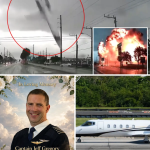
Now, a new 3D flight reconstruction created by video creator Bilawal Sidhu is bringing together publicly available flight-tracking data, weather radar, air traffic control recordings and bystander footage to illustrate the aircraft’s final moments.
The independent visualization follows approximately 78 seconds of the flight’s final descent — a sequence that shows how rapidly the situation deteriorated.
 A REQUEST TO CLIMB ABOVE THE WEATHER
The aircraft had departed Austin-Bergstrom International Airport in Texas, heading toward North Eleuthera in the Bahamas.
On board were seven passengers and two crew members: Captain Jeff Gregory and 20-year-old First Officer Nathalia Gadelha Filgueiras.
Among the passengers were Austin technology entrepreneur Adam Robinson, his wife Helen Sharp, their two young children, their caregiver Anita Maria Cetina, and family friends Rachael Reed and Charmi Fehr.
Approximately two hours into the journey, the crew reported encountering moderate turbulence and light clear icing while flying at around 35,000 feet.
The pilots also reported altitude fluctuations of approximately 700 feet.
As conditions became increasingly difficult, the crew requested permission to climb to 37,000 feet in search of a smoother flight.
Air traffic control approved the request.
But the situation soon changed dramatically.
 THE FIRST MAYDAY CALL
According to recorded communications, the crew began reporting a rapidly worsening descent.
At approximately 12:48 p.m. Eastern time, the aircraft was reportedly descending at around 8,000 feet per minute.
A mayday call followed.
The crew then reported that the aircraft was losing altitude at approximately 10,000 feet per minute.
Just seconds later, the situation became even more alarming.
The pilot reported an overspeed condition and a descent rate of approximately 20,000 feet per minute.
That figure is equivalent to roughly 333 feet of altitude lost every second.
The aircraft was no longer simply descending. The crew was facing an emergency that was unfolding at an extraordinary speed.
WHAT DOES LOSING 333 FEET EVERY SECOND MEAN?
To understand the scale of the emergency, consider what a descent rate of 20,000 feet per minute actually represents.
At that rate, the aircraft would lose more than 333 feet of altitude in a single second.
The crew subsequently reported a descent rate of approximately 22,000 feet per minute — equivalent to about 367 feet per second.
During the final radio transmissions, the crew also reported that the aircraft was banking steeply, with an indicated bank angle of approximately 60 degrees.
The independent reconstruction places these communications alongside the aircraft’s estimated flight path, allowing viewers to see how quickly its altitude and direction changed.
However, the animation is a data-based reconstruction, not an official NTSB determination of what caused the aircraft to lose control.
The precise sequence and underlying cause remain under investigation.
WRECKAGE SUGGESTS PARTS OF THE AIRCRAFT SEPARATED BEFORE IMPACT
The crash left a devastating scene near South Military Trail in Greenacres.
Investigators recovered debris from several major sections of the aircraft, including both wings, both engines, the flight deck and components of the tail assembly.
Among the most significant findings were pieces of the left elevator, a flight-control surface that helps control the aircraft’s pitch.
Some of these pieces were discovered miles from the main impact location.
The NTSB is examining the recovered components to determine what they may reveal about the aircraft’s condition and the sequence of events before impact.
The discovery of separated components does not, by itself, establish what caused the aircraft to break apart.
NTSB RECOVERS THE COCKPIT VOICE RECORDER
One of the most important developments came on November 9, when the National Transportation Safety Board announced that investigators had recovered the cockpit voice recorder.
The device was found at the initial impact site and transported to the NTSB’s Vehicle Recorders Laboratory in Washington, D.C., for evaluation.
The recorder could provide investigators with information about conversations between the pilots, sounds inside the cockpit and the crew’s response to the emergency.
The NTSB has not yet confirmed whether usable audio has been recovered or released any findings from its examination.
Investigators have also completed excavation work at the initial impact site, while recovered aircraft components are being examined in specialized laboratories.
NINE PEOPLE — NINE LIVES LOST
Behind the flight data and technical investigation are nine people whose lives ended in the crash.
Adam Robinson, a technology entrepreneur, was traveling with his wife, Helen Sharp, and their two young children.
Their family caregiver, Anita Maria Cetina, was also aboard, along with friends Rachael Reed and Charmi Fehr.
Both pilots were killed as well.
Nathalia Gadelha Filgueiras was just 20 years old. She had developed a passion for aviation at a young age and earned her pilot’s license as a teenager.
Captain Jeff Gregory also lost his life in the disaster.
The tragedy has left multiple families grieving loved ones who were simply traveling toward what should have been an ordinary destination.
THE MOST IMPORTANT QUESTION REMAINS UNANSWERED
The new reconstruction offers a chilling visual account of the Learjet’s final moments, but it cannot explain why the aircraft entered such a catastrophic descent.
Investigators are examining the weather, reported icing and turbulence, aircraft systems, recovered wreckage, flight-tracking information and cockpit communications.
At this stage, no probable cause has been established.
The recovered cockpit voice recorder may provide important clues, but the investigation is far from complete. A final NTSB report could take many months or longer.
For the families of the nine victims, the hope is that every recovered piece of evidence will bring investigators closer to understanding what happened.
A request to climb above the weather became a desperate call for help. Within approximately 78 seconds, nine lives were lost.
The reconstruction shows how quickly the final moments unfolded. The investigation must now determine why.