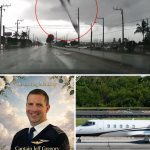
“THREADING A GAP BETWEEN THUNDERSTORMS” — EARLIER TURBULENCE INCIDENT PUTS FATAL LEARJET FLIGHT UNDER FRESH SCRUTINY

“THREADING A GAP BETWEEN THUNDERSTORMS” — EARLIER TURBULENCE INCIDENT PUTS FATAL LEARJET FLIGHT UNDER FRESH SCRUTINY
A disturbing detail from the flight history of a Learjet 60 that crashed in Florida, killing nine people, is attracting renewed attention after aviation commentator Captain Steeeve examined an earlier turbulence encounter involving the same aircraft.
The 2004 Learjet, registered as N722BD, went down near Greenacres in Palm Beach County on November 1, 2026, while traveling from Austin, Texas, to North Eleuthera in the Bahamas.
Among those killed were Austin technology entrepreneur Adam Robinson, his wife Helen Sharp, their two young children, three other passengers, and both pilots.
Now, a review of the aircraft’s previous flight near Newark in May 2026 has raised questions about whether the earlier encounter with severe turbulence was properly investigated and whether it could reveal anything about the aircraft’s condition before the fatal flight.
No official connection between the two incidents has been established.
 THE MAY FLIGHT: “THAT’S NOT MODERATE TURBULENCE”
One of the most striking details in Captain Steeeve’s analysis comes from air traffic control audio recorded during a May 2026 flight involving N722BD near Newark, New Jersey.
During that encounter, the crew initially described the conditions as moderate turbulence, or “moderate chop.”
However, the pilots also reported difficulty maintaining altitude.
An air traffic controller challenged their description, explaining that an aircraft unable to maintain altitude in those conditions could be experiencing severe turbulence.
The exchange has now drawn attention because the same aircraft was involved in the November tragedy.
The earlier recording raises an important question: Did the May encounter result in any damage, and were the appropriate inspections and maintenance procedures completed afterward?
At this stage, there is no publicly established evidence that the aircraft suffered damage during that flight or that the turbulence contributed to the later crash.
 A FLIGHT INTO DANGEROUS WEATHER
On November 1, N722BD departed Austin-Bergstrom International Airport with seven passengers and two crew members aboard.
The destination was North Eleuthera Airport in the Bahamas.
As the aircraft crossed Florida, the crew began reporting increasingly difficult weather conditions.
According to information released by the National Transportation Safety Board, the pilots reported light clear-air icing and moderate turbulence while flying at approximately 35,000 feet.
The crew also experienced altitude fluctuations of around 700 feet.
They subsequently reported encountering precipitation and requested permission to climb to 37,000 feet in search of improved conditions.
Air traffic control approved the request.
But the situation deteriorated within moments.
THE FINAL RADIO CALLS
Less than 30 seconds after receiving permission to climb, the aircraft reported an unexpected descent.
The co-pilot, Nathalia Gadelha Filgueiras, 20, communicated that the aircraft was descending rapidly and experiencing an overspeed condition.
The reported descent rate increased dramatically, reaching approximately 20,000 feet per minute in one of the final transmissions.
The crew declared an emergency, but air traffic controllers were unable to regain contact.
The Learjet crashed near Greenacres shortly before 1 p.m. local time.
All nine people aboard were killed.
The NTSB subsequently reported evidence suggesting that the aircraft began breaking apart before reaching the ground.
CAPTAIN STEEEVE EXAMINES THE THUNDERSTORM THEORY
In his independent aviation review, Captain Steeeve examined weather information and flight communications surrounding the aircraft’s final journey.
One possibility he discussed was whether the crew attempted to navigate through a narrowing opening between developing thunderstorm cells.
This maneuver is sometimes described by pilots as “shooting the gap.”
It can be extremely dangerous when storm systems are rapidly intensifying, because powerful updrafts, downdrafts, turbulence and precipitation can create hazardous conditions even at high cruising altitudes.
The analysis also discussed reports of rapidly rising storm tops and the possibility that the available route became increasingly difficult to navigate.
However, these observations remain part of an independent review.
The NTSB has not officially concluded that the crew attempted to fly through a gap between thunderstorms or that such a maneuver caused the accident.
THE COCKPIT VOICE RECORDER HAS BEEN RECOVERED
A major development in the investigation came on November 9, when the NTSB confirmed that investigators had recovered the aircraft’s cockpit voice recorder.
The device was located at the initial impact site and transported to the agency’s Vehicle Recorders Laboratory in Washington, D.C., for evaluation.
The cockpit voice recorder could provide investigators with information that was never transmitted to air traffic control.
It may help establish what the pilots discussed, what warnings they received, how they responded to the developing emergency and whether they attempted particular recovery procedures.
Investigators are also examining recovered aircraft components, including parts of both wings, both engines, the flight deck, stabilizers and sections of the flight-control system.
Pieces of the left elevator were found scattered between approximately 1.3 and 3.8 miles from the main crash site.
The elevator is an important flight-control surface that helps pilots control the aircraft’s pitch.
Investigators have not yet established whether its separation contributed to the accident or occurred as a consequence of the aircraft breaking apart during the final descent.
NINE PEOPLE WHO NEVER MADE IT TO THEIR DESTINATION
The crash destroyed a family and devastated the lives of those who loved the passengers and crew.
The victims included pilot Jeff Gregory, 55, and co-pilot Nathalia Gadelha Filgueiras, 20.
Also aboard were entrepreneur Adam Robinson, his wife Helen Sharp, their children Emma, 4, and Charlie, 2, as well as Rachael Reed, Charmi Fehr and the family’s nanny, Anita Maria Apellido Cetina.
Their journey to the Bahamas ended in tragedy, leaving families and friends searching for answers.
WHAT INVESTIGATORS STILL NEED TO FIND
The May turbulence recording has become an important point of discussion, but investigators must establish whether it has any connection to the November crash.
That means examining maintenance records, inspection reports, possible damage history, aircraft systems, flight-control components, weather conditions and the information recovered from the cockpit voice recorder.
The central questions remain:
- Did the May turbulence encounter cause any damage to N722BD?
- Were the required inspections completed after that incident?
- What role did icing and thunderstorms play during the final flight?
- Why did the aircraft enter such a rapid descent?
- Did a mechanical or flight-control problem contribute to the loss of control?
For now, none of these questions has an officially confirmed answer.
The NTSB investigation remains ongoing, and the agency has not determined the probable cause.
What began as a flight from Texas to the Bahamas has become a complex investigation involving weather, aircraft maintenance and the final decisions made inside the cockpit.
And as investigators examine the aircraft’s history, the earlier turbulence encounter may become an important piece of the puzzle — but only if the evidence establishes a connection.