Chuck Norris stood in bronze, watching his people say goodbye
“The Day The World Walked Him Home”
A city stopped breathing, a generation bowed its head, and somewhere at the end of a long street — Chuck Norris stood in bronze, watching his people say goodbye
There are funerals. And then there are homecomings.
This was a homecoming.
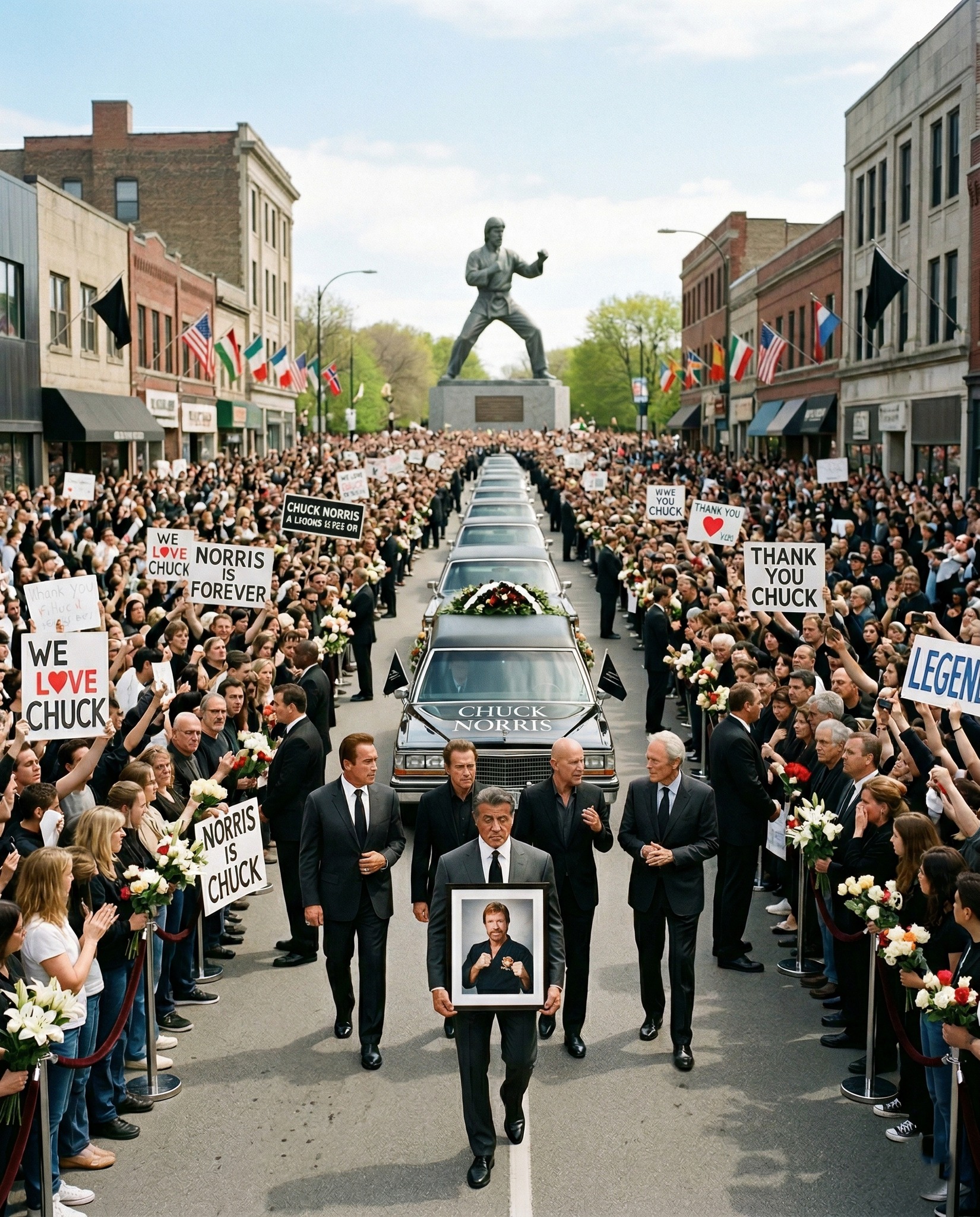
Look at this street. Look at it from one end to the other and try to find where the crowd ends — you cannot. It stretches beyond the frame of the photograph, beyond the edge of vision, back into the city and out into the world that this one man touched across eight and a half extraordinary decades. Thousands of people lining both sides of a wide American street, holding flowers and signs and each other, their faces carrying that particular expression that only grief produces — the open, undefended look of people who have stopped pretending that loss doesn’t hurt and are simply standing in it together.
We Love Chuck.
Norris Is Forever.
Thank You Chuck.
Legend.
The signs are handwritten. Marker on cardboard, the way the most sincere things always are — not printed, not produced, not polished. Just words from hands that needed to say something and grabbed the nearest surface available.
And at the front of it all, moving slowly through the avenue of love that this city has made of itself — a hearse bearing the name Chuck Norris on its side, followed by pallbearers in black, and ahead of them, carrying a portrait of the man himself, a figure who needs no introduction because his grief is the most visible thing on this street.
Sylvester Stallone. Walking his brother home.
And at the far end of the street, rising above everything — above the crowd, above the storefronts, above the flags of a dozen nations hanging in tribute — a statue. Bronze and eternal, frozen in a fighting stance, fists raised in the posture that defined a career and a life and a philosophy.
Chuck Norris, watching his own funeral procession.
Watching the people come to say goodbye.
There is something almost unbearably poetic about this. The living man is in the hearse. The eternal man stands at the end of the street in bronze, unchanging, permanent — exactly as he will always be in the memory of everyone present. The statue does not grieve. The statue does not diminish. The statue simply stands, as Chuck Norris always stood, facing whatever was coming with his fists ready and his faith intact.
Never Gone. Forever Kicking.
Sylvester Stallone walks at the front.
He carries the portrait of Chuck Norris the way a soldier carries a flag — with the specific, deliberate reverence of someone who understands that what he holds is not simply an object but a responsibility. The responsibility to bring his brother to his rest with dignity. To walk the full length of this street in front of this crowd without looking away from what it means.
Stallone has played men who faced impossible odds his entire career. He has written characters who refused to collapse under the weight of everything the world threw at them. He has spent fifty years telling the world that the measure of a person is not whether they fall but whether they get up.
Today he does not have to act any of that.
Today he simply walks. Step by step down a long American street, carrying the face of his friend, while a city weeps on both sides and somewhere at the far end, the bronze image of Chuck Norris watches him come.
This is the most real scene Stallone has ever been in. And there is no script. And there is no director. And there is no second take.
There is only the walk. And he makes it.
Beside him and behind him — the men who shaped an era.
Arnold Schwarzenegger, who has stood beside Chuck Norris in triumph and in laughter and in the easy warmth of men who have been through enough together to stop needing to explain themselves to each other. Today he walks in black and his face carries the weight of someone calculating, perhaps for the first time with true immediacy, the arithmetic of mortality. The generation is going. The giants are falling one by one. And the world keeps insisting on continuing, which is simultaneously the greatest comfort and the most bewildering cruelty.
The others — the pallbearers, the friends, the men who answered when the call came because that is what you do, that is what Chuck Norris would have done without hesitation or condition — they walk in the measured, deliberate pace of men who want this moment to last because the alternative is arriving at the grave and then there is nothing left to do but turn around and go back to a world with a permanent absence in it.
So they walk slowly.
They give this street the time it deserves.
Look at the faces in the crowd.
They are not celebrity faces. They are not the faces of people who knew Chuck Norris personally, who sat at his table or sparred in his gym or shared the particular intimacy of genuine friendship.
They are the faces of people who grew up with him. Who watched Walker, Texas Ranger on Saturday nights with their families — the ritual gathering that his show became for millions of American households, that specific weekly appointment with a character who was reliably, comfortingly, completely good. Who watched his films in theaters and drove home feeling like the world was a more navigable place than it had seemed before the lights went down.
They are the faces of people who needed what Chuck Norris offered — and what he offered was not escape but affirmation. The affirmation that goodness was real. That discipline was worth it. That faith could coexist with strength. That a man could be completely, formidably powerful and use that power only in service of what was right.
In a world that has always been confused about what masculinity should look like, Chuck Norris was an answer that made sense. Not a perfect answer — no person is a perfect answer. But a genuine one. An honest one. A man who lived what he claimed to believe, who practiced what he preached, who was the same person whether anyone was watching or not.
The crowd came to say goodbye to a man who had been, without ever announcing it, a moral compass for a generation.
The flags hang overhead — American, international, the banners of a man whose reach extended far beyond his country’s borders because the things he represented — discipline, loyalty, faith, the refusal to give up — translate into every language and land on every continent with the same recognizable truth.
Chuck Norris belonged to America first. He was Texas and Oklahoma and the Air Force and the dojo and the small towns that produce men who work without applause and believe without audience. He was the American heartland made flesh — not the heartland of politics and division, but the heartland of the original promise. The idea that what you become is determined not by where you start but by how hard you are willing to work and how firmly you are willing to stand.
But he also belonged to the world. Because that idea — the idea of the self-made, integrity-led life — is not exclusively American. It is human. It is the oldest story we tell about ourselves, the one that lives in every culture’s mythology and every generation’s heroes.
Chuck Norris told that story for sixty years.
The world came to his funeral to say: we heard it. It mattered. We are who we are because you told it.
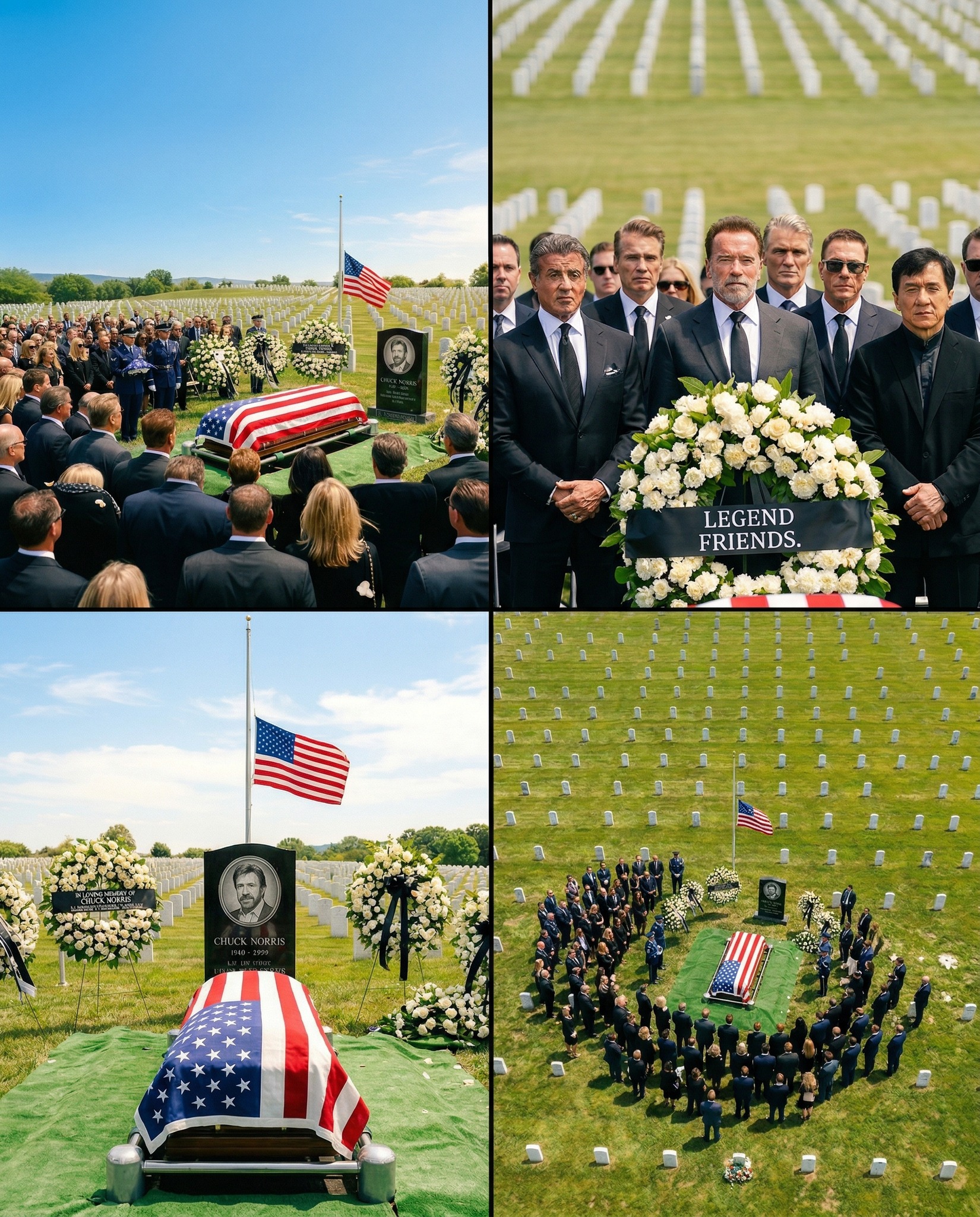
At the end of the street, the bronze statue stands with its fists raised.
From this distance — from the beginning of the procession, where Stallone walks with the portrait — you cannot see the statue’s face. But you know its expression. You have seen it a thousand times across a thousand hours of film and television. The set jaw. The steady eyes. The complete, untroubled certainty of a man who knows what he is doing and why.
It is the face of someone who is not afraid.
Not of opponents. Not of age. Not of the end.
Chuck Norris faced everything in his life with that expression. He faced the ring and the camera and the diagnosis and the years — all eighty-five of them — with the same fundamental orientation toward the world: I am here. I am ready. Whatever comes, I will meet it standing.
He met the end standing.
Of course he did.
The hearse moves slowly down the street toward the statue.
The crowd’s silence is more eloquent than any noise it could make. Thousands of people choosing, collectively, to be quiet — to give this procession the dignity of their full, undistracted attention. To be present in a way that the ordinary pace of ordinary life rarely allows.
This is what Chuck Norris always asked of people, without asking: be present. Be here. Be who you are, fully and without apology, in this moment that will not come again.
The street obliges.
The city obliges.
The world, for this one long slow mile, obliges.
Sylvester Stallone walks the full length of the street.
He does not stop.
He does not look away.
He carries the face of his brother all the way to the end.
And at the end of the street, the bronze Chuck Norris stands with his fists raised.
Watching the man who loved him most walk him home.
The statue does not move.
It does not need to.
It is already exactly where it needs to be —
exactly where Chuck Norris always was.
At the end of the road.
Standing.
Waiting.