Even the strongest warriors, no matter how unbreakable they seem, must one day lay down their strength and find their final rest.
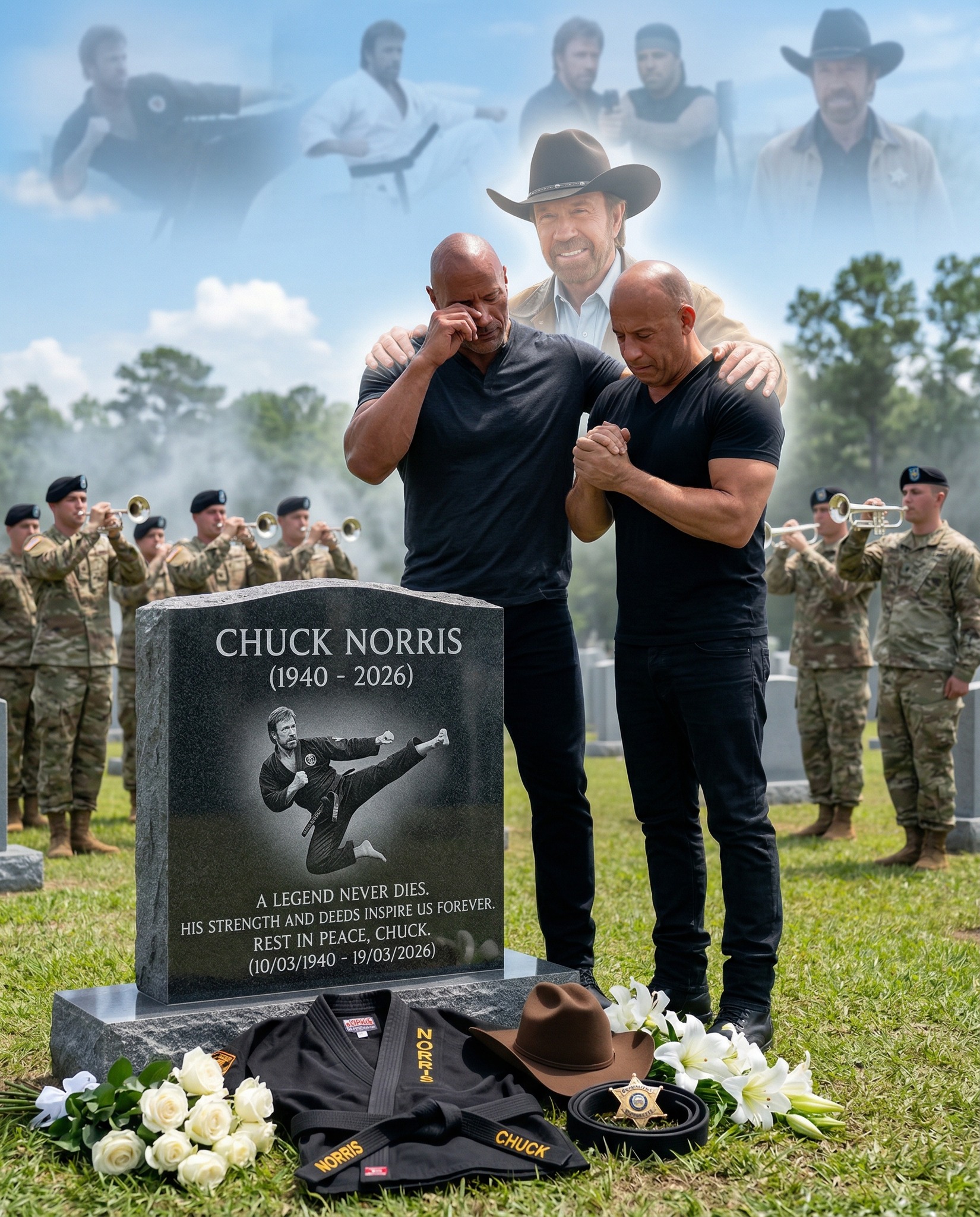
1940–2026: Remembering Chuck Norris—a legend whose spirit endures beyond time.
Even the strongest warriors, no matter how unbreakable they seem, must one day lay down their strength and find their final rest.
The cemetery was quiet except for the soft rustle of wind brushing through the trees and the solemn notes of a military trumpet echoing across the field. On that day, two towering figures—Dwayne Johnson and Vin Diesel—stood side by side in front of a polished gravestone bearing the name of a legend. Both men, known for their strength, resilience, and larger-than-life personas on screen, seemed smaller in the presence of the moment. Their heads bowed, hands clasped, they were not action heroes here—they were simply men paying tribute to someone who had shaped generations.
Behind them, rows of American soldiers stood in formation, their uniforms crisp, their expressions solemn. Some held trumpets, others rifles, all united in respect. The air carried a sense of honor and loss, as if the very ground understood the weight of the farewell. White flowers lay carefully arranged at the base of the gravestone, beside a martial arts uniform and a black belt embroidered with the name “Norris.” A cowboy hat rested nearby—a quiet symbol of the rugged spirit Chuck Norris had embodied both on and off the screen .
Dwayne Johnson placed a firm but gentle hand on Vin Diesel’s shoulder. Diesel, visibly emotional, wiped away tears. The bond between them—forged through years of shared experiences in Hollywood—was now deepened by grief. “He wasn’t just a legend,” Johnson whispered, his voice thick with emotion. “He was a standard we all tried to live up to.”
Above them, as if emerging from memory itself, faint images of Chuck Norris seemed to linger in the sky—moments from his life and career: a spinning kick mid-air, a determined gaze, the iconic cowboy hat. These were not just scenes; they were symbols of a man who had transcended cinema.
Chuck Norris was more than an actor. He was a martial artist, a cultural icon, and a symbol of discipline and perseverance. His career spanned decades, and his influence reached far beyond Hollywood. He rose to fame through films such as Way of the Dragon, where he famously fought Bruce Lee in one of the most legendary fight scenes in cinema history. That battle was not just choreography—it was a moment that defined martial arts in film forever.
He went on to star in a series of action-packed films, including Lone Wolf McQuade and Missing in Action, portraying characters that embodied justice, strength, and unwavering moral conviction. Later, he became a household name through the television series Walker, Texas Ranger, where he played a Texas Ranger who combined martial arts with a deep sense of justice. That role cemented his image as not just a fighter, but a protector.
Vin Diesel took a deep breath and looked at the gravestone again. “We build our careers trying to be strong,” he said quietly. “But Chuck… he didn’t just act strong. He *was* strong—in spirit, in discipline, in heart.”
The soldiers began playing a slow, mournful tune. The sound carried across the cemetery, wrapping everyone in a shared moment of remembrance. Some of the younger soldiers had grown up watching Chuck Norris on television, inspired by his unwavering sense of justice. To them, this was not just a ceremony—it was saying goodbye to a hero who had quietly shaped their values.
Dwayne Johnson stepped forward and gently placed a wreath at the base of the grave. “Your legacy isn’t buried here,” he said. “It lives in every person who refuses to give up, every person who stands for what’s right.”
In that moment, the divide between Hollywood and real life seemed to disappear. The strength portrayed in films met the reality of loss, reminding everyone that even the greatest legends are human. Yet, in another sense, Chuck Norris felt immortal—not because he could never die, but because what he represented could never fade.
The sky above remained bright, but softened by drifting clouds, as if nature itself was honoring the occasion. The faint, imagined image of Chuck Norris smiling down gave a sense of peace. It was as if he were reminding everyone that strength is not just about fighting—it is about enduring, inspiring, and leaving behind something meaningful.
Vin Diesel knelt briefly, placing his hand on the gravestone. “Rest easy, legend,” he whispered. “We’ll carry it forward.”
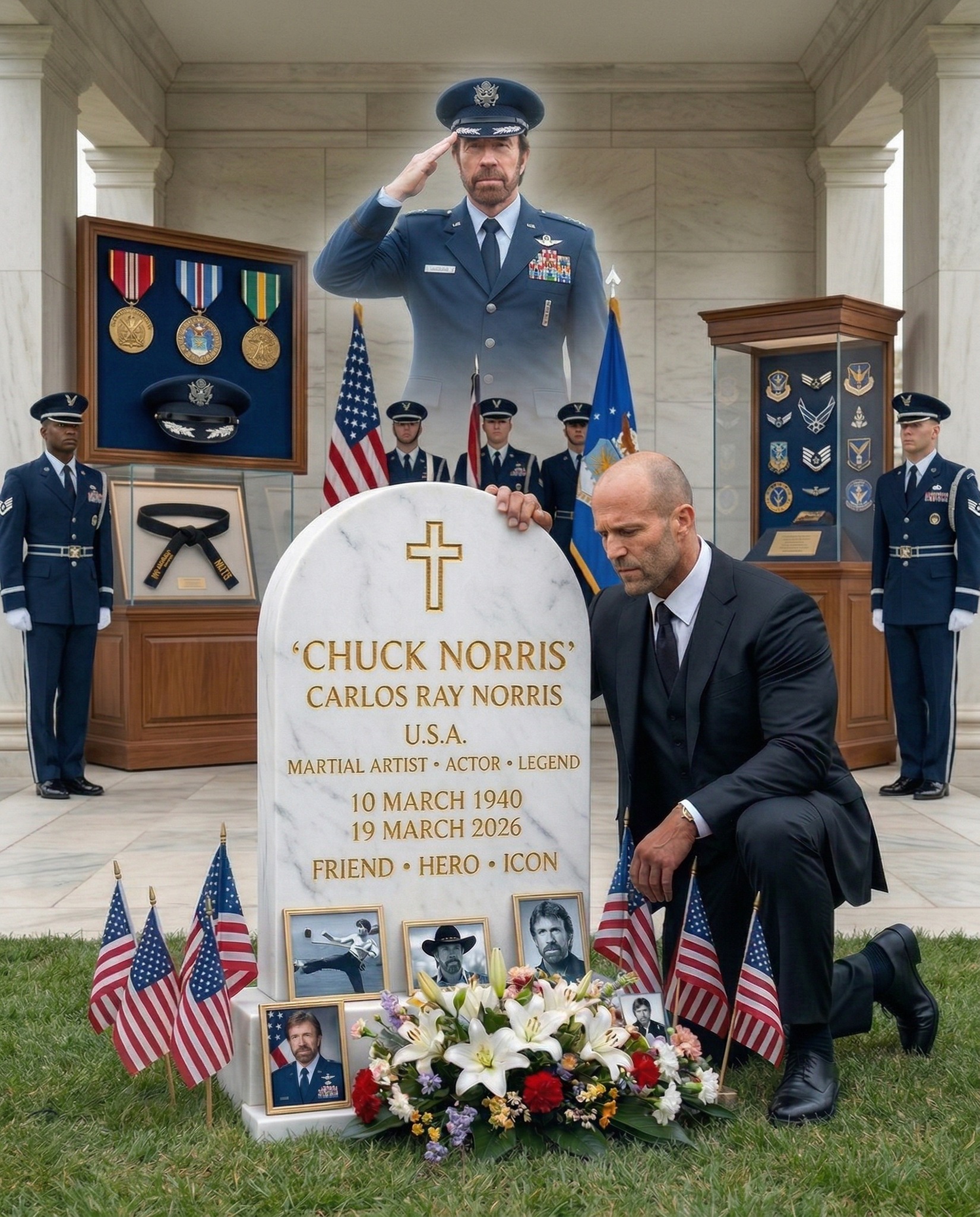
As the ceremony came to an end, the soldiers saluted in unison. The sharp motion echoed with respect and finality. One by one, they began to leave, but the feeling lingered. Dwayne Johnson and Vin Diesel remained a moment longer, unwilling to rush away from a presence that had meant so much.
Walking away, Johnson turned back one last time. “You know,” he said softly, “guys like him don’t really leave. They just… become something bigger.”
And perhaps that was true.
Because Chuck Norris was never just a man.
He was a symbol—of resilience, discipline, courage, and honor.
And symbols like that don’t fade.
They live on in stories, in memories, in the quiet determination of those who follow.
Even in silence, his legacy speaks.