Title: The $10,000 Sacrifice: Why Finish Lines Matter Less Than Human Souls
Title: The $10,000 Sacrifice: Why Finish Lines Matter Less Than Human Souls
In the world of professional sports, we are taught that winning is everything. We celebrate the ruthless, the fastest, and the most competitive. But in 2010, during the Zheng-Kai International Marathon, a Kenyan runner named Jacqueline Nyetipei Kiplimo reminded the world that while a gold medal is made of metal, a human heart is made of something far more precious.
A Split-Second Choice
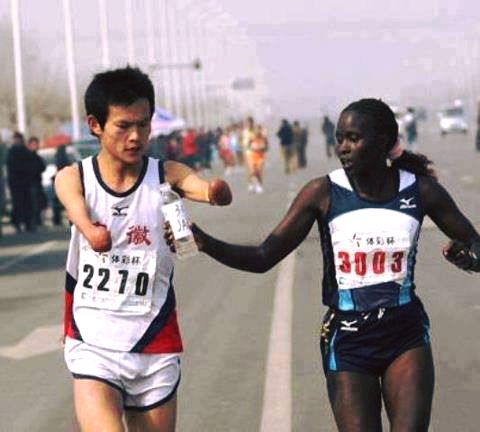
Kiplimo was at the peak of her career, leading the race and on track for a first-place finish. At the 6.2-mile (10km) mark, she encountered a fellow competitor—an elite runner from China who was a double amputee. He was struggling, dehydrated, and unable to grasp the water bottles at the hydration stations.
In that moment, Kiplimo faced a choice that would define her legacy:
-
She could maintain her pace, secure her lead, and claim the $10,000 prize money that would surely change her life.
-
She could stop being a competitor and start being a companion.
She chose the latter.
The Longest 17 Miles
From the 6.2-mile mark all the way to the 23-mile mark (38km), Kiplimo stayed by his side. For nearly 17 miles, she slowed her elite pace to match his. At every watering station, she would grab the water, open it, and help him drink. She didn’t just provide water; she provided the dignity and support he needed to keep going.
Think about the physical toll of a marathon. Every second counts. By choosing to help, Kiplimo watched her lead vanish. She watched other runners pass her by. She watched the $10,000—a fortune for many—slip through her fingers.
Winning by Losing
Kiplimo eventually finished in second place. She lost the title. She lost the top prize. But what she gained was the eternal respect of the global community.
When asked about her decision later, it was clear that to her, it wasn’t a “sacrifice”—it was a necessity of the soul. She showed us that a true leader isn’t the one who stands alone at the top of the podium, but the one who refuses to leave a disadvantaged person behind. She proved that human connection is the ultimate finish line.
The Legacy of the “Helper”
Today, many people may not remember who took first place in that marathon, but millions remember the name Jacqueline Nyetipei Kiplimo. Her story serves as a profound lesson for all of us in our daily “races”:
-
Success without compassion is empty.
-
Greatness is measured by what we do for others when no one is forcing us to.
-
The most valuable things in life often don’t have a price tag.
In a world that often rushes to judge and competes to crush, let’s strive to be more like Jacqueline. Let’s be the ones who slow down to hand a cup of water to someone struggling. Because in the end, we aren’t remembered for the trophies we collected, but for the hands we held along the way.