The Last Frame of an Era: How This Forgotten 1981 Photo Captured the Immortality of Two Icons
The Last Frame of an Era: How This Forgotten 1981 Photo Captured the Immortality of Two Icons
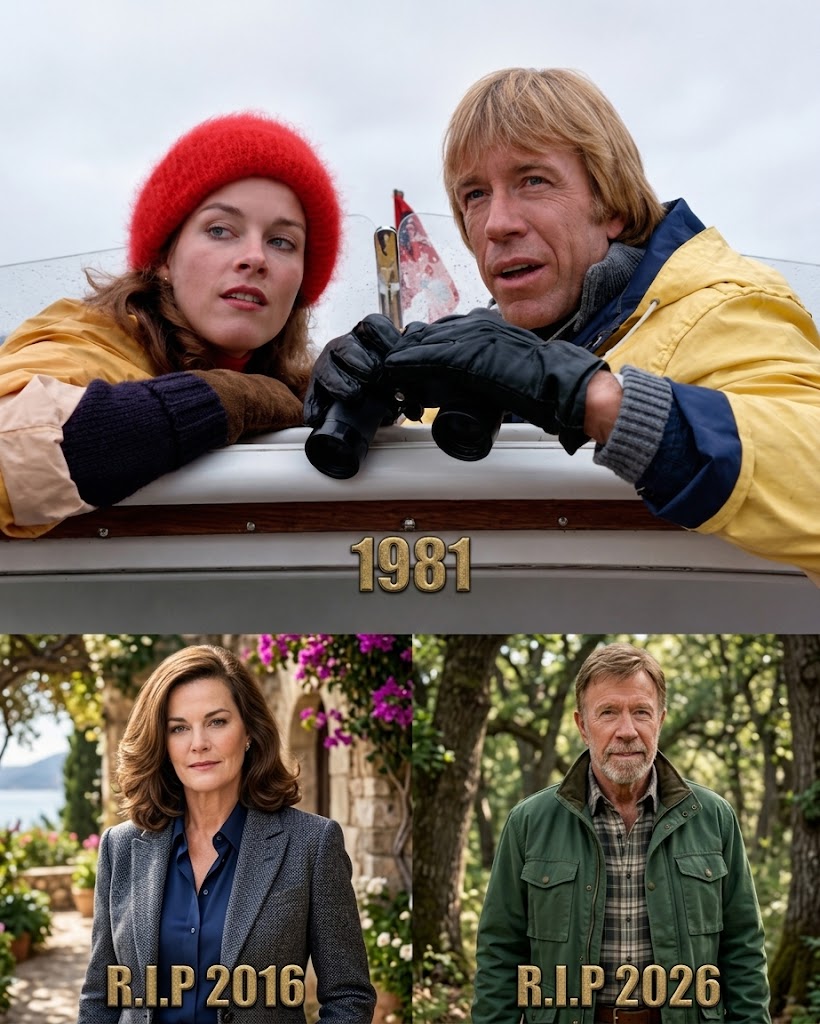
Amidst the chilly San Francisco fog of 1981, Chuck Norris and Maggie Cooper lay side by side, hunting for justice on a small boat. Decades later, with both actors now gone, that single photograph has transformed into a haunting reminder that cinema possesses the unique power to keep people alive far longer than time itself.
In the grand history of action cinema, there are certain images that outlive the very celluloid they were printed on. They endure not because they are louder or more explosive than the blockbusters around them, but because time quietly translates them into something entirely different: memory, elegy, and undeniable evidence that two human beings once stood together inside a story and believed in it completely. This raw, behind-the-scenes photograph is one of those rare images.
It captures a cold, grey morning off the coast of San Francisco. The deck of a small vessel rocks gently beneath a heavy, overcast sky. There is no glamorous Hollywood lighting, no artificial hero poses, and no green screens. Instead, the frame shows just two figures stretched low against the cabin roof, binoculars raised, and their eyes fixed intently on a danger existing somewhere just beyond the edge of the frame. The atmosphere feels immediate and remarkably alive. It is the kind of scene where the coastal wind cuts sharply through jackets and the heavy ocean air carries the distinct scent of salt, diesel fuel, and impending trouble.
On one side of the frame lies Chuck Norris as Sean Kane, the relentless narcotics detective from the classic thriller An Eye for an Eye. At that specific moment in his legendary career, Norris was no longer simply a world-class martial artist trying to find his footing in the film industry. He was actively evolving into a uniquely American screen presence built not on flashy speeches or theatrical emotional outbursts, but on pure stillness. His cinematic power came from a deep, calculated restraint. Kane was a character devastated by the brutal murder of his partner, abandoned by a compromised justice system, and driven forward solely by the quiet certainty that some evils cannot be ignored.
Norris carried that heavy role with the same grounded, disciplined intensity that defined his real life. The former Air Force serviceman from Oklahoma, who had discovered martial arts while stationed in Korea and famously fought Bruce Lee on screen, proved with this film that he could hold the emotional anchor of a gritty narrative. His characteristic calmness was never a sign of weakness; it was absolute control.
Beside him rests Maggie Cooper as Heather Sullivan, bringing a vital warmth and palpable humanity into a film otherwise consumed by violence and vengeance. Cooper possessed that rare, effortless authenticity that cannot be taught. Beside the imposing presence of Norris, she never seemed to be merely playing a part; she was fully present and alive inside the scene. Her performance grounded the high-stakes narrative, reminding the audience that behind every act of cinematic vengeance lies something painfully human worth protecting.
Born in Washington state in 1955, Cooper built a meaningful career through television and film before later transitioning into a respected journalist for CBS News. Those who worked alongside her described her as exceptionally intelligent and compassionate—a woman whose genuine energy elevated every room she walked into.
Tragically, Maggie Cooper passed away in 2016 after a brave battle with ovarian cancer. Chuck Norris would follow a decade later in 2026, leaving behind one of the most enduring legacies in entertainment history. By the end of his journey, Norris had transcended Hollywood to become a global cultural symbol of discipline, toughness, humility, and unwavering moral certainty.
Yet, this timeless photograph exists entirely before all of that finality. Inside this frozen moment, they are both still young, the story is still actively unfolding, and the future has not yet arrived with its inevitable losses, memorials, and final farewells. Two people remain side by side on a boat beneath a grey California sky, searching the horizon together with complete concentration.
That remains the true miracle of cinema. The years ruthlessly move forward, people change, and eventually, they disappear from the earth. But the frame itself remains completely untouched, holding forever the exact second when the world was still full of danger, hope, unfinished business, and the beautiful possibility that justice might still win before sunset. The eyes that once looked through those binoculars have closed, but the image still watches back.