The Cat Who Stopped Paying Rent for Love and Finally Came Home
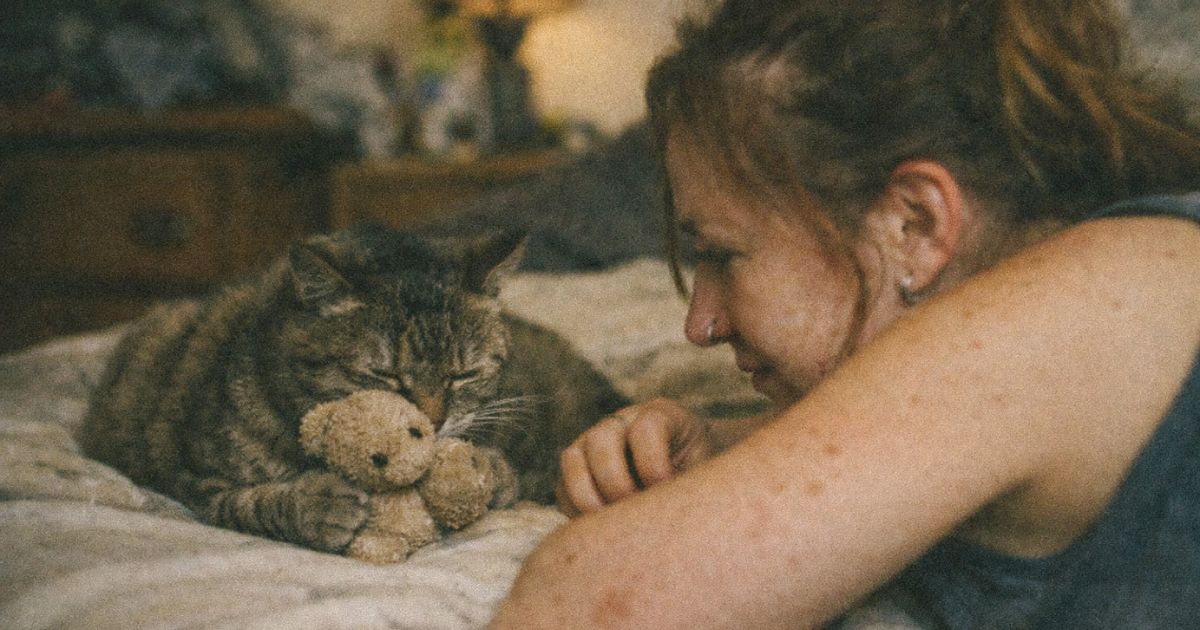
The Cat Who Stopped Paying Rent for Love and Finally Came Home
Two years after the cat once tried to “pay rent” in the only way she knew how—by offering a dirty stuffed bear like it was currency for affection—someone told me I was projecting.
That word stuck.
Projecting.
As if grief, loneliness, and the strange intelligence of a rescued animal could be reduced to a psychological accusation instead of something living, breathing, and quietly changing the shape of a home.
That was when this story stopped being just about a cat.
And started becoming about everything else I had refused to name.
It didn’t begin dramatically.
It never does.
It began on a Thursday night with a half-washed coffee cup in my hand, the sink running too loudly, and my phone vibrating against the kitchen counter like it couldn’t decide whether the message mattered.
Outside, the apartment was too quiet in that way that makes you notice your own thoughts too clearly.
And on the couch behind me—
Mabel was asleep.
Curled into a small, careful shape.
The stuffed bear—dirty, soft, missing one eye—rested against her paws like it had never been anything other than essential.
I didn’t know then that I was about to remember everything I had learned to stop thinking about.
Two years earlier, I had gone to the shelter thinking in simple terms.
Get a cat.
Give it a home.
End of story.
But life rarely respects simplicity.
Because I didn’t come home with just a cat.
I came home with something quieter.
Something older than its body should have suggested.
A presence that seemed to carry memory in its bones.
I didn’t name her immediately.
For the first three days, she barely existed outside the bathroom.
Not out of defiance.
Out of calculation.
She ate only when I wasn’t watching.
She moved only when she thought she wouldn’t be noticed.
And always—always—she carried that stuffed bear with her.
It was shredded at the edges, faded, wrong in every way that suggested it had survived something it was never designed to survive.
She would take it from the corner of the bathroom and relocate it.
Not randomly.
Not playfully.
Carefully.
Like placement mattered more than comfort.
Like the world made sense only if that object stayed within reach.
At the time, I thought it was just attachment.
Later, I understood it was practice.
I gave her the smallest room in the apartment.
The bathroom.
Not because I was cold.
But because small spaces feel like safety when everything outside them has already proven itself unreliable.
That’s what I told myself, anyway.
The truth was simpler.
I recognized her.
Not as a cat.
But as a pattern.
A quiet instinct to shrink before the world had the chance to do it for you.
By the end of the first week, something shifted.
Not dramatically.
Just enough to notice if you were paying attention.
She stopped hiding behind objects.
She started positioning herself near me instead.
Never close enough to touch.
Always close enough to be acknowledged.
And always with the bear.
She would place it on the floor between us like an offering.
A negotiation.
A fragile attempt at communication in a language I didn’t yet understand.
Then she would wait.
Watching.
Measuring.
As if love was something you had to prove you were qualified to receive.
I started talking to her without meaning to.
Or maybe I was talking to myself and she simply tolerated it.
“Hi,” I would say, pretending I was speaking to the television.
“Okay,” I would mutter when she moved the bear two inches closer.
“You don’t have to do that,” I once said, though I didn’t know if I meant her… or me.
She never responded in words.
But she always responded.
That was the part I wasn’t prepared for.
On the fifth night, she jumped onto the couch.
Not into my lap.
That would have been too direct.
Too honest.
She chose the far cushion instead, placing the bear beside her like a witness.
And for a long time, neither of us moved.
The apartment was quiet in a different way then.
Not empty.
But shared.
Like silence had finally agreed to include more than one participant.
That was the beginning of the second phase.
Not of adoption.
But of trust.
And trust, I learned, does not arrive as a decision.
It arrives as repetition.
As small, unremarkable returns to the same place.
Over and over again.
Until one day you realize nothing is running away anymore.
Mabel never stopped bringing the bear.
But eventually, she stopped treating it like currency.
It became something else.
A habit.
A memory she no longer needed to trade.
And slowly—without announcement, without ceremony—she started coming closer.
First the couch arm.
Then the space beside my knee.
Then, one night, the edge of my lap.
Like she was testing whether the world had finally stopped changing its mind about her.
Two years later, I still think about that first version of her.
The one who believed love had to be earned through offering.
Through repetition.
Through persistence.
And I think about how many of us are still doing the same thing.
Carrying something old.
Setting it down carefully.
Waiting to see if it will be accepted.
Mabel stirs now beside me as I finish the coffee cup I forgot I was holding.
She doesn’t open her eyes.
She doesn’t need to.
She knows I’m here.
And maybe that is what home really is.
Not a place.
Not a rescue.
But the moment something stops asking to be chosen—
because it finally believes it already was.