I Found a Little Boy Hidden in a Laundry Cart, Then His Sister Handed Me a Frozen Note
I Found a Little Boy Hidden in a Laundry Cart, Then His Sister Handed Me a Frozen Note
“Don’t touch the blanket.”
The girl’s voice cracked behind me like ice underfoot.
I froze, mop still dripping in my hand, the laundromat lights buzzing overhead like angry bees. Dryer number seven thumped with someone’s forgotten jeans. My back ached from hours of scrubbing, and my heart did that familiar lonely squeeze it always did at 2:47 a.m.
At first I thought it was just a pile of laundry someone left behind.
Then the pile breathed.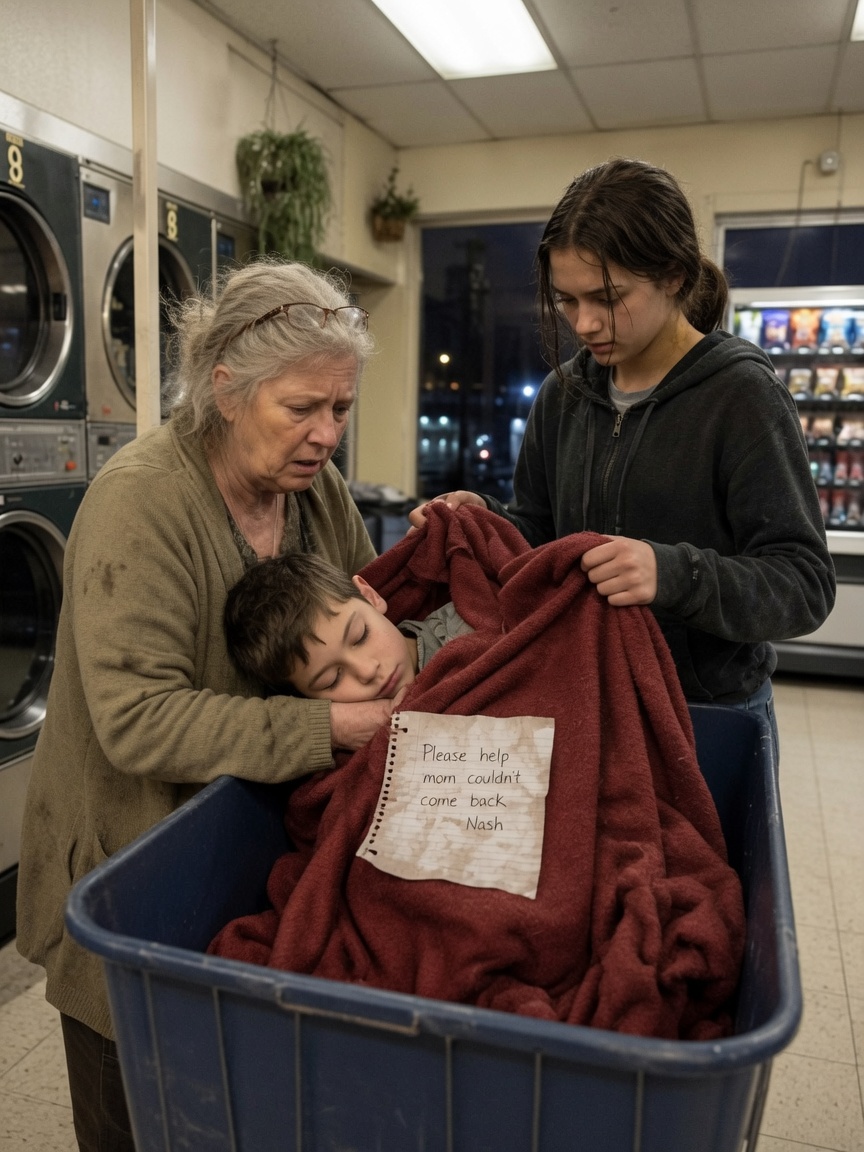
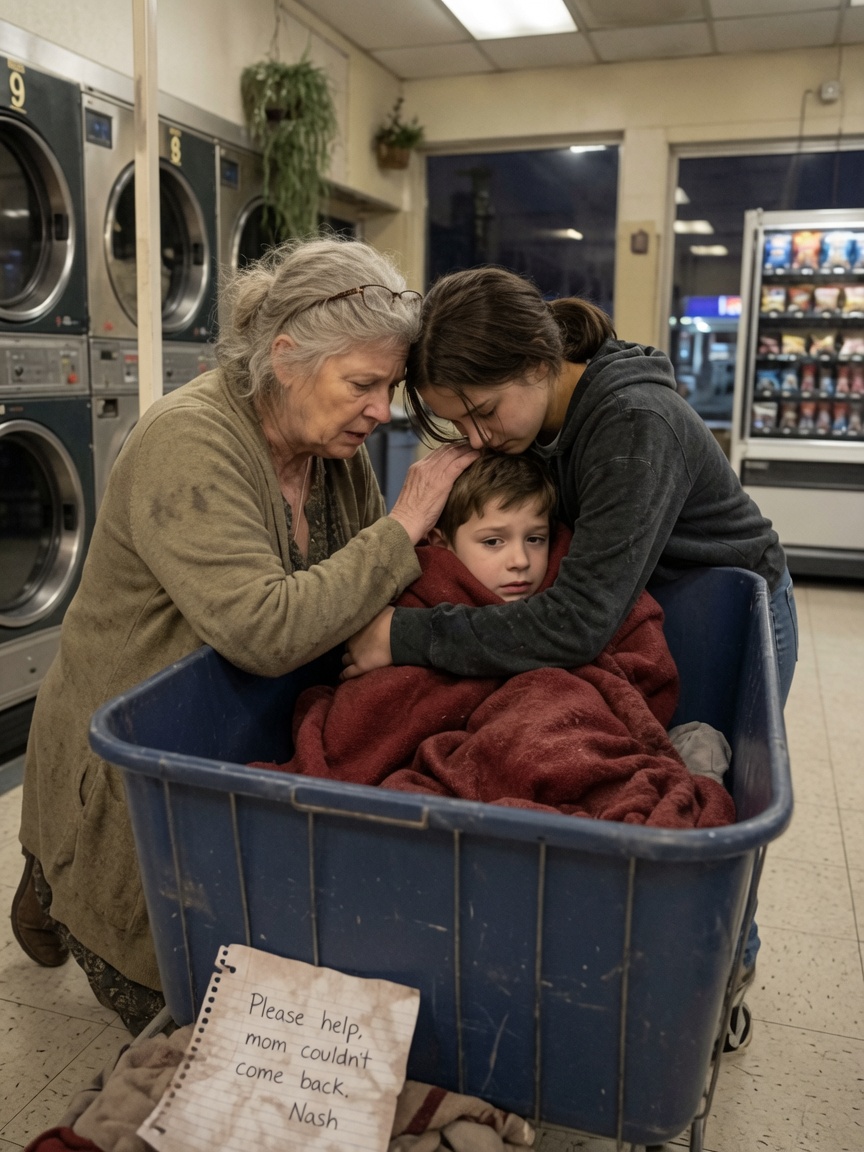
A tiny boy, no more than seven, curled tight inside the big blue rolling cart. Knees to his chest, lips almost blue, wrapped in a faded red blanket like it was armor. His small fingers clutched the edge so hard the knuckles were white.
The girl stepped out from behind the row of vending machines, hands up like I might arrest her. She was maybe fifteen or sixteen, coat soaked through, shoes leaving puddles, a torn grocery bag clutched to her chest like a shield.
“We’re leaving right now,” she said fast. “He just needed to get warm. Please.”
Her eyes were wide and hunted. Her chin shook even though she tried to stop it.
I looked back at the boy. A damp note was taped to the blanket.
Please don’t throw away the red blanket. It’s all he has left of home.
I was sixty-four. Widowed. Childless in every way that mattered. Cleaning this dying laundromat in a town that had been forgetting itself for years. Any other night I would have called the sheriff.
But something in that red blanket stopped me.
“What’s his name?” I asked softly.
She flinched like I’d slapped her. “Why do you need to know?”
“Because if he wakes up scared, I don’t want to be a stranger.”
She swallowed hard. “Quill. His name is Quill.”
“And yours?”
“Brindle.”
I nodded slow. “I’m Tamsin Bellweather. I clean here after midnight. I’m too old to chase and too tired to judge. So let’s talk quiet.”
Brindle’s shoulders dropped just a fraction.
“We’re waiting for our aunt Liora,” she whispered. “Her car broke down again. Our heat’s out. We didn’t know where else to go.”
Quill stirred and made a tiny sound. Brindle was beside him in a heartbeat, stroking his hair.
I didn’t call anyone.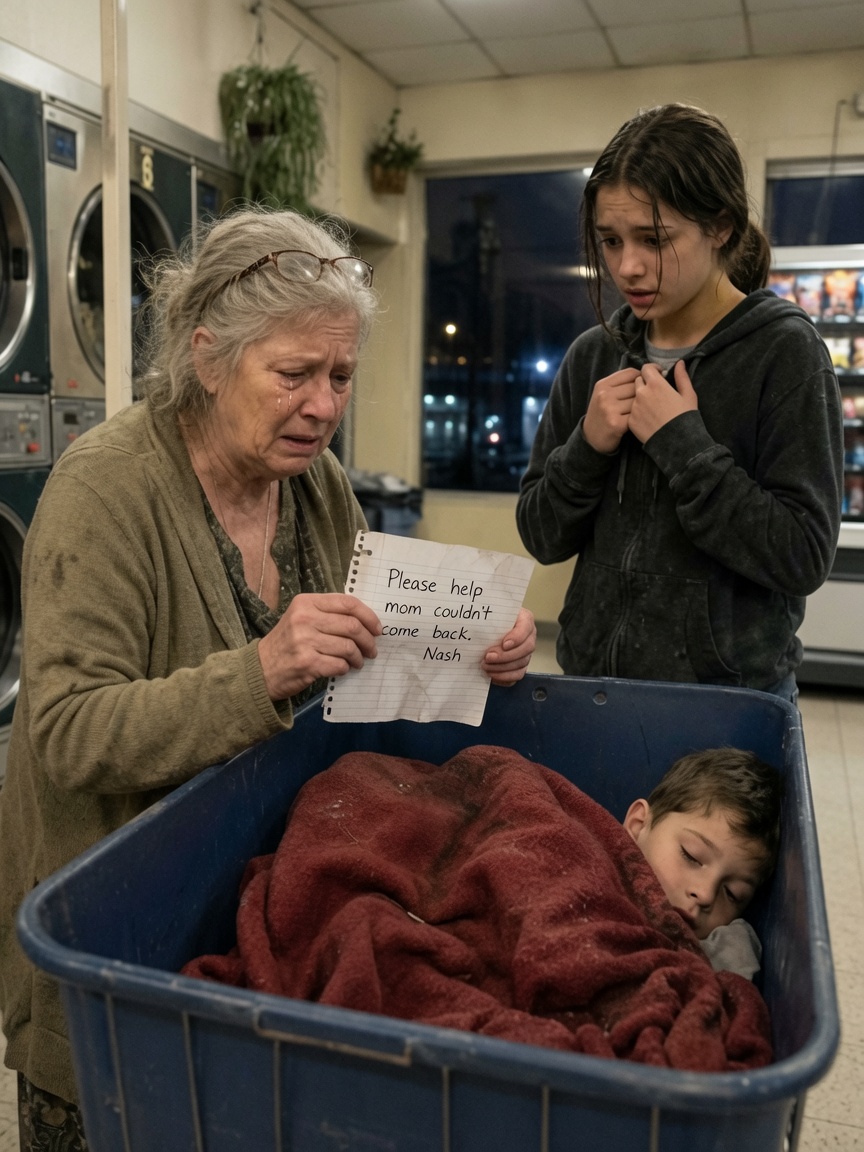
Instead I went to the little back counter, pulled out the two cans of chicken noodle I kept for myself, and warmed them in the ancient microwave that rattled like it was dying too.
Brindle watched every move.
When I set three foam cups on the folding table, she still didn’t move.
“Eat first,” I told her. “I’ll prove it’s safe.”
I took a sip. It burned my tongue like fire. I coughed and laughed a little. “See? Awful, but not poison.”
That cracked something in her. She brought a cup to Quill, helped him sit up. He looked at me with those huge tired eyes and whispered, “The universe gave us ugly socks?” when I offered him the pair of green star-patterned ones from the lost-and-found.
Brindle almost smiled.
That night I learned their aunt Liora worked two jobs and the bus had left them stranded in the cold. I learned they were terrified of being separated. I learned the red blanket had been their mother’s before she passed.
I let them stay until Liora finally arrived at 4:12 a.m., exhausted and crying gratitude.
The next night they came back because the heat was still broken.
Then Sable from the diner across the street brought hot coffee and toast “for the night owls.” Calder, the retired handyman who hadn’t spoken to anyone in three years, showed up with tools and fixed their aunt’s heater for free. Someone left gloves. Someone else left phone chargers.
I made a little sign on the counter:
Warm Table
Free coffee. Dry socks. Charger.
No questions first. Just warmth.
People complained at first. The owner, Mr. Vale, called me yelling about liability. But slowly, quietly, the lonely people of our dying town started coming. The widow who hadn’t left her house in months. The teenager who failed his classes. The veteran with nightmares.
They sat. They drank coffee. They talked when they were ready.
Brindle started volunteering after school. Quill drew pictures of the laundromat with hearts around every person. Liora got steady work because someone at the Warm Table knew a boss who needed help.
One evening Mr. Vale stormed in ready to shut us down. But he saw old Mrs. Harlan crying into her coffee because she finally told someone her son hadn’t called in six years. He saw Quill hand her a drawing of a happy family. He saw me holding Brindle’s hand while she cried about missing her mom.
He didn’t say a word. Just turned around, came back the next day with a new coffee maker and a sign that said “Approved.”
A full year later we held the first “Warm Town Supper” right there in the parking lot between the laundromat and the diner. Strings of lights. Long tables. Everyone brought something.
Quill ran around with his drawings pinned to his jacket. Brindle laughed loud and free for the first time. Liora danced with Calder. My own daughter Nerys — who I hadn’t spoken to in four years after a stupid fight — showed up with tears and a hug that lasted ten whole minutes.
I stood back and watched the town that used to feel empty now full of voices and laughter.
The little boy who once hid under a red blanket in a laundry cart had done something none of us could have planned.
He reminded us we all get cold sometimes.
And that the simplest warmth — a cup of soup, a pair of borrowed socks, a place with no questions first — can thaw an entire town.
Buster the dog from next door lay at my feet, and I swear he smiled.
If you felt this story in your heart, drop a and tell me you want Part 2 — where the Warm Table faces its biggest test when a storm hits and the whole town shows up to protect the kids who started it all. I’ll write it right here in the comments.
Some blankets aren’t just for warmth.
Some are for second chances.