Bull Moose Charges Into a Snowy Road-Rage Confrontation—and Suddenly Nobody Wants to Fight
A blast of a car horn had turned an ordinary winter drive into an angry confrontation.
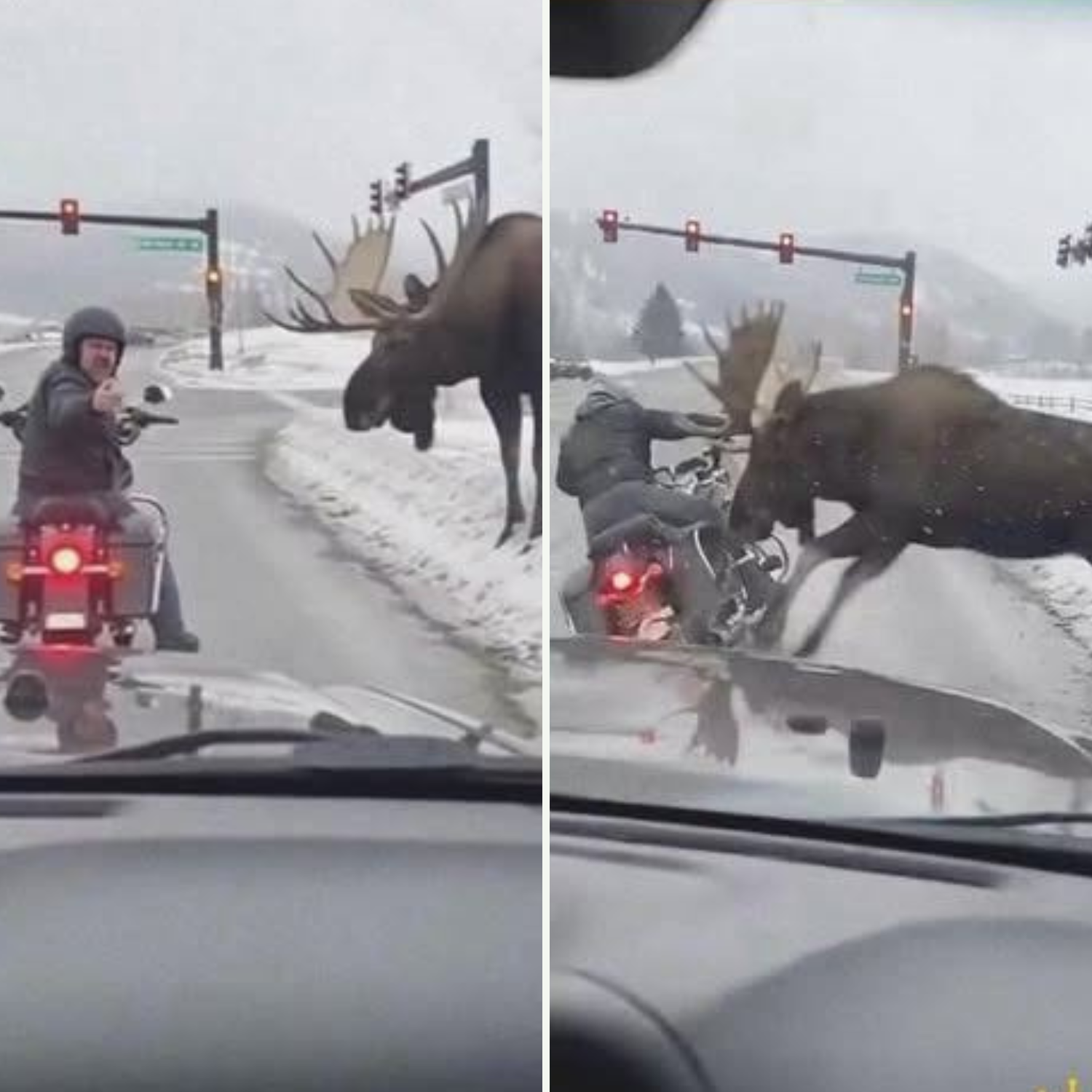
At a red light on a snow-covered Canadian road, a motorcyclist who had been riding ahead of a woman’s vehicle turned toward her car and began shouting. Moments earlier, she had sounded her horn after his maneuver created what she believed was a dangerous situation on the slick roadway.
Now the disagreement was escalating.
Then something far more intimidating than either driver entered the intersection.
A massive bull moose emerged from the snowy roadside—and within seconds, the argument no longer mattered.
A Small Traffic Dispute Quickly Escalates
The encounter began during what had otherwise been an uneventful trip through a Canadian winter landscape.
The woman was driving along a road surrounded by snow and wilderness when a motorcyclist moved in front of her vehicle. Concerned by the maneuver, she briefly used her horn.
From her perspective, it was simply a warning.
The rider apparently interpreted it very differently.
Rather than leaving the incident behind, he became angry. When the two vehicles reached the next intersection and stopped for a red light, the motorcyclist turned back toward the woman.
He shouted and pointed toward her vehicle as the confrontation intensified.
It was the kind of road-rage scene that can develop from almost nothing. One person reacts to a maneuver, another takes offense, and suddenly a few seconds of irritation become something much larger.
But while the two strangers were focused on each other, neither appeared prepared for what was approaching from nearby.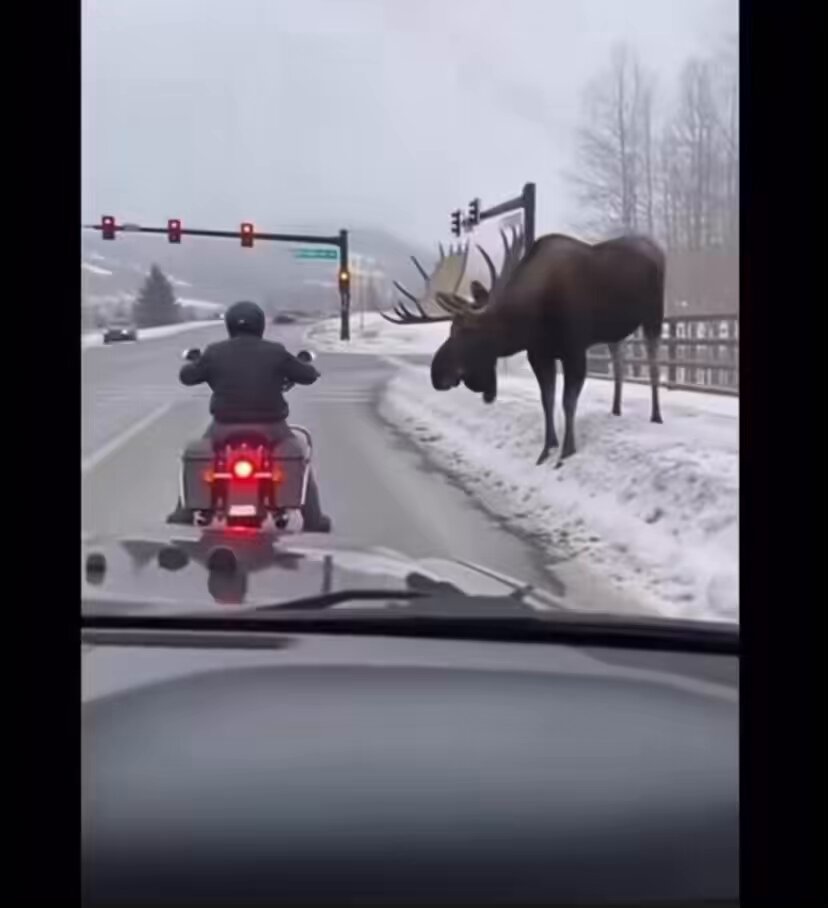
The Moose Changes Everything
From the snowy roadside came a bull moose.
Its arrival instantly transformed the scene.
A few moments earlier, the motorcyclist’s attention had been fixed on the woman in the car. Now he was dealing with an enormous wild animal moving toward him.
According to the account, the moose charged toward the motorcycle.
The bike went down.
The rider, who seconds before had been consumed by anger, suddenly scrambled to escape the animal.
There was no longer any interest in arguing over who had made the wrong move in traffic. The shouting stopped. Frustration was replaced by fear as the unexpected encounter became a question of immediate safety.
For the woman watching from her vehicle, the emotional shift was just as dramatic.
Whatever irritation existed between the two drivers disappeared once she saw the rider facing possible danger.
Instead of driving away, she pulled over to see whether he was all right.
Fortunately, the frightening encounter did not leave him seriously injured. He was able to get back up, and the moose eventually moved away from the scene.
Within a short period of time, the roadside had gone from peaceful, to confrontational, to chaotic—and then quiet again.
An Argument Suddenly Put Into Perspective
The unlikely timing helped make the encounter memorable.
Road rage often begins with something insignificant: a lane change, a slow driver, an unexpected maneuver, a horn or a gesture interpreted as disrespect.
Yet anger can rapidly give those moments an importance they never deserved.
That appeared to be happening on the snowy road.
The motorcyclist had stopped focusing on simply reaching his destination and instead turned his attention toward confronting another driver.
Then the moose arrived.
Suddenly, the original disagreement looked remarkably small.
Neither human controlled what happened next. The moose had no understanding of the argument and had not arrived to settle a dispute. It was simply a wild animal moving through its surroundings.
Yet its presence instantly reset everyone’s priorities.
Who had annoyed whom no longer mattered.
Safety did.
The encounter offered an almost perfectly timed example of how quickly perspective can change when something genuinely serious interrupts an everyday frustration.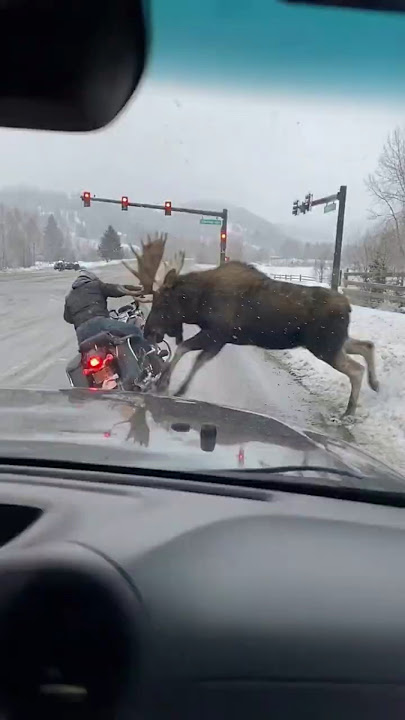
Sharing the Road With the Wilderness
Wildlife appearing near roads is not necessarily unusual in parts of Canada, where forests, communities and transportation routes often exist close together.
Animals can move through places humans use every day, and a seemingly empty stretch of road can unexpectedly become part of a wildlife encounter.
A bull moose is especially difficult to ignore.
Large and powerful, with an imposing frame and antlers, the animal can dominate a scene simply by appearing. Even an animal that initially seems calm can become dangerous when it feels threatened.
That reality gave the confrontation an additional lesson beyond road rage.
Wild animals are not participating in human drama. They do not understand arguments, traffic rules or personal grievances. Their behavior is shaped by instinct, making distance and respect essential when people encounter them.
The moose in this story was not punishing anyone or choosing a side.
It was simply being a moose.
And that was more than enough to bring the argument to an abrupt end.
Fear Replaces Anger
Perhaps the most revealing part of the encounter was how completely the emotional atmosphere changed.
Before the moose appeared, the motorcyclist seemed determined to confront the woman.
Afterward, the woman who had been the target of his anger was concerned enough to stop and check on him.
That transition—from opponents to two people dealing with an unexpected danger—showed how temporary their conflict really was.
A horn had seemed important enough to provoke shouting.
A charging wild animal made it irrelevant.
There is an almost cinematic quality to the sequence: a quiet snowy road, a traffic dispute escalating at a red light, and then an enormous animal unexpectedly emerging from the wilderness.
Yet the larger meaning comes from what happened once the drama ended.
The rider got up.
The woman checked that he was safe.
The immediate danger passed.
And the moose eventually continued on its way.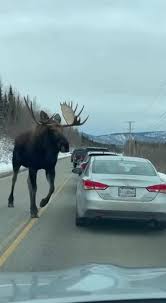
Nature Gets the Last Word
The animal did not remain at the intersection to witness the aftermath.
It had no idea that its appearance had transformed an argument or that people would later find meaning—and even some humor—in the extraordinary timing of the encounter.
It simply disappeared back into the winter landscape.
For the people involved, however, the moment carried a harder-to-forget message.
Anger can make a minor inconvenience feel enormous. It can convince someone that a stranger’s mistake or gesture deserves confrontation. But circumstances can change in seconds, revealing just how little many of those disputes matter.
On this particular road, it took a bull moose to make that point.
One moment, two strangers were focused on a horn and a traffic maneuver.
The next, there was only an enormous animal, a fallen motorcycle and the instinct to get everyone safely out of danger.
The argument ended without anyone winning it.
Instead, nature simply made the entire dispute seem too small to continue.