Three Movies, Three Transformations: Jason Momoa’s Wild 2026 From Lobo to Blanka to Dune
Jason Momoa has spent much of his blockbuster career being instantly recognizable: towering frame, long hair, beard, tattoos and the kind of physical presence filmmakers rarely try to hide.
In 2026, Hollywood has done almost the opposite.
Across three major franchise movies, Momoa has moved from a pale-faced intergalactic outlaw to a green-skinned fighting-game creature, before returning to a science-fiction role whose transformation is less obvious to the eye — but far stranger once the story behind it is revealed.
The three characters could hardly be more different. Yet together, Lobo, Blanka and Duncan Idaho have turned 2026 into one of the most unusual years of Momoa’s career.
First Came Lobo — and the End of the Aquaman Image
For years, Momoa was one of the defining faces of DC’s previous movie era.
As Arthur Curry, he played a reluctant underwater royal who eventually accepted his place as Aquaman and king of Atlantis. His final standalone outing in the role came with Aquaman and the Lost Kingdom in 2023.
Then DC gave him another comic-book character — one that allowed him to move in almost the opposite direction.
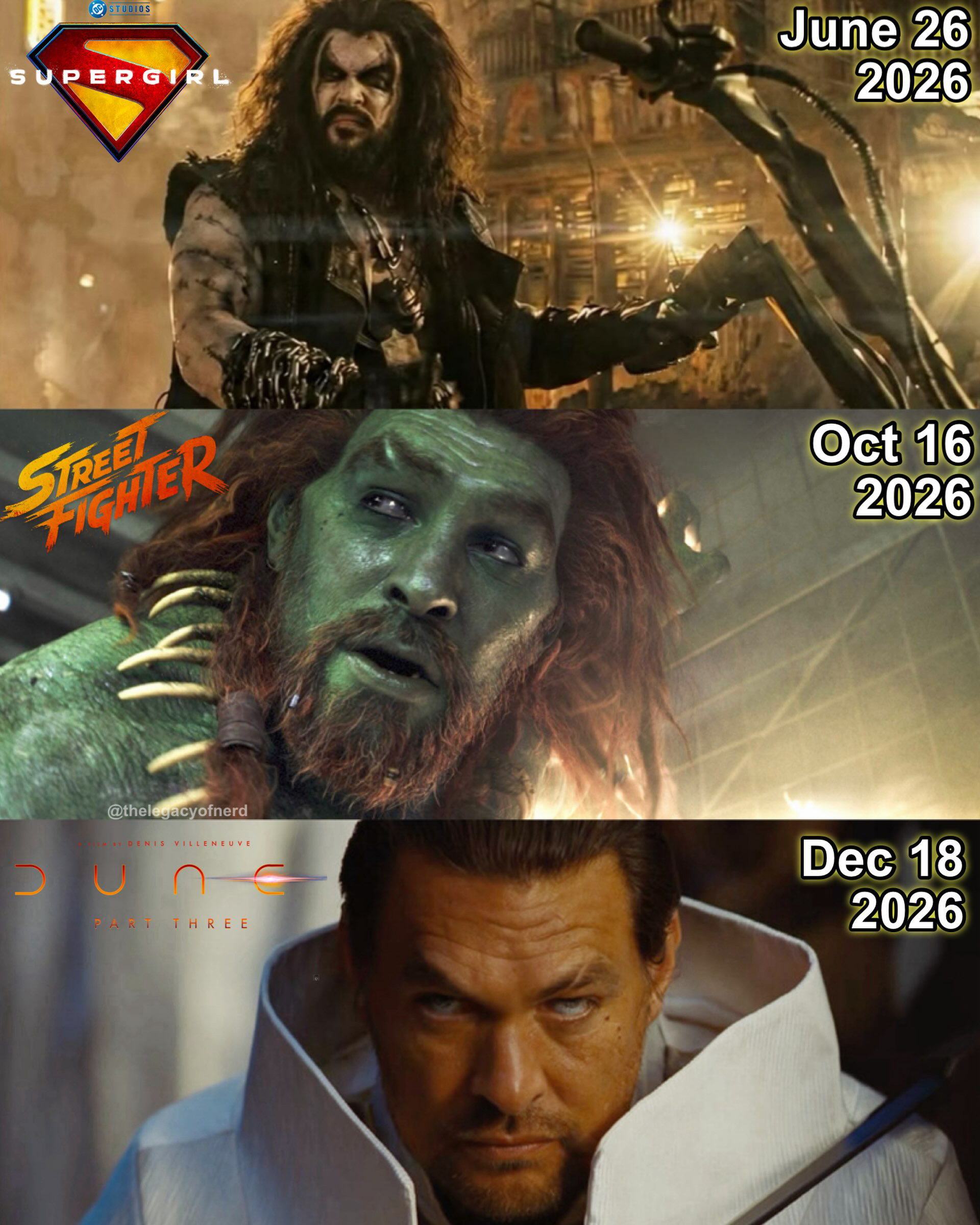
Momoa made his debut as Lobo in Supergirl, which opened in North American theaters on June 26, 2026. The character is an intergalactic bounty hunter known for motorcycles, cigars, violence and an aggressively anarchic personality.
Visually, the transformation did not require DC to erase everything recognizable about Momoa. His size, long hair and biker energy actually made the casting feel unusually natural.
The difference was what those qualities now represented.
Aquaman may have been rebellious and rough around the edges, but he was ultimately a hero with responsibilities to a kingdom. Lobo is a roaming cosmic wild card whose entire appeal comes from being difficult to control.
That contrast was not accidental.
DC Studios co-head Peter Safran said Momoa had been talking about playing Lobo even during his Aquaman years. When Safran and James Gunn took control of DC Studios, Momoa reportedly sent them an enthusiastic message consisting essentially of Lobo’s name in capital letters and a barrage of exclamation points.
The role therefore felt less like DC simply recycling a familiar star and more like Momoa finally getting the character he had wanted all along.
But his next 2026 transformation makes Lobo look almost restrained.
Then Blanka Turned Momoa Into Something Almost Unrecognizable
If Lobo changes the way audiences interpret Jason Momoa, Street Fighter changes what they see.
Momoa plays Blanka in Legendary and Paramount’s new live-action adaptation of Capcom’s fighting-game franchise, arriving in theaters on October 16, 2026. Legendary also lists Momoa as a producer on the film.
This is easily the year’s biggest physical transformation.
The familiar dark-haired movie star disappears beneath Blanka’s green skin, enormous physique and explosion of orange-red hair. With exaggerated features and a feral posture, Momoa looks less like a conventionally styled action hero than a character who has somehow escaped directly from an arcade screen.
And that is precisely the challenge.
Blanka has been one of Street Fighter’s most visually recognizable fighters since the early 1990s. Translating a character that exaggerated into live action means finding a balance between faithfulness and something that can exist beside human performers without looking completely disconnected from them.
Momoa said before the film’s release that the production would use both practical techniques and CG to create the character. He was also unusually confident about the casting, declaring, “There’s no one better to play Blanka.”
By mid-2026, audiences could see what he meant.
A special preview released in late July put Blanka directly into combat with Andrew Koji’s Ryu. Instead of hiding Momoa’s physicality beneath the transformation, the footage uses it: Blanka charges, rolls and fights with the explosive force associated with the video-game character, while his green body and orange mane make Momoa look dramatically different from either Aquaman or Lobo.
That makes Blanka the perfect middle chapter in Momoa’s year.
Lobo still looks like a distorted, more dangerous extension of the actor audiences already know. Blanka pushes him much further, turning his recognizable size into the foundation for something almost creature-like.
The film itself brings together a large roster of familiar game characters. Andrew Koji plays Ryu, Noah Centineo is Ken, Callina Liang plays Chun-Li, David Dastmalchian is M. Bison, Cody Rhodes plays Guile and Roman Reigns appears as Akuma. Paramount says the movie is set for an October 16 theatrical release, including IMAX presentation.
Yet Momoa still has one more transformation waiting in 2026.
And at first glance, it is the least dramatic of all.
Duncan Idaho Looks Familiar — Until You Remember What Happened to Him
On December 18, Momoa returns to Denis Villeneuve’s universe in Dune: Part Three.
Compared with Blanka, the transformation seems almost modest.
There is no green skin. No enormous orange mane. No alien biker makeup.
Momoa even prepared for the role by shaving his beard for the first time in roughly six years, saying he was doing it for Villeneuve as he returned to Duncan Idaho. Official material for Dune: Part Three has since confirmed Momoa among the returning cast, while Warner Bros. has dated the movie for December 18, 2026.
Duncan remains the gifted fighter and House Atreides loyalist audiences met beside Timothée Chalamet’s Paul Atreides.
But there is a reason his return carries a bigger narrative transformation than either of Momoa’s other 2026 roles.
Duncan Idaho is dead.
Near the end of 2021’s Dune, he sacrificed himself while fighting Sardaukar soldiers, buying Paul and Lady Jessica the time they needed to escape. Momoa consequently did not appear as Duncan in Dune: Part Two.
And now he is back.
Momoa first publicly confirmed the comeback in 2025, joking that readers of Frank Herbert’s novels already knew there was more to Duncan’s story. The marketing for the third movie has gone further, showing Momoa again and identifying the character as Hayt/Duncan Idaho.
That makes the final transformation of Momoa’s 2026 run the cleverest one.
With Lobo, audiences watch a former DC king become a chaotic bounty hunter.
With Blanka, they watch one of Hollywood’s most recognizable action stars virtually disappear inside green skin and fiery hair.
With Dune: Part Three, the face is familiar.
The real transformation is realizing that the man wearing it was never supposed to be standing there again.
By the time 2026 ends, Momoa will have crossed DC Comics, one of gaming’s biggest franchises and Villeneuve’s Dune universe within six months. But the striking part is not simply the number of blockbuster properties involved.
It is how differently each one uses him.
One turns Jason Momoa into the role he spent years wanting. Another transforms him almost beyond recognition. And the last brings back a familiar warrior whose very presence creates a question the first Dune appeared to have answered five years earlier.