Tom Hanks Says There’s One Cast Away Moment He Still Leaves the Room Before — 26 Years Later
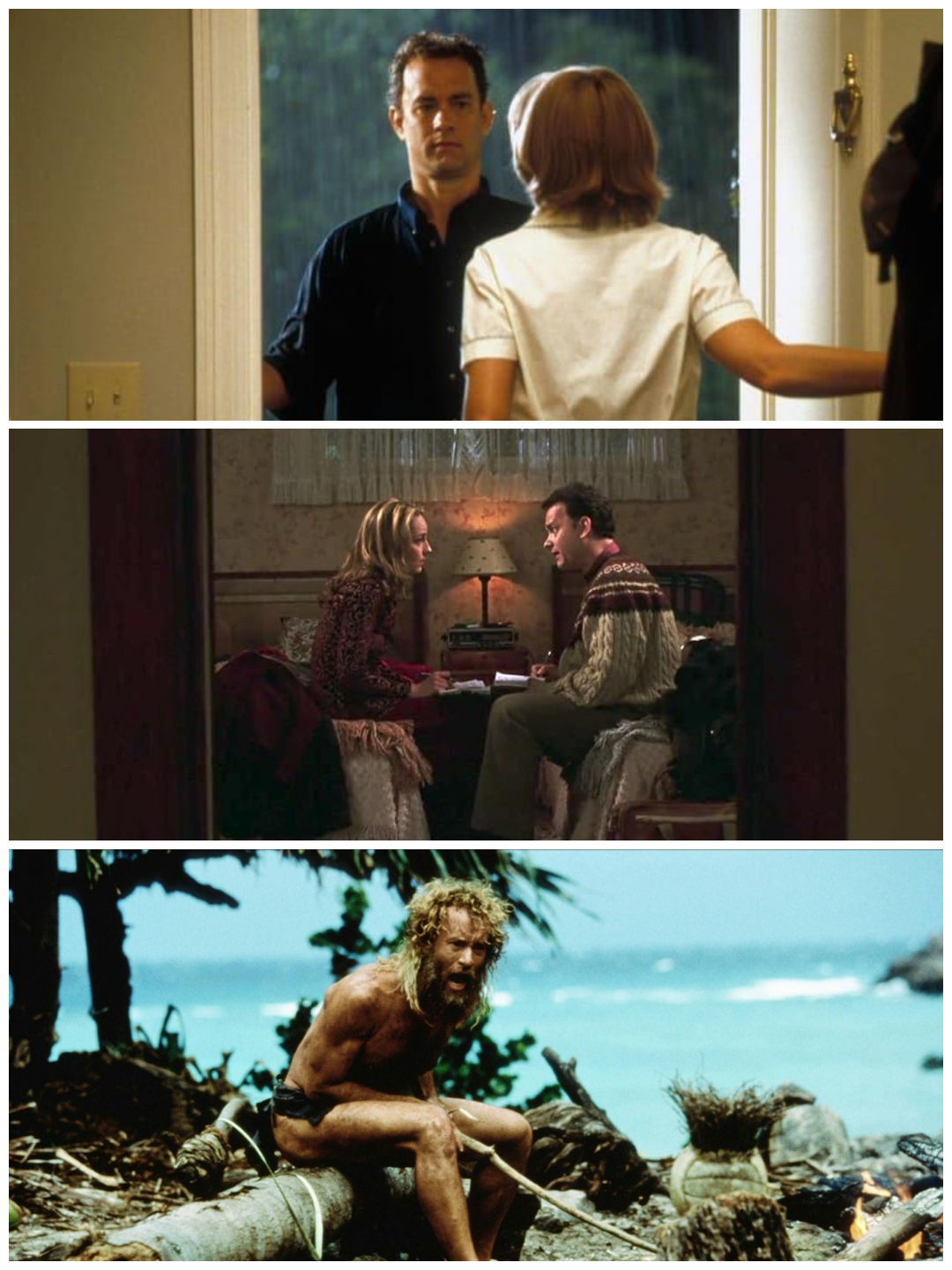
Tom Hanks has watched himself perform some of the most famous scenes in modern movie history.
He has played Forrest Gump running across America, Captain Miller leading soldiers through Normandy, and Woody saying goodbye to Andy.
But there is one moment in Cast Away that Hanks still does not like to see.
It is not the plane crash.
It is not Chuck Noland screaming for Wilson as the volleyball drifts away.
It is not even one of the long stretches in which Hanks had to carry the movie almost entirely by himself.
The moment that still bothers him comes much later, after Chuck has escaped the island and returned home.
According to Hanks, there is one tiny gesture during his reunion with Kelly, played by Helen Hunt, that feels so wrong to him that if Cast Away is playing somewhere, he will leave the room before the scene arrives.
And the reason is remarkably specific.
Hanks says that for just a moment, he can see Tom Hanks on the screen instead of Chuck Noland.
The Scene Comes After Chuck Has Already Survived Everything
Released in 2000 and directed by Robert Zemeckis, Cast Away follows FedEx systems analyst Chuck Noland after a plane crash leaves him stranded alone on a remote island.
Much of the movie’s power comes from how thoroughly Hanks disappears into Chuck’s isolation.
There are long stretches with almost no dialogue.
Chuck learns how to make fire, find food, survive injuries and live with the possibility that rescue may never come.
His only “companion” is Wilson, the volleyball whose blood-stained handprint becomes a face and eventually a kind of emotional lifeline.
When Chuck finally escapes and returns to civilization years later, the movie shifts into something quieter.
He survived.
But the life he knew did not wait for him.
Kelly, the woman he loved before the crash, believed he was dead. She has married someone else and built a family.
Their reunion is emotional precisely because there is no easy way to restore what has been lost.
That is the section of the film containing the moment Hanks now wishes he had played differently.

It Happens When Chuck Returns the Pocket Watch
Hanks discussed the scene on the June 17 episode of The Rest Is Entertainment.
The actor said the moment involves Chuck returning Kelly’s pocket watch.
The watch carries enormous emotional weight in the movie.
Kelly had given it to Chuck before his ill-fated flight, and he kept it with him throughout his years of isolation. Inside is a photograph of her.
It becomes one of the few physical connections Chuck has to the life he left behind.
So when he eventually returns it, the gesture should belong entirely to Chuck.
But Hanks says there is a particular physical choice he made in that scene that no longer feels truthful to him.
Looking back, he believes the gesture is “false.”
He does not see Chuck Noland doing it.
He sees himself.
For an actor whose performance in Cast Away earned an Academy Award nomination for Best Actor, that is a surprisingly harsh judgment about a moment most viewers probably never questioned.
Hanks Says He “Didn’t Get There”
The fascinating part of Hanks’ criticism is how small the mistake appears to be.
He is not saying the entire scene failed.
He is not criticizing Helen Hunt.
He is not arguing that the writing, direction or emotional idea was wrong.
He is talking about one performance choice.
One gesture.
Hanks said that in that particular moment, he simply “didn’t get there.”
For him, the line between actor and character briefly became visible.
That is something audiences may never have noticed.
Hanks is so closely associated with natural, emotionally accessible performances that viewers rarely seem to be watching him “act.” His best-known roles often feel effortless.
But actors can experience their own performances very differently.
A viewer may see a moving scene.
The performer may see the exact second when concentration slipped or an instinct felt artificial.
That appears to be what Hanks experiences when he watches this particular moment.
He Did Not Realize It While Filming
Perhaps the most interesting detail is that Hanks did not necessarily know he had a problem with the gesture when he performed it.
The discomfort came later.
Watching the finished movie, he recognized something in the physical choice that felt like his own mannerism rather than Chuck’s.
That distinction matters enormously to an actor.
Chuck Noland is not supposed to behave like Tom Hanks simply because Tom Hanks is playing him.
By the time Chuck returns from the island, he has been transformed by years of isolation.
He has endured extreme physical deprivation, loneliness and uncertainty.
Every interaction with his old world now carries a strange distance.
So if Hanks sees a gesture that feels casual, familiar or recognizably “Tom Hanks,” it can break the illusion for him — even if almost nobody else notices.
The Scene Is One of the Movie’s Emotional Payoffs
That may be another reason the moment has stayed with him.
The reunion between Chuck and Kelly is not an ordinary romantic scene.
Chuck spends much of the movie surviving partly because the memory of Kelly gives him something to hold onto.
Yet survival does not reward him by restoring his old life.
Kelly still loves him.
Chuck still loves her.
But circumstances have changed.
The film refuses to give them the simple ending audiences might expect.
Instead, their reunion is filled with affection, regret and the painful recognition that some things cannot be recovered.
That emotional complexity makes every small choice matter.
A gesture can say as much as dialogue.
For Hanks, one of those gestures now feels wrong.
He Still Avoids Watching It
Hanks’ reaction to the scene is stronger than simply saying he would change it if he could.
He said that if Cast Away is playing, he will leave the room before that moment arrives.
Twenty-six years after the film’s release, the choice still bothers him enough that he would rather not watch himself make it.
That does not mean he dislikes Cast Away.
Far from it.
The film remains one of the defining performances of his career.
Hanks underwent a dramatic physical transformation for the role, carrying enormous portions of the movie with almost no other human actor on screen.
His performance was widely praised and earned him an Oscar nomination.
But that success does not erase the one moment he wishes he could redo.

Now Fans Have Something New to Look For
Hanks’ confession creates an irresistible challenge for anyone who has seen Cast Away multiple times.
The next time Chuck returns home and meets Kelly, watch closely.
When he gives back the pocket watch, there is a gesture that Hanks believes does not belong to Chuck.
Most viewers may still see nothing wrong with it.
That is part of what makes the revelation so interesting.
For audiences, it may remain a perfectly convincing moment.
For Hanks, it is the instant the character disappears and the actor shows through.
After 26 years, millions of viewers can still watch Cast Away and be completely absorbed in Chuck Noland’s journey.
Tom Hanks, apparently, knows exactly where the illusion breaks.
And before it happens, he leaves the room.