At 41, Sylvester Stallone Built His Most Extreme Rambo Body — Then Learned What a Lifetime of Pushing Too Far Could Cost
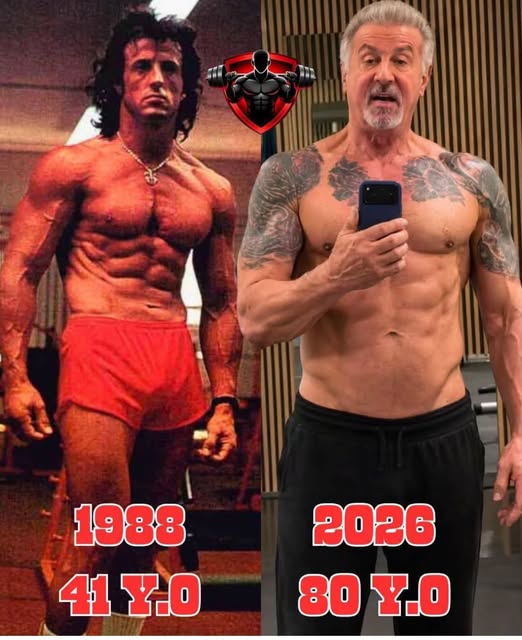
41 and 80.
The remarkable thing isn’t simply that Sylvester Stallone still trains.
It’s what happened to his body in the 39 years between those two photographs.
At 41, Stallone was filming Rambo III, transforming himself into perhaps the most physically imposing version of John Rambo ever put on screen. Nearly four decades later, at 80, he remains muscular, active and committed to the gym.
But the older Stallone is not simply repeating what the younger one did.
Between those two versions of the same man came torn muscle, brutal movie fights, spinal damage, metal hardware and repeated operations — along with a hard-earned realization that looking indestructible and actually preserving your body are very different goals.
For Rambo III, the Gym Became Part of the Production
When Rambo III began filming in 1987, Stallone was already one of Hollywood’s defining physical stars.
Yet he wanted Rambo to look even more formidable.
Contemporary reporting from the Los Angeles Times described an extraordinary setup on location. Stallone had 13 pieces of exercise equipment transported with the production so his training could continue as filming moved. A trainer worked with him during daily sessions at his hotel and remained available on set, particularly before shirtless scenes, when Stallone would exercise between takes to make his muscles appear fuller on camera.
The circumstances made the routine even harder.
Much of the film was shot in Israel under punishing desert conditions, with temperatures reportedly climbing past 120 degrees. Stallone later said he had spent roughly a year bodybuilding for the movie because he expected the heat to strip weight from him during production.
His solution was more training.
He recalled getting up around 4:30 in the morning to exercise before the worst heat arrived, then sometimes training again around 9 or 10 at night.
The result was unmistakable.
During the Israeli shoot, the 41-year-old Stallone was reported at roughly 178 to 180 pounds — about 15 pounds heavier than he had been for Rambo: First Blood Part II. Rambo was no longer simply a lean survivor. His body had become part of the movie’s spectacle.
And that was exactly the point.
Stallone had spent years making his physique serve his characters. Rocky had to look like a fighter. Rambo had to look capable of surviving circumstances that would destroy ordinary men.
Eventually, however, the line between transformation and punishment became dangerously thin.

The Physique Was Never Meant to Last
Stallone’s most extreme experiments with leanness actually stretched back through the Rocky films.
He has described reaching extraordinarily low body-fat levels while preparing for Rocky III, using such restrictive eating that his concentration and memory suffered. In a later interview with Larry King, Stallone recalled taking radical dieting so far that he felt mentally depleted and eventually recognized that the condition could not be maintained.
His conclusion was simple: movie-star “shredded” conditioning is temporary.
Years later, discussing the methods required to appear extraordinarily lean on camera, Stallone again acknowledged that draining the body and following an almost entirely protein-based diet was not healthy and that such a ripped appearance could only exist briefly.
That distinction matters when looking back at Rambo III.
The body audiences saw was not an ordinary everyday fitness standard. It was the product of a specific cinematic mission — equipment hauled around the world, a trainer nearby, controlled meals, repeated workouts and a willingness to organize production days around maintaining an appearance.
And Stallone’s willingness to push himself did not stop when the cameras moved away from the gym.
His body had already begun accumulating damage.

One Bench-Press Contest Nearly Changed Rocky II
One of Stallone’s most memorable injuries happened away from a movie set.
During a WWE interview with Hulk Hogan, Stallone recalled getting into a bench-press contest around 1979 with Franco Columbu, the celebrated bodybuilder and strongman who helped train him.
Stallone knew the matchup made little sense.
He competed anyway.
The result was a catastrophic pectoral tear. Stallone said the muscle tore from the bone and the injury required roughly 160 stitches.
He was preparing for Rocky II at the time.
Years later, Stallone described thinking that his career might be finished because he was supposed to direct, star in and physically perform in the movie while one arm was badly compromised.
Yet he kept going.
That pattern — injury followed by adaptation followed by another physical challenge — would repeat throughout his career.
During Rocky IV, Stallone asked Dolph Lundgren to make their climactic fight look brutally real. According to Stallone, Lundgren struck him so hard in the chest that hours later his blood pressure soared and swelling developed around his heart. He was flown from Canada to California and spent four days in intensive care.
Then he returned to finish the movie.
The Rambo films demanded their own physical punishment. Stallone performed dangerous action, worked in extreme environments and repeatedly built his body around what the character needed to look capable of doing.
But the injury that changed everything came much later.
The Expendables Left a Bill That Took Years to Pay
By the time Stallone made The Expendables, he was in his 60s — but he was still approaching action scenes with the mentality that had defined his younger years.
During the first movie, released in 2010, Stallone fought professional wrestler Steve Austin in an intensely physical sequence.
The damage did not disappear when filming ended.
In 2024, Stallone revealed on The Family Stallone that injuries from that production ultimately resulted in seven surgeries. He described damage involving his neck, back and shoulders, including spinal fusion and a metal plate in his neck.
Most strikingly, he said that after making the film, he was never physically the same.
His family saw the consequences too. The surgeries were not action-movie mythology. They meant recovery periods, repeated procedures and years of dealing with what those performances had done to his body.
The man who had built a career playing characters who absorbed impossible punishment had finally accumulated enough real punishment that it could no longer be edited away.
At 80, the Goal Has Changed
Stallone turned 80 on July 6, 2026.
He still trains.
Earlier this year, shortly before that milestone, he appeared in his home gym and admitted that exercising becomes “harder and harder” with age. Yet he described the gym not as a place to chase the body he had at 41, but almost as a sanctuary — somewhere to maintain the physical strength and confidence needed to keep facing life’s challenges.
That philosophy has evolved over decades.
Stallone has previously admitted that one of his greatest mistakes was overtraining. During his younger years he could spend six days a week in the gym and then continue exercising at home, leaving his body, as he later put it, in a constant state of breakdown. He eventually shifted toward fewer and more focused sessions instead.
That may be the real story hidden inside those two numbers.
At 41, Stallone trained to convince an audience that John Rambo was nearly indestructible.
At 80, after torn muscles, frightening fight injuries, spinal damage and repeated surgeries, simply continuing to move has become its own kind of victory.
Stallone didn’t beat aging by training the same way forever.
He survived long enough to learn that training for the mirror and training to keep moving are two very different things.