Three Men Defined Kingdom of Heaven — and the Director’s Cut Reveals the Story the Theatrical Version Nearly Lost
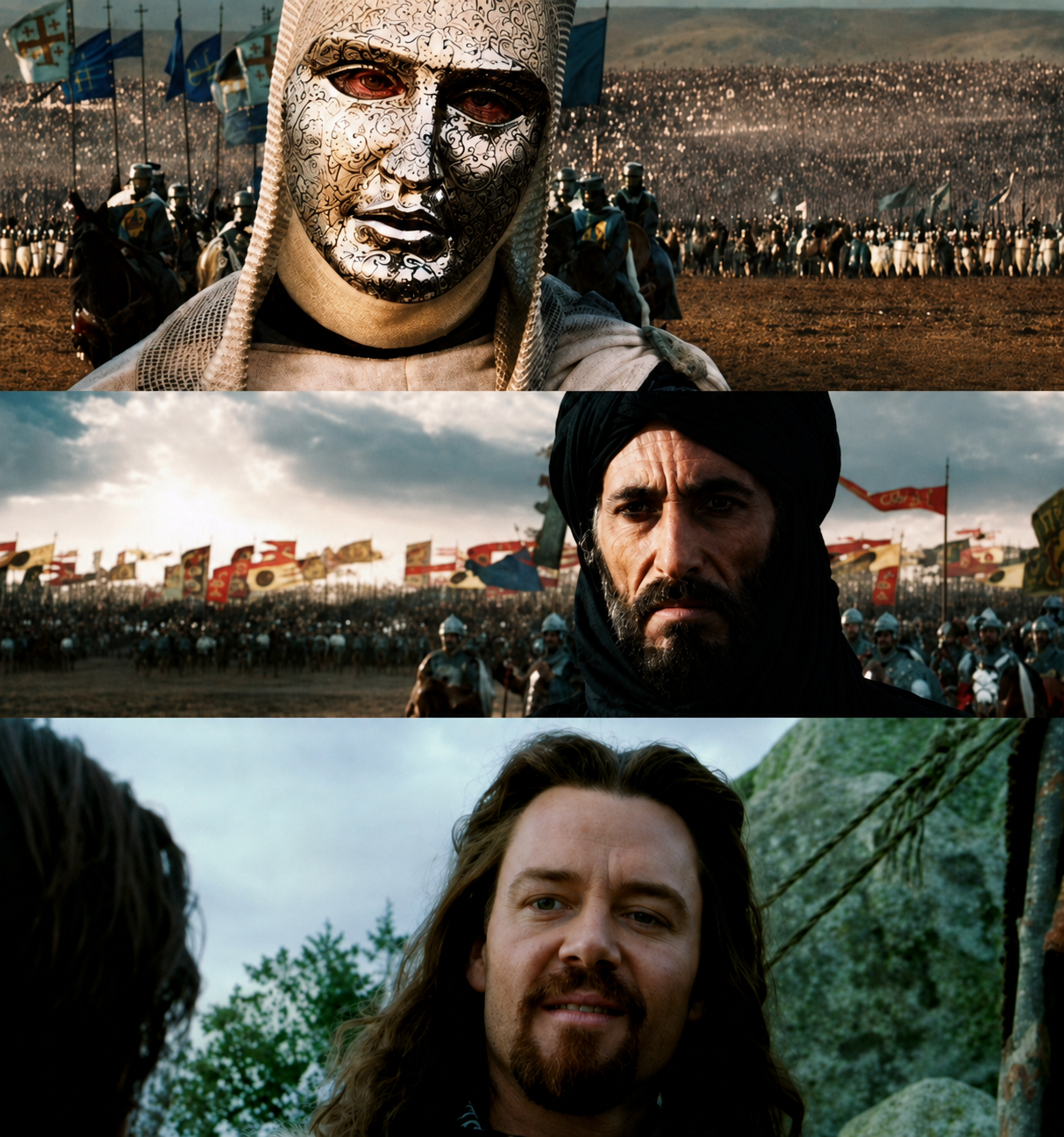
When King Baldwin IV rides out to confront Saladin outside Kerak, Kingdom of Heaven briefly stops feeling like a conventional medieval war film.
Two armies stand ready. One wrong decision could trigger a slaughter. Yet the most powerful figures on the field do not immediately reach for their swords.
Baldwin, physically devastated by leprosy and hidden behind his silver mask, demands that the fragile peace be restored. Saladin, commanding the stronger Muslim force, accepts the withdrawal once the offenders are punished.
Between them stands the philosophy that gives Ridley Scott’s 2005 epic its identity: war may be easy to begin, but responsible rulers understand its cost.
That idea is embodied by three radically different men. Edward Norton’s Baldwin IV represents restraint. Ghassan Massoud’s Saladin represents discipline and strategic patience. Marton Csokas’ Guy de Lusignan represents the dangerous alternative—a man who sees conflict not as a last resort, but as an opportunity.
And when Kingdom of Heaven is viewed in Scott’s much longer Director’s Cut, their differences become even more meaningful.
Baldwin IV: The King Behind the Mask
Baldwin appears for surprisingly little of the film, yet he became one of its most recognizable characters.
Part of that comes from the unforgettable design. Norton performs almost entirely behind a silver mask, forcing emotion into his voice, posture and movements rather than facial expressions. Empire singled him out even while criticizing the theatrical cut, calling his masked Baldwin one of the film’s standout performances.
But the mask works because it reinforces the contradiction inside the character.
Baldwin looks almost supernatural, yet his body is failing. He possesses a crown but knows he cannot control what happens after his death. He has military authority but repeatedly chooses diplomacy when possible.
The historical Baldwin IV really did rule Jerusalem while suffering from leprosy. He became king in 1174 as a teenager and spent much of his reign confronting both Saladin’s growing power and dangerous divisions among Jerusalem’s own nobility. His succession became increasingly urgent as his illness advanced.
Scott turns those pressures into the character’s defining tragedy.
Baldwin knows Jerusalem’s peace depends partly on people behaving more responsibly than their hatred encourages. He therefore treats Guy and Reynald not merely as political rivals but as threats capable of destroying the balance he has spent his reign protecting.
His most memorable scenes are rarely about spectacle. His meeting with Balian, his confrontation with Guy, the march to Kerak and his quiet final moments work because Baldwin seems aware that he is running out of time.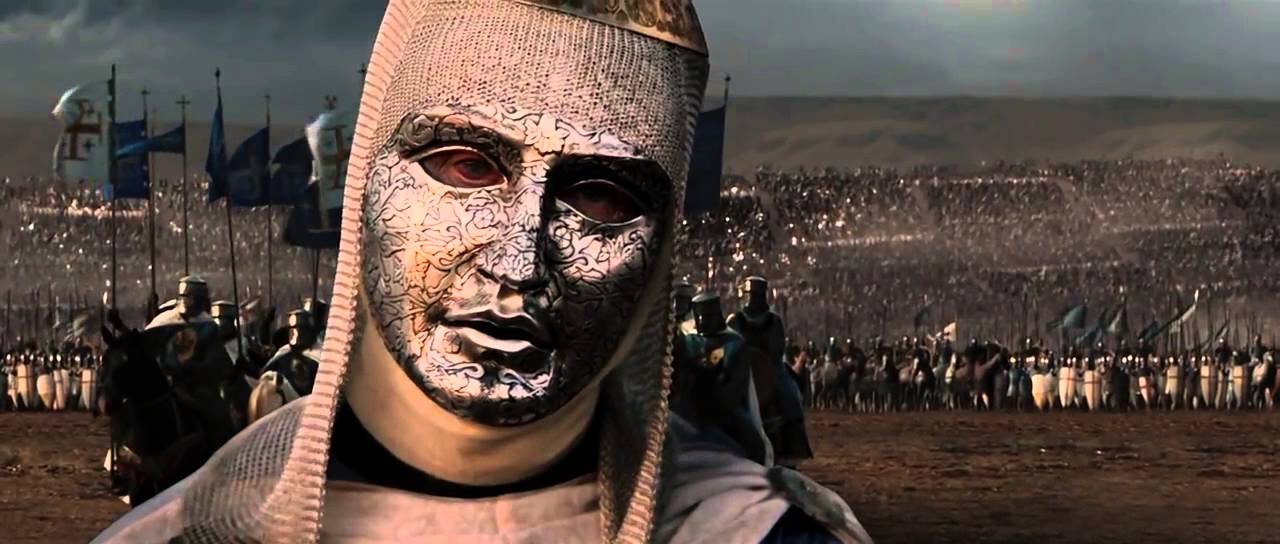
Saladin: Power Without Impulsiveness
Saladin could easily have been written as the enemy waiting outside Jerusalem.
Instead, Ghassan Massoud plays him as a commander whose danger comes from control.
He does not need to shout constantly or prove his courage. He watches, calculates and chooses when fighting serves a purpose.
That makes his relationship with Baldwin especially compelling. They are opponents, but the film repeatedly suggests that each recognizes the other as a serious ruler.
Their encounter at Kerak captures that relationship perfectly. Baldwin demands justice from his own side; Saladin accepts the possibility of peace rather than wasting lives simply because his army is ready to fight.
The respect does not make them allies. It makes them professionals surrounded by men who may be far less careful.
Historically, Christian and Muslim rulers in the region could fight one another while also negotiating truces and maintaining pragmatic political relationships. Such arrangements were considerably more complicated than the film’s moral framework suggests, but diplomacy was an important part of survival in the crusader states.
Once Baldwin is gone, that restraint begins collapsing.
And Saladin does not miss the opportunity.
Guy: The Man Who Wants the War Baldwin Fears
Guy represents almost everything Baldwin is attempting to contain.
Where Baldwin considers consequences, Guy seeks confrontation. Where Saladin calculates patiently, Guy mistakes aggression for strength.
The film makes that contrast increasingly visible after Baldwin’s death. Guy and Reynald help destroy the political order that had prevented open war, and Guy eventually leads Jerusalem’s army toward the disaster at Hattin.
The historical picture is more complicated than the movie’s deliberately villainous portrayal of Guy. But the catastrophe itself was real: in July 1187, the army of the Kingdom of Jerusalem under Guy suffered a devastating defeat against Saladin at Hattin. Jerusalem fell to Saladin later that year.
Within Scott’s story, Guy therefore becomes more than an antagonist.
He is the answer to a question Baldwin’s entire character poses: What happens when power passes from someone who understands the cost of war to someone attracted to it?
Balian’s Transformation Makes the Conflict Personal
Standing between these competing visions is Orlando Bloom’s Balian.
In the theatrical cut, his transformation can seem abrupt. He begins as a grieving French blacksmith and soon becomes a knight, landowner, military engineer, royal adviser and ultimately the man organizing Jerusalem’s defense.
That problem was noticed at the time. Empire criticized the theatrical version for giving too little explanation of how its blacksmith suddenly becomes such an accomplished strategist.
The Director’s Cut repairs much of that gap.
Restored material establishes that this Balian is not simply an inexperienced village craftsman. He has military experience and knowledge of engineering and construction. Additional scenes also give greater weight to his grief over his wife and child, making his journey toward Jerusalem feel less like an adventure and more like an attempt to discover whether his life can still possess meaning.
By the siege, he has changed dramatically.
The man who once travels seeking forgiveness eventually becomes someone willing to challenge religious certainty, aristocratic hierarchy and the idea that possessing Jerusalem is worth destroying the people inside it.
His final confrontation with Saladin matters because both men reach essentially the same practical conclusion: the city has symbolic value, but its inhabitants are not expendable.
The Director’s Cut Restores the Missing Heart
The theatrical version ran about 144 minutes. Scott’s extended presentation reaches roughly three hours and ten minutes, depending on whether its roadshow elements are counted, restoring around 45–50 minutes of material.
Those minutes do far more than make the movie longer.
They restore motivation.
Balian becomes more credible. Baldwin’s political anxieties gain context. Jerusalem’s internal divisions become clearer. Guy’s rise feels like the culmination of a succession crisis rather than a sudden plot development.
Most importantly, Sibylla becomes a fundamentally different character.
The theatrical film largely jumps from Baldwin IV’s death toward Sibylla and Guy taking power. The Director’s Cut restores the story of Sibylla’s young son, Baldwin V, who succeeds his uncle.
In the movie, she discovers that her child is developing leprosy and ultimately chooses to end his life rather than watch him endure Baldwin IV’s suffering.
That specific diagnosis and death are fictionalized; the historical Baldwin V did briefly succeed Baldwin IV and died as a child, but the film transforms that succession into Sibylla’s personal tragedy.
The consequences ripple through every major character.
Baldwin’s fear about what will happen after him becomes painfully justified. Guy’s route to power gains another stage. The political structure protecting Jerusalem continues to disintegrate. And Saladin is no longer facing the kingdom Baldwin held together, but one consuming itself.
Screenwriter William Monahan and Scott’s own commentary make clear how much characterization had disappeared in the shorter version, particularly material involving Balian and Sibylla. Scott later described the expanded version as the film that should have been released in the first place.
That is why the Director’s Cut has developed such a different reputation from the theatrical edition.
It does not merely provide more Baldwin, more Saladin or more battles.
It reveals what those characters were always fighting over.
Baldwin believes power requires restraint. Saladin believes victory requires patience. Guy believes force itself proves strength. Balian begins the story searching for personal redemption and ends it understanding that protecting human lives can matter more than possessing sacred ground.
The armies make Kingdom of Heaven spectacular.
Those competing ideas are what make it memorable.