19 Years Before The Expendables, Stallone, Schwarzenegger and Bruce Willis Had Already Joined Forces — And It Changed Their Relationship
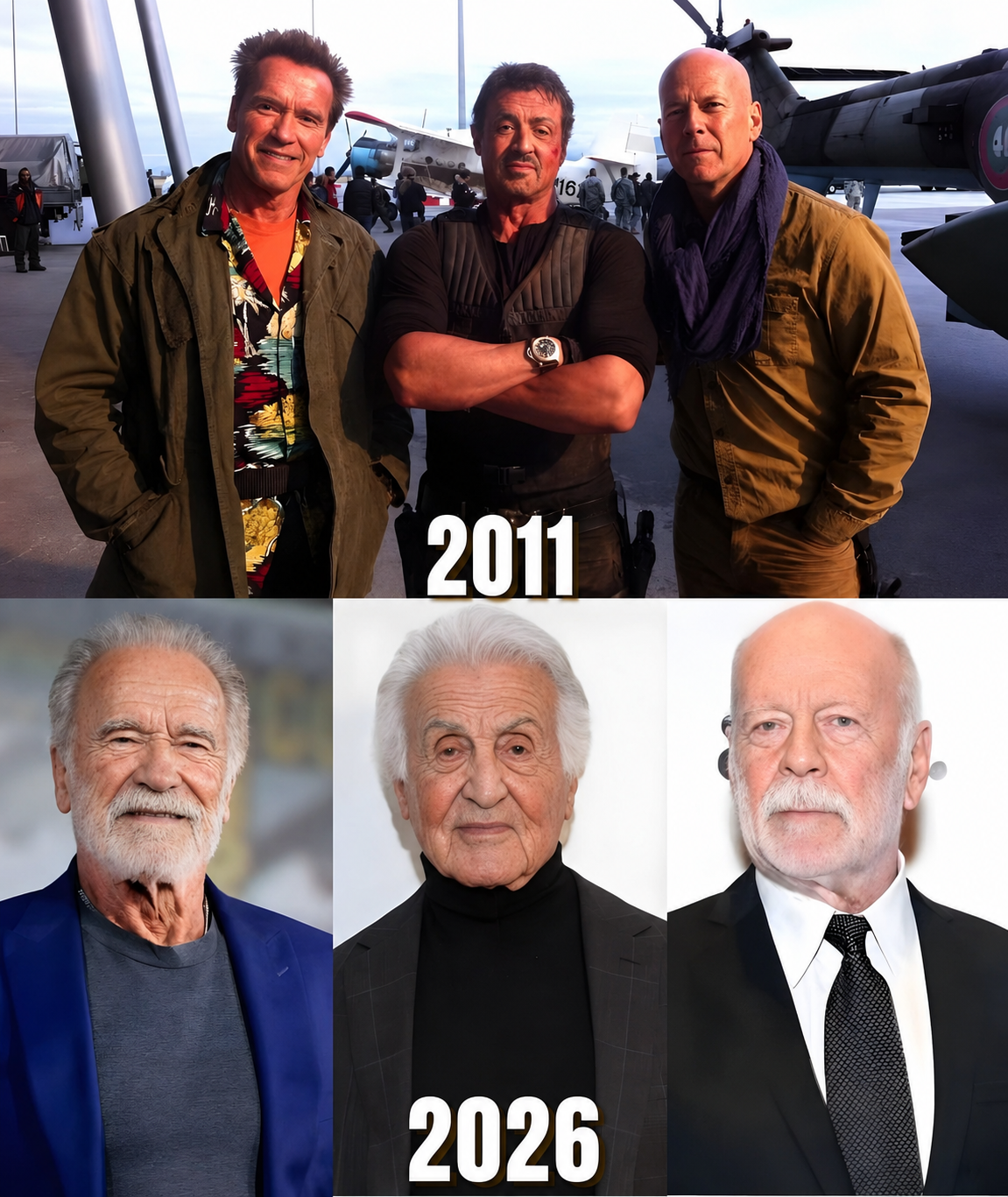
When Sylvester Stallone, Arnold Schwarzenegger and Bruce Willis appeared together inside a church in The Expendables, the scene felt almost impossible.
Three of the defining action stars of the 1980s and 1990s were finally standing in the same movie, trading jokes about one another’s screen personas while discussing a dangerous mercenary job.
For audiences who remembered their careers at their peak, it was an event disguised as a cameo.
But the three men had already formed an unlikely alliance 19 years earlier. It did not involve weapons, explosions or a movie studio.
It involved hamburgers.
In 1991, Stallone, Schwarzenegger and Willis became the celebrity partners most closely identified with Planet Hollywood, the movie-themed restaurant venture that would become one of the most spectacular pop-culture businesses of the decade. Their involvement connected three enormous Hollywood names long before The Expendables — and, in Stallone and Schwarzenegger’s case, helped transform a famously intense rivalry into a genuine friendship.
Before They Became Partners, Stallone and Schwarzenegger Were Rivals
The partnership was especially surprising because Stallone and Schwarzenegger had spent much of the previous decade trying to outdo each other.
Stallone had Rocky and Rambo. Schwarzenegger countered with Conan the Barbarian, Commando, Predator and The Terminator. Both men built enormous screen personas around strength, action and increasingly elaborate spectacle.
Years later, they openly admitted that the competition became personal.
Stallone described the dynamic as two dominant personalities colliding, while Schwarzenegger acknowledged that having Stallone ahead of him gave him someone to chase. Their competition extended from box-office success to physiques, weapons, body counts and even whose movies could deliver the biggest action.
Schwarzenegger has since revealed that Planet Hollywood unexpectedly helped change that relationship.
In 2025, he recalled that while working with restaurant executive Robert Earl and producer Keith Barish on the concept, a lawyer who also represented Stallone asked whether there might be room for Stallone in the venture.
Schwarzenegger agreed.
By his own later account, he recognized that working together could finally bring the two men closer after years of hostility.
Bruce Willis soon became another central celebrity face of the business.
So three actors audiences associated with Rocky, The Terminator and Die Hard suddenly had something entirely different connecting them: stock, restaurant openings and a global brand.

Planet Hollywood Became a Spectacle of Its Own
The first Planet Hollywood opened on West 57th Street in New York in October 1991.
The idea was simple but perfectly suited to the era. Diners would not merely eat; they would be surrounded by Hollywood.
Movie costumes and props became decorations. Schwarzenegger’s Terminator motorcycle and Stallone’s Rocky boxing memorabilia were among the attractions associated with the chain. The stars themselves supplied something even more valuable: publicity.
Soon, opening a Planet Hollywood could resemble a movie premiere more than the launch of a restaurant.
By the mid-1990s, the company was expanding internationally and attracting huge crowds. A Beverly Hills opening in 1995 closed sections of Rodeo Drive and featured an extraordinary celebrity turnout. Elton John performed, while Willis later took the stage with his band.
Willis admitted at the event that even the partners had not expected the idea to become so enormous.
Demi Moore, then married to Willis, also became a celebrity partner. Other famous figures became associated with Planet Hollywood as the company tried to turn fame itself into a business model.
For a while, it worked spectacularly.
When Planet Hollywood went public in 1996, enthusiasm sent its valuation soaring. During its first trading day, its stock briefly reached $32.13, giving the company a paper value of roughly $3.5 billion.
The company eventually had restaurants and franchises scattered around the world. At its late-1990s peak, Planet Hollywood and its franchisees and licensees operated 95 restaurants across 31 countries.
Then the fantasy started collapsing.

The Planet Came Crashing Back to Earth
The problem with celebrity spectacle was that customers had to keep returning after the celebrities had left.
Sales weakened. Expansion had become costly. Some locations struggled to turn first-time curiosity into repeat business.
Planet Hollywood had gone public at $18 a share in 1996. By August 1999, trading had been suspended with the stock at just 75 cents. That October, the company entered Chapter 11 bankruptcy protection and closed nine restaurants as part of its restructuring.
Schwarzenegger formally left Planet Hollywood in January 2000, selling his ownership interest after nearly nine years with the company. He said he had enjoyed helping develop the concept internationally but was disappointed that its success had not continued as hoped.
The trouble was not over.
Planet Hollywood filed for Chapter 11 again in October 2001, saying the collapse in tourism following the Sept. 11 attacks had badly affected restaurants concentrated in major tourist destinations. It emerged from its second bankruptcy reorganization in 2002 as a much smaller privately held company.
The business partnership had risen, exploded across the globe and nearly imploded.
The personal connection survived.

Then Stallone Put All Three Men in a Church
Nearly two decades after the original New York opening, Stallone was assembling The Expendables, his deliberate throwback to the muscular action movies that had made him famous.
His cast already included Jason Statham, Jet Li, Dolph Lundgren, Mickey Rourke, Terry Crews and Randy Couture.
Then came the dream combination.
Willis agreed to appear. Schwarzenegger, who was still governor of California, also made time for a brief scene. His appearance was filmed on Oct. 24, 2009, and his office said he was not paid for it.
Stallone later said Willis and Schwarzenegger both participated without pay as a gesture of support.
The resulting sequence placed Willis, Schwarzenegger and Stallone together inside a church, with Willis’ mysterious character offering a job to Stallone’s Barney Ross and Schwarzenegger’s Trench Mauser.
The dialogue deliberately played with their real-world images.
For Stallone, directing the meeting was unexpectedly intimidating. He later recalled being extremely nervous because he understood exactly what the moment represented: three men who had dominated the same genre in distinctly different ways were finally occupying one frame.
It was brief, but audiences noticed.
The Expendables transformed what had once been an off-screen Hollywood alliance into an onscreen one.
Schwarzenegger and Willis returned with larger roles in The Expendables 2, while Schwarzenegger and Stallone would go on to work together again in Escape Plan. The rivalry that once pushed the two men to compete over almost everything had become a friendship strong enough for them to joke about those years publicly.
That may be the strangest legacy of their original partnership.
Long before Hollywood found an excuse to put Rocky, the Terminator and John McClane’s star personas in the same movie, a restaurant had already done what seemed unlikely in the 1980s: it put Stallone, Schwarzenegger and Willis on the same team.
Planet Hollywood eventually lost much of its empire.
But one partnership it helped create lasted far longer than the hype surrounding the restaurants ever did.