PSYCHOLOGIST REVEALS LINDSAY CLANCY’S FIRST WORDS TO HUSBAND — THEN DEFENSE DEMANDS MISTRIAL
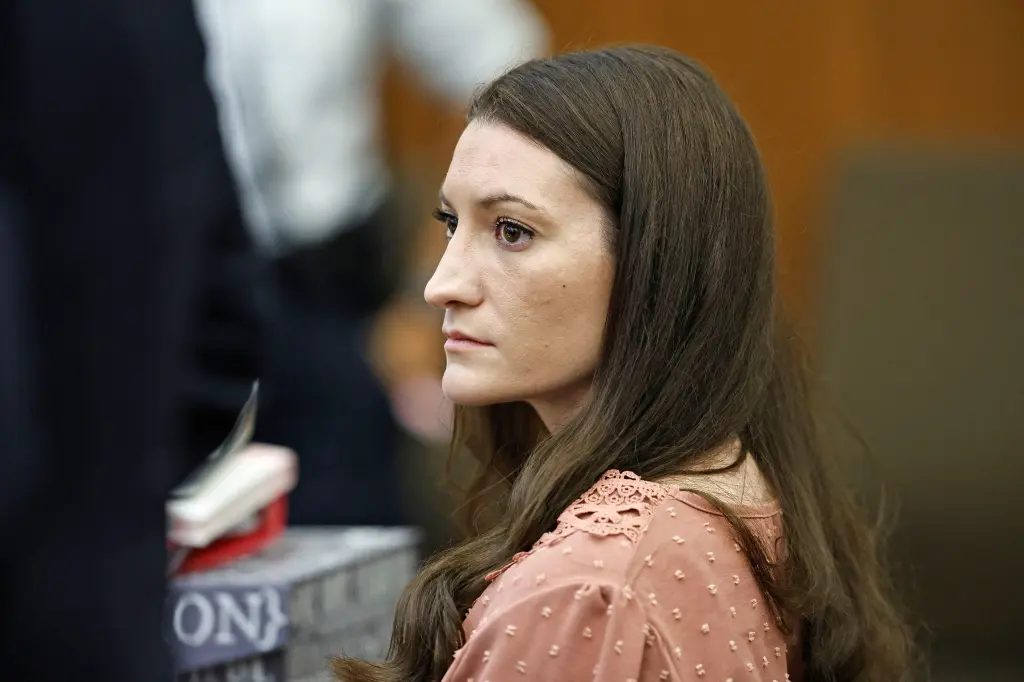
PSYCHOLOGIST REVEALS LINDSAY CLANCY’S FIRST WORDS TO HUSBAND — THEN DEFENSE DEMANDS MISTRIAL
PLYMOUTH, Mass. — A new prosecution witness has offered the jury a detailed account of Lindsay Clancy’s mental state and the first words she reportedly said to her husband after he returned home and discovered their three children dead.
The testimony came during a dramatic day in Clancy’s Massachusetts murder trial — one that ended with her defense attorney asking for a mistrial after the prosecution’s expert referenced Clancy’s Catholic upbringing.
The judge rejected the request and instructed jurors to disregard the religious reference.
Clancy, 36, is charged in the January 2023 deaths of her children Cora, 5, Dawson, 3, and Callan, 8 months, at the family’s home in Duxbury.
She has pleaded not guilty by reason of lack of criminal responsibility, with her defense arguing that she was experiencing postpartum psychosis at the time.
:max_bytes(150000):strip_icc():focal(745x298:747x300):format(webp)/Dr-Kirk-Heilbrun-and-Lindsay-Clancy-in-court--5f74f3d0c9a446188ef2da0b37afd462.jpg) THE PSYCHOLOGIST’S ACCOUNT OF WHAT CLANCY TOLD HER HUSBAND
THE PSYCHOLOGIST’S ACCOUNT OF WHAT CLANCY TOLD HER HUSBAND
Forensic psychologist Dr. Kirk Heilbrun, who evaluated Clancy over three days in April 2026, testified that he diagnosed her with Bipolar II disorder.
He said the condition involved depressive episodes but that he found no evidence of manic episodes.
Heilbrun also discussed what he considered one of the most significant pieces of evidence concerning Clancy’s mental state: what she told her husband, Patrick Clancy, when he arrived home.
According to the psychologist, Patrick asked what she had done.
Clancy responded:
“I tried to kill myself.”
Heilbrun testified that he considered that response inconsistent with acute psychosis because, in his opinion, someone experiencing a command hallucination might instead attribute the act directly to the voice or believe they had no choice.
That interpretation is now a major point of dispute between the prosecution and defense.
:max_bytes(150000):strip_icc():focal(812x430:814x432):format(webp)/patrick-clancy-court-072726-d9a967cc00a144f39fe641446cc4c43a.jpg) THE DEFENSE SAYS SHE WAS EXPERIENCING POSTPARTUM PSYCHOSIS
THE DEFENSE SAYS SHE WAS EXPERIENCING POSTPARTUM PSYCHOSIS
Clancy’s attorneys have argued that she was suffering from a severe psychiatric condition after the birth of her youngest child.
Their defense relies heavily on the theory that she experienced postpartum psychosis, including hallucinations and delusional thinking that impaired her ability to understand the nature or wrongfulness of her actions.
Earlier defense testimony from forensic psychiatrist Dr. Phillip Resnick described Clancy as “frankly psychotic” and said she appeared to be experiencing a command hallucination.
The prosecution has presented a very different interpretation.
Heilbrun testified that Clancy suffered from mental illness and severe depression but ultimately rejected the theory that she was experiencing acute psychosis when the children died.
THE MYSTERIOUS VOICE LASTED ONLY ABOUT 18 MINUTES
Another extraordinary detail emerged during Heilbrun’s testimony.
Clancy reportedly told him that she heard a male voice instructing her to kill her children and then herself.
According to her account, the voice appeared for the first and only time during approximately 18 minutes, the period in which the children were killed.
Heilbrun called the timing highly unusual.
He also testified that Clancy had given inconsistent descriptions of what the voice told her to do.
The defense maintains that the reported voice was evidence of psychosis.
The prosecution’s expert, however, questioned whether the account demonstrated an actual psychotic episode.
WHY HEILBRUN SAID SHE MAY HAVE KILLED THE CHILDREN
Heilbrun offered two possible explanations for Clancy’s actions.
One possibility, he said, was that she believed her children would suffer after her own death and therefore believed she needed to kill them as well.
The second possibility was acute psychosis.
But after evaluating her, Heilbrun said he ultimately rejected the psychosis explanation.
He described the first theory as “altruistic filicide” — the idea that a parent believes the children would be better off dead rather than left behind.
According to his testimony, Clancy believed the children would suffer without her and that killing them would allow them to be together in heaven.
That conclusion directly conflicts with the defense’s argument that Clancy’s behavior was driven by hallucinations and delusions beyond her control.
THEN THE TRIAL TOOK AN UNEXPECTED TURN
Heilbrun’s testimony was interrupted when he referenced Clancy’s Catholic faith while answering a later question.
Defense attorney Kevin Reddington immediately moved for a mistrial, arguing that religion had been repeatedly introduced during the trial even though it was irrelevant to whether Clancy was criminally responsible.
Prosecutors argued that the reference was not intentional.
Judge William Sullivan denied the mistrial request.
Instead, he instructed the jury that the religious reference was inappropriate and must not be considered.
The judge told jurors that the information was to be stricken from the record and emphasized that they could not use it in reaching their verdict.
The jury was subsequently dismissed for the day.
THE CASE NOW COMES DOWN TO ONE CRUCIAL QUESTION
At the heart of the trial is not simply whether Clancy committed the acts.
Her defense has acknowledged that she was responsible for the children’s deaths.
The central legal question is whether she was criminally responsible for those actions under Massachusetts law.
Did she understand what she was doing?
Did she understand that it was wrong?
Or was she experiencing a severe psychiatric episode that prevented her from being legally responsible?
Those competing interpretations have produced sharply different expert testimony.
One defense expert has described a woman experiencing psychosis and command hallucinations.
The prosecution’s experts have portrayed someone suffering from serious mental illness but who nevertheless retained awareness and control.
CLOSING ARGUMENTS ARE APPROACHING
The prosecution is expected to present one more rebuttal witness before closing arguments.
The trial has already featured testimony from dozens of witnesses and extensive evidence about Clancy’s mental health, medications, medical history and behavior before and after the children’s deaths.
The final arguments will ultimately ask jurors to decide which interpretation of Clancy’s mental state is supported by the evidence.
For the families involved, the case has been unfolding for more than three years.
For the jury, however, the decision now comes down to the evidence presented in court.
A psychologist says Clancy’s own words to her husband reveal an awareness inconsistent with acute psychosis. The defense says her mind was overwhelmed by a devastating psychiatric illness. And after years of investigation, the jury is now approaching the moment when it must decide which account is supported by the evidence