The Famous 2003 Photo of Tom Hanks, Tom Cruise and Brad Pitt Was Only Half of an Even Bigger Hollywood Moment
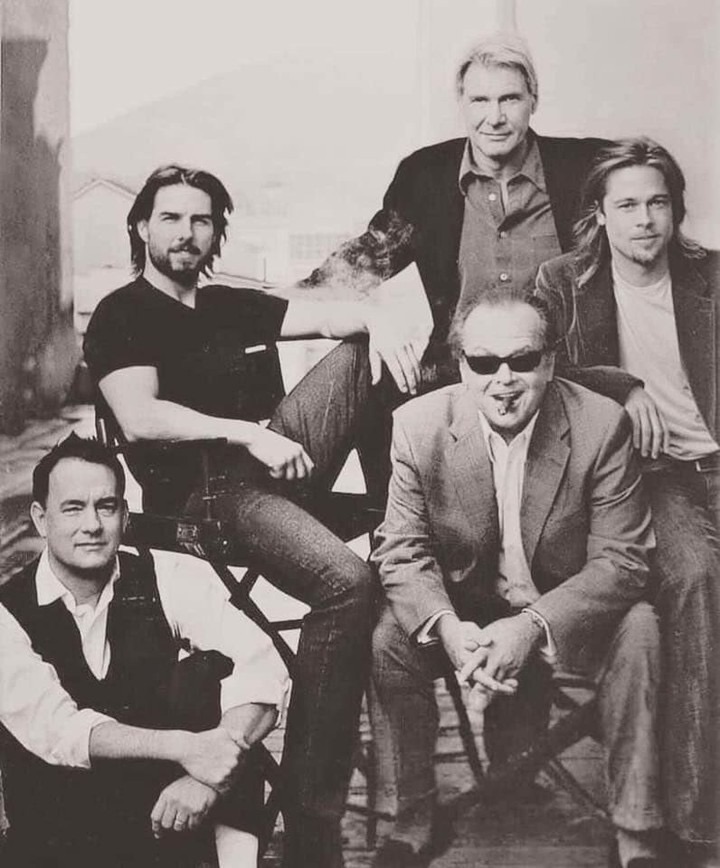
It already looks like a photograph that should have been almost impossible to arrange.
Tom Hanks sits at the front. Tom Cruise leans back in a director’s chair. Harrison Ford stands behind him. Jack Nicholson, wearing dark sunglasses, occupies the center with the unmistakable confidence of a Hollywood legend. Brad Pitt is nearby, while Edward Norton appears farther across the image.
That six-man version of a famous 2003 Hollywood portrait has circulated online for years.
But it is not the whole photograph.
The original image kept going.
Beyond Norton were Jude Law, Samuel L. Jackson, Don Cheadle, Hugh Grant, Dennis Quaid, Ewan McGregor and Matt Damon — bringing the complete lineup to an extraordinary 13 actors.
The portrait, photographed by legendary photographer Annie Leibovitz for Vanity Fair’s 2003 Hollywood Issue, was called “Alpha List.”
And the story behind getting that many major movie stars into one photograph is nearly as impressive as the finished image itself.
The Version Most People Know Is Only Part of the Portrait
The photograph was created as a large foldout magazine cover.
That meant readers looking at the issue on a newsstand would not immediately see everyone.
The front portion emphasized some of the biggest movie stars of the era, including Hanks, Cruise, Ford, Nicholson and Pitt. Opening the cover revealed more and more actors until the full lineup appeared.
That design helps explain why cropped versions have continued circulating independently.
Depending on where the image is cut, viewers might see five stars, six stars or another section of the lineup without realizing the original photograph stretches much farther.
And once the complete version is revealed, the amount of star power becomes almost ridiculous.
Tom Hanks had already won two Academy Awards for Best Actor.
Jack Nicholson had accumulated three acting Oscars and decades of classic performances.
Harrison Ford had already become both Han Solo and Indiana Jones, two of the most recognizable characters in movie history.
Tom Cruise had spent years as one of the most bankable stars in the world.
Brad Pitt was already firmly established as one of Hollywood’s leading men.
And that was only the beginning.
Keep moving across the photograph and you find Edward Norton, Jude Law, Samuel L. Jackson, Don Cheadle, Hugh Grant, Dennis Quaid, Ewan McGregor and Matt Damon.
It looks less like a magazine portrait and more like someone somehow managed to empty several major movie premieres into the same room.
Annie Leibovitz Had to Get Them Into One Studio
The portrait was photographed at the Culver Studios in Culver City, California.
That detail is more significant than it may initially sound.
Large celebrity group photographs can sometimes be assembled from separate sessions. Scheduling even a few major actors can be difficult; gathering more than a dozen internationally famous stars creates an entirely different logistical problem.
But this lineup really came together for the session.
These were actors with films in production, international travel, family responsibilities, publicity commitments and schedules controlled down to the hour.
Yet somehow, 13 of them arrived for one enormous Hollywood portrait.
Behind the polished final image were the ordinary complications of getting people into position, dressing the set, adjusting lighting and waiting for everyone to be ready.
And some of the biggest stars apparently behaved far more casually than their enormous fame might suggest.
Several drove themselves.
Some arrived surprisingly early.
One reportedly showed up wearing mismatched socks.
Among the men providing entertainment during the long process was Jack Nicholson, whose personality was apparently just as noticeable behind the scenes as it was in the finished photograph.
Tom Hanks Arrived Early — With a Very Specific Mission
One of the most charming stories from the session involved Tom Hanks.
Hanks reportedly arrived roughly half an hour before he was expected.
That alone was unusual enough to attract attention during a celebrity shoot.
But he had also brought his teenage niece.
There was a reason.
She was a huge Brad Pitt fan.
So before the group portrait became an iconic image of Hollywood power, Hanks found himself participating in something much more ordinary: helping a young relative meet one of her favorite movie stars.
He even got behind a camera and took photographs of his niece with Pitt.
It is an amusing contrast.
Inside one studio were men whose films had collectively generated billions of dollars and whose faces were known around the world.
Yet for a moment, Hanks was simply an uncle making sure his niece got a memorable photograph.
Tom Cruise Was in the Middle of Making Another Epic
Cruise presented a different example of how complicated the scheduling must have been.
At the time, he was working on The Last Samurai, the historical epic that would reach theaters later in 2003.
His appearance in the Vanity Fair portrait reflected the production. He had longer hair and facial hair associated with the film and arrived with his children, Isabella and Connor.
Despite the demands surrounding the movie, Cruise reportedly brought his trademark energy to the studio.
At one point, he even became involved in a handstand competition while the group was preparing for the photograph.
Then, after his work on the portrait was finished, his schedule returned to filmmaking.
It is a small behind-the-scenes detail, but it demonstrates what Leibovitz and the magazine were dealing with.
These were not 13 actors casually waiting around Los Angeles for something to do.
They were among the busiest performers in the industry.
Getting them into one place required coordinating careers that stretched across studios, continents and productions.
The final photograph makes that effort invisible.
Everyone simply appears to belong there.
The Picture Captured Several Generations of Hollywood at Once
Part of what makes the portrait more fascinating today is the range of careers frozen inside it.
Nicholson and Ford represented stars whose defining work stretched back into the 1970s.
Cruise and Hanks became towering figures of the 1980s and 1990s.
Pitt had moved from young heartthrob to serious movie star.
Then there were actors such as Norton, Law, Cheadle, McGregor and Damon, whose careers would continue expanding dramatically over the following decades.
Samuel L. Jackson already possessed one of cinema’s most recognizable voices and screen personalities.
Hugh Grant brought the enormous popularity of 1990s romantic comedies into the lineup.
Dennis Quaid represented another long-running tradition of American movie leading men.
Seen today, the photograph almost functions like a timeline.
Different generations of Hollywood overlap inside one frame.
Some had already played the roles that would define them forever.
Others still had some of their most famous work ahead.
Even the Younger Men Would Become Hollywood Veterans
The passage of time has made the image even more remarkable.
In 2003, Matt Damon was still closely associated with the explosive success that followed Good Will Hunting and had only recently launched the Jason Bourne franchise.
Ewan McGregor had already played Obi-Wan Kenobi in two Star Wars prequels, with Revenge of the Sith still two years away.
Jude Law was entering one of the busiest periods of his career.
Don Cheadle had not yet become globally familiar to Marvel audiences as James Rhodes.
Edward Norton had already delivered acclaimed performances in films such as Primal Fear, American History X and Fight Club, yet decades of work still remained ahead of him.
Looking at the picture now creates an unusual feeling.
The younger members of the group are no longer Hollywood’s rising generation.
They are veterans themselves.
The Crop Completely Changes What the Picture Means
That is why the widely shared cropped version can be misleading.
Seeing Hanks, Cruise, Ford, Nicholson, Pitt and Norton together already feels like an astonishing Hollywood gathering.
It seems complete.
But move farther across the original image and an entirely different group of stars suddenly appears.
Jude Law.
Samuel L. Jackson.
Don Cheadle.
Hugh Grant.
Dennis Quaid.
Ewan McGregor.
Matt Damon.
The photograph does not simply contain a handful of famous actors.
It contains an unusually concentrated snapshot of Hollywood at a particular moment in time.
More than two decades later, assembling those exact 13 men again would feel almost unimaginable.
Their careers have expanded, franchises have come and gone, Oscar histories have changed, and Hollywood itself has transformed dramatically since 2003.
Yet for one photo session in Culver City, they were all there.
And perhaps the most appropriate thing about the portrait is that a normal magazine cover was never large enough to show them.
To see the complete lineup, readers had to open it wider.