Before Spider-Man, Tobey Maguire Looked Completely Different — The Long-Haired 2000 Era Hollywood Quickly Left Behind
For millions of moviegoers, Tobey Maguire is frozen in a remarkably specific image: clean-shaven, boyish, with short dark hair framing his face as Peter Parker prepares to become Spider-Man.
Go back only a little further, however, and Maguire can look like an entirely different Hollywood star.
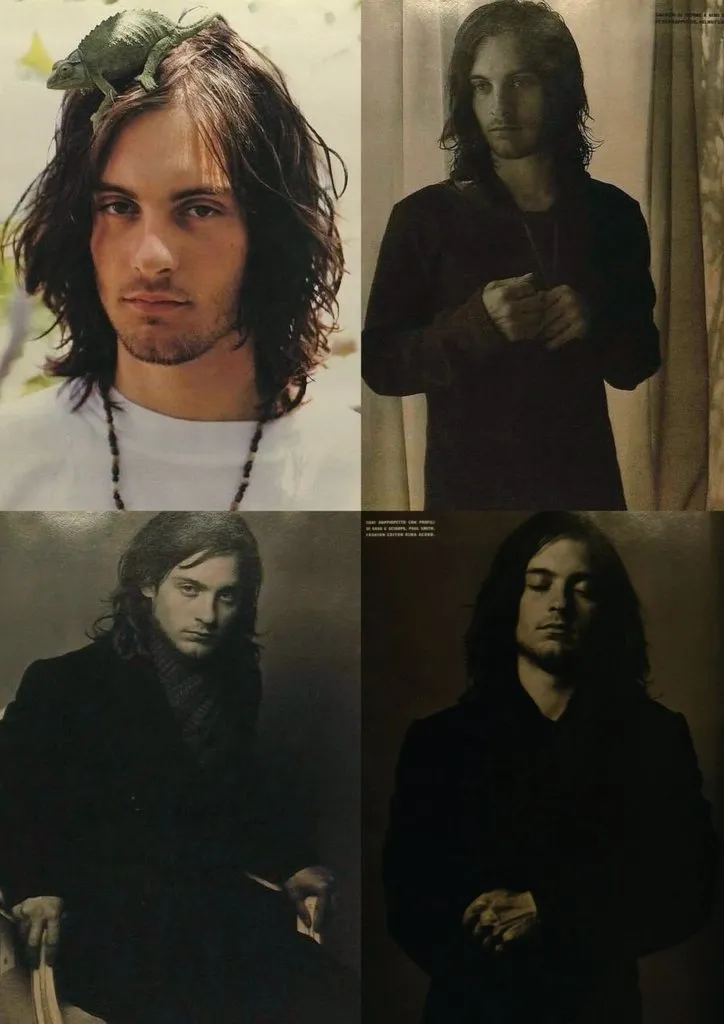
Around 2000, photographs captured the actor with dark hair falling toward his shoulders, sometimes loosely parted around his face and paired with the understated, slightly brooding fashion of the era. One particularly memorable period came just before his superhero transformation, when Maguire was appearing in fashion editorials and promoting the kind of serious dramas that had made him one of Hollywood’s most promising young actors.
Looking at those images now is striking.
This was Tobey Maguire before the Spider-Man haircut, before the red-and-blue suit, before blockbuster fame permanently changed the way audiences saw him.
And the transformation happened much faster than many fans may remember.
He Was Already Successful — Just Not as an Action Star
By 2000, Maguire was hardly an unknown actor waiting for his first major opportunity.
He had spent the late 1990s building an impressive reputation through serious, character-driven films.
In Ang Lee’s The Ice Storm, he played Paul Hood, a thoughtful teenager navigating the emotional confusion surrounding the adults in his life. He followed that period with Pleasantville, Gary Ross’ inventive fantasy drama in which Maguire and Reese Witherspoon are transported into the black-and-white world of a 1950s television show.
He then reunited with Lee for Ride with the Devil, appeared opposite Michael Caine in The Cider House Rules, and played the mysterious James Leer in Curtis Hanson’s Wonder Boys.
It was a remarkable run for an actor still in his early 20s.
But there was a pattern to many of those roles.
Maguire often played quiet young men. Outsiders. Observers. Characters whose vulnerability mattered more than physical strength.
His understated style worked perfectly in intimate dramas, where a hesitation or expression could communicate more than an elaborate speech.
Nothing about that career path suggested he was about to become the face of one of the biggest superhero movies ever made.
Then Peter Parker entered the picture.
Spider-Man Changed Everything in 2000
Maguire was cast as Peter Parker in 2000, when director Sam Raimi was preparing Sony’s long-awaited live-action Spider-Man movie.
At the time, the choice was not as obvious as it seems in retrospect.
Maguire was known for dramatic acting rather than action movies. He did not have the exaggerated physique associated with traditional comic-book heroes, and his screen persona was much closer to an awkward college student than a fearless crime fighter.
That turned out to be part of the appeal.
Peter Parker was never supposed to begin his story as Superman.
He was a shy, intelligent young man who struggled socially, worried about money and carried responsibilities that often overwhelmed him. The audience needed to believe Peter before they could believe Spider-Man.
Maguire already knew how to play that kind of vulnerability.
His performances in films such as The Cider House Rules demonstrated that he could make a restrained character emotionally compelling. Rather than turning Peter Parker into a conventional action hero, Raimi could build the superhero around the qualities Maguire already possessed.
There was only one problem.
The actor still had to look convincing once Peter gained extraordinary powers.
From Long-Haired Drama Star to Superhero
Preparing for Spider-Man required a physical transformation unlike anything Maguire had previously done for a major role.
He trained intensively to develop a stronger, more athletic appearance and worked on flexibility and movement so that Peter’s transformation into Spider-Man would feel believable.
The visual changes were impossible to miss.
The longer hairstyle associated with Maguire around 2000 disappeared.
His hair became shorter and more carefully controlled. His physique changed. His costumes emphasized Peter Parker’s awkwardness before gradually allowing the character to look more confident as his powers developed.
The transformation becomes especially dramatic when photographs from 2000 are placed beside images from the finished movie.
The earlier Maguire could look like a young musician or an emerging independent-film star — slim, long-haired and almost deliberately detached from the polished Hollywood blockbuster image.
The 2002 version was unmistakably Peter Parker.
Remarkably, those two identities were separated by only a short period of time.
Spider-Man reached theaters in May 2002.
By then, the long-haired version of Maguire was already becoming a snapshot of a career that had suddenly moved in a completely different direction.

The Movie That Rewrote His Public Image
When Spider-Man opened, it did far more than establish Maguire as an action star.
It became a cultural event.
The movie earned more than $100 million during its opening weekend in North America, becoming the first film in history to achieve that milestone. It eventually collected hundreds of millions of dollars around the world and helped accelerate Hollywood’s growing obsession with comic-book adaptations.
For Maguire, the consequences were immediate.
Millions of people who had never seen Wonder Boys, Ride with the Devil or The Ice Storm suddenly knew his face.
But they knew him as Peter Parker.
The short dark hair, wide-eyed expression and slightly awkward demeanor became inseparable from the character. Even people who had followed Maguire’s earlier work began viewing those older films through the lens of the superhero role that followed them.
He returned in Spider-Man 2 in 2004, a sequel that became one of the most acclaimed superhero movies of its era.
Then came Spider-Man 3 in 2007.
By that point, Maguire and Peter Parker were permanently connected in popular culture.
A Snapshot of a Different Hollywood Era
That is what makes Maguire’s long-haired 2000 look so interesting more than two decades later.
It captures more than a different hairstyle.
It captures a version of Hollywood just before superhero franchises became the center of the movie business.
In 2000, Maguire could still be primarily identified with films such as Pleasantville, The Cider House Rules and Wonder Boys. He was a respected young dramatic actor whose future could seemingly have gone in several directions.
Two years later, one role changed the equation.
Hollywood itself was changing at roughly the same time.
Comic-book movies had existed for decades, but the extraordinary success of Spider-Man demonstrated how enormous their commercial potential could be when spectacle was combined with character-driven storytelling.
Maguire suddenly found himself at the center of that transition.
The actor who had spent years playing introspective outsiders became one of the defining faces of the emerging superhero era.
The Image Fans Never Forgot
Maguire eventually moved beyond Peter Parker, appearing in projects including Seabiscuit, Brothers and The Great Gatsby.
But Spider-Man remained different.
When he returned as Peter Parker years later in Spider-Man: No Way Home, the reaction demonstrated just how deeply audiences still associated him with the character.
For fans who grew up with Raimi’s trilogy, Maguire did not simply play Spider-Man.
He was their Spider-Man.
That makes his appearance immediately before the franchise even more fascinating.
The long-haired Tobey Maguire of 2000 belonged to the final stage of his career before global blockbuster fame changed his image almost overnight.
He was already talented. Already successful. Already working with celebrated directors.
He simply had not yet stepped into the role that would overshadow almost everything that came before it.
Within roughly two years, the transformation was complete.
The longer hair disappeared. The superhero physique arrived. Peter Parker entered theaters.
And an entire generation stopped seeing Tobey Maguire as Hollywood’s quiet young dramatic actor.
They saw Spider-Man.