TWO AIR TR@FFIC CONTROLLERS LEFT WORK EARLY BEFORE DE@DLY LAGUARDIA CR@SH, FAA MOVES TO FIRE THEM
TWO AIR TRAFFIC CONTROLLERS LEFT WORK EARLY BEFORE DEADLY LAGUARDIA CRASH, FAA MOVES TO FIRE THEM
A startling new development has emerged in the investigation into the deadly runway collision at New York’s LaGuardia Airport.
Two air traffic controllers reportedly left their shifts about an hour early on the night an Air Canada Express jet collided with a Port Authority fire truck, leaving only two controllers in the tower as the airport faced an unusually heavy workload.
Now, the Federal Aviation Administration is taking steps to fire the two controllers, according to people familiar with the matter.
The revelation has raised fresh questions about staffing, oversight and whether the tower had adequate support during one of the busiest periods of the night.
:max_bytes(150000):strip_icc():focal(999x0:1001x2):format(webp)/laguardia-crash-1-165e66ce3d7043549fb8cfb76aea2e78.jpg) TWO CONTROLLERS LEFT BEFORE THE CRASH
TWO CONTROLLERS LEFT BEFORE THE CRASH
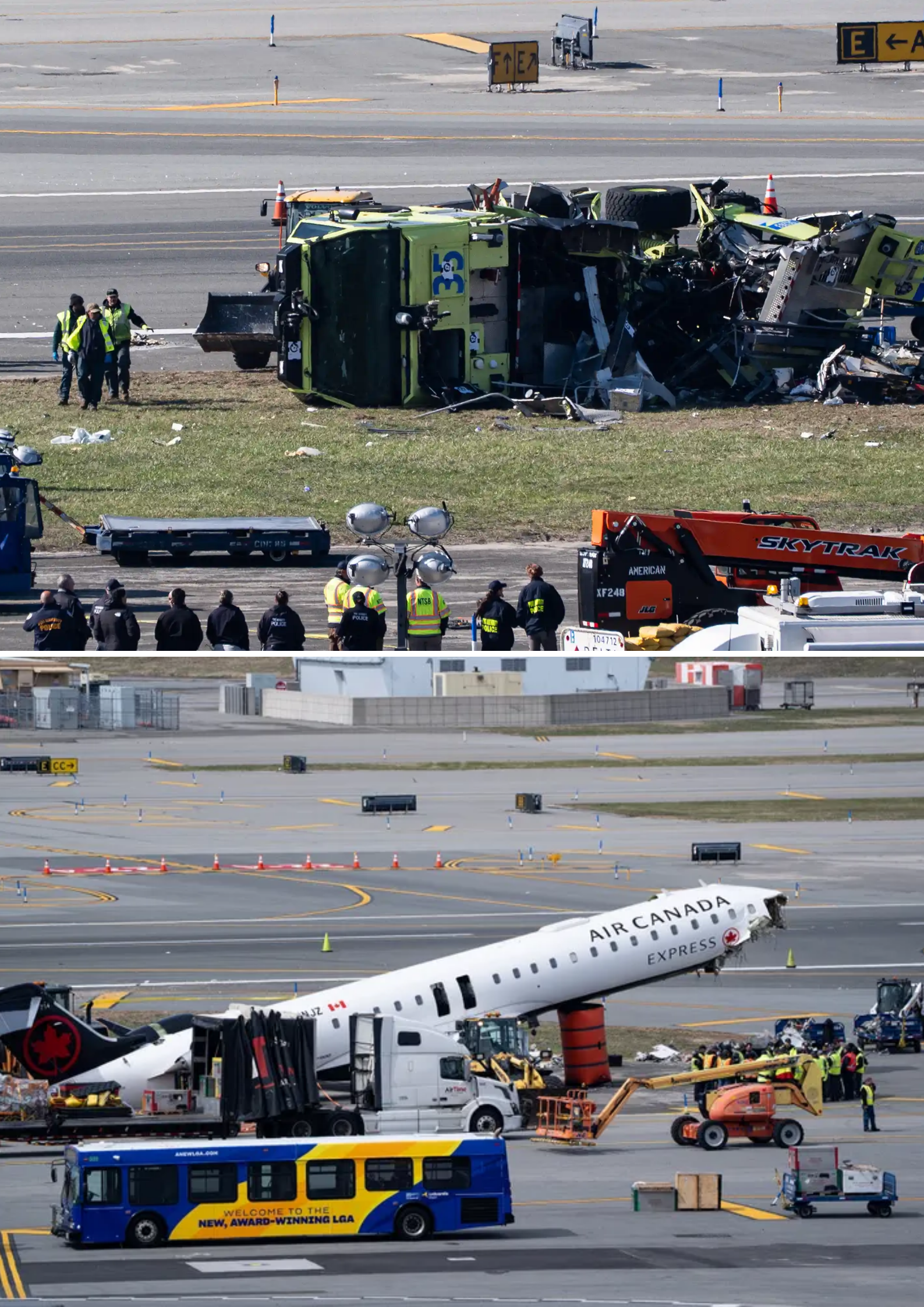
The incident occurred shortly before midnight on March 22, 2026, when an Air Canada Express flight arriving at LaGuardia collided with a fire truck on the runway.
Both pilots aboard the aircraft were killed.
Dozens of other people were injured, including passengers and two Port Authority Aircraft Rescue and Firefighting personnel aboard the truck.
According to investigators and people familiar with the FAA review, two additional controllers who were scheduled to be working that night left approximately an hour before their shifts officially ended.
That left two controllers working in the tower.
While having two controllers on the midnight shift can be normal at LaGuardia, the circumstances that night were anything but ordinary.
:max_bytes(150000):strip_icc():focal(999x0:1001x2):format(webp)/laguardia-crash-2-b36d3bf4f3d94cf2a426d0ba3288f4a4.jpg) THE AIRPORT WAS DEALING WITH HEAVY TRAFFIC
THE AIRPORT WAS DEALING WITH HEAVY TRAFFIC
Weather-related delays had pushed a large volume of flights into the later hours.
The Wall Street Journal reported that LaGuardia was handling more than twice its usual traffic volume that night, placing additional pressure on the controllers who remained on duty.
According to PEOPLE, more than 70 flights were handled in less than two hours during the unusually busy period.
The staffing revelation has therefore become a major focus of scrutiny.
However, investigators have not concluded that the two controllers’ early departure caused or contributed to the collision.
The National Transportation Safety Board is continuing to examine staffing and other factors involved in the crash.
FAA MOVES TO FIRE THE CONTROLLERS
The FAA is reportedly moving to terminate the two controllers for leaving their posts early.
The agency considers the practice a form of timecard fraud because employees may receive credit for hours they did not actually work.
The practice has reportedly been referred to within the air-traffic-control system as an “early shove.”
Current and former controllers have described it as a longstanding informal practice in some facilities, sometimes occurring when supervisors determine that traffic is light enough to allow employees to leave early.
But the FAA is now taking a harder line.
Transportation Secretary Sean Duffy said the agency would not tolerate employees who take advantage of taxpayers, place additional burdens on fellow controllers or potentially affect the nation’s airspace system.
QUESTIONS ABOUT SUPERVISION
The revelations have also raised questions about the supervisors and managers who were overseeing the tower that night.
Former air traffic controller Todd Yeary told CBS News that investigators should examine not only the employees who allegedly left early but also the supervisors responsible for managing staffing and traffic.
Among the questions is whether the early departures were formally approved, whether the controllers were on authorized leave or using compensatory time, and what the supervisors knew about the staffing situation.
Those questions could become increasingly important as the FAA continues its review.
A CRASH THAT SHOCKED NEW YORK
The March collision involved an Air Canada Express regional jet and a Port Authority fire truck operating on the runway.
The crash killed the aircraft’s pilot and co-pilot and injured numerous others.
The NTSB has been examining a wide range of factors, including air traffic control communications, runway operations, staffing and the airport’s collision-avoidance systems.
Investigators have not said that staffing shortages or the controllers’ early departure were responsible for the tragedy.
That distinction is important as officials work to determine exactly how the collision unfolded.
BROADER CRACKDOWN ON AIR TRAFFIC CONTROL STAFFING
The FAA’s action against the two controllers comes as the agency intensifies efforts to address staffing and workplace practices throughout the nation’s air traffic control system.
The agency has been hiring aggressively to address a nationwide shortage of controllers.
According to the FAA, more than 2,000 controllers had been hired in 2026, representing approximately 94% of the agency’s hiring target for the year.
The National Air Traffic Controllers Association said it is discussing the allegations with FAA leadership.
The union also emphasized the dedication of thousands of controllers who continue working under demanding conditions.
THE BIG QUESTION REMAINS
The discovery that two controllers left work early before the LaGuardia collision adds another troubling detail to an already complex investigation.
But it does not, by itself, establish that their absence caused the crash.
The NTSB investigation remains ongoing.
As investigators continue reconstructing the final moments before the collision, officials will be looking closely at staffing levels, communications, runway movements and the decisions made inside the control tower.
For now, two controllers face possible termination.
And a much larger question remains unanswered:
Did the staffing situation that night play any role in one of the most serious aviation accidents in New York in recent years?
Investigators are still working to find out.