TWO LA GUARDIA AIR TRAFFIC CONTROLLERS LEFT WORK EARLY BEFORE DE@DLY CRASH — NOW THE FAA WANTS THEM FIRED
TWO LA GUARDIA AIR TRAFFIC CONTROLLERS LEFT WORK EARLY BEFORE DEADLY CRASH — NOW THE FAA WANTS THEM FIRED
NEW YORK — Five months after a devastating runway collision at New York’s LaGuardia Airport claimed the lives of two pilots, a disturbing new detail has emerged that is putting air-traffic-control staffing under intense scrutiny.
Two air traffic controllers reportedly left the LaGuardia tower about an hour before their scheduled shifts ended on the night of the crash, according to people familiar with the investigation.
Their early departure left just two controllers in the tower during an unusually hectic period — one that would soon end with an Air Canada regional jet colliding with a fire truck on the runway.
Now, the Federal Aviation Administration is reportedly moving to fire the two controllers.
But investigators have not concluded that their departure caused the crash.
And that distinction could prove crucial.
:max_bytes(150000):strip_icc():focal(999x0:1001x2):format(webp)/laguardia-crash-1-165e66ce3d7043549fb8cfb76aea2e78.jpg) A BUSY NIGHT AT LA GUARDIA
A BUSY NIGHT AT LA GUARDIA
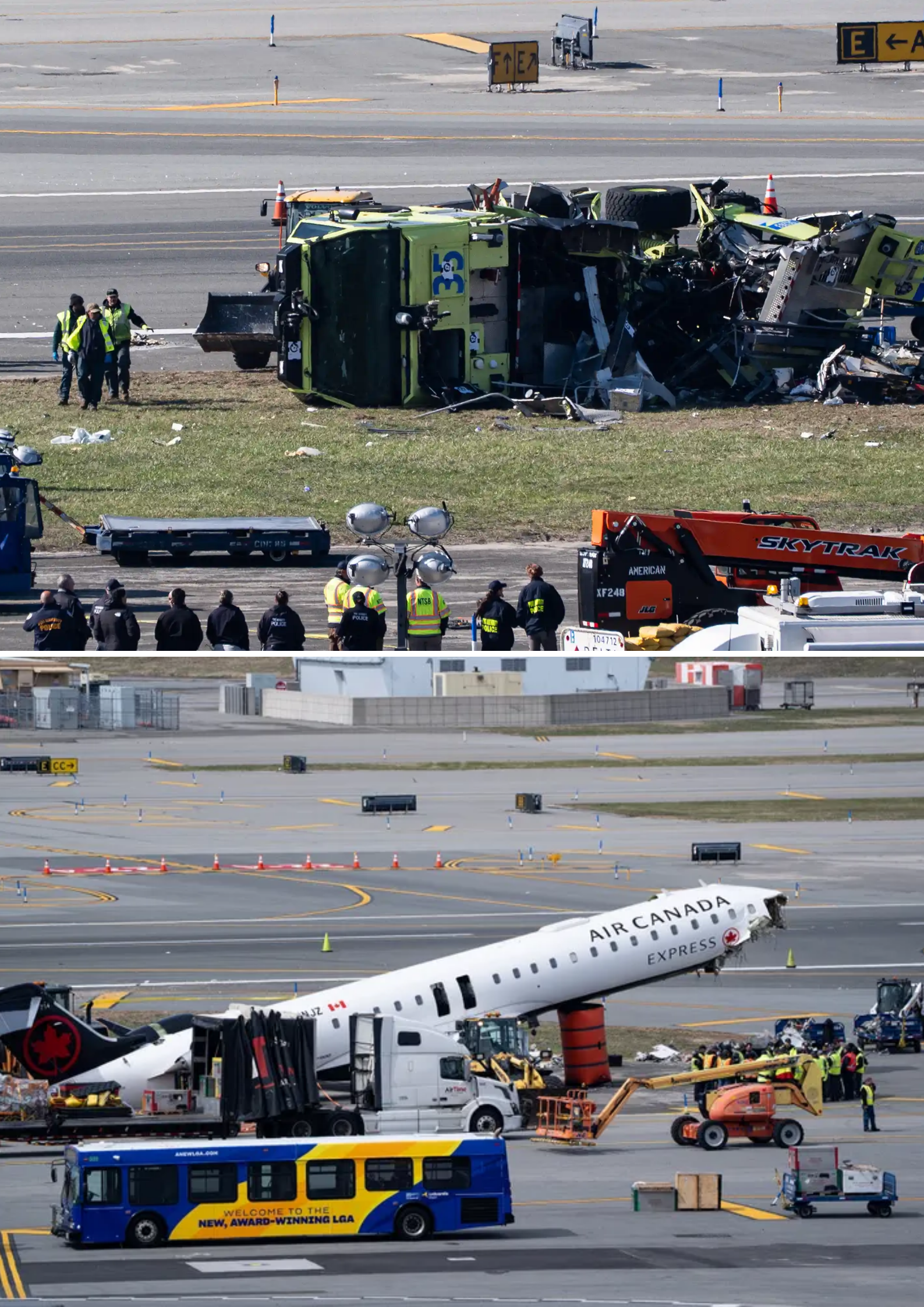
The collision occurred on March 22, 2026, when an Air Canada Express regional jet operated by Jazz Aviation collided with a Port Authority fire truck while landing at LaGuardia.
The crash killed both pilots, Antoine Forest and Mackenzie Gunther, and left dozens of other people injured.
What made the situation especially troubling was how busy the airport had become that night.
Weather-related delays dramatically increased the number of flights moving through LaGuardia.
According to reporting cited by PEOPLE and Reuters, approximately 70 commercial flights arrived or departed between 10 p.m. and 11:37 p.m., more than twice the 31 flights originally scheduled during that period.
And during that critical window, the tower had fewer controllers than it was supposed to have.
TWO CONTROLLERS LEFT EARLY
The two controllers were scheduled to remain at work beyond the time of the collision.
Instead, they reportedly left roughly an hour early.
The practice is sometimes referred to within the industry as an “early shove.”
While early departures have reportedly occurred in air-traffic-control facilities before, federal officials are now taking a much harder line against the practice.
The FAA reportedly considers leaving early while remaining on the timecard to be a form of timecard fraud.
Sources told Reuters that the agency is pursuing termination proceedings against the two LaGuardia controllers.
The National Air Traffic Controllers Association has acknowledged that it is discussing the allegations with FAA leadership.
:max_bytes(150000):strip_icc():focal(999x0:1001x2):format(webp)/laguardia-crash-2-b36d3bf4f3d94cf2a426d0ba3288f4a4.jpg) THE TWO CONTROLLERS WHO REMAINED
THE TWO CONTROLLERS WHO REMAINED
The early departures meant that only two controllers remained in the tower.
That would normally be considered sufficient for a quieter overnight period.
But March 22 was not a normal night.
The remaining controllers were suddenly dealing with an unusually high volume of aircraft as weather delays rippled through the airport.
At the same time, an emergency involving another aircraft was unfolding on the ground.
The combination created a workload far greater than what controllers would typically face during that period.
According to an AP source familiar with the investigation, the two controllers who left early could have provided crucial backup had they remained at the airport.
THEN CAME THE FATAL COLLISION
As an Air Canada Express flight approached LaGuardia, a Port Authority fire truck was crossing the runway after responding to an emergency.
The aircraft and emergency vehicle ended up on the same runway.
Seconds later, they collided.
The two pilots aboard the aircraft were killed.
Several others suffered serious injuries, while dozens more were treated following the crash.
The National Transportation Safety Board immediately launched an investigation.
From the beginning, investigators cautioned against blaming a single individual.
The preliminary investigation has identified multiple factors involving airport operations, communications and safety systems.
STAFFING IS ONLY ONE PIECE OF THE PUZZLE
The NTSB has not concluded that reduced tower staffing caused the crash.
That remains an open question.
Investigators have been examining the actions of the controllers, the fire truck crew, the aircraft crew and the airport’s safety systems.
Earlier findings indicated that the fire truck did not have a transponder that would have allowed certain runway-surveillance systems to track it properly.
The NTSB has also examined the warning systems and communications immediately before the collision.
That means investigators are dealing with a chain of events rather than a single alleged mistake.
THE CONTROLLER WAS ALREADY HANDLING ANOTHER EMERGENCY
One of the controllers working that night was reportedly handling another emergency shortly before the collision.
Earlier in the investigation, NTSB officials said at least one controller was performing multiple roles inside the tower.
NTSB Chair Jennifer Homendy cautioned against immediately blaming the individual controller, emphasizing the heavy workload involved at the airport.
That warning is important now that the FAA’s disciplinary action has brought renewed attention to staffing.
The question is not simply whether individual employees broke rules.
Investigators must determine whether the staffing situation itself created conditions that increased the risk of the collision.
FAA CRACKDOWN
The LaGuardia case is also part of a broader FAA crackdown on controllers allegedly leaving work early.
Sources told Reuters that the agency has taken disciplinary action against more than 10 controllers for alleged timecard-related misconduct since the beginning of 2026.
The FAA has emphasized that it will hold employees accountable and has pointed to efforts to rapidly expand the air-traffic-control workforce.
The agency says more than 2,000 controllers were hired in 2026, part of an effort to address long-standing staffing shortages.
But critics argue that hiring more controllers will not immediately solve the operational pressures facing the existing workforce.
WHAT HAPPENS NEXT?
The NTSB investigation is still underway.
The agency has not determined whether the early departure of the two controllers contributed to the fatal collision.
The FAA’s disciplinary proceedings are separate from the NTSB’s safety investigation.
That means the controllers could face employment consequences even if investigators ultimately determine that their absence did not cause the crash.
Meanwhile, investigators continue examining the precise sequence of events that placed the Air Canada aircraft and fire truck on the same runway.
A TRAGEDY WITH NO SIMPLE EXPLANATION
The revelation that two controllers left early adds another unsettling layer to a crash that already involved multiple apparent safety breakdowns.
But the evidence does not yet support a simple conclusion that “two controllers caused the crash.”
Instead, investigators are examining whether a combination of factors — heavy traffic, reduced staffing, competing emergencies, communications, airport procedures and technology limitations — came together at exactly the wrong moment.
Two pilots never made it home that night.
Now, months later, the focus has shifted from the wreckage on the runway to the decisions made inside the control tower.
And one question remains at the center of the investigation:
If those two controllers had stayed until the end of their shifts, would the outcome have been different?
The NTSB has not answered that question.
For now, investigators are still searching for the answer.