Police Ran Her Name — Then the Domestic Call Took a Stunning Turn

For several minutes, officers had been trying to answer one simple question:
Who was the woman standing in front of them?
What began as a domestic dispute involving a 12-year-old girl had already become tense. The woman had resisted identifying herself, questioned why officers were there and repeatedly insisted that the residence was not hers.
But by the time another officer began asking for identifying information, the encounter was on the verge of changing completely.
The woman said she did not have anything with her name on it.
She told officers she did not live there.
Then she gave them a name.
And almost immediately, the details stopped adding up.
Her Identity Raises More Questions
An officer asked whether she had a debit card, credit card or anything else that could confirm who she was.
She said no.
“This is not my house,” she repeated.
The officer then asked about the name she had provided, including whether it was “Tania” or a similar variation.
The conversation became increasingly specific.
Was there an “A” at the beginning of the name?
Did she have a sister with a similar name?
How was the full name spelled?
What was her middle name?
Instead of clearing things up, the answers appeared to create more uncertainty.
That uncertainty mattered because officers had already indicated earlier that they believed she had provided false information.
Now they were trying to verify exactly who they were dealing with.
Then came the moment that changed the entire encounter.
One officer, speaking with another, said:
“We have a warrant.”
A moment later, the conversation became even more startling.
“She’s got like 87 warrants,” the officer said.
The transcript later shows officers describing warrants from multiple locations, including Athens, and saying she had warrants “out of everywhere right now.”
The domestic dispute was no longer the only issue in front of them.
Police now believed the woman they had been trying to identify was wanted on a huge number of outstanding warrants.
The Earlier Refusal Suddenly Had New Meaning
Minutes earlier, the woman’s reluctance to give her name might have appeared to be part of a heated disagreement with police.
Now the situation looked different.
Officers had arrived because of a call involving her daughter.
They had not, based on the transcript, arrived primarily to serve warrants.
But once they began checking the woman’s identity, the scope of the encounter changed.
The transcript does not provide a complete breakdown at this stage of what each warrant was for, and the exact “87” figure appears in an officer’s conversation rather than as a formal court record shown in the video.
Still, what officers believed they had discovered was enough to trigger immediate action.
They went back to the woman.
This time, the conversation was no longer about whether she wanted to identify herself.
It was about taking her into custody.
“You Have Warrants”
Police called out to the woman and asked her to step away from the kitchen area.
She hesitated.
“I don’t feel safe moving until my people get here, please,” she said.
Then an officer told her directly:
“You have warrants.”
He also confronted her about the identifying information she had provided, saying she had given them a bad birth date.
The instructions became immediate.
Put the phone down.
Put your hands behind your back.
An officer also tried to keep the situation from escalating in front of the children.
“Let’s not make this an issue in front of your child,” he said.
But within seconds, the arrest became a physical struggle.
The Arrest Escalates Almost Instantly
As officers moved in, the woman began shouting.
“They’re touching me,” she called out.
Officers responded that their cameras were on.
Then her voice rose further.
She yelled that an officer had his arm or hand around her neck, while officers repeatedly ordered her to put her hands behind her back.
The scene quickly became chaotic.
“Put your hands behind your back,” officers shouted more than once.
The woman screamed.
She then accused them of breaking her arm.
Police continued trying to get control of her hands and secure the handcuffs.
At one point, an officer warned that she could get a finger pinched as they tried to manage the restraints.
The encounter had shifted completely from questioning to physical arrest.
There was no longer any uncertainty about whether police intended to detain her.
The only question was how the arrest was going to end.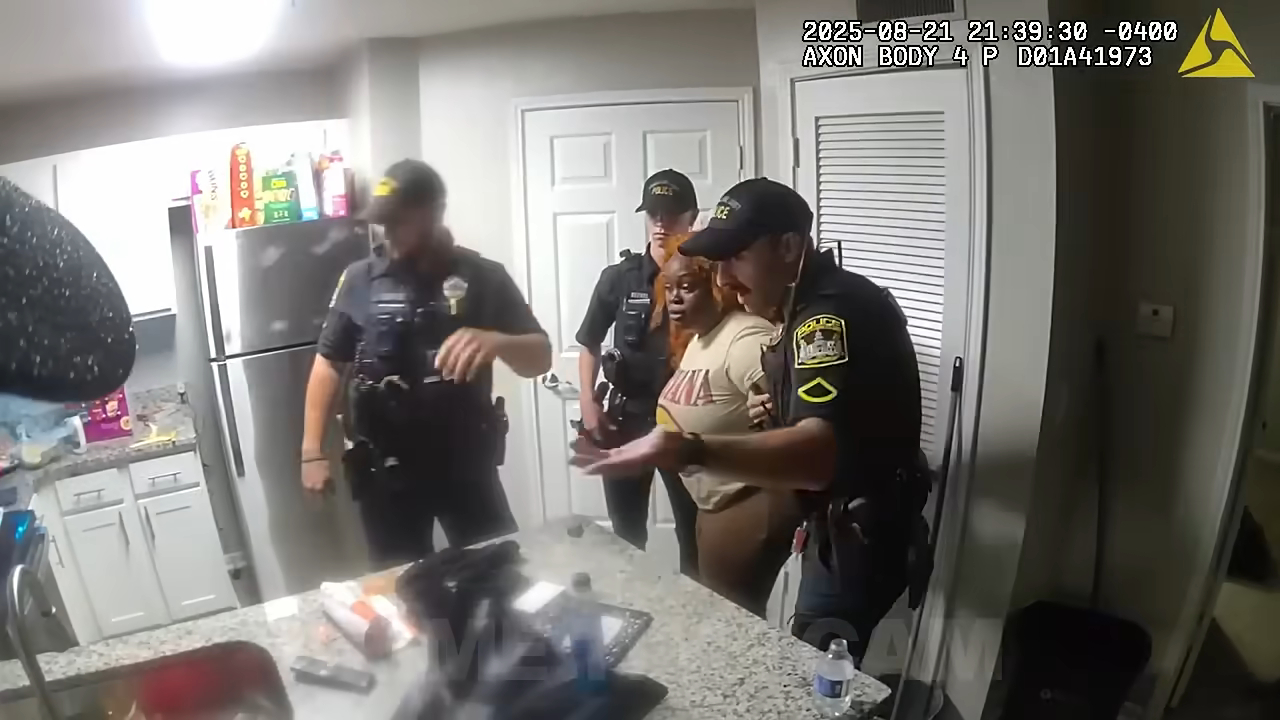
“You’re Going to Walk”
Once officers managed to move her toward the outside, the struggle did not fully stop.
The woman accused police of pulling her.
An officer responded that she was not walking on her own.
She again claimed someone had held her by the neck.
One officer rejected that accusation and told her to keep moving.
Then she asked:
“Why are y’all dragging me?”
The officer gave her a blunt choice.
They could drag her, or she could walk.
Within seconds, the woman’s focus shifted.
She began asking for her phone.
Then she asked to retrieve things for her children.
But the officers’ tone suggested that, after the resistance they believed had just occurred, those requests were no longer their immediate priority.
“You lost that when you decided to resist,” one officer told her.
The arrest had now created a second major problem.
The woman was being taken away.
But several children were still inside or around the residence.
And among them was the 12-year-old whose call had started the entire encounter.
A Domestic Call Becomes a Much Larger Crisis
In less than ten minutes, the nature of the incident had changed repeatedly.
Police first responded to a frightened child describing a dispute with her mother.
Then the mother resisted identifying herself.
Officers began questioning whether the name and information she provided were accurate.
A records check apparently revealed what officers described as an extraordinary number of outstanding warrants.
That discovery immediately turned the encounter into an arrest.
And the arrest itself escalated into a struggle that would later result in an additional resisting-arrest charge, according to the closing summary of the transcript.
But even after the woman was placed in custody, the most emotionally difficult part of the night was still ahead.
Police now had to determine what would happen to the children left behind.
For the 12-year-old girl who had initially asked officers, “Am I in trouble?”, the consequences of that phone call were about to become far more complicated than she could have expected.