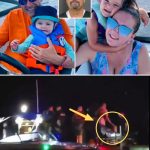
ONE TRACKING DEVICE, ONE CRITICAL STATEMENT — AND THE DETAIL NOW UNDER SCRUTINY IN THE SAYLOR HAYES CASE

ONE TRACKING DEVICE, ONE CRITICAL STATEMENT — AND THE DETAIL NOW UNDER SCRUTINY IN THE SAYLOR HAYES CASE
The search for 5-year-old Saylor Hayes began with a piece of information that investigators believed could help bring the missing child home.
Her parents reportedly told authorities that Saylor was wearing a Project Lifesaver tracking transmitter.
That information immediately became important.
Search teams had access to the technology needed to detect the device’s signal. Hundreds of people joined the effort as authorities searched around the family’s vacation rental in Pawleys Island, South Carolina.
But the signal never came.
Because, investigators later discovered, the transmitter was not with Saylor at all.
It was back in Virginia.
And arrest warrants now allege that Saylor’s parents knew she was not wearing it when she disappeared — while also directing search efforts away from nearby water.
Those allegations have placed the parents’ actions during the crucial first hours of the search under intense scrutiny.
 THE TRACKER WAS SUPPOSED TO HELP FIND HER
Saylor, who was severely nonverbal and autistic, had been enrolled in the Project Lifesaver program in Virginia since 2024.
The system is designed to help locate people who are at risk of wandering. A small transmitter worn by the individual emits a radio frequency that specially equipped search teams can detect.
According to Virginia authorities, Saylor’s transmitter had been working properly and had been maintained shortly before the family trip.
But when she disappeared from the family’s rental property on August 30, the transmitter was not on her.
Authorities searching in South Carolina could not detect her assigned frequency.
Investigators then contacted officials in Virginia.
The transmitter was eventually located inside a vehicle at the family’s home in Virginia, more than 300 miles away from the South Carolina vacation property.
Washington County Sheriff Blake Andis said the equipment performed as designed when deputies searched for Saylor’s assigned frequency.
The problem was that the transmitter was not with the child.
THE SEARCH CONTINUED WITHOUT A SIGNAL
The discovery created a disturbing question for investigators:
Why had searchers been told to look for a signal that could not possibly be coming from Saylor?
According to arrest warrants, the parents allegedly encouraged search efforts to use Project Lifesaver technology despite knowing that Saylor was not wearing the transmitter.
Authorities say search teams consequently spent valuable time trying to locate a signal that was never going to appear.
The technology itself was not malfunctioning.
It simply wasn’t where investigators believed it was.
People who participated in the search were therefore working with information that investigators now say was inaccurate.
THEN THERE WAS THE WATER
The tracking-device issue was not the only allegation contained in the arrest records.
Investigators also allege that the parents directed search efforts away from a nearby body of water.
The warrants state that Saylor had been left unsupervised approximately 15 meters from water despite her known history of wandering and her attraction to water.
That detail has become particularly significant because Saylor’s body was ultimately recovered from the water near Hagley Landing the following morning.
South Carolina Department of Natural Resources personnel found her on August 31.
A preliminary autopsy later found pulmonary edema consistent with drowning, although the final autopsy report was still pending in the latest reporting.
A CHILD WHO WAS KNOWN TO WANDER
According to investigators, Saylor had a documented history of elopement, the term commonly used when a person with autism or another cognitive condition wanders away from a safe environment.
Authorities allege that her caregivers therefore had a responsibility to provide appropriate supervision and safeguards.
The arrest warrants accuse John Herb Hayes III and Geordyn Nichole Hayes of placing Saylor at an unreasonable risk of harm by failing to provide supervision and safeguards appropriate for a severely nonverbal autistic child.
They also allege that the tracking device had been removed before the family left Virginia.
The parents have been charged with unlawfully placing a child at risk or causing harm and willfully abandoning a child.
THE HOURS THAT MAY NOW MATTER MOST
Saylor disappeared from the family’s rental home in the Pawleys Island area on the morning of August 30.
An extensive search followed.
Law enforcement agencies, volunteers and members of the local community searched properties and waterways, while drones, helicopters, divers and specialized equipment were deployed.
The scale of the response grew rapidly.
But investigators now say two pieces of information may have affected those efforts:
The tracker wasn’t with Saylor.
And, according to the warrants, searchers were allegedly directed away from nearby water.
The following morning, Saylor was found in that water.
THE PARENTS ARE NOW FACING PROSECUTION
John Herb Hayes III and Geordyn Nichole Hayes were arrested in Tennessee on September 1 and later extradited to South Carolina.
A South Carolina magistrate subsequently denied bond, and the case remains under investigation.
The allegations against the parents do not, by themselves, establish criminal guilt. They remain entitled to the presumption of innocence unless and until proven guilty in court.
But the investigation has raised serious questions about what happened during the first hours after Saylor disappeared — and what her parents knew about her safety, her tracking device and the surrounding water.
ONE DETAIL HAS CHANGED THE QUESTIONS
At first, the Project Lifesaver transmitter appeared to be the tool that could help rescuers find Saylor.
Instead, investigators say it became one of the most important contradictions in the case.
Searchers were looking for a signal.
The signal was more than 300 miles away.
And while that search unfolded, authorities allege that attention was directed away from water just meters from where Saylor had last been seen.
Now, the central questions are no longer simply about where Saylor went.
They are about what her parents knew, what they told investigators, and whether those statements affected the search for their daughter when every minute mattered.
The investigation remains ongoing.