THE CAPTAIN PUT HIS HANDS ON THE WRONG WOMAN
PART 1 — THE HAND THAT WOULDN’T LET GO
Four hundred battle-ready Marines were close enough to witness what happened when an arrogant captain grabbed my arm and accused me of pretending to be a military officer.
He was convinced I was a civilian wearing a uniform I had no right to wear.
He wanted to humiliate me in front of everyone, expose me as a fraud, and prove that he was the one in charge.
What he didn’t know was that something hidden beneath my collar was about to destroy every ounce of confidence he possessed.
And by the time Captain Ryan Crawford realized his mistake, it would already be too late.
“Remove your hand from my arm, Captain.”
I spoke quietly, keeping my tone measured despite the pressure of his fingers digging into my bicep.
Captain Crawford didn’t release me.
Instead, his grip became even more forceful.
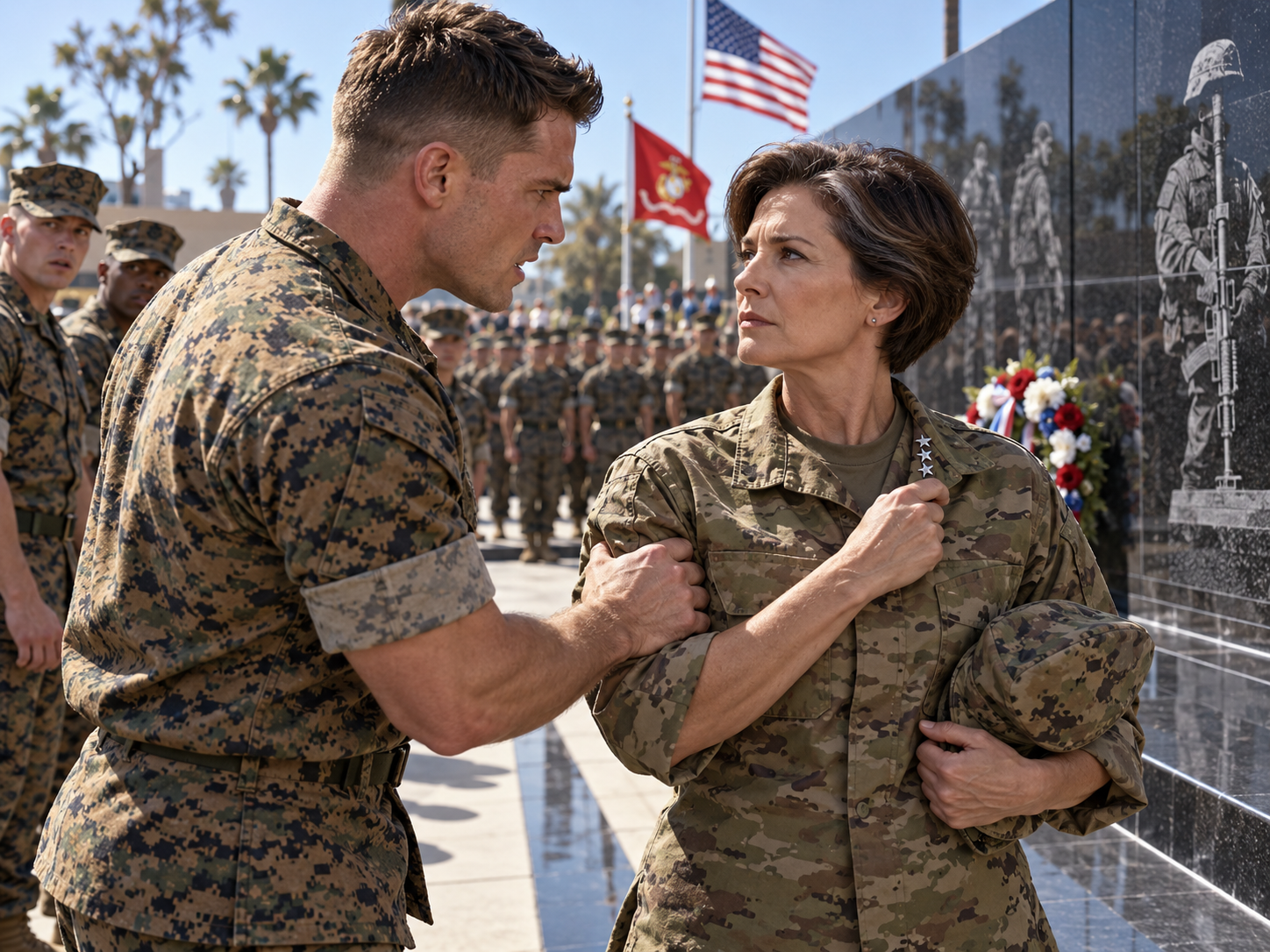
We were standing beside the polished black granite memorial wall during a Memorial Day observance at a Marine Corps installation in California.
The afternoon sky was clear and bright. Rows of Marines stood in disciplined formation, their uniforms immaculate beneath the sunlight.
Only a short distance away, the ceremony’s keynote speaker was reading the names of service members who had lost their lives defending their country.
It was supposed to be a moment of remembrance.
A moment of respect.
But Captain Crawford had apparently decided that humiliating me was more important than honoring the fallen.
A self-satisfied grin spread across his face.
Then, without warning, he pulled me sharply toward him.
“We’re going to finish this conversation before you go anywhere.”
I didn’t stumble.
I didn’t fight his grip.
And I certainly didn’t give him the frightened reaction he seemed to be expecting.
Instead, I stood perfectly still and met his eyes.
Something changed in his expression.
For the briefest moment, uncertainty crossed his face.
He had expected intimidation to work.
He hadn’t expected me to remain calm.
But his hesitation disappeared almost immediately, replaced by the same arrogant confidence he’d displayed from the beginning.
“Do you seriously believe you can put on a set of utility fatigues and suddenly act like you have military authority?”
He deliberately raised his voice.
Several Marines standing nearby turned their heads.
I glanced at his hand.
“Let go of my arm.”
His fingers tightened again.
“You don’t get to give me orders,” he snapped. “You have no authority over me.”
The mood around us began to change.
A metal folding chair scraped against the pavement.
Nearby conversations gradually stopped.
Marines who had been watching the solemn ceremony started looking in our direction.
Even from the corner of my eye, I could see people trying to understand why an officer had physically restrained a woman in uniform beside a memorial honoring fallen Americans.
Crawford noticed the attention.
And rather than reconsidering his behavior, he seemed encouraged by it.
He straightened his shoulders, lifted his chin, and projected his voice even farther.
“You think you can just walk onto this base wearing suspicious military clothing and nobody’s going to ask questions?”
I remained silent.
He interpreted that silence as weakness.
“Where’s your rank insignia?” he demanded.
I answered without hesitation.
“Properly secured inside my patrol cap.”
His gaze immediately dropped to the folded cap resting beneath my free arm.
He gave a mocking laugh.
“Oh, that’s convenient, isn’t it?”
“It’s consistent with operational requirements,” I replied.
Crawford shook his head dramatically, making certain the Marines watching us could see his disbelief.
“Unbelievable. You actually expect everyone here to accept that you’re a serving officer?”
I kept my eyes on his.
“My position doesn’t require your personal belief or permission, Captain.”
That was when his smile finally disappeared.
His jaw tightened.
A dark flush crept along his throat and spread across his face.
The growing audience had changed the stakes for him.
What had begun as an attempt to intimidate one woman had become a spectacle, and Crawford was now far more concerned with protecting his pride than discovering the truth.
Behind us, the keynote speaker continued the roll of honor.
Names echoed across the memorial grounds.
Names of people who had served.
People who had sacrificed everything.
Yet just a few yards away, Crawford had transformed a day of remembrance into a demonstration of his own ego.
I could see that he understood how many people were watching.
Unfortunately, he also seemed determined not to back down.
“I’m not allowing you to leave,” he announced, “until we establish exactly who you are and what gives you the right to wear that uniform.”
I lowered my gaze once more to his fingers wrapped around my upper arm.
Then I slowly looked back at him.
My voice remained steady.
“Captain, this is your last opportunity. Release me.”
A brief silence followed.
He could have ended everything right there.
He could have taken his hand away, asked for identification through the appropriate channels, and avoided what was coming.
Instead, he leaned closer.
His expression was defiant.
His grip remained firm.
He was still convinced that the woman standing before him was nothing more than an impostor he could easily intimidate.
I watched him for another second.
Then I gave a small nod.
“Very well.”
His face brightened.
He mistook those two words for surrender.
He actually smiled, looking around as though he expected the surrounding Marines to admire how thoroughly he’d handled the situation.
But I wasn’t surrendering.
I had simply decided that he had been given enough warnings.
Without making any sudden movement, I raised my free hand toward the collar of my uniform.
Captain Crawford continued smiling.
At first.
My fingers slipped carefully beneath the fabric, reaching the exact place where I’d secured an insignia that wasn’t meant to be openly displayed under the circumstances.
He followed the movement with his eyes.
Then the first small edge of the concealed insignia came into view.
And Captain Ryan Crawford’s entire expression changed.
His smile vanished.
His eyes widened.
The redness that had covered his neck moments earlier drained away so quickly that his face seemed to turn pale before me.
For the first time since he’d grabbed my arm, he looked genuinely frightened.
His gaze remained fixed on the object beneath my collar.
He finally understood that the woman he’d accused of being a fraud was someone he should never have treated that way.
And with four hundred Marines nearby, there was nowhere left for him to hide his mistake.
PART 2 — FOUR STARS BENEATH THE COLLAR
Captain Crawford’s fingers opened as though something had burned him.
I felt the pressure disappear from my arm.
For several seconds, neither of us moved.
The tiny insignia resting against my palm caught the California sunlight.
Four silver stars.
Not a souvenir. Not a decoration purchased from a military surplus store. Not some meaningless ornament belonging to a woman desperate to appear important.
The insignia of a general.
My name was General Eleanor Hayes, United States Army.
I was fifty-three years old, had worn a uniform for thirty-one years, and had spent most of my adult life learning the difference between authority and the abuse of it.
That distinction had never seemed more important than it did beside that memorial wall.
Crawford stared at the stars.
Then at my face.
Then back at the stars.
“Ma’am,” he whispered.
It was barely audible.
I let the insignia rest in my palm.
“Do you recognize it, Captain?”
His mouth opened.
Nothing came out.
“Answer the question.”
“Yes, ma’am.”
“Then you understand why this conversation should have been handled differently.”
He took a step backward.
The movement was small, but the Marines closest to us noticed.
A young corporal beside the memorial straightened instinctively.
Another Marine lowered his eyes toward Crawford’s hand, which still hovered awkwardly between us.
The captain swallowed.
“General, I—”
“Stand at attention.”
His heels came together.
The sound was sharp enough to cut through the murmuring crowd.
I could have raised my voice. I could have demanded that every Marine within hearing distance recognize my rank. I could have made Crawford feel a fraction of the humiliation he’d attempted to inflict upon me.
But I had not traveled to California to stage a public execution of a junior officer’s career.
I had come for the names on the wall.
And one name in particular.
“Captain Crawford,” I said, “the ceremony is still underway.”
“Yes, ma’am.”
“You will remain where you are until the observance concludes. You will not approach me again without permission.”
“Yes, General.”
“Afterward, you will report to your commanding officer and provide an accurate account of what happened here.”
His throat moved.
“Understood.”
I secured the insignia again.
At that moment, a deep voice came from behind the gathering crowd.
“General Hayes?”
I turned.
A Marine colonel was moving toward us from the direction of the reviewing stand.
He was tall, broad-shouldered, with close-cropped silver hair and the controlled expression of a man accustomed to solving problems before they became disasters.
Colonel Daniel Mercer.
The installation’s senior operations officer.
I knew him from joint exercises in Europe, where he’d once earned my respect by refusing to send exhausted Marines into a training evolution simply because a visiting delegation wanted an impressive demonstration.
He stopped three paces away.
His eyes flicked toward Crawford.
Then toward the reddening marks visible through the edge of my rolled sleeve.
Something hardened in his face.
“Ma’am,” he said, “we weren’t expecting you until the private reception.”
“I arrived early.”
“I see.”
He didn’t ask why a captain was standing at attention beside me.
He didn’t have to.
Crawford attempted to speak.
“Colonel, I was performing a security—”
Mercer held up one hand.
“Captain. Not now.”
The silence that followed was absolute.
Then Mercer looked at me again.
“General, shall I escort you to the reviewing stand?”
“No, Colonel. Thank you. I’d like to remain here.”
His expression softened with recognition.
He glanced toward the memorial wall.
Toward the name engraved on the third panel, seventh row.
SERGEANT FIRST CLASS MATTHEW REED.
He understood.
“Of course, ma’am.”
For an instant, I wasn’t a general.
I was thirty years old again, standing in a military hospital hallway with dried blood on my sleeves, waiting for a doctor to tell me something I already knew.
Matthew Reed had been twenty-seven when he died.
He’d been my platoon sergeant during an overseas deployment early in my career. He had a laugh that could fill an entire maintenance bay and a habit of carrying extra socks because he believed every problem in the world became slightly more manageable when a soldier’s feet were dry.
He’d also had a wife named Sarah.
And a six-year-old daughter named Lily.
The afternoon he died, he’d gone back into a damaged vehicle to retrieve two soldiers who couldn’t get themselves out.
Both survived.
He didn’t.
For twenty-five years, I’d carried the memory of his last words.
Tell Lily I wasn’t afraid.
I never did tell her that.
I told her something else.
I told her that her father had been brave, that he loved her, and that no military decoration could ever measure the size of what she’d lost.
The difference mattered.
Bravery wasn’t the absence of fear.
It was choosing to do what was right while fear was still there.
Behind me, Crawford remained rigid.
Mercer signaled a military police officer stationed near the walkway.
“Sergeant, remain with Captain Crawford until the ceremony concludes. Make sure neither of them is disturbed.”
“Yes, sir.”
I turned back toward the wall.
The speaker’s voice carried across the open grounds.
“Sergeant First Class Matthew Reed.”
My chest tightened.
The name hung in the air.
Then a bell sounded.
One clear note.
I pressed my lips together and lowered my head.
For several moments, everything else disappeared.
The captain.
The watching Marines.
The pain beginning to bloom beneath my sleeve.
There was only the bell and the name of a man who should have been standing somewhere beside his grown daughter, complaining about gray hair and asking when she planned to make him a grandfather.
When the final bell sounded, the ceremony continued with a moment of silence.
Four hundred Marines bowed their heads.
So did I.
Only when the silence ended did I allow myself to breathe normally.
The trouble began again forty minutes later.
I was standing inside a small conference room in the headquarters building, holding a paper cup of coffee, when Colonel Mercer entered with a woman wearing a Navy legal service uniform.
“This is Commander Rebecca Sloan,” he said. “She’s been assigned to advise the command regarding the incident.”
Sloan was in her early forties, with intelligent dark eyes and a manner that suggested she preferred facts to ceremony.
“General Hayes.”
“Commander.”
Mercer closed the door.
“I apologize for what happened.”
“You weren’t the one who grabbed me.”
“He was an officer under our command.”
“That makes it a command concern. It doesn’t make his conduct yours.”
Mercer nodded, though I could tell he hadn’t forgiven himself for allowing the situation to develop.
Sloan placed a folder on the table.
“We’ve already identified several witnesses. Two Marines recorded portions of the encounter on their phones.”
I frowned.
“During the observance?”
“Unfortunately.”
Mercer looked embarrassed.
“One of them started recording after the captain raised his voice.”
“Preserve the footage,” I said. “And make sure nobody pressures those Marines to delete it.”
Sloan made a note.
“Already in progress.”
I lowered myself into a chair.
My upper arm throbbed.
Sloan noticed.
“May I ask whether you need medical attention?”
“It’s a bruise.”
“Respectfully, General, an examination would help establish the facts.”
I considered arguing.
Then I thought about how often junior service members were told to document injuries, only to discover their superiors disliked the paperwork that followed.
“Fair point,” I said. “Arrange it.”
Mercer exhaled.
For the first time since entering the room, he looked slightly relieved.
But Sloan wasn’t finished.
“There’s something else.”
She glanced at Mercer.
He nodded.
Sloan opened the folder.
“This may not be Captain Crawford’s first incident involving unauthorized physical contact or intimidation.”
I put down my coffee.
“How many?”
“We don’t know yet.”
“Then what do you know?”
Mercer answered.
“Six months ago, a lance corporal requested reassignment after an altercation during a field exercise. Three months before that, a sergeant received an adverse counseling entry following a disagreement with Crawford over safety procedures.”
“Connected?”
“Possibly.”
Sloan slid a sheet of paper across the table.
“The sergeant alleged that Captain Crawford grabbed him by the front of his uniform. The complaint was closed informally after the sergeant withdrew it.”
I stared at the document.
“Why did he withdraw it?”
“We’re trying to determine that.”
“And the lance corporal?”
Mercer’s jaw tightened.
“He left the unit.”
“Was he interviewed?”
“Not during the initial review.”
I leaned back.
A familiar, unpleasant feeling settled beneath my ribs.
This was no longer about a captain embarrassing himself in front of a four-star general.
It was about something much more dangerous.
A pattern.
A possibility that others had been mistreated and had remained silent because the person responsible controlled their assignments, evaluations, and futures.
I looked at Sloan.
“Commander, I want one thing absolutely clear.”
“Yes, ma’am.”
“My rank does not make what happened to me more serious than what may have happened to a corporal or a sergeant.”
She held my gaze.
“I understand.”
“If this investigation discovers that Crawford has been abusing Marines who lacked the protection of senior rank, I expect those allegations to be treated with the same seriousness as mine.”
Mercer nodded.
“They will be.”
I studied his face.
“Then don’t tell me what you intend to do. Show me what your system actually does.”
For a moment, neither spoke.
Then Sloan closed her folder.
“There’s a complication, General.”
“What complication?”
“The captain’s father.”
I already disliked the direction of the conversation.
Mercer looked out the window before answering.
“Retired Lieutenant General Charles Crawford.”
The name meant something.
Not because I knew him well.
Because I’d spent enough years in Washington to recognize men whose influence remained long after their uniforms were placed in retirement closets.
Charles Crawford had friends in high places, an extensive network of defense-industry contacts, and a reputation for treating disagreement as personal disloyalty.
His son had apparently inherited the last quality.
“Has his father contacted the command?” I asked.
Sloan hesitated.
“Twice.”
“Already?”
“Yes, ma’am.”
“What did he want?”
Mercer gave a tired smile that contained no amusement.
“He wanted assurance that his son’s career wouldn’t be damaged by what he called a misunderstanding.”
I looked toward the closed conference-room door.
Outside, Marines moved through the hallway, their footsteps echoing against polished tile.
“Colonel,” I said, “how much time passed between the incident and the first call?”
“Seventeen minutes.”
That detail stayed with me.
Seventeen minutes.
Crawford had wasted his opportunities to release my arm, stop humiliating me, and resolve the encounter professionally.
But he’d found seventeen minutes to ask his father for help.
I stood.
“Commander Sloan, preserve every relevant record. Colonel Mercer, ensure the witnesses are protected from retaliation.”
“Yes, ma’am.”
“And tell Captain Crawford that the incident will be investigated through proper channels. No shortcuts. No private arrangements.”
Mercer nodded.
As I reached the door, Sloan spoke again.
“General?”
I turned.
“There is something I believe you should see.”
She handed me a printed photograph.
It showed a young Marine standing beside a training vehicle.
His left arm was wrapped in a medical sling.
Underneath the photograph was a handwritten sentence.
HE DIDN’T FALL. THE CAPTAIN PUSHED HIM.
I looked up.
“Who sent this?”
“We don’t know.”
“When did you receive it?”
Sloan’s expression darkened.
“Ten minutes after Captain Crawford was removed from the memorial grounds.”
I studied the young Marine’s face.
He couldn’t have been older than twenty.
There was something familiar about his eyes.
Then I noticed the name tape.
REED.
My breath caught.
“Commander,” I said quietly, “what is this Marine’s full name?”
Sloan checked her notes.
“Lance Corporal Matthew Reed Jr., ma’am.”
For a moment, the room seemed to tilt.
Matthew Reed.
The same name as the man whose sacrifice had brought me to California.
I looked again at the young Marine’s face.
And suddenly I understood why his eyes seemed familiar.
They were his grandfather’s eyes.
The son of Lily Reed.
The grandson of the man who had died saving two soldiers.
And according to the photograph in my hand, Captain Ryan Crawford had hurt him too.
I slowly placed the picture on the table.
“Find that Marine,” I said.
Mercer nodded.
“We’re working on it.”
“No, Colonel. You don’t understand.”
My voice had become very quiet.
“Find him before someone decides he needs to disappear from this investigation.”
PART 3 — THE MARINE WHO WAS TOLD TO KEEP QUIET
Lance Corporal Matthew Reed Jr. was missing from his assigned barracks when the duty noncommissioned officer went looking for him.
That was the first piece of news I received the following morning.
The second was worse.
His military phone had been turned off.
The third arrived twenty minutes later.
Someone had accessed his personnel record at 2:14 that morning.
The access originated from a terminal normally used by Captain Crawford’s administrative section.
I was standing beside a window overlooking the installation’s parade ground when Commander Sloan delivered the information.
Below us, Marines were preparing for a morning formation.
From a distance, everything looked orderly.
That was one of the things I’d learned about institutions.
Disorder could hide beneath immaculate uniforms and perfectly aligned formations.
“What exactly was accessed?” I asked.
“Transfer paperwork, medical history, and the adverse counseling entry related to Reed’s reassignment request.”
“Who logged in?”
“The account belongs to Staff Sergeant Andrew Bell, Crawford’s administrative chief.”
“Has Bell been interviewed?”
“Not yet.”
“Why not?”
Sloan paused.
“Because he reported sick this morning.”
I turned away from the window.
“Convenient.”
“We’ve secured the terminal and requested the access logs.”
“Good.”
Colonel Mercer entered before I could ask another question.
He looked as though he’d slept in his office.
“We found Reed’s vehicle.”
“Where?”
“In the parking area outside the installation’s family assistance center.”
“Is he there?”
“No. But his mother is.”
My heart tightened.
“Lily?”
Mercer nodded.
“She’s asking to speak with you.”
I hadn’t seen Lily Reed in almost nine years.
The last time had been at a scholarship ceremony in Virginia, where she’d stood beside me with the hesitant smile of a woman who had spent her entire life being introduced as someone’s surviving daughter.
She was thirty-one then.
A teacher.
Recently married.
Pregnant with her second child.
Now she was forty.
Her brown hair had begun to show strands of silver near her temples. Her face was thinner than I remembered, and the confidence she’d carried as a young teacher had been replaced by the unmistakable strain of a mother afraid for her child.
She stood when I entered the private waiting room.
“Eleanor.”
Not General.
Not ma’am.
Eleanor.
I crossed the room and embraced her.
She held on for a long time.
When she finally stepped back, her eyes were red.
“He didn’t want me to call you.”
“Matthew?”
She nodded.
“He said you’ve already done enough for our family.”
I tried to smile.
“Your grandfather once told me I’d be hearing from his family forever if I didn’t learn how to take care of myself.”
Her mouth trembled.
“He used to say things like that?”
“All the time.”
For a moment, she looked like the six-year-old girl who had clutched a stuffed rabbit at her father’s funeral.
Then she sat down and opened her handbag.
Inside was a folded envelope.
“Matthew gave me this three weeks ago.”
I accepted it.
The writing on the front was neat and careful.
Mom — if anything happens, please don’t believe I quit.
I looked at her.
“Why didn’t you open it?”
“He asked me not to unless something went wrong.”
“Did he tell you what was happening?”
“Only pieces.”
She twisted her wedding ring.
“He said Captain Crawford didn’t like Marines questioning orders. He said there had been an accident during training, but that it wasn’t really an accident.”
I opened the envelope.
Inside were copies of medical records, photographs, and three pages of handwritten notes.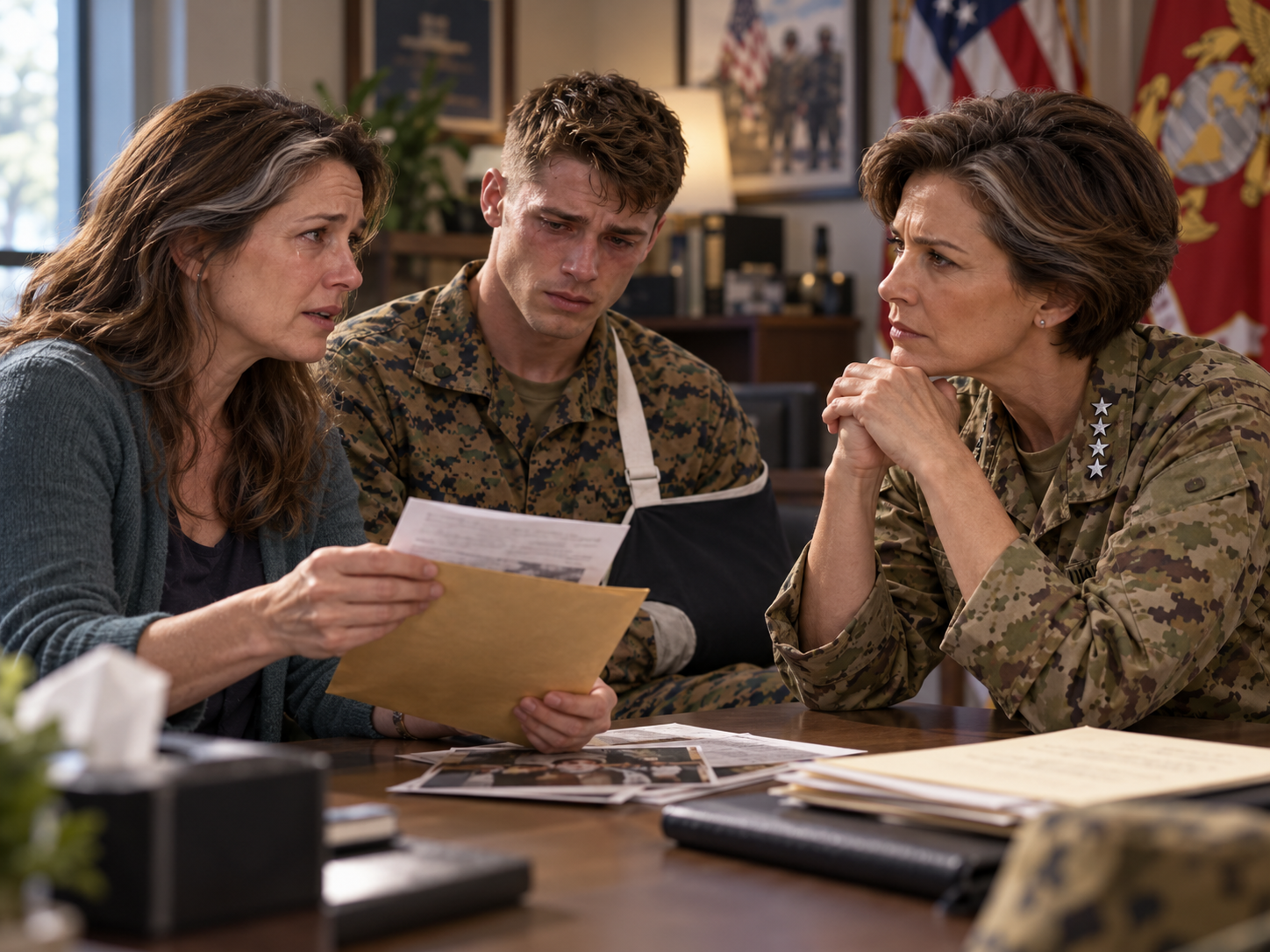
The notes described a field training event eleven weeks earlier.
A mobility exercise had been scheduled for late afternoon.
Temperatures were unusually high.
One vehicle had developed a mechanical fault, and the maintenance chief had recommended withdrawing it.
Crawford had reportedly ordered the training to continue.
Reed, assigned as a safety observer, questioned the decision.
According to his notes, Crawford had responded by accusing him of cowardice.
Then came the line that made me stop reading.
The captain grabbed my vest and shoved me against the vehicle. My shoulder hit the steel bracket. He told everyone I slipped.
Beneath it, Reed had written:
Staff Sergeant Bell saw everything.
I glanced at Lily.
“Why didn’t Matthew report it immediately?”
“He did.”
The words came out almost as a whisper.
“He filed a statement. Three days later, the statement was gone. Then he was told he’d misunderstood what happened.”
“Who told him?”
“He wouldn’t say.”
“And his shoulder?”
“He needed surgery.”
I closed my eyes briefly.
Lily continued.
“He was afraid of losing his place in the Corps. His grandfather’s name meant so much to him. He wanted to serve the way his grandfather had.”
I reached across the table and took her hand.
“Lily, your grandfather’s legacy is not a requirement that Matthew endure mistreatment.”
She nodded, but tears were already moving down her cheeks.
“He thinks standing up for himself would dishonor him.”
“No,” I said. “Remaining silent because someone in authority frightens you is not the same as loyalty.”
She wiped her face.
Then she asked the question she’d been carrying since I’d entered.
“Can you protect him?”
I wanted to say yes.
I wanted to promise that no one would ever touch her son again, that his career would be safe, and that the people responsible would be held accountable.
But I’d spent thirty-one years in the military.
I knew better than to promise outcomes I couldn’t control.
“What I can do,” I said, “is make sure his account is heard, that the evidence is preserved, and that the process is not controlled by the people he’s accusing.”
Her shoulders lowered slightly.
It wasn’t the reassurance she’d wanted.
But it was the truth.
Matthew Reed Jr. was found shortly before noon.
He hadn’t deserted.
He hadn’t fled.
He was sitting in a small civilian clinic forty miles from the installation, waiting for a consultation about persistent nerve pain in his injured shoulder.
His military medical appointments had been delayed repeatedly.
He’d finally decided to seek an independent evaluation.
When he learned that investigators were looking for him, he became frightened.
Not because he had done anything wrong.
Because he’d spent months being told that asking questions would make his situation worse.
Commander Sloan arranged for him to return voluntarily and meet with an independent military investigator.
I did not attend the interview.
That mattered.
My personal connection to his family and my rank could unintentionally influence the investigation.
Instead, I waited in an adjoining office with Lily.
By late afternoon, a clearer picture had begun to emerge.
Reed described being shoved during the training exercise.
He also described repeated threats involving poor evaluations and reassignment.
He claimed Crawford had mocked his grandfather’s service after discovering the family connection.
“He told me,” Reed said in his recorded statement, “that famous dead relatives don’t make good Marines.”
When Sloan summarized that line for me, I felt a cold anger settle in my chest.
I had heard cruel things in the military.
Cruelty sometimes came disguised as toughness.
But attacking a young Marine through the memory of his grandfather was not leadership.
It was smallness wearing the costume of authority.
There were additional allegations.
A second Marine claimed Crawford had ordered personnel to continue training despite a safety warning.
A third said he’d witnessed Crawford grab Reed.
Two others reported that they had been pressured not to submit statements.
None of those accounts had yet been independently proven.
But they required serious investigation.
And then Staff Sergeant Andrew Bell returned to duty.
He came directly to Commander Sloan’s office.
I learned about his visit later that evening.
Bell was thirty-six, married, and the father of two children.
He’d served fourteen years without a significant disciplinary issue.
According to Sloan, he looked physically ill.
He asked whether he could speak without Captain Crawford being informed immediately.
Sloan explained the limits of confidentiality and the procedures available to protect witnesses.
Bell sat silently for nearly a minute.
Then he said, “I changed the report.”
Sloan asked him to explain.
Bell stared at the floor.
“The original incident statement said Captain Crawford shoved Reed. The version entered into the personnel system said Reed lost his footing during training.”
“Who directed you to make that change?”
Bell swallowed.
“Captain Crawford.”
“Did you retain the original?”
“Yes.”
“Where?”
“At home.”
“Why?”
Bell raised his eyes.
“Because I knew one day someone might ask what really happened.”
The interview lasted nearly two hours.
Bell admitted that he’d accessed Reed’s records overnight.
He said Crawford had called him after the Memorial Day incident and demanded to know whether Reed had made another complaint.
Bell claimed he’d initially obeyed because he feared retaliation.
Then, after seeing footage of Crawford grabbing a senior officer in public, he’d realized the captain might finally be investigated.
He retrieved his personal copies of the original report and arranged to submit them.
That explanation didn’t absolve Bell.
Altering an official record was serious misconduct.
But his cooperation offered a possible path toward establishing what had happened.
When Sloan told me, I asked one question.
“Does the original report exist?”
She nodded.
“We have a copy now. We’re verifying its authenticity.”
I looked at the document she’d brought.
The language was plain.
No dramatic accusations.
No emotional embellishment.
Just a description of a captain grabbing a Marine and forcing him backward against a vehicle.
Three witnesses were identified.
Two had subsequently been reassigned.
One had left active duty.
The third had remained.
Bell.
I sat quietly.
The situation was beginning to resemble something I’d seen too many times before.
One person abused authority.
Another looked away.
A third convinced himself that silence was necessary for survival.
Eventually, misconduct became routine enough that nobody recognized how far the standard had fallen.
But there was still something we didn’t understand.
“Commander,” I said, “why was Reed’s reassignment request blocked?”
Sloan turned another page.
“That’s what we’re investigating.”
“Who denied it?”
“The paperwork carries an electronic endorsement from Colonel Mercer.”
I stared at her.
“Mercer?”
“Yes, ma’am.”
I thought about the colonel’s expression when he’d learned Crawford had grabbed me.
The obvious anger.
The immediate apology.
The careful commitment to a proper investigation.
“Has he seen this document?”
“Not yet.”
“Then ask him.”
Sloan hesitated.
“General, there’s another problem.”
She placed two versions of the reassignment form side by side.
The dates were identical.
The signatures appeared the same.
But the justification paragraphs were different.
One cited medical readiness concerns.
The other stated that Reed had demonstrated poor judgment and insufficient resilience.
I examined the forms.
“Which one was officially submitted?”
“We don’t know.”
“Which one did Mercer approve?”
“That is also unclear.”
I felt a slow chill.
The investigation was moving beyond Captain Crawford’s conduct.
Someone had manipulated paperwork.
Someone had possibly used a senior officer’s approval to block a young Marine’s transfer.
And someone had worked hard to ensure that the events surrounding Reed’s injury remained buried.
Before I could speak, Sloan’s phone vibrated.
She checked the screen.
Her expression changed.
“What is it?”
She read the message again.
Then she looked at me.
“Captain Crawford has retained civilian counsel.”
“That is his right.”
“Yes, ma’am.”
“What’s the concern?”
Sloan took a breath.
“His attorney has notified the command that Crawford intends to file a formal allegation against you.”
I stared at her.
“On what grounds?”
“Improper interference with a command investigation. Abuse of rank. And unlawful influence over potential witnesses.”
For a moment, I almost laughed.
Almost.
Then Sloan added the detail that made the situation far more serious.
“His attorney claims to have a recorded conversation in which you allegedly ordered Colonel Mercer to destroy Captain Crawford’s career.”
I went still.
“I never said that.”
“I know what you told us, General.”
“Then where did this recording come from?”
“We haven’t received it yet.”
Outside the window, the evening sun was sinking behind the distant hills.
I looked toward the memorial grounds.
For twenty-five years, I’d returned to places like that one to remember the people we’d lost.
Now, somehow, honoring one fallen soldier had led me into a fight over the future of his grandson.
And the captain who had grabbed my arm was no longer merely defending himself.
He was preparing to attack the credibility of anyone who challenged him.
Sloan gathered the documents.
“We need to be careful.”
I nodded.
“Yes.”
Because at that moment, I understood something Crawford apparently did not.
He had mistaken my restraint for a lack of resolve.
And the next move he made would determine whether this remained a disciplinary investigation or became a much larger reckoning.
PART 4 — THE RECORDING THAT WAS SUPPOSED TO DESTROY ME
The recording arrived at 8:06 the following morning.
By 8:20, a military attorney had advised me to stop discussing the case with anyone outside my own counsel and the designated investigators.
By 9:00, a short portion of the recording had appeared on social media.
And by lunchtime, people who had never met me were calling for my resignation.
The audio was only eighteen seconds long.
A woman’s voice, sounding remarkably like mine, said:
“I don’t care what the investigation finds. Crawford’s career is finished. Make certain he never wears this uniform again.”
The voice was calm.
Controlled.
And unmistakably authoritative.
It was also not a statement I had made.
The first time I heard it, I felt an unsettling sensation.
Hearing a voice that sounded like yours utter words you’d never spoken was like looking into a mirror and watching your reflection move independently.
I replayed the clip once.
Then a second time.
Something sounded wrong in the final sentence.
The cadence.
A tiny hesitation before uniform.
A faint change in background noise.
But I wasn’t an audio specialist.
My suspicions were not evidence.
Commander Sloan listened beside me.
“His attorney says this was recorded in Colonel Mercer’s conference room.”
“Who recorded it?”
“They haven’t identified the source.”
“Who was present?”
“You, Mercer, me, and the conference-room recording system.”
I looked at her.
“Was that system operating?”
“Not to our knowledge.”
The military attorney assigned to advise me, Colonel Patricia Voss, spoke from the far end of the table.
“General, I recommend we make no public statement about authenticity until technical examination is complete.”
I nodded.
“Agreed.”
Voss closed her notebook.
“You also need to understand that any appearance of pressure from your office could compromise the investigation.”
“Then I won’t apply pressure.”
“Even indirectly.”
I met her eyes.
“Colonel, I understand the difference between wanting someone held accountable and deciding the outcome in advance.”
She studied me for a moment.
Then nodded.
“I believe you do.”
But belief wasn’t going to protect anyone.
Not me.
Not Reed.
And certainly not the Marines who had begun speaking about their experiences with Crawford.
By late afternoon, the situation had become a public spectacle.
A photograph of Crawford gripping my arm had circulated alongside the audio clip.
Some accounts portrayed me as a decorated general assaulted by an arrogant captain.
Others claimed I had used my rank to retaliate against an officer performing a legitimate security function.
A few suggested the entire confrontation had been staged.
The truth had become less interesting to certain people than whichever version confirmed their existing opinions.
I watched none of the television coverage.
But Colonel Voss insisted I remain informed about developments that could affect the case.
She entered my temporary office carrying a printed statement.
“Lieutenant General Charles Crawford has spoken publicly.”
I held out my hand.
She gave me the paper.
The statement described his son as an honorable officer who had acted out of concern for installation security.
It accused unnamed senior leaders of turning a misunderstanding into a career-ending spectacle.
And it concluded by warning against the political misuse of military rank.
I read it twice.
Then set it aside.
“Did he mention the physical contact?”
“No.”
“Did he mention the repeated orders to release me?”
“No.”
“Did he mention Reed?”
Voss shook her head.
“Not directly.”
I looked out the window.
“That isn’t surprising.”
“General, I need to ask something.”
“Go ahead.”
“Do you know Charles Crawford personally?”
“We served on a joint planning board years ago.”
“Any conflict?”
“Not one involving his son.”
“Anything else?”
I considered the question.
There had been an argument fifteen years earlier over a readiness assessment.
Charles Crawford had wanted an accelerated deployment schedule.
I’d opposed it because several units lacked required medical and maintenance support.
He’d called me obstructive.
I’d called his proposal irresponsible.
The board had ultimately delayed the deployment.
It was an ordinary professional disagreement.
At least to me.
Apparently, Crawford senior had remembered it differently.
Voss listened carefully.
“We should document that history.”
“Fine.”
Then I asked what had been bothering me since the recording surfaced.
“What happens to the Marines who reported his son’s conduct?”
“Protected channels remain available, and retaliation allegations will be handled separately.”
“Are they safe?”
“We’re checking.”
“Check again.”
Voss raised an eyebrow.
“General.”
I stopped.
She didn’t have to finish.
Even my concern could become problematic if expressed through command channels in a way that suggested interference.
I leaned back.
“Understood.”
For the first time in many years, I felt the peculiar helplessness of being unable to solve a problem by working harder.
I had spent decades responsible for thousands of lives.
Now the appropriate thing was to stay out of an investigation affecting people I cared about.
It was harder than I expected.
The following morning, Colonel Mercer requested a private meeting through my attorney.
He arrived carrying a sealed envelope.
Voss was present.
So was Commander Sloan, acting in her designated investigative role.
Mercer stood rather than taking the offered chair.
“I need to correct the record,” he said.
I watched him.
“About what?”
“Lance Corporal Reed’s transfer.”
He placed the envelope on the table.
“The endorsement was mine.”
Sloan opened her notebook.
“Colonel, please explain.”
Mercer looked exhausted.
“Crawford recommended denial. His report described Reed as unfit for reassignment because of repeated disciplinary problems.”
“Did you review the supporting documents?” Sloan asked.
“Not personally.”
“Why?”
“I relied on the battalion’s administrative review.”
Sloan’s pen stopped.
“Were you aware of the allegations against Crawford?”
“I knew there had been a training injury and a dispute over the safety report.”
“Did you know Reed claimed Crawford pushed him?”
Mercer looked down.
“I had heard that allegation.”
The room went quiet.
I felt something heavy settle in my chest.
Sloan asked the next question.
“Why wasn’t the allegation referred for a formal review?”
Mercer rubbed a hand across his forehead.
“Because I was told the Marine had withdrawn it.”
“By whom?”
“Captain Crawford.”
I stared at Mercer.
The colonel who had always seemed principled.
The officer who had once stopped a dangerous exercise despite pressure from visiting officials.
He had relied on the account of the very man being accused.
And a young Marine had paid the price.
Mercer looked directly at me.
“General, I failed to ask the necessary questions.”
I wanted to be angry.
I was angry.
But underneath that anger was disappointment.
The kind that hurt because it involved someone you had trusted.
“You did,” I said.
His face tightened.
“I didn’t intend—”
“Intent is important, Colonel. But it doesn’t erase consequences.”
He nodded.
“No, ma’am.”
Sloan continued questioning him.
Mercer admitted that he’d signed the denial based on a summary.
He had not reviewed Reed’s medical recommendations.
He had not interviewed the witnesses.
And he had not verified whether the original complaint had truly been withdrawn voluntarily.
That omission mattered.
Yet Mercer had done something Crawford hadn’t.
He had come forward.
He had acknowledged his responsibility.
And he had provided the documents necessary to understand what happened.
It did not absolve him.
But it gave the investigators facts instead of another carefully crafted denial.
When the meeting ended, Mercer lingered near the door.
“General,” he said, “I owe that young Marine an apology.”
“You owe him more than an apology.”
“I know.”
“Then make sure you cooperate completely. Let the process determine what you owe him.”
He nodded.
For the first time since the Memorial Day incident, I saw something in his eyes that looked like the beginning of real accountability.
Not fear of losing position.
Recognition of harm.
The recording began to unravel three days later.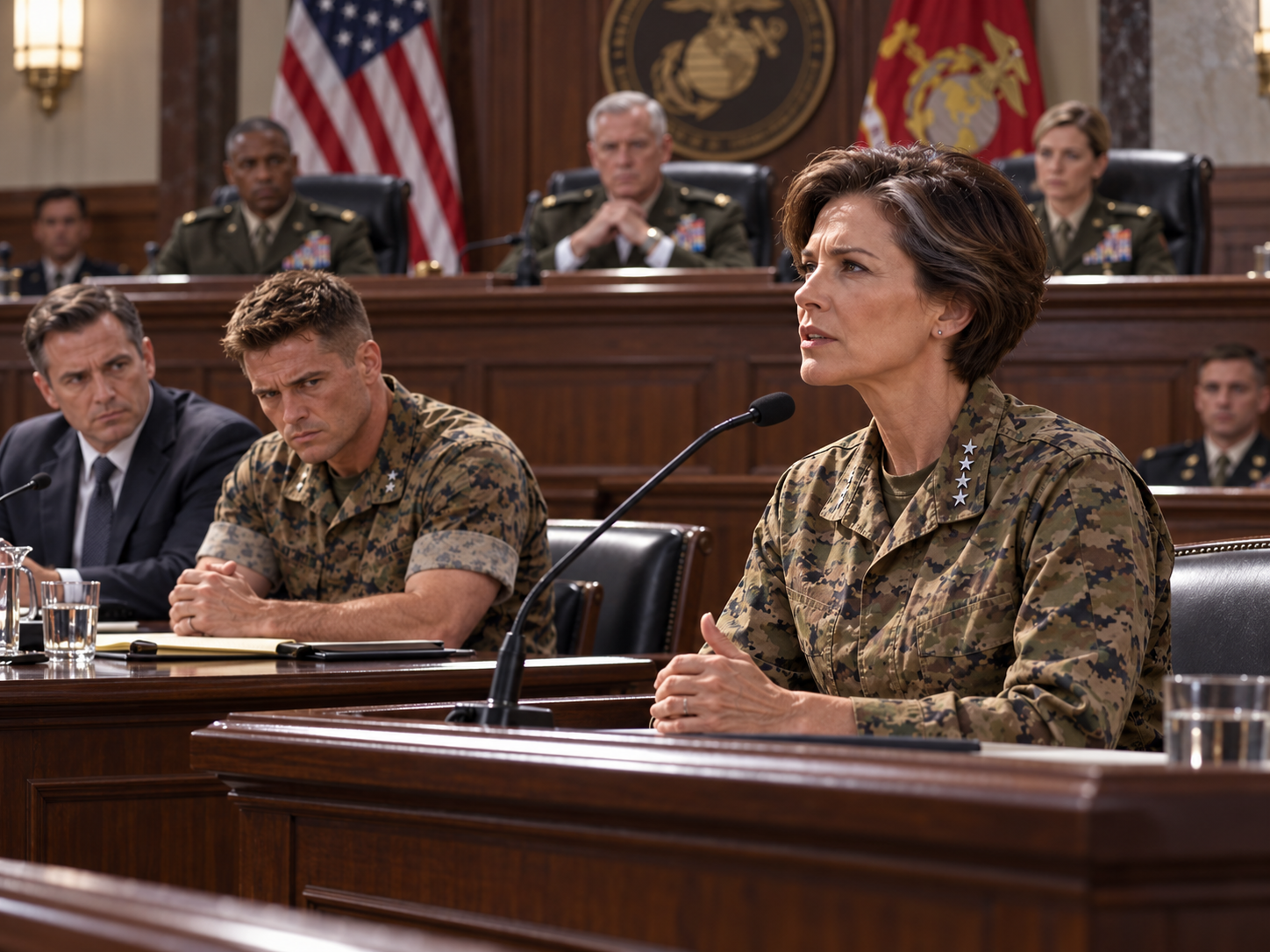
An independent digital forensic examiner compared the leaked audio with the conference-room recording system’s available records.
The room had not recorded the meeting.
There was no original source file.
Metadata associated with the submitted recording was inconsistent with the date its owner claimed it had been created.
More importantly, the examiner identified multiple discontinuities in the audio.
The exact method of alteration remained under investigation, and the technical team refused to speculate beyond its findings.
But the clip could not be authenticated as an accurate recording of the alleged conversation.
That finding changed the direction of the case.
Crawford’s attorney issued a statement saying the recording had been received from an anonymous source and that his client had not personally created it.
That was possible.
It was also impossible to verify at the time.
I had learned to be wary of the satisfaction that came from seeing an accusation collapse.
An unsupported allegation did not automatically prove every theory about who had manufactured it.
The investigators needed evidence.
Not revenge.
Then came a development none of us had expected.
Staff Sergeant Bell requested another interview.
This time, he brought his attorney.
He admitted that he’d been contacted by a civilian consultant associated with Charles Crawford’s defense network.
The consultant had asked whether Bell possessed recordings of the meeting between me and Mercer.
Bell said he did not.
Days later, the consultant had sent him an audio clip and asked him to confirm whether the voice sounded like mine.
Bell had refused.
He provided the message records and agreed to have his devices examined.
It wasn’t yet proof of who had altered the recording.
But it established a chain investigators could follow.
And that chain led directly toward the people attempting to influence the narrative surrounding Captain Crawford.
The most difficult conversation of the entire week happened after sunset.
I met Matthew Reed Jr. in a quiet room at the family assistance center.
His mother waited outside.
Matthew was twenty-one.
Tall, lean, with his grandfather’s brown eyes and a stubborn set to his jaw.
His injured left shoulder sat slightly lower than the right.
He stood when I entered.
“General.”
“At ease, Lance Corporal.”
He relaxed his posture but remained visibly nervous.
I sat across from him.
For several seconds, neither of us spoke.
Then I smiled.
“You have your grandfather’s eyes.”
His expression changed.
“Mom says that.”
“She’s right.”
He looked down at his hands.
“I didn’t know you knew him that well.”
“He was my platoon sergeant.”
“I know.”
“He saved my career more than once.”
Matthew gave a brief, surprised laugh.
“Seriously?”
“Seriously. He had a remarkable ability to tell me when I was being an idiot without technically saying the word.”
That earned a real smile.
Then the smile disappeared.
“I wanted to be like him.”
I studied him.
“Why?”
“Because everyone says he was a hero.”
“He was.”
Matthew nodded.
“I thought if I became a Marine, I’d make him proud.”
“Your grandfather was Army.”
“I know. Mom reminds me.”
We both smiled.
Then he became serious.
“When Captain Crawford said I wasn’t tough enough, I thought maybe he was right.”
I didn’t interrupt.
“He said I couldn’t handle pressure. That I complained too much. That I was embarrassing my grandfather’s name.”
His voice tightened.
“I kept trying harder. I trained through the pain. I stopped asking about my shoulder. I didn’t tell Mom how bad it was.”
“Why?”
“Because I thought quitting would mean he was right.”
I leaned forward.
“Matthew, look at me.”
He raised his eyes.
“Your grandfather did not die so you could spend your life proving yourself to men who enjoy hurting people.”
His lips parted slightly.
“He died because two soldiers needed help and he believed he could reach them. He made a choice based on duty and love for the people beside him.”
Matthew swallowed.
“He was afraid,” I continued. “He told me so.”
The young Marine stared.
“Mom always said he wasn’t.”
“She wanted you to remember his courage. But courage doesn’t require you to be fearless.”
His eyes shone.
I let the silence settle.
Then I said, “You were right to question an unsafe order. You were right to report an injury. And you were right to seek medical help.”
A tear escaped down his cheek.
He wiped it away quickly.
“Sorry, General.”
“Don’t apologize.”
“I just wanted to make him proud.”
I felt my own throat tighten.
“I believe you already have.”
He looked at the floor.
After a moment, he reached into his pocket.
“I found something.”
He placed a small folded note on the table.
It had been written on ordinary lined paper.
He explained that it came from a fellow Marine who had witnessed the training incident but had been afraid to speak.
The note contained a name.
A name that hadn’t appeared on the original report.
Gunnery Sergeant Peter Wallace.
Beneath the name were five words.
He has the original footage.
I looked at Matthew.
“Have you given this to the investigators?”
“Not yet.”
“Then we should arrange that.”
He nodded.
“Do you think it will help?”
“I don’t know.”
It was the truth.
Then I added, “But it deserves to be examined.”
Matthew stood when our conversation ended.
He hesitated before leaving.
“General?”
“Yes?”
“If Grandpa were here, what would he tell me?”
I smiled through the ache in my chest.
“He’d probably tell you to drink more water, change your socks, and stop worrying so much about what other people think.”
Matthew laughed.
Then I stood.
“And after that, he’d tell you something important.”
“What?”
I looked at the young man carrying a family legacy much heavier than anyone his age should have to bear.
“He’d tell you that being a good Marine starts with being a good human being.”
Matthew nodded.
“Thank you.”
He left the room with his shoulders a little straighter.
For the first time since I’d seen his photograph, I felt hope.
But it lasted only until Commander Sloan called.
She spoke without greeting.
“General, Gunnery Sergeant Wallace has been located.”
“Good. Has he agreed to provide the footage?”
“He says the original storage device disappeared from his locker yesterday.”
I closed my eyes.
“Was the locker forced?”
“No.”
“Who had access?”
“We’re establishing that.”
Then Sloan delivered the final sentence.
“Wallace says Captain Crawford personally ordered the locker inspected.”
The investigation had uncovered witnesses, records, and a possible recording of the original assault.
Now someone was removing evidence.
And Captain Crawford, apparently unwilling to accept that the truth might emerge, had created a far more serious problem than the one he’d faced beside the memorial wall.
Because military misconduct could destroy a career.
But trying to bury evidence could destroy the credibility of everyone involved.
PART 5 — THE NAME ON THE WALL
The missing footage was recovered from a place no one had thought to search.
Not a hidden safe.
Not a private computer.
Not a secure military archive.
An old external hard drive in Gunnery Sergeant Wallace’s garage.
Wallace had copied the training video months earlier after becoming concerned that the official file might be lost or altered.
He had kept it because he knew Reed’s injury had not happened the way Captain Crawford described.
He had also kept it because he was afraid.
That was something the investigation revealed repeatedly.
Fear did not always look like trembling.
Sometimes it looked like silence.
Sometimes it looked like a senior noncommissioned officer going home, sitting alone at his kitchen table, and deciding that tomorrow would be a better day to do the right thing.
Then tomorrow became next week.
Next week became next month.
And someone else continued suffering.
When Wallace finally turned over the drive, he also provided a sworn statement explaining why he’d retained the copy and why he’d delayed reporting what he knew.
The video was clear enough to resolve the central question.
Reed had been standing beside the vehicle.
Crawford had approached him.
They’d exchanged words.
Crawford had grabbed the front of Reed’s vest.
Then he’d shoved him backward.
Reed’s shoulder struck the steel bracket.
He dropped to one knee.
For several seconds, he remained bent forward, one hand pressed against his injured arm.
Crawford stood over him.
The video had no usable audio.
But the physical sequence was unmistakable.
The captain had not accidentally bumped him.
Reed had not tripped.
The injury had followed an intentional shove.
I did not watch the footage immediately.
My attorney advised that my personal connection to the family made it better for the investigators to complete their assessment without my involvement.
I accepted that.
Later, after the relevant findings were formally summarized, I reviewed the verified description.
It was enough.
The young Marine had told the truth.
And for months, the system around him had failed to recognize it.
The investigation took weeks.
During that time, Captain Crawford was removed from positions involving direct supervisory authority over the witnesses while the command addressed safety and retaliation concerns.
He retained legal representation.
He was given opportunities to respond to the allegations.
The investigators examined records, interviewed witnesses, authenticated available evidence, and separated allegations that could be supported from those that remained uncertain.
That distinction mattered deeply to me.
Accountability without fairness becomes another form of abuse.
I had no desire to replace one misuse of power with another.
I wanted the truth established.
Even if the truth complicated the story people preferred to tell.
And it did.
The investigation did not conclude that every officer in Crawford’s chain of command had deliberately protected him.
Some had made careless decisions.
Others had failed to verify information.
A few had relied on incomplete summaries.
One administrative official had altered a record under pressure.
Each failure required a different response.
Colonel Mercer received formal administrative action for his handling of Reed’s transfer and the deficiencies in his review.
He accepted responsibility.
He also provided detailed cooperation that helped investigators reconstruct the sequence of events.
Staff Sergeant Bell faced administrative and disciplinary consequences for altering official documentation, though his cooperation and disclosure of retained evidence were considered in the disposition.
Other witnesses were interviewed without Captain Crawford controlling their assignments or evaluations.
As for the manipulated audio recording, investigators established that it was not a reliable record of my conversation.
Its origin became part of a separate inquiry.
No finding was made against me for the allegations Crawford’s attorney had raised.
But the damage caused by the public accusation did not disappear overnight.
There were still strangers who believed the recording.
Still people who insisted I’d arranged the entire confrontation.
Still commentators who treated an incomplete social-media clip as stronger evidence than a documented investigation.
I learned to live with that.
A long career had taught me that reputation was fragile when other people controlled the story.
Character was what remained when the noise stopped.
Captain Crawford’s case proceeded through the military justice system.
I was called to provide testimony about the incident at the memorial.
I described what happened.
The physical contact.
The repeated requests that he release me.
His accusations.
The moment I revealed my rank.
I did not speculate about his private intentions.
I did not describe him as evil.
I did not ask the court to punish him because he’d embarrassed a general.
I told the facts.
When I finished, the defense attorney stood.
“General Hayes, did you believe Captain Crawford was performing an actual security function?”
“I believed he was claiming to perform one.”
“Those are different things?”
“Yes.”
“Isn’t it possible he genuinely suspected you were impersonating an officer?”
“It’s possible he had that suspicion initially.”
The attorney seemed encouraged.
“Then his actions were understandable?”
I paused.
“Suspicion can justify asking questions through appropriate procedures. It does not automatically justify physical intimidation.”
The attorney looked down at his notes.
“General, did you reveal your rank immediately?”
“No.”
“Why not?”
“Because I believed the captain should release my arm when asked, regardless of the rank of the person whose arm he was holding.”
A faint rustle moved through the courtroom.
The attorney continued.
“Wouldn’t revealing your rank sooner have prevented the escalation?”
“Possibly.”
“Then don’t you share some responsibility for what happened?”
I looked directly at him.
“I gave the captain repeated opportunities to end the physical contact. He chose not to.”
“Did you intend to embarrass him?”
“No.”
“Did you know that revealing four stars in front of hundreds of Marines would be humiliating?”
“I expected it would clarify my identity.”
“And his status?”
“His status was not the issue.”
“What was the issue?”
I held the attorney’s gaze.
“His conduct.”
For a moment, the room was completely still.
Then he returned to his table.
I stepped down.
It was the most important testimony I’d given in years.
Not because it involved me.
Because I knew that somewhere in the room, Matthew Reed Jr. was listening.
I wanted him to understand that the truth did not need to be exaggerated to be powerful.
It only needed to be told.
Crawford was ultimately found responsible for multiple offenses connected to the established incidents, including the unlawful physical contact and misconduct against Marines under his authority.
The disposition included dismissal from military service following the applicable legal process.
His career ended.
But not because a general had decided to destroy him.
It ended because his own actions, examined through the proper process, had consequences.
The inquiry into the fabricated recording led to additional civilian and military investigative referrals, though some questions about its production remained unresolved when Crawford’s case concluded.
I was satisfied with neither revenge nor spectacle.
I was satisfied that the Marines had been heard.
Yet when I saw Ryan Crawford leave the building after the final proceeding, I felt no triumph.
He looked older.
His shoulders were slumped.
His father walked beside him, speaking urgently into a phone.
Crawford’s eyes moved across the crowd.
For a brief moment, they met mine.
There was no arrogance left in his face.
Only exhaustion.
He approached slowly, stopping several feet away.
My attorney remained nearby.
“General Hayes.”
“Mr. Crawford.”
He flinched slightly at the civilian form of address.
For several seconds, he stared at the ground.
Then he spoke.
“I was wrong.”
I said nothing.
He swallowed.
“I thought you were somebody I could push around.”
The admission was so direct that it surprised me.
“I know,” I replied.
He looked up.
“I didn’t realize who you were.”
I studied him.
“That was never the point.”
His expression tightened.
“I understand that now.”
“Do you?”
He hesitated.
Then nodded.
“I treated people differently depending on what I thought they could do to me.”
It was the first thing he’d said that sounded like genuine understanding.
I took a breath.
“Captain—”
I stopped myself.
“Ryan. You have a long life ahead of you.”
His eyes filled with something he struggled to hide.
“Doesn’t feel that way.”
“It may not right now.”
He looked toward the parking lot.
“My father says I should appeal everything.”
“That is a decision you and your counsel must make.”
“He says I was treated unfairly.”
I considered my response.
“Fair process and favorable outcomes are not the same thing.”
Ryan looked at me.
For a moment, I saw the young man beneath the arrogance.
A man who might once have entered military service wanting to become someone honorable.
A man who had allowed insecurity and entitlement to turn authority into a weapon.
“I’m sorry I grabbed you,” he said.
I nodded.
“Thank you for saying that.”
“And Reed.”
His voice broke slightly.
“I owe him an apology too.”
“You do.”
“I don’t know if he’ll ever listen.”
“That is his choice.”
Crawford lowered his head.
Then he walked away.
I watched him go.
There had been a time in my life when I would have believed justice required a villain to suffer visibly.
Age had changed that.
Justice meant establishing the truth, protecting the vulnerable, and imposing consequences through a fair process.
What someone did afterward was a different question.
One only they could answer.
Matthew Reed Jr. underwent surgery several months later.
The procedure addressed damage that had gone untreated longer than it should have.
His rehabilitation was difficult.
There were days when he couldn’t lift his arm above shoulder height.
Days when frustration made him question whether he would ever return to full duty.
Days when he called his mother and told her he wanted to quit.
Lily called me after one particularly hard afternoon.
“He thinks everything is over,” she said.
I listened.
Then I asked to speak with him.
Matthew came on the line sounding tired.
“General.”
“Your mother says you’re having a rough day.”
“I’m fine.”
“That’s what people usually say when they’re not.”
He sighed.
“I can’t even do the basic exercises without pain.”
“What does your therapist say?”
“That I’m improving.”
“Do you believe them?”
“Not today.”
I smiled.
“Then let them believe it for you today.”
He was quiet.
“That’s allowed?”
“Of course.”
He laughed softly.
“I thought Marines were supposed to be strong.”
“They are. Strength doesn’t mean recovering without help.”
For a while, we talked about ordinary things.
His favorite food.
The football team he followed.
The old pickup truck he was restoring with his mother’s husband.
Then he asked a question.
“Did Grandpa ever fail at anything?”
I laughed.
“Constantly.”
“Really?”
“He once managed to get an entire platoon lost during a navigation exercise because he was so certain the map was wrong.”
Matthew laughed.
“What happened?”
“We walked three extra miles before he admitted the compass had been right.”
“Mom never told me that.”
“She probably didn’t know.”
He grew quiet.
Then he said, “I think I’ve spent my whole life trying to be someone who never made mistakes.”
“Your grandfather made plenty. What mattered was what he did afterward.”
Matthew considered that.
“Do you think I’ll be able to stay in?”
“I don’t know.”
It was painful to say.
But I refused to make him promises.
“Your medical team and the appropriate authorities will determine what options are available. Whatever happens, your worth isn’t measured by whether you’re able to remain in uniform.”
He said nothing for a long moment.
Then:
“I wish I’d known that earlier.”
“So do I.”
The following spring, I received an invitation.
It came in a plain white envelope, addressed in handwriting I recognized.
Inside was a photograph.
Matthew standing outside a rehabilitation facility.
His injured arm raised high above his head.
He was smiling.
On the back he’d written:
General Hayes, I lifted it all the way today. First time without help. Thought you’d want to know.
Beneath that was a second message.
Mom says Grandpa would’ve celebrated with terrible coffee and a big breakfast. We’re doing that Saturday. Hope you can come.
I stared at the photograph for a long time.
Then I laughed.
Because Matthew Reed Sr. absolutely would have celebrated that way.
He’d have found the cheapest diner within driving distance, ordered enough food for six people, and insisted the coffee was excellent while complaining about it the entire time.
I put the photograph beside my desk lamp.
Then I picked up the phone.
“Lily?”
“Eleanor!”
“I received the invitation.”
“Can you make it?”
I looked at the calendar.
There were briefings.
Meetings.
A scheduled trip to Washington.
Several obligations people had described as essential.
I thought about a young Marine raising his arm above his head after months of pain.
Then I smiled.
“Save me a seat.”
The diner stood along a quiet coastal road outside Oceanside.
It had red vinyl booths, a faded sign, and coffee that tasted almost exactly as terrible as Matthew Reed Sr. would have appreciated.
I arrived wearing jeans and a blue sweater.
No uniform.
No stars.
No staff officers.
Just Eleanor.
Lily was already seated with her husband, David, and Matthew.
There was an empty chair beside them.
Matthew stood when he saw me.
“General!”
I pointed at him.
“Not today.”
He grinned.
“Eleanor?”
“Better.”
He hugged me carefully with both arms.
It was the first time he’d been able to do that without wincing.
I held him for an extra moment.
Then we sat.
The waitress brought pancakes, eggs, bacon, and four cups of coffee.
David raised his mug.
“To Matthew.”
Matthew blushed.
“Come on.”
“To hard work,” Lily said.
“To physical therapists who never give up,” I added.
Matthew smiled.
“And to Grandpa?”
My throat tightened.
I raised my cup.
“To Grandpa.”
We drank.
The coffee was awful.
It was perfect.
After breakfast, Matthew and I walked outside.
The ocean was visible in the distance.
The air smelled of salt and warm asphalt.
He stopped beside my car.
“I’ve decided something.”
I looked at him.
“What?”
“If I’m medically cleared, I want to return to duty. But if I’m not, I’m going to finish college.”
“That sounds like a good plan.”
“I’ve been thinking about studying physical therapy.”
I smiled.
“Really?”
He nodded.
“There’s a guy at rehab who lost part of his leg in an accident. He’s been helping me stay motivated. I want to do that for someone else.”
I looked toward the ocean.
There it was.
The same instinct I’d seen in his grandfather.
Not the need to be recognized.
The desire to help.
Matthew shifted his weight.
“Do you think Grandpa would approve?”
I turned back to him.
“Matthew, I think he’d be bragging so loudly the entire diner would hear him.”
He laughed.
Then his expression grew serious.
“Can I ask you one more thing?”
“Of course.”
“Why did you come to the memorial that day without telling anyone?”
I took a slow breath.
“Because sometimes being a general means people see the stars before they see the person.”
He listened.
“I wanted to stand beside your grandfather’s name without anyone making a ceremony out of my presence.”
“Did you know Captain Crawford would be there?”
“No.”
“Would you have done anything differently?”
I thought about the question.
About the bruises.
The investigation.
The recording.
The testimony.
The years of misconduct that might have continued if four hundred Marines hadn’t witnessed that captain’s behavior.
“I might have handled some details differently,” I said. “But I would still have insisted he release my arm.”
Matthew nodded.
“Because it didn’t matter who you were?”
“Exactly.”
He smiled.
Then he said something I would remember for the rest of my life.
“Grandpa would have liked that.”
One year after the original incident, I returned to the same installation for Memorial Day.
This time, the visit was coordinated in advance.
The memorial grounds looked almost identical.
The black granite wall.
The rows of folding chairs.
The flags shifting gently in the California breeze.
The white flowers arranged beneath the engraved names.
But something had changed.
The installation had introduced a leadership development program focused on professional conduct, lawful authority, reporting responsibilities, and preventing retaliation.
It wasn’t named after me.
It wasn’t named after Crawford.
It was named the Reed Leadership Initiative.
The program honored Sergeant First Class Matthew Reed and other service members whose actions demonstrated that courage and responsibility belonged together.
Participation included junior and senior leaders.
Some sessions used anonymized case studies.
Others invited service members to discuss what made it difficult to challenge unsafe decisions or report misconduct.
No one pretended a training program could eliminate every abuse of authority.
But it created a place where uncomfortable questions could be asked openly.
And that mattered.
At the dedication, Colonel Mercer stood before the audience.
He had been reassigned after his administrative action and had returned by invitation.
His expression was solemn.
“Leadership,” he said, “is not merely the ability to give orders. It is the responsibility to recognize when our own decisions have failed the people we’re entrusted to lead.”
He paused.
“I failed in that responsibility.”
The words carried across the silent grounds.
“I signed a document without asking the questions that needed to be asked. A young Marine suffered consequences that should have prompted a more thorough review.”
Mercer looked toward Matthew.
“I cannot undo that. I can only accept responsibility, learn from it, and spend the rest of my service ensuring that I never repeat the failure.”
He stepped away from the microphone.
There was no dramatic applause.
No standing ovation.
Just silence.
Appropriate silence.
Because responsibility was not a performance that earned instant forgiveness.
It was a commitment to doing better.
Afterward, Mercer approached Matthew.
They spoke privately.
I stayed back.
Whatever passed between them belonged to the two men involved.
When Matthew returned, his eyes were wet.
“He apologized,” he said.
I nodded.
“How do you feel?”
“I’m not sure.”
“That’s okay.”
He looked toward the colonel.
“I told him I appreciated it, but I still have things to work through.”
I smiled.
“That sounds fair.”
The ceremony began at noon.
Four hundred Marines stood in formation.
The same number who had witnessed the confrontation a year earlier.
Some of the same faces were there.
Others had transferred or completed their service.
But the memorial wall remained.
And the names remained.
I wore my Army service uniform.
My four stars were clearly visible.
Not because I wanted people to notice them.
Because this time I had been invited to speak in an official capacity.
When my turn came, I approached the podium.
The wind lifted the edges of my notes.
I looked across the formation.
Hundreds of Marines stood beneath the bright sky.
Young faces.
Experienced faces.
Men and women whose lives would be shaped by decisions made in moments nobody could predict.
I folded my prepared remarks.
Then I spoke.
“Twenty-six years ago, a soldier named Matthew Reed died while trying to save two people who needed his help.”
I paused.
“He was not a perfect man. He was stubborn. He was occasionally impatient. He made mistakes.”
A few quiet smiles appeared.
“But he understood something fundamental about service.”
I looked toward the wall.
“He understood that the measure of a person is not how much power they possess, but what they choose to do with the power they have.”
The grounds were silent.
“Every uniform represents responsibility. Every rank represents trust. Neither grants permission to humiliate, intimidate, or disregard the dignity of another person.”
I glanced across the faces.
“Some of you will become senior leaders. Some will serve one enlistment and go home to build lives outside the military. Some will face decisions that require extraordinary courage.”
I drew a breath.
“When those moments come, remember this: doing the right thing may cost you comfort. It may cost you approval. Sometimes it may even cost you opportunities.”
I looked toward Matthew.
“But the price of remaining silent can be far greater.”
He stood beside his mother.
His left arm rested comfortably at his side.
Lily had one hand pressed against her heart.
I felt my voice soften.
“Today, we remember people who gave their lives in service. We honor them not by pretending they were flawless, but by carrying forward the best of what they believed.”
I unfolded my notes but didn’t look at them.
“Let us honor their courage by protecting those who serve beside us. Let us honor their integrity by telling the truth even when it is inconvenient. And let us honor their sacrifice by remembering that the uniform never makes us more human than the person standing next to us.”
I stepped away from the podium.
For a few moments, nobody moved.
Then the commander of troops called the formation to attention.
The ceremony continued.
Names were read.
Bells sounded.
And finally, the last note faded into the California afternoon.
After the ceremony, I walked toward the memorial wall alone.
I stopped before the third panel.
Seventh row.
SERGEANT FIRST CLASS MATTHEW REED.
I reached into my pocket.
Inside was an old photograph.
Matthew Reed Sr. standing beside a dusty military vehicle.
His uniform sleeves rolled up.
His grin enormous.
He’d been holding two cups of coffee, looking as though he’d just discovered the funniest joke in the world.
I’d carried that photograph through deployments, promotions, sleepless nights, and some of the hardest decisions of my life.
The corners were worn.
The colors had faded.
But his smile remained.
I placed my fingertips against his name.
“Your grandson’s doing well, Matt,” I whispered.
The wind moved softly through the flags.
“He’s stronger than he knows.”
I swallowed.
“And Lily’s okay. You’d be proud of her.”
For a moment, I could almost hear his laugh.
Almost hear him telling me to stop getting sentimental and go find something useful to do.
I smiled.
Then I heard footsteps.
Matthew stood a respectful distance away.
“Sorry. Mom said you’d probably be here.”
“She’s a smart woman.”
He stepped beside me.
We stood together, looking at the engraved name.
After a moment, he asked, “Can I tell you something?”
“Always.”
“I used to think being strong meant never backing down.”
I waited.
“Captain Crawford was always talking about strength. About who deserved respect. About who could handle pressure.”
Matthew looked at his grandfather’s name.
“But he wasn’t strong, was he?”
I considered the question.
“He had authority. He had training. He had opportunities to lead well.”
“But he didn’t.”
“No.”
Matthew nodded slowly.
Then he said, “I think Grandpa was strong because he could have saved himself, but he went back for those soldiers.”
“Yes.”
“And you were strong because you didn’t let Crawford make you act like him.”
I looked at him.
His words caught me off guard.
For a moment, I couldn’t answer.
Matthew smiled.
“Mom says I notice more than people think.”
“I believe her.”
He extended his hand.
I looked at it.
Then shook it.
His grip was firm.
Healthy.
No wince.
No hesitation.
A year earlier, he’d been afraid he might never regain full use of that arm.
Now he was standing beside his grandfather’s name, shaking hands with the officer who’d once served alongside him.
Life didn’t always offer moments so complete.
I intended to remember this one.
“General?” he said.
“Yes?”
“Do you think people can really change?”
I looked across the memorial grounds.
In the distance, Colonel Mercer was speaking with a group of young officers.
Beyond him, families gathered around photographs of loved ones.
Some were smiling.
Some were crying.
All were remembering.
“I think people can,” I said. “But change takes more than regret. It takes the willingness to recognize the harm you’ve caused and make different choices even when no one is watching.”
Matthew considered that.
“Even Crawford?”
“Even Crawford.”
“Do you think he will?”
“I don’t know.”
I turned toward him.
“But his future doesn’t have to decide yours.”
He smiled.
“That’s a good answer.”
“Your grandfather would have said the same thing with fewer words.”
Matthew laughed.
Then he stepped toward the wall and placed a small folded piece of paper beneath the flowers.
I looked at him.
“What’s that?”
“A letter.”
“To your grandfather?”
He nodded.
“Can I ask what it says?”
Matthew hesitated.
Then he unfolded it and read aloud.
“Dear Grandpa,
I used to think I had to become exactly like you to make you proud.
I thought I had to be fearless. I thought I had to be perfect. And when someone told me I wasn’t good enough, I believed him.
But this year I learned something.
Being brave doesn’t mean letting people hurt you.
Being loyal doesn’t mean helping someone hide the truth.
And being strong doesn’t mean never asking for help.
I’m still figuring out what kind of man I want to be.
I hope that’s okay.
I love you.
Matthew.”
By the time he finished, my vision had blurred.
I looked away toward the flags.
Matthew refolded the letter and placed it carefully beneath the flowers.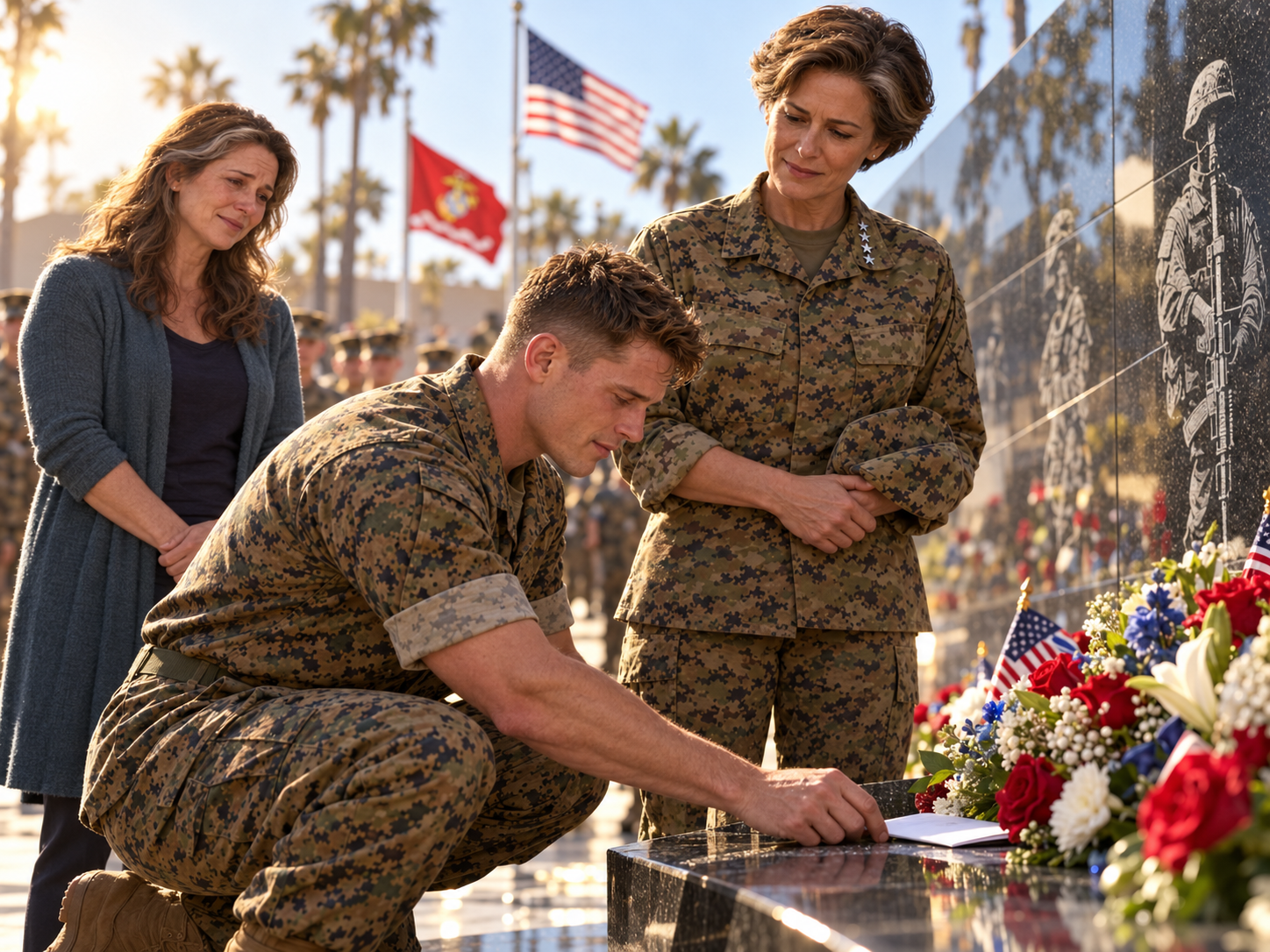
Then he stood.
For a long time, neither of us spoke.
Finally, he said, “Mom’s waiting.”
I nodded.
“We shouldn’t keep her.”
We began walking toward the parking lot.
The afternoon sun spread golden light across the memorial grounds.
Behind us, the black granite wall reflected the sky.
I thought about Captain Crawford’s hand closing around my arm a year earlier.
About his certainty that authority belonged to the loudest person in the room.
About the four silver stars he’d feared.
And about everything that had followed.
There had been pain.
There had been betrayal.
There had been consequences no one could avoid.
But there had also been courage.
A staff sergeant who eventually told the truth.
A colonel who acknowledged his failure.
A mother who refused to abandon her injured son.
A young Marine who learned that his worth was greater than his uniform.
And a family that found a new way to honor a man they’d lost.
When we reached the cars, Lily opened her arms.
Matthew walked into her embrace.
I watched them for a moment.
Then Lily turned toward me.
“Breakfast next year?”
I smiled.
“Same place?”
“Same terrible coffee.”
“Wouldn’t miss it.”
We laughed.
And in that ordinary, beautiful moment, I realized something.
Captain Ryan Crawford had believed the greatest power in the world was the power to make someone afraid.
He had believed rank was something to hide behind, authority something to impose, and respect something to demand.
But the four stars beneath my collar had never been the source of my strength.
The real strength had come from the people who taught me how to lead.
People like Matthew Reed.
People whose names were carved into stone because they’d chosen others over themselves.
People whose courage endured long after their voices were gone.
I glanced one last time toward the memorial wall.
The wind stirred the flags.
Somewhere beyond the installation, the Pacific Ocean continued its endless movement toward shore.
I had entered that Memorial Day ceremony hoping to spend a few quiet moments honoring an old friend.
Instead, I’d been reminded of a lesson he had taught me decades earlier.
Leadership isn’t proven by the power you have over someone. It’s proven by what you refuse to do to someone who has less power than you.
And that was the lesson I hoped four hundred Marines would carry with them long after they forgot the afternoon a captain had grabbed the wrong woman.
Because in the end, the captain hadn’t ruined his career by putting his hands on a four-star general.
He’d ruined it by forgetting that every person deserved dignity, whether they wore four stars, two stripes, or no rank at all.
And the young Marine standing beside his mother had proved something far more important.
A legacy of courage could survive cruelty.
A damaged future could be rebuilt.
And sometimes the most meaningful victory wasn’t watching someone powerful fall.
It was watching someone who had been hurt finally stand tall again.
THE END.