THE NOTE BESIDE THE ABANDONED BABY SAID “SHE’S YOURS NOW”—BUT THE LONELY COWBOY NEVER EXPECTED A STUBBORN WIDOW TO MAKE THEM A FAMILY- PART 2 — THE SECRET BURIED IN THE PAST
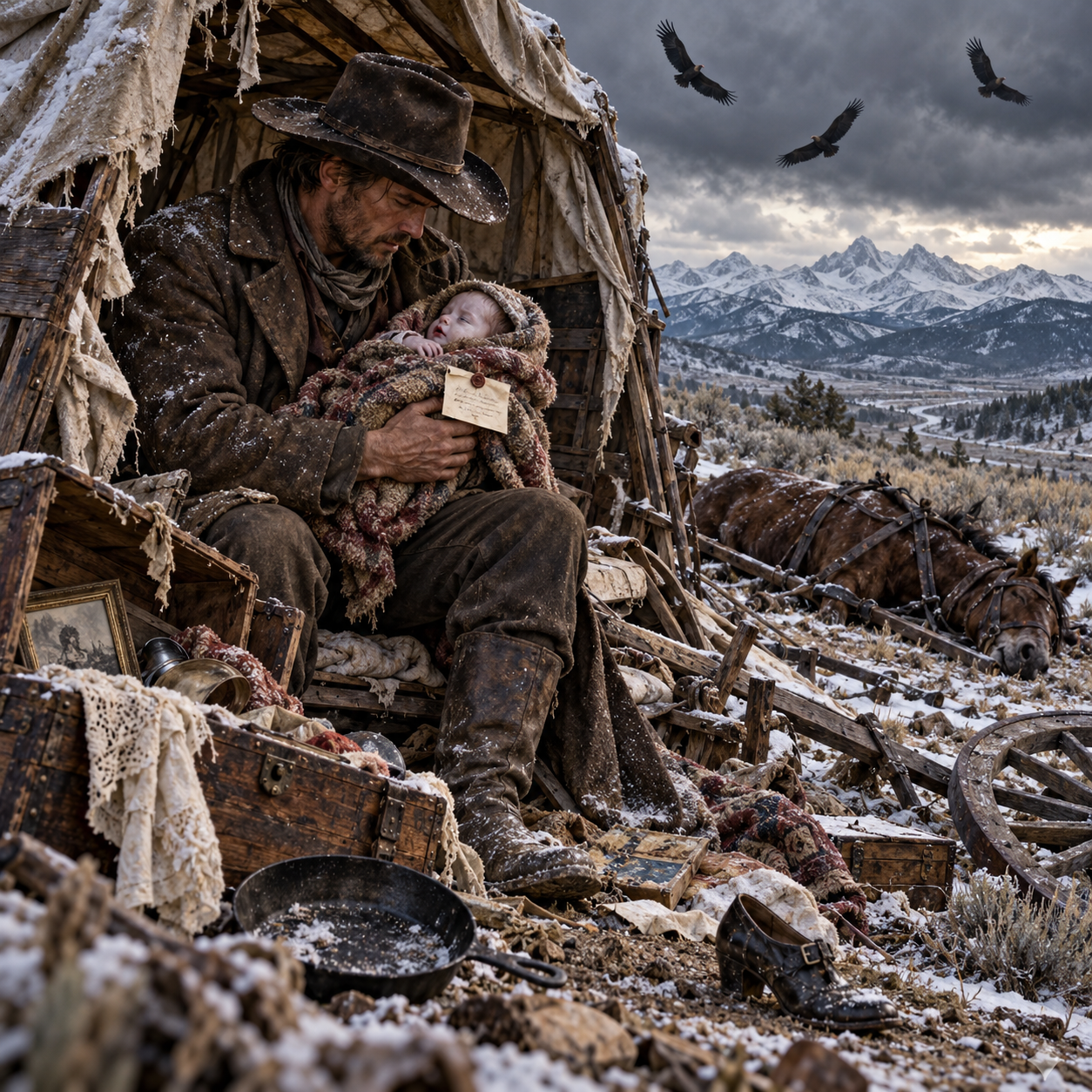
Tate Renlow had spent years avoiding the past, living alone on his Wyoming ranch where the wind asked no questions and the mountains kept their secrets.
But everything changed when he discovered a wrecked wagon on a deserted trail.
Inside lay a freezing baby girl, barely four months old, wrapped in a worn wool shawl. Pinned to her clothing was a mysterious note containing four desperate words:
“She’s yours now. Please.”
There was no sign of the child’s mother.
Fearing the infant would die before he could reach town, Tate carried her to the nearest ranch, where Erin, a fiercely independent widow, immediately took charge of saving her life.
Then Erin recognized the baby’s shawl.
A frightened young woman had visited her ranch the previous afternoon. Erin had given her that very shawl, along with directions to a man she seemed desperate to find.
That man was Tate Renlow.
And when Erin revealed that the stranger had specifically asked for him, Tate realized the abandoned baby might be connected to a past he had spent eleven years trying to forget.
What he didn’t know was that the child had brought something far more dangerous than a mystery to his doorstep.
Someone was searching for her.
And someone else was willing to kill to make sure Tate never discovered why.
PART 2 — THE SECRET BURIED IN THE PAST
“She was looking for you.”
Erin’s words settled between them like a loaded pistol placed on a kitchen table.
For several seconds, Tate Renlow did not move.
Outside, the Wyoming wind scraped against the walls of the little ranch house. A loose shutter tapped beneath the eaves. Somewhere in the darkening pasture, a horse gave a restless snort.
Inside, the baby lay motionless in Erin’s arms.
Tate looked at the child.
Then at the shawl.
Then back at Erin.
“What did she look like?”
Erin adjusted the quilt around the infant before answering.
“Twenty-five, perhaps twenty-six. Brown hair. Gray eyes. Thin enough that I could see the bones in her wrists.”
“Did she give you a name?”
“No.”
“Did she say where she came from?”
“No.”
“Did she tell you why she wanted me?”
Erin’s expression hardened.
“If she’d answered any of those questions, Tate, I’d have told you already.”
He swallowed.
Erin was forty years old, with dark hair usually twisted into a practical knot and eyes that had learned to recognize trouble long before it reached her front gate.
She had buried a husband six winters earlier and spent every season since proving that a woman could keep a ranch alive without surrendering it to the first man who offered assistance.
Tate respected that.
It was one of the reasons he rarely argued with her.
But tonight, the restraint that had kept him alive through the war was wearing thin.
“Think,” he said quietly. “Anything she said. Anything at all.”
Erin looked down at the baby.
“She asked if you lived alone.”
Tate’s jaw tightened.
“What did you tell her?”
“That you did.”
He turned toward the window.
“She asked whether you were a decent man,” Erin continued. “I told her you were stubborn, unpleasant before coffee, and more likely to shoot a rattlesnake than speak politely to a stranger.”
Despite everything, Tate almost smiled.
“Then I told her you were the kind of man who would ride twenty miles through a snowstorm if someone needed help.”
His faint smile disappeared.
“What did she say?”
Erin hesitated.
“She cried.”
The room seemed to become smaller.
“She just stood on my porch,” Erin said, “holding that baby against her chest. She looked toward the mountains, and then she started crying.”
Tate stared at her.
“Did she tell you why?”
Erin shook her head.
“But before she left, she asked me something strange.”
“What?”
“She asked if you still kept the silver watch.”
Tate went completely still.
For a long moment, the only sound was the soft crackling of the stove.
Erin noticed the change immediately.
“Tate?”
He slowly lowered himself into the chair beside the table.
His right hand moved toward the inside pocket of his vest.
There, resting against his chest beneath years of dust, leather, and hard living, was a silver pocket watch.
He removed it.
The case was dented.
One side bore a deep scratch from a piece of Confederate shrapnel.
The glass had been replaced twice.
He had carried it for eleven years.
Erin stared.
“I’ve never seen that before.”
“Most people haven’t.”
“Whose was it?”
Tate turned the watch over.
On the back, beneath the scratches, someone had engraved two letters.
J. R.
His fingers tightened around the metal.
“It belonged to a man I knew during the war.”
Erin waited.
Tate had never spoken much about the war.
She knew only that he had enlisted young, returned older than his years, and purchased his remote ranch shortly afterward.
Whatever had happened between those two points had followed him home.
Now, looking at the little girl in Erin’s arms, he understood that the past had finally found his address.
“His name was Jonathan Reed.”
The baby stirred.
Erin gently rocked her.
“And who was Jonathan Reed?”
Tate looked toward the fire.
“My closest friend.”
Eleven years earlier, Jonathan Reed had been twenty-two, newly married, and foolish enough to believe the world could be repaired simply because good men wanted it repaired.
He had joined the Union Army with Tate in the spring of 1863.
They had trained together.
Fought together.
Starved together.
And on a muddy battlefield in Virginia, Jonathan had pulled Tate from beneath a fallen horse while bullets tore through the trees around them.
Tate had repaid the favor eight months later.
But not well enough.
In the final winter of the war, Jonathan had received a letter telling him his wife was expecting a child.
He carried that letter everywhere.
Read it beside campfires.
Read it beneath his blanket.
Read it whenever another man died and the living needed reminding that something still waited beyond the fighting.
He told Tate that if the child was a girl, they would name her Margaret.
After Jonathan’s mother.
If it was a boy, they would name him Samuel.
After his father.
Jonathan never saw the child.
A week before his scheduled transfer home, his company was attacked near a narrow crossing.
Tate remembered smoke.
Mud.
Screaming horses.
And Jonathan collapsing beside him with a bullet wound beneath his ribs.
Tate dragged him to shelter.
He pressed both hands against the wound.
He begged him to stay awake.
Jonathan only smiled.
Then he handed Tate the silver watch.
“Take it home,” he whispered.
Tate promised he would.
Jonathan died before sunset.
Three weeks later, the war ended.
Tate traveled to Missouri carrying a watch, a bloodstained letter, and the burden of telling a young widow that her husband would never return.
But when he arrived at the Reed family’s house, he found it burned to the ground.
The neighbors told him the family had disappeared during a night raid.
No one knew where Jonathan’s wife had gone.
No one knew whether the baby had survived.
Tate searched for nearly two months.
Then the trail went cold.
Eventually, he carried the watch west.
And stopped speaking Jonathan Reed’s name.
Until now.
Erin listened without interrupting.
When Tate finished, the fire had burned low.
She glanced at the baby.
“You think that young woman was Jonathan’s daughter?”
“She would be about the right age.”
“Then the baby would be his granddaughter.”
Tate nodded.
Erin looked at him with an expression he could not read.
“And she knew about the watch.”
“Yes.”
“She knew your name.”
“Yes.”
“And she brought her daughter all the way into the mountains to find you.”
Tate stared at the little girl.
The possibility was almost too terrible to hold.
Jonathan Reed had died trusting him.
And now, eleven years after Tate had given up searching for his family, a child carrying that family’s blood had been left to freeze beside a broken wagon.
Erin’s voice softened.
“You couldn’t have known.”
Tate said nothing.
He had heard those words before.
From army surgeons.
From commanding officers.
From a chaplain who had tried to explain why some men survived battles while others never came home.
They had never brought him much comfort.
The infant suddenly made a small, strained sound.
Erin leaned forward.
“Enough questions. She’s still too cold.”
She checked the baby’s face and moved closer to the stove, careful not to place her directly against the heat.
“Fetch that clean linen from the shelf.”
Tate obeyed.
“And boil some water.”
He reached for the kettle.
“Not for her to drink,” Erin warned. “I need clean cloths.”
“I know how to boil water.”
“Then demonstrate.”
For the first time that evening, Tate heard something resembling ordinary life.
It was a small thing.
A woman giving orders.
A kettle rattling.
A helpless child demanding care.
But after years of eating alone and waking alone, the sounds unsettled him more than the mystery outside.
He found himself wanting them to continue.
Then the baby coughed.
A weak, frightening little cough.
Erin’s expression changed instantly.
“Tate, saddle your horse.”
His stomach dropped.
“What’s wrong?”
“Her breathing is too shallow. Her skin’s warming, but she isn’t responding the way she should.”
“Can you help her?”
“I can keep her warm. I can try to get some milk into her. But she needs Doctor Bellamy.”
“That’s fourteen miles.”
“I know how far it is.”
“The trail will freeze after sundown.”
Erin looked directly into his eyes.
“Then you had better ride before it does.”
Tate reached the door just as the first snow began to fall.
He was pulling on his coat when Erin called after him.
“One more thing.”
He turned.
She stood beside the stove with the baby against her shoulder.
“If there’s someone looking for that woman, don’t tell every stranger you meet what you’ve found.”
Tate frowned.
“You think she was running?”
“I know she was frightened.”
“Of what?”
Erin’s gaze moved to the window.
“She kept looking behind her while she stood on my porch. Every few moments, she stopped talking to listen.”
“Did you see anyone following?”
“No.”
“Then why didn’t you tell me?”
“Because I thought she was escaping a cruel husband. Women pass through this country carrying worse secrets than that.”
Tate opened his mouth.
Erin held up a hand.
“And before you ask, yes. I offered her a place to stay.”
“She refused?”
“She said staying would put me in danger.”
The cold seemed to reach through Tate’s coat.
“Those were her words?”
“Exactly.”
For the first time since finding the wrecked wagon, Tate felt something sharper than confusion.
He felt fear.
Not for himself.
For the woman standing in front of him.
For the tiny child breathing against her shoulder.
“I’ll be back before midnight,” he said.
Erin gave him a look of open disbelief.
“Bring the doctor, Tate. Don’t waste time making promises.”
He stepped into the snow.
Behind him, the door closed.
And somewhere beyond the dark pasture, a horse moved where no horse should have been.
Tate stopped.
His hand dropped toward his revolver.
The movement came again.
A faint metallic jingle.
A bridle.
He stood motionless, listening.
Then the sound vanished.
He scanned the cottonwoods bordering Erin’s creek.
Nothing.
Only branches moving in the rising wind.
Tate walked to his horse.
But before mounting, he loosened the revolver in its holster.
Someone might have been watching the house.
And if Erin was right about the young woman’s fear, that someone might already know where the baby had gone.
Doctor Amos Bellamy was closing his office when Tate arrived.
The older man opened the door with a lamp in one hand and an irritated expression on his face.
“Renlow? Somebody dead?”
“Not yet.”
That was enough.
Ten minutes later, Bellamy had collected his medical bag, pulled on a heavy coat, and borrowed a fresh horse from the livery stable.
As they rode west, Tate explained what he had found.
Bellamy listened carefully.
When Tate mentioned the wagon, the doctor interrupted.
“Where exactly?”
“East of Coyote Pass. About six miles from the old logging road.”
The doctor went quiet.
“What?”
“I saw two strangers in town this afternoon.”
Tate turned.
“What kind of strangers?”
“One was a tall fellow with a black beard. The other had a scar along his cheek.”
“Did they say where they were headed?”
“They asked whether anyone had brought an injured woman into town.”
Tate felt his pulse quicken.
“What did you tell them?”
“That I’d treated no such person.”
“Then what?”
“They asked about a baby.”
The horses continued through the darkness.
Tate tightened his grip on the reins.
“And?”
Bellamy glanced at him.
“I told them I hadn’t seen one.”
“Did they give names?”
“No.”
“Did they explain why they were looking?”
“They claimed the child’s mother was unwell. Said she had stolen the baby from its father.”
Tate stared ahead.
The road narrowed between the trees.
“Did you believe them?”
Bellamy considered the question.
“No.”
“Why?”
“Because they couldn’t tell me the child’s name.”
The wind hissed across the frozen trail.
Tate said nothing.
Bellamy continued.
“And because the taller man was carrying a woman’s handbag.”
Tate looked sharply at him.
“What kind?”
“Brown leather. Brass clasp.”
“Anything else?”
“Blood on the handle.”
Tate’s horse stumbled over a buried stone.
He steadied it with one hand.
“Where did they go?”
“Toward the eastern road.”
“Did they have horses?”
“Two. A bay gelding and a gray mare.”
Tate remembered the strange sound outside Erin’s pasture.
A horse moving beyond the cottonwoods.
His stomach clenched.
“Doctor.”
Bellamy looked over.
“We need to ride faster.”
By the time they reached Erin’s ranch, the kitchen window was glowing against the snow.
Tate dismounted before his horse had fully stopped.
He found the door barred.
“Erin!”
No answer.
He knocked.
Hard.
“Erin, it’s Tate!”
A chair scraped inside.
Then her voice came through the door.
“Who’s with you?”
“Doctor Bellamy.”
There was a pause.
The bolt slid back.
Erin opened the door just far enough for them to enter.
Tate noticed the shotgun resting against the wall.
Its hammer was cocked.
He shut the door behind him.
“What happened?”
Erin looked toward the window.
“Someone came.”
Bellamy immediately moved toward the baby, but Tate stayed near the door.
“Who?”
“I don’t know.”
“When?”
“Perhaps half an hour ago.”
“What did he want?”
“He asked whether I’d seen a woman traveling with an infant.”
Tate’s throat tightened.
“What did you tell him?”
“That I hadn’t.”
“Did he believe you?”
Erin shook her head.
“He tried to look past me.”
Tate glanced around the room.
“Where was the baby?”
“In the bedroom.”
“Did he see her?”
“No.”
“What did he do?”
“He smiled.”
Something in Erin’s voice made Tate look directly at her.
“That’s all?”
“He told me there was a reward for information.”
“How much?”
“Fifty dollars.”
Tate felt cold anger rise in his chest.
A baby.
A frightened mother.
And men offering money as though they were searching for a stolen horse.
“What did you say?”
“I told him fifty dollars wouldn’t buy my conscience.”
Tate almost laughed.
Then Erin continued.
“He said he’d return tomorrow with someone who could make me reconsider.”
The smile disappeared from Tate’s face.
“What did he look like?”
“Tall. Black beard. Dark coat.”
Bellamy slowly lifted his head.
“The same man.”
Tate turned toward the window.
“Did he come alone?”
“He left the road on foot. I heard a horse farther down the creek.”
“Which direction?”
“East.”
Tate looked back at her.
“Erin, you need to leave this ranch.”
“No.”
“They know something.”
“Then they can learn it somewhere else.”
“I’m serious.”
“So am I.”
He stepped closer.
“If these men hurt that woman—”
“Then they’re not getting through my door.”
Tate lowered his voice.
“This isn’t a dispute over fence lines.”
Erin crossed her arms.
“And I’m not a frightened schoolgirl.”
“I know that.”
“Then stop treating me like one.”
Their eyes met.
For a moment, neither spoke.
Finally, Bellamy cleared his throat.
“If the two of you have finished trying to outstubborn each other, I could use some light.”
They turned.
The doctor was holding the baby near the stove.
Her cheeks had gained a little color.
But her breathing remained uneven.
Bellamy examined her carefully, then looked at Erin.
“What have you given her?”
“Small amounts of milk from my cow, just enough that she could swallow.”
Bellamy nodded slowly.
“She’s dangerously weak. We need to avoid forcing anything while she’s struggling to breathe.”
Tate stood frozen.
“Will she live?”
The doctor glanced down.
“I won’t promise what I can’t know.”
Tate felt the words like a blow.
Then Bellamy added, “But she is warmer than when you found her. Her pulse is stronger. That gives us something to work with.”
Erin sat beside the doctor.
“Tell me what to do.”
Bellamy opened his bag.
“We’ll take this one careful step at a time.”
An hour passed.
Then another.
The storm strengthened.
Snow hissed against the windowpanes.
Tate kept the stove fed while Bellamy watched the child’s breathing and Erin remained close enough to reach for her at the slightest sound.
At last, the baby opened her eyes.
They were gray.
Deep, soft gray.
Tate remembered Jonathan Reed’s eyes.
And suddenly he had to sit down.
The child looked at him without recognition.
Of course she did.
She knew nothing about promises made on battlefields.
Nothing about widows waiting beside empty windows.
Nothing about men who spent eleven years believing they had failed the dead.
She was simply hungry, exhausted, and alive.
But when Tate extended one rough finger, her tiny hand closed around it.
He stopped breathing.
Her grip was impossibly small.
Yet it held him more firmly than any chain.
Erin watched from beside the stove.
For the first time that night, her expression softened.
“She likes you.”
Tate swallowed.
“She doesn’t know any better.”
“She’ll learn.”
There was a faint smile in her voice.
Tate looked at her.
Something passed between them that neither was prepared to name.
Then the baby began to cry.
Not the thin, exhausted sound Tate had heard in the wagon.
This cry had strength.
Anger.
Demand.
Bellamy gave a weary smile.
“That’s the finest complaint I’ve heard all evening.”
Erin laughed.
It was a small laugh.
Brief and surprised.
But Tate realized he had not heard her laugh like that in years.
For a moment, the room seemed safe.
The storm remained outside.
The child was alive.
And the terrible uncertainty surrounding the missing woman felt almost bearable.
Then someone knocked on the back door.
Three slow knocks.
Tate stood immediately.
Erin reached for the shotgun.
Bellamy rose from his chair.
The knocks came again.
Tate drew his revolver.
“Who’s there?”
No answer.
He moved beside the door, careful not to stand directly in front of it.
“Speak.”
A woman’s voice came through the wood.
Weak.
Almost swallowed by the wind.
“Please.”
Tate froze.
The woman coughed.
“Please… don’t let them take her.”
Erin’s face went white.
Tate slid back the bolt.
And opened the door.
The stranger collapsed across the threshold.
She was young.
Brown-haired.
Barefoot on one side.
Blood had soaked through her coat near the shoulder, and her lips were nearly blue from the cold.
Tate caught her before her head struck the floor.
Erin dropped to her knees beside them.
“It’s her.”
Tate looked up.
“The woman from yesterday?”
Erin nodded.
“Yes.”
The young woman’s eyes fluttered.
She tried to sit up.
Tate held her gently.
“Easy. You’re safe.”
The woman seized his coat.
“No,” she whispered.
Her fingers tightened.
“No, we’re not.”
Bellamy hurried forward.
“Get her to the table.”
Together, Tate and Erin lifted the stranger onto the kitchen table after clearing it.
The doctor examined her shoulder.
“A bullet passed through the upper muscle,” he said. “She’s lost blood, and she’s been in the cold far too long.”
The woman struggled against his hands.
“My baby.”
Erin took her wrist.
“She’s here.”
The young woman’s eyes widened.
“Alive?”
“Yes.”
“Please.”
Her voice broke.
“Please let me see her.”
Erin hesitated only long enough to glance at the doctor.
Then she brought the baby close.
The young woman stared.
Her expression crumpled.
“Oh, my sweet girl.”
She reached out with a trembling hand.
The baby’s fingers opened.
And the woman began to weep.
Tate turned away.
He had seen men die without shedding a tear.
He had watched homes burn.
He had ridden through towns where no family had escaped the war untouched.
But the sound of this wounded mother seeing her child alive was nearly more than he could bear.
Bellamy carefully guided her arm back down.
“You need to stay still.”
The woman barely heard him.
She was staring at Tate.
“Renlow?”
He stepped closer.
“Yes.”
Her mouth trembled.
“Jonathan said you’d come.”
Tate felt the room tilt beneath his feet.
“What?”
The woman shook her head weakly.
“He said… if anything happened…”
She reached toward him.
Tate caught her hand.
“Who are you?”
The woman closed her eyes.
For an instant, Tate thought she had lost consciousness.
Then she whispered two words.
“Margaret Reed.”
Tate’s blood turned cold.
Jonathan’s daughter.
The little girl he’d never found.
The child Jonathan had dreamed of holding.
Alive.
All these years.
Standing before him as a grown woman who had crossed half the country to place her own daughter in his care.
Tate sank into the chair beside the table.
“Margaret?”
Her eyes opened.
“My father told my mother about you.”
Tate shook his head.
“That can’t be.”
“He wrote letters.”
The words came slowly.
“He told her… you were his brother in every way that mattered.”
Tate covered his mouth.
Margaret studied his face.
“You have his watch.”
He nodded.
“Yes.”
A faint expression of relief crossed her face.
“Then I found the right man.”
Bellamy cleaned and dressed the wound while Margaret drifted between wakefulness and exhaustion.
The bullet had not lodged inside her shoulder, but the injury was serious, and the hours she had spent traveling through the cold had left her dangerously weak.
Erin prepared fresh cloths.
Tate remained at the table.
He could not bring himself to step away.
Each time Margaret opened her eyes, he asked another question.
And each answer revealed a deeper wound.
Her mother had survived the raid on the Reed house.
She had escaped west with her infant daughter after armed men burned the property and killed two household servants.
For years, they moved from one settlement to another.
Sometimes under false names.
Sometimes living with distant relatives.
Sometimes surviving on the generosity of strangers.
“Why?” Tate asked.
Margaret looked at him.
“Because of what my father carried during the war.”
Tate frowned.
“Jonathan was a soldier.”
“He was more than that.”
Her voice weakened.
Tate leaned forward.
“What do you mean?”
Margaret glanced toward Bellamy.
Then toward Erin.
Finally, she looked back at Tate.
“Before he died, my father sent my mother a letter. He told her he’d discovered something terrible.”
“What?”
“Records. Names. Men who were stealing army supplies and selling them to both sides.”
Tate stared.
Margaret continued.
“Officers were involved. Men with money. Men who became powerful after the war.”
Tate’s mind began racing.
He remembered Jonathan receiving strange visitors near the end of the fighting.
Remembered his friend refusing to explain why he had been called to headquarters.
Remembered a night when Jonathan had burned several papers beside the campfire.
And remembered something else.
The final morning of the battle.
Jonathan had been frightened.
Not of dying.
Of something happening after his death.
Tate leaned closer.
“Did he give your mother names?”
Margaret swallowed.
“One.”
“Who?”
Her lips parted.
Then her eyes moved toward the window.
A shadow passed across the curtain.
Tate saw it.
So did Erin.
He reached for his revolver.
Margaret gripped his wrist.
“No!”
The room fell silent.
“They followed me,” she whispered.
Tate moved toward the door.
Erin caught his arm.
“Don’t go out there.”
He stopped.
Margaret’s breathing quickened.
“They’re not looking for the baby because of her father.”
Tate turned.
“What are they looking for?”
Margaret tried to answer.
But the words dissolved into a cough.
Blood spotted the cloth Bellamy held near her mouth.
The doctor leaned over her.
“Enough. She needs rest.”
Tate shook his head.
“Doctor, those men are outside.”
“Then protect the house. But if you keep forcing her to speak, she may not survive to tell you anything.”
Tate looked toward the window again.
Nothing moved.
For several seconds, the entire room listened.
Then Erin spoke.
“Tate, if they wanted to come through that door tonight, they wouldn’t have knocked politely.”
He looked at her.
She continued.
“Whoever passed that window may be watching. We need to know how many.”
Tate nodded.
Bellamy reached for his own revolver.
“I’ll help.”
“No,” Tate said. “You stay with the women.”
Erin bristled.
“Women?”
Tate glanced at the shotgun in her hands.
“Armed women.”
“Better.”
Despite the danger, Bellamy almost smiled.
Tate extinguished the lamp nearest the window.
Then he stepped into the storm.
The snow was knee-deep in places.
Tate moved along the side of the house, keeping low beneath the windows.
The wind covered most sounds.
But it also made tracks difficult to follow.
He reached the corner and crouched beside the rain barrel.
There.
Footprints.
A man’s.
Large boots.
Fresh.
The tracks led from the cottonwoods toward the kitchen window.
Then back toward the creek.
Tate followed them carefully.
Twenty yards.
Thirty.
The snow grew deeper beneath the trees.
At the edge of the creek, he found a place where someone had tied a horse.
The animal was gone.
But the tracks remained.
One horse had stood there.
Possibly two.
Tate knelt.
Something dark lay half-buried near the tree roots.
He brushed away the snow.
A cigar.
Still faintly warm.
He had barely lifted it when a voice spoke behind him.
“That’s far enough, Renlow.”
Tate froze.
A revolver clicked.
“Stand up.”
Slowly, Tate rose.
A man stepped from behind a cottonwood.
Tall.
Black beard.
Dark coat.
His face was narrow, and his eyes carried the cold confidence of someone accustomed to frightening people.
Tate kept his hands visible.
“Looking for something?”
The man smiled.
“You tell me.”
“Strange place to smoke.”
“Strange place to find a wounded woman.”
Tate’s expression remained unchanged.
The man watched him closely.
“Where is she?”
“Who?”
“Don’t make me waste time.”
Tate looked at the revolver.
“You always introduce yourself with a gun?”
“Only when I’m speaking to dangerous men.”
“Then you’re poorly informed.”
The stranger took one step closer.
“I know exactly who you are.”
Tate’s pulse slowed into the steady rhythm he remembered from battle.
“Then we have an advantage. You know my name. I don’t know yours.”
The man tilted his head.
“Silas Vane.”
Tate had never heard it.
But something about the name felt rehearsed.
“What’s your business with Margaret Reed?”
Silas smiled again.
“So she’s told you who she is.”
Tate said nothing.
“Then perhaps she’s told you about the child.”
Tate’s jaw tightened.
“You mean the baby your men nearly froze to death?”
Silas’s expression changed.
“Careful.”
Tate took a slow breath.
“What do you want?”
“The girl.”
“Which one?”
Silas stared.
Tate continued.
“The mother or the baby?”
The man’s smile returned.
“Both.”
“Why?”
“Because they belong to someone who paid a great deal to find them.”
Tate’s hand hovered near his belt.
“People aren’t cattle.”
“In my experience, Mr. Renlow, everything belongs to someone.”
A gust of wind passed between them.
Silas raised the revolver slightly.
“I’ve been instructed to bring them back alive. Preferably unharmed.”
“By whom?”
The man looked amused.
“Someone who doesn’t enjoy hearing the word no.”
Tate thought of Margaret bleeding on Erin’s table.
Of the shattered wagon.
Of the child who had nearly died before he found her.
“Then he’ll be disappointed.”
Silas’s smile vanished.
“You think being an old war hero makes you untouchable?”
Tate looked at him steadily.
“No.”
“Good.”
“I think it taught me what happens when men believe a gun makes them important.”
Silas tightened his grip.
For one suspended moment, the two men stood in the falling snow.
Then a rifle cracked from somewhere behind the trees.
Silas jerked sideways.
His revolver discharged into the ground.
Tate dove behind the cottonwood.
A second shot tore splinters from the trunk.
Silas stumbled backward into the darkness.
“Get down!” Tate shouted.
He heard running footsteps.
A horse screamed.
Then another shot rang out.
And the creek fell silent.
Tate waited.
Ten seconds.
Twenty.
Finally, a familiar voice called from the slope above.
“Renlow!”
Erin.
Tate turned sharply.
She stood near the fence with his rifle braced against a post.
“You all right?”
He stared at her.
“You fired?”
“Yes.”
“Why?”
“Because that man was about to shoot you!”
Tate looked toward the place where Silas had been standing.
A dark patch stained the snow.
But there was no body.
“He’s gone.”
Erin lowered the rifle.
“Then we’d better get inside before he finds his courage again.”
When they returned, Margaret was awake.
She stared at Tate’s snowy coat.
“You saw him.”
Tate nodded.
“Silas Vane.”
Margaret closed her eyes.
“He’s not the worst of them.”
Tate pulled a chair close to the table.
“Who sent him?”
She shook her head.
“Please. I need you to listen.”
Her voice carried enough urgency that even Bellamy stopped protesting.
Tate leaned forward.
Margaret reached inside her torn coat.
With shaking fingers, she removed a small leather pouch.
It was dark with age and stained with dried blood.
She pressed it into Tate’s hand.
“My mother gave me this before she died.”
Tate opened the pouch.
Inside lay a folded piece of paper.
And a narrow brass key.
The key was unusual.
Small.
Its head was shaped like a six-pointed star.
Tate unfolded the paper.
A name had been written across it.
Elias Whitcomb.
His expression changed.
He knew that name.
Every rancher in three counties knew that name.
Elias Whitcomb owned the largest cattle operation between Sheridan and the southern foothills.
He controlled freight contracts.
Lending offices.
Half the trading posts along the northern road.
And according to rumors, he had enough influence to decide which sheriff kept his badge and which judge kept his seat.
Tate looked at Margaret.
“What does Whitcomb have to do with your father?”
Margaret began to tremble.
“He was one of the men.”
“One of what men?”
“The officers who stole from the army.”
Tate studied the paper.
“Jonathan knew about him?”
“He had proof.”
“Where?”
Margaret pointed weakly toward the key.
Tate lifted it.
“What does this open?”
She swallowed.
“A box.”
“Where?”
Margaret looked toward the sleeping baby.
“My mother kept it hidden for years. She said my father had risked everything to protect what was inside.”
“Protect it from whom?”
“Whitcomb.”
Tate’s jaw tightened.
“And the box?”
Margaret’s eyes filled.
“He found out about it.”
Tate leaned closer.
“Where is it now?”
Margaret glanced toward Erin.
Then back at Tate.
“I hid it before they attacked my wagon.”
Tate went still.
“At the wreck?”
She nodded.
“Beneath the wagon floor. Near the rear axle.”
Tate remembered the broken wagon.
The scattered supplies.
The split wooden trunk.
He had searched it.
But not beneath the floorboards.
Margaret clutched his hand.
“You have to get it before they do.”
“What does it contain?”
Her voice dropped.
“Letters. Payment records. Names of men who were supposed to be dead.”
Tate looked at her sharply.
“What men?”
Margaret began crying.
“My father tried to stop them. That’s why they killed him.”
The words struck Tate harder than any bullet.
“No.”
Margaret squeezed his hand.
“He wasn’t killed by chance in battle, Tate.”
Tate felt his throat close.
He remembered Jonathan falling.
The bullet.
The strange angle of the wound.
The way the attack had come after their company was ordered toward the crossing.
He had spent eleven years believing his friend died in combat.
Eleven years mourning an accident of war.
But Margaret was telling him something else.
Jonathan had been murdered.
And if the men responsible were still alive, then the danger had never ended.
Tate rose slowly.
Erin watched his face.
“What are you thinking?”
He looked toward the window.
“I’m thinking someone sent Jonathan into that ambush.”
Margaret nodded.
“And someone has spent eleven years making sure the truth stayed buried.”
Near dawn, the storm eased.
The house had become a fortress of exhausted people.
Bellamy had finally persuaded Margaret to sleep.
Erin sat in the rocking chair with the baby against her chest.
Tate stood beside the kitchen window, staring into the pale gray morning.
He had not slept.
The little girl stirred.
Erin looked down.
“I think she’s decided you’re not allowed to leave this house without permission.”
Tate turned.
“What?”
“She wakes whenever you move away.”
He approached slowly.
The baby blinked at him.
Then reached toward his shirt.
Erin smiled.
“See?”
Tate extended a finger.
The tiny hand wrapped around it.
He felt something shift inside him.
For years, he had told himself that solitude was a choice.
That a quiet house meant freedom.
That having no one to lose was better than suffering another loss.
But the truth was standing in front of him.
Or rather, resting in Erin’s arms.
He had been afraid to care for anyone because he knew exactly what caring could cost.
And now, somehow, a four-month-old child had crossed miles of dangerous country to teach him that fear was not the same as peace.
“Does she have a name?” he asked quietly.
Erin looked toward Margaret.
“She hasn’t said.”
Tate glanced at the sleeping woman.
Then back at the baby.
“Jonathan wanted to name his daughter Margaret.”
Erin nodded.
“What would Margaret want to name hers?”
A small voice answered from the table.
“Rose.”
They turned.
Margaret was awake.
Her face was pale, but her eyes were clear.
“Her name is Rose.”
Erin smiled.
“That’s beautiful.”
Margaret looked at Tate.
“Rose Elizabeth Reed.”
Tate repeated it softly.
“Rose.”
The baby opened her mouth in a wide, silent yawn.
For the first time since discovering the wagon, Tate laughed.
It surprised everyone.
Including him.
Margaret watched with tears in her eyes.
“You look like him when you smile.”
Tate’s laughter faded.
“Your father?”
She nodded.
“My mother used to say he smiled like he was keeping a secret from the whole world.”
Tate looked down at Rose.
“He was a better man than I ever was.”
Margaret shook her head.
“He trusted you.”
Tate could not answer.
Erin shifted the baby in her arms.
“Margaret, you need to recover. Whatever those men want, they won’t get Rose while she’s here.”
Margaret’s eyes moved between them.
For a moment, she looked almost peaceful.
Then her expression changed.
“Tate.”
He turned.
“Yes?”
“The note.”
He frowned.
“What note?”
“The one I left with Rose.”
He reached into his vest and removed the folded paper.
The four words were still there.
She’s yours now. Please.
Margaret looked at it.
“I wrote more.”
Tate examined the stained page.
“The rain washed it away.”
Margaret closed her eyes.
“I knew they were close. I couldn’t carry her and escape through the rocks. I thought… if I left her where someone might find her…”
Her voice broke.
Erin crossed the room and laid a hand on her shoulder.
“You did what you thought would keep her alive.”
Margaret nodded weakly.
“I meant to write that Tate Renlow was the only man I could trust.”
Tate stared at the paper.
Margaret reached for his hand.
“And I wrote something else.”
“What?”
Her eyes filled.
“If I didn’t come back… I wanted you to raise her.”
Tate felt the breath leave his chest.
Margaret looked toward her daughter.
“I don’t have anyone else.”
The room became very quiet.
Tate looked at Erin.
She was watching him with an expression he could not quite understand.
Not pity.
Not fear.
Something warmer.
Something that frightened him far more.
Then he looked at Rose.
The little girl was asleep again, one fist tucked beside her cheek.
He had found her beneath a wagon.
He had carried her through the cold.
He had watched her struggle to breathe.
And now her mother was asking him to become the very thing he believed himself least capable of being.
Family.
Tate took a slow breath.
“Margaret, you’re going to live.”
Her eyes filled.
“And you’re going to raise your daughter.”
“But if—”
“If anything happens,” Tate interrupted gently, “Rose will never be alone.”
Erin stepped beside him.
“Neither will her mother.”
Tate turned.
She looked directly at Margaret.
“This house has room.”
Margaret began to cry.
Tate stared at Erin.
“You’d take them in?”
Erin lifted her chin.
“I believe I just did.”
“Those men might come back.”
“Then they’d better knock.”
Tate almost smiled.
Erin continued.
“And don’t mistake my kindness for foolishness. I’m not asking trouble to move in. I’m telling it that these two aren’t being sent back into the snow.”
For a brief moment, Tate saw a future he had never permitted himself to imagine.
A table with more than one plate.
A child laughing beside the stove.
Erin’s voice calling from the kitchen.
Perhaps even a home where the past no longer dictated every decision.
But the future had enemies.
And one of them was already preparing to come.
Tate left after sunrise.
He told Erin he was riding to the wrecked wagon.
She objected immediately.
“That’s exactly where they’ll expect you to go.”
“I know.”
“Then why go?”
“Because Margaret risked her life protecting whatever is hidden there.”
Erin folded her arms.
“And you intend to risk yours retrieving it?”
“If Whitcomb gets those records, he’ll bury the truth with them.”
Erin stared at him.
“And what happens to Rose if you die on that trail?”
The question stopped him.
He looked toward the bedroom.
Margaret was sleeping.
Rose lay in a cradle Erin had borrowed from the neighboring ranch years before, never expecting to need it herself.
Tate took off his hat.
For several seconds, he said nothing.
Then he looked at Erin.
“I’ll come back.”
She shook her head.
“You keep making promises like you think the world owes you the chance to keep them.”
Tate stepped closer.
“What would you have me do?”
“Use your head instead of your guilt.”
He frowned.
Erin continued.
“Ride along the western ridge. The creek crossing is exposed. If anyone is watching the road, they’ll see you coming.”
Tate considered it.
She was right.
“And take the old logging trail down to the wagon.”
He stared at her.
“You know that trail?”
“I know every trail within twenty miles of my ranch.”
For the first time, Tate smiled.
“Of course you do.”
Erin looked away, but not before he noticed the faint color rising in her cheeks.
She moved to the shelf and handed him a small packet of food.
“Eat something.”
“I’m not hungry.”
“I didn’t ask.”
He took it.
Then, without quite understanding why, he reached for her hand.
Erin looked down.
His fingers were scarred and rough.
Hers were equally work-worn.
For a moment, neither moved.
“Thank you,” he said quietly.
“For what?”
“For staying.”
Erin looked at him.
“This is my house, Tate.”
He shook his head.
“You know what I mean.”
Her expression softened.
“Yes,” she whispered. “I do.”
For one suspended moment, the space between them seemed smaller than it had ever been.
Then Rose began crying from the bedroom.
Erin withdrew her hand.
“Go find your answers, cowboy.”
Tate put on his hat.
“And Tate?”
He turned at the door.
“Come home.”
He looked at her.
Neither had called Erin’s house his home before.
But he did not correct her.
The road to Coyote Pass was nearly unrecognizable beneath the snow.
Tate rode carefully through the timber, following the western ridge as Erin had instructed.
The storm had covered most tracks.
But near a narrow ravine, he found hoofprints cutting across the trail.
Several horses.
Recently ridden.
He dismounted and examined the marks.
Four animals.
Possibly five.
All heading toward the old wagon.
Tate’s expression darkened.
He had hoped to reach the wreck before Whitcomb’s men returned.
Now he knew he was too late.
He tied his horse among the pines and continued on foot.
The ravine opened onto a barren stretch of country.
Below him lay the wagon.
Or what remained of it.
The broken vehicle stood crooked beneath a layer of snow.
Its canvas cover had been torn away.
The dead mule was gone.
The scattered belongings had been moved into piles.
Someone had searched the place.
Thoroughly.
Tate crouched behind a large rock.
Three men stood near the wagon.
One was Silas Vane.
His left arm hung stiffly in a sling.
Erin’s shot had found him.
Another man knelt beside the rear axle, using a pry bar to tear up the floorboards.
The third stood beside a horse, watching the ridge.
Tate’s hand moved to his revolver.
He could not fight three armed men in the open and expect to survive.
He needed to wait.
Then the man beside the axle shouted.
“Found something!”
Silas hurried toward him.
The man lifted a small iron box from beneath the wagon floor.
Tate’s heart sank.
They had found Margaret’s hiding place.
Silas took the box and examined its lock.
“Where’s the key?”
The other man shrugged.
“Wasn’t there.”
Silas swore.
“Break it.”
The man set the box on a flat rock and raised his pry bar.
Tate slowly drew his revolver.
He had one chance.
Perhaps two.
Then a fourth rider appeared from the southern trail.
Tate froze.
The newcomer rode a tall black horse and wore a long dark coat.
Unlike the others, he carried no visible rifle.
He dismounted slowly.
Silas straightened at once.
“Mr. Whitcomb.”
Tate stared.
Elias Whitcomb had come himself.
The cattle baron was older than Tate remembered, with silver hair, a neatly trimmed beard, and an expensive coat that looked absurdly clean against the ruined wagon.
He examined the iron box.
“Did you find the woman?”
Silas shook his head.
“No, sir.”
“The child?”
“No.”
Whitcomb’s expression hardened.
“Then why am I looking at an empty wagon instead of two prisoners?”
Silas glanced toward his injured arm.
“We had complications.”
Whitcomb looked at the sling.
“Apparently.”
The third man shifted nervously.
“We believe Renlow has them.”
Whitcomb became very still.
“Tate Renlow?”
“Yes, sir.”
For several seconds, Whitcomb said nothing.
Then he smiled.
And Tate felt something cold settle in his stomach.
The smile was not surprise.
It was recognition.
“So,” Whitcomb murmured, “the old soldier has finally become useful again.”
Silas frowned.
“You know him?”
Whitcomb ran one gloved finger across the lid of the iron box.
“Oh, I know Mr. Renlow.”
Tate held his breath.
Whitcomb looked toward the mountains.
“Eleven years ago, he cost me a great deal of money.”
Silas blinked.
“How?”
Whitcomb’s smile faded.
“By surviving.”
The words struck Tate like a hammer.
He remembered the ambush.
Jonathan falling beside him.
The smoke.
The screaming horses.
And suddenly he understood that the attack had not been meant for Jonathan alone.
Both men had been targets.
Whitcomb continued.
“I gave very clear orders. Neither soldier was supposed to leave that crossing alive.”
Tate’s fingers tightened around his revolver.
The truth was worse than he had imagined.
Jonathan’s death had been arranged.
And Tate’s survival had been a mistake.
One Whitcomb apparently intended to correct.
Silas placed the iron box on the wagon seat.
“What do you want done with it?”
Whitcomb considered.
“Take it to the old mine.”
“And the woman?”
“Bring her to me.”
“Alive?”
“If possible.”
“The child?”
Whitcomb’s expression turned cold.
“The child is the reason any of this matters.”
Tate’s pulse quickened.
Silas glanced toward the iron box.
“I thought the records were what mattered.”
“They do.”
“Then why the girl?”
Whitcomb looked directly at him.
“Because the records tell only half the story.”
Silas frowned.
“And the other half?”
Whitcomb reached into his coat.
He withdrew a small photograph.
Tate couldn’t see the picture clearly from the ridge.
But he heard every word that followed.
“The child is the only living person who can prove the truth.”
Silas looked confused.
“A baby?”
Whitcomb nodded.
“A baby.”
“Then why not kill her?”
The question was so casual that Tate nearly rose from his hiding place.
Whitcomb’s expression hardened.
“Because I need her alive until I have what belongs to me.”
He returned the photograph to his pocket.
“And once I have it, Mr. Vane, I assure you the child will no longer be necessary.”
Tate felt rage surge through him.
He wanted to step from the rocks.
Wanted to put a bullet through Whitcomb’s heart.
But there were three armed men below him, and Erin had made him a promise without speaking it plainly.
He had people waiting for him now.
People who needed him alive.
So he stayed hidden.
And listened.
Whitcomb turned to Silas.
“Renlow will come looking for the box.”
“He may already be close.”
“Good.”
Whitcomb glanced toward the ridgeline.
“Then we’ll give him something worth coming for.”
He motioned to the man with the pry bar.
“Open it.”
The man jammed the metal bar beneath the lid.
A sharp crack rang out.
The lock broke.
He lifted the lid.
All four men stared inside.
Then Silas frowned.
“There’s nothing here.”
Tate leaned forward.
Whitcomb reached into the box.
He removed a folded scrap of cloth.
Nothing else.
No documents.
No records.
No letters.
Whitcomb’s face turned red.
“Where are they?”
Silas shook his head.
“I don’t know.”
Whitcomb threw the cloth into the snow.
For the first time, his composure vanished.
“She moved them.”
Tate understood immediately.
Margaret had lied about the box.
Or told only part of the truth.
Perhaps the records had never been there.
Perhaps she had moved them before the attack.
Then Whitcomb said something that made Tate’s breath stop.
“She must have found the second compartment.”
Silas looked up.
“What second compartment?”
Whitcomb stared at the empty box.
“The one Jonathan Reed never knew existed.”
The wind swept across the ridge.
Tate’s heart hammered.
Whitcomb turned toward his men.
“Forget the wagon. I want Margaret Reed, and I want her alive.”
He paused.
“Bring the baby too.”
Silas nodded.
“And Renlow?”
Whitcomb looked toward the mountains.
“Kill him.”
Tate waited until the riders departed.
Only when the sound of hooves had faded beyond the ravine did he approach the wagon.
He examined the broken iron box.
Its false bottom had been pried loose years earlier.
Beneath the damaged lining, he found scratches.
Recent ones.
Someone had opened the hidden compartment before Whitcomb arrived.
Tate searched the wreck carefully.
He lifted broken boards.
Turned over the scattered belongings.
Checked beneath the driver’s seat.
Nothing.
Then he noticed the torn mattress.
It lay half-buried in the snow.
One corner had been crudely stitched with a different thread.
He knelt.
Using his knife, he cut the seam.
Inside was a small piece of oilcloth.
Tate unfolded it.
A letter.
Only one.
The handwriting was unmistakable.
Jonathan Reed.
Tate recognized the slanted letters immediately.
His hands trembled as he opened it.
The paper was brittle and yellowed.
He read.
My dearest Anna,
If this letter reaches you, then I have failed to stop what is coming.
There are men among us who wear the same uniform yet serve only themselves. I have witnessed their crimes, and I possess records they would kill to destroy.
I have entrusted part of the truth to someone who does not understand what he carries.
Tate stopped reading.
His pulse quickened.
He continued.
If I do not return, find Tate Renlow.
He is a better man than he knows.
And he carries the one thing that will open what they have hidden.
Tate stared at the words.
His gaze slowly moved toward his vest.
The silver watch.
He removed it.
Turned it over.
Examined the scratched back.
There was nothing unusual.
Only the engraved initials.
J. R.
Then he remembered.
Jonathan had once told him the watch was special.
Not because it was expensive.
Because his father had modified it.
Tate pressed his thumb against the lower edge.
A tiny movement.
Almost imperceptible.
He pressed again.
The back plate shifted.
A hidden compartment opened.
Inside lay a thin, folded strip of paper.
Tate stared.
For eleven years, he had carried the watch.
For eleven years, he had kept it wound.
Protected it.
Cleaned it.
Remembered the friend who gave it to him.
And never once discovered the secret hidden inside.
He carefully removed the paper.
A series of numbers had been written across it.
Beneath them, one sentence.
The truth lies where the dead were never buried.
Tate’s mouth went dry.
Then he unfolded the rest of Jonathan’s letter.
The final lines had been written hastily.
The ink was smeared.
But the message remained clear.
Whatever happens, do not trust the man who offers to help you after I am gone.
He will come bearing news of my death.
And he will tell you it was an accident.
Tate read the sentence twice.
Then a memory surfaced.
A man riding into camp after the ambush.
An officer with polished boots.
A silver beard.
A calm voice.
The officer had told Tate that Jonathan’s death was an unfortunate consequence of war.
He had offered to send word to the family.
Offered assistance.
Offered condolences.
Tate had never seen him again.
Until today.
At the wagon.
Elias Whitcomb.
Tate folded the letter with shaking hands.
Everything he believed about Jonathan’s death was breaking apart.
The ambush had been planned.
The watch had been deliberately entrusted to him.
The Reed family’s disappearance had followed almost immediately.
And somewhere in Wyoming, evidence powerful enough to terrify a wealthy cattle baron was waiting to be uncovered.
But Tate understood something else.
Margaret had brought her daughter to him for more than protection.
She had been following the final instructions of a dead father.
And the baby had become tangled in a secret that began long before her birth.
He tucked the papers into his coat.
Then heard a horse approaching.
Fast.
Tate turned.
A rider appeared over the ridge.
For an instant, Tate reached for his revolver.
Then he recognized the horse.
Erin’s sorrel mare.
The rider was not Erin.
It was a teenage boy from the neighboring cattle ranch.
Billy Carter.
He came hard down the slope, his face pale beneath his hat.
“Mr. Renlow!”
Tate caught the horse’s bridle.
“Billy? What happened?”
The boy was gasping.
“Miss Erin sent me.”
Tate’s stomach dropped.
“Why?”
Billy swallowed.
“Men came to the ranch.”
Tate gripped the bridle harder.
“How many?”
“Four. Maybe five.”
“Did they get inside?”
The boy nodded.
Tate felt his blood run cold.
“Where’s Erin?”
Billy began shaking.
“I don’t know.”
“What do you mean, you don’t know?”
“She told me to ride for you. Said to use the west trail. I heard shooting before I reached the trees.”
Tate’s heart lurched.
“Was anyone hurt?”
Billy’s eyes filled.
“Mr. Renlow, I saw one of the men carrying the baby.”
The world seemed to go silent.
Tate could hear his own breathing.
“Rose?”
Billy nodded.
“And Miss Erin ran after him.”
Tate released the bridle.
He swung into his saddle so quickly that the horse startled beneath him.
“Get back to town,” he ordered. “Find the sheriff. Tell him everything.”
Billy nodded.
Tate turned toward the western ridge.
Then the boy shouted after him.
“Mr. Renlow!”
Tate stopped.
Billy looked terrified.
“There was something else.”
“What?”
“One of the men said they weren’t taking the baby to Mr. Whitcomb.”
Tate frowned.
“Then where?”
Billy hesitated.
“He said they were taking her to her father.”
Tate stared.
Rose’s father.
The man Margaret had never mentioned.
The man Tate had not once thought to ask about.
“Did he give a name?”
Billy nodded slowly.
And when he spoke, Tate felt the ground disappear beneath him.
“He said Rose’s father had been waiting eleven years to meet you.”
Tate could not breathe.
Eleven years.
Rose was only four months old.
Margaret was Jonathan’s grown daughter.
Whoever had taken the baby was not speaking about an ordinary family reunion.
There was another secret.
One that reached all the way back to the war.
One that Margaret had not yet told him.
And then Billy reached into his coat.
“Miss Erin told me to give you this if anything happened.”
He handed Tate a folded paper.
Tate opened it.
Inside was a single sentence written in Erin’s hurried handwriting.
Don’t trust Margaret until you ask her who Rose’s father really is.
Tate stared at the words.
His mind raced.
Erin knew something.
Something Margaret had revealed after he left.
Something important enough to make Erin warn him while armed men were closing in on her home.
He looked toward the mountains.
Then toward the road leading back to the ranch.
For the first time that morning, the choice before him was more terrifying than any battlefield decision he had ever faced.
If he rode after Rose, he might be riding into a trap.
If he delayed, the baby might disappear forever.
And if Erin had been taken with her, the one woman who had begun to make his lonely life feel worth living might already be paying the price for helping him.
Tate folded the note and tucked it beside Jonathan’s letter.
He drew his revolver.
Then he drove his heels into the horse’s sides.
The animal lunged forward.
Snow exploded beneath its hooves.
And Tate Renlow rode toward the only place he had begun to think of as home.
But he was too late.
When Tate reached Erin’s ranch, the front door stood open.
The kitchen table had been overturned.
A chair lay broken beside the stove.
Blood stained the floorboards.
The cradle was empty.
And Erin was gone.
Tate stumbled into the room.
“Erin!”
No answer.
“Margaret!”
Only silence.
He searched the bedroom.
The pantry.
The back porch.
Nothing.
Then he noticed a fresh piece of paper pinned to the kitchen wall with a hunting knife.
His hands shook as he pulled it free.
The handwriting was elegant.
Controlled.
Almost familiar.
Mr. Renlow,
You have something that belongs to me.
I have someone who belongs to you.
Bring Jonathan Reed’s watch to the abandoned church at Blackwater Crossing before sunset.
Come alone.
If you involve the sheriff, the widow dies first.
Tate’s fingers tightened until the paper crumpled.
At the bottom was a signature.
Not Elias Whitcomb.
Not Silas Vane.
A name Tate had not spoken in eleven years.
A name he had watched a military surgeon write onto a list of the dead.
Captain Nathaniel Graves.
Tate stared.
Graves had commanded Jonathan’s company.
Graves had ordered the disastrous march to the crossing.
And Graves had been declared dead two days after the battle.
Tate slowly lowered the note.
Outside, the wind rattled the open door.
Then a faint sound rose from the floorboards beneath the overturned kitchen table.
A groan.
Tate spun around.
He dropped to his knees and pulled the table aside.
A section of floor near the pantry had been forced open.
Below it was Erin’s narrow storage cellar.
Someone was moving in the darkness.
“Erin?”
A weak voice answered.
“Tate…”
He grabbed the lantern from the stove and lowered himself through the opening.
Erin lay against the stone wall.
Her hands had been bound.
Blood darkened her sleeve.
But she was alive.
Tate cut the rope immediately.
“Thank God.”
Erin caught his wrist.
“Listen to me.”
“I’m getting you out.”
“Tate, listen!”
He stopped.
Her eyes were filled with terror.
Not for herself.
For something she had discovered.
“Margaret isn’t who you think she is.”
Tate stared.
“What?”
Erin gripped his coat.
“She told me everything after you left.”
“Everything about what?”
Erin struggled to draw breath.
“The baby… Rose…”
Tate leaned closer.
“What about her?”
Erin’s voice became a whisper.
“Rose isn’t Margaret’s daughter.”
Tate went motionless.
Above them, the wind howled through the empty house.
Erin’s fingers tightened around his wrist.
“And Tate…”
She swallowed.
“Margaret didn’t come here because Jonathan Reed was her father.”
Tate felt his heart hammer.
“Then why?”
Erin looked into his eyes.
“Because she knows what happened to your wife.”
For a moment, Tate could not speak.
His wife.
The woman he had buried before the war.
The woman whose death had sent him wandering west with nothing left to lose.
He had never told Erin about her.
Never told anyone in Wyoming.
And yet Margaret knew.
Erin’s next words were barely audible.
“Tate, the little girl you found in that wagon…”
She stopped.
Tate caught her shoulders.
“Erin. Tell me.”
A tear slipped down her cheek.
“She has your wife’s family name.”
Tate stared at her.
“And Margaret says the woman you buried eleven years ago…”
Erin drew a trembling breath.
“…wasn’t your wife.”
TO BE CONTINUED IN PART 3 — THE WOMAN WHO WAS SUPPOSED TO BE DEAD
💖 If you enjoyed this story, please leave a “YES” in the comments below to read the full story!