THE MAIL-ORDER BRIDE HE REJECTED BECAME THE ONLY WOMAN WHO COULD SAVE A LONELY MOUNTAIN MAN’S FAMILY. PART 2 — THE CHILDREN WHO HAD LEARNED TO FEAR LOVE
Previously in Part 1 — The Woman Nobody Wanted
Kora Wade had traveled halfway across America to marry Amos Higgins, a man who had promised her a home and a future. But when she arrived at the railway station, Amos humiliated her in front of strangers, declaring that she was too small and delicate to survive the harsh mountain winters.
Abandoned with little money and nowhere to go, Kora received an unexpected offer from Griffin, a widowed mountain man raising six-year-old twins alone.
Griffin wasn’t looking for a wife. He needed someone to care for his children, teach them, and bring order to his neglected cabin.
Kora accepted the position, although the twins immediately warned her that she wouldn’t survive the winter.
But when Griffin’s little daughter silently placed a dirty cup beside Kora’s hand, it seemed that the smallest crack had appeared in the wall surrounding those lonely children.
What Kora didn’t know was that the twins had a secret.
And someone in the valley was determined to make sure she never discovered it.
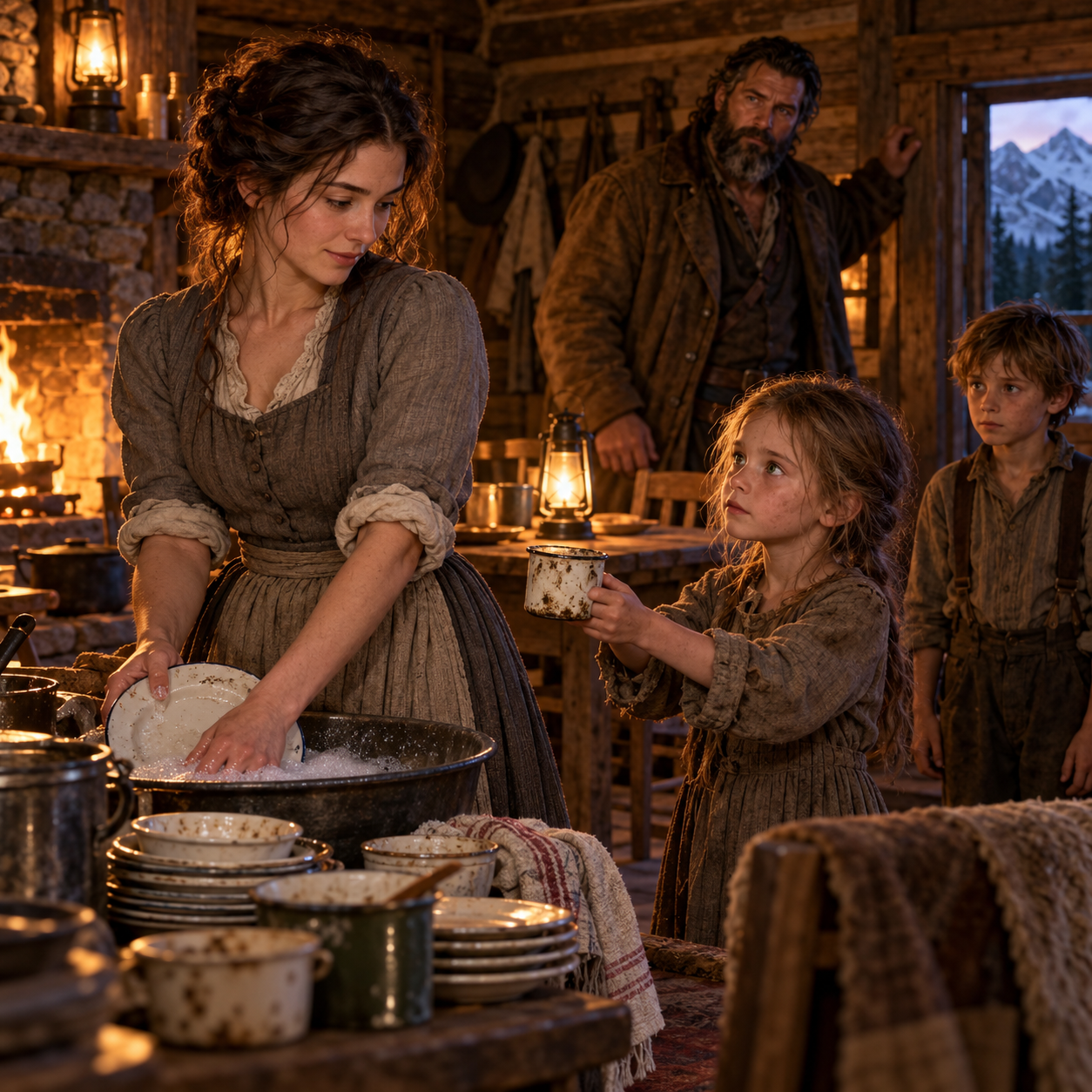
The little girl stood perfectly still.
Her small fingers gripped the handle of the dirty cup so tightly that her knuckles had turned white.
Kora looked from the cup to the child’s suspicious face.
“Would you like me to wash this?”
The girl said nothing.
“Or would you rather wash it yourself?”
A pause.
Then the child whispered, “You won’t make me?”
Kora’s hands stopped moving.
It was an ordinary question.
But something about the way the little girl asked it made Kora feel an unexpected chill.
“Of course not.”
The girl studied her.
“Papa makes us wash things.”
“Your father probably thinks you’re old enough to help.”
“He says everybody has to work.”
“He’s right about that.”
Kora smiled gently.
“But there’s a difference between helping someone and being forced to do something because you’re afraid.”
The girl lowered her eyes.
For a moment, Kora thought she might disappear back into the shadows.
Instead, she carefully set another cup beside the first.
“This one’s Tommy’s.”
“Then perhaps Tommy would like to come help.”
From behind the kitchen table came a sharp voice.
“I ain’t washing nothing for you.”
Kora turned.
The boy stood with his arms folded across his narrow chest.
His dark hair stuck out in every direction, and his green eyes were almost identical to Griffin’s.
“Very well,” Kora answered.
Tommy frowned.
“Very well what?”
“Very well, you don’t have to.”
He looked disappointed.
Apparently, he’d been hoping for an argument.
Kora returned to the basin.
The little girl remained beside her.
“What’s your name, sweetheart?”
The child’s lips moved.
“Nell.”
“That’s a lovely name.”
“My mama gave it to me.”
Kora’s expression softened.
“Then she must have loved you very much.”
The girl’s face changed.
It happened so quickly Kora almost missed it.
One moment, Nell was simply a wary little girl standing beside a stranger.
The next, her eyes filled with something darker than sadness.
“She went away.”
Kora dried her hands.
“I’m sorry.”
Nell shook her head fiercely.
“Papa says she didn’t want to.”
“Then I’m sure she didn’t.”
Tommy suddenly slammed his fist against the table.
“Don’t talk about Mama!”
The sound cracked through the cabin.
Nell flinched.
Kora immediately stepped away from the washbasin.
“All right.”
Tommy’s breathing grew ragged.
“Don’t say her name. Don’t ask about her. And don’t touch her things.”
Kora nodded.
“I won’t.”
The boy stared at her.
“You promise?”
“I promise.”
He searched her face for some sign that she was lying.
Then, without another word, he grabbed his sister’s hand and dragged her toward the back room.
The door slammed.
Kora stood alone in the kitchen.
Behind her, Griffin spoke quietly.
“They haven’t mentioned their mother in months.”
She turned.
He stood in the doorway, his enormous frame nearly filling it.
His face was unreadable.
“I didn’t mean to upset them.”
“You didn’t.”
“Then why—”
“Because nobody gets close to those children without them thinking they’re going to lose someone again.”
Griffin looked toward the closed bedroom door.
“And I don’t know how to change that.”
For the first time, Kora saw something beneath the mountain man’s stern exterior.
Not anger.
Not impatience.
Helplessness.
The helplessness of a father who could survive a blizzard, wrestle a stubborn mule, and cut enough timber to heat a cabin through winter.
Yet couldn’t reach his own children.
Kora slowly folded the dishcloth.
“Perhaps,” she said, “we shouldn’t try to change them tonight.”
Griffin looked at her.
“What should we do?”
“Give them a reason to come out tomorrow.”
He raised an eyebrow.
“And how exactly do you plan to accomplish that?”
Kora glanced toward the flour sack beside the stove.
“You mentioned they eat like wolves.”
“They do.”
“Then I suppose we’d better start with breakfast.”
For the first time since she’d met him, Griffin almost smiled.
Almost.
But not quite.
Kora woke before sunrise.
The cabin was bitterly cold.
Frost had formed along the inside edges of the windowpanes, and the blanket Griffin had provided barely kept the mountain air from creeping into her bones.
She sat up slowly.
Outside, the wind whistled through the pine trees.
For one terrible moment, she wondered whether Amos Higgins had been right.
Perhaps she was too small.
Perhaps the mountains really would swallow her whole.
Then she remembered the way Nell had asked whether she would be forced to wash a cup.
And the way Tommy had reacted when his mother was mentioned.
Kora pushed back the blanket.
She had survived twelve-hour shifts in a Chicago sewing shop, weeks of hunger after her father’s death, and winters in a boardinghouse where the windows leaked icy air.
She could survive a cold morning.
Especially when there were two children who needed breakfast.
She dressed quickly and entered the kitchen.
Griffin was already gone.
A note lay beside the stove.
Gone to check the northern traps. Back before supper. Wood stacked outside. Food in pantry.
Beneath the message, in awkward handwriting, he had added:
Thank you for staying.
Kora read those last four words twice.
Then she folded the note carefully and tucked it into her apron pocket.
She spent the next hour making biscuits, frying salt pork, and warming preserved apples with cinnamon.
By the time the twins appeared, the cabin smelled better than it probably had in months.
Tommy stopped in the doorway.
Nell nearly collided with him.
Both children stared at the table.
Kora pretended not to notice.
“Good morning.”
Neither answered.
“I made breakfast.”
Tommy sniffed suspiciously.
“What’s that smell?”
“Apples.”
“Apples don’t smell like that.”
“These do.”
“Why?”
“Because I put cinnamon in them.”
Tommy moved closer.
“What’s cinnamon?”
Kora held out a spoon.
“Something you might like to taste.”
He stared at it.
Then at her.
“Could be poison.”
Kora calmly tasted the apples herself.
“Then I’m afraid we’re both in terrible trouble.”
Nell giggled.
It was a tiny sound.
Barely more than a breath.
But Tommy turned toward her as though she’d committed a crime.
Nell immediately covered her mouth.
Kora said nothing.
She simply placed two plates on the table.
“You may sit wherever you like.”
Tommy claimed the chair nearest the door.
Nell climbed into the one beside the stove.
Both children began eating with astonishing speed.
Kora watched in silence for a moment.
Then she said, “There’s plenty.”
Tommy froze.
“What?”
“There’s enough food. You don’t have to hurry.”
He stared at his plate.
Then, very slowly, he put down his fork.
Nell did the same.
Kora’s heart tightened.
Children didn’t eat that way without a reason.
She wondered what life had been like before Griffin brought her here.
What had frightened these children so badly that kindness seemed unfamiliar?
But she didn’t ask.
Not yet.
Instead, she reached for a piece of paper and a pencil.
“Now, I have a proposition.”
Tommy groaned.
“What’s that mean?”
“It means I have an idea.”
“Probably a bad one.”
“Possibly.”
Kora drew three simple shapes on the paper.
A circle.
A square.
And a triangle.
“I’ll make you something sweet every afternoon if you can learn three new things each day.”
Tommy narrowed his eyes.
“Like what?”
“Letters. Numbers. Words. Anything useful.”
“I already know things.”
“I’m sure you do.”
“I know how to set a rabbit snare.”
“Excellent.”
“And how to tell when snow’s coming.”
“Very impressive.”
“And how to shoot a rifle.”
Kora paused.
“Your father taught you that?”
“No. I watched him.”
“Well, perhaps today we can learn something that doesn’t involve catching or shooting anything.”
Tommy considered this.
Then he pointed at the circle.
“What’s that?”
“A circle.”
“Looks like the moon.”
“Very good.”
Nell pointed at the square.
“That looks like Papa’s window.”
Kora smiled.
“Exactly.”
Tommy leaned forward.
“What happens if we learn six things?”
Kora pretended to think.
“Then perhaps there will be extra honey on tomorrow’s biscuits.”
Both children looked at each other.
For the first time, they shared an expression that wasn’t fear.
It was conspiracy.
And Kora suspected she’d just made her first real bargain in the mountains.
By the fourth day, everything had begun to change.
Not dramatically.
Not all at once.
But in tiny ways that Griffin noticed even when he pretended not to.
Tommy stopped hiding his boots beneath the bed.
Nell started humming while helping Kora knead dough.
The twins began washing their hands without being reminded.
And every evening, when Griffin returned from the timberline, he found three chairs drawn close together beside the fire.
Kora taught the children their letters using charcoal and scraps of wood.
She taught Nell how to sew a crooked little pouch.
She taught Tommy to count the jars in the pantry.
And she learned things from them in return.
Which berries were poisonous.
How to listen for elk in the trees.
How quickly mountain weather could turn dangerous.
One afternoon, Nell surprised her by taking her hand.
“Miss Kora?”
“Yes?”
“Can you braid hair?”
Kora looked down at the child’s tangled curls.
“I believe I can.”
“Mama used to.”
The words were barely audible.
Kora swallowed.
“Then I would be honored to try.”
Nell sat on a stool while Kora gently worked the knots loose.
Halfway through, the little girl whispered, “Mama used to sing.”
“What did she sing?”
Nell hesitated.
Then began humming a slow, unfamiliar tune.
Kora listened carefully.
It was a lullaby.
Soft.
Sad.
Beautiful.
She hummed along when she understood the melody.
Nell leaned back against her.
And for the first time, she allowed herself to be held.
Neither noticed Griffin standing in the doorway.
He had returned early from the forest.
His heavy boots were dusted with snow.
A bundle of firewood rested against his shoulder.
But he didn’t move.
He simply watched as his daughter sat peacefully in the arms of a woman she’d known less than a week.
His jaw tightened.
Then he quietly stepped outside again.
Because there were some things a lonely man didn’t know how to witness without breaking.
That evening, Griffin found Kora alone at the table.
She was mending Tommy’s torn coat.
The fire cast warm golden light across her face.
For several minutes, Griffin stood silently near the stove.
Then he cleared his throat.
“Kora.”
She looked up.
“Yes?”
“You’ve done good work.”
“Thank you.”
“The children seem…”
He stopped.
Kora waited.
“Different,” he finished.
“They’re wonderful children.”
Griffin gave a humorless laugh.
“They’re stubborn as mountain goats.”
“That too.”
He sat opposite her.
The chair creaked beneath his weight.
“I need to tell you something.”
Kora set down the needle.
His expression had changed.
Something heavy had settled behind his eyes.
“When their mother died, I didn’t handle things well.”
Kora remained quiet.
“I buried her on the ridge above the creek. Then I went back to work.”
He stared at his hands.
“I figured if I kept food in their bellies and a roof over their heads, they’d be all right.”
His voice grew rough.
“But they weren’t.”
Kora waited.
Griffin drew a slow breath.
“Tommy stopped talking for nearly two months. Nell wouldn’t sleep unless her brother was beside her.”
“That must have been terrible.”
“It was.”
He looked toward the children’s room.
“And then someone told them their mother hadn’t really died.”
Kora went still.
“What?”
Griffin’s expression hardened.
“Someone said she’d left because she didn’t want them anymore.”
A sick feeling spread through Kora’s stomach.
“Who would say such a thing to children?”
“I don’t know.”
“Did they believe it?”
Griffin looked at her.
“Some days I think they still do.”
Before Kora could answer, a small voice came from the hallway.
“Because it’s true.”
Tommy stood in the darkness.
His face was pale.
Nell appeared behind him.
Griffin rose.
“Son—”
“Mama didn’t die!”
The words exploded from Tommy.
“She went away!”
Griffin took a step toward him.
“Tommy, we’ve talked about this.”
“No!”
The boy’s eyes filled with tears.
“Mr. Higgins said so!”
Silence.
Kora felt her entire body go cold.
“Higgins?”
Tommy nodded violently.
“The man from town.”
Griffin’s expression changed.
“What man?”
“The one who came when you were gone.”
Nell clutched her brother’s sleeve.
“He said Mama was tired of us.”
Kora stared at the children.
Then at Griffin.
The mountain man’s face had become frighteningly still.
“When did this happen?”
Tommy swallowed.
“Before the first big snow last year.”
Griffin’s hands curled into fists.
“Why didn’t you tell me?”
Tommy’s chin trembled.
“Because he said you’d be angry.”
Griffin knelt.
His enormous hands rested carefully on the boy’s shoulders.
“Listen to me.”
Tommy tried to look away.
Griffin gently lifted his chin.
“Your mama loved you.”
The boy’s eyes overflowed.
“Then why’d she leave?”
“She didn’t leave.”
“Mr. Higgins said—”
“I don’t care what Higgins said!”
His voice thundered through the cabin.
Both children recoiled.
Griffin immediately stopped.
He looked horrified by his own outburst.
“I’m sorry.”
Tommy backed away.
Nell began crying.
And before either adult could reach them, the twins disappeared into their bedroom.
The door slammed.
Kora remained seated.
Her pulse hammered.
Amos Higgins.
The same man who had rejected her on the railway platform.
The same man who had looked at her as if she were worthless.
What possible reason could he have had to visit Griffin’s children?
And why would he tell them such a cruel lie?
Griffin stood motionless.
Then he spoke through clenched teeth.
“Higgins and I have unfinished business.”
The next morning, Griffin saddled his horse before dawn.
Kora found him tightening the girth strap.
“Where are you going?”
“Town.”
“To see Amos?”
He didn’t answer.
“Griffin.”
His hands stopped.
She stepped closer.
“If you storm into town and start a fight, those children will be frightened all over again.”
“He had no right to come onto my land.”
“I agree.”
“He had no right to speak to them.”
“I agree with that too.”
Griffin turned.
“Then what would you have me do?”
Kora looked toward the cabin.
“Find out why he came.”
“He wanted to hurt me.”
“Perhaps.”
“Perhaps?”
She met his eyes.
“Men like Amos Higgins don’t usually go ten miles up a mountain just to frighten two children.”
Griffin’s jaw flexed.
“Then what are you suggesting?”
“That he wanted something.”
The silence between them deepened.
Griffin finally looked away.
“There are things about my wife’s death you don’t know.”
Kora waited.
He pulled his hat lower.
“And there are things about this mountain I’d rather you never had to learn.”
Before she could respond, he swung into the saddle.
“Keep the children inside today.”
Then he rode away.
Kora watched him disappear between the pines.
A strange uneasiness settled over her.
Something was wrong.
Something much larger than a cruel remark made by a bitter man.
And she feared Griffin knew more than he was willing to say.
By midday, snow had begun falling.
Fine white flakes drifted against the windows.
Inside, Kora tried to distract the twins with reading lessons.
Tommy refused to participate.
Nell barely spoke.
Eventually, Kora put the books away.
“Would you like to tell me about your mother?”
Tommy’s head snapped up.
“You promised not to ask.”
“You’re right.”
She folded her hands.
“And I’ll keep that promise. But if you ever want to tell me something about her, I’ll listen.”
Neither child answered.
Then Nell slipped from her chair.
She disappeared into the bedroom.
A minute later, she returned carrying a small wooden box.
The box was made from dark cedar.
Its brass hinges were green with age.
Nell placed it on the table.
“Mama’s.”
Kora looked at Tommy.
The boy stared at the box.
“Papa doesn’t know we kept it.”
“Then perhaps we shouldn’t open it.”
Nell shook her head.
“Mama said to.”
Kora frowned.
“Your mother told you to open it?”
Nell nodded.
“When the bad man came back.”
The room seemed to grow colder.
Kora looked at Tommy.
“What bad man?”
The boy swallowed.
“The man with the black gloves.”
Kora’s heart began beating faster.
“Was that Amos Higgins?”
Tommy hesitated.
“I don’t know.”
Nell pointed at the box.
“Mama told us to hide it.”
Kora gently touched the lid.
“Before she died?”
Nell nodded.
“She was coughing. Real bad.”
Kora’s throat tightened.
“Did she say anything else?”
The little girl’s voice dropped to a whisper.
“She said Papa mustn’t give him the papers.”
Kora looked down at the box.
Papers?
What papers?
She slowly opened the lid.
Inside lay a faded blue ribbon, a silver thimble, a dried flower, and a packet wrapped in yellowed cloth.
Beneath them was a folded letter.
Kora carefully lifted it out.
The handwriting was elegant but uneven, as though the writer’s hands had been trembling.
Across the front were three words.
For my children.
Kora felt the twins move closer.
“Will you read it?” Nell whispered.
Kora hesitated.
This was their mother’s letter.
Something precious.
Something private.
But the children were watching her with desperate hope.
So she unfolded the paper.
My dearest Tommy and Nell,
If you are reading this, then I have gone somewhere I cannot follow you home from.
Please believe that nothing in this world could ever make me leave you willingly.
You are the greatest gifts God ever gave me.
Kora paused.
Nell’s fingers tightened around her sleeve.
She continued.
Your father is a good man, though he carries sorrow like a stone in his chest. He will protect you, even when he cannot find the words to comfort you.
But there is something I fear.
Before I became ill, I discovered that a man your father trusted had been stealing from us.
Kora’s breath caught.
She read on.
He believes I destroyed the proof.
I did not.
I hid it where he would never think to look.
The next sentence made her blood run cold.
If Amos Higgins comes to the cabin, do not let him inside.
Kora stopped reading.
For a long moment, the only sound was the crackling fire.
Tommy stared at her.
“What’s wrong?”
Kora forced herself to breathe.
“Nothing, sweetheart.”
But that wasn’t true.
Nothing about this was right.
Amos Higgins hadn’t simply humiliated her at the station.
He was connected to Griffin’s dead wife.
And somehow, Kora had walked directly into the middle of something dangerous.
She looked at the remaining lines.
I have placed the most important paper beneath the false bottom of this box.
Do not show it to anyone except your father.
And if the man returns before your father knows the truth—
The writing broke off.
There was a dark stain near the bottom of the page.
And the last few words had been written so shakily that Kora could barely understand them.
Remember what happened at Blackwater Ridge.
Kora stared at the name.
Blackwater Ridge.
She had heard it before.
Griffin had mentioned it once, when describing the eastern boundary of his land.
It was a stretch of wilderness he rarely visited.
A place where the old mining trails had collapsed decades earlier.
She carefully replaced the letter.
“We need to tell your father.”
Tommy shook his head.
“He’ll get mad.”
“No, sweetheart.”
Kora drew both children close.
“He’ll be grateful you kept something so important safe.”
Nell looked up.
“Do you think Mama knew you’d come?”
Kora’s eyes stung.
“No, darling.”
Nell leaned against her.
“I think she did.”
Kora held the child tighter.
And for the first time since arriving in the mountains, she felt something she hadn’t expected.
Not merely responsibility.
Not merely gratitude.
Love.
It had entered her heart quietly, through two frightened children and a little cedar box.
And now she knew she would do whatever was necessary to protect them.
Griffin returned just before sunset.
His horse was sweating.
His coat was dusted with fresh snow.
And there was blood on his knuckles.
Kora met him outside.
“What happened?”
“Nothing worth discussing.”
“Griffin.”
He dismounted stiffly.
“Higgins wasn’t at his house.”
“Did you ask where he went?”
Griffin looked at her.
“The stable keeper says he left town yesterday.”
Kora’s stomach tightened.
“Where was he going?”
“North.”
“Toward the mountain?”
Griffin didn’t answer.
Kora stepped closer.
“The children found something.”
His expression changed.
“What?”
“A letter from your wife.”
Griffin went completely still.
For several seconds, he didn’t even seem to breathe.
“What letter?”
Kora explained.
The wooden box.
The warning.
Amos Higgins.
Blackwater Ridge.
With every word, Griffin’s face grew paler.
When she finished, he gripped the porch railing.
“Where’s the box?”
“Inside.”
“Did you open the bottom?”
“Not yet.”
Griffin closed his eyes.
“Dear God.”
Kora touched his arm.
“Griffin, what’s happening?”
He looked at her.
For the first time, she saw fear in his eyes.
Real fear.
The kind that no mountain storm could inspire.
“My wife told me she thought someone was stealing timber from our land.”
Kora waited.
“She said she had proof.”
“What happened?”
“I didn’t believe her.”
His voice broke.
“She was already sick. Feverish. Weak. I thought she was imagining things.”
Kora said nothing.
Griffin looked toward the darkening trees.
“Three days before she died, Amos Higgins came to the cabin.”
Kora felt a cold wave move through her.
“Why?”
“He said he was collecting an old debt.”
“What debt?”
Griffin’s expression hardened.
“A debt that never existed.”
Suddenly, a sound rang out from inside the cabin.
A crash.
Then Nell screamed.
Griffin moved instantly.
He rushed through the doorway with Kora close behind.
They found Tommy standing beside the kitchen table.
The cedar box lay open on the floor.
Its contents were scattered.
And the boy was pointing toward the back window.
“Someone was watching us!”
Griffin crossed the room.
Outside, snow swirled between the trees.
For a moment, there was nothing.
Then Kora saw it.
A dark figure moving beyond the woodpile.
A man.
Tall.
Wearing a black coat.
And black gloves.
Griffin grabbed his rifle.
“Stay inside!”
He threw open the door and vanished into the snow.
Kora slammed the door behind him.
She turned to the twins.
“Come here.”
Nell ran into her arms.
Tommy remained frozen beside the window.
“That’s him.”
Kora knelt.
“Who?”
“The man who came before Mama died.”
“Are you certain?”
Tommy nodded.
“He told Mama that if she didn’t give him the papers, something bad would happen.”
Kora felt her heart pound against her ribs.
“Did your father know?”
Tommy shook his head.
“Mama said not to tell him.”
“Why?”
The boy looked toward the door.
“Because the man said he’d hurt Papa first.”
Outside, a gunshot shattered the evening silence.
Nell screamed.
Kora pulled both children to the floor.
A second shot followed.
Then a third.
And then—
Silence.
Terrible, endless silence.
Minutes passed.
Kora waited.
She held the children close beside the stove.
The fire crackled.
The wind battered the walls.
Somewhere beyond the cabin, Griffin was facing a man who might have threatened his wife’s life.
Kora glanced toward the rifle hanging above the mantel.
Then toward the door.
She couldn’t leave the twins.
But she couldn’t bear doing nothing.
Finally, she heard footsteps.
Slow.
Heavy.
The door handle moved.
Kora grabbed the fireplace poker.
“Who’s there?”
No answer.
The handle turned again.
Kora stepped in front of the children.
“Answer me!”
A familiar voice came from outside.
“It’s me.”
Griffin.
She rushed forward and opened the door.
He stumbled inside.
Blood stained his sleeve.
His breathing was uneven.
And in his left hand, he carried something that made Kora’s stomach drop.
A woman’s blue ribbon.
The same shade as the ribbon inside the cedar box.
“Griffin!”
She helped him toward a chair.
“Are you hurt?”
“Just grazed.”
“Who was out there?”
He looked at the children.
Then at Kora.
“I didn’t see his face.”
“Did he get away?”
Griffin nodded.
“Left his horse below the ridge. He knows these woods.”
Kora pressed a clean cloth against his arm.
“Then we have to contact the sheriff.”
Griffin gave a bitter laugh.
“The sheriff?”
“Yes.”
“The sheriff’s brother worked for Higgins for twelve years.”
Kora stared at him.
“And that means?”
“It means I’m not certain who we can trust.”
The twins began crying quietly.
Griffin looked at them.
Something in his expression softened.
He reached out his uninjured arm.
Both children rushed toward him.
He held them so tightly Kora feared he might never let go.
“I’m here,” he whispered.
“Papa’s here.”
Kora looked away.
She suddenly understood the terrible weight of the past fourteen months.
Griffin hadn’t simply lost a wife.
He had lost the part of himself that knew how to hope.
And now that hope was being threatened again.
Later that night, after the children finally fell asleep, Kora and Griffin examined the cedar box.
The false bottom lifted with the tip of a kitchen knife.
Beneath it lay three folded documents.
The first was a handwritten account of timber taken from the eastern boundary.
The second contained dates, measurements, and payments.
The third was a legal document bearing the signature of Amos Higgins.
Kora read it carefully.
Then read it again.
“Griffin.”
He looked up.
“This isn’t just about stolen timber.”
“What do you mean?”
She pointed toward a paragraph near the bottom.
“According to this, Higgins arranged to transfer the mineral rights beneath Blackwater Ridge to a company in Denver.”
Griffin frowned.
“There’s nothing worth mining on Blackwater.”
“Perhaps there is.”
He shook his head.
“My father worked those hills. He would’ve known.”
Kora tapped the document.
“Then why would someone pay so much money to acquire them?”
Griffin leaned closer.
The amount written on the paper was staggering.
More money than he could earn in twenty years.
His face went blank.
“That’s impossible.”
Kora turned to the second page.
“These payments were made over three years.”
“And?”
“The first was made before your wife became ill.”
Griffin stared.
“The last one was made two weeks after she died.”
The cabin fell silent.
Kora slowly looked up.
“Griffin…”
He was no longer looking at the paper.
He was staring into the fire.
“She told me,” he whispered.
“What?”
“She told me Higgins was trying to take something from us.”
Kora waited.
“I thought she was frightened because she was sick.”
He pressed a hand against his forehead.
“I told her to rest.”
His voice broke.
“God forgive me, I told her to stop worrying over foolishness.”
Kora reached across the table.
“She was trying to protect your family.”
Griffin looked at her.
“And I didn’t listen.”
For a moment, the giant mountain man seemed smaller than she’d ever seen him.
Then his gaze fell upon the third document.
His expression sharpened.
“Wait.”
“What is it?”
He lifted the paper toward the lamp.
“That isn’t my signature.”
Kora frowned.
“Where?”
He pointed to the bottom.
The document had been signed in his name.
Griffin Mercer.
Kora stared at the handwriting.
“You didn’t sign this?”
“No.”
“Are you certain?”
Griffin’s eyes flashed.
“I know my own name.”
Kora’s pulse quickened.
“Then someone forged it.”
Griffin rose slowly.
His chair scraped against the floor.
“And if this document is legal, they can claim I sold the rights.”
“Unless we prove it’s fraudulent.”
He looked toward the children’s bedroom.
“And if I can’t?”
Kora understood.
Their home.
Their land.
The only place the twins had ever known.
Everything Griffin had spent his life building could be taken away.
She stood.
“Then we find proof.”
Griffin looked at her for a long time.
“You don’t owe us this.”
Kora felt something ache in her chest.
“I know.”
“You could leave tomorrow.”
“I know.”
“You’d be safer.”
She stepped closer.
“Griffin, the day I arrived in this town, a man looked at me and decided I wasn’t worth keeping.”
Griffin’s jaw tightened.
Kora continued.
“You were the first person who looked beyond what I appeared to be.”
He said nothing.
“And those children have given me something I thought I’d never have.”
“What?”
She smiled sadly.
“A reason to wake up and feel that someone needs me.”
Griffin stared at her.
The firelight moved across his face.
For one suspended moment, the distance between them seemed very small.
Then he spoke.
“Kora…”
Before he could finish, a noise came from the porch.
Three heavy knocks.
Both froze.
It was nearly midnight.
The snowstorm had intensified.
No decent traveler would be wandering the mountain at such an hour.
Griffin reached for his rifle.
The knocks came again.
Then a voice called through the door.
“Griffin Mercer! Open up!”
Kora recognized the voice.
Her blood ran cold.
Amos Higgins.
Griffin moved toward the door.
Kora grabbed his sleeve.
“Don’t.”
Outside, Amos shouted again.
“I know you’ve found the papers!”
Griffin stopped.
The voice continued.
“And if you know what’s good for those children, you’ll hand them over!”
Griffin’s expression became murderous.
Kora tightened her grip.
“Please.”
But then Amos said something neither of them expected.
“Your wife didn’t die from fever alone, Mercer!”
The words seemed to stop time.
Griffin went rigid.
Kora felt the room tilt around her.
Outside, Amos laughed.
“You really thought she just got sick?”
Griffin’s hand trembled around the rifle.
“What did you say?”
“You heard me.”
Kora looked toward the children’s room.
The door was slightly open.
Two small faces watched from the darkness.
Amos spoke again.
“There’s something your precious wife never told you.”
Griffin stepped toward the door.
Kora whispered, “Don’t listen to him.”
But Amos wasn’t finished.
“She discovered what was buried beneath Blackwater Ridge.”
A terrible silence followed.
Then Amos lowered his voice.
“And she wasn’t the first person who died trying to keep it a secret.”
Griffin opened the door.
The winter wind rushed inside.
Amos stood on the porch, snow clinging to his hat and shoulders.
A revolver hung at his hip.
But he wasn’t alone.
Two men stood behind him.
One carried a shotgun.
The other held a lantern.
And tied behind their horses was a third figure.
A man with his hands bound.
His face was badly bruised.
Griffin stared at him.
Then all the color drained from his face.
“No…”
Kora stepped forward.
“Who is that?”
Griffin’s lips barely moved.
“My brother.”
Kora stared.
Griffin had never mentioned a brother.
Not once.
The bound man slowly raised his head.
His eyes were the same pale green as Griffin’s.
Blood ran from a cut above his eyebrow.
“Don’t give him the papers,” he rasped.
Amos struck him across the face.
Griffin lunged forward.
The shotgun rose instantly.
“One more step,” Amos warned, “and your brother dies.”
Kora grabbed Griffin’s arm.
He was shaking with fury.
“Where have you been?” Griffin demanded.
The prisoner managed a bitter smile.
“Trying to keep you alive.”
Amos laughed.
“Enough family reunion.”
He extended one gloved hand.
“The documents, Mercer.”
Griffin didn’t move.
Amos’s expression darkened.
“Now.”
Kora’s mind raced.
The papers were still on the kitchen table.
The twins were watching.
Griffin’s brother was bleeding.
And three armed men stood between them and the road.
There was no way to fight without risking someone’s life.
Then the prisoner looked directly at Kora.
Something flashed in his expression.
Recognition.
His eyes widened.
He stared at her as though he’d seen a ghost.
“Wait…”
Amos glanced toward him.
The prisoner struggled against his bindings.
“You brought her here?”
Griffin frowned.
“What are you talking about?”
The man ignored him.
His gaze remained fixed on Kora.
“What’s your name?”
Kora swallowed.
“Kora Wade.”
The prisoner went white.
Amos’s expression changed instantly.
“Shut your mouth!”
But the bound man leaned forward.
“Wade?”
Kora stared at him.
“Yes.”
He began shaking his head.
“No… no, that can’t be possible.”
Amos drew his revolver.
“I said shut up!”
But Griffin’s brother shouted over him.
“YOUR FATHER DIDN’T DIE IN CHICAGO!”
Kora felt the ground disappear beneath her.
For twelve years, she had believed her father was dead.
Twelve years of mourning.
Twelve years of struggling alone.
Twelve years of accepting that the only family she’d ever known was gone.
She stared at the stranger.
“What?”
His eyes filled with desperation.
“Your father came to Blackwater Ridge!”
Amos raised the gun.
The prisoner shouted one final sentence.
“AND HE’S THE REASON GRIFFIN’S WIFE WAS KILLED!”
A gunshot exploded across the porch.
Kora screamed.
Griffin lunged forward.
The lantern shattered.
And the mountain disappeared into darkness.
TO BE CONTINUED IN PART 3…