“One Last Round Together” The Day Two Warriors Said Goodbye to Their Brother
“One Last Round Together”
The Day Two Warriors Said Goodbye to Their Brother
The church is full, but the silence has weight.
Not the silence of emptiness — the silence of too much feeling compressed into too small a space, of hundreds of people breathing carefully, of grief so collective and so genuine that it becomes its own kind of presence in the room. White flowers everywhere. White lilies, white roses, white chrysanthemums — the color of farewell chosen by people who wanted this to be beautiful, because he deserved beautiful, because Carlos Ray Norris deserved every last petal.
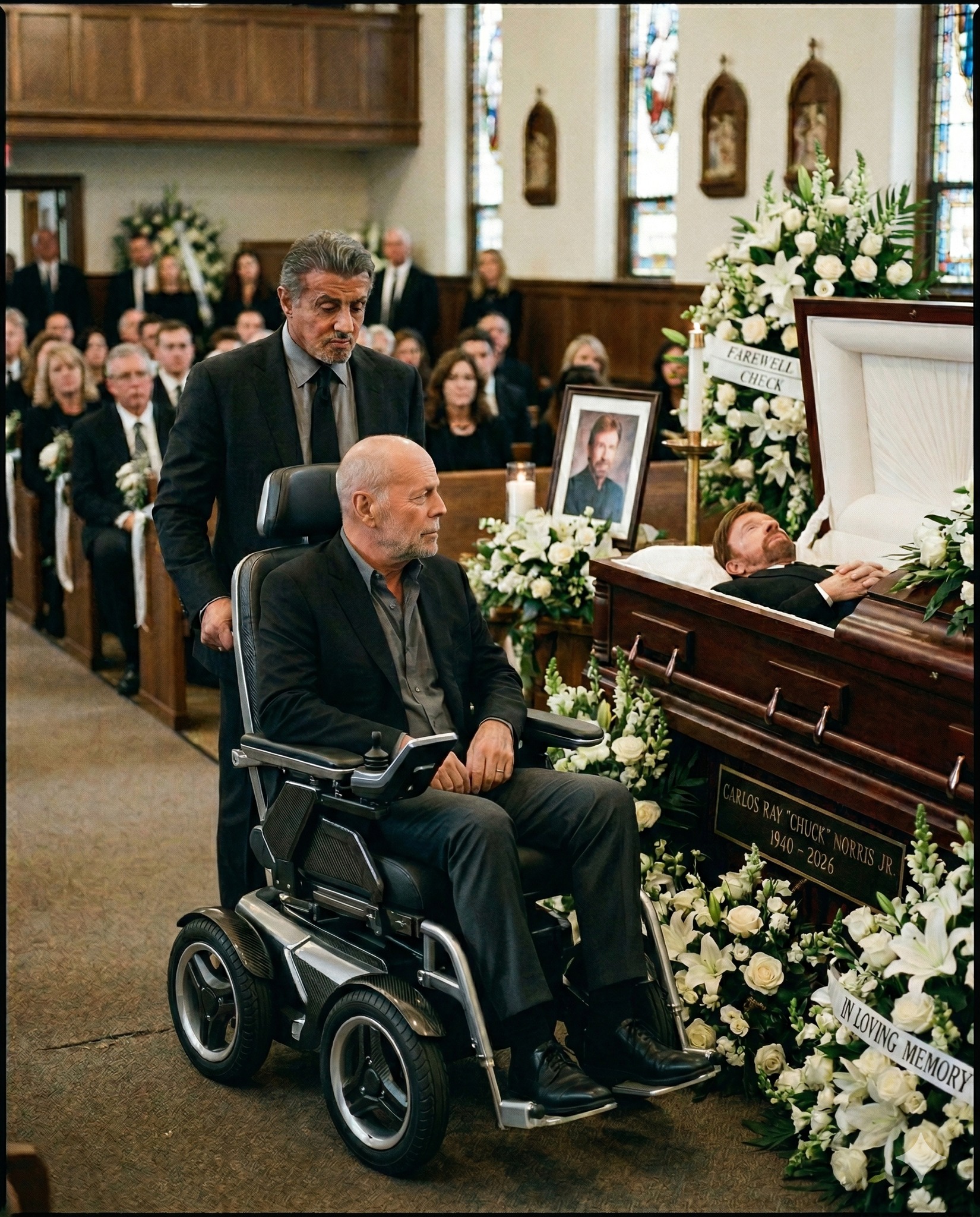
And at the front of that silent, flower-filled church, two men approach the open casket.
One is in a wheelchair. The other walks behind him, one hand resting on the chair — not pushing, exactly. Just present. Just close. Just refusing to let his brother make this walk alone.
Bruce Willis and Sylvester Stallone.
Two men who are themselves living inside their own difficult final chapters — Bruce with the aphasia that has stolen his words, Sly with the years that have slowed but never stopped him — and yet here they are. Here they came. Because when Chuck Norris needed them to show up one last time, there was never any question.
Look at Bruce Willis’s face.
The illness has taken so much — the quick wit, the wisecracking cadence, the yippee-ki-yay energy that made him the defining action hero of a generation. Words come harder now. The man who delivered some of cinema’s most iconic lines sits in his chair and cannot easily form sentences. But grief does not require sentences. Love does not require sentences. And what is written across Bruce Willis’s face in this moment — the set jaw, the eyes fixed on the open casket, the stillness of a man feeling something too large for the body to fully contain — speaks with absolute clarity.
I remember you, Chuck. I remember all of it.
And Sly stands behind him — Sylvester Stallone, who has buried Carl Weathers, who held the photograph of Rocky’s brothers, who knows by now the specific weight of saying goodbye to the men who shaped the same era, who fought in the same celluloid wars, who made the world believe that ordinary men could be extraordinary —
Sly stands behind Bruce and looks at Chuck, and something passes across his face that belongs only to men who have lived long enough to stand at too many caskets.
We were young together once.
God, we were so young.
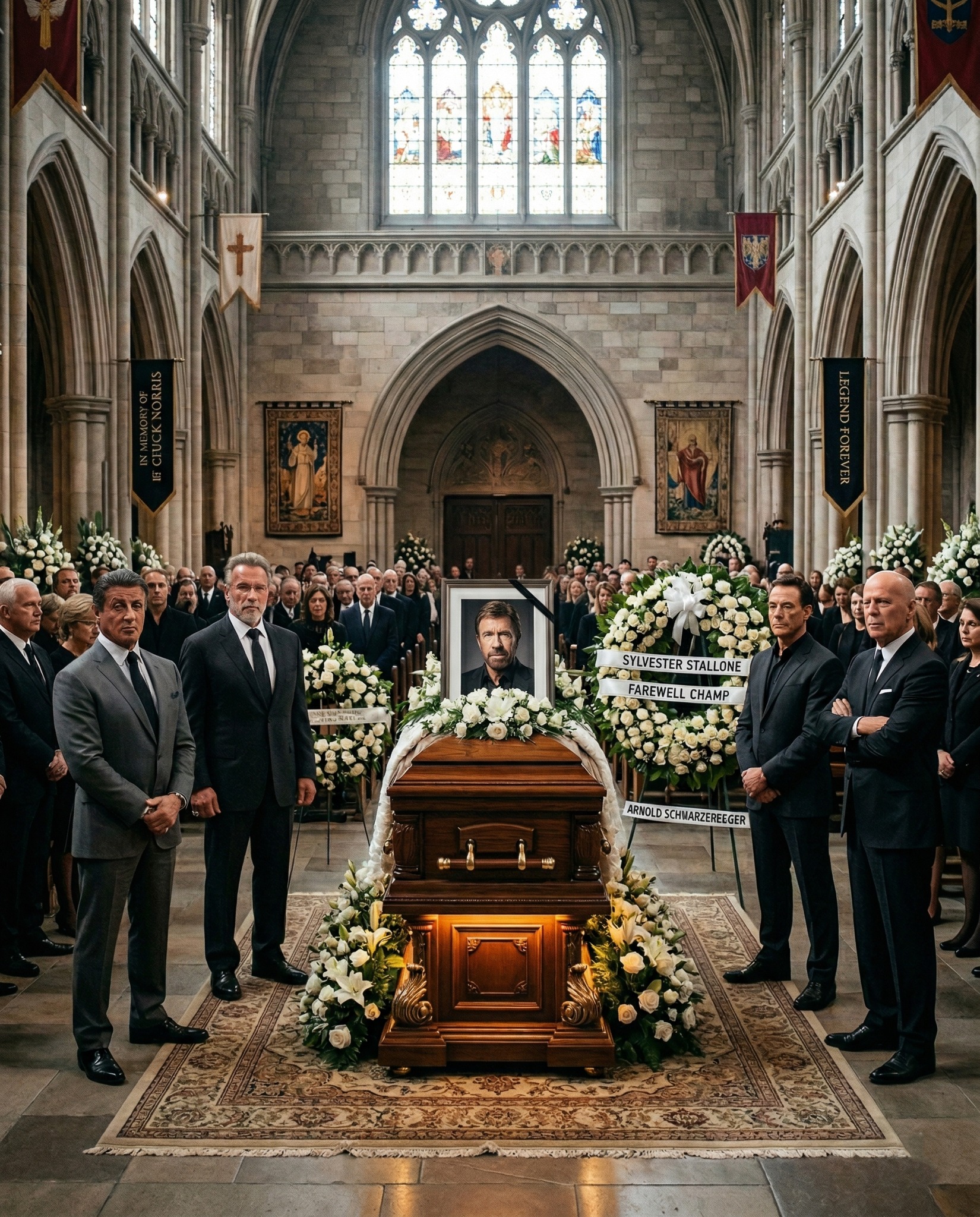
The three of them — Chuck, Bruce, Sly — belonged to the same impossible decade. The 1980s made them mythological. The Expendables brought them back together on screen and reminded a new generation what it felt like when these men occupied the same frame. Off camera, they shared the bond that forms between people who understand each other’s particular madness — the obsession with physical perfection, the willingness to suffer for the craft, the stubborn, beautiful refusal to be anything less than completely committed.
They argued sometimes. Competed always. Loved each other in the wordless, fierce way that men of their generation love — by showing up. By respecting the work. By being there, without being asked, when it mattered most.
Chuck Norris is still now. The casket plaque reads: Carlos Ray “Chuck” Norris Jr. 1940–2026. In Loving Memory.
Bruce reaches out a hand toward the casket edge. Sly’s hand tightens slightly on the wheelchair.
Neither speaks.
Nothing needs to be said.
The last round bell has rung for Chuck.
And his brothers came to hear it.