I never thought silence could be so loud until Linda was gone.
I never thought silence could be so loud until Linda was gone.
We were married for thirty-seven years. She died on a Tuesday morning in March, just after I brought her a cup of tea. One minute she was telling me the garden needed weeding, and the next she was gone. A massive heart attack, the doctor said. I don’t remember much about the funeral. People came and went. Someone brought a casserole. Someone else took the flowers away when they started to wilt. Then everyone left, and the house became quiet in a way I had never experienced before.
The first few months, I moved through the days like I was underwater. I would wake up at 6:15 out of habit, make coffee for two, then remember and pour one cup down the sink. I kept her reading glasses on the side table next to her chair for almost five months. I couldn’t bring myself to move them. Some nights I would sit in the living room with the television on but the sound turned all the way down, just so the house wouldn’t feel completely empty.
I stopped going to the grocery store for a while. It was too hard to walk past the things she liked — the peppermint tea, the dark chocolate she always hid in the back of the pantry, the little packs of tissues she kept in every coat pocket. I lived off frozen meals and whatever neighbors dropped off. My daughter called every Sunday, but I could hear in her voice that she didn’t know what to say to me anymore. I didn’t blame her. I didn’t know what to say to myself either.
One afternoon in late summer, I was sitting on the front porch when I saw the new neighbors moving in across the street. A young woman, maybe thirty, with a little boy who looked about five or six. She was struggling with a heavy box while the boy ran circles around her. I watched them for a while, then went back inside. It wasn’t my business.
But the next morning, I saw her again trying to mow the overgrown lawn with an old push mower that kept getting stuck. Something in me moved before I could talk myself out of it. I walked across the street and asked if she needed help. She looked surprised, then relieved. Her name was Rachel. Her son was called Noah. Her husband had left when Noah was two. They had just moved here because the rent was cheaper.
I ended up mowing the lawn that day. It felt strange to be doing something useful again. When I finished, Rachel offered me a glass of lemonade. We sat on her porch steps while Noah played with a toy truck in the grass. He kept looking over at me but didn’t come close. Rachel told me later that he was shy around men.
After that day, I started finding small reasons to be outside when they were. I fixed their broken mailbox. I helped carry in groceries when Rachel came home looking exhausted after work. One Saturday, Noah finally came over and asked if I had any tools he could use to fix his toy car. I spent the whole afternoon on the driveway with him, showing him how to use a screwdriver and letting him hand me things. He didn’t say much, but he kept coming back.
Slowly, without me really noticing, my days started to have shape again.
I began cooking real meals — simple things at first, but enough for leftovers. Some evenings I would make extra and take a container across the street. Rachel always protested, but she never turned it down. Noah started calling me “Mr. Robert” and would wave from the window when I came outside in the morning. On Sundays, sometimes Rachel would invite me over for dinner. We would eat together at their small kitchen table, and for a little while the house across the street didn’t feel so quiet anymore.
It’s been almost two years now since Linda passed.
I still miss her every single day. There are still mornings when I reach for her side of the bed before I remember. I still talk to her sometimes when I’m working in the garden. But the silence doesn’t feel quite so heavy anymore.
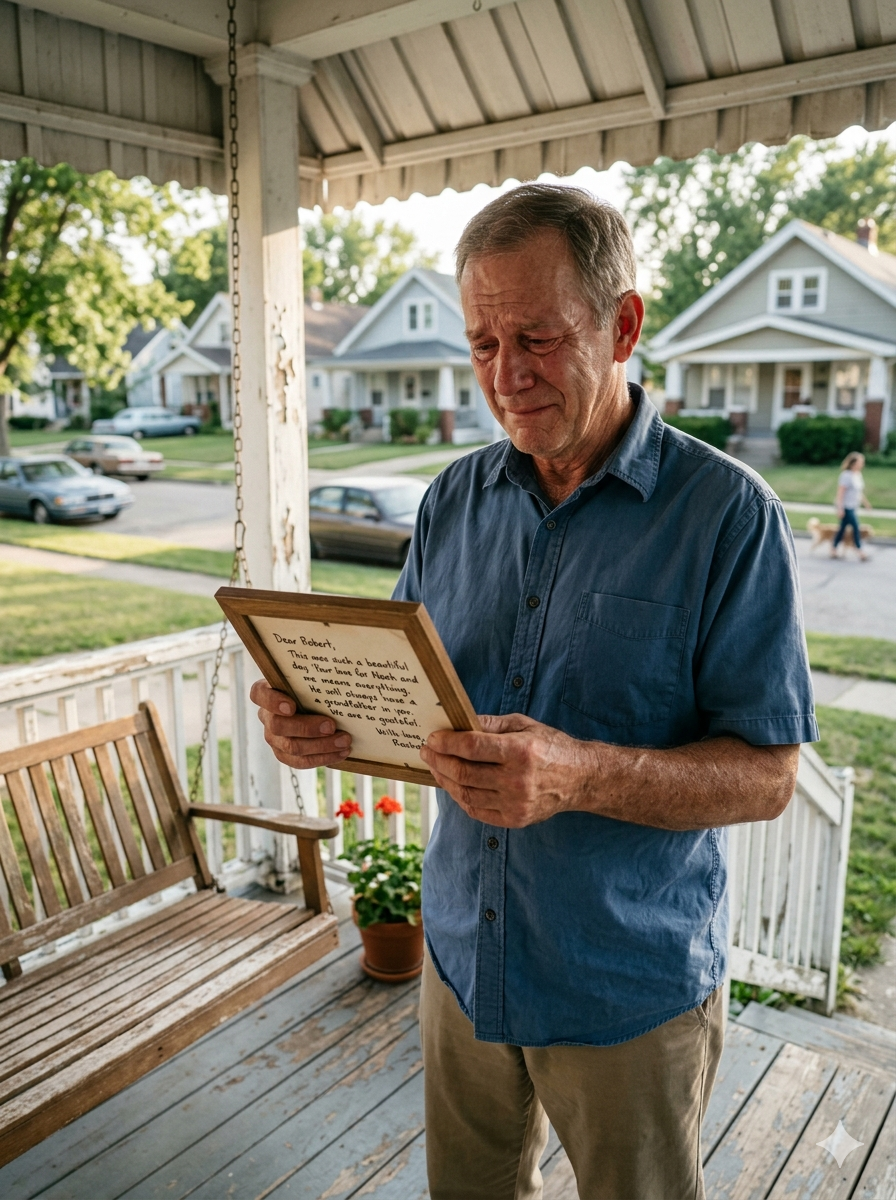
Last month, on what would have been our thirty-ninth anniversary, I went to the cemetery in the morning like I always do. I brought her favorite flowers and sat on the bench near her stone for a long time. When I got home, there was a small box on my porch. Inside was a framed photo of the three of us — me, Rachel, and Noah — taken at the park a few weeks earlier. On the back, Rachel had written in her neat handwriting:
“You’ve become family to us. Linda would be proud of the man you still are. Thank you for showing up.”
I stood on my porch holding that frame for a long time. Then I walked across the street and knocked on their door. When Rachel opened it, I didn’t say anything at first. I just hugged her. Noah came running and wrapped his arms around my leg like he always does now.
I don’t know what the future looks like. I’m sixty-four years old and I still wake up some mornings missing my wife so much it hurts to breathe. But I also know that I’m not just waiting to die anymore.
I’m still here. And for the first time in a long time, that feels like enough.
If you’ve ever lost someone who felt like half of you, or if you’re still learning how to live in a house that suddenly feels too big, I hope you know you’re not alone. Healing doesn’t mean forgetting. It just means finding new reasons to keep going. And sometimes those reasons show up in the most unexpected places — like across the street with a little boy who needs someone to teach him how to use a screwdriver.