Lost for 13 Days, a Hiker Was Finally Spotted by a Drone — But Rescuers Were Stunned by the Tiny Animal Walking Beside Him
By the thirteenth day, the search had become painfully familiar: another drone flight above dense wilderness, another sweep of terrain that had already been examined, another attempt to find a man who had vanished among the trees.
Then something moved below.
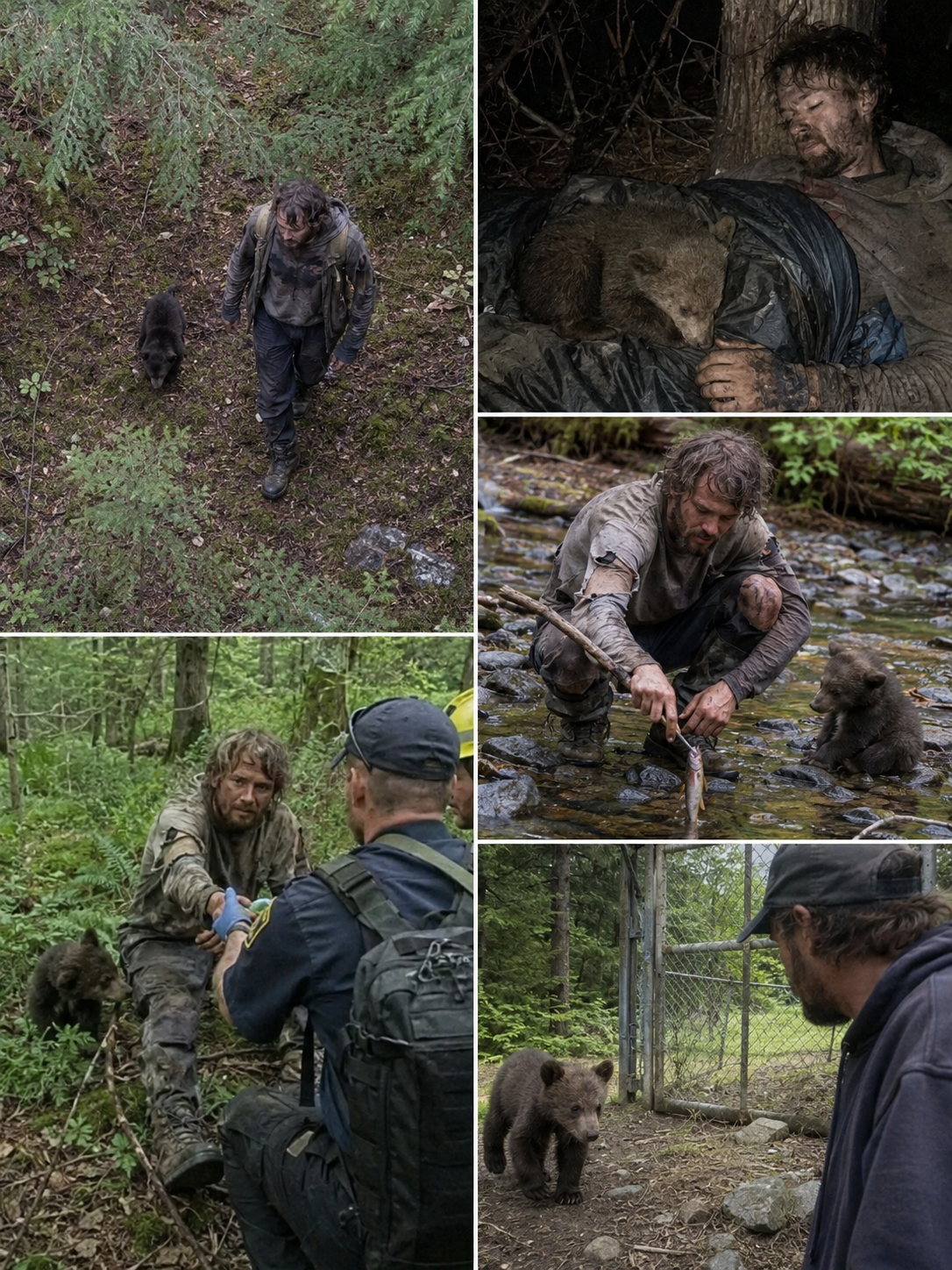
The drone operator spotted a human figure making his way through the forest. He was moving slowly and unsteadily, but he was moving. Beside him was a much smaller shape.
At first, rescuers assumed it was a dog.
When the camera moved closer, they realized they were looking at something far more unusual.
Walking beside missing hiker Matthew was a young bear cub.
A Camping Trip Takes a Dangerous Turn
Matthew’s ordeal had begun almost two weeks earlier during a camping trip with a group of people. What was supposed to be an escape from everyday pressure changed after fellow campers played a prank on him, convincing him that snakes had gotten inside his tent.
The joke frightened and angered Matthew enough that he left the campsite to spend some time alone.
He expected to calm down and eventually return.
Instead, he wandered farther than he realized. Familiar surroundings disappeared, the forest grew thicker, and the sounds of camp faded behind him.
Then his situation became much worse.
While crossing rocky terrain, Matthew slipped on a hillside and struck his head. He lost consciousness, and when he awoke, his memories were fragmented. He knew who he was and remembered that he had been camping, but he could no longer determine exactly where he was or how he had gotten there.
He was injured, disoriented and alone in the wilderness.
An Unexpected Visitor in the Darkness
The first night brought cold temperatures and the unsettling noises of an unfamiliar forest after sunset.
Exhausted, Matthew eventually settled near a tree to rest.
Then he felt something close to his face.
When he opened his eyes, he found a tiny bear cub only inches away.
His first reaction was fear—not necessarily of the cub, but of what might be nearby. A young bear could mean that a protective mother was somewhere close, so Matthew remained still and waited.
No adult bear appeared.
As time passed, another possibility became increasingly clear: the cub seemed to be alone.
Rather than disappearing into the forest, the young animal stayed near Matthew. When he moved, it followed. When he stopped, the cub stopped as well.
Two creatures who had each become separated from everything familiar had somehow found one another.
Survival Becomes a Shared Routine
Matthew still faced the same brutal realities.
His injuries made traveling difficult. He had little food. Every mile consumed energy he could barely afford to lose.
Water became his first priority, so he followed streams whenever possible and searched the landscape for anything that might help him survive. He paid closer attention to birds, animal movement and changes in the forest around him.
The cub, moving instinctively through its natural environment, became an unlikely companion to watch.
Finding enough to eat was harder.
Using a fallen branch, Matthew fashioned a basic tool and repeatedly tried to catch small fish in shallow water. Several attempts failed before he finally succeeded.
When he had enough food, he placed some near the cub.
The bear approached cautiously and ate.
From then on, the companionship deepened.
During the days, the pair traveled through the forest together. At night, when the temperature dropped, the cub curled close to Matthew, providing warmth as they rested.
For a man cut off from his family and uncertain whether rescuers would ever reach him, the animal’s presence gave him something food and water could not: a sense that he was no longer facing the wilderness entirely by himself.
Hundreds Search as the Days Pass
Outside the forest, Matthew’s disappearance had triggered an extensive search.
Rescue crews and volunteers examined trails, riverbanks and difficult slopes. Helicopters searched from above, while drones scanned areas hidden beneath miles of wilderness.
His family waited for news.
Day after day passed without a breakthrough.
Matthew, meanwhile, had no idea how close—or how far away—help might be. His condition was deteriorating as hunger, dehydration and exhaustion took their toll.
But every morning, the cub was still nearby.
Matthew came to feel that another life now depended on him. Caring about whether the little animal survived gave him another reason to continue moving when his own body wanted to stop.
Then, on day 13, the drone found them.
Rescuers Find Two Survivors
Once the drone team confirmed that the moving figure was Matthew, rescuers headed toward the coordinates.
When they reached him, nearly two weeks in the wilderness had left obvious marks. He was severely dehydrated, weak from hunger and exhausted. His clothing was dirty and torn.
But he was alive.
And the bear cub remained beside him.
Rather than immediately fleeing when rescuers appeared, the small animal stayed close to the man it had followed for days.
Matthew was transported out of the wilderness and taken for medical care. After 13 days spent wondering whether anyone would ever find him, he could finally stop concentrating on the next stream, the next meal or the next place to sleep.
The cub’s future also had to be addressed.
Wildlife specialists took responsibility for the young bear, which needed professional care and rehabilitation. It was transferred to a wildlife facility where experts could monitor its health and help prepare it for life as a wild animal.
Matthew understood that their extraordinary experience did not make the bear a pet.
One More Meeting
After recovering, Matthew frequently returned to one part of his ordeal when describing what had kept him going.
It was not simply his survival skills.
It was the cub.
He remembered the quiet nights, the warmth beside him and the strange comfort of knowing that another living creature was still there when everything familiar seemed impossibly distant.
Months later, Matthew was given the opportunity to visit the wildlife rehabilitation center.
The little bear had changed. It was healthier, stronger and more confident.
But caretakers noticed its reaction when Matthew arrived.
The bear watched him and moved closer.
Whether the animal understood the reunion in the same way Matthew did could not be expressed in words. For Matthew, simply seeing it alive and thriving was enough.
Wildlife specialists explained that young animals separated from their mothers can seek warmth, protection and a sense of safety. Matthew believed that may have helped bring the cub toward him during that first frightening night.
Their paths would ultimately separate. Matthew returned to his human life, while the cub continued toward a future appropriate for a wild bear.
But for 13 extraordinary days, those paths had been joined.
Matthew entered the forest alone and injured, unsure whether he would ever come home. The cub appeared alone as well, vulnerable and apparently without its mother.
Neither could understand the other’s fear.
Yet as they walked, searched for food and slept beneath the trees, companionship gave both of them something the wilderness had nearly taken away: a reason to keep going.