Lionel Messi Questions How Much Longer He Can Play After Losing His Father
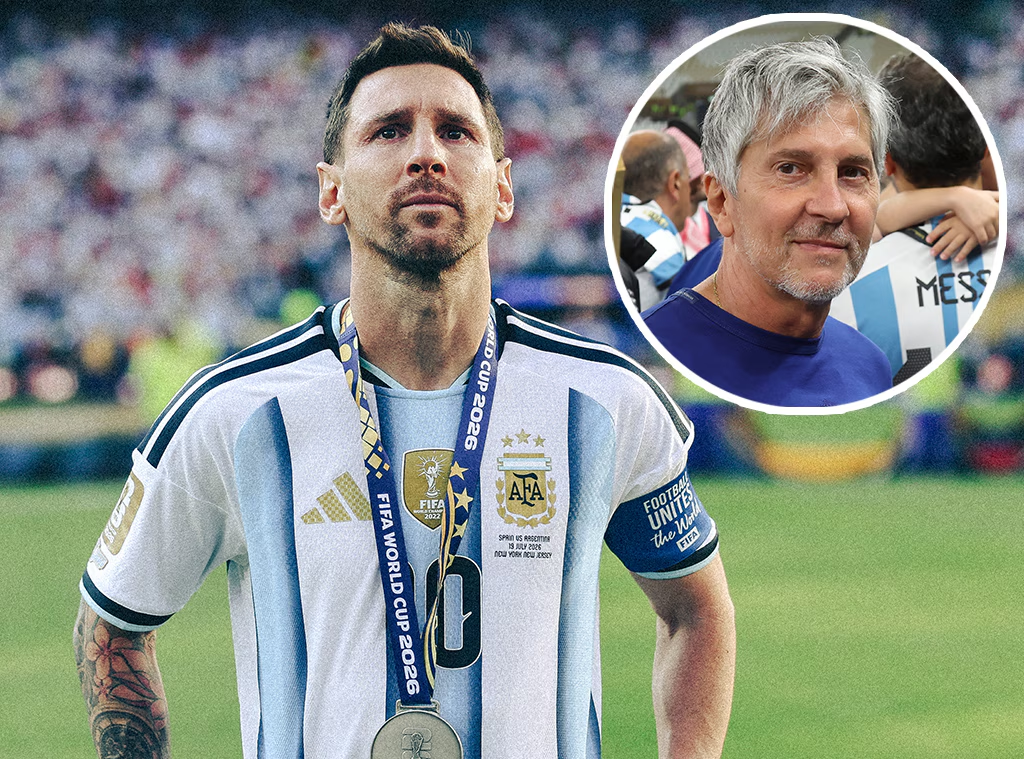
For nearly Lionel Messi’s entire life in soccer, one person had been there before the trophies, before the stadiums and before the world knew his name.
His father, Jorge Messi, was more than a parent watching from the stands. He was a trusted adviser, a representative and a constant presence through a career that eventually carried his son to the very top of the sport.
Now, at 39, Messi is confronting a future in soccer without him.
Jorge died at age 68, and five days later, on Aug. 12, Messi shared an emotional statement reflecting on the loss. In it, he admitted that his father’s death has left him questioning something he had spent most of his life doing almost automatically: continuing to play.
“Dad, I still can’t believe you’re gone,” Messi began in the message, which was translated from Spanish. He described struggling to accept that there would be no more conversations with the man who had accompanied him through virtually every stage of his remarkable journey.
Messi acknowledged that his father had been suffering and that death had ended that pain. But knowing that did not make the timing easier to accept.
To Messi, it still felt far too soon.
A World Cup His Father Wanted Him to Play
The loss carried another painful connection to one of the biggest moments of Messi’s final years on the international stage.
His father had encouraged him to take part in the 2026 World Cup and pursue another championship.
But shortly before the tournament began, Jorge’s condition worsened. It meant that for the first time, Messi entered a major tournament without his father physically there to experience it alongside him.
Messi recalled hoping the situation would change.
His mother continued telling him that Jorge might improve enough to travel. And Messi kept playing, carrying the hope that if Argentina remained in the tournament long enough, perhaps his father would still have an opportunity to watch him.
After games, however, Messi found himself waiting for something that had long been part of his routine: a message from his dad.
That absence made the seriousness of Jorge’s health increasingly difficult to ignore.
Still, Argentina kept advancing.
Eventually, Messi and his teammates reached the July 19 World Cup final against Spain. The run gave him the chance to chase another title, but it also became deeply personal. He wanted another trophy not simply for himself or Argentina, but for the father who had pushed him to play one more tournament.
Argentina ultimately lost the final to Spain.
Messi later reflected that he had wanted desperately to win and bring another World Cup home to his father. But he could not force his body any further.
The disappointment was painful, yet his father’s earlier advice remained with him. Even without another championship, Messi came away believing Jorge had been right to encourage him to participate and experience the tournament.
The Man Who Was There From the Beginning
That connection helps explain why Messi’s grief now reaches far beyond losing a loved one.
Jorge had been woven into his son’s soccer life from its earliest chapters.
Messi described him not only as his father, but as a friend and representative—the person he could depend on at every stage.
Their partnership had survived the enormous transformation of Messi’s life, from a gifted young player with an uncertain future to one of soccer’s most recognizable figures.
For decades, playing soccer and having his father beside him were almost inseparable realities.
Now one remains, while the other is gone.
That has forced Messi to confront a question that no trophy or record can answer.
How do you continue doing the thing that defined your life when the person who shared that entire journey is no longer there?:max_bytes(150000):strip_icc():focal(749x0:751x2)/Jorge-Messi-World-Cup-Final-080826-d385c277adcc490e9f8f525f747ce365.jpg)
Messi Admits He Has Doubts About Continuing
In his tribute, Messi did not announce his retirement.
But he made clear that continuing no longer feels as straightforward as it once did.
He said soccer was essentially all he had ever done, yet losing his father had left him with serious doubts about whether he would keep playing for much longer.
The uncertainty carries extra emotional weight because Messi could already see the end of his playing career approaching.
His father had been there from the beginning.
Messi wished he could have remained just a little longer so they could reach the end together.
It is a striking admission from an athlete whose career has so often been measured through goals, championships and individual honors. This time, Messi was not talking about another record to chase.
He was talking about whether the journey still felt the same without the man who had helped him begin it.
For now, there is no definitive answer.
Messi’s words instead reveal someone grieving while trying to imagine what the next part of his life will look like.
Jorge’s Influence Will Continue Beyond Soccer
Even as Messi questioned his future on the field, he made clear that his father’s influence would not disappear with the end of their time together.
He pointed toward his own children and the way he is raising them.
The lessons he received from his parents, he said, are now being passed into another generation. In that sense, Jorge’s role in Messi’s life will continue long after the final game of his career, whenever that game comes.
Messi ended his tribute by asking his father to rest peacefully and continue watching over the family from above, just as he had protected and supported them during his life.
For a player who spent decades knowing where to look after a match—toward his family, toward his father, toward the familiar voice waiting with advice—the next chapter will inevitably be different.
Whether Messi plays for months or years longer remains unanswered.
What is already clear is that when he finally does walk away from soccer, the man who helped him begin that journey will still be part of the way he understands its ending.