Tim Curry Found Frank-N-Furter’s Voice on a London Bus — Then the Role Changed His Career Forever
The voice that helped make Tim Curry famous did not begin in an acting class, a rehearsal room or a carefully planned conversation with a director.
It came from a stranger on a London bus.
In the early 1970s, Curry was trying to figure out how Dr. Frank-N-Furter should sound in a strange new stage musical called The Rocky Horror Show. He had already experimented with the character, initially giving the flamboyant scientist a German accent.
Then Curry overheard a woman speaking on public transportation.
Her voice was unmistakably upper-class British. Curry later remembered hearing her ask someone, “Do you have a house in town or a house in the country?”
Something clicked.
Curry decided Frank-N-Furter should sound, as he later put it, “like the Queen.”
It was an almost absurdly ordinary moment. Yet that borrowed accent became one ingredient in one of the most recognizable performances in cult-film history — a role that introduced Curry to movie audiences, followed him for the rest of his life and helped turn a tiny London theater experiment into a cultural phenomenon.

Frank-N-Furter Began in a Theater With About 60 Seats
Curry was not yet a movie star when The Rocky Horror Show came into his life.
After studying drama and English at the University of Birmingham, he moved to London and joined the original West End production of Hair in 1968. He later worked with the Royal Shakespeare Company and became a familiar presence at London’s Royal Court Theatre.
That connection proved crucial.
Richard O’Brien, whom Curry knew through the theatrical world surrounding Hair, had created an unusual musical mixing 1950s rock ‘n’ roll, science-fiction movies, horror films, comic-book imagery and sexual rebellion.
Curry auditioned for the role of Dr. Frank-N-Furter, the commanding scientist at the center of the story. He has recalled performing Little Richard’s “Tutti Frutti” at the audition, throwing himself into the performance with the kind of uninhibited energy that would later become inseparable from Frank.
The show opened at the Royal Court’s Theatre Upstairs on June 19, 1973. The venue was tiny — Curry later described it as seating roughly 60 people — but the production quickly proved too big in spirit to remain there. It transferred to larger London venues as its reputation grew.
But Frank was still evolving.
Curry’s early German interpretation made a certain logical sense. The character was a mad scientist, and the show deliberately played with clichés from old horror movies.
The bus encounter gave Curry something much stranger.
The Posh Accent Made Frank Even More Unpredictable
The upper-class voice created a contradiction at the heart of the character.
Frank-N-Furter could stride around in heels, corsets, pearls and dramatic makeup while speaking with the polished confidence of British privilege. He could sound refined while behaving outrageously, move from comedy to menace, and then unexpectedly reveal vulnerability.
That tension became part of what made Curry’s performance difficult to categorize.
The visual transformation mattered too. Costume designer Sue Blane’s corsetry and fishnets helped establish Frank’s unforgettable silhouette, while Curry supplied the swagger, vocal authority and theatrical control that made the costume feel less like a joke and more like a declaration.
The result was not simply an eccentric mad scientist. Curry created a character who seemed completely certain that everyone else had entered his world and would simply have to adjust.
The stage production became a hit, eventually traveling beyond Britain. Curry performed Frank in London and Los Angeles before bringing the role to film.
And that film would change his relationship with audiences forever.
Rocky Horror Became Curry’s First Movie
Released in 1975, The Rocky Horror Picture Show reunited Curry with several performers from the stage production, including O’Brien, Patricia Quinn and Nell Campbell. Susan Sarandon and Barry Bostwick joined the film as Janet and Brad, the innocent young couple whose breakdown in a rainstorm leads them into Frank’s castle.
For Curry, it was his first feature film.
That meant the character millions of viewers would come to associate with him was also the first version of Curry they ever saw on a movie screen.
At first, however, there was little reason to believe the film would become legendary.
Its initial 1975 release struggled commercially. The strange mixture of parody, glam rock, horror and sexuality did not immediately find a mainstream audience. For a moment, it appeared that the phenomenon might end almost as quickly as it had begun.
Then Rocky Horror found midnight.
Beginning in 1976, late-night screenings — most famously at New York’s Waverly Theater — attracted repeat viewers. Fans began shouting responses at the screen, dressing as the characters and eventually performing scenes in front of the movie.
Instead of simply watching Rocky Horror, audiences began participating in it.
A box-office disappointment was turning into something Hollywood had rarely seen before: a movie sustained not by a conventional release but by a community that kept reinventing the experience every weekend.
And at the center of that ritual was Curry’s Frank-N-Furter.
The Role Opened Doors — and Became Difficult to Escape
Curry understood that Frank had given him an extraordinary opportunity. He also understood the danger of being mistaken for one spectacular character.
In a 2005 interview, Curry recalled that his first movie performance was so outrageous that afterward he became deliberately quieter in public, wanting people to understand that Frank was a role rather than his actual personality.
For a period, he also kept some distance from the Rocky Horror phenomenon and did not participate heavily in its fan culture.
Eventually, his attitude softened. Asked years later how he regarded the project, Curry described it with characteristic understatement: “It’s neither a blessing nor a curse.” He added that he had been lucky to get the role.
His subsequent career demonstrated just how far beyond Frank he could travel.
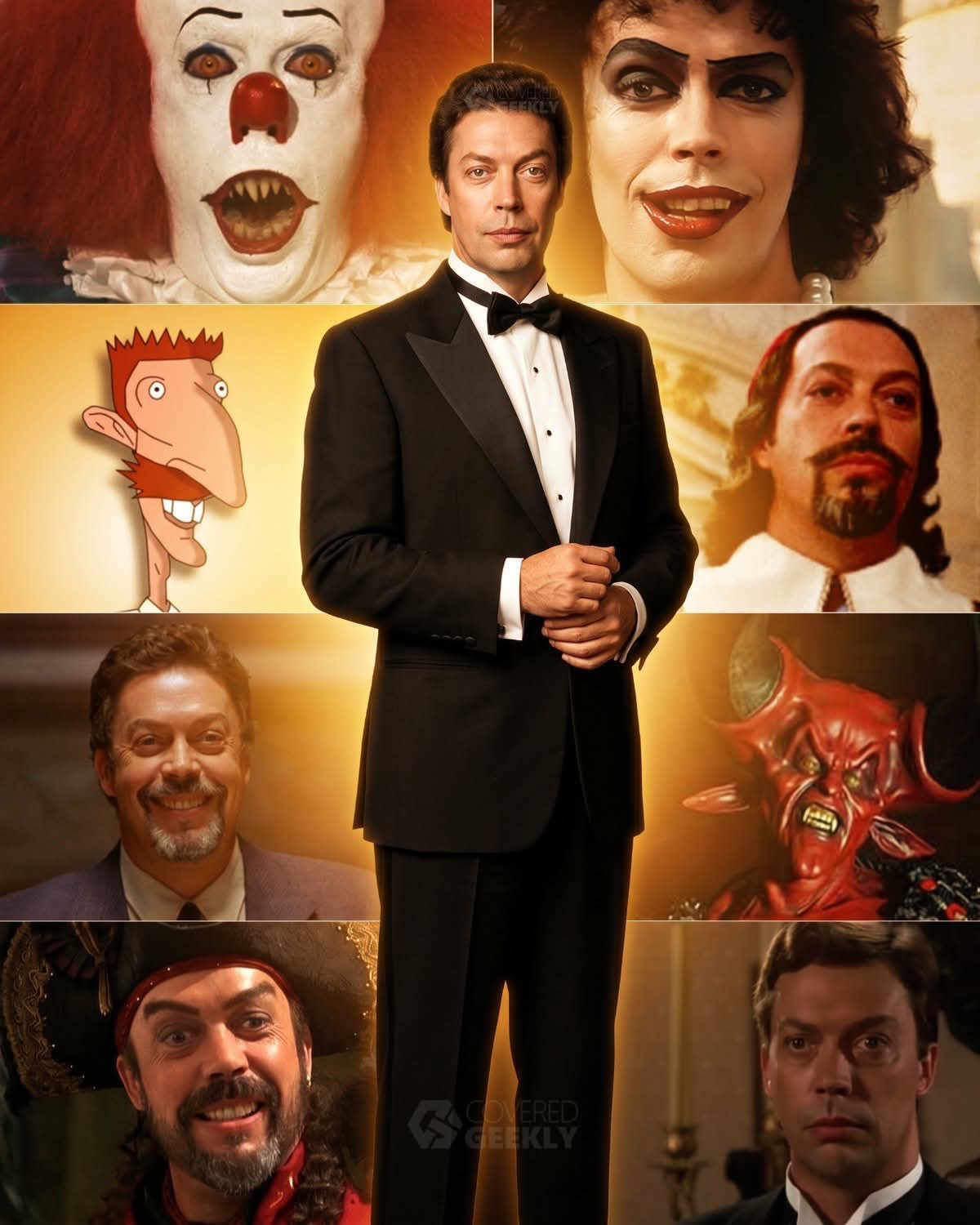
Curry became Mozart in Amadeus on Broadway, earned Tony nominations for Amadeus, My Favorite Year and Spamalot, played the frantic butler Wadsworth in Clue, terrified television audiences as Pennywise in the 1990 adaptation of Stephen King’s It, and appeared in films including Annie, The Hunt for Red October and Home Alone 2: Lost in New York. His distinctive voice also powered an extensive animation and voice-acting career.
Still, Frank remained unavoidable.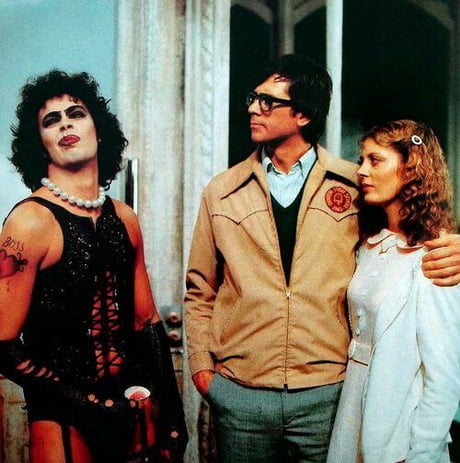
A Chance Encounter Became Part of Film History
By 2005, The Rocky Horror Picture Show had been added to the Library of Congress’ National Film Registry, which recognizes films considered culturally, historically or aesthetically significant.
Its survival is particularly remarkable because almost everything about its beginning was small: a modest experimental stage, an unconventional musical, an actor still building his career and a character whose voice had not yet been settled.
Then Curry boarded a bus and listened.
More than five decades later, following Curry’s death at his Los Angeles home on Aug. 25, 2026, at age 80, Frank-N-Furter remains one of the performances most closely connected to his legacy. His manager said no cause of death had been disclosed.
Curry would go on to create villains, kings, clowns, butlers and countless animated voices. Yet few roles were as instantly recognizable as the scientist who welcomed Brad and Janet into his extraordinary world with perfect confidence and an unexpectedly aristocratic voice.
A stranger on a London bus almost certainly had no idea an actor was listening.
Curry was.
And he knew exactly what to do with what he heard.