Melissa Joan Hart Was Cut Entirely From ‘Crocodile Dundee.’ The Movie Still Sends Her Checks 40 Years Later
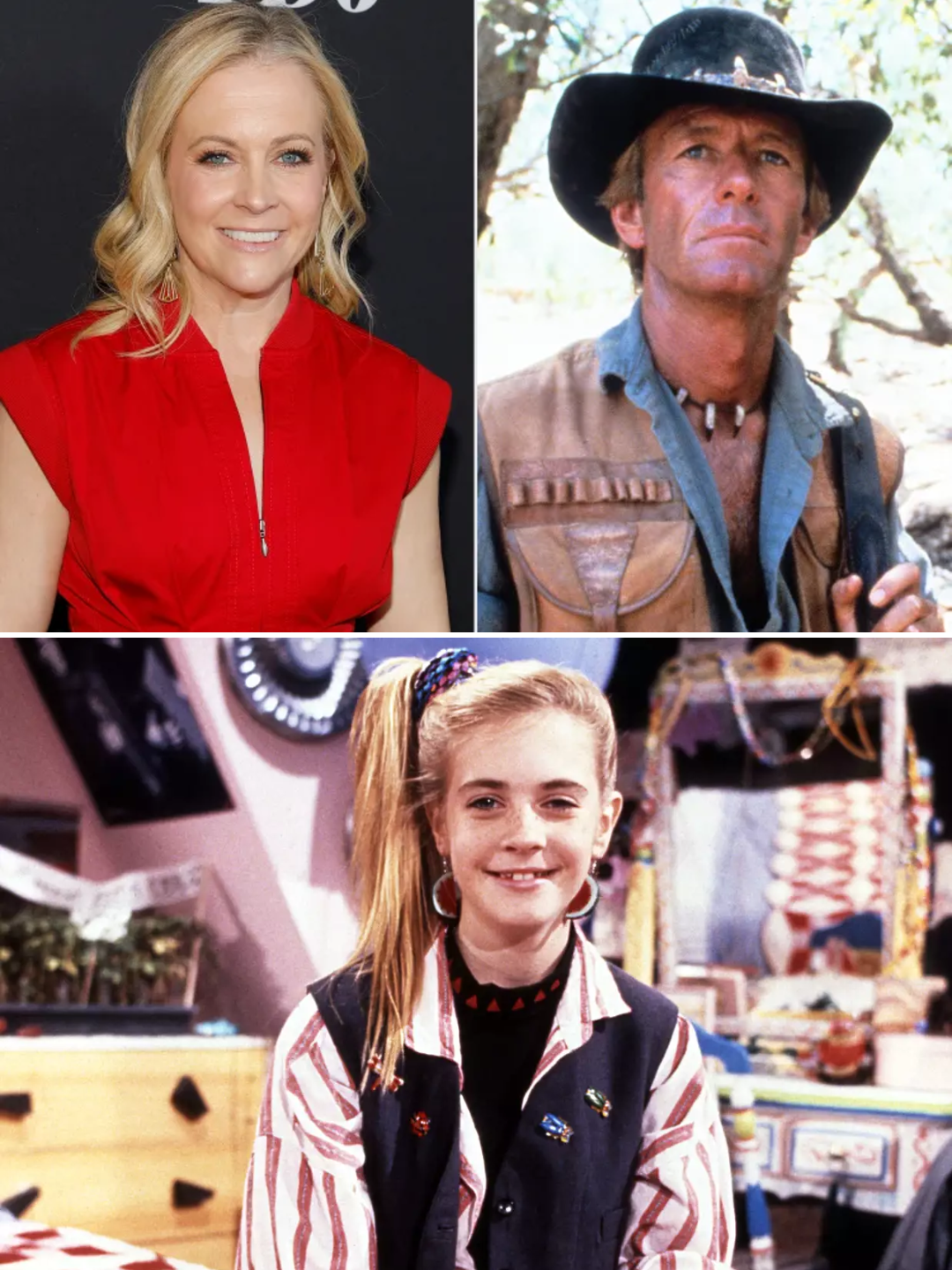
Melissa Joan Hart has a credit connected to one of the biggest movie hits of the 1980s — except audiences cannot actually find her anywhere in it.
Long before Clarissa Explains It All and Sabrina the Teenage Witch made Hart a familiar face on television, she was a child actor trying to build a career one small job at a time.
One of those early jobs brought her onto the set of Crocodile Dundee.
Hart was about 10 years old when she filmed a scene with Paul Hogan for the 1986 comedy. She remembers working in Central Park and playing a young girl who had scraped her knee. Hogan’s Mick “Crocodile” Dundee came over to help her.
Hart did the work.
The cameras rolled.
The movie became a massive success.
There was only one problem.
Her entire scene was cut.
Nearly four decades later, however, Crocodile Dundee is still paying her.
Hart recently revealed that residual checks connected to the film continue arriving even though viewers who watch the finished movie will never see the performance that earned them.
And the amount written on some of those checks today makes the story even stranger.
She Filmed the Scene When She Was About 10
Hart was still years away from becoming one of the most recognizable young television stars of the 1990s when Crocodile Dundee was being made.
The movie followed Paul Hogan’s Mick Dundee, an Australian outdoorsman who travels to New York City after journalist Sue Charlton, played by Linda Kozlowski, meets him in the Australian Outback.
Much of the comedy comes from Dundee trying to navigate Manhattan with the instincts of a man accustomed to life in the wilderness.
Hart’s small role would have fit naturally into that part of the movie.
She recalled filming in Central Park as a young girl who had hurt herself.
“I scraped my knee,” Hart remembered of the scene.
Dundee was supposed to come to her aid.
For a 10-year-old actor, even a brief scene opposite the star of a major movie could feel significant.
But when Crocodile Dundee reached theaters, Hart wasn’t there.
Her scene had been removed completely.
There is no quick glimpse of her in the background and no brief exchange for nostalgic fans to rediscover years later.
As far as the theatrical movie is concerned, Melissa Joan Hart simply isn’t in Crocodile Dundee.
Financially, though, the story is different.:max_bytes(150000):strip_icc():focal(731x233:733x235):format(webp)/melissa-joan-hart-paul-hogan-082726-85adf94ef8a646f887ea0722d7e1ab23.jpg)
The Movie Still Has to Pay Her
Actors can receive residual payments when productions they worked on continue to be reused, broadcast or otherwise distributed under contracts that provide for additional compensation.
Being cut from the finished film did not erase Hart’s contractual connection to the production.
She had performed the work.
As a result, residual payments connected to Crocodile Dundee have continued to reach her decades later.
That creates an unusually funny Hollywood contradiction.
A movie that contains no visible Melissa Joan Hart performance still occasionally sends Melissa Joan Hart money.
The checks are no longer exactly life-changing.
Hart recently revealed that some payments have fallen to approximately 26 cents.
And they can arrive every few months.
It is difficult to imagine a better illustration of how strange residual accounting can become after a movie has spent decades circulating through different markets.
Crocodile Dundee premiered when Hart was a child.
She has since starred in multiple television series, directed projects, produced films and spent decades working in entertainment.
Yet somewhere in the accounting system, that deleted Central Park scene is apparently still alive.
Twenty-six cents at a time.

There Is Even a Place for Checks Like Hers
Hart also joked about a piece of Los Angeles culture perfectly suited to actors receiving residual checks that are worth less than the postage or paperwork surrounding them.
She mentioned Residuals Tavern, a bar associated with a long-running tradition involving tiny residual checks.
The idea is simple: actors sometimes receive payments so small that the checks themselves become funny.
A few cents.
A dollar.
Maybe several dollars for work completed years or even decades earlier.
For performers, the checks can serve as miniature reminders of old jobs that continue resurfacing in some form.
Hart’s Crocodile Dundee payments may be especially amusing because the job itself cannot be seen in the movie.
Imagine receiving a check for a performance almost nobody has ever watched.
Then imagine receiving another one nearly 40 years later.:max_bytes(150000):strip_icc():focal(667x194:669x196):format(webp)/Clarissa-Explains-It-All-a68f274a51c4447cb44a1c818d881b80.jpg)
Being Cut Taught Hart Something Early
For a child performer, disappearing from a major movie after actually filming the role could have been crushing.
Hart has instead described the experience as an early Hollywood lesson.
Acting involves rejection at nearly every stage.
Sometimes an actor does not get an audition.
Sometimes they audition and lose the role.
Sometimes they get the role, perform it and still disappear before audiences ever see the finished product.
That last version can be particularly difficult because the actor has already experienced the excitement of getting the job.
Hart learned that lesson unusually young.
She had gone to the set, worked with Hogan and filmed the scene.
None of that guaranteed she would appear in the movie.
It was an early introduction to something experienced by performers at every level: editing decisions are often beyond an actor’s control.
A scene can work perfectly well on its own and still be removed because of pacing, running time or changes to the larger story.
For Hart, getting cut from Crocodile Dundee became one small chapter in a career that was about to become much bigger.
A Few Years Later, Everyone Knew Her Face
Hart eventually reached the level of fame that makes the Crocodile Dundee story particularly fun in retrospect.
She became the star of Nickelodeon’s Clarissa Explains It All in the early 1990s, playing Clarissa Darling and establishing herself as one of the network’s defining young stars.
Then came Sabrina the Teenage Witch.
Hart played Sabrina Spellman for seven seasons, turning the character into a major piece of late-’90s and early-2000s television nostalgia.
For millions of viewers, Hart became instantly recognizable.
That makes the idea of her having a completely invisible role in another famous piece of pop culture even more surprising.
Both Hart and Crocodile Dundee became enormously familiar to American audiences.
They were technically connected all along.
Most viewers simply had no way of knowing it.
Deleted Scenes Can Create Strange Hollywood Ghosts
Hart’s story is also a reminder that the movie audiences watch is only a fraction of what may have been filmed.
Actors sometimes spend days working on material that disappears entirely.
Characters can be reduced.
Subplots can vanish.
Scenes that seemed important during production can become unnecessary once editors assemble the entire film.
Normally, those deleted performances become little more than memories.
Hart’s has something more tangible attached to it.
A check.
Even now.
It may only be for a few cents, but every time one arrives, it proves that somewhere in the legal and financial history of Crocodile Dundee, Melissa Joan Hart is still part of the movie.
Audiences may never see the little girl in Central Park with the scraped knee.
The accounting department, apparently, has never forgotten her.