Sylvester Stallone Took a Comedy to Beat Arnold Schwarzenegger — Years Later, Arnold Admitted Why He Let Him Have It
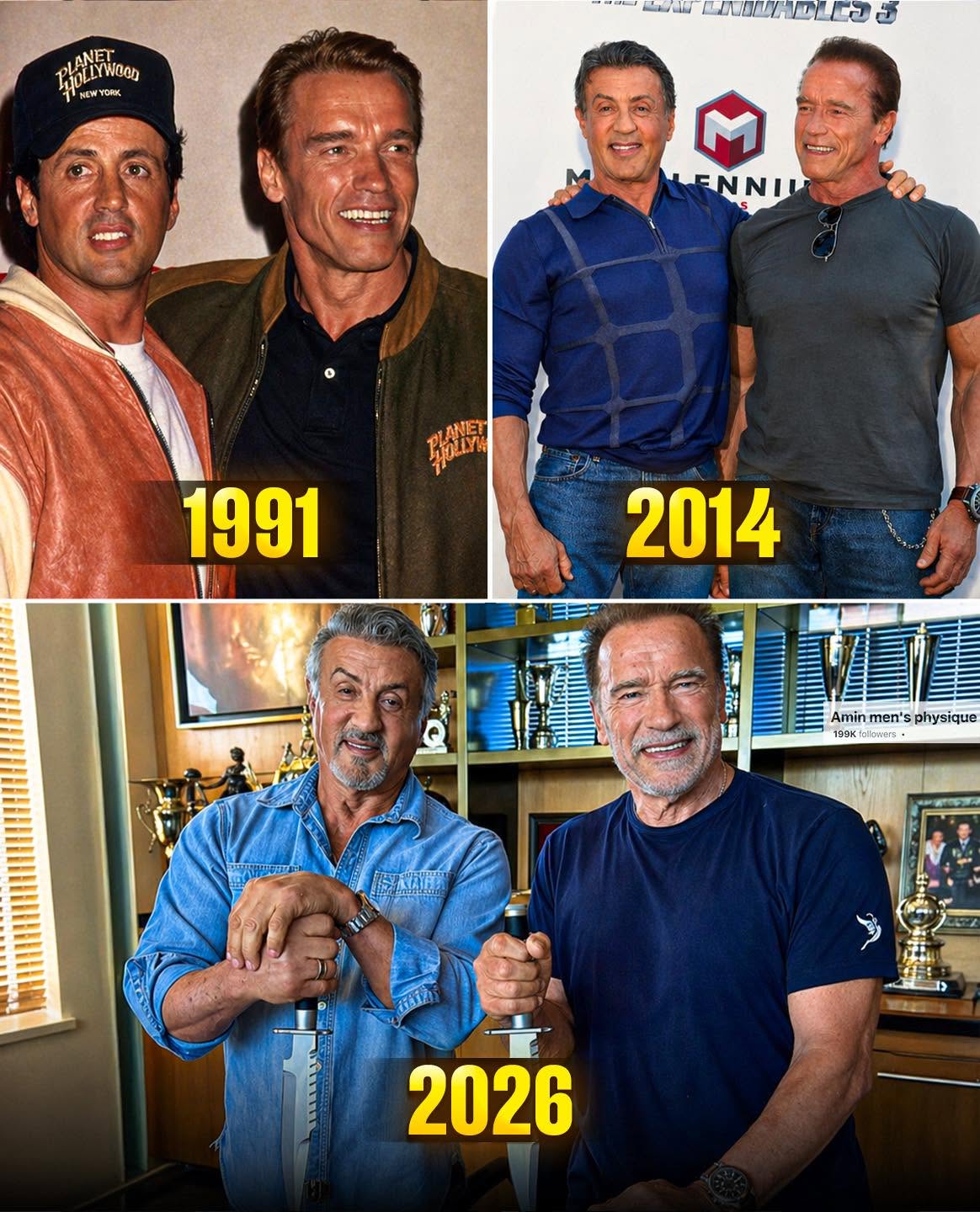
In the 1980s, Sylvester Stallone and Arnold Schwarzenegger were not simply two movie stars working in the same genre. They were locked in what sometimes looked like a Hollywood arms race.
A bigger hit mattered. Bigger muscles mattered. Bigger weapons mattered. Even the number of enemies eliminated on-screen could become another unofficial scorecard.
Schwarzenegger later described the rivalry as an obsession with who had the better box office, the more impressive physique, the larger guns and the more spectacular action. Stallone remembered it similarly: if one man raised the stakes, the other immediately wanted to raise them again.
At one point, the competition became almost comically literal.
Schwarzenegger recalled that while making Predator, he wanted a weapon large enough to top what Stallone had carried in the Rambo movies. The result was the enormous minigun wielded in the film — the kind of weapon normally associated with military vehicles rather than one man walking through a jungle.
But the most memorable victory in their rivalry did not involve muscles, guns or explosions.
It involved a comedy script Schwarzenegger did not want.
Arnold Had Already Found a New Weapon: Comedy
By the end of the 1980s, Schwarzenegger had discovered that audiences were willing to laugh at the same oversized screen persona that had made him an action phenomenon.
Twins, released in 1988, paired him with Danny DeVito and became a major change of pace. Then came Kindergarten Cop in 1990, putting the former Terminator in a classroom surrounded by children.
Suddenly, Schwarzenegger was not merely competing with Stallone in action movies. He had successfully expanded his image.
Stallone was experimenting too. He starred in the 1991 comedy Oscar, but his attempt to move away from the familiar territory of Rocky Balboa and John Rambo had not given him the kind of comic breakthrough Schwarzenegger was enjoying.
Then another comedy project appeared.
Its title was almost impossible to forget:
Stop! Or My Mom Will Shoot.
The premise cast a tough police officer opposite his meddling mother, who arrives for a visit and begins interfering with everything from his personal life to his police work. Estelle Getty, already beloved for The Golden Girls, would eventually play the mother opposite Stallone.
There was only one problem.
Arnold Schwarzenegger had read the script first.
And he thought it was terrible.
Schwarzenegger Realized the Script Could Still Be Useful
Years later, Schwarzenegger explained that he had no intention of making the movie after reading it.
But simply rejecting it would have wasted an opportunity.
He knew Stallone.
More importantly, he knew how competitive Stallone was.
So Schwarzenegger allowed the impression to circulate that he was interested in the project.
It was exactly the kind of information likely to reach his rival.
And it did.
Stallone eventually contacted Schwarzenegger and asked whether he had been approached about the movie. That gave Schwarzenegger another opportunity to end the trick.
Instead, he doubled down.
Schwarzenegger later recalled telling Stallone that he was considering the project and suggesting it was a strong idea.
That was apparently enough.
According to Schwarzenegger’s account, Stallone reacted as a fierce competitor might: if Arnold wanted the movie, Sly wanted to get there first.
Stallone took the role.
The trap had worked.
Stallone Thought He Had Beaten Arnold to the Movie
Stop! Or My Mom Will Shoot arrived in theaters in February 1992, with Stallone playing Los Angeles police sergeant Joe Bomowski and Getty playing his mother, Tutti.
The reaction was brutal.
The film received overwhelmingly negative reviews and quickly became one of the least celebrated entries in Stallone’s career.
For Stallone, the experience was especially frustrating because comedy was exactly the territory in which Schwarzenegger had recently proved unexpectedly successful.
Stallone himself became even harsher about the movie as the years passed.
When discussing career regrets, he repeatedly singled it out. He once jokingly ranked it among the worst movies imaginable, and in later interviews explained what he believed had gone wrong creatively.
The mother character, Stallone felt, should have been far more abrasive. Instead, Getty was so naturally warm and lovable that the central comic conflict lost some of the edge that might have made the premise work.
But Stallone also had another explanation for how he had ended up making the movie in the first place.
Arnold.
Stallone said he had heard Schwarzenegger wanted the project and remembered thinking that if Arnold wanted it, he should get there first.
Only later did he realize what may actually have happened.
“I think he set me up,” Stallone said.
Years afterward, Schwarzenegger was asked directly about Stallone’s accusation.
His answer removed any remaining mystery.
It was “100 percent true.”
Schwarzenegger admitted that he had deliberately created the impression that he wanted the movie because he suspected Stallone’s competitive instincts would take over.
What had sounded for years like an almost too-perfect Hollywood legend was, according to both men, essentially what happened.
Their Rivalry Was Ridiculous — but It Also Made Them Better
The trick is funny now partly because Stallone and Schwarzenegger no longer talk about each other like enemies.
But during their peak years, the hostility was very real.
Stallone has said they genuinely disliked each other.
Their careers were constantly compared, and neither seemed comfortable allowing the other to claim the title of Hollywood’s dominant action star without a fight.
If one had a major box-office success, the other wanted something bigger.
If one appeared more muscular, the other trained harder.
If one carried an enormous weapon, the other wanted an even larger one.
The competition could become absurd, but both men have acknowledged something more important about it.
It pushed them.
Schwarzenegger has said that whenever Stallone released something successful, it created another target for him. Bigger action. Better conditioning. A more impressive movie. Another reason to work.
Stallone has described Schwarzenegger in much the same way: as a rival whose success made standing still impossible.
“Competition creates performance,” Schwarzenegger later said while looking back on those years.
Without Stallone constantly challenging him, Schwarzenegger has suggested, he might not have pushed himself with the same intensity.
The rivalry that produced childish one-upmanship — bigger muscles, bigger guns and even deceptive movie rumors — also helped fuel two of the most successful action careers Hollywood had ever seen.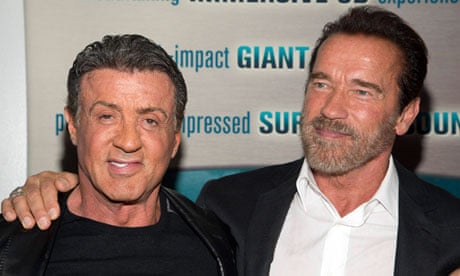
Then the Two Rivals Became Partners
Perhaps the greatest irony is that the men who spent years trying to defeat each other eventually discovered they worked surprisingly well on the same side.
In the early 1990s, Schwarzenegger, Stallone and Bruce Willis became closely associated with Planet Hollywood, the celebrity-backed restaurant chain.
That business relationship helped soften the hostility between the two stars.
Over time, rivalry gradually became friendship.
Hollywood eventually gave audiences something that would have seemed almost impossible during the fiercest years of their competition: Stallone and Schwarzenegger sharing the same movie.
Schwarzenegger appeared in Stallone’s The Expendables franchise, first in a smaller role before receiving more screen time in later installments.
Then, in 2013, they became genuine co-stars in Escape Plan.
The premise was almost perfectly suited to their history.
Instead of competing for the title of biggest action star, the two men were now trapped together inside a high-security prison and forced to cooperate.
By then, the old feud had become something they could laugh about.
They could tell stories about the muscles, the weapons, the box office and the endless attempts to outdo each other.
And one story remained better than almost all the others.
Schwarzenegger had found a way to defeat Stallone without making a movie, throwing a punch or firing a gun.
He simply convinced his rival that there was something worth stealing.
Stallone rushed to take it.
Arnold stepped aside.
And years later, both men could finally laugh about who had really won.
For years, Stallone and Schwarzenegger tried to beat each other at Hollywood. In one case, Arnold won by convincing Sly to beat him to a movie Arnold never wanted in the first place.