Sylvester Stallone Created Rocky and Played Him for Decades — Yet Says He Owns “Zero” of the Franchise
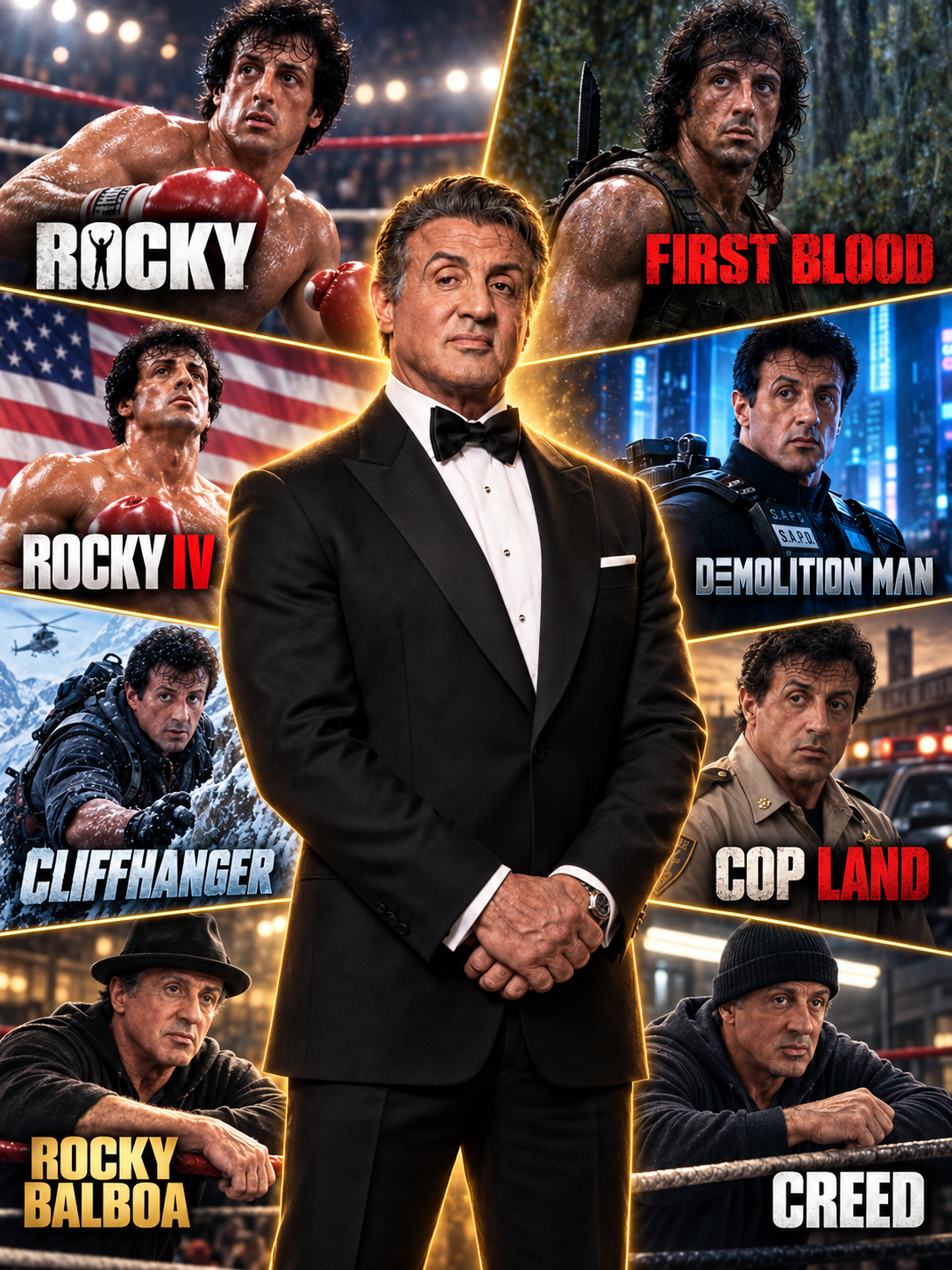
Rocky.
Rambo.
Cliffhanger.
Demolition Man.
Cop Land.
Creed.
Sylvester Stallone has spent half a century building a career around characters and movies that became part of Hollywood culture.
But the character most inseparable from his name is also the one Stallone says he does not own.
That character is Rocky Balboa.
Long before Rocky became a statue-worthy Philadelphia icon, a sequel machine and the foundation for the Creed films, he existed on pages written by a struggling Stallone.
The gamble changed everything.
Released in 1976, Rocky starred Stallone as a small-time Philadelphia boxer who receives an almost impossible opportunity to fight heavyweight champion Apollo Creed. John G. Avildsen directed, but the screenplay — and Rocky himself — came from Stallone.
The film turned its fictional underdog into a cultural symbol and transformed its writer-star into one of Hollywood’s biggest names.
At the Academy Awards, Stallone was nominated both for his performance as Rocky and for his screenplay. The movie won Best Picture, Best Director and Best Film Editing.
And that was only the beginning.
Stallone would spend decades writing Rocky’s story, physically embodying the character and repeatedly returning to the franchise as writer, director and actor.
Yet years later, when discussing what he actually owned of the property, Stallone gave an answer that seemed almost impossible given his connection to it.
“I have zero ownership of Rocky.”
For Stallone, the dispute goes back decades.
He told Variety in 2019 that after Rocky II became a major success and Rocky III proved the series could keep growing, he began asking why he did not have an ownership stake in the creation.
By then, Rocky was no longer simply a successful movie role.
It was a franchise.
Stallone said he was effectively told that ownership was not part of the arrangement. The producers and financiers had taken the risk, he was receiving increasingly substantial compensation, and he was not entitled to equity simply because he had created the character.
When Stallone raised the matter again around the period of Rocky IV, he remembered emphasizing just how much of the series came directly from him — the writing, promotion, direction and even the choreography of its boxing sequences.
The answer, as he later recalled it, was brutally simple:
“You got paid.”
That distinction is essential to understanding the dispute.
Stallone has never claimed that Rocky left him financially unrewarded.
Far from it.
For the original movie, he has said he received roughly $75,000 for his screenplay and acting work, plus profit participation, eventually earning about $2.5 million from the film. As the franchise expanded, his compensation grew dramatically.
He received lucrative participation on later installments, and Variety reported that one source estimated he earned more than $10 million from each of the first two Creed movies.
Producer Irwin Winkler has also disputed any suggestion that Stallone was treated poorly financially, arguing that the star made extremely substantial sums from the franchise.
The disagreement, then, is not really about whether Stallone was paid.
It is about ownership.
A paycheck rewards work already completed. An ownership stake can continue through decades of sequels, licensing, spinoffs and future productions — and potentially be passed to a creator’s family.
That difference became the emotional center of Stallone’s frustration.
In 2022, he publicly called on Winkler to return at least “a little” of what Stallone described as his remaining rights.
“This is a painful subject that eats at my soul,” Stallone wrote, explaining that he wanted to leave something of Rocky to his children.
That made his anger about more than another Hollywood compensation dispute.
Stallone had watched Rocky outgrow the original movie and become something that could continue long after his own involvement ended.
And few actors have contributed more personally to a franchise.
Stallone wrote all six films bearing the Rocky name.
After Avildsen directed the original, Stallone himself directed Rocky II, Rocky III and Rocky IV. Avildsen returned for Rocky V, while Stallone again took the director’s chair for 2006’s Rocky Balboa.
Nearly 40 years after the first film, Stallone returned once more for Ryan Coogler’s Creed in 2015, this time allowing Rocky to age.
He was no longer the hungry boxer chasing his one opportunity.
Rocky became the mentor to Adonis Creed, played by Michael B. Jordan, the son of his old rival and friend Apollo Creed.
The performance earned Stallone another Academy Award nomination, this time for supporting actor.
He returned in Creed II and also helped write that film.
But the tension over ownership never disappeared.
In a 2022 interview, Stallone revealed another telling chapter in the fight.
According to him, the producers approached him about making another Rocky movie.
At first, he was willing.
But after more than four decades, Stallone wanted the terms to change.
He said he asked whether he could finally receive a piece of the property he had created — not retroactive control over everything that had come before, but some ownership and influence going forward.
When that request was rejected, he said he walked away from the proposed movie.
By that stage, the franchise had already demonstrated that it could continue without Rocky at its center.
Creed III, released in 2023, became the first movie in the wider Rocky saga in which Stallone did not appear, although he retained a producer credit.
The series had moved into a new generation.
That development made the ownership issue especially poignant.
In 1976, Stallone needed Hollywood to take a chance on a screenplay written by an actor who desperately wanted to play its lead.
Decades later, Hollywood no longer needed Rocky Balboa himself in order to keep expanding the world Rocky Balboa created.
For Stallone, there is also an uncomfortable irony in the original success.
Producers Irwin Winkler and Robert Chartoff did take significant financial risks bringing the first movie to the screen. Stallone became wealthy and internationally famous because of the arrangement, and his career, his family and generations of audiences benefited from what followed.
But commercial compensation and creative ownership are not the same thing.
Stallone’s argument has always focused on that gap.
He could write Rocky.
He could transform his body to play him.
He could direct him, choreograph his fights, revive him after years away, and eventually turn the fighter into an aging mentor.
What he says he could not do was pass ownership of Rocky down to his own family.
Sylvester Stallone gave Rocky his voice, his face and more than four decades of his career.
The irony is that the one thing he says he could never give his children was ownership of Rocky himself.