TWO SILVER STARS: THE GENERAL THEY TRIED TO THROW OUT
PART 1 — THE WOMAN IN THE SNOW-COVERED COAT
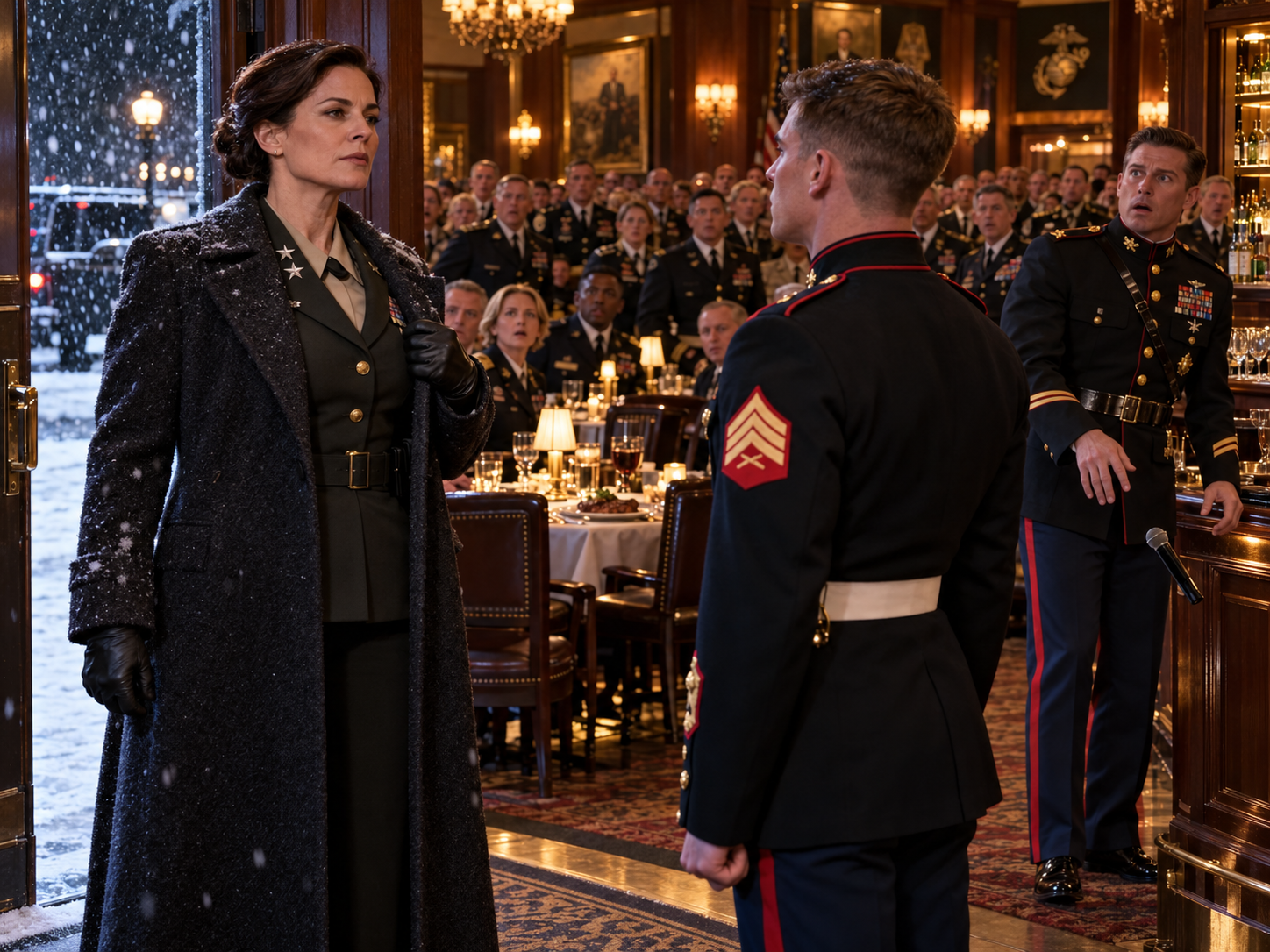
Nearly two hundred officers laughed when a Marine major pointed at me and said into a microphone:
“Unless you’re here to clear tables, you don’t belong here.”
Then he ordered security to remove me as a civilian.
I didn’t argue.
I didn’t explain.
I stood quietly in my snow-covered coat and waited for the guard to reach me.
Because Major Preston Hale had absolutely no idea what was hidden beneath my collar.
“Officers only, ma’am.”
His voice echoed through the club.
Hale stood near the bar beneath warm amber lights, one hand around the microphone, ribbons shining across his chest.
He had the relaxed posture of a man who believed the entire room belonged to him.
Around two hundred officers filled the tables.
Steak plates.
Beer glasses.
Candles.
Low conversation.
Then Hale looked at me and smiled.
I knew that smile.
He wanted an audience.
“Unless you’re here to clear tables,” he continued, “you’re in the wrong building.”
The room burst into laughter.
I stood just inside the entrance.
Snow was melting into the shoulders of my charcoal coat.
Cold air still lingered behind me as the heavy doors closed.
The room smelled like grilled meat, floor wax, and expensive cologne.
I said nothing.
Didn’t move.
That seemed to bother him.
People who humiliate others in public usually need a reaction.
Anger.
Shame.
Tears.
Something that proves the humiliation worked.
I gave Hale nothing.
He lifted the microphone again.
“I’m trying to help you.”
A few officers chuckled.
“The enlisted dining facility is two buildings over.”
Then he added:
“Maybe they can find something useful for you to do.”
More laughter followed.
But this time, it was weaker.
A few people had stopped smiling.
They were looking at me more carefully now.
My stance.
My shoes.
The way I held myself beneath the coat.
A young female lieutenant near the front pushed her chair back.
“Sir, maybe we should—”
“Sit down, Lieutenant Torres.”
Hale didn’t even look at her.
“The adults are talking.”
Her face reddened as she slowly sat.
Our eyes met for a second.
And I understood what she was feeling.
She wasn’t embarrassed for herself.
She was embarrassed for the room.
Hale mistook the silence for encouragement.
“You lost, sweetheart?”
That word landed harder than he knew.
For one second, I wasn’t forty-six anymore.
I was twenty-three.
Newly commissioned.
Standing inside another officers’ club while senior men laughed at the gold bars on my collar.
“You’re a guest in our Marine Corps.”
I could still hear it.
Still remember the moment I wondered whether maybe they were right.
Then the memory disappeared.
I was back in the present.
Candles flickering.
Wet wool against my neck.
Major Hale gripping the microphone like a weapon.
He pointed toward the entrance.
“Sergeant.”
The young Marine near the door straightened.
“Remove the civilian before she embarrasses herself.”
The Marine started walking toward me.
His name tape read DALTON.
He looked no older than twenty-six.
But the closer he got, the more uncertain he became.
His instincts were telling him something Hale had missed.
His steps slowed.
“Ma’am…”
He reached carefully toward my shoulder.
I waited.
His fingers touched the coat.
Then I turned slightly.
And slowly pulled my collar aside.
His eyes dropped.
Two silver stars.
The color left his face.
He immediately snapped to attention.
Then his voice cut through the room.
“Two-star general on deck!”
Nearly two hundred chairs scraped backward at once.
But I wasn’t looking at them.
I was looking at Major Preston Hale.
And watching the microphone slowly slide out of his hand.
It struck the carpet with a dull thump.
For several seconds, nobody moved.
The silence was so complete that I could hear melted snow dripping from my coat onto the polished wooden floor.
I looked at the young sergeant.
“At ease, Sergeant.”
“Yes, ma’am.”
His voice was steady, but his face remained pale.
“What’s your first name?”
“Daniel, ma’am. Sergeant Daniel Dalton.”
“Sergeant Dalton, you haven’t done anything wrong. You followed the instruction given to you, and you approached a stranger without being unnecessarily aggressive. Thank you.”
He blinked.
“Thank you, General.”
I turned toward the room.
“Everyone, please sit down.”
Nobody did.
Not immediately.
They were waiting for what came next.
For the explosion.
For the public dressing-down.
For the kind of punishment that men like Hale would have delivered without hesitation if our positions had been reversed.
Instead, I removed my gloves.
Folded them together.
And placed them inside my coat pocket.
“My name is Major General Alexandra Bennett,” I said. “I appreciate the welcome, although I suspect there was some confusion about my arrival.”
An older colonel standing near the head table looked as though he might faint.
“General Bennett, I am Colonel Richard Mercer. I command the installation support group. We weren’t informed that you would arrive tonight.”
“That was intentional, Colonel.”
His expression changed.
Not relief.
Something closer to dread.
I had spent twenty-three years watching officers realize that the person standing in front of them knew more than they expected.
The expressions were usually remarkably similar.
I looked toward Hale.
“Major, please retrieve your microphone.”
He bent down immediately.
His fingers fumbled around the black handle.
When he stood, he seemed several inches shorter than he had a minute earlier.
“General, I sincerely apologize. I had no idea—”
“That I was a general?”
He swallowed.
“Yes, ma’am.”
I nodded slowly.
“That’s what concerns me.”
A few officers shifted uncomfortably.
Hale looked around, searching for someone who might rescue him.
No one volunteered.
“General, if I’d recognized you, I would never have—”
“Major.”
He stopped.
“Would you have treated a civilian differently if you’d known her name?”
His mouth opened.
Closed.
“I was maintaining standards for an officers-only event.”
“Were you?”
“Yes, ma’am.”
“Then perhaps you can explain why your standards required nearly two hundred people to laugh at someone standing alone in the doorway.”
His ears turned crimson.
I glanced toward Lieutenant Torres.
She had risen with everyone else.
Her hands were clasped tightly in front of her.
“Lieutenant, what were you attempting to say before the major interrupted you?”
She hesitated.
Hale’s head turned toward her.
A warning flashed across his face.
I noticed.
So did she.
“Lieutenant,” I said gently, “you may speak freely.”
Torres drew a breath.
“I was going to suggest that he ask whether you needed assistance, ma’am. The weather is terrible, and you appeared to have just arrived.”
“A reasonable suggestion.”
“Yes, ma’am.”
“Thank you.”
I looked back at Hale.
“Apparently the youngest officer in the conversation understood something the senior officer did not.”
His expression hardened for an instant.
Then disappeared behind an apologetic smile.
“I accept responsibility, General.”
“Good.”
I paused.
“Because we have something more important to discuss.”
From inside my coat, I removed a small white envelope.
On its front were three words written in blue ink.
PROJECT NORTHSTAR — PRIVATE
Colonel Mercer saw the envelope.
His eyes moved toward the far end of the room.
There, a civilian contractor in an expensive gray suit abruptly placed his glass on the table.
I watched both reactions.
And understood that my arrival had disturbed more than an officers’ dinner.
“I came here tonight,” I said, “because three weeks ago, a young Marine made an allegation that should have been impossible to ignore.”
Nobody spoke.
“According to the information sent to my office, she reported dangerous equipment failures during a winter training exercise. Instead of receiving help, she was told that she had misunderstood what happened.”
I looked across the room.
“The report was closed.”
Colonel Mercer stared straight ahead.
“The equipment was certified safe.”
The man in the gray suit pushed his chair back.
“And four days later, another Marine was seriously injured.”
A murmur passed through the room.
Hale’s face had lost nearly all its color.
I held up the envelope.
“I want to know who altered the maintenance records.”
The contractor stopped moving.
“And I want to know why the officer who questioned those records was removed from her assignment.”
Lieutenant Torres looked at me.
For the first time that evening, there was something other than embarrassment in her expression.
Hope.
Hale cleared his throat.
“General, those matters have already been investigated.”
I turned to him.
“Have they?”
“Yes, ma’am.”
“Then you won’t mind explaining why the investigation contains a statement from a Marine who says he was never interviewed.”
Hale said nothing.
I took one step toward him.
“Or why the original maintenance report was signed electronically at 2:17 in the morning from an account belonging to someone who was deployed overseas?”
His jaw tightened.
Across the room, the civilian contractor reached discreetly into his jacket.
Not for a weapon.
For his phone.
I noticed the movement.
So did Sergeant Dalton.
I continued speaking.
“And most importantly, Major, I want to know why someone sent an anonymous message to my office yesterday warning me not to visit this installation.”
The room had gone silent again.
I opened the envelope.
Inside was a photograph.
It showed a snow-covered military training vehicle lying on its side beside a mountain road.
Across the bottom, someone had written:
THEY KNEW THE BRAKES WOULD FAIL.
I placed the photograph on the nearest table.
Then I looked directly at Major Preston Hale.
“Now,” I said quietly, “shall we discuss why you were so determined to keep me out of this room?”
For the first time since I had arrived, Hale looked genuinely afraid.
Not embarrassed.
Not offended.
Afraid.
And as I watched him, I realized something that would change the entire investigation.
He wasn’t afraid of what I knew.
He was afraid of who else might start talking.
PART 2 — THE REPORT THAT WAS NEVER SUPPOSED TO EXIST
The first person to move was the man in the gray suit.
He had been sitting near the rear windows, beneath a framed photograph of Marines raising the American flag over Iwo Jima.
Tall.
Silver-haired.
Expensive watch.
The kind of civilian whose confidence came from knowing precisely which senior officers answered his telephone calls.
I had noticed him when I entered.
Not because of his clothing.
Because Major Hale had glanced toward him before ordering Sergeant Dalton to remove me.
Now the man was heading toward a side exit.
“Sir,” I called.
He stopped.
Slowly, he turned.
“Yes, General?”
“Leaving so soon?”
His smile was practiced.
“Unfortunately, I have an early flight.”
“Then perhaps we should speak before you go.”
He glanced at Colonel Mercer.
The colonel avoided his eyes.
That told me something.
“I’m sorry,” the man replied, “but I don’t believe we’ve been introduced.”
“Major General Alexandra Bennett.”
“Yes, of course. An honor.”
“And you are?”
“Victor Langford. Regional director for Aegis Defense Systems.”
There it was.
The name I had been expecting.
Aegis held a multimillion-dollar contract to maintain specialized vehicles used during cold-weather training at Fort Wexler, a remote mountain installation in northern Colorado.
The company had won praise for its efficiency.
Its maintenance reports showed impressive reliability.
Its executives regularly appeared in photographs with senior military leadership.
And according to a twenty-four-year-old Marine corporal lying in a rehabilitation hospital, one of its vehicles had nearly cost him his life.
“Mr. Langford,” I said, “your company maintains the vehicles involved in Exercise Northern Shield.”
“We provide technical support under an established government contract.”
“Does that include certifying braking systems?”
“Among other services.”
“Excellent. Then you can help us understand what happened.”
His expression barely changed.
“General, with respect, I would prefer any official questions to go through our legal department.”
“That is certainly your right.”
His shoulders relaxed slightly.
“But I would recommend preserving all relevant company records. Your legal department will understand why.”
He looked at me for a long second.
Then his phone vibrated.
His eyes dropped toward the screen.
“Am I free to leave?”
“Of course. You are not under arrest.”
I stepped aside.
“But Mr. Langford?”
He paused.
“Please don’t mistake the absence of an accusation for the absence of an investigation.”
He walked away without answering.
Sergeant Dalton watched him go.
Then he looked toward me.
Something troubled his expression.
“General?”
“Yes, Sergeant?”
“Permission to speak privately?”
I studied him.
“Granted.”
He took one cautious step closer.
“It’s about that man.”
“What about him?”
Dalton glanced toward the doorway through which Langford had disappeared.
“I wasn’t supposed to let you into the building.”
That stopped me.
“Explain.”
“About twenty minutes before you arrived, Major Hale told me a female civilian might attempt to enter the event.”
A tightness formed beneath my ribs.
“Did he describe her?”
“Middle-aged. Dark coat. Traveling alone.”
I kept my expression neutral.
“What else?”
“He said she was causing problems for command and might claim to have official business.”
Across the room, Hale stood absolutely still.
Dalton lowered his voice.
“He ordered me to turn her away before she could speak to anyone.”
“Why didn’t you?”
The sergeant hesitated.
“Because he told me not to check her identification.”
I looked at him.
“That’s unusual.”
“Yes, ma’am.”
“Did you question the order?”
“I asked whether she was on an installation access restriction list.”
“What did he say?”
“He told me to stop asking questions.”
There are moments in an investigation when separate pieces suddenly acquire a common shape.
This was one of them.
Hale had not simply mistaken me for an unwelcome civilian.
Someone had anticipated my arrival.
Someone had provided a description.
And someone had wanted me removed before I could introduce myself.
“Thank you, Sergeant,” I said. “Write down everything you remember about that instruction. Include the time, location, and anyone present.”
“Yes, ma’am.”
“Do not discuss your statement with Major Hale.”
His eyes flickered toward the major.
“Understood.”
I turned to Colonel Mercer.
“Colonel, I’d like a private room.”
“Of course, General. My office is available.”
“Somewhere neutral.”
He blinked.
“Ma’am?”
“A conference room that isn’t assigned to anyone potentially involved in this matter.”
After a moment, he nodded.
“The small briefing room behind the administration wing.”
“That will do.”
I looked at the officers around us.
“Dinner is over. Everyone should return to their duties or quarters according to normal procedures. Anyone with relevant information should preserve it and report through the appropriate investigative channels. No one is to pressure another person about what they witnessed tonight.”
Chairs moved.
Conversations began in frightened whispers.
Lieutenant Torres remained standing near her table.
As I passed her, she spoke.
“General Bennett?”
I stopped.
“Yes, Lieutenant?”
“My name is Isabel Torres.”
“I know.”
Surprise crossed her face.
I offered a small smile.
“You’re the officer who submitted the original maintenance concern.”
Her eyes widened.
“I wasn’t sure the report reached anyone.”
“It did.”
She pressed her lips together.
For a moment, I thought she might cry.
Instead, she straightened her shoulders.
“Then you should know something else.”
“What?”
“The report wasn’t the only thing they changed.”
I waited.
Torres looked toward the far end of the club, where the last groups of officers were leaving.
“The night Corporal Reed was injured, the exercise wasn’t supposed to be happening.”
The words settled between us.
“Why not?”
“Because I had already recommended suspending vehicle operations.”
“On what authority?”
“I was the duty maintenance officer for that exercise. I couldn’t cancel the whole event, but I could recommend grounding the affected vehicles and elevate the issue.”
“Who received the recommendation?”
“Major Hale.”
I glanced across the room.
He was speaking urgently with Colonel Mercer.
“And what did he do?”
Torres’s voice became quieter.
“He told me the decision had already been made.”
“By whom?”
She swallowed.
“That’s what I’ve been trying to find out.”
The small briefing room had no windows.
A rectangular table occupied most of the space, beneath harsh fluorescent lights.
On the wall hung a faded map of Fort Wexler and the surrounding training areas.
I removed my coat and hung it behind the door.
Underneath, I wore my Army service uniform.
Two silver stars rested on each shoulder.
On the left side of my chest were ribbons representing twenty-three years of service, including deployments that had taken me farther from home than the young lieutenant sitting opposite me could probably imagine.
But I hadn’t come to Fort Wexler because of those ribbons.
I had come because of a letter.
It had arrived at my office in Virginia nineteen days earlier.
No return address.
No official letterhead.
Only six handwritten pages, a damaged maintenance report, and a photograph of a young Marine beside a hospital bed.
The letter began:
General Bennett, I don’t know if you will read this. But somebody needs to understand that my brother’s injuries were preventable.
It was signed by a woman named Emily Reed.
She was twenty-eight, a high school science teacher from Pueblo, Colorado.
Her younger brother, Corporal Nathan Reed, had been serving his fourth year in the Marine Corps when the training vehicle he was riding overturned on an icy road.
Nathan survived.
He suffered a crushed leg, a fractured pelvis, and a spinal injury that left him facing months of rehabilitation.
The official preliminary findings described the accident as an unfortunate combination of weather conditions and operator error.
But Emily’s letter included something the official report did not.
A maintenance photograph taken forty-six hours before the crash.
It showed a brake-fluid leak beneath the damaged vehicle.
And beside that photograph was a handwritten note:
Vehicle unsafe. Remove from service pending repair.
The note carried Lieutenant Torres’s initials.
Yet the finalized electronic record showed the same vehicle as safe for operation.
I placed the papers on the table.
“Lieutenant, I’d like you to tell me everything from the beginning.”
Torres looked at the photograph.
Then at me.
“Am I under investigation, ma’am?”
“No.”
She exhaled.
“But I have to be clear about something. If you made mistakes, I need to know about them. Protecting you doesn’t mean protecting inaccurate information.”
“I understand.”
“Good. Start with the inspection.”
She folded her hands.
“Four days before the accident, Corporal Reed brought Vehicle 417 to the maintenance bay. He complained that the brake pedal felt soft on downhill runs.”
“Did anyone else report similar symptoms?”
“Two other operators. Different vehicles, same series.”
“Were they inspected?”
“Yes. We found deterioration in several hydraulic components.”
She paused.
“I recommended removing six vehicles from service.”
“Six?”
“Yes, ma’am.”
The initial documents I had reviewed identified only one defective vehicle.
That discrepancy mattered.
“What happened?”
“I submitted the recommendation through the maintenance system. Sergeant First Class Mason approved the technical findings, and the vehicles were marked unavailable pending further inspection.”
“Then?”
“Major Hale called me into his office.”
Her fingers tightened.
“He said we couldn’t cancel the exercise because visiting officials and Aegis representatives were scheduled to observe the demonstration.”
“What did you tell him?”
“That the vehicles weren’t safe.”
“And his response?”
“He said technical officers sometimes confuse professional caution with command authority.”
I felt an old memory stirring.
A different office.
A different senior officer.
The same lesson delivered in the same condescending voice.
Torres continued.
“He told me that if I wanted a successful career, I needed to understand the difference.”
“Did he order you to change the maintenance status?”
“No. Not directly.”
“What did he say?”
“He told me to find a solution that wouldn’t embarrass the command.”
A familiar phrase.
Embarrass the command.
I had heard it used to discourage difficult questions in too many places.
Usually by people who confused personal reputation with institutional responsibility.
“And did you?”
“I refused to certify the vehicles.”
“What happened next?”
“My access to the maintenance system was suspended.”
“Who suspended it?”
“I don’t know. The administrator told me it was a routine permissions update.”
“Do you believe that?”
“No, ma’am.”
She reached into her bag.
“I made copies before I lost access.”
She placed a small notebook on the table.
Every page was dated.
Every observation written in neat block letters.
Inspection times.
Vehicle numbers.
The names of people present.
And one entry, circled twice in red:
417 — RELEASED 0217 — AUTHORIZATION UNKNOWN.
“Why keep a handwritten notebook?” I asked.
Torres looked down.
“My grandfather was a mechanic in the Army. He used to say computers are useful, but paper doesn’t forget who held the pen.”
I smiled faintly.
“He sounds like a wise man.”
“He was.”
The past tense was quiet.
I didn’t interrupt.
After a moment, she continued.
“There’s something else you should know.”
She opened the notebook to another page.
“Two weeks after the accident, I was reassigned from maintenance oversight to administrative inventory.”
“Who approved the reassignment?”
“Major Hale.”
“Was a reason given?”
“Professional development.”
She laughed once.
There was no amusement in it.
“That’s what the memo said.”
“What happened to Sergeant First Class Mason?”
Her expression changed.
“He requested transfer.”
“Why?”
“He wouldn’t tell me.”
“Where is he now?”
“On leave. I think he’s staying with his daughter in Colorado Springs.”
I wrote down the name.
Then asked the question I had been holding.
“Lieutenant, do you believe Major Hale knew the vehicle was unsafe when he authorized the exercise?”
She met my eyes.
“Yes, ma’am.”
“Why?”
“Because I told him myself.”
At 11:43 that night, I called Brigadier General Marcus Shaw.
Marcus had served alongside me during two overseas deployments.
He was patient, methodical, and one of the few people I trusted to challenge my judgment when necessary.
He had also been designated to coordinate the independent review of the Fort Wexler allegations.
“You’ve arrived,” he said.
“I have.”
“How was the welcome?”
“Memorable.”
I described the incident at the officers’ club.
For several seconds, Marcus said nothing.
Then he sighed.
“Alexandra.”
“I know.”
“You were supposed to remain discreet.”
“I wore a coat.”
“That apparently wasn’t enough.”
“There are advantages to being underestimated.”
“Not when you attract two hundred witnesses.”
“Those witnesses may prove useful.”
His tone changed.
“What have you found?”
I told him about Torres’s records.
The six vehicles.
The suspended access.
The suspicious release authorization.
And Sergeant Dalton’s statement that Hale had expected a civilian woman to arrive.
Marcus was silent when I finished.
“That’s worse than we thought.”
“Possibly.”
“Do you have enough to establish deliberate falsification?”
“Not yet.”
“Then don’t confront anyone else until the investigative team arrives.”
“I don’t intend to.”
“Alexandra.”
“What?”
“You’ve been doing this long enough to know how complicated it becomes when careers, contracts, and command reputations intersect.”
“I do.”
“Then remember that an allegation isn’t a conviction.”
I looked at the photograph of Corporal Reed.
His hospital gown was folded around a metal brace.
Beside him stood his sister, smiling with the strained determination of someone who had decided crying would only make things harder.
“I remember,” I said.
Marcus softened.
“How’s the lieutenant?”
“Scared.”
“Of course.”
“But not defeated.”
“That sounds familiar.”
I almost smiled.
“Send the investigators in the morning. Tell them we need an immediate records-preservation review.”
“Already arranging it.”
Before ending the call, Marcus added something unusual.
“Alexandra, be careful with Langford.”
“Why?”
“He has connections outside the installation.”
“I assumed as much.”
“No. I mean powerful connections.”
“Does that change the evidence?”
“No.”
“Then it doesn’t change the investigation.”
Marcus hesitated.
“Just watch your back.”
The next morning, I went to see Corporal Nathan Reed.
The military medical center outside Denver was quiet when I arrived.
Snow drifted beyond the windows.
The corridors smelled of disinfectant and coffee.
At the rehabilitation ward, a nurse guided me to a room near the end of the hall.
Nathan sat beside the window in a wheelchair.
He was twenty-four.
Broad shoulders.
Close-cropped brown hair.
A jagged scar along his left temple.
His right leg was secured in an orthopedic brace, and a thin blanket covered his knees.
His sister stood beside him, holding a plastic cup.
When she saw my uniform, her expression changed.
“General Bennett?”
I nodded.
“Emily Reed?”
“Yes.”
She set down the cup.
For a moment, she simply stared.
Then she covered her mouth.
“You actually came.”
“I said I would.”
Nathan attempted to straighten in his wheelchair.
“Ma’am—”
“Stay comfortable, Corporal.”
He froze anyway.
I pulled a chair beside him.
“Your sister sent me a letter.”
“I know.”
“She says you’re stubborn.”
He glanced at Emily.
“She exaggerates.”
“She also says you were a good Marine before the accident.”
His eyes dropped.
“I’m still a Marine, ma’am.”
I felt something tighten in my chest.
“Of course you are.”
He looked toward the window.
Outside, snowflakes moved past the glass.
“Some people don’t seem to think so.”
“Who?”
He hesitated.
“People who talk about whether I’ll be useful again.”
Emily’s face hardened.
“That’s what one of the visiting officers said.”
I turned toward her.
“Which officer?”
“I don’t know his name. He came with two other men. He asked Nathan about the accident.”
“When?”
“About a week after he woke up.”
“What did he ask?”
Nathan answered.
“He wanted me to say I had been driving too fast.”
“Were you?”
“No, ma’am.”
“How do you know?”
“Because I wasn’t driving.”
I stared at him.
The preliminary accident report identified Corporal Nathan Reed as the vehicle operator.
“What?”
Nathan gave a bitter laugh.
“I was sitting behind the driver. I was the assistant vehicle commander.”
I kept my voice calm.
“Who was driving?”
“Lance Corporal Jason Miller.”
“Why does the report say you were operating the vehicle?”
“That’s what I’ve been asking.”
Emily retrieved a folder from the cabinet.
“Look at the accident diagram.”
She handed me a photocopy.
The operator’s position had been marked with Nathan’s name.
“The investigators said it was probably a clerical mistake,” she explained. “But they never corrected it.”
I studied the document.
One error might be an oversight.
A second might be incompetence.
But this was beginning to look like something else.
“Nathan,” I asked, “what do you remember about the accident?”
He swallowed.
“All of it.”
“Only tell me what you’re comfortable telling.”
He looked directly at me.
“I told Lieutenant Torres the brakes felt wrong. She listened. She took us off the schedule. Then the next morning, we were told the vehicle was cleared.”
“Who told you?”
“Major Hale.”
“Personally?”
“Yes, ma’am. At the safety briefing.”
“What did he say?”
Nathan’s hands tightened around the arms of his wheelchair.
“He said maintenance had signed off, and if we weren’t comfortable driving, we needed to decide whether we belonged in the Marine Corps.”
Emily stared at the floor.
Nathan continued.
“Jason was nervous. He asked if we could use another vehicle.”
“What happened?”
“Hale told him to stop making excuses.”
“Then?”
“We went out.”
He paused.
I waited.
“We were coming down the northern service road. The brake pedal went almost to the floor. Jason shouted that he couldn’t slow down.”
Nathan’s breathing changed.
“Then we hit ice.”
He looked at his leg.
“I remember the vehicle turning sideways. I remember somebody screaming. And then everything was upside down.”
His voice broke.
“The last thing I remember is Jason yelling that he was sorry.”
I reached across the space between us.
Not touching him.
Just resting my hand on the table.
“What happened to Jason?”
“He’s okay physically. He was discharged from the hospital after two days.”
“Where is he now?”
Nathan looked at Emily.
Neither spoke.
Then he said something I had not expected.
“He disappeared from the unit three days after the accident.”
“Disappeared?”
“He got emergency leave. That’s what we were told.”
“Has anyone heard from him?”
“He called me once.”
“When?”
“Last week.”
“What did he say?”
Nathan looked toward the doorway.
Then leaned closer.
“He said I needed to stop asking questions.”
“Why?”
“He was crying.”
I felt the temperature of the room seem to drop.
“What else?”
Nathan’s voice became a whisper.
“He said somebody had threatened his family.”
Emily gripped the back of the wheelchair.
“And before he hung up,” Nathan continued, “he told me something I’ve been trying to understand.”
“What was it?”
Nathan looked straight into my eyes.
“He said, ‘The major isn’t the one giving orders.’”
I remained still.
“Did he say who was?”
Nathan shook his head.
“No, ma’am.”
Then his eyes filled with tears.
“But he said if I wanted to know why our vehicle was sent onto that mountain, I should ask about the demonstration scheduled for the next day.”
I glanced down at my notes.
“Demonstration?”
Nathan nodded.
“For the visiting defense executives.”
And suddenly, the accident looked less like a reckless decision made by one arrogant major.
It looked like a decision someone had been willing to risk lives to protect.
PART 3 — THE PRICE OF SILENCE
By noon, I understood why everyone at Fort Wexler had been so careful with their words.
The military installation was small enough that nearly everyone knew everyone else’s business.
But it was large enough to hide the truth inside procedures, electronic approvals, and chains of command.
Some people had seen the warning signs.
Others had been told the warnings were exaggerated.
And a few had apparently decided that protecting their positions mattered more than protecting the Marines entrusted to them.
I was determined to separate those groups.
That afternoon, Brigadier General Shaw arrived with a small independent review team, including military legal counsel and investigators empowered to coordinate with the appropriate criminal investigative authorities.
We established temporary offices in a building away from the installation headquarters.
No ceremonial reception.
No photographs.
No speeches.
Only a conference table, secured computers, and several boxes of records that the installation had been directed to preserve.
Marcus studied the documents Lieutenant Torres had provided.
Then he looked at me.
“This is either a remarkable series of administrative failures or a coordinated concealment.”
“Agreed.”
“What troubles me most is the electronic approval.”
He turned his laptop toward me.
The screen displayed a maintenance certification timestamped at 2:17 a.m.
The approval carried Sergeant First Class Robert Mason’s credentials.
But Mason had reportedly been traveling out of state that night.
“We need to establish where the access originated,” Marcus said.
“And whether Mason authorized anyone to use his account.”
“Exactly.”
A knock interrupted us.
An investigator entered.
“General Bennett, Sergeant First Class Mason has been located.”
“Where?”
“Colorado Springs.”
“Has he agreed to speak?”
“Yes, ma’am. But he requested a private meeting.”
“Why?”
The investigator hesitated.
“He says he has something that wasn’t included in the official records.”
Robert Mason arrived shortly after four.
He was fifty-one, with tired blue eyes and the rough hands of a man who had spent more of his career repairing equipment than sitting behind a desk.
His uniform was immaculate.
His expression was not.
He entered the room, stopped at attention, and saluted.
I returned it.
“At ease, Sergeant First Class.”
“Thank you, General.”
“Please sit down.”
He lowered himself into the chair opposite me.
For a moment, he looked at the recorder on the table.
Marcus explained the purpose of the interview, the distinction between administrative review and criminal investigation, and the procedures that would apply if his status changed.
Mason nodded.
“I understand.”
“Then tell us why you requested this meeting,” I said.
He removed a folded envelope from his pocket.
“My daughter told me I needed to stop being afraid.”
He pushed the envelope across the table.
Inside was a photograph of a maintenance bay.
Three vehicles stood beneath fluorescent lights.
Two men in civilian coveralls worked near the rear axle of one vehicle.
A third man stood beside them, holding a clipboard.
I recognized him immediately.
Victor Langford.
“When was this taken?” I asked.
“Forty-eight hours before the accident.”
“Why was Langford in the maintenance bay?”
“He said he wanted to inspect the vehicles before the demonstration.”
“Did he participate in repairs?”
“No, ma’am. But his technicians did.”
“Were those repairs authorized?”
Mason looked down.
“Not through the normal process.”
Marcus leaned forward.
“Explain.”
“Aegis had installed an updated braking component in several vehicles. The company claimed it would improve performance during extreme cold.”
“Was it approved?”
“For evaluation under controlled conditions.”
“Not for operational use?”
Mason shook his head.
“Not without additional certification.”
My stomach tightened.
“What happened to that requirement?”
“Langford said the approval was being accelerated.”
“Who told him that?”
“He wouldn’t say.”
Mason rubbed his hands together.
“I told Major Hale we needed to suspend operations until the components passed inspection. Lieutenant Torres told him the same thing.”
“And?”
“He said the demonstration couldn’t be delayed.”
“Why?”
“Because the company had senior visitors coming.”
Marcus took a note.
“Who?”
Mason stared at the envelope.
“That’s where things got complicated.”
He reached inside again.
This time, he removed a photocopy of a memorandum.
At the top was an official-looking routing line.
Below it was a list of attendees for the demonstration.
Defense executives.
Procurement representatives.
Several senior officers.
And one name that made me stop reading.
Brigadier General Charles Whitcomb.
I knew Charles Whitcomb.
He had once been my superior.
A decorated officer.
An articulate speaker.
A man who spoke often about accountability while insisting that difficult problems should be handled privately.
Fifteen years earlier, when I was a young major, Whitcomb had dismissed my concerns about a flawed training plan.
He had eventually been proven wrong.
But not before a promising junior officer had been relieved for bringing the same concerns forward.
Whitcomb had never forgiven me for challenging him.
Now he served in a senior advisory position connected to training modernization programs.
“General?” Marcus asked.
I looked up.
“Continue.”
Mason swallowed.
“The demonstration was supposed to support the next phase of Aegis’s contract.”
“What phase?”
“Expansion to additional installations.”
“How much money?”
“I don’t know exactly.”
“Estimate.”
“More than eighty million dollars over several years.”
Silence settled across the table.
I studied the photograph again.
Six vehicles had been flagged.
One had crashed.
And the company responsible for the experimental components was seeking a substantial expansion of its contract.
“Sergeant First Class,” I said, “did you approve the release of Vehicle 417?”
“No, ma’am.”
“Did you authorize anyone to use your credentials?”
“No.”
“Did you know the vehicle had returned to service?”
“Not until after the accident.”
“Why didn’t you report the unauthorized release immediately?”
Mason’s eyes filled.
“Because I was scared.”
I waited.
“My wife has been sick for almost two years. Cancer. We’re still paying medical bills that aren’t fully covered. My daughter just started college.”
His voice became rough.
“When I questioned the report, I was told I could face disciplinary action for failing to protect my login credentials.”
“Who told you?”
“Major Hale.”
“Did he threaten you?”
“Not in so many words.”
“What did he say?”
Mason looked at the recorder.
“He said the investigators could decide I was responsible for the accident.”
I felt anger rise.
Not the sharp anger of personal insult.
Something colder.
The anger that comes when someone uses the fears of a decent person to keep them silent.
“What did you do?”
“I tried to explain.”
“And?”
“He told me that if I kept pushing, I could lose my retirement.”
Mason wiped his eyes with the back of one hand.
“I’ve given twenty-nine years to the military, General. Twenty-nine. I thought if I just kept my mouth shut, maybe they’d leave my family alone.”
I leaned forward.
“Sergeant First Class Mason, I need you to understand something. Your responsibility now is to tell the complete truth, including anything you may have done wrong.”
He nodded.
“Truthful testimony cannot erase mistakes,” I continued. “But intimidation must not prevent those mistakes from being examined fairly.”
For the first time, he raised his head.
“Then there’s something else.”
He reached beneath his uniform jacket.
From an inner pocket, he removed a small black data drive.
“I made a copy of the original maintenance history before they locked me out.”
Marcus and I exchanged a glance.
“When?”
“The morning after the accident.”
“Why didn’t you turn it over?”
“I was afraid they’d destroy it.”
I looked at the drive.
Evidence can change the direction of an investigation.
But evidence without a documented history can also create complications.
“Who has handled this since you copied it?” Marcus asked.
“Only me.”
“Has anyone accessed or modified the contents?”
“No, sir.”
“We’ll need to document that and have the specialists examine it. Until then, we won’t assume what it proves.”
Mason nodded.
Then he said quietly, “There’s a video on it.”
I looked at him.
“What video?”
“Security footage from the maintenance bay.”
“Of Langford?”
“Yes.”
“Doing what?”
Mason drew a breath.
“Meeting with Major Hale and General Whitcomb.”
The footage was reviewed that evening.
It was grainy.
Silent.
Recorded from a camera mounted near the maintenance bay’s rear entrance.
The timestamp showed 10:38 p.m., two nights before the crash.
Langford entered first.
Hale followed.
Then Whitcomb appeared in civilian clothing.
The three men stood beside Vehicle 417 for several minutes.
Langford pointed toward the braking assembly.
Hale shook his head.
Whitcomb appeared to say something.
Then Langford handed Hale a folder.
Hale opened it.
Read something.
And slowly nodded.
At 10:46, a technician approached the vehicle.
The technician removed a maintenance tag that indicated the vehicle was unavailable for service.
The footage ended thirty seconds later.
Marcus leaned back.
“That proves they were present when the tag was removed.”
“Not what they said,” I replied.
“No.”
“Not who authorized it.”
“No.”
“But it establishes that Whitcomb was involved before the vehicle returned to service.”
Marcus nodded.
“And the official report doesn’t mention his presence.”
We sat in silence.
Then an investigator knocked.
“General Bennett?”
“Yes?”
“We’ve received a communication from headquarters.”
He handed Marcus a printed message.
I watched Marcus read it.
His expression changed.
“What is it?”
He handed me the page.
The message came from a senior administrative office.
It instructed us to suspend all direct interviews related to the contracting issue pending jurisdictional review.
The stated reason was to prevent overlapping investigations.
I read it twice.
Then looked at the sender’s name.
Brigadier General Charles Whitcomb.
“He’s trying to stop us,” Marcus said.
“Or redirect us.”
“What do you want to do?”
I placed the page on the table.
“We verify the instruction through the proper legal channels. We won’t ignore an order because we dislike its source, and we won’t allow a potentially interested officer to control an investigation into his own conduct.”
Marcus smiled faintly.
“That sounds like you.”
I picked up the phone.
“Call the independent investigative authorities. They need to know about Whitcomb’s appearance in the footage before anyone changes our access.”
At 8:15 the following morning, I received an unexpected visitor.
Major Preston Hale.
He arrived without his usual confidence.
No microphone.
No admiring audience.
Only a man in uniform standing outside my temporary office with dark circles beneath his eyes.
“General Bennett, permission to speak?”
I considered him.
“Have you been advised about the nature of the investigation?”
“Yes, ma’am.”
“Then understand that questions about the accident must be handled through the proper investigative process.”
“I understand.”
He hesitated.
“I’m not here to discuss the accident.”
“Then what?”
He looked down the hallway.
“I came to apologize for the officers’ club.”
I said nothing.
His hands tightened at his sides.
“What I said was inappropriate. Humiliating. I understand that now.”
“Do you?”
“Yes, ma’am.”
“Then tell me why you did it.”
He swallowed.
“I thought you were someone trying to disrupt the event.”
“Who told you that?”
“I received a description.”
“From whom?”
He looked at me.
I waited.
“General Whitcomb.”
There it was.
The first direct connection between my arrival and the effort to exclude me.
“What exactly did he tell you?”
“That a civilian woman might come asking questions about the accident. He said she was connected to people trying to damage the command.”
“And you accepted that?”
“Yes, ma’am.”
“Without checking her identity?”
“Yes.”
“Then you publicly humiliated her?”
His face reddened.
“I thought it would discourage her from making a scene.”
I stared at him.
“You decided a woman deserved humiliation because someone more senior told you she was inconvenient.”
He lowered his eyes.
“Yes, ma’am.”
I leaned back.
“Major, do you know what disturbs me most about that evening?”
“That I disrespected a general?”
“No.”
He looked up.
“That you believed disrespect was acceptable when you thought the person had no authority to challenge you.”
He said nothing.
“You didn’t suddenly become wrong when you saw my stars. You were wrong before you saw them.”
For a long moment, he stared at the floor.
Then his voice changed.
“General, I don’t think you understand what Whitcomb can do.”
I watched him carefully.
“Explain.”
Hale looked toward the door.
“He’s been deciding people’s careers for years.”
“That’s not unusual for a senior officer.”
“No, ma’am. I mean he decides what happens to people who don’t cooperate.”
His breathing quickened.
“He knows about my financial problems.”
“What financial problems?”
Hale closed his eyes.
“My father needed long-term care. My wife and I were already struggling. I took a consulting payment I shouldn’t have accepted.”
“From whom?”
“A company connected to Aegis.”
I felt my jaw tighten.
“Did that payment influence your decision to release the vehicles?”
He didn’t answer.
“Major, stop. Before you say anything further, you need legal counsel. I will arrange for the investigators to contact you through the appropriate procedures.”
His eyes opened.
“I’m going to lose everything.”
“I can’t promise you otherwise.”
His face crumpled.
“I never wanted anyone hurt.”
“That doesn’t change what happened.”
He stood motionless.
Then whispered, “Whitcomb told us the vehicle had to make the demonstration.”
“Why?”
Hale looked at me.
“Because the contract decision had already been made.”
I waited.
“And the demonstration was just supposed to make it look legitimate.”
He took a trembling breath.
“After the accident, Whitcomb said he could make the problem disappear.”
My stomach turned.
“How?”
Hale’s voice fell almost below hearing.
“By making Nathan Reed responsible for his own injuries.”
That evening, I went back to the rehabilitation hospital.
Emily Reed met me near the elevators.
She looked exhausted.
“General, something happened.”
“What?”
“Nathan received a visitor.”
“Who?”
“A lawyer.”
“Whose lawyer?”
“He wouldn’t say.”
I felt an immediate surge of concern.
“Did Nathan speak with him?”
“Only for a few minutes.”
“What did the visitor want?”
Emily pulled an envelope from her bag.
“He offered us money.”
I looked at the document inside.
A proposed confidential settlement.
The amount printed on the first page was substantial.
Enough to relieve much of the family’s immediate financial burden.
But the conditions were troubling.
Nathan would acknowledge responsibility for operating the vehicle unsafely.
He would withdraw certain complaints.
And the family would agree not to pursue further claims against the contractor under the proposed agreement.
I handed it back.
“Have you signed anything?”
“No.”
“Good. Have independent counsel review it before making any decision.”
Emily’s eyes were wet.
“We could really use the money.”
“I understand.”
“You don’t.”
Her words came out sharper than she intended.
Then she shook her head.
“I’m sorry.”
“You don’t need to apologize.”
She pressed the envelope against her chest.
“My parents are gone. Nathan is all I have. I’m trying to pay bills, work full time, and keep him from giving up. And now someone is telling us we can make the financial problems disappear if he signs a paper saying the accident was his fault.”
I watched her struggle to remain composed.
Then she said something I would never forget.
“Why does telling the truth always seem to cost more than lying?”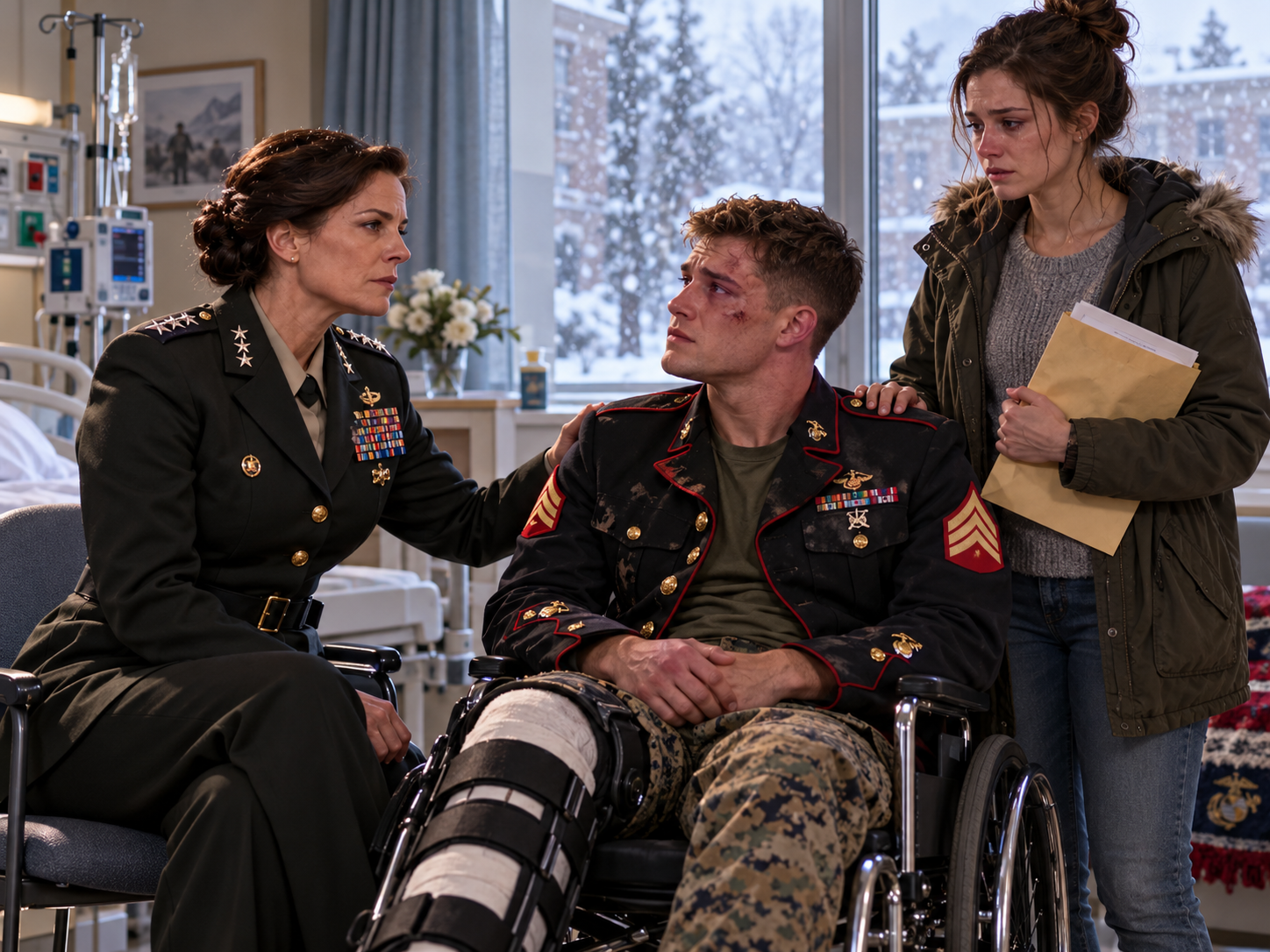
I had no easy answer.
So I didn’t give her one.
Instead, I said, “You and Nathan deserve an independent assessment of this offer and a fair investigation. I can’t promise what either will produce, but I will not help anyone bury evidence to make the problem go away.”
Emily nodded slowly.
Then she reached into her pocket.
“Nathan told me to give you this.”
It was a folded piece of paper.
On it was a telephone number.
Beneath the number, Nathan had written:
JASON MILLER. HE’S READY TO TALK.
PART 4 — THE GENERAL WHO THOUGHT HE WAS UNTOUCHABLE
Lance Corporal Jason Miller answered on the fifth ring.
“Hello?”
His voice was strained.
I identified myself.
There was a long silence.
Then I heard a door close.
“General Bennett?”
“Yes.”
“Is Nathan okay?”
“He’s recovering.”
Another silence.
“His sister said you wanted to speak with investigators.”
“I do.”
“Are you somewhere safe?”
He laughed bitterly.
“I don’t know anymore.”
I looked toward Marcus, seated across the table.
“Jason, I want you to speak with the investigative team. They’ll explain the process and your rights. You should tell them what you actually witnessed.”
He took a shaky breath.
“Will they protect my family?”
“We’ll take any threats seriously and work with the appropriate authorities. But I won’t promise security measures I can’t personally guarantee.”
He was quiet.
Then he said, “That’s more honest than what anyone else has told me.”
Jason arrived at the independent investigation office the next afternoon.
He was twenty-two, thin, and visibly frightened.
He wore civilian clothes and carried a backpack.
Before his formal interview, he requested permission to speak briefly with me.
I agreed, with an investigator present.
“General,” he said, “I didn’t know what to do.”
“Start by telling the truth.”
He nodded.
“My mother has a small house outside Grand Junction. My little brother still lives with her.”
His eyes grew wet.
“After the accident, somebody sent photographs of their house to my phone.”
I stayed still.
“What kind of photographs?”
“The driveway. Her car. My brother leaving for school.”
“Did the sender identify themselves?”
“No.”
“What did the message say?”
He opened his phone and showed the investigator.
The message was short.
Accidents happen to families too. Remember what you signed.
I felt a cold fury settle over me.
Not because the threat was surprising.
Because someone had decided that frightening a young Marine’s family was an acceptable way to protect a business arrangement.
Jason placed another document on the table.
It was a signed statement acknowledging that excessive speed had contributed to the accident.
“Did you write this?” the investigator asked.
“No.”
“Is that your signature?”
“Yes.”
“Explain.”
Jason’s hands shook.
“Major Hale brought it to my hospital room. He said it was routine paperwork.”
“Did you read it?”
“I tried, but I was on pain medication. He said it was just confirming my identity and involvement.”
“Did you later discover what it said?”
“Yes.”
“Why didn’t you challenge it?”
Jason stared at the floor.
“Because then I got the messages.”
He wiped his face.
“I’ve been a Marine for three years. I thought I understood courage. But when somebody starts sending pictures of your mother, you find out you’re afraid of things you never imagined.”
I leaned forward.
“Courage isn’t the absence of fear, Jason.”
He looked up.
“Sometimes it means admitting you’re frightened and telling the truth anyway.”
His expression changed slightly.
“What happens now?”
“The investigators will take your account and examine the evidence. There may be difficult questions about what you signed and what you did afterward. Answer them completely.”
He nodded.
Then he unzipped his backpack.
“I kept something.”
From inside, he removed a small dashboard recording device.
“This was mounted inside Vehicle 417.”
The investigator examined it without touching the controls.
“Was it installed by the unit?”
“Temporarily. For training review.”
“Has anyone examined the recording?”
“Not that I know of.”
Jason swallowed.
“I took it out after the crash, before the recovery crew moved the vehicle. I didn’t want anybody changing what it showed.”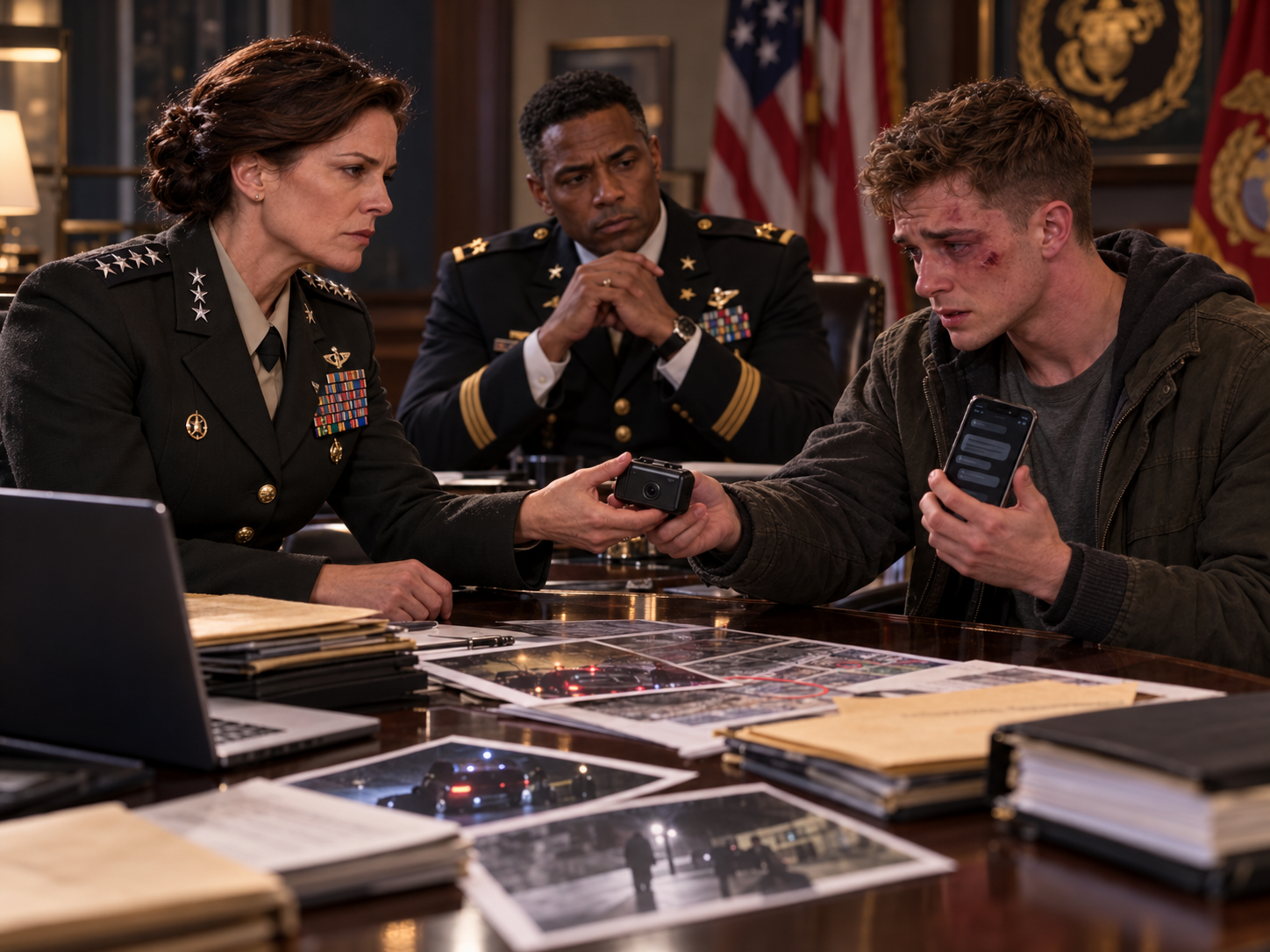
“Did you watch it?”
“Part of it.”
“What did you see?”
He looked at me.
“Major Hale telling us to proceed after I reported the brake problem.”
The recording would take time to authenticate.
But the video investigators recovered from the device that evening supported a devastating sequence of events.
Inside Vehicle 417, Jason could be heard asking whether they should turn around.
Nathan Reed, seated behind him, said the brake pedal felt worse than it had during inspection.
Jason replied that he was experiencing the same problem.
The vehicle’s internal radio crackled.
A voice identified during the preliminary review as Major Hale’s instructed them to continue toward the demonstration staging area.
Jason reported difficulty slowing down.
The response came several seconds later.
“Maintain your route. We cannot delay this movement.”
Then the recording became chaos.
An engine racing.
A shouted warning.
A violent impact.
The picture disappeared.
For several seconds, only ragged breathing remained.
Then Nathan’s voice.
Weak.
Panicked.
“Jason? Jason, answer me.”
The recording ended.
I stared at the dark screen.
No matter how many years someone serves, certain sounds never become ordinary.
The sound of a young person calling for help after an avoidable catastrophe is one of them.
Marcus shut the laptop.
“We have corroboration for their warning.”
“Yes.”
“And potentially evidence that Hale directed the vehicle to continue.”
“Yes.”
He watched me.
“What are you thinking?”
“That nobody gets those seconds back.”
The next morning, Whitcomb called my office.
I recognized his voice immediately.
“Alexandra.”
“General Whitcomb.”
“No need to be formal. We’ve known each other too long.”
“Then you should know I prefer professional channels when discussing an active investigation.”
He chuckled.
“Still difficult.”
“What can I do for you?”
“I hear you’re turning a minor maintenance incident into a scandal.”
I looked at the photographs spread across my desk.
One showed Nathan Reed learning to stand with the support of two physical therapists.
“Minor?”
“You know what I mean. Training accidents happen.”
“So do preventable ones.”
His tone hardened.
“I understand you have personal feelings about this.”
“My concern is the evidence.”
“Don’t be naive. These programs affect national readiness. One defective component does not justify destroying years of progress.”
“Then an accurate investigation should establish that.”
He went silent.
I continued.
“Charles, did you personally authorize the release of Vehicle 417?”
“That is an inappropriate question.”
“Did you direct Major Hale to proceed with the exercise despite the maintenance concerns?”
“You are crossing a line.”
“Then direct your response through the investigators.”
His voice dropped.
“You always did enjoy humiliating people who outranked you.”
I felt the old memory return.
Twenty-three years old.
Newly commissioned.
Standing in a crowded officers’ club while senior men dismissed me as an outsider.
Whitcomb had been a captain then.
He had not been the man who started the ridicule.
But he had laughed.
And later, when I reported a training safety concern, he had told me that ambitious young women sometimes confused attention with leadership.
“I remember you, Charles,” I said.
He paused.
“What’s that supposed to mean?”
“I remember the officer who told me that questioning a bad decision was disloyal.”
“That was a long time ago.”
“It was.”
“And you’re still holding a grudge?”
“No.”
I looked at Nathan’s photograph.
“I’m holding a responsibility.”
Whitcomb exhaled sharply.
“You think those stars make you untouchable?”
“No.”
“Then be careful.”
I remained quiet.
He continued.
“An officer at your level can still lose everything.”
I waited.
Then said, “General Whitcomb, you’ve called me during an active inquiry and made statements that may be relevant to it. This conversation will be documented. Any further discussion should go through counsel and the investigative authorities.”
He hung up.
I kept the phone in my hand for several seconds.
Then I wrote down the time.
Three days later, the investigation changed direction.
A forensic review of the maintenance system identified an administrator-level session used to restore six vehicles to operational status.
That session originated from a workstation assigned to an Aegis technical supervisor.
The system also recorded a separate authentication approval through an account connected to Whitcomb’s program office.
Investigators cautioned that account records alone did not establish who had physically operated either device.
But together with witness statements, the maintenance-bay footage, and recovered correspondence, they supported a much broader inquiry.
The next discovery was financial.
A series of consulting payments had been routed through an intermediary company to Major Hale.
A separate set of transactions raised questions about whether Langford had improperly influenced officials involved in evaluating Aegis’s contract.
Those findings were referred to authorities with the jurisdiction to investigate contracting misconduct and potential criminal offenses.
Langford retained an attorney.
Hale was temporarily removed from duties involving training oversight.
And Whitcomb was directed to preserve relevant records while investigators examined his involvement.
No one had yet been convicted.
But the system of silence was beginning to collapse.
The most important development came from an unlikely place.
Sergeant Dalton.
He appeared at my office one afternoon holding a sealed envelope.
“General, I think you should see this.”
“What is it?”
“The event security roster.”
“From the officers’ club?”
“Yes, ma’am.”
He laid it on the desk.
“Major Hale asked for one entry to be removed after you left that evening.”
I examined the page.
There was a blank space in the visitor log.
Beside it, a handwritten notation:
Female visitor — access denied by command direction.
“Who made this entry?”
“I did.”
“Who told you to remove it?”
“Major Hale.”
“Did you?”
“No, ma’am.”
“Why not?”
Dalton’s expression was steady.
“Because it wasn’t true.”
I looked at him.
He continued.
“You were never denied access. You entered the club. And he never gave me a lawful reason to falsify the log.”
I studied the young sergeant.
He had no influential friends in the room.
No powerful family connections.
No two silver stars.
Yet when asked to alter an official record, he had refused.
“Sergeant Dalton,” I said, “you did the right thing.”
He nodded.
Then hesitated.
“General, may I ask something?”
“Of course.”
“When Major Hale told me to remove you, I almost did.”
“You approached me, yes.”
“If I hadn’t seen your stars, I probably would have escorted you outside.”
I waited.
His eyes dropped.
“How do I make sure I don’t become the kind of Marine who thinks that’s okay?”
For a long moment, I could not answer.
Then I remembered the officer who had once laughed at me when I was twenty-three.
The years it had taken me to stop hearing his voice.
The choices I had made afterward.
“You ask questions,” I said. “You treat people with dignity before you know whether they can reward or punish you. And when you make a mistake, you correct it instead of defending it.”
He considered that.
“Yes, ma’am.”
I offered him a small smile.
“You’ve already started.”
The public reckoning began six weeks later.
By then, the independent review had identified substantial failures in maintenance oversight, reporting, supervision, and contractor accountability.
The relevant investigative authorities had opened formal cases concerning suspected document falsification, improper payments, and efforts to influence witnesses.
The military also initiated its own administrative proceedings.
At a command-wide safety forum, officers and senior enlisted personnel gathered in the same club where Hale had humiliated me.
The event was not a trial.
Nor was it designed to announce guilt before the legal process had run its course.
Its purpose was to explain the documented safety failures, the corrective measures already ordered, and the duty of every service member to raise concerns without fear of retaliation.
I stood at the podium.
Beyond the windows, sunlight reflected from fresh snow.
In the front row sat Lieutenant Isabel Torres.
Beside her was Sergeant First Class Robert Mason.
Sergeant Dalton stood near the side wall.
And in a wheelchair near the center aisle sat Corporal Nathan Reed, with Emily beside him.
When I saw Nathan, my throat tightened.
I hadn’t expected him to attend.
He raised one hand in a small wave.
I nodded.
Then I turned toward the microphone.
“Six weeks ago,” I began, “a major stood at this podium and told a woman she didn’t belong in this room.”
The audience remained silent.
“He was wrong.”
I paused.
“But what happened to me that evening was not the greatest failure uncovered at this installation.”
I looked toward Nathan.
“The greatest failure was that Marines reported a safety hazard, and those warnings were not handled as they should have been.”
I let the words settle.
“Rank is a responsibility, not a shield. Authority is an obligation, not a license to humiliate others. And loyalty does not require anyone to conceal a preventable danger.”
Nobody moved.
I continued.
“Some people here spoke when it was uncomfortable. Some preserved records. Some eventually came forward after being intimidated. Their actions deserve fair consideration, and every allegation must still be examined through the proper process.”
Then I said the words I had been carrying since my visit to the hospital.
“A uniform does not make us honorable. What we do when honoring our duty costs us something—that is what reveals our character.”
Nathan lowered his head.
Emily placed a hand on his shoulder.
And for the first time, I saw Lieutenant Torres smile.
But the story was not finished.
Not yet.
Because the next morning, I received a message from Whitcomb’s attorney.
His client had agreed to cooperate with investigators.
And he was prepared to identify the person who had first proposed concealing the failed brake inspection.
PART 5 — WHAT THE TWO STARS REALLY MEANT
The name Whitcomb gave investigators was not one I recognized.
Elliot Voss.
He was Aegis Defense Systems’ vice president for government programs.
Until then, Voss had remained almost invisible.
He did not attend demonstrations.
He rarely appeared in promotional photographs.
And unlike Victor Langford, he avoided direct contact with junior military personnel.
But according to records investigators subsequently recovered, he had exercised considerable influence over the company’s efforts to secure an expanded defense contract.
Whitcomb alleged that Voss had first suggested keeping the problematic vehicles in service long enough to complete the demonstration.
The investigators did not accept that allegation on faith.
They traced emails, financial records, meeting calendars, and technical reports.
What emerged was more disturbing than a single order.
The experimental braking component had shown inconsistent performance in freezing temperatures during preliminary testing.
Aegis engineers had documented the problem.
Some had recommended additional testing before operational use.
But delaying the demonstration would have risked postponing the contract evaluation.
And the company’s leadership had already committed substantial resources to the expansion.
An internal email became particularly important.
It had been sent from Voss’s account eleven days before Nathan’s accident.
Its subject line read:
Northern Shield — Demonstration Readiness
The message included one sentence that investigators examined closely:
We cannot allow unresolved technical concerns to disrupt the scheduled customer presentation.
Standing alone, that sentence might have been interpreted as ordinary corporate pressure.
But another recovered message was much harder to explain.
It had been sent after Aegis engineers reported abnormal brake behavior.
Coordinate with the installation team. The vehicles need to be available for the demonstration. We will address documentation issues afterward.
The phrase documentation issues troubled me.
It suggested that someone had begun treating a safety problem as a paperwork problem.
And a paperwork problem, in the wrong hands, could be made to disappear.
The formal investigation continued for months.
As additional evidence was collected, the legal and administrative processes moved at different speeds.
The contracting authorities suspended the affected vehicle program pending independent technical evaluation.
The defective braking components were removed from operational use.
Aegis’s expansion award was halted while the government’s contracting officials reviewed the integrity of the procurement process.
Investigators also examined whether other installations had received vehicles with the same experimental components.
Fortunately, the review did not uncover another serious accident linked to the issue.
But several vehicles required corrective maintenance.
The findings confirmed what Lieutenant Torres had tried to explain from the beginning.
Her warning had not been an overreaction.
It had been a legitimate safety concern.
One that should have been taken seriously before Nathan Reed ever climbed into Vehicle 417.
The military investigation also established that her maintenance recommendation had been improperly overridden and that her subsequent reassignment had been connected to her refusal to approve the vehicles.
Her personnel records were corrected.
Her professional reputation was formally restored.
When she learned the decision, she called me.
“General Bennett?”
“Lieutenant.”
“I received the notification.”
“Good.”
There was a pause.
Then she said, “I don’t know what to do.”
I smiled.
“About what?”
“Everyone is acting like I did something extraordinary.”
“You refused to approve equipment you believed was unsafe.”
“That’s what I was supposed to do.”
“Exactly.”
She was quiet.
Then I heard a small, embarrassed laugh.
“My grandfather would have liked that answer.”
“I think he would.”
She took a breath.
“General, may I ask you something?”
“Certainly.”
“Do you think I still have a future in the military?”
The question hurt more than she realized.
After everything she had endured, she still feared that doing her job properly might end her career.
“Isabel,” I said, “I can’t predict every decision that will be made about your assignments or promotions.”
“I understand.”
“But I can tell you that your judgment and integrity are qualities the military needs.”
She exhaled.
“Thank you, ma’am.”
“And Lieutenant?”
“Yes?”
“Don’t let anyone convince you that silence is the price of belonging.”
Sergeant First Class Mason’s situation was more complicated.
He had preserved important evidence.
He had also waited too long to report what he knew.
That hesitation mattered.
As a senior enlisted leader, he had responsibilities that did not disappear because he was frightened.
The administrative review examined both his failures and the pressure placed upon him.
Ultimately, the authorities determined that the evidence did not support the allegation that he had authorized the false certification.
His credentials had been used without his permission.
His retirement eligibility was preserved, although his delayed reporting remained part of the formal assessment of his conduct.
I saw him once more before he left Fort Wexler.
He stood outside the maintenance building, watching younger Marines work beneath the raised hood of a training vehicle.
“General.”
“Sergeant First Class.”
He saluted.
I returned it.
“How’s your wife?”
“Better, ma’am. Her latest scans were encouraging.”
“I’m glad.”
He looked toward the mechanics.
“I keep thinking about what would have happened if I’d spoken sooner.”
I didn’t interrupt.
“Maybe Nathan wouldn’t have gotten hurt.”
“Maybe,” I said.
His eyes closed briefly.
“I wish I could change it.”
“I know.”
“What do I do with that?”
I thought about the question.
“You tell the truth about what happened. Especially to the younger Marines who trust you.”
He nodded slowly.
“That’s what my daughter said.”
“Then listen to her.”
For the first time since I had met him, Mason smiled.
“I think she’s smarter than both of us, ma’am.”
“Very possible.”
Major Preston Hale faced the most painful consequences of anyone in uniform directly involved in the vehicle’s release.
Evidence showed that he had known about the maintenance warning.
He had directed the training movement to continue.
He had accepted improper financial benefits.
And he had participated in efforts to shift responsibility for the accident onto Marines who had reported the problem.
Following the applicable military justice proceedings, he was convicted of offenses related to his misconduct.
His military career ended in disgrace.
I did not celebrate.
I did not feel victorious.
A man losing his career was not a victory.
A young Marine nearly losing his life was not a victory.
The fact that the system had eventually uncovered wrongdoing was important.
But it could not restore Nathan’s health or erase the months of pain his family had endured.
Hale requested one final meeting with me before his departure.
I agreed only after confirming that the legal process permitted it and that the discussion would not interfere with any pending matters.
He entered the room wearing civilian clothing.
For the first time, he looked like an ordinary man.
No ribbons.
No microphone.
No audience.
“General Bennett.”
“Mr. Hale.”
He flinched slightly at the change in address.
Then sat.
“I wanted to tell you that I’m sorry.”
I waited.
“Not just about the club.”
He looked at his hands.
“About Nathan. Lieutenant Torres. Mason. All of it.”
“Have you apologized to them?”
“I wrote letters.”
“That’s a beginning.”
He nodded.
His eyes were tired.
“My wife left.”
I said nothing.
“My children barely speak to me.”
He swallowed.
“I spent my entire life believing respect was something people owed me because of my rank.”
I watched him.
“And when you walked into that club, I thought embarrassing you would make me look important.”
“What do you think now?”
He looked toward the window.
Outside, snow fell softly over the training grounds.
“I think I was terrified of being unimportant.”
It was the first truly unguarded thing I had ever heard him say.
For a moment, I saw not the arrogant officer with the microphone, but a deeply insecure man who had mistaken control for strength.
That realization did not excuse him.
But it helped explain him.
“Hale,” I said, “you made choices that harmed people. You cannot undo those choices.”
“I know.”
“But you still have a choice about what kind of man you become afterward.”
He looked at me.
“You think there’s anything worth saving?”
“That isn’t mine to decide for you.”
His eyes filled.
“I wish someone had told me this before.”
“People probably did.”
He lowered his head.
“You’re right.”
I stood.
The meeting was over.
As he reached the door, he turned.
“General?”
“Yes?”
“Why didn’t you destroy me that night in front of everyone?”
I considered the question.
Then answered.
“Because I wasn’t there to prove that I was more powerful than you.”
He waited.
“I was there to make sure the truth had a chance to be heard.”
Hale nodded.
And left without another word.
Whitcomb’s case took longer.
His cooperation helped investigators reconstruct the events surrounding the demonstration, but it did not erase his own conduct.
He eventually acknowledged that he had participated in decisions that allowed the unsafe vehicles to remain in service.
He also admitted supporting efforts to minimize the resulting safety concerns.
After the relevant proceedings, his military career ended, and he faced additional legal consequences associated with the misconduct established against him.
Victor Langford and Elliot Voss also faced legal action arising from the contracting investigation.
The government pursued recovery of improperly obtained funds and examined the company’s eligibility for future contracts.
For me, the important outcome was not the public downfall of powerful men.
It was that the people who had tried to report the danger were finally heard.
Still, the process left scars.
Nathan’s rehabilitation continued.
Jason Miller underwent counseling after the threats against his family.
Emily Reed spent months navigating medical appointments, legal consultations, and insurance paperwork.
The truth had emerged.
But the truth did not magically solve every problem.
That was the part of justice people rarely included in speeches.
Eight months after the night at the officers’ club, I returned to Colorado.
This time, there was no secret arrival.
No charcoal coat concealing my uniform.
No security guard ordered to remove me.
I had been invited to attend a rehabilitation milestone ceremony at Nathan’s medical center.
Emily met me near the entrance.
She was smiling.
A real smile.
Not the brave, exhausted expression I remembered from our first meeting.
“General!”
She hurried forward.
“It’s so good to see you.”
“You too, Emily.”
She glanced toward the hallway.
“He’s nervous.”
“About what?”
“You’ll see.”
She led me into a small therapy room.
Physical therapists stood along one wall.
Jason Miller was there, too.
So were Lieutenant Torres, Robert Mason, and Nathan’s closest friends.
And at the far end of the room stood Corporal Nathan Reed.
Not sitting.
Standing.
He held the parallel bars with both hands.
A brace supported his right leg.
His face was pale with concentration.
But he was standing.
I stopped walking.
For a moment, I couldn’t speak.
Nathan saw me.
“General Bennett.”
“Corporal Reed.”
He smiled.
“Thought I’d show you something.”
A therapist stood close beside him.
“Ready, Nathan?”
He nodded.
Then released one hand.
Shifted his weight.
And took a step.
A small step.
Awkward.
Painful.
But a step.
Emily pressed both hands over her mouth.
Nathan took another.
Then another.
By the fourth, his arms were trembling.
The therapist helped him settle into a chair.
The room erupted in applause.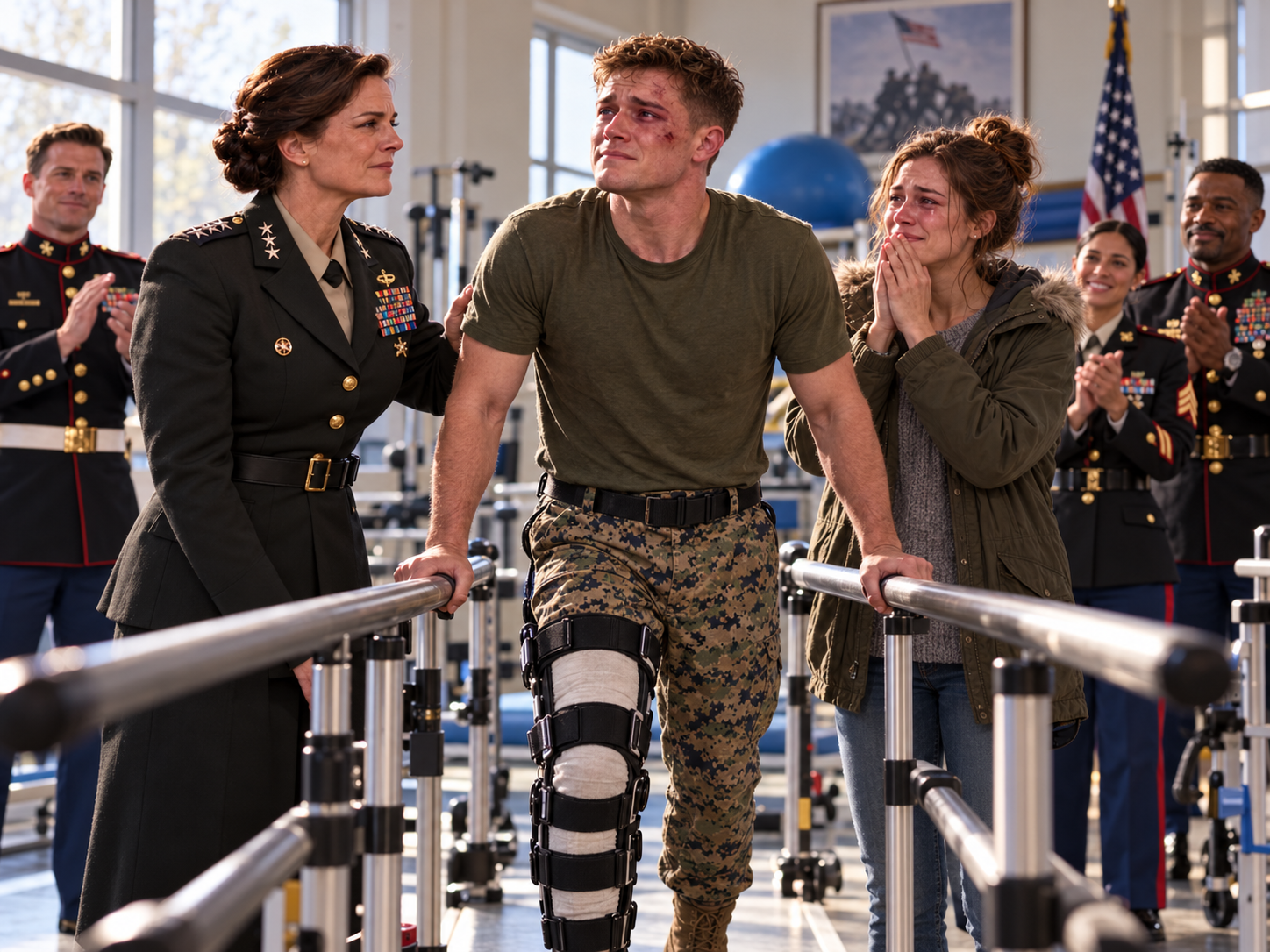
Nathan was breathing hard.
But he was grinning.
I walked toward him.
“Well done, Corporal.”
He laughed.
“Wasn’t pretty.”
“Didn’t need to be.”
His eyes filled.
“They told me there was a chance I might never walk again.”
I nodded.
“I remember.”
“I’m not going to run a marathon tomorrow.”
“I wouldn’t recommend it.”
He laughed again.
Then grew serious.
“General, I wanted you here because you listened.”
I looked at him.
“A lot of people helped.”
“I know.”
He glanced at his sister.
“Emily never gave up.”
She wiped her eyes.
“Never.”
He looked toward Jason.
“Jason came back and told the truth.”
Jason nodded, unable to speak.
“Lieutenant Torres tried to keep us off that road.”
Torres pressed her lips together.
“And Sergeant Mason kept the records.”
Mason lowered his head.
Nathan looked back at me.
“But when everybody else kept telling us to move on, you came to my hospital room and asked what happened.”
I felt my throat tighten.
“That was my job.”
“Maybe.”
He reached for something beside his chair.
A small wooden plaque.
He handed it to me.
On its surface were two silver stars.
Beneath them were the words:
THE STARS MADE THEM STAND.
YOUR CHARACTER MADE YOU STAY.
For several seconds, I couldn’t speak.
I had received medals.
Commendations.
Awards presented beneath flags in distant countries.
But few things had ever affected me as deeply as that little wooden plaque.
“Thank you, Nathan.”
He smiled.
“Thank you, General.”
A year after the accident, Nathan returned to limited duty while his long-term medical and service status continued to be evaluated.
His recovery was not complete.
Some pain remained.
There were days when he still needed assistance.
But he had regained enough mobility to walk short distances with support, and he had begun helping newly injured service members adjust to rehabilitation.
He discovered that encouragement came more naturally to him than he had expected.
Jason completed his remaining service obligation and later began studying mechanical engineering.
He wanted to work on vehicle safety systems.
When someone asked why, he gave a simple answer.
“Because I know what happens when they fail.”
Robert Mason retired and moved closer to his daughter.
He volunteered occasionally with a veterans’ technical training program, where he taught young mechanics to document their work carefully and question any certification they could not support.
Lieutenant Isabel Torres continued her career.
The next time I saw her name, it appeared on a list of officers selected for a competitive technical leadership course.
She sent me a short note.
My grandfather would have framed this letter.
I wrote back:
Then make sure you earn another one.
Sergeant Daniel Dalton also advanced.
I received a message from him several months later.
He had been promoted to staff sergeant.
He told me he was responsible for training younger Marines.
And every time he discussed military bearing, he reminded them of something he had learned at the officers’ club.
Respect is not something you save for people with impressive insignia.
It is something you show before you know who they are.
I kept his message.
Along with Nathan’s plaque.
Two years after that snowy night, I attended a formal military leadership gathering in Virginia.
Hundreds of officers filled the ballroom.
Generals.
Colonels.
Majors.
Young lieutenants beginning careers they hoped would matter.
As I waited near the entrance, a young female officer approached.
“General Bennett?”
“Yes, Lieutenant?”
She looked nervous.
“May I ask you something?”
“Of course.”
“I heard a story about you.”
I smiled faintly.
“That could be dangerous.”
She laughed.
“About a major who tried to throw you out of an officers’ club.”
I nodded.
“It’s true.”
“Did he really not know you were a general?”
“He did not.”
Her eyes widened.
“And you just stood there?”
“For a little while.”
“Why?”
I considered the question.
“Because I wanted to understand how he treated someone he believed couldn’t challenge him.”
She looked thoughtful.
Then said, “I don’t think I could have stayed so calm.”
“You might surprise yourself.”
She hesitated.
“Can I ask one more question?”
“Certainly.”
“What’s the most important thing you’ve learned about leadership?”
I looked beyond her.
Across the ballroom, officers were greeting old friends.
Young service members were arranging chairs.
A civilian server carried a tray of water glasses through the crowd.
Someone accidentally bumped his elbow.
Water spilled onto the carpet.
The server apologized immediately.
A senior officer stepped aside and helped him steady the tray.
No laughter.
No humiliation.
Just one person helping another.
I watched the small exchange.
Then turned back to the lieutenant.
“Never become so impressed with your position that you forget the people you’re supposed to serve.”
She nodded slowly.
“I’ll remember that, ma’am.”
I smiled.
“I hope you do.”
Later that evening, I returned to my hotel room.
I removed my uniform jacket and laid it carefully across the chair.
For a moment, I studied the two silver stars on my shoulders.
When I was twenty-three, I had believed earning respect meant proving that I deserved a place in rooms where other people thought I didn’t belong.
I worked harder.
Studied longer.
Volunteered for difficult assignments.
Carried the weight of every dismissive remark as though it were something I had to overcome by becoming exceptional.
And somewhere along the way, I learned a different lesson.
Rank could command attention.
Authority could compel obedience.
A decorated uniform could make a room stand.
But none of those things guaranteed respect.
Not the kind that mattered.
The kind that lived in a young sergeant’s refusal to falsify a log.
In a lieutenant’s courage to report an unsafe vehicle.
In a frightened mechanic’s decision to preserve evidence.
In a wounded corporal’s determination to stand again.
And in a sister who refused to let the world forget what had happened to her brother.
I opened my travel bag.
Inside was the wooden plaque Nathan had given me.
I had carried it to nearly every assignment since the rehabilitation ceremony.
Two silver stars.
And the words beneath them.
THE STARS MADE THEM STAND.
YOUR CHARACTER MADE YOU STAY.
I placed it on the desk.
Then I looked out at the lights of the city.
Somewhere far away, Nathan was building a new life.
Torres was teaching younger officers.
Dalton was training Marines.
And hundreds of service members I would never meet were making quiet decisions that would never appear in an award citation.
Choosing to speak.
Choosing to help.
Choosing to do what was right when no one important was watching.
My phone vibrated.
A message from Emily Reed.
There was a photograph attached.
Nathan stood in a park beside Jason.
No wheelchair.
One hand resting lightly on a walking cane.
Both men were smiling.
Beneath the picture, Emily had written:
He walked half a mile today. Slowly, but he did it. He wanted you to know.
I sat on the edge of the bed.
For a long moment, I just looked at the photograph.
Then I replied:
Tell him I’m proud of him. Every step counts.
A moment later, another message appeared.
He says you still owe him that cup of coffee.
I laughed softly.
I had promised him one during his second week in rehabilitation.
A promise made in a hospital room when neither of us knew how much he would recover.
I typed:
Tell him the coffee is on me.
Then I set down my phone.
And for the first time in a very long while, I felt the particular peace that comes not from winning a battle, but from knowing that something good has survived it.
I still remember the sound of that microphone striking the carpet.
I remember the laughter.
The melting snow.
Major Preston Hale’s face when Sergeant Dalton called the room to attention.
But those are no longer the moments I think about most.
I think about Nathan taking his first steps.
I think about Lieutenant Torres choosing the truth over her career prospects.
I think about Emily holding her brother’s hand when he feared his life would never be the same.
And I think about Sergeant Dalton, a young Marine who understood that following orders did not mean abandoning judgment.
Nearly two hundred officers had stood when they saw my stars.
But the people I came to respect most were the ones who stood up for what was right before anyone told them to.
That snowy night, Major Hale believed he was teaching an unwelcome woman where she belonged.
Instead, he reminded me why I had spent my entire adult life wearing a uniform.
Not to be recognized.
Not to be feared.
Not to stand above anyone.
But to serve.
And if I could go back to that doorway, with snow melting against my collar and a room full of strangers laughing at me, I would make the same choice.
I would stand quietly.
I would let the young sergeant approach.
I would wait until the moment he saw those two silver stars.
But this time, I would already know something I had spent twenty-three years learning.
The greatest honor of wearing a uniform isn’t having the power to make people stand when you enter a room.
It’s having the courage to stand beside them when everyone else has walked away.
THE END.