THE GENERAL THEY ERASED: SIXTEEN YEARS OF SILENCE, ONE SALUTE, AND THE TRUTH THAT DESTROYED A PERFECT FAMILY
PART 1 — THE FORGOTTEN DAUGHTER
My father laughed in front of the entire ballroom and announced,
“If my daughter is really a general, then I suppose I’m a ballerina.”
The room erupted.
For sixteen years, my family had erased my name, hidden every achievement, and behaved as if I had simply disappeared from their lives.
Then, only moments later, the ballroom doors burst open.
Military officers marched inside.
And every person who had laughed at me went completely still when they realized exactly who they had just insulted.
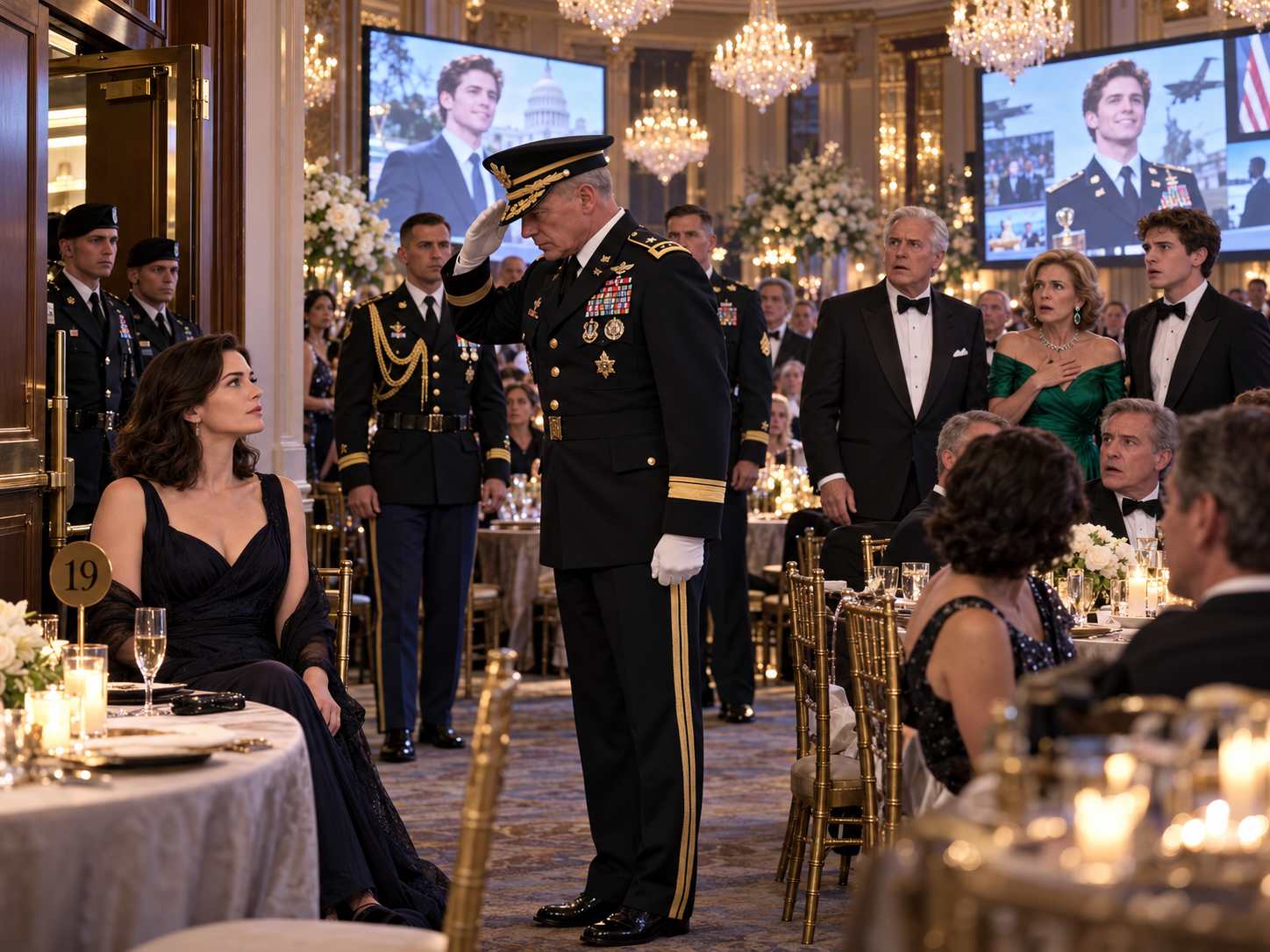
The Westbridge Hotel ballroom glittered beneath crystal chandeliers, polished silver, and the kind of carefully displayed wealth designed to make every guest feel important just for being there.
The moment I walked inside, nearby conversations softened.
A staff member checked the seating chart.
Then checked it again.
Finally, she pointed toward Table 19.
Near the emergency exit.
Far from the center of the room.
The tablecloth was wrinkled.
One of the water glasses had a cloudy mark around the rim.
My place card read:
Dr. Elena Whitmore.
Nothing else.
No rank.
No decorations.
No acknowledgment of the sixteen years my family had spent pretending my military career was some embarrassing phase I would eventually outgrow.
Across the ballroom, my mother stood in an emerald silk gown beside my younger brother, Ethan.
She looked radiant.
Proud.
Completely at home.
The evening belonged to him.
Ethan had recently been promoted to managing director at one of Chicago’s largest investment firms.
And every image projected onto the ballroom walls seemed carefully selected to prove that the Whitmore family had raised exactly one successful child.
Ethan at graduation.
Ethan shaking hands with executives.
Ethan standing beside my parents at the country club.
Ethan smiling beneath award banners.
Not one photograph of me.
I took my seat.
Straightened my shoulders.
Then lifted my water glass while the room applauded another photograph of my brother.
Military intelligence had trained me to keep my expression unreadable when people around me were waiting to see how I would react.
My family had taught me why that skill mattered.
Then Mara Jensen approached my table.
We had gone to high school together.
Back then, she used to borrow my chemistry notes and pretend she had only stopped by to say hello.
Now she looked uncomfortable.
She didn’t sit down.
Instead, she slid her phone across the table.
“You need to see this.”
An email filled the screen.
Sent sixteen years earlier.
Sender:
My father.
Subject:
REQUEST FOR REMOVAL FROM RECOGNITION.
My fingers stopped around the water glass.
I read.
“Given Elena Whitmore’s decision to pursue an unconventional, non-civilian professional direction, we ask that she be removed from all future alumni recognition materials so they may more accurately reflect our family’s values.”
For one brutal second, the ballroom disappeared.
The music.
The silverware.
The low laughter.
All of it.
They had not forgotten me.
They had not misunderstood my career.
They had deliberately removed me.
At eighteen, I left home for basic training with one duffel bag.
My father refused to drive me to the station.
In the years that followed, I served on missions my relatives would never hear about.
I helped build evacuation routes through active combat areas.
Worked under conditions where seconds mattered.
Learned how to keep my voice perfectly calm when people’s lives depended on it.
Ethan built investment portfolios.
I helped bring human beings home alive.
Yet my father had reduced everything I had done to an “unconventional path” because it didn’t fit neatly into photographs taken at country club dinners.
Mara quietly took her phone back.
Then my father’s laughter rose above the room.
Apparently, one of Ethan’s colleagues had asked about me.
“Military intelligence?”
Dad laughed loudly enough for several nearby tables to hear.
“Come on.”
More people turned.
“If Elena is a general, then I must be a ballerina.”
The laughter spread in waves.
My mother smiled into her wineglass.
Ethan lowered his eyes.
He said nothing.
A server froze with a tray balanced on one hand.
A guest held a fork halfway to his mouth.
The ice in Dad’s whiskey shifted slowly as chandelier light flashed across the glass.
Something inside me did not break.
It simply stopped asking them to understand.
I set my water glass down.
Then the ballroom doors flew open.
Three officers in full uniform entered first.
Behind them came two armed military escorts.
Their polished shoes struck the marble floor in precise, measured steps.
The room changed immediately.
Conversations died table by table.
Guests moved aside.
My father stopped smiling.
The most senior officer scanned the ballroom.
His gaze passed over the stage.
Past Ethan.
Past my parents.
Then settled on me.
Table 19.
Near the emergency exit.
The forgotten seat.
He started walking.
Straight toward me.
He never once looked at my father.
Never glanced at my mother.
Never acknowledged the enormous photograph of Ethan glowing against the wall.
When he reached my table, he stopped.
Snapped to attention.
Then raised his hand in a salute so sharp that several guests nearby visibly flinched.
“General Whitmore,” he said.
And suddenly, nobody in the ballroom was laughing anymore.
PART 2 — THE SALUTE THAT CHANGED EVERYTHING
For three seconds, nobody moved.
Colonel James Mercer stood before me with his hand raised, his expression controlled, his uniform immaculate beneath the ballroom lights.
I returned his salute.
“At ease, Colonel.”
His hand dropped.
“Ma’am, I apologize for the interruption. General Donovan requests your presence at the National Service Leadership reception upstairs. There’s been a change to the recognition program, and he asked that I escort you personally.”
I glanced at the clock above the ballroom entrance.
8:17 p.m.
“Is there an operational emergency?”
“No, ma’am. Nothing requiring immediate command action.”
“Then why the security detail?”
“General Donovan’s party was passing through the adjoining conference area. The security officers are assigned to his movement. He asked us to locate you before the presentation begins.”
I nodded.
That explanation mattered.
I had spent years learning that authority should never be used carelessly, especially around people who were already intimidated by a uniform.
The officers had not come to punish my father.
They were not there to provide me with a dramatic demonstration of military power.
They had a legitimate reason to find me.
The timing was simply extraordinary.
“Give me five minutes, Colonel.”
“Yes, ma’am.”
He stepped aside.
The room remained silent.
Then a chair scraped against the floor.
My father had stood up.
Richard Whitmore was sixty-one, silver-haired, and still handsome in the deliberate way of men who spent more time polishing their reputations than examining their consciences.
He looked from Mercer to me.
Then back again.
“I’m sorry,” he said, smiling uncertainly. “Did you just call my daughter a general?”
Mercer turned.
“Yes, sir.”
My father’s smile grew rigid.
“A general in the United States Army?”
“Yes.”
“Well, there must be some misunderstanding.”
Mercer’s expression did not change.
“I’m not aware of one, sir.”
My mother approached, clutching her evening bag.
“Richard,” she whispered, “not here.”
But Dad was already moving toward us.
“Elena, what is this?”
I looked at him.
“What is what?”
“This performance.”
I almost laughed.
Even now, standing before an Army colonel who had addressed me by rank, my father believed the world might be participating in some elaborate deception designed to embarrass him.
“It’s not a performance.”
He glanced toward the officers.
“Surely there are regulations about pretending to be—”
“Sir.”
Mercer’s voice was polite, but unmistakably firm.
“Major General Elena Whitmore is a commissioned officer of the United States Army. Her rank is not a matter of interpretation.”
A murmur traveled through the ballroom.
Major General.
Two stars.
I watched the words settle over my father’s face.
I had worn that rank for eleven months.
My promotion ceremony had taken place in Virginia, attended by officers whose lives had intersected with mine across four continents.
My father had received an invitation.
So had my mother.
Neither came.
Two weeks afterward, Dad sent a brief email asking whether I could recommend an Army procurement contact for one of his business associates.
He never mentioned the promotion.
My mother finally spoke.
“Major general?” she repeated faintly.
“Yes, Mother.”
“But you’re only thirty-four.”
“Thirty-four-year-olds can become generals,” I replied. “It’s uncommon. It doesn’t make it imaginary.”
My father stared.
“Why didn’t you tell us?”
That question struck harder than his joke.
I remembered the calls.
The photographs.
The invitations.
The messages that went unanswered.
I remembered standing outside a hospital in Germany after seventy-two hours coordinating the evacuation of wounded civilians, calling home because I wanted to hear a familiar voice.
My father answered.
He listened for six seconds.
Then said, “Elena, I’m hosting investors. This isn’t a good time.”
I had not called again for eleven months.
“I did tell you,” I said.
He shook his head.
“Not like this.”
“No,” I agreed. “Not like this.”
A woman near the stage lifted her phone.
Several guests followed.
I turned toward them.
“Please don’t record this.”
One by one, most lowered their devices.
My father noticed the movement.
Something old and familiar appeared in his eyes.
Calculation.
He glanced toward the stage, where the enormous photograph of Ethan still hung above the company logo.
Then he smiled.
A broad, public smile.
“Well!”
His voice rose.
“Ladies and gentlemen, apparently my daughter has been keeping some extraordinary news from her own family!”
A few people shifted uncomfortably.
He stretched out an arm toward me.
“Elena, come up here. We should celebrate this properly.”
I stayed where I was.
“No, thank you.”
“Don’t be ridiculous.”
“I’m not.”
His expression tightened.
“This is a family celebration.”
I looked toward Table 19.
“Then perhaps you should have seated me with the family.”
Several guests turned.
My mother went pale.
Ethan remained near the stage, his hands clasped in front of him.
Dad lowered his voice.
“Elena, don’t make a scene.”
I held his gaze.
“You already did.”
He stepped closer.
“Whatever disagreements we’ve had, they belong inside the family.”
“Then you should have kept your joke inside the family.”
A waiter quietly placed his tray on a sideboard.
Nobody laughed.
My father looked toward Mercer, perhaps hoping another man in authority would intervene.
Mercer stood perfectly still.
This was not his conversation.
It was mine.
My mother reached for my wrist.
“Elena, sweetheart, let’s talk somewhere private.”
I gently withdrew my hand.
“There’s something I’d like to ask first.”
Dad exhaled sharply.
“What now?”
“Why did you write to the alumni board sixteen years ago requesting my removal from its recognition program?”
For the first time that evening, I saw genuine fear.
Not confusion.
Not irritation.
Fear.
His eyes moved toward Mara Jensen.
Mara stood near Table 19, holding her phone against her chest.
Dad looked back at me.
“I have no idea what you’re talking about.”
“Then I can show you the email.”
His jaw worked.
“That was a private family matter.”
“An email to the alumni board wasn’t private.”
“It was sixteen years ago!”
“Yes.”
I paused.
“I was eighteen.”
My mother looked away.
Ethan suddenly moved forward.
“Dad,” he said quietly. “Stop.”
My father ignored him.
“You have no idea what things were like then.”
I felt an old wound open.
I knew exactly what things had been like.
I remembered waiting at the kitchen table with my enlistment documents while my father told me I was throwing away a future at Stanford.
I remembered my mother refusing to sign a congratulatory card because she said joining the Army was not an achievement worth celebrating.
I remembered Ethan, eighteen months younger, standing in the hallway with tears in his eyes while Dad ordered him upstairs.
I remembered leaving at dawn.
Only our elderly neighbor, Mrs. Callahan, had come outside to say goodbye.
She gave me twenty dollars and a sandwich wrapped in foil.
“Your life belongs to you, Elena,” she said.
I had carried that sentence into every difficult year afterward.
“You’re right,” I told my father. “I don’t know everything that happened after I left.”
He looked relieved.
“Exactly.”
“But I’m beginning to find out.”
Mara stepped forward.
“There are more documents.”
My father turned sharply.
“Mara, this is inappropriate.”
She looked frightened.
Then she raised her chin.
“Maybe. But deleting someone’s name from the history of a school is inappropriate too.”
Ethan stared at her.
“What documents?”
Mara hesitated.
“Not here.”
Before anyone could answer, a hotel manager appeared near Mercer.
“General Whitmore? They’re ready for you upstairs.”
I checked my watch.
Then turned to Mara.
“Will you still be here in an hour?”
“Yes.”
“Good.”
My father tried once more.
“Elena, whatever you think happened, we can discuss it tomorrow.”
I looked at him for a long moment.
“Sixteen years ago, you decided my achievements weren’t worth acknowledging.”
My voice remained steady.
“Tonight, when you discovered you were wrong, your first instinct was to make my achievement part of your celebration.”
His face reddened.
“That isn’t fair.”
“Neither was Table 19.”
I turned to the officers.
“Colonel Mercer, let’s go.”
“Yes, ma’am.”
As we crossed the ballroom, guests stood aside.
Some nodded respectfully.
Others looked ashamed.
Near the door, I heard a voice.
“Elena?”
It was Ethan.
I stopped.
My brother approached with the awkwardness of a man who had never learned how to speak to me without first checking our father’s expression.
“I didn’t know,” he whispered.
I studied him.
“About my rank?”
He swallowed.
“About what Dad did.”
I wanted to believe him.
I truly did.
But the email Mara had shown me had contained more than an insult.
It had been sent to people who controlled records, scholarships, and institutional recognition.
My father had not simply refused to praise me.
He had used his influence to make others forget me.
I looked at Ethan.
“Then I suppose we both have things to learn.”
I left the ballroom.
And on the elevator to the next floor, Colonel Mercer handed me a cream-colored folder.
“General Donovan asked that you review the revised ceremony program.”
I opened it.
The first page contained my official biography.
Below it was a photograph from a humanitarian evacuation operation.
I recognized the ruined bridge behind me.
I remembered the smoke, the rain, the exhaustion.
And the little girl whose hand I had held while we waited for the last convoy.
Under the photograph were the words:
THE ELENA WHITMORE SERVICE AND LEADERSHIP FELLOWSHIP
My breath caught.
“Colonel, what is this?”
Mercer looked surprised.
“You haven’t seen the announcement?”
“No.”
He hesitated.
“The fellowship was approved last month. General Donovan will explain the details.”
I stared at the page.
A fellowship.
With my name.
Then I turned to the next sheet.
My stomach tightened.
Beneath the fellowship announcement was a partnership acknowledgment.
One organization appeared at the top.
The Whitmore Family Foundation.
And directly beneath it was a signature.
Mine.
A signature I had never written.
PART 3 — THE SIGNATURE THAT SHOULD NOT EXIST
I stopped inside the elevator.
The doors slid shut behind us.
For a moment, I could hear nothing except the low mechanical hum carrying us upward.
“Colonel Mercer.”
“Yes, ma’am?”
“Who submitted this partnership document?”
He glanced at the folder.
“I believe the program office received it from the civilian foundation administrator.”
“Who verified the signature?”
“I don’t know.”
I turned the page toward him.
“This is not my signature.”
Mercer studied the document.
His expression changed.
“Are you certain?”
“Absolutely.”
The initials were mine.
The name was mine.
But the signature carried a flourish I had abandoned when I was twenty.
Someone had copied it from an old document.
More importantly, the page contained an authorization clause suggesting I had endorsed a financial partnership between the fellowship and the Whitmore Family Foundation.
I had never signed such an agreement.
I had never been consulted.
And until thirty seconds earlier, I had never heard of the fellowship.
“We need to notify the program office,” I said.
Mercer nodded.
“I’ll contact them.”
“No public announcement of the partnership until the documentation is verified.”
“Understood.”
The elevator opened.
Upstairs, the hotel looked different.
The same expensive furniture.
The same polished marble.
But the adjoining conference hall was filled with military officers, public-service leaders, veterans, emergency-response professionals, and civilians who had spent their careers working in places where a title mattered far less than whether someone could be trusted.
General Patrick Donovan stood near the registration desk.
He was sixty-four, tall, broad-shouldered, and wore the patient expression of a man who had survived enough meetings to know which ones were worth attending.
He smiled when he saw me.
“Elena.”
“Sir.”
We shook hands.
“I’m glad Mercer found you. I was beginning to think Chicago had swallowed you whole.”
“Not quite, sir.”
He noticed my expression.
“Something wrong?”
I handed him the folder.
“Yes.”
We moved into a quiet conference room with Mercer and a civilian program director named Rebecca Lane.
I explained the signature.
Rebecca’s face drained of color.
“Oh, no.”
Donovan looked at her.
“Rebecca?”
She opened her tablet.
“The Whitmore Family Foundation pledged three million dollars over five years for the fellowship. Their representative provided documentation indicating General Whitmore supported the arrangement.”
“Which representative?” I asked.
Rebecca hesitated.
“Richard Whitmore.”
My father.
I closed my eyes briefly.
The evening had started with a cruel joke.
Now my family name appeared on documents that could compromise a professional recognition initiative.
“Was any money transferred?” I asked.
“Not to the fellowship account,” Rebecca replied. “The agreement was preliminary. The formal grant was scheduled to be finalized next week.”
A small relief.
But only a small one.
“Who prepared the announcement?”
“An outside communications consultant retained by the foundation.”
“Then suspend it.”
Donovan nodded immediately.
“Agreed.”
Rebecca looked distressed.
“We’ve already printed the program.”
“Then we’ll correct it,” Donovan said. “There’s nothing dishonorable about correcting a mistake before it becomes a bigger one.”
He turned to me.
“Elena, the fellowship itself is legitimate. The selection committee approved the concept independently. It honors people working in humanitarian logistics, evacuation planning, and crisis leadership.”
I glanced at the document.
“And the funding?”
“Several contributors are involved. The Whitmore pledge was the largest proposed private contribution, but it wasn’t the basis of the award.”
I exhaled.
Donovan continued.
“You’ve spent sixteen years protecting people whose names never appeared in headlines. We thought it was time to recognize that kind of service.”
For the first time that evening, I had difficulty finding words.
Recognition had always made me uncomfortable.
Not because I disliked it.
Because I understood how many people rarely received it.
The medics who stayed behind.
The drivers who returned under fire.
The interpreters who risked their families.
The junior officers who noticed something important when everyone else was exhausted.
I thought of Captain Sarah Bennett, who had once crossed a damaged airfield three times to escort frightened civilians to safety.
She never received the public recognition she deserved.
She had died two years later in an accident unrelated to the mission.
People like Sarah were the reason I had accepted positions that required sacrifice.
I looked at Donovan.
“If you proceed, I want the fellowship to recognize teams, not just senior leaders.”
He smiled.
“I had a feeling you’d say that.”
Then his face grew serious.
“About the forged document. This needs to be examined through the appropriate channels.”
“I agree.”
“And Elena?”
“Yes, sir?”
“Whatever your family connection, don’t investigate it yourself.”
“I won’t.”
He understood immediately.
An intelligence officer who allowed personal grievances to interfere with professional judgment could create more damage than the person she was trying to expose.
I had no intention of using military resources against my relatives.
If someone had forged my signature, that was a matter for the program’s legal staff and, if warranted, civilian authorities.
My responsibility was to preserve the evidence and tell the truth.
We arranged for the document to be retained.
Rebecca secured the relevant correspondence.
Mercer recorded who had handled the folder.
Then Donovan changed the ceremony program.
The fellowship announcement would proceed.
The questionable foundation partnership would not.
At nine o’clock, I stood in a side aisle while the ceremony began.
I had changed into the dress uniform Mercer had arranged to be brought from my hotel room, since I had planned to attend the reception after my family’s dinner.
The fabric felt familiar.
Comfortable.
Not because of the stars on my shoulders.
Because of everything that had happened before I earned them.
Donovan approached the podium.
He spoke about service, responsibility, and the difference between authority and leadership.
Then he announced the fellowship.
“In the years I’ve known Major General Elena Whitmore,” he said, “I’ve watched her make difficult decisions under circumstances most people will never experience.”
A photograph appeared behind him.
An evacuation center.
Rows of families.
Children wrapped in blankets.
I recognized it immediately.
Donovan continued.
“Leadership is not the privilege of being seen. It is the obligation to serve, especially when no one is watching.”
The audience stood.
Applause filled the room.
I walked toward the stage.
And as I did, my phone vibrated.
A message from Mara.
You need to come back downstairs when you’re finished. Ethan just found something in the foundation records. Your father is trying to stop him from showing it to anyone.
I stopped for half a heartbeat.
Then continued walking.
I accepted the recognition.
I thanked the people who had made the fellowship possible.
I spoke about the medics, drivers, analysts, engineers, and civilian partners whose courage deserved equal attention.
And I dedicated the first year of fellowship awards to the memory of Captain Sarah Bennett.
My voice nearly broke when I said her name.
I let it.
Then I stepped away from the podium.
The applause followed me.
For sixteen years, I had imagined what it might feel like if my parents finally saw me.
Standing beneath those lights, I realized something unexpected.
Their approval was no longer necessary for my achievements to be real.
But their choices still mattered.
Especially if those choices had harmed other people.
When the reception ended, I returned downstairs.
The ballroom had changed.
The music was gone.
The enormous photographs of Ethan were disappearing from the screens.
Staff members cleared abandoned plates.
Guests gathered in small groups, speaking quietly.
Near the stage, my father stood with two men in dark suits.
My mother sat at the head table, looking exhausted.
Ethan waited beside Mara.
When he saw me, he hurried forward.
“Elena.”
“What happened?”
He held out a manila envelope.
His hands were trembling.
“I found a payment record.”
“What payment?”
He swallowed.
“Dad’s foundation has been using your name for years.”
I didn’t take the envelope immediately.
“How?”
He glanced toward our father.
“Scholarship fundraising. Veteran outreach. Corporate donations. The foundation’s annual reports mention your military service.”
I stared at him.
“But the family told everyone I wasn’t successful enough to acknowledge.”
“I know.”
“Which is it, Ethan?”
His eyes filled.
“That depends on who Dad was talking to.”
Mara opened her laptop on a nearby table.
“I’ve been helping the alumni association digitize older records,” she explained. “When you showed me that email, I started checking whether anything else had been altered.”
She turned the screen toward me.
A scanned brochure appeared.
It was dated eleven years earlier.
The title read:
WHITMORE LEADERSHIP INITIATIVE — SUPPORTING THE FAMILIES OF THOSE WHO SERVE.
Underneath was a paragraph describing me as a distinguished military professional whose commitment to service reflected the foundation’s guiding principles.
My photograph had been used.
A photograph taken at a ceremony overseas.
I had no idea how my father obtained it.
Another brochure appeared.
Then another.
Ethan pointed toward a donation summary.
“Several contributors believed you were directly involved.”
“Was I listed as an officer of the foundation?”
“No. But the materials suggested you helped advise its military outreach programs.”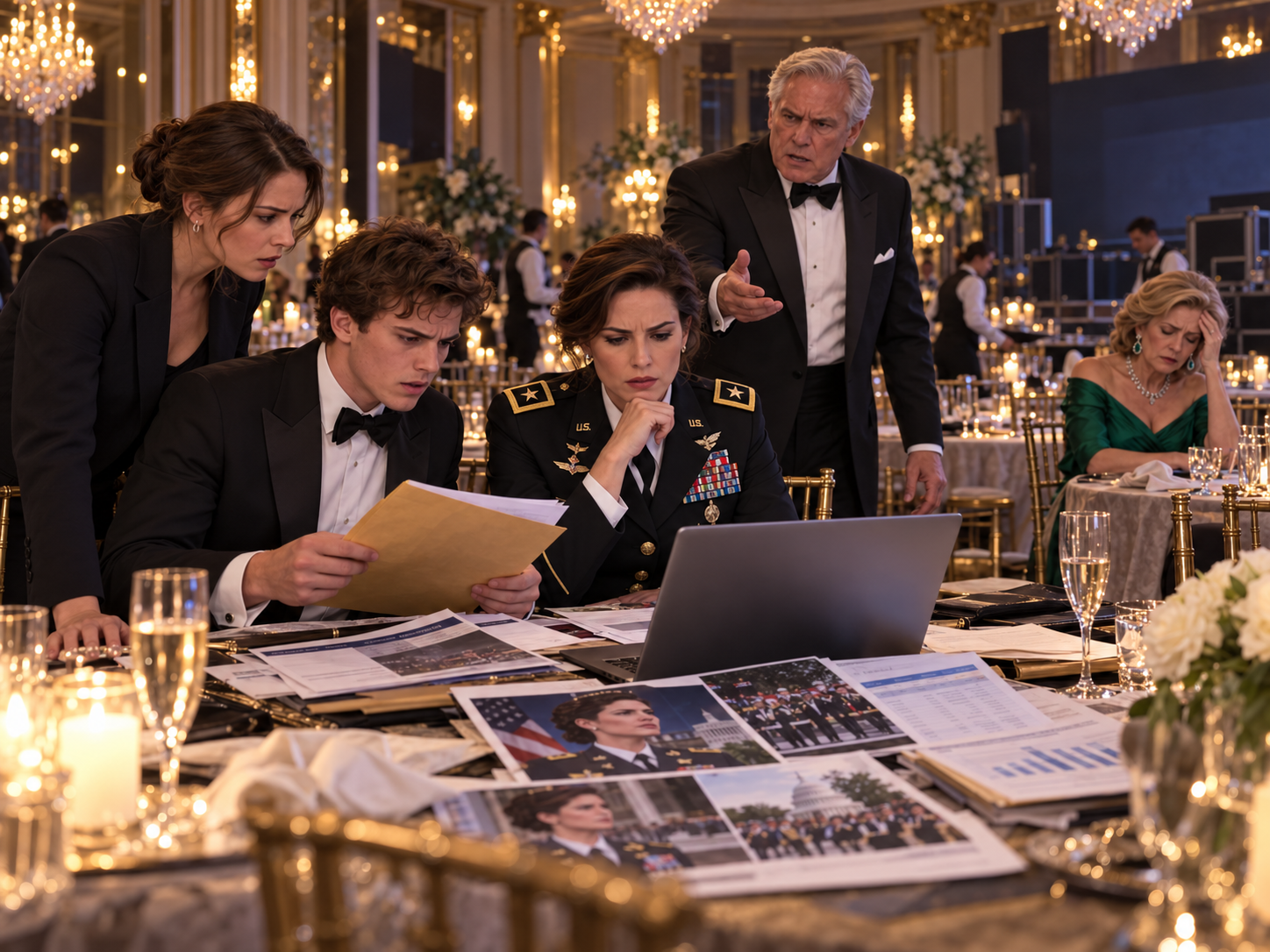
I looked at the figures.
Millions had been raised over several years.
How much had gone to legitimate programs was unclear.
Some charities were real.
Some grants had clearly been distributed.
Others were described in language so vague that even Ethan could not explain where the money had gone.
And there were payments to a consulting company.
Whitmore Strategic Advisory.
My father’s private firm.
I looked at my brother.
“Did you know?”
He didn’t answer quickly enough.
“Ethan.”
“I knew Dad used your service in presentations,” he admitted. “He said you had given permission years ago.”
“Did you ever ask me?”
“No.”
“Why not?”
His face crumpled.
“Because I was afraid of the answer.”
That hurt more than I expected.
Not because Ethan had been my enemy.
Because he had chosen not to know.
I looked back at Mara.
“Do you have the original files?”
“Copies of the publicly distributed materials and records I was authorized to access. Ethan has his own copies of the foundation reports.”
“Keep them exactly as they are. Don’t alter anything.”
She nodded.
My father approached.
“That’s enough.”
His voice cut through the emptying ballroom.
I turned.
He looked older than he had two hours earlier.
Not humbled.
Angry.
“You’ve had your little triumph, Elena. Everyone knows you’re important now. Is that what you wanted?”
I stared at him.
“Someone forged my signature.”
His expression flickered.
“I don’t know anything about that.”
“Then you should be concerned.”
He laughed bitterly.
“Oh, please. A signature on a preliminary partnership letter? You’re making it sound like a federal conspiracy.”
“I haven’t called it anything.”
“Then stop treating your father like a criminal!”
I stepped closer.
“Did you authorize someone to sign my name?”
“No.”
“Did you know the document existed?”
He hesitated.
“Of course I knew about the partnership.”
“Did you tell the program office I supported it?”
“I told them you were my daughter.”
“That wasn’t the question.”
His eyes hardened.
“I spent sixteen years trying to protect this family’s reputation while you ran around the world doing God knows what.”
I felt my chest tighten.
“Protect it from what?”
“From embarrassment!”
The word echoed through the ballroom.
My mother closed her eyes.
Ethan stepped between us.
“Dad, stop.”
But Richard Whitmore had never stopped simply because someone asked him to.
He pointed toward the laptop.
“All of you are turning against me over paperwork!”
Ethan raised the envelope.
“This isn’t paperwork. There are seven hundred thousand dollars in consulting payments that I can’t reconcile against services.”
Dad went still.
Mara stopped typing.
Even the distant clatter of dishes seemed to fade.
My father stared at Ethan.
“Where did you get those figures?”
“From the records you asked me to review before the fundraising dinner.”
“Those are confidential.”
“I’m an authorized reviewer for the foundation.”
“You don’t understand the agreements.”
“Then explain them.”
Dad reached for the envelope.
Ethan pulled it back.
A movement so small.
Yet I knew that something fundamental had changed.
For the first time in his life, my brother had refused our father.
Richard looked at me.
“This is your doing.”
“No.”
I glanced at Ethan.
“This is his decision.”
My father leaned closer.
“If you take this any further, Elena, you won’t have a family left.”
I held his gaze.
Then I said the words I had been avoiding for sixteen years.
“Dad, you made sure of that a long time ago.”
PART 4 — THE FAMILY EMPIRE BEGINS TO CRACK
By the following morning, three videos from the Westbridge ballroom had circulated widely online.
The first showed my father’s joke.
The second showed Colonel Mercer’s salute.
The third showed Richard Whitmore trying to invite me onto the stage moments after discovering my rank.
Someone had edited the clips together.
By noon, the video had been viewed hundreds of thousands of times.
I hated it.
Not because I was embarrassed.
Because a deeply personal injury had become entertainment for strangers.
There were comments celebrating my father being humiliated.
Others accused me of orchestrating the entire evening.
Some praised my career.
Others invented details about military operations that had never occurred.
I made one brief public statement through the appropriate Army communications office.
I confirmed my rank.
I asked people to respect the privacy of those involved.
And I declined to discuss an ongoing family dispute.
Then I put my phone away.
My father did not.
He issued a statement through a public-relations firm.
It described the evening as an unfortunate misunderstanding.
It insisted our family remained loving and united.
And it claimed I had always received unwavering parental support.
Mara sent me a screenshot.
I read it twice.
Then I laughed.
A quiet, exhausted laugh that surprised even me.
Unwavering support.
I remembered sleeping on the floor of a temporary barracks during my early years, using a folded sweatshirt as a pillow because my family refused to help me replace belongings lost during a move.
I remembered receiving my first major award and calling my mother.
She answered.
I told her the news.
She asked whether I could send money for Ethan’s graduate-school expenses.
I remembered the first Thanksgiving I missed because of deployment.
My father sent a family photograph showing everyone gathered around the dinner table.
Someone had written across the bottom:
ALL THE WHITMORES TOGETHER.
I had stared at that photograph for nearly an hour.
The next morning, I volunteered for an additional shift.
Work was easier than grief.
Now my father was publicly describing himself as my greatest supporter.
My phone rang.
Unknown number.
I answered.
“General Whitmore?”
“Yes.”
“My name is Daniel Price. I’m an attorney representing the independent oversight committee reviewing the Whitmore Family Foundation.”
I sat upright.
“What can I do for you?”
“Your brother has supplied information suggesting that your name and biography may have been used without your authorization. Would you be willing to speak with our outside counsel?”
“Yes, provided the conversation is properly documented.”
“Of course.”
He paused.
“General, there’s something else.”
I waited.
“We’ve identified a discrepancy involving an education fund established sixteen years ago.”
My pulse quickened.
“What education fund?”
“The Eleanor Whitmore Memorial Scholars Fund.”
I knew the name.
Eleanor Whitmore was my grandmother.
My father’s mother.
She had been a public-school teacher for forty-three years.
She taught mathematics, loved old jazz records, and believed that education was the only kind of wealth nobody could steal from you.
When I told her I wanted to join the military, she didn’t try to stop me.
Instead, she bought me a watch.
A plain silver watch with a scratched leather strap.
I still owned it.
She died six months before I enlisted.
Her estate included money designated for educational scholarships and a smaller personal educational account for me.
My father had told me the scholarship program was postponed because of legal complications.
He told me my personal educational account had been exhausted by taxes and estate expenses.
I believed him.
At eighteen, I didn’t know enough to question an estate settlement.
“What discrepancy?” I asked.
Price hesitated.
“We’re still verifying the records. But it appears the educational account designated for you was closed after a transfer authorized by a document bearing your signature.”
I gripped the phone.
“What year?”
“The year you enlisted.”
“I didn’t authorize a transfer.”
“That’s what we need to establish.”
I looked across my hotel room.
My suitcase stood open beside the bed.
On the nightstand lay the silver watch.
I had carried it through training, deployments, and every promotion ceremony.
I picked it up.
The second hand moved steadily.
For sixteen years, I had believed my father had simply rejected my choices.
Now I was beginning to understand that rejection might have been only one part of what happened.
“Mr. Price,” I said, “please send the documents to my attorney.”
“You have retained counsel?”
“I will have by this afternoon.”
I called an old friend.
Her name was Claire Benton.
We had met years earlier when she worked on legal assistance issues for military families. She now practiced commercial litigation in Washington, D.C.
When I explained the situation, she listened without interruption.
Then she said, “Elena, I need you to promise me something.”
“What?”
“Do not confront your father about the money.”
“I already confronted him about the foundation.”
“Then don’t do it again until we’ve reviewed the documents.”
“Understood.”
“And don’t ask your military colleagues to investigate.”
“I wouldn’t.”
“I know. I’m saying it because the situation is going to become ugly, and I want every line between your public duties and your private case perfectly clear.”
She was right.
We arranged for her to review the records.
By evening, she had found something disturbing.
A transfer authorization bearing my name had been dated eleven days after I left for basic training.
The signature resembled the one on the new fellowship partnership document.
And attached to the transfer was a letter stating that I voluntarily relinquished my beneficiary interest in the educational account to support the broader Whitmore family mission.
I stared at the scanned page.
I remembered that week.
I had been at Fort Jackson, learning how to march, how to handle exhaustion, how to follow instructions, and how to function without the comforts I had taken for granted.
I had barely had access to a telephone.
I certainly hadn’t signed estate documents.
Claire’s voice came through the speaker.
“The records alone don’t establish who signed it or whether it was properly executed. But there are serious questions.”
“How much?”
“The original educational account was approximately two hundred and eighty thousand dollars.”
I closed my eyes.
It wasn’t the money itself that broke through my composure.
I had built a career without it.
I had paid for education through military programs, earned scholarships, and accepted years of demanding assignments.
What hurt was the image of my grandmother.
Sitting in her small kitchen.
Carefully setting aside money.
Believing she was giving me choices.
And someone deciding those choices could be taken away.
Claire continued.
“We also have to distinguish your account from the memorial scholarship fund. Don’t assume every irregularity is related.”
“I understand.”
“Good. We’ll follow the evidence.”
That evening, Ethan came to my hotel.
He looked terrible.
His tie hung loose.
His eyes were bloodshot.
When I opened the door, he stood for several seconds without speaking.
Then he said, “Dad told me you signed everything.”
I stepped aside.
“Come in.”
He sat on the edge of the sofa.
For years, Ethan had been the family’s polished success story.
He had attended expensive schools, entered the right professional circles, and learned to say exactly what important people wanted to hear.
Now he looked like the frightened boy who used to sit outside my bedroom when our parents were arguing.
“I checked the account,” he said.
“What account?”
“Grandma’s.”
I sat opposite him.
“What did you find?”
He rubbed his face.
“The transfer happened. The money moved into a family-controlled account. Some of it went toward investments Dad managed.”
I said nothing.
“Some of those investments later funded my education.”
His voice cracked.
“I didn’t know.”
I wanted to believe him.
The young Ethan I remembered would never knowingly have taken my grandmother’s gift.
But the adult man sitting before me had accepted years of comfort without asking difficult questions.
“Did Dad tell you where the money came from?”
“No.”
“Did you ever wonder why everything was so easy for you?”
He looked up.
“Yes.”
That answer surprised me.
He swallowed.
“I wondered. But every time I asked, he told me I was being ungrateful.”
I looked toward the window.
Chicago glittered beyond the glass.
Cars moved along the avenue.
People hurried between buildings, living ordinary lives while mine seemed to be coming apart in ways I had not anticipated.
Ethan leaned forward.
“Elena, I’m going to cooperate with the review.”
“That’s the right thing to do.”
“Even if it destroys Dad’s reputation.”
I turned back.
“His reputation isn’t more important than the truth.”
“I know.”
“Do you?”
He lowered his eyes.
“I think I’m finally learning.”
For a long time, we sat in silence.
Then Ethan whispered, “Do you remember my tenth birthday?”
I did.
He had wanted a telescope.
Our father bought him one, enormous and expensive.
But the thing he loved most was a cheap star chart I had drawn by hand.
We spent three hours in the backyard finding constellations.
“You told me stars didn’t disappear just because clouds covered them,” Ethan said.
I felt my throat tighten.
“I remember.”
He looked at me.
“I spent sixteen years letting Dad convince me you had disappeared.”
A tear rolled down his cheek.
“But you were there the whole time.”
I wanted to hug him.
I wanted to forgive him immediately.
I wanted the old closeness back.
But sixteen years couldn’t be repaired in one conversation.
“You can start by telling the truth,” I said.
He nodded.
“I will.”
Then he took a folded piece of paper from his pocket.
“There’s something else you should see.”
It was a photocopy of a letter.
Handwritten.
My grandmother’s handwriting.
Dated three months before she died.
At the top she had written:
For Elena, when the world tries to tell her she isn’t enough.
I stared.
Ethan spoke softly.
“Dad kept it in a locked cabinet.”
My hands began to tremble.
“Why?”
“I don’t know.”
I unfolded the letter.
And for the first time in sixteen years, I heard my grandmother’s voice again.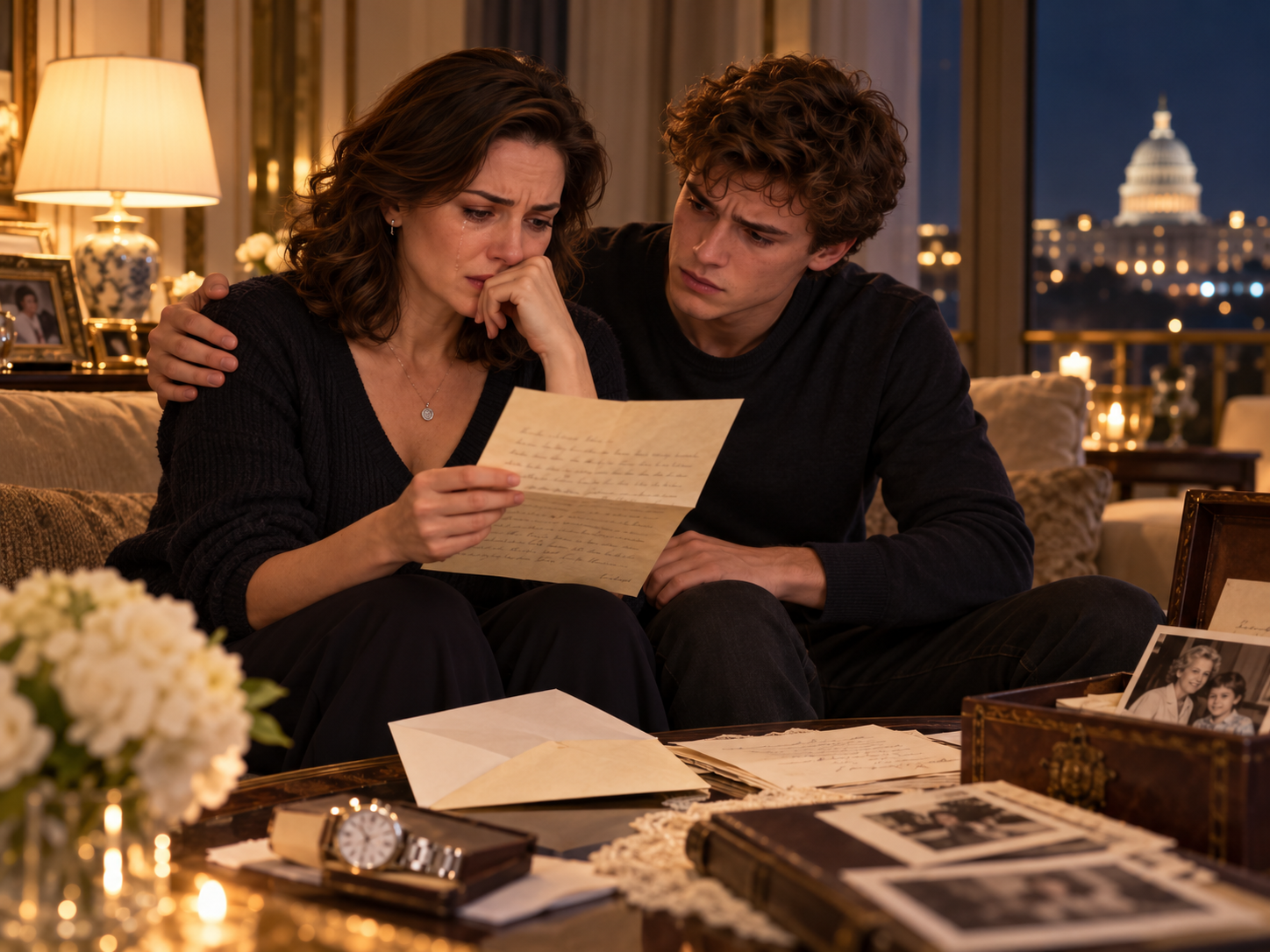
My dearest Elena,
You have always been brave in ways your father does not understand.
I see it when you stand up for people who have no one else. I see it when you ask difficult questions at dinner. I see it when you refuse to laugh at something cruel simply because everyone around you is laughing.
Your father believes security comes from money, position, and being admired.
I believe security comes from knowing who you are.
If you choose the military, choose it because the calling is yours. If you choose medicine, choose it because your heart is there. If you choose something none of us has imagined, I will be proud of that too.
You are not responsible for becoming the daughter your father wishes he had.
You are responsible for becoming the woman you know you can be.
And whatever happens, remember this:
You do not have to earn your place in a family by becoming smaller.
Love always,
Grandma Eleanor.
I couldn’t finish reading aloud.
The paper blurred.
Ethan moved toward me.
This time, when he put his arms around me, I let him.
And I cried.
Not as a general.
Not as an officer.
Just as a granddaughter who had finally received a letter that should have been hers sixteen years earlier.
But the following morning brought news that changed everything.
Claire called at 6:42 a.m.
“Elena, the independent accountants have identified another transfer.”
My stomach sank.
“From Grandma’s fund?”
“No.”
She paused.
“From a donor-restricted scholarship account that was supposed to provide education grants to children of deceased service members.”
I went cold.
“How much?”
“More than four hundred thousand dollars was moved through questionable transactions over several years. We don’t yet know the ultimate use of every payment.”
I stood.
“And who authorized the transfers?”
“Your father’s signature appears on the approvals.”
I stared at the wall.
Until that moment, the financial irregularities had felt deeply personal.
Now they involved families who might have needed that assistance to survive.
Claire continued.
“An independent review is underway, and appropriate authorities may become involved. Ethan has already agreed to provide the records he holds.”
I looked down at my grandmother’s letter.
Then at the silver watch beside it.
My father had spent sixteen years teaching me that family loyalty meant silence.
Now I faced a decision.
I could protect his reputation.
Or I could help establish what had happened to money intended for children who had already lost so much.
I knew which choice my grandmother would have made.
“Claire,” I said, “tell the committee I’ll cooperate fully.”
PART 5 — THE DAUGHTER WHO FINALLY CAME HOME TO HERSELF
The investigation did not end quickly.
Real accountability rarely does.
There was no dramatic confession beneath a chandelier.
No single document that explained everything.
No moment when every guilty person suddenly admitted what they had done.
Instead, there were months of interviews, financial records, legal correspondence, forensic reviews, and difficult conversations.
The Whitmore Family Foundation suspended its fundraising activities while independent accountants examined its finances.
The civilian partnership proposed for the leadership fellowship was withdrawn.
The fellowship itself continued with other donors, under a new oversight structure that required clear conflict-of-interest disclosures and independent financial controls.
Ethan resigned from the foundation board.
He also stepped away temporarily from his managing-director responsibilities while his employer conducted its own compliance review.
That decision cost him professionally.
People who had once celebrated him stopped returning his calls.
Invitations disappeared.
Friends suddenly became busy.
For the first time, Ethan experienced what it meant to be judged by association rather than by his own actions.
One evening, he called me.
“I used to think the worst thing in the world was losing Dad’s approval,” he admitted.
“And now?”
He sighed.
“Now I think the worst thing is realizing how much of my life I spent trying to deserve it.”
I understood more than he knew.
My father’s approval had shaped my childhood too.
The difference was that I had eventually stopped chasing it.
Ethan was only beginning.
My mother struggled in a different way.
For weeks, Margaret Whitmore refused to speak directly about the foundation.
When reporters called, she described everything as a misunderstanding.
When family friends asked questions, she said Richard was being unfairly targeted.
When I called to check on her, she asked whether I could make the scrutiny disappear.
“No, Mom.”
“Elena, your father is under enormous stress.”
“So are the families who expected scholarships.”
She became quiet.
“Must you always be so hard?”
I looked at the phone.
There it was.
The same accusation from my childhood.
When I questioned a cruel remark, I was difficult.
When I disagreed, I was ungrateful.
When I refused to smile through humiliation, I was hard.
“I don’t enjoy any of this,” I told her. “But I won’t pretend it’s harmless.”
She ended the call.
For nearly two months, we didn’t speak.
Then, one rainy afternoon in early spring, she appeared outside my apartment in Virginia.
I had returned to duty several weeks earlier.
My life had resumed its demanding rhythm.
Briefings.
Travel.
Long days.
Phone calls arriving at inconvenient hours.
It was ordinary for me.
Which meant it was anything but ordinary for the people around me.
When the building concierge called, I thought there had been a mistake.
“My mother?”
“Yes, General. She’s downstairs.”
I stared at the receiver.
Then told him to send her up.
When I opened the door, Margaret stood in the hallway wearing a beige coat.
No emerald silk.
No diamonds.
No carefully arranged smile.
She looked tired.
And frightened.
“May I come in?” she asked.
I stepped aside.
She entered slowly, looking around my apartment.
It was modest for someone with my rank.
A few framed photographs lined the shelves.
Military friends.
A hiking trip.
A group of children at a humanitarian aid center.
My grandmother.
There were no enormous portraits of myself.
No awards displayed prominently.
My mother stopped before one photograph.
It showed me in uniform, standing beside three service members in front of a medical evacuation aircraft.
“You look happy,” she said.
“I was exhausted.”
She smiled weakly.
“You still look happy.”
“I was with good people.”
She turned.
“Why didn’t you ever send us these pictures?”
I stared at her.
“Mom.”
Her smile faded.
“I know.”
We sat at the kitchen table.
I made tea.
For several minutes, she said nothing.
Then she opened her handbag and removed a small envelope.
“I found this while going through some old boxes.”
Inside was a photograph.
Me at seventeen.
Standing in the backyard.
Wearing jeans and a faded blue sweatshirt.
Holding an acceptance letter for a summer leadership program.
I remembered the day.
I had been so excited that I ran into the house shouting.
My father glanced at the letter and said the program wasn’t prestigious enough to matter.
My mother asked me to lower my voice because Ethan was studying.
In the photograph, I was smiling anyway.
“Your grandmother took that,” Mom whispered.
“Yes.”
“She told me to frame it.”
I looked at her.
“Why didn’t you?”
Margaret’s eyes filled with tears.
“Your father said it would encourage you to become arrogant.”
A painful laugh escaped me.
“And you believed him?”
“At the time.”
I waited.
She wiped her cheeks.
“I believed many things I shouldn’t have.”
The room went quiet.
Then she said something I had waited half my life to hear.
“I was wrong.”
I didn’t move.
She looked directly at me.
“I was wrong to ignore your accomplishments. I was wrong to let your father make you feel unwelcome. I was wrong to treat Ethan as though his life mattered more than yours.”
My throat tightened.
She continued.
“And I was wrong to tell myself that keeping peace in my marriage was more important than protecting my daughter.”
I looked down at my hands.
For years, I had imagined apologies.
Perfect words.
Emotional embraces.
The instant healing of every old wound.
The reality was quieter.
Painful.
Less satisfying.
And more meaningful.
“Why now?” I asked.
She looked toward the window.
“Because I found Grandma Eleanor’s letters.”
I lifted my eyes.
“Letters?”
“More than one.”
My mother took a breath.
“She wrote to your father about the educational account. She asked him to make sure the money remained available to you. She also wrote to me.”
“What did she say?”
Mom’s voice trembled.
“She said that silence can become a kind of cruelty when it protects the person causing the harm.”
I stared at her.
“She knew?”
“She knew your father was controlling. I don’t think she knew everything he would eventually do.”
Margaret pressed her fingertips against her eyes.
“I spent years telling myself I had no power to change anything. But I did. I could have called you. I could have attended your ceremonies. I could have refused to let your photographs disappear.”
She lowered her hands.
“I didn’t.”
The admission hung between us.
I felt anger.
Grief.
Relief.
And the strange exhaustion of hearing the truth after so many years.
“I can’t pretend that didn’t happen,” I said.
“I know.”
“I can’t promise we’ll suddenly be close.”
“I know that too.”
She reached across the table, then stopped before touching my hand.
“Could we start with coffee once in a while?”
I looked at her.
Not the glamorous woman from the ballroom.
Not the mother who had smiled into her wineglass while my father mocked me.
Just a woman finally beginning to understand the consequences of choices she had spent years avoiding.
“We can try,” I said.
She nodded.
And began to cry.
I didn’t tell her everything was forgiven.
Because it wasn’t.
But when she reached for a tissue, I moved the box closer.
Sometimes reconciliation begins with something that small.
Three months later, the independent financial review reached its first major conclusions.
The accountants identified improper transfers from restricted charitable accounts, unsupported consulting payments, and documents containing signatures that had not been authenticated.
The findings were referred to the appropriate authorities.
Investigators separately examined the disputed authorization connected to my grandmother’s educational account.
An independent document examiner concluded that the questioned signature was not consistent with authenticated examples from that period.
That conclusion did not establish who had written it.
But it established that the document required serious scrutiny.
My father initially denied responsibility.
Then, faced with mounting financial and documentary evidence, he retained new counsel and began negotiating repayment arrangements for funds the foundation’s trustees determined had been improperly transferred.
Several transactions remained under formal investigation.
No one involved pretended the matter was finished.
My grandmother’s educational account became the subject of a separate civil claim.
Through counsel, my father eventually agreed to a settlement restoring the disputed funds, with an additional amount reflecting their lost use over time.
I did not regard the settlement as an apology.
It was a financial remedy.
An overdue correction.
Nothing more.
The money was placed into a new independent scholarship trust.
I named it the Eleanor Whitmore Opportunity Fund.
Its first priority would be educational support for the children of deceased service members, with trustees independent of my family.
The fund would also preserve a smaller program honoring students who demonstrated leadership through service rather than wealth or connections.
Claire helped establish the governance rules.
Ethan contributed part of his personal savings.
My mother made a private donation.
And I insisted on one condition.
My father would not control it.
Not now.
Not ever.
When the first scholarships were announced, I attended the small ceremony in a community college auditorium outside Chicago.
There were no crystal chandeliers.
No gold-trimmed menus.
No photographs of executives.
Only folding chairs, paper programs, and families dressed in their Sunday best.
One recipient was nineteen-year-old Grace Miller.
Her father had died when she was twelve.
She wanted to become a nurse.
When Grace stepped to the podium, she held a sheet of paper so tightly that it trembled.
“My dad used to say that helping one person doesn’t change the whole world,” she began.
Then she smiled through tears.
“But it changes the world for that person.”
I pressed my lips together.
Grace continued.
“This scholarship means I can finish my first year without taking on another job. It means I can keep helping my little brother with his homework. And it means my mom can stop pretending she’s not tired.”
The room stood to applaud.
I watched Grace embrace her mother.
And suddenly, the pain of the past year felt connected to something larger than my father.
The money that should have opened doors was finally doing exactly that.
Afterward, a woman approached me.
She was perhaps fifty, with tired eyes and a warm smile.
“General Whitmore?”
“Yes?”
“My name is Angela Miller. Grace’s mother.”
We shook hands.
“I wanted to thank you.”
“Your daughter earned that scholarship.”
“I know,” she said. “But someone had to make sure it existed.”
I thought of my grandmother.
And all the quiet choices that had led to that moment.
“I’m glad it does,” I replied.
Angela hesitated.
“Grace read about what happened with your family.”
I stiffened slightly.
She noticed.
“I’m sorry. I don’t mean to intrude.”
“It’s all right.”
Angela looked toward her daughter.
“I just wanted you to know something.”
“What?”
“When people who should believe in us don’t, it’s easy to start thinking they’re right.”
I swallowed.
She smiled gently.
“But they aren’t always right.”
For several seconds, I couldn’t speak.
Then I thanked her.
Across the auditorium, Ethan stood beside the refreshment table.
He had come alone.
He wasn’t wearing an expensive suit.
His sleeves were rolled up, and he was helping distribute water bottles.
When he noticed me, he raised a hand.
I walked toward him.
“You’re working hard for a former managing director.”
He grinned.
“Turns out water bottles don’t care about résumés.”
I smiled.
He had begun rebuilding his career at a smaller firm with a strong compliance culture.
The transition had been humbling.
He earned less.
Worked longer hours.
And seemed strangely happier.
“Grace was incredible,” he said.
“She was.”
He looked toward the scholarship recipients.
“Grandma would have loved this.”
“Yes.”
We stood together for a moment.
Then Ethan reached into his pocket.
“I have something for you.”
I gave him a suspicious look.
“Another document?”
He laughed.
“No.”
He handed me a small photograph.
Two children stood beneath a backyard tree.
A girl of eight held a homemade cardboard sword.
Beside her, a boy of six wore a blanket tied around his shoulders like a cape.
I recognized us immediately.
“Where did you find this?”
“In one of Mom’s boxes.”
I turned it over.
In childish handwriting, someone had written:
ELENA AND ETHAN — DEFENDERS OF THE UNIVERSE.
I burst out laughing.
Ethan joined me.
For a moment, we were children again.
Before the pressure.
Before the comparisons.
Before our father’s obsession with status created a competition neither of us had wanted.
“I used to think you could beat anyone,” Ethan said.
“I usually could.”
He laughed.
Then grew serious.
“I’m sorry, Elena.”
I looked at him.
“For what?”
“For letting you face Dad alone. For pretending not to notice things. For enjoying being the favorite because I was afraid of what would happen if I wasn’t.”
My eyes stung.
“I wanted my brother back,” I admitted.
His face changed.
“You have him.”
I shook my head gently.
“Not all at once.”
He nodded.
“I know.”
“But we’re getting somewhere.”
We embraced.
And that time, it felt like the beginning of something real.
My father and I didn’t speak for nearly a year.
He sent several messages.
Some angry.
Some defensive.
A few unexpectedly quiet.
The first said the family had been publicly humiliated.
The second insisted that nobody understood the pressure he had been under.
The third contained a long explanation of business decisions, economic downturns, and obligations that he claimed had forced his hand.
I responded through counsel when the messages concerned legal matters.
Personally, I answered none of them.
Then, one evening, a handwritten letter arrived.
The envelope contained no business logo.
No expensive stationery.
Only my name.
I opened it at my kitchen table.
Elena,
I have spent most of my life believing that success is something other people must be made to recognize.
When you chose the Army, I saw it as rejection. I wanted you to follow the path I had imagined. When you refused, I decided you were wrong rather than considering that I might be.
I punished you for that.
I encouraged others to overlook you because I could not bear the possibility that you might succeed without my approval.
I also used your achievements when they benefited me, while refusing to acknowledge them when you needed me.
There is no honorable explanation for that.
The financial matters are being addressed through the proper processes. I know repayment does not repair what I did.
I cannot ask you to forgive me.
But I want you to know I am no longer pretending I was a good father simply because I provided a comfortable home.
You deserved better.
Dad.
I read it twice.
Then put it down.
I didn’t cry.
I didn’t feel triumphant.
I felt tired.
But beneath the tiredness was something I hadn’t expected.
A quiet relief.
For the first time, my father had written a letter in which he did not blame me.
He did not blame the military.
He did not blame Ethan.
He did not blame the economy, the newspapers, or the changing values of society.
He acknowledged his own choices.
It was not enough to repair sixteen years.
But it was more honesty than I had ever received from him.
I folded the letter.
Placed it beside my grandmother’s.
And decided I did not have to answer immediately.
Forgiveness, I had learned, was not a military order.
It could not be demanded.
It could not be rushed.
And it did not require restoring someone’s access to your life.
For the first time, I had permission to decide what happened next.
One year after the Westbridge dinner, the fellowship bearing my name held its first annual leadership conference.
This time, the venue was a university auditorium in Virginia.
The scholarship program had expanded.
Students from military families, humanitarian aid workers, and emerging crisis-response leaders attended workshops, lectures, and practical exercises.
The event celebrated service across professions and ranks.
I had insisted on that.
A young logistics coordinator received an award for developing a more reliable emergency supply process for rural communities.
A former Army medic was recognized for building a volunteer network that helped older veterans reach medical appointments.
A student engineering team demonstrated a low-cost system for distributing water after storms.
They were exactly the kinds of people I wanted the fellowship to support.
At the end of the conference, I was scheduled to speak.
Backstage, Colonel Mercer approached me.
He had been promoted since the night at the Westbridge.
Brigadier General James Mercer now wore a single star on each shoulder.
“Ma’am,” he said, smiling, “ready?”
“As I’ll ever be.”
He looked amused.
“You know, I still get asked about that hotel.”
I sighed.
“Please don’t tell me.”
“Someone recently asked whether I planned the entrance.”
I shook my head.
“What did you say?”
“That I was simply following the schedule.”
We laughed.
Then he became serious.
“I’m proud of what you’ve built, Elena.”
I looked through the curtain.
Students filled the auditorium.
Families sat together.
Several veterans in the front row wore jackets displaying the names of units in which they had served.
“It’s not mine alone,” I said.
“Nothing worthwhile ever is.”
He smiled.
“That’s why they chose you.”
The stage manager signaled.
I stepped into the light.
Applause rose.
I waited until the room settled.
Then I looked at the audience.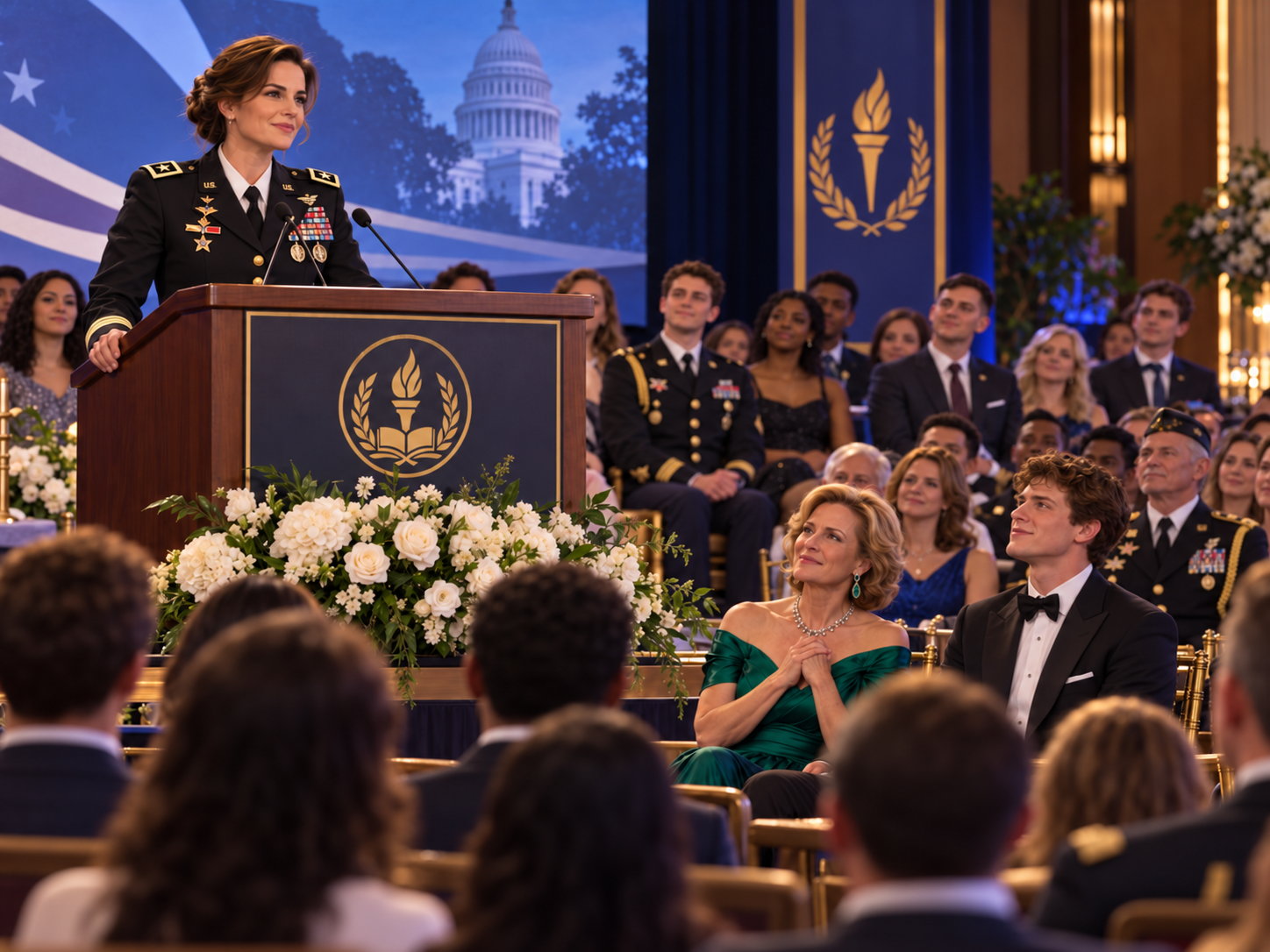
“When I was eighteen,” I began, “someone told me that the path I had chosen would never make my family proud.”
A stillness spread through the auditorium.
“I believed that person for a long time.”
I paused.
“Not because I thought my career was meaningless. But because I thought the love of people close to us was something we had to earn by meeting their expectations.”
In the third row, my mother sat beside Ethan.
They had asked permission to attend.
I had said yes.
My mother smiled through tears.
Ethan gave me a small nod.
My father was not there.
That was my choice.
Our relationship remained distant, though I had begun exchanging occasional letters with him.
He was cooperating with the remaining legal processes and working privately to make restitution where it was owed.
There were still consequences.
There were still questions.
And there were wounds that might never close completely.
But I no longer organized my life around waiting for him to become someone different.
I looked back toward the students.
“Over the years, I’ve worked alongside people whose names may never appear in newspapers. I’ve seen extraordinary courage from individuals who had no prestigious titles, no family connections, and no reason to expect applause.”
I took a breath.
“They served anyway.”
A young woman in the front row leaned forward.
“Some carried wounded strangers to safety. Some rebuilt destroyed schools. Some spent nights making sure frightened families had enough food, water, and medicine.”
I glanced toward the screen behind me.
A photograph appeared.
Captain Sarah Bennett.
Smiling.
Dust on her uniform.
Standing beside a group of children she had helped evacuate.
My voice softened.
“This fellowship exists for people like Captain Bennett, and for those who continue the work she believed in.”
The auditorium was silent.
Then I said the words I had carried from my grandmother’s letter.
“You do not have to become smaller to deserve a place in the world.”
A few people nodded.
“You do not have to surrender your values because someone powerful refuses to recognize them.”
I looked across the audience.
“And you do not have to wait for the people who underestimated you to admit they were wrong before you begin living the life you were meant to live.”
The applause started slowly.
Then grew.
I stood quietly until it faded.
After the ceremony, students surrounded me with questions.
Some asked about leadership.
Some about military service.
Others about failures, difficult decisions, and what I had done when plans collapsed.
I answered as many as I could.
Near the end, a seventeen-year-old girl approached.
She had dark hair, nervous eyes, and a notebook pressed against her chest.
“General Whitmore?”
“Yes?”
“My parents think I should go into finance.”
I smiled.
“What do you think?”
“I want to study emergency medicine.”
“Why?”
She hesitated.
“Because when my little brother was hurt in an accident, the paramedics were the first people who made me feel like everything might be okay.”
I waited.
“And I want to be that person for someone else.”
I felt something warm unfold in my chest.
“Then that’s worth exploring seriously.”
She swallowed.
“But what if my parents are disappointed?”
I looked at her for a long moment.
Then I told her something I wished someone had told me at eighteen.
“Listen to their concerns. Learn what the path requires. Make sure you’re choosing it for the right reasons.”
She nodded.
“But remember that the person who has to live your life is you.”
She smiled.
A bright, hopeful smile.
“Thank you.”
“What’s your name?”
“Emily.”
“Well, Emily, whatever you choose, do it with integrity. And don’t mistake someone else’s disappointment for proof that you’ve failed.”
Her smile widened.
She thanked me again and disappeared into the crowd.
I watched her go.
Then I felt a gentle touch on my shoulder.
My mother.
“Elena.”
“Hi, Mom.”
She looked toward the doors where the girl had disappeared.
“You were good with her.”
“I hope so.”
Margaret smiled.
“Your grandmother would have been proud.”
My throat tightened.
“I think she’d have liked the fellowship.”
“She would have loved it.”
Ethan joined us.
He was carrying three paper cups of coffee.
“Two regular, one decaf,” he announced.
Mom looked offended.
“Since when do I drink decaf?”
“Since you yelled at the waiter for bringing you a double espresso last month.”
“That was one time.”
We laughed.
The sound surprised me.
Easy.
Unforced.
Ordinary.
Something I hadn’t experienced with them in a very long time.
We found an empty bench outside the auditorium.
The afternoon sunlight warmed the stone walkway.
Students passed by carrying folders and tote bags.
Some stopped to greet me.
Others waved from a distance.
For once, I didn’t feel the need to rush anywhere.
My phone vibrated.
A message from Colonel Mercer.
Excellent speech, ma’am. And for the record, Table 19 was never good enough for you.
I smiled.
Ethan noticed.
“What?”
“Nothing.”
“Come on.”
I showed him the message.
He laughed.
Then he became thoughtful.
“You know what I remember most about that night?”
“What?”
“Dad making the joke?”
I shook my head.
“The salute?”
“No.”
He looked curious.
“Then what?”
I glanced toward the sky.
“I remember sitting at that table and realizing I was still waiting for Dad to notice me.”
My mother lowered her eyes.
I continued.
“Even after everything I had accomplished, some part of me still wanted him to look across the room and say he was proud.”
Ethan nodded slowly.
“And when the officers came in?”
I smiled faintly.
“I thought I’d finally feel vindicated.”
“Didn’t you?”
“For a moment.”
I looked toward the auditorium doors.
“But the best part of that night wasn’t the salute.”
“What was it?”
“Walking away.”
My mother reached for my hand.
This time, I let her take it.
We sat quietly.
Three people who had once been connected by obligation, expectations, and fear.
Now trying to build something based on honesty.
Not perfect.
Not effortless.
But real.
Later that evening, after my family had left, I returned to my apartment.
I hung my uniform carefully.
Placed my shoes beside the closet.
Then opened the wooden box on my bookshelf.
Inside were my grandmother’s watch, her letters, the photograph of Ethan and me as children, and a small stack of personal keepsakes from sixteen years of service.
At the bottom lay a photograph taken on the night of my promotion.
I stood between two senior officers.
Behind us, the American flag hung against a blue curtain.
I was smiling.
Not because of the stars.
Because I remembered the eighteen-year-old girl who had boarded a bus alone with one duffel bag.
She had been frightened.
Angry.
Heartbroken.
She had wondered whether she was making the greatest mistake of her life.
She had no idea how many wonderful people she would meet.
How much she would learn.
How often she would fail and have to begin again.
Or how much strength she would discover in herself.
I placed the photograph beside my grandmother’s letter.
Then I noticed something.
On the back of the picture, one of my friends had written a message after the promotion ceremony.
Elena, you never needed those stars to be worthy of this moment.
But you’ve earned every one.
I sat down.
Read the words.
And smiled.
For sixteen years, my family had behaved as if my name were something to hide.
My father had written letters asking institutions to erase me.
He had celebrated my brother while pretending my service meant nothing.
He had laughed in a ballroom full of influential people because he believed the world would always agree with him.
Then one officer walked across the room.
One salute silenced hundreds of voices.
And the truth finally became impossible to ignore.
But the greatest victory wasn’t watching my father lose his smile.
It wasn’t seeing my name restored to records.
It wasn’t recovering money, receiving an award, or hearing strangers applaud.
Those things mattered.
Some of them helped repair real harm.
But none defined my worth.
The real victory was discovering that I had never been the forgotten daughter.
I had been the daughter who kept going.
The soldier who kept serving.
The woman who built a meaningful life while people who should have loved her insisted she was building the wrong one.
I picked up my grandmother’s watch.
Fastened it around my wrist.
And looked at the time.
Tomorrow would be another demanding day.
There would be decisions to make.
People to support.
Problems that couldn’t be solved with applause or a perfect speech.
I was ready.
Because my life had never belonged to the people who laughed at me.
It belonged to me.
And after sixteen years, I finally understood something my grandmother had known all along.
You cannot erase someone who refuses to disappear.
THE END