THE FOUR-HUNDRED-DOLLAR HOUSEKEEPER- PART 2 — THE TWO CHILDREN WHO DIDN’T WANT A MOTHER
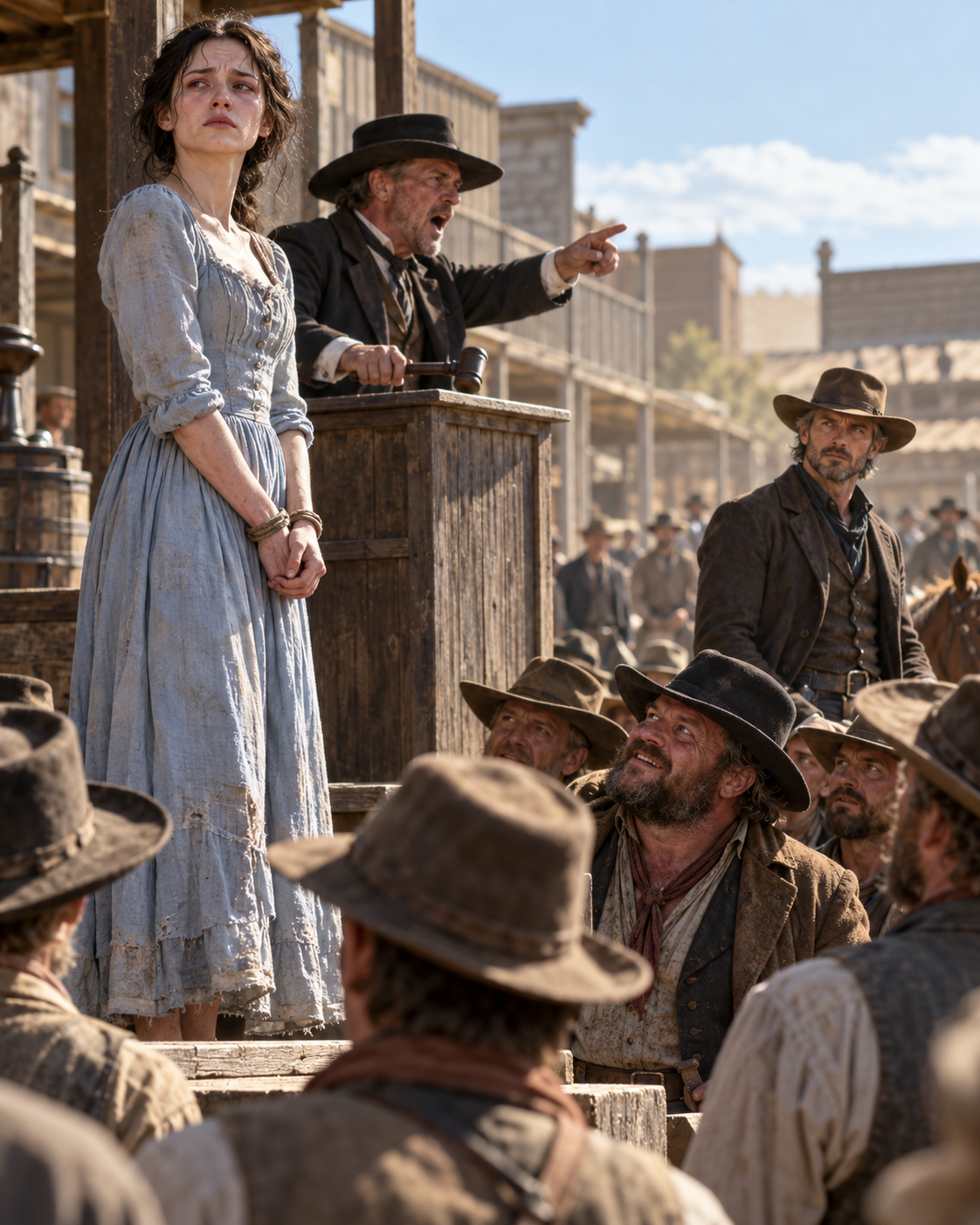
In Part 1, eighteen-year-old Norah Finch lost everything after her father’s death. Desperate and penniless, she found herself standing on an auction platform, where rancher Mr. Calhoun paid four hundred dollars for her labor. He brought her to his isolated ranch, where his six-year-old twins, Lizzy and Sam, had already driven away three housekeepers. Now Norah stood before the two suspicious children, knowing that her future might depend on what happened next.
The little girl crossed her arms.
The boy narrowed his eyes.
Then, without saying a word, they both turned around and disappeared inside the house.
I glanced at Mr. Calhoun.
He sighed.
“Well, that’s better than last time.”
I blinked.
“Last time?”
“Last housekeeper got a bucket of cold water over her head before she’d even crossed the porch.”
I looked toward the open doorway.
“Should I be worried?”
He adjusted his hat.
“Probably.”
Then he picked up my little travel bag and carried it inside.
I followed him.
The farmhouse was larger than I’d expected. There was a long hallway, a sitting room with a stone fireplace, and a dining room with a heavy oak table.
Everything was clean, but the house felt strangely empty.
A woman’s portrait hung above the fireplace.
She had soft brown hair, kind eyes, and a smile that seemed to belong to a happier time.
I stopped to look at it.
“That’s their mother,” Mr. Calhoun said quietly.
I nodded.
“She was beautiful.”
“Her name was Margaret.”
He said nothing more.
I noticed that the portrait had been polished recently, but the little table beneath it was covered with dust.
It was as though nobody wanted to stand there for too long.
Mr. Calhoun pointed toward a narrow staircase.
“Your room is upstairs. You’ll have your own bed, a washstand, and a small chest. Supper is at six. Breakfast at sunrise.”
“Yes, sir.”
“And one more thing.”
He turned toward me.
“Don’t let those children convince you to leave.”
I swallowed.
“I’ll try.”
He studied my face.
“Don’t try. Just remember that they’re children. They’ve been through more than most grown folks.”
Before I could answer, a loud crash came from the kitchen.
Then came a giggle.
Mr. Calhoun closed his eyes.
“Lord help us.”
He headed toward the kitchen.
I followed.
And what I saw made me stop in the doorway.
A bag of flour had been emptied across the floor.
A wooden spoon lay broken beneath the table.
And Sam was standing on a chair, holding a bowl over his head.
Lizzy stood beside him, trying desperately not to laugh.
Mr. Calhoun looked at them.
“Explain.”
Sam pointed at his sister.
“She did it.”
Lizzy pointed at her brother.
“He did!”
Their father rubbed his forehead.
“Both of you. Upstairs. Now.”
Neither child moved.
Then Lizzy looked directly at me.
“You’re going to leave.”
It wasn’t a question.
I looked at the flour scattered across the floor.
Then at the two little faces watching me.
“No,” I answered.
She frowned.
“Why not?”
“Because I haven’t even made supper yet.”
Sam looked confused.
“Don’t you know we’re bad?”
I picked up the broken spoon.
“I’ve met worse spoons.”
Neither child laughed.
But something changed in their expressions.
For the first time, they seemed uncertain about what to do next.
My first evening at the ranch was a disaster.
The twins refused to eat the stew I’d prepared.
Sam claimed the potatoes tasted like horse feed.
Lizzy announced that her previous housekeeper had made better biscuits.
I smiled politely.
“Then I suppose I’ll have to learn to make better ones.”
Lizzy stared at me.
“She cried when we hid her shoes.”
I placed another biscuit on Sam’s plate.
“That must have been inconvenient.”
“She left the next morning.”
“Well, I hope she found her shoes.”
Sam nearly smiled.
But Lizzy caught him.
She kicked his foot beneath the table.
He immediately returned to his scowl.
Mr. Calhoun sat at the head of the table, watching the entire exchange.
He looked as though he was waiting for an explosion.
After supper, he stood.
“I need to check the north pasture. I’ll be back before dark.”
He looked at the twins.
“Listen to Norah.”
Both children nodded.
The moment the front door closed, Sam whispered:
“Now we’re going to get rid of you.”
I turned toward him.
“Is that so?”
He nodded proudly.
“Yes.”
Lizzy leaned forward.
“We have a plan.”
I folded my hands.
“Well, I hope it’s a good one.”
They exchanged excited looks.
And that was when I realized something.
These children weren’t simply spoiled.
They were frightened.
They had discovered that if they made life difficult enough, every new person would eventually disappear.
Perhaps that was easier than risking another goodbye.
The following morning, I found my shoes hanging from a tree outside the kitchen.
My apron had been stuffed into the chicken coop.
And someone had placed a dead grasshopper inside my washbasin.
I knew exactly who was responsible.
But I didn’t shout.
I didn’t threaten anyone.
I simply went about my work.
At breakfast, I made pancakes.
Sam stared suspiciously at his plate.
“What’s that?”
“Breakfast.”
“Why is it round?”
“Because the pan was round.”
He looked disappointed.
Lizzy poked hers with a fork.
“Maybe it’s poisoned.”
I raised an eyebrow.
“Then I suppose I should eat the first one.”
I cut off a piece and tasted it.
Both children watched carefully.
I swallowed.
“Still alive.”
Sam giggled.
Lizzy tried to hide her smile behind her cup.
It was the first time I’d heard either child laugh.
But the moment I noticed, they stopped.
That afternoon, I found Lizzy sitting alone beneath the porch.
She was holding a small wooden horse.
Its paint had worn away, and one leg had been repaired with a tiny piece of wire.
I sat on the step a few feet away.
“That’s a handsome horse.”
She pulled it against her chest.
“It belonged to Mama.”
I nodded.
“Did she give it to you?”
Lizzy shook her head.
“She gave it to Sam. But he let me play with it.”
I looked toward the corral.
“Your brother must be very kind.”
“He used to be.”
I turned toward her.
“What happened?”
Her little fingers tightened around the wooden horse.
“After Mama died, Papa stopped singing.”
I didn’t know what to say.
She continued.
“He used to sing when he brushed the horses. And sometimes he danced with Mama in the kitchen.”
Her voice became quieter.
“But now he doesn’t.”
I watched her lower her head.
“Maybe he misses her.”
Lizzy looked at me.
“Don’t you miss your mama?”
The question struck somewhere deep inside me.
I thought of my father’s empty chair.
The Bible I’d sold.
The quilt I’d surrendered.
And the brass locket that had once rested against my mother’s old photograph.
“I miss my family every day,” I whispered.
Lizzy looked surprised.
“You had a family?”
“I did.”
“Where are they?”
I swallowed.
“They’re gone.”
For a moment, neither of us spoke.
Then she moved closer.
Not much.
Just enough that her shoulder touched mine.
And somehow, that small movement felt more important than anything I’d accomplished since arriving.
On the fourth morning, something happened that changed everything.
I was hanging laundry behind the house when I heard a scream.
“HELP!”
It came from the direction of the barn.
I dropped the wet sheets and ran.
When I reached the barn, Sam was standing near the hayloft ladder.
His face was pale.
“Lizzy!”
I looked up.
My heart nearly stopped.
Lizzy was sitting on a narrow wooden beam above the empty stall.
She had climbed up to retrieve a small cloth doll.
Now she was too frightened to climb down.
“Don’t move!” I called.
Her lower lip trembled.
“I can’t!”
“That’s all right. Just look at me.”
I moved beneath the ladder.
The beam creaked.
Lizzy began crying.
“I want Papa!”
“I know, sweetheart.”
“He’s not here!”
“I know. But I’m here.”
I climbed slowly.
The wood was old, and every movement made it groan.
When I reached her, she clung to my dress.
“I can’t get down!”
I wrapped one arm around her.
“Then we’ll come down together.”
She buried her face against my shoulder.
I carefully guided her toward the ladder.
One step.
Then another.
Finally, her feet touched the ground.
Sam rushed forward and hugged his sister.
Then he looked at me.
His eyes were wet.
“Are you going to tell Papa?”
I brushed the dust from Lizzy’s hair.
“Tell him what?”
“That we climbed up there.”
I looked at the frightened boy.
“Would telling him make your sister feel better?”
He shook his head.
“Then perhaps we should talk about being more careful instead.”
Lizzy suddenly grabbed my hand.
“Don’t tell Papa I cried.”
I smiled.
“Your secret is safe with me.”
But I didn’t realize someone had been watching.
When I turned toward the barn entrance, Mr. Calhoun stood there.
His hat was in his hands.
His expression was unreadable.
He had returned early.
And he’d heard everything.
That evening, Mr. Calhoun found me washing dishes.
He stood in the kitchen doorway for several seconds before speaking.
“Norah.”
I turned.
“Yes, sir?”
“I owe you an apology.”
I nearly dropped the plate.
“For what?”
“For letting you walk into this mess without telling you how difficult things had become.”
I dried my hands.
“You don’t owe me an apology.”
He leaned against the doorframe.
“Those children have been through three housekeepers. Their mother died, and I thought giving them everything they wanted would somehow make it easier.”
He looked down at his hands.
“Turns out money doesn’t buy back a mother.”
I didn’t answer immediately.
Then I said something I’d been thinking since my first evening.
“They don’t need someone to replace their mother.”
He looked up.
“They need someone who stays.”
For the first time since I’d met him, his expression softened.
He stared at me as though those words had reached somewhere he hadn’t allowed anyone to touch.
Then he nodded.
“You’re right.”
He turned to leave.
But before he reached the hallway, he stopped.
“Norah?”
“Yes?”
“Thank you for staying.”
I watched him disappear.
And for the first time in months, I felt something unfamiliar.
I felt useful.
Not because someone had paid four hundred dollars for my labor.
But because two little children had begun to trust me.
The following week, the ranch began to feel different.
Lizzy started following me into the kitchen.
Sam began helping me carry firewood.
They still argued over toys and refused to eat certain vegetables, but the deliberate cruelty had disappeared.
One afternoon, Sam brought me a drawing.
It showed a large house, two little children, a tall man wearing a hat, and a woman standing beside them.
I smiled.
“Who’s this?”
“That’s you.”
“And who’s that?”
“Papa.”
I looked at the picture again.
“Why did you draw us all together?”
Sam shrugged.
“Because you live here.”
It was such a simple answer.
But I had to turn away for a moment because my eyes were filling with tears.
That evening, Lizzy asked me to brush her hair.
Then she asked whether I could tell her a bedtime story.
Sam insisted that he didn’t need one.
But five minutes later, he was sitting on the other side of the bed, waiting for me to begin.
I told them a story about a little girl who had lost her way in a forest but found a cabin where an old woman gave her bread and a warm blanket.
When I finished, Lizzy whispered:
“Will the girl ever go home?”
I tucked the blanket beneath her chin.
“Maybe home isn’t always the place where you started.”
She thought about that.
Then she reached for my hand.
“Can you stay until morning?”
I smiled.
“I’ll be here when you wake up.”
She closed her eyes.
And I sat there for a long time, listening to the quiet breathing of two children who had finally fallen asleep without fear.
I didn’t know it then, but that promise would soon become much harder to keep.
It happened on a Thursday afternoon.
Mr. Calhoun had ridden into town to purchase supplies.
I was preparing supper when I heard the sound of a horse approaching.
At first, I thought it was him returning early.
But when I looked through the kitchen window, I saw a black horse pulling a polished carriage.
A man climbed down.
He was the same man who had stood near the front of the auction crowd.
The tobacco-chewing bidder.
The man whose smile had made my stomach turn.
His name was Harlan Pike.
I recognized him immediately.
He wore a dark coat, expensive boots, and a silver watch chain across his vest.
He removed his hat and looked toward the farmhouse.
Then he smiled.
Not kindly.
Not warmly.
It was the kind of smile that made a person wish they had locked every door.
I stepped onto the porch.
“Can I help you, sir?”
He looked me up and down.
“Well, I’ll be damned.”
I stiffened.
“Do you need something?”
He chuckled.
“So it’s true. Calhoun really did take you home.”
I said nothing.
He walked toward the porch.
“Four hundred dollars. That’s a mighty expensive price for a kitchen girl.”
“Mr. Calhoun hired me to work here.”
“Is that what he told you?”
I didn’t answer.
Harlan leaned against the porch railing.
“Tell me something, Miss Finch. Did he explain why he was so eager to outbid me?”
My stomach tightened.
“He needed a housekeeper.”
Harlan laughed.
“Three housekeepers couldn’t manage those children, and suddenly he spends four hundred dollars on an eighteen-year-old stranger?”
He shook his head.
“That’s not like Calhoun.”
I stepped back.
“If you have business with him, you’ll need to come back when he’s home.”
“Perhaps.”
His eyes moved toward the farmhouse windows.
“Are the children inside?”
“That’s none of your concern.”
His smile disappeared.
For a moment, something cold passed across his face.
Then he reached into his coat and produced a folded piece of paper.
“Give this to Calhoun.”
I didn’t take it.
“What is it?”
“Something he should have dealt with two years ago.”
I stared at the document.
He placed it on the porch railing.
Then he leaned closer.
“And while you’re at it, tell him Harlan Pike has come to collect what was promised.”
He climbed back into his carriage.
Before driving away, he looked over his shoulder.
“Oh, and one more thing, Miss Finch.”
I met his eyes.
“Be careful what you believe about this family.”
Then he rode away.
I waited until the sound of his carriage disappeared.
Then I picked up the folded paper.
It was addressed to Mr. Calhoun.
The handwriting was neat, but the paper was old and yellowed.
I knew I shouldn’t read someone else’s private correspondence.
But something about Harlan Pike’s visit troubled me.
I unfolded the document just enough to see the first few lines.
And my blood ran cold.
It wasn’t a business letter.
It was a legal notice.
The first paragraph mentioned a disputed land agreement.
The second mentioned the name Margaret Calhoun.
And the final paragraph contained a sentence that made my hands begin to shake.
In the event of Mr. Calhoun’s refusal to surrender the original agreement, all claims against the northern property shall be enforced without further notice.
I folded the paper quickly.
What agreement?
Why was Margaret’s name written there?
And why had Harlan spoken as though he knew something about the family that nobody else did?
I was still standing on the porch when Lizzy appeared behind me.
“Who’s that man?”
I turned.
She was holding her wooden horse.
“Just someone who came to see your father.”
She looked at the road.
Then she whispered something that made my heart stop.
“That’s the bad man.”
I crouched beside her.
“What bad man, sweetheart?”
She looked toward the barn to make sure Sam wasn’t listening.
“The man Mama was afraid of.”
I felt a chill move down my spine.
“What did you say?”
Lizzy gripped the wooden horse.
“Mama told us never to open the little box in Papa’s office if that man ever came back.”
I stared at her.
“What little box?”
She shook her head.
“I don’t know. Mama hid it.”
“Where?”
Lizzy looked toward the farmhouse.
“Behind the big clock.”
Before I could ask another question, Sam came running out of the barn.
“Lizzy! You promised!”
He stopped when he saw us.
His face turned pale.
Then he looked at the folded paper in my hand.
“Did he come back?”
I stood.
“Who, Sam?”
The little boy swallowed.
“The man who took Mama’s things.”
I felt the ground shift beneath me.
“What do you mean?”
Sam began crying.
Lizzy grabbed his hand.
And then, in a tiny voice, she told me something I would never forget.
“Mama didn’t die because she was sick.”
I stared at her.
“What?”
She looked directly into my eyes.
“Mama said that bad man would come back someday. She said he wanted something Papa had hidden.”
I could barely breathe.
“Did your father know?”
Lizzy shook her head.
“Papa thinks Mama got a fever.”
A horse suddenly thundered into the yard.
Mr. Calhoun had returned.
He jumped down from the wagon and hurried toward the porch.
“Norah! What’s happened?”
I looked at him.
Then at the children.
I held out Harlan’s letter.
“Mr. Calhoun, someone came looking for you.”
He took the paper.
The moment he saw the handwriting, the color drained from his face.
His fingers began to tremble.
“Where did you get this?”
“Harlan Pike brought it.”
He stared at me.
Then he looked toward the road.
“What did he say?”
I hesitated.
“He said you should surrender the original agreement.”
Mr. Calhoun slowly lowered the letter.
For several seconds, he didn’t speak.
Then Lizzy stepped forward.
“Papa?”
He turned toward her.
She looked up at him with frightened eyes.
“Mama told us about the box.”
The paper slipped from his hand.
“What box?”
Lizzy pointed toward the house.
“The one behind your big office clock.”
Mr. Calhoun went completely still.
I had never seen a grown man look so frightened.
Not when the cattle market collapsed.
Not when his children had nearly been hurt.
Not even when Harlan Pike had appeared on his property.
But now, his face had gone pale.
He looked at Lizzy.
Then at Sam.
Finally, he turned toward me.
“Norah,” he said quietly.
“Take the children upstairs. Lock the bedroom door. Don’t let anyone in.”
My heart began pounding.
“Why?”
He looked toward his office window.
And when he spoke, his voice was barely more than a whisper.
“Because if that box is still where Margaret left it…”
He stopped.
Then he said something that made my blood run cold.
“…then I’ve spent two years believing my wife died without knowing that someone in this town murdered her.”
I stared at him.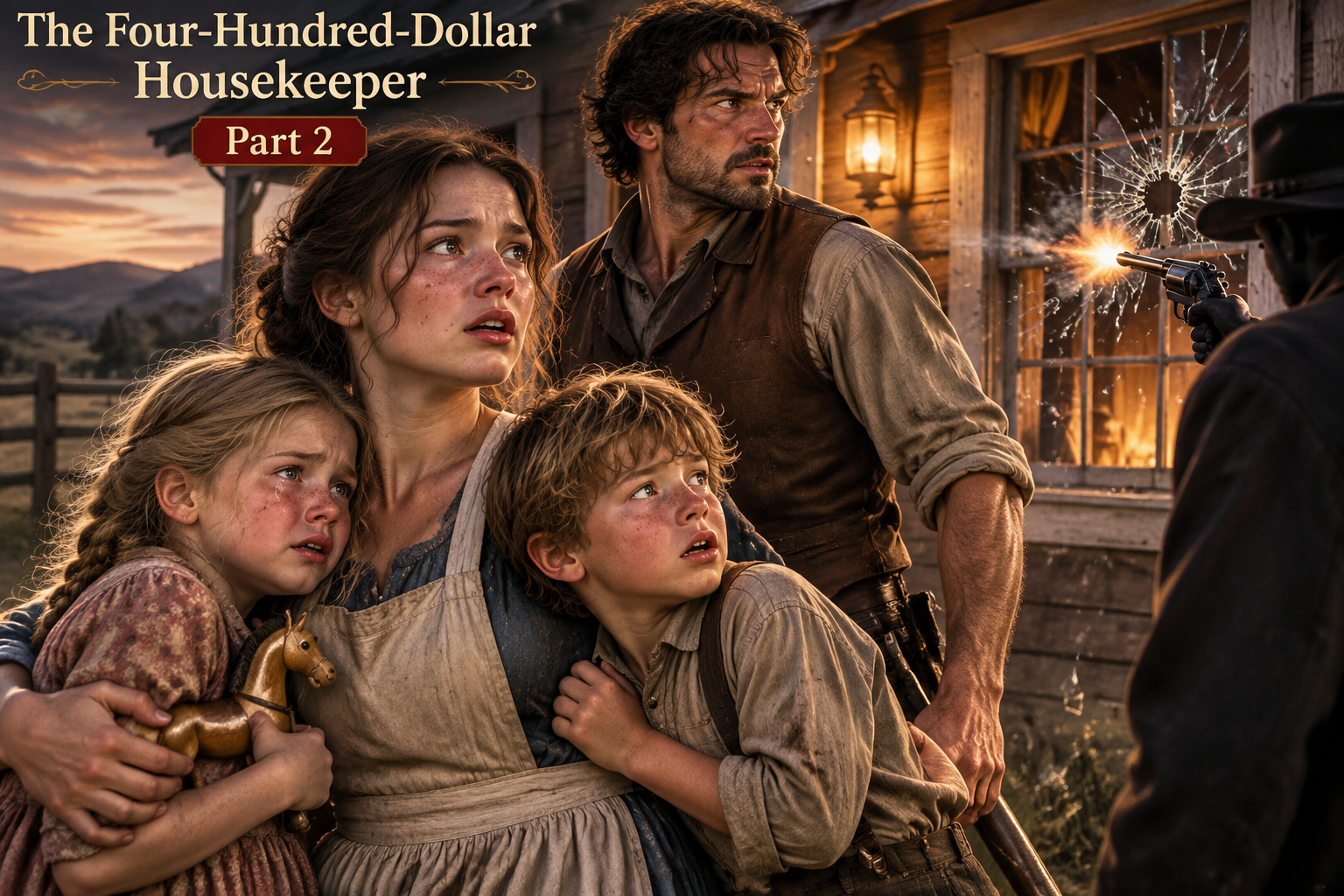
And before I could ask another question, a gunshot exploded from somewhere outside the farmhouse.
Then the office window shattered.
And someone shouted from the darkness:
“CALHOUN! WE KNOW YOU HAVE THE BOX!”
To be continued…