🐎🔥 THEY LEFT A WIDOW TO DIE IN THE DESERT… UNTIL HER DYING HORSE WALKED STRAIGHT INTO A SOLID MOUNTAIN AND VANISHED!
PART 1 — THE SECRET HIDDEN INSIDE THE MOUNTAIN
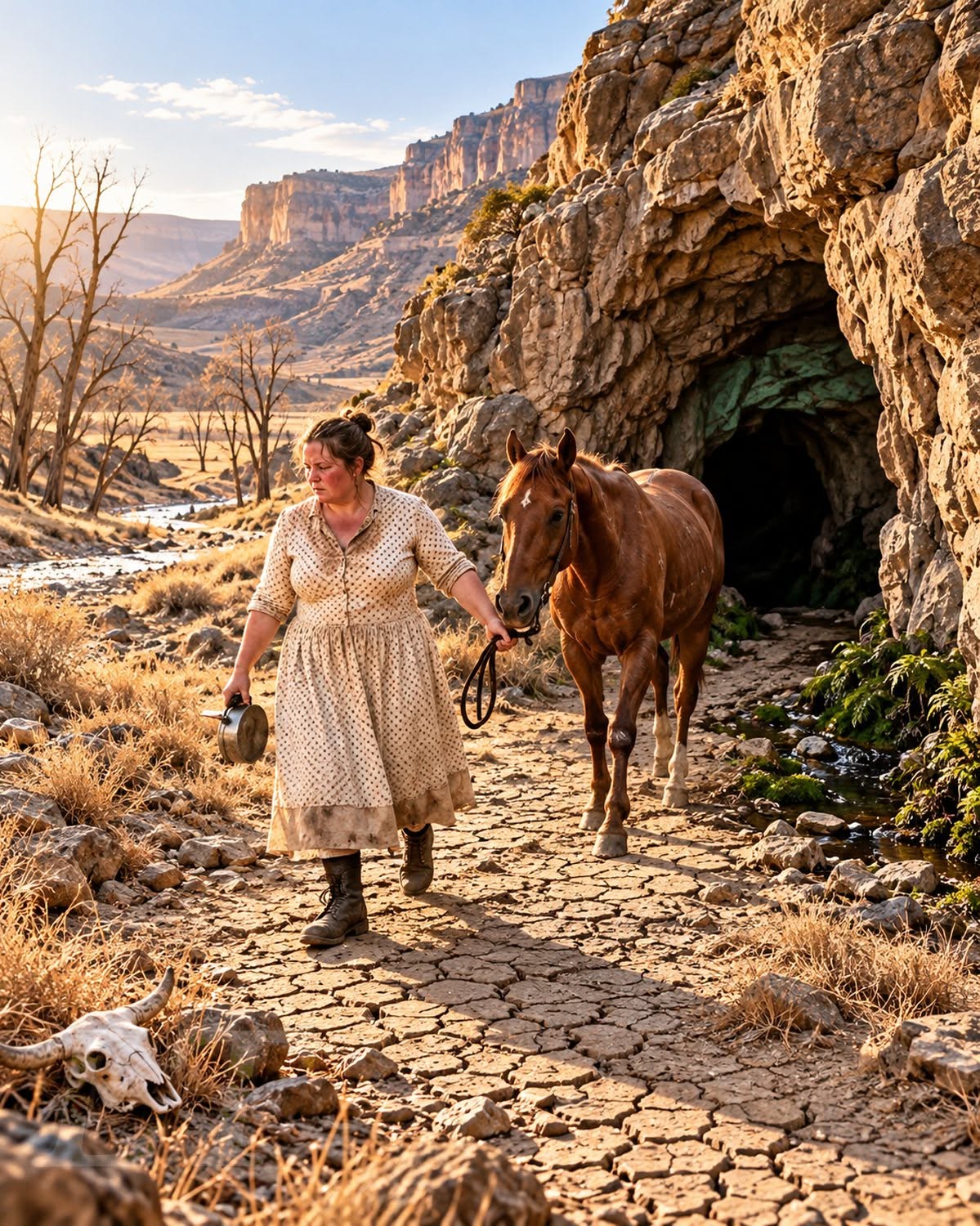
I had raised my dead husband’s revolver to my old horse’s forehead when he suddenly turned away and began walking toward a mountain that had no entrance.
I followed him, even though I knew we were both close to dying.
What I discovered inside that mountain would change everything I believed about the desert, my husband’s death, and the land we had left behind.
My name is Hetty Brazwell. I was a widow in New Mexico Territory, and in the summer of 1886, I had almost nothing left.
The horse standing before me was Copper.
He had been with me for sixteen years.
His injured ankle had swollen to twice its normal size. The bandage was black with dried blood, stiff as old leather. The smell beneath it told me what I already feared.
The wound was infected.
I had watched enough cattle die from injuries on my husband’s ranch to recognize when an animal had reached the end.
I raised the revolver.
My hand trembled.
“I’m sorry, old boy,” I whispered.
But Copper didn’t look at the gun.
His ears turned toward the north.
Beyond the cracked desert stretched a jagged line of mountains the miners called the Sawbacks. Their dark granite peaks rose against the burning sky like the spine of some enormous buried creature.
Nobody went there.
There were no wagon roads, no known water sources, and no established mining claims.
Even the most stubborn prospectors avoided those mountains.
Yet Copper began walking toward them.
His injured leg dragged through the dust.
I lowered the revolver.
“Copper, stop.”
He ignored me.
I called again, but he continued forward, moving with a determination I hadn’t seen in him for years.
And I made the decision that would save both our lives: I followed him.
Sixteen years earlier, my husband Rosco had brought Copper home as a bright chestnut yearling.
The little horse had chewed through two lead ropes before his first birthday.
Rosco had laughed so hard he nearly fell off the barn steps.
Copper had hauled timber for our barn, carried seed bags every spring, and stood patiently while Rosco repaired the fences.
He was the last living creature who had known my husband as I had known him.
Rosco had been gone eleven months.
A fever had swept through the valley and taken him in less than a week.
I had buried him beneath a cottonwood tree that was now completely bare.
Before leaving our ranch, I had knelt beside his grave and pressed a handful of seeds into the powdered earth.
They would never grow there.
I knew that.
But I had done it anyway.
Because those seeds were the last things I had carried from our life together.
Now I had six cartridges, an empty canteen, a handful of dried beans, a hunting knife, and a small leather pouch of seeds pressed against my ribs.
Three days of walking had left my throat raw.
The summer drought had destroyed everything.
Creek beds cracked like broken pottery. Cattle skulls lay beside empty troughs. The well Rosco had dug during our first year together had stopped producing water five mornings before I left.
I wasn’t searching for a better life anymore. I was simply trying not to die.
By afternoon, the ground began rising sharply.
Loose stones shifted beneath my boots, and the heat seemed to rise directly from the rocks.
I slipped twice.
The second time, I fell onto one knee and remained there, struggling to catch my breath.
Copper stopped.
He turned his head and looked at me with one dark eye.
“Go on,” I whispered. “You don’t have to wait for me.”
But he waited.
Then he turned forward again.
I pushed myself up and followed.
The canyon gradually narrowed. Red sandstone walls closed around us until the sky became nothing more than a thin strip of burning light.
The wind disappeared.
The silence was strange.
I could hear my own ragged breathing, the scrape of Copper’s hooves, and something else.
A faint, steady sound.
Tap.
Tap.
Tap.
At first, I thought it was water dripping somewhere inside the rocks.
But the rhythm was too regular.
I stopped.
Copper stopped, too.
Then he continued walking.
We rounded one final bend.
And there it stood.
A massive wall of solid granite, nearly thirty feet high.
There was no visible entrance.
No trail.
No opening large enough for a rabbit.
The canyon ended there.
I stared at the rock.
My legs were shaking, my canteen was empty, and Copper could barely stand.
“This is it,” I whispered. “This is where we die.”
I leaned against the stone.
Copper nudged my shoulder.
I pushed him away.
He nudged me again, harder this time.
“Not now, old boy.”
But he refused to move away.
Then something happened that made my blood run cold.
Copper turned sideways, pressed his body against the granite, and disappeared.
I stumbled backward.
For several seconds, I couldn’t move.
The horse had been standing directly in front of me.
Now there was nothing.
Then I heard it.
A faint click of hooves.
Somewhere beyond the stone.
I approached cautiously, revolver in hand.
Behind a leaning granite slab, I discovered a narrow crack.
It was barely eighteen inches wide.
I stared at the opening.
There was no way my body could fit through comfortably.
But from somewhere inside came a sound I hadn’t heard in months.
Water.
And then a breath of cold air touched my face.
The smell of wet earth.
I dropped the revolver and tried to squeeze through.
The rock scraped my back.
My shoulders became trapped.
For three terrifying seconds, I couldn’t move forward or backward.
I nearly panicked.
Then I exhaled as deeply as I could, twisted my body, and pushed.
Something tore.
The stone released me.
And I stumbled into darkness.
What I saw next brought me to my knees.
A beam of sunlight fell through an opening high above the chamber.
Below it was a pool of water so clear I could see the individual grains of sand on its bottom.
Beside the pool lay dark, rich soil.
Not dust.
Not dry desert sand.
Real, fertile earth.
There was also an old circle of fire stones, arranged carefully against the wall.
I stared at everything, unable to believe what I was seeing.
Then I noticed something carved into the granite.
A hand.
Five fingers spread wide.
Beneath it were seven small marks resembling seeds.
I reached out and traced the carving with my fingertips.
Who had made it?
And why?
Behind me, Copper was already drinking from the pool.
I dropped to my knees and plunged both hands into the water.
It was cold.
Sweet.
Real.
I drank until my chest hurt, then began sobbing.
For the first time in three days, I could breathe without feeling that my body was shutting down.
I looked at Copper.
“You found it,” I whispered. “You wonderful old fool. You found us water.”
But before I could examine the chamber further, Copper suddenly raised his head.
Both ears pointed toward the narrow entrance.
His entire body stiffened.
I turned toward the darkness.
Then I heard something outside.
A horseshoe striking loose stone.
Once.
Twice.
And then a man’s voice, calm and unmistakably close.
“The tracks go in here.”
I slowly reached for my revolver.
Because whoever had followed us into the mountains had just discovered the entrance to the place I thought would save my life.
And I had no idea whether he had come looking for water…
OR FOR WHATEVER WAS HIDDEN INSIDE THAT MOUNTAIN.
PART 2 — THE MAN WHO WANTED TO OWN THE WATER
“The tracks go in here.”
I froze.
The voice came from the other side of the narrow opening.
Copper lifted his head from the pool. Water dripped from his muzzle as he turned toward me.
I extinguished the small flame I had managed to make and moved behind a massive stone formation near the back wall.
Then I heard footsteps.
Three men entered the chamber.
The first was tall, broad-shouldered, and dressed in an expensive brown coat. His boots were polished despite the dust covering the canyon.
The second carried a rifle.
The third was younger, with a narrow face and a revolver hanging loosely at his waist.
I recognized the tall man.
Harland Slade.
He owned the largest water company in Ashfall and had spent the past year buying abandoned ranches for almost nothing.
He was also the reason so many families had begun leaving the valley.
Slade walked toward the pool.
For several seconds, he said nothing.
Then he smiled.
“Well, gentlemen. Looks like the mountain has finally decided to pay us.”
The younger man approached the water.
“That’s enough to supply the whole valley.”
“More than enough,” Slade answered.
He pulled a small knife from his pocket and walked toward the granite wall.
I watched him carve a large S inside a circle.
“This property belongs to Harland Slade now.”
One of his men frowned.
“What about the land claim?”
Slade laughed.
“By the time anyone files a complaint, I’ll have purchased every surrounding parcel. The water rights will be mine, and these people will have nowhere else to go.”
I felt my fingers tighten around Rosco’s revolver.
He continued.
“Forty families are desperate. Some haven’t paid their debts in months. Once they realize I control the only reliable water source, they’ll sell their land for whatever I offer.”
“And if they refuse?”
Slade turned.
“Then they can watch their children go thirsty.”
I nearly stepped out from behind the stone.
But there were three men, and I was alone.
My body was still weak. My revolver had only a few cartridges left.
I had to be patient.
Then a rifle cracked somewhere outside.
The younger man spun around.
“Did you hear that?”
Another shot echoed through the canyon.
Slade cursed.
“Someone’s on the lower trail. Durkin, go find out who it is.”
The two armed men hurried toward the entrance.
Slade remained for a moment, looking at the pool.
He touched the water with his fingers.
“Beautiful,” he whispered.
Then he followed his men.
I waited until the hoofbeats disappeared.
Only then did I emerge.
I approached the wall and stared at the symbol he had carved.
An S inside a circle.
As though a man could put his name on something that had existed long before he was born.
I pulled Rosco’s hunting knife from my belt and scratched across the symbol until the granite was marked with deep, uneven lines.
“You don’t own this,” I whispered.
Then I looked at Copper.
The old horse was standing beside the water.
His injured leg trembled, but his eyes were brighter than they had been in days.
I wanted to stay.
The chamber had water, shelter, and enough fertile soil to grow food.
But I remembered the families in Ashfall.
I remembered the children standing beside empty barrels.
I remembered the widows who had buried their husbands after months of hauling water across the desert.
If Slade controlled this spring, he would destroy everything they had left.
I filled my canteen.
Then I placed the leather pouch of seeds inside my dress and approached Copper.
“I have to go get help, old boy.”
He nudged my shoulder.
“I know. I don’t want to leave you either.”
I tied a loose rope near the entrance, made sure he could reach the pool, and promised I would return.
Then I squeezed through the narrow opening.
I walked nearly six miles before sunrise.
By the time I reached Ashfall, my boots were torn, my hands were bleeding, and my knees threatened to give out.
The first place I went was Gideon Pratt’s blacksmith shop.
Gideon was a gray-haired man with a wooden leg and hands that looked as though they had been carved from iron.
He had known Rosco for twenty years.
When he saw me standing in the doorway, he dropped his hammer.
“Hetty Brazwell?”
I nodded.
“Lord Almighty. We thought you were dead.”
“I nearly was.”
He brought me inside, gave me water, and listened while I described what I had discovered.
The hidden chamber.
The spring.
The fertile soil.
And Harland Slade’s plan.
When I finished, Gideon sat quietly for a long time.
Then he looked at me.
“If Slade gets that water, Ashfall is finished.”
“Then we have to stop him.”
He shook his head.
“You don’t understand how many people that man has working for him.”
“I understand what happens when a man decides that water belongs to him.”
Gideon looked toward the street.
“Then we’d better find some people who still remember what it means to be neighbors.”
By noon, several townspeople had gathered inside the blacksmith shop.
There was Martha Foss, who had raised her nephew alone after her sister died.
Margaret Eids, a widow with two young daughters.
The Hulcom brothers, Frank and Will, who repaired wagons and farm equipment.
And Doc Sutterly, the town physician.
A fourteen-year-old boy named Emmett stood near the door.
He had been listening without saying a word.
Finally, he stepped forward.
“I’ll help.”
His aunt Martha immediately grabbed his shoulder.
“You’re fourteen years old, Emmett.”
He looked at her.
“And Mrs. Brazwell can’t save forty families by herself.”
Nobody spoke.
Gideon finally nodded.
“The boy has a point.”
We made a plan.
Emmett would ride ahead to the mountains and help me locate the entrance.
Gideon would organize the others.
Doc would bring medical supplies.
The Hulcom brothers would bring tools and rope.
Margaret would bring her shotgun.
And Martha would prepare enough food for everyone.
For the first time in eleven months, I felt something I had almost forgotten.
Hope.
But when I returned to the canyon, my heart stopped.
The rope I had left near the entrance had been cut.
Copper was gone.
Emmett stood beside me, his face pale.
“Mrs. Brazwell…”
I turned.
“Where is he?”
He lowered his eyes.
“Slade’s men took him.”
I felt the ground shift beneath my feet.
“Are you certain?”
“I saw their horses. They were leading him toward the north side of the mountain.”
I closed my eyes.
Copper had been with me for sixteen years.
He was the last living creature who had known Rosco as I had known him.
Losing him felt like losing my husband all over again.
I wanted to scream.
Instead, I reached for my revolver.
“Show me.”
We climbed above the hidden chamber until we found a narrow opening overlooking the interior.
Below us, Slade’s men had been busy.
They had driven iron stakes into the ground around the pool.
They had torn up part of the dark soil and scraped moss from the walls.
And Copper was tied to one of the stakes.
Five feet from the water.
My old horse stood with his head lowered, unable to reach the spring he had discovered.
His injured leg was swollen again.
I pressed my fist against my mouth.
“Hold on, old boy.”
My voice broke.
“I’m coming back.”
Emmett looked at the scene.
“We should go get the others.”
I nodded.
“Ride to Ashfall. Tell Gideon everything. Don’t stop for anything.”
“What about you?”
“I’ll find another way down.”
He hesitated.
“Mrs. Brazwell, please be careful.”
I placed a hand on his shoulder.
“You’ve already done more than most grown men would.”
He mounted his mare and disappeared down the trail.
I descended the northern face alone.
By the time I reached town, my palms were bleeding and one of my boots had split open.
But the others were waiting.
Gideon examined my hands.
“Can you still hold that revolver?”
I nodded.
“Then let’s go.”
We left after sunset.
Gideon carried his hammer.
Margaret carried her shotgun.
The Hulcom brothers brought rifles and a coil of heavy rope.
Doc brought bandages, medicine, and a small medical bag.
I carried Rosco’s revolver and the little pouch of seeds.
We approached the canyon under cover of darkness.
Two guards stood near the outer trail.
The Hulcom brothers distracted them while Gideon and I slipped toward the narrow opening.
We entered one at a time.
Then we saw Copper.
He lifted his head.
A weak sound escaped his throat.
“Copper!”
I hurried toward him.
His eyes widened when he recognized me.
I cut the rope and guided him toward the pool.
He drank desperately.
I placed my forehead against his neck.
“You’re all right, old boy. You’re all right.”
Then his injured leg struck one of the iron stakes.
The metal rang against the stone.
A shout came from the entrance.
“Who’s in there?”
We froze.
Then came the sound of approaching horses.
Gideon looked at me.
“Slade.”
Torches appeared beyond the narrow passage.
Harland Slade’s voice echoed through the mountain.
“Mrs. Brazwell! I know you’re in there!”
I stepped beside Copper.
Slade continued.
“The spring belongs to me. You have thirty seconds to surrender!”
Gideon gripped his hammer.
Margaret raised her shotgun.
Frank and Will took positions beside the pool.
I looked at the water.
Then at the seeds in my pocket.
I knew we could not retreat.
The sound of metal striking granite shattered the silence.
Slade’s men were widening the entrance.
And if they succeeded, there would be nothing between them and the only water source capable of saving Ashfall.
I turned toward Gideon.
“Let them come.”
He frowned.
“Hetty?”
I looked at the iron stakes surrounding the pool.
“We’re not defending a hole in the mountain. We’re protecting something that belongs to an entire community.”
I pointed toward the stakes.
“Move them closer to the water. Make sure everyone can be seen.”
Gideon studied me.
Then he smiled.
“I think I understand.”
We moved quickly.
Frank and Will repositioned the iron stakes.
Margaret took cover behind a stone outcrop.
Doc remained beside Copper, examining his injured leg.
Gideon stood in the center of the chamber.
I climbed onto a narrow shelf above the spring.
Then the final blow came.
A large piece of granite broke away.
Torchlight flooded the entrance.
And Harland Slade stepped inside.
He stopped when he saw us.
Then he smiled.
“Well, well. Looks like Ashfall has organized itself.”
Gideon stepped forward.
“Mr. Slade.”
“Mr. Pratt.”
Slade looked around the chamber.
Then at the pool.
“Getting comfortable in my spring?”
Gideon laughed.
“Your spring?”
“I’ve surveyed this property.”
“You haven’t filed a valid claim.”
Slade’s smile disappeared.
“You don’t know what you’re talking about.”
Gideon reached inside his coat and unfolded a document.
It was one of the water contracts recovered from Slade’s surveying equipment.
The document showed that he had promised to sell water to several ranches at three dollars a gallon.
Three dollars.
More than most families could afford in an entire week.
Gideon held it up.
“You raised your prices before you even secured another source of water.”
Slade shrugged.
“That’s business.”
“No,” Gideon answered. “That’s extortion.”
He produced another paper.
A list of abandoned properties.
Beside each name was an estimated purchase price.
Every amount was far below the land’s actual value.
“You were planning to buy these places after their owners could no longer afford water.”
Slade’s jaw tightened.
“And you think a few papers will stop me?”
“No,” Gideon said. “But these papers, your survey records, and the testimony of forty families might.”
Then I spoke.
“Harland Slade.”
He looked up.
I stepped forward into the torchlight.
“You took my horse.”
His expression barely changed.
“He was wandering on the mountain.”
“You tied him five feet from water.”
Slade glanced at Copper.
I continued.
“You stood in a room full of water and let an injured animal suffer.”
He said nothing.
“And you planned to do the same thing to an entire town.”
Slade shook his head.
“You don’t understand business, Mrs. Brazwell.”
I looked directly into his eyes.
“No. I understand it perfectly.”
I pointed toward the pool.
“You saw forty families dying of thirst and thought you had found a way to become rich.”
Then I looked at the people standing behind me.
“But you forgot something.”
I paused.
“People who have nothing left to lose are sometimes the hardest people to frighten.”
For several seconds, nobody moved.
Then one of Slade’s men lowered his rifle.
It was Durkin.
The same man who had helped take Copper.
Slade turned sharply.
“What are you doing?”
Durkin looked at him.
“I’m finished.”
Slade stared.
“You work for me.”
“You haven’t paid me in three months.”
“I told you I’d pay when the land deals were complete.”
Durkin shook his head.
“Exactly. You were planning to steal these people’s homes before you paid your own men.”
Another guard lowered his weapon.
Then another.
Slade looked around.
For the first time that evening, he seemed to understand that he was losing control.
He turned toward me.
“Five hundred dollars.”
I frowned.
“What?”
“I’ll pay you five hundred dollars. You can keep access to this spring. I’ll release the water contracts.”
Five hundred dollars.
Enough to rebuild part of my homestead.
Enough to buy cattle.
Enough to start my life again.
For a moment, I thought about Rosco’s grave beneath the cottonwood.
I thought about the empty well.
I thought about the years we had spent building our ranch.
Then I looked at Margaret.
At Gideon.
At the Hulcom brothers.
At Doc.
And finally at Copper.
“No.”
Slade blinked.
“No?”
“This spring doesn’t belong to me.”
“Then who does it belong to?”
I looked at the water.
“Everyone who needs it.”
He laughed bitterly.
“Water has value, Mrs. Brazwell.”
“Yes,” I answered. “More than you understand.”
I stepped closer.
“You see money when you look at this pool. I see forty families. I see children who have been told to stop drinking before they’re no longer thirsty. I see mothers wondering whether their families will survive another week.”
I placed a hand against Copper’s neck.
“And I see an old horse who remembered where water could be found when every road led toward death.”
Slade had no answer.
Gideon stepped forward.
“Here’s what happens now. These documents go to the territorial authorities. A petition has already been sent to Santa Fe requesting that private claims over this spring be suspended until its ownership and public access can be reviewed.”
Slade’s face changed.
“You can’t do that.”
Gideon smiled.
“We already did.”
Slade looked around.
His men were no longer willing to fight.
He picked up his lantern.
“This isn’t finished.”
I met his eyes.
“No. It isn’t.”
He turned and walked toward the entrance.
His remaining men followed.
For several seconds, nobody moved.
Then Margaret lowered her shotgun.
Frank sat down against the wall.
Will laughed nervously.
Gideon looked toward me.
“Well, Hetty.”
I smiled faintly.
“Well, Gideon.”
Copper lowered his head against my shoulder.
And for the first time since entering the Sawbacks, I believed we might actually win.
PART 3 — THE SEVEN SEEDS THAT CHANGED EVERYTHING
The following morning, Gideon returned to Ashfall.
He told everyone what had happened.
The spring was still flowing.
Slade had been forced to withdraw.
And the people of Ashfall finally had a chance.
By afternoon, the first families began arriving.
They carried empty canteens, wooden buckets, metal barrels, and worn leather waterskins.
Some brought children.
Others brought elderly parents who could barely walk.
I stood near the narrow entrance and helped them through.
One at a time.
Carefully.
The first woman was Sarah Lunn.
Her husband had died three weeks earlier while hauling water from a distant well.
She had three children.
When she entered the chamber and saw the pool, she stopped.
Her lips began trembling.
“Is that really water?”
I nodded.
“Yes, Sarah.”
She walked toward it.
Then dropped to her knees.
For a long moment, she simply placed both hands beneath the surface.
Her youngest son approached.
“Mama?”
She looked up.
“Yes, sweetheart?”
“Can I have some?”
Sarah began crying.
She filled a small cup and handed it to him.
“Drink as much as you need.”
The boy stared at her.
“Really?”
“Really.”
He drank.
And nobody told him to stop.
I turned away because I didn’t want anyone to see my tears.
Gideon stood beside me.
“Rosco would have loved this.”
I swallowed.
“Yes.”
My voice broke.
“He would.”
Work began immediately.
We organized the collection of water.
The Hulcom brothers built wooden storage barrels.
Gideon supervised the construction of stone channels.
Margaret organized food and supplies.
Doc treated injured workers and checked Copper’s leg.
Even Durkin returned.
He came without his rifle.
“I can help build the channels,” he said.
Gideon looked at him suspiciously.
“Why should we trust you?”
“You shouldn’t.”
Durkin lowered his eyes.
“But I know how to work. Let me repair some of what I helped destroy.”
I studied him.
“You’ll work without payment for three months.”
He nodded.
“Fair enough.”
“And you’ll help carry water to the families who can’t make the journey.”
“I will.”
Gideon looked at me.
I nodded.
Durkin had made his choice.
He would have to live with it.
But I believed people should be given a chance to do something right after doing something wrong.
The next task was restoring the garden.
Slade’s men had torn up much of the dark soil.
We gathered what remained and rebuilt the planting beds.
I opened my leather pouch.
Inside were the seeds Rosco and I had saved from better years.
Beans.
Squash.
Corn.
A few small seeds of wildflowers.
I held them in my palm.
For a moment, I remembered Rosco standing beside me in our old garden.
His sleeves rolled up.
His hands covered in dirt.
“Plant them deep enough to stay cool, Hetty.”
I smiled.
Then I began pressing the seeds into the soil.
This time, I believed they might grow.
Four days later, Emmett returned from Santa Fe.
His mare was exhausted.
His clothes were covered in dust, and his face was red from the sun.
But he was smiling.
“Mrs. Brazwell!”
I turned.
“Emmett?”
He jumped from his horse and held up a folded document.
“I did it!”
Gideon approached.
“What happened?”
Emmett handed me the paper.
It bore the official seal of the territorial land office.
I unfolded it.
My hands began shaking as I read.
The authorities had placed a temporary hold on private claims concerning the spring while the community petition was reviewed.
Slade had not secured the ownership rights he wanted.
And the records submitted by Emmett had helped expose the fraudulent contracts.
“He didn’t get the claim?” I asked.
Emmett shook his head.
“Nothing was filed in his name. The clerk said his papers weren’t valid.”
Martha rushed forward and wrapped both arms around her nephew.
“You foolish boy!”
He laughed.
“I kept my promise!”
She held him tighter.
“Mostly.”
For the first time since entering the Sawbacks, I allowed myself to believe we might truly win.
But Harland Slade wasn’t finished.
Two weeks later, a territorial deputy arrived in Ashfall.
He carried a warrant for Slade’s arrest.
Gideon’s documents, the testimony of Durkin, and the statements from the families had revealed more than anyone expected.
Slade had forged water agreements, threatened homesteaders, falsified land records, and arranged the unlawful seizure of property belonging to several families.
The deputy found him in his office.
Slade tried to deny everything.
Then Durkin gave his testimony.
He explained how Slade had ordered him to take Copper, how the spring was deliberately concealed, and how the water contracts had been prepared before the supposed discovery of the source.
The deputy placed Slade under arrest.
As they led him through the street, people gathered outside their homes.
Some watched silently.
Others called out the names of the families he had threatened.
Slade looked at me as he passed.
“You think you’ve won?”
I stood beside Copper.
“No,” I answered. “I think we’ve survived.”
He was taken to the county jail to await trial.
Several months later, the court found him guilty of fraud, unlawful intimidation, and the illegal seizure of property.
His fraudulent claims were voided.
His contracts were canceled.
He was ordered to repay money taken from struggling families and serve a prison sentence.
The man who had believed he could purchase an entire town with a barrel of water had finally lost everything.
And Ashfall began to recover.
The drought did not disappear overnight.
The sky remained clear.
The creeks remained dry.
But water now reached the town.
Families filled their barrels.
Livestock drank again.
Children carried cups without fear that the last drop might be gone forever.
People who had planned to abandon their homes began repairing their fences.
The gardens slowly returned.
And inside the mountain, the first green shoots appeared.
I remember kneeling beside them one morning.
A small bean plant had broken through the earth.
Its stem was pale.
Its leaves were delicate.
But it was alive.
I laughed.
A strange, unfamiliar sound.
I hadn’t heard myself laugh in nearly a year.
Copper stood nearby.
His injured leg was healing.
The swelling had disappeared, and the wound had finally closed.
He still walked with a slight limp, but his appetite had returned.
He was becoming the horse Rosco and I had raised sixteen years earlier.
One evening, Doc examined his leg.
He stepped back and smiled.
“Looks better.”
I looked hopeful.
“Will he walk normally again?”
Doc studied the old wound.
“He may always favor it a little.”
I nodded.
“That’s all right.”
I placed my hand against Copper’s neck.
“He’s earned the right to walk however he likes.”
Doc smiled.
Then his expression changed.
“Hetty?”
I looked up.
“Yes?”
“There is something I should have told you months ago.”
My heart tightened.
“What is it?”
He looked toward the mountains.
“Rosco asked me to give you a message before he died.”
I froze.
For eleven months, I had carried the memory of my husband’s final days.
The fever.
The exhaustion.
His breathing becoming weaker.
I had believed there was nothing left unsaid.
“What did he say?”
Doc hesitated.
Then answered.
“He told me, ‘Tell Hetty the ground remembers what she plants.’”
My eyes filled with tears.
For a moment, I couldn’t speak.
Then I looked toward the garden.
The bean shoots.
The squash leaves.
The corn beginning to rise toward the sunlight.
I remembered kneeling beside Rosco’s grave.
Pressing seeds into soil that had turned to powder.
Believing nothing would ever grow again.
“Why didn’t you tell me sooner?”
Doc looked uncomfortable.
“I thought it was something he said because of the fever. I didn’t understand what he meant.”
I wiped my eyes.
“And now?”
He looked at the garden.
Then at Copper.
Finally, he looked toward the families collecting water.
“Now I’m beginning to understand.”
That evening, I climbed the rocky slope above the hidden entrance.
The sunset painted the New Mexico desert gold.
Below me, families moved along the trail toward Ashfall.
Children laughed.
Men guided wagons.
Women carried baskets of vegetables from the first small harvest.
The town was still struggling.
There were debts to settle.
Land to repair.
Homes to rebuild.
But there was something the people of Ashfall had not possessed in a long time.
A future.
I reached into my pocket.
The leather seed pouch was nearly empty.
Only seven seeds remained.
I poured them into my palm.
Then I looked at the carving inside the mountain.
Five fingers spread wide.
Seven marks shaped like seeds.
I had wondered about that carving since the first day I entered the chamber.
Now I understood something.
Rosco had known this place.
Years earlier, he had explored the Sawbacks with Copper when the horse was still a young chestnut colt.
He had once told me about an underground spring, but I had forgotten the story among the ordinary troubles of ranch life.
He had never claimed the place as his own.
He believed water should belong to the people who needed it.
The hand on the wall was older than Rosco.
It had been carved by people who understood the same truth.
The seven marks represented the seven original families who had promised to keep the spring open to anyone in need.
Rosco had found that promise.
And Copper had remembered the way.
I knelt beside the entrance.
The ground was rocky and thin.
I dug seven small holes with my thumb.
One seed in each.
I covered them carefully and poured a little water over the earth.
Then I sat back.
Copper approached.
His hoofbeats were slow and steady.
He stopped beside me and rested his head near my shoulder.
I laughed softly.
“You remember this place, don’t you?”
He breathed against my neck.
I looked toward the horizon.
The same mountains Rosco had once explored.
The same rocks where he had brought Copper as a young horse.
The same place where I had nearly given up on both of us.
“Rosco,” I whispered.
“I think you were right.”
The wind moved through the canyon.
I touched the earth where the seeds rested.
“The ground remembers.”
I stayed there until the first stars appeared.
Then Copper and I returned to the spring.
Inside, the water continued flowing.
Clear.
Cold.
Steady.
The garden rested beneath the opening in the ceiling, where a narrow beam of moonlight touched the young plants.
And the carved hand still watched over everything.
Five fingers spread wide.
Seven marks shaped like seeds.
I placed my hand against the granite.
My fingers were thick and scarred.
Calloused from years of work.
Hands that had planted crops.
Built walls.
Held my dying husband’s hand.
And fought to keep an entire town alive.
I finally understood something.
I had spent eleven months believing that Rosco’s death had taken away everything we had built together.
Our home.
Our ranch.
Our future.
But he had left something behind.
Not money.
Not property.
Not a fortune hidden beneath the floorboards.
He had left me a reason to keep planting.
And Copper had carried that reason across the desert when I was too broken to find it myself.
I rested my forehead against the old horse’s neck.
“Thank you, old boy.”
He shifted his weight.
One injured leg.
Three strong ones.
A heart that had carried him farther than I had ever thought possible.
They had left Hetty Brazwell to die in the desert.
They believed a widow without money, without a home, and without a healthy horse had nothing left to offer the world.
Harland Slade believed that whoever controlled the water controlled the people.
He believed desperation could be turned into profit.
He believed every piece of land had a price.
But he had forgotten something.
People standing alone can be broken by hardship.
People standing together can change what hardship demands of them.
And I learned one final lesson from the old chestnut who walked into a mountain.
Sometimes the path that saves your life doesn’t look like a path at all.
Sometimes it looks like a dead end.
Sometimes it takes you through darkness, fear, and a place you never imagined you could enter.
But if you keep moving, you may discover that what looked impossible was only hidden.
And sometimes, when everything else has been taken away, the smallest seed is enough to begin again.
THE END.