The Moment the Show Stopped: Pope Leo XIV’s Radical Act of Presence
The Moment the Show Stopped: Pope Leo XIV’s Radical Act of Presence
There are moments in history when the grandeur of an office is stripped away, leaving only the raw, beautiful reality of one human being caring for another. Today, May 7, 2026, the world is still reeling from a viral broadcast that was supposed to be a polished international event but instead became a testament to the “Shepherd’s Heart” of Pope Leo XIV.
In the middle of a high-stakes live broadcast, as cameras rolled and millions watched, the first American-born Pope did the unthinkable: he broke protocol. He didn’t just go off-script; he stopped the entire production.
“Lower the Stage”
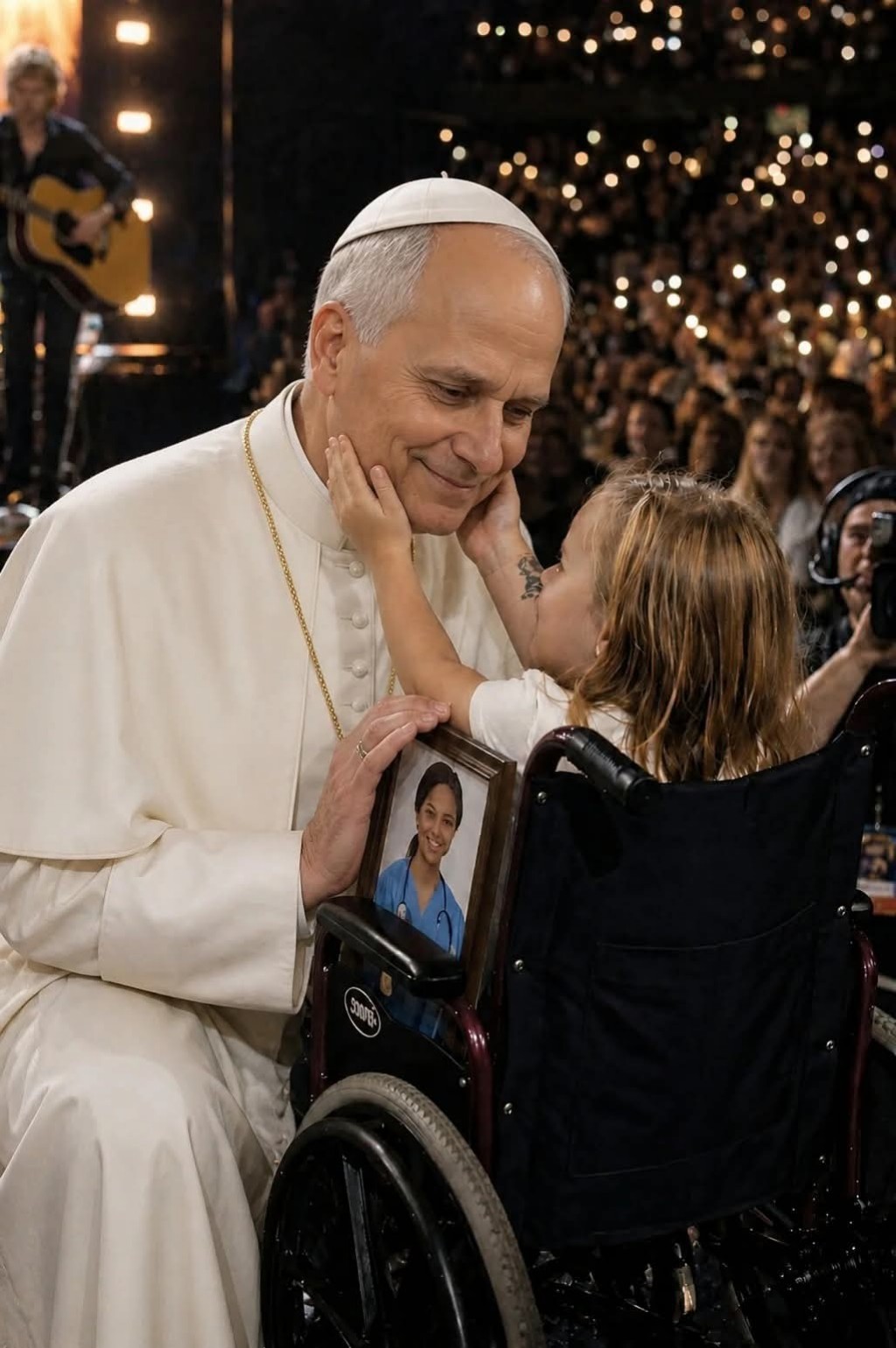
As the Pope stood on a raised platform, he locked eyes with a young girl in the front row. She was in a wheelchair, clutching a framed photograph of her mother—a nurse who had lost her life serving on the front lines. The grief in that image, held by such small hands, was a silent scream that the Holy Father could not ignore.
Ignoring the frantic cues from the stage directors, Pope Leo XIV gave the command that has since become a global headline: “Lower the stage. I’m coming down.”
The Vibration of Grace
What happened next was a masterclass in empathy. The Pope walked directly into the audience, bypassing security and cameras, to kneel beside the girl. In a gesture that left the world breathless, he gently placed her hand on his throat. He wanted her to not just hear his words of comfort, but to feel the vibration of the prayer he was whispering for her mother.
For those few minutes, the “show” was gone. There was no teleprompter, no lighting cues, and no celebrity Pontiff. There was only a pastor and a grieving child.
A New Kind of Papacy
This act reflects the unique energy Pope Leo XIV has brought to the Vatican since his election last year. Whether he is standing firm against political pressure regarding global conflicts or calling for ethical certainty in the age of AI, his focus remains stubbornly fixed on the individual. He is a leader who understands that the “universal Church” is made up of single, often broken, hearts.
As the broadcast finally resumed, the atmosphere had shifted. The world was no longer watching a distant figure on a pedestal; they were watching a man who was willing to come down to earth to stand beside those in pain.