Part 2: He looked at Derek. “In a minute.”
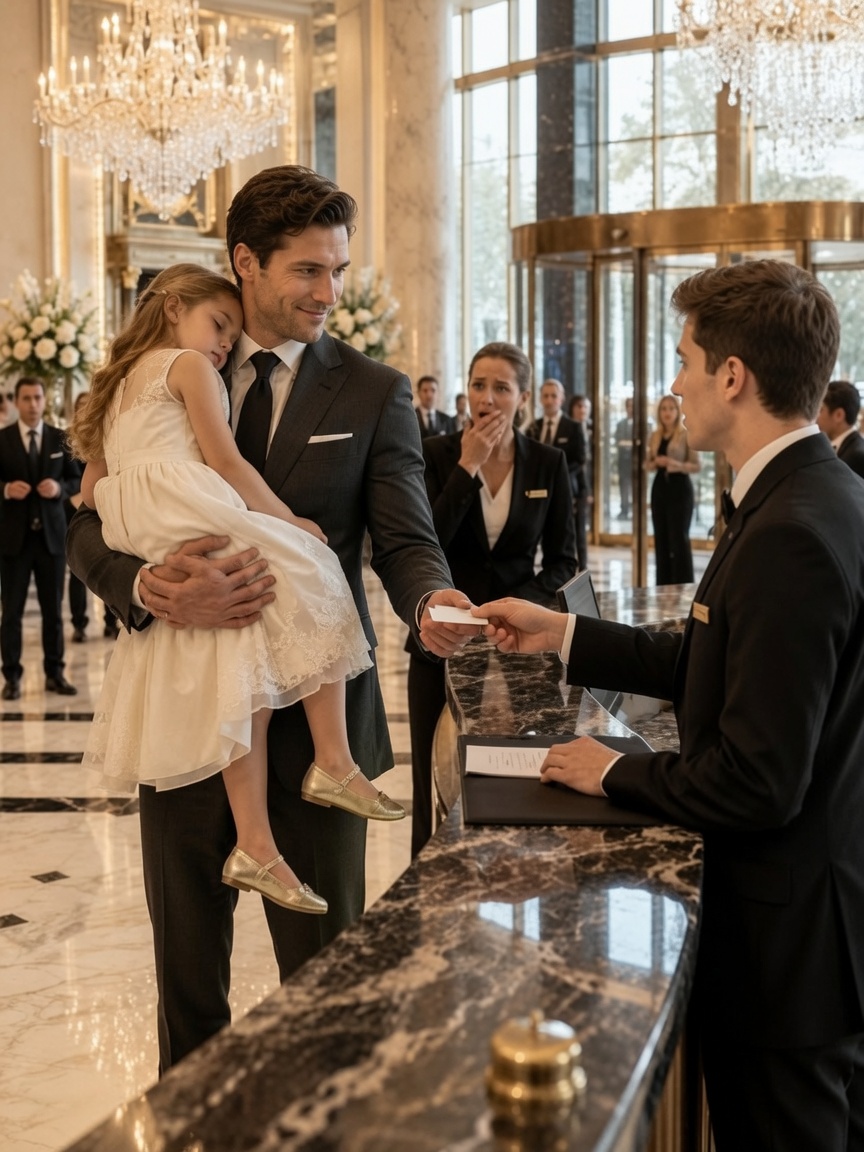
Marcus didn’t raise his voice.
That was the first thing people usually expected—and the first mistake they usually made.
Instead, he adjusted Zoe’s weight slightly on his arm, as if she were the only part of the situation that required immediate, careful attention. Her small head rested against his shoulder, completely unaware of the tension sharpening every breath around them.
“When appropriate,” he repeated, softly.
Richard held his ground behind the counter, posture perfect in the way of someone who had learned that authority is often just repetition dressed up as certainty.
“Yes,” Richard said. “When the hotel determines a guest may not be suitable for accommodation, we act accordingly.”
Derek shifted behind him, suddenly very interested in the edge of the desk. His earlier confidence had evaporated completely, replaced by the uneasy stillness of someone who understood too late that he had chosen the wrong side of a moment.
Marcus looked at him.
Not Richard.
Derek.
“I want you to say it,” Marcus said.
Derek blinked. “Sir?”
“The reason,” Marcus continued. “Out loud. The reason you told me there were no rooms.”
A silence dropped into the lobby.
The older couple near the fireplace stopped pretending to read the dessert menu.
The bartender’s polishing slowed.
Even the air seemed to tighten, as if the building itself had become aware of what was about to be named.
Derek forced a small laugh, but it broke halfway out. “That’s not necessary.”
Marcus took one step closer to the desk.
Still calm. Still controlled. But now there was something unmistakable in the stillness—pressure, contained and deliberate, like a hand closing slowly around a glass.
“I didn’t ask if it was necessary,” Marcus said. “I asked you to say it.”
Richard stepped in smoothly, cutting the space between them like a practiced blade.
“There seems to be a misunderstanding,” he said. “Derek followed standard procedure.”
“Standard procedure,” Marcus echoed again.
His eyes flicked briefly around the lobby.
The concierge—Maya Ellis—was still behind her desk. Still motionless. But now Marcus noticed something different in her posture. The hand over the brochures had lowered slightly. Not enough to be obvious. Just enough to suggest she was listening harder than she was allowed to look.
Their eyes met again.
This time she didn’t look away immediately.
Just held it for a fraction longer than before.
And in that fraction, Marcus understood something without her needing to speak it.
Not confusion.
Recognition.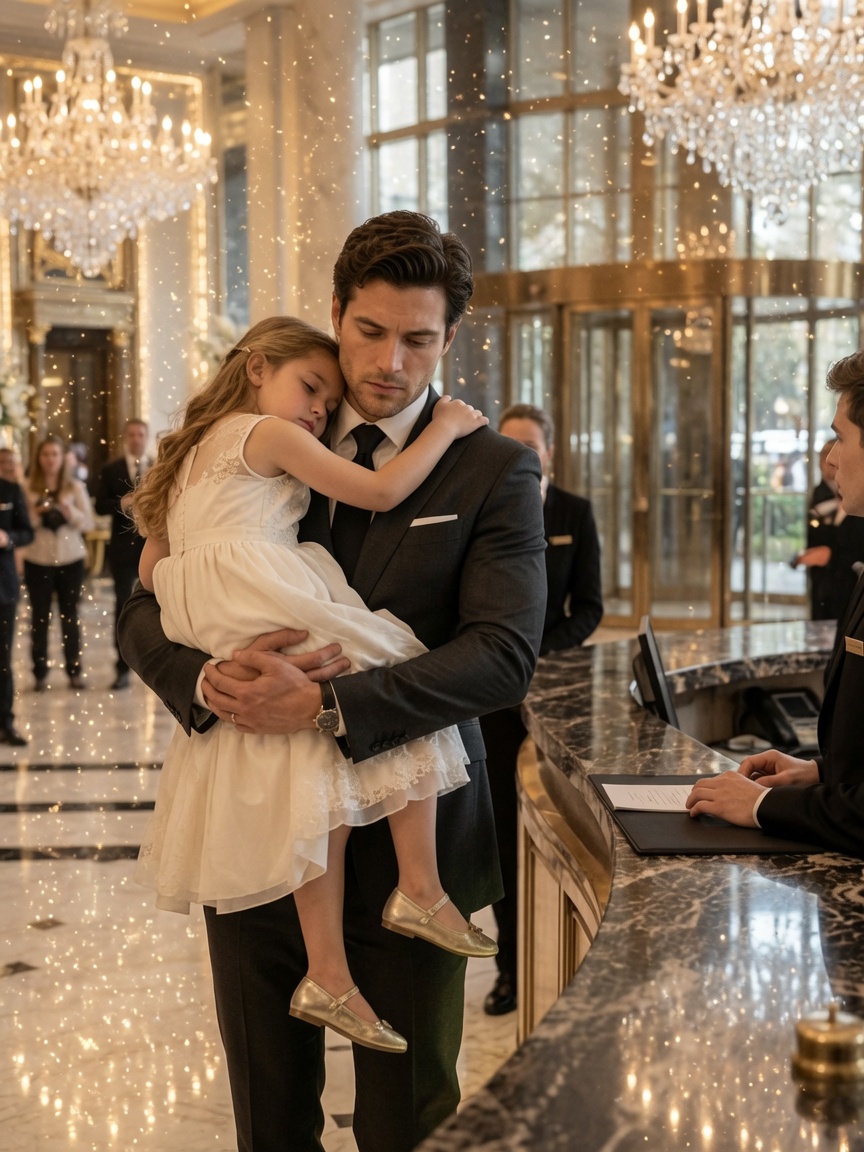
Not of him—but of what had happened here before he arrived.
Then she looked down again, carefully, like someone placing a fragile object back where it wouldn’t be seen.
Richard cleared his throat. “Sir, if you would like, we can discuss alternative accommodations nearby. We are happy to assist—”
“I already had accommodations,” Marcus interrupted.
The words were quiet.
But they landed hard enough that even Richard stopped speaking.
Marcus shifted Zoe slightly again, his grip steady, his attention never leaving the front desk.
“I had a reservation,” he said. “Confirmed. Paid. And you gave my room to someone else.”
Richard’s jaw tightened.
“We reserve the right to manage inventory in real time,” he said.
There it was again.
Language carefully constructed to sound like policy instead of decision.
Marcus nodded slowly, as if considering it.
Then he leaned forward just enough that his voice dropped—not louder, but sharper in its restraint.
“When appropriate,” he said again, “you decided I wasn’t appropriate.”
A beat of silence.
Richard didn’t answer immediately.
And in that delay, something shifted—not loudly, not dramatically, but unmistakably.
Because now it wasn’t about rooms anymore.
It was about who got to decide what “appropriate” meant.
And for the first time since Marcus walked in, Richard looked like he wasn’t entirely sure he liked the answer forming in front of him.