The Beautiful Circle of Life: How a Premature NICU Baby Returned to the Same Hospital Twenty-Eight Years Later as a Doctor
The Beautiful Circle of Life: How a Premature NICU Baby Returned to the Same Hospital Twenty-Eight Years Later as a Doctor
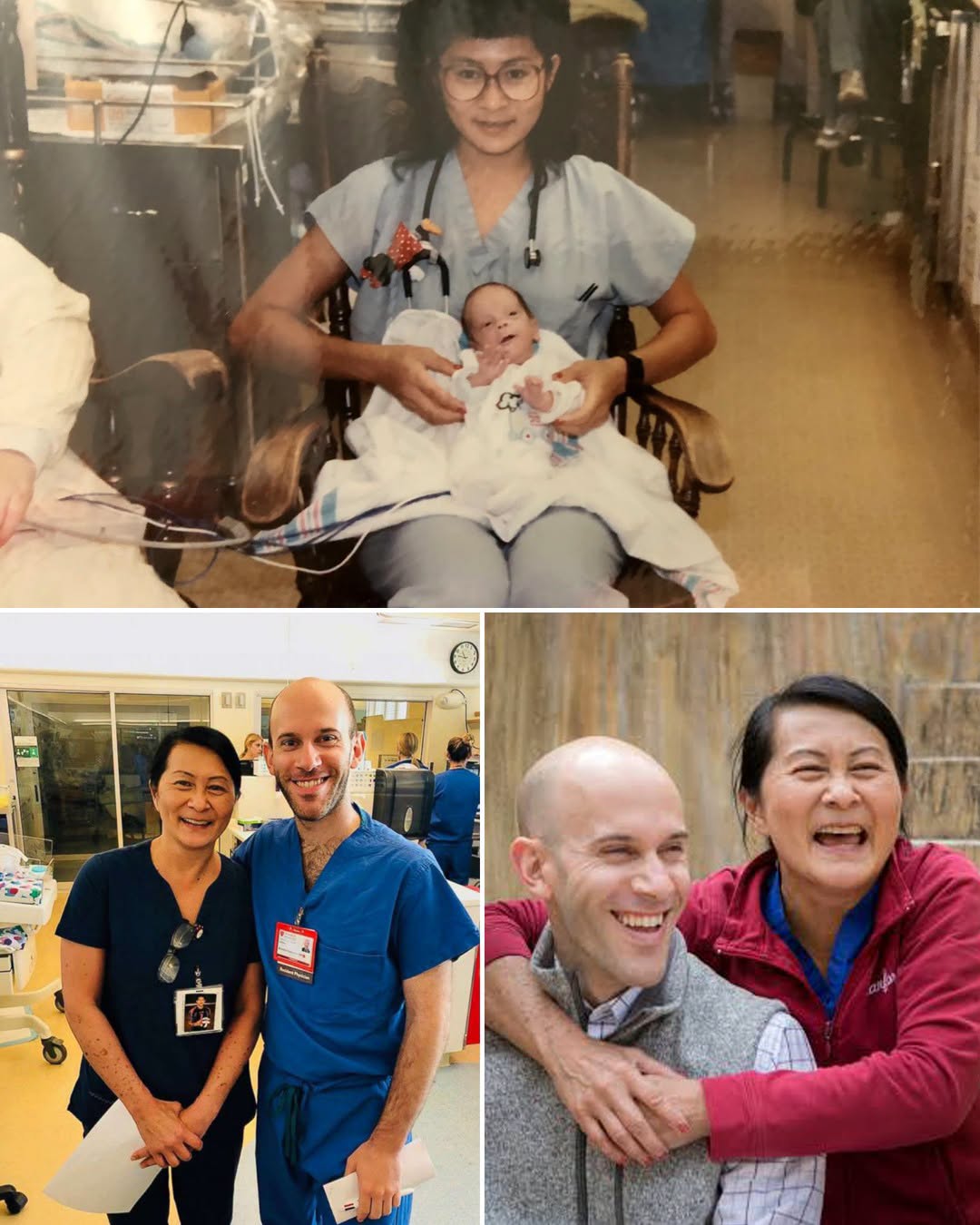
Sometimes, life has a way of coming full circle in the most breathtaking and unexpected ways, weaving paths together across decades to remind us of the lasting impact of human dedication. In 1990, Vilma Wong was working as a dedicated neonatal intensive care unit nurse at Lucile Packard Children’s Hospital Stanford, spending her days and nights caring for some of the absolute tiniest and most vulnerable infants. Her daily reality revolved around helping premature newborns fight against incredible odds for their very survival. One of those fragile patients was a little boy named Brandon Seminatore.
Brandon entered the world prematurely at just twenty-nine weeks, weighing a mere two pounds. For more than a month, Vilma was a constant presence by his side in the intensive care unit, monitoring his progress where every single gram gained and every independent breath taken was celebrated as a monumental victory. Under the watchful, nurturing care of Vilma and the medical team, Brandon gradually grew stronger, eventually reached a safe weight, and was finally discharged to go home with his family. As the years rolled by, life moved forward for both of them, and the memory of that tiny infant faded into the background of a busy hospital.
Nearly twenty-eight years later, Vilma was still working on the very same unit at Stanford, continuing her lifelong mission of saving newborns. One morning, while attending standard medical rounds, she caught the name of a newly arrived pediatric resident: Dr. Brandon Seminatore. Something about the unique name resonated deeply within her memory. Driven by a sudden burst of curiosity, she approached the young resident and began asking him a few simple, probing questions about his background. She asked him where he had grown up, and if by any chance his father had been a local police officer.
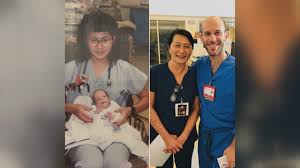
As Brandon answered her questions, the pieces of a decades-old puzzle suddenly clicked perfectly into place. The young doctor standing proudly in front of her was not just another medical resident passing through the hospital corridors. He was the exact same premature baby she had held, monitored, and kept alive nearly three decades earlier. Only this time, he was no longer a fragile infant lying helplessly inside a sterile incubator. He was standing tall, wearing a crisp white medical coat, and looking back at her as a peer.
Brandon had consciously chosen to return to the exact facility where his own life had begun. However, instead of being the patient fighting for survival, he was now the one responsible for administering care to the next generation of children. The dedicated nurse who had once used her skills to keep him alive and the tiny baby she had watched over so closely were now walking the same hospital wings, working side by side as professional colleagues.
For Vilma, it was an unforgettable validation of her life’s work, seeing the living embodiment of her past efforts. For Brandon, it provided a rare and beautiful opportunity to look into the eyes of someone who had protected him before he was even old enough to form memories, and to offer his deepest gratitude. This extraordinary reunion serves as a powerful testament to how far a single life can travel, proving that the smallest, most vulnerable patients can grow up to make the absolute biggest difference in the world.