Hollywood Called His Body Unmarketable and His Accent Impossible—Arnold Schwarzenegger Turned Both Into His Greatest Weapons
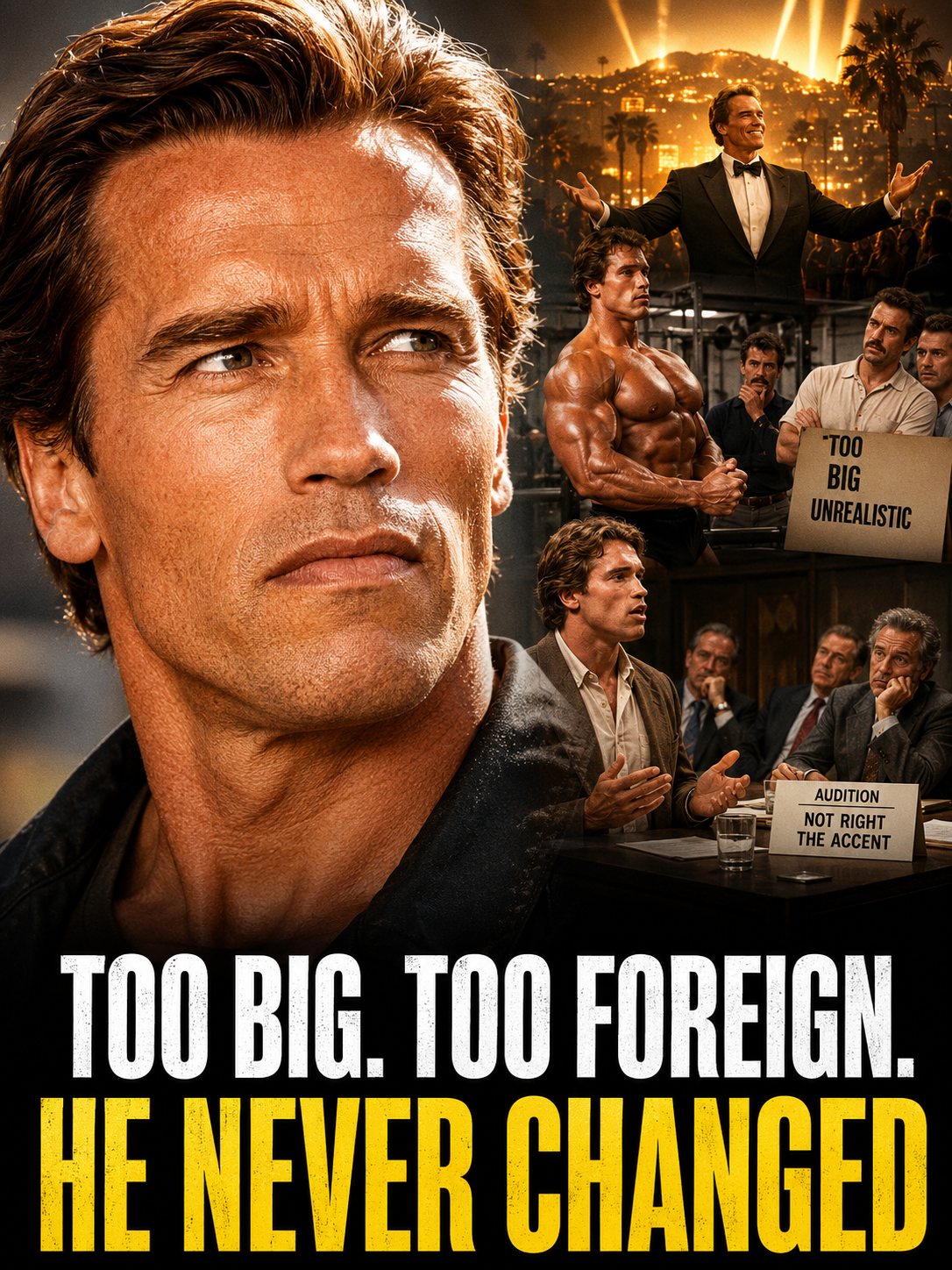
When Arnold Schwarzenegger first tried to move from bodybuilding into acting, Hollywood professionals did not see the future face of a global film franchise.
They saw a collection of problems.
His body was considered excessively muscular. His Austrian accent was so heavy that some people struggled to understand him. His surname was long, unfamiliar, and supposedly impossible for American audiences to pronounce.
Agents advised him to lose weight, soften his physique, improve his English, and consider changing his name. Schwarzenegger listened to the criticism—but refused to abandon the qualities that made him different.
He studied acting and worked on his speech, yet he never accepted the idea that becoming a movie star required erasing himself. The body Hollywood considered too strange eventually made him the perfect Conan. The accent executives considered a fatal weakness became one of cinema’s most imitated voices.
By the time the transformation was complete, Schwarzenegger had not simply entered Hollywood.
He had forced Hollywood to create a new kind of leading man.
A Dream Formed Far From California
Schwarzenegger was born on July 30, 1947, in Thal, a village in postwar Austria.
His childhood unfolded under the strict authority of his father, Gustav, a local police chief. Home life could be severe, and Schwarzenegger later described physical punishment and an atmosphere in which discipline mattered more than affection.
The future mapped out for him seemed narrow. He was expected to remain in Austria, find conventional work, and live within the limits of the world around him.
Schwarzenegger wanted something larger.
As a boy, he became fascinated by American movies and bodybuilding magazines. He admired muscular stars such as Reg Park, who had moved from competitive bodybuilding into films. Park’s example offered Schwarzenegger a blueprint: build the body, become a champion, travel to America, and use success in one field to enter another.
At 15, he began training seriously with weights.
The physical transformation separated him from other teenagers, but Schwarzenegger did not view bodybuilding merely as exercise. Every repetition was connected to the future he imagined.
At 20, he won the Mr. Universe title. He eventually collected seven Mr. Olympia championships and became the dominant personality in professional bodybuilding. His confidence, competitive instincts, and gift for self-promotion helped turn a niche sport into a larger cultural spectacle.
In 1968, at 21, he moved to the United States with assistance from bodybuilding publisher and promoter Joe Weider. His official biography describes that journey as the beginning of a career that would eventually encompass bodybuilding, entertainment, business, and politics.
But success in bodybuilding did not guarantee acceptance in Hollywood.
The Actor Nobody Thought Could Work
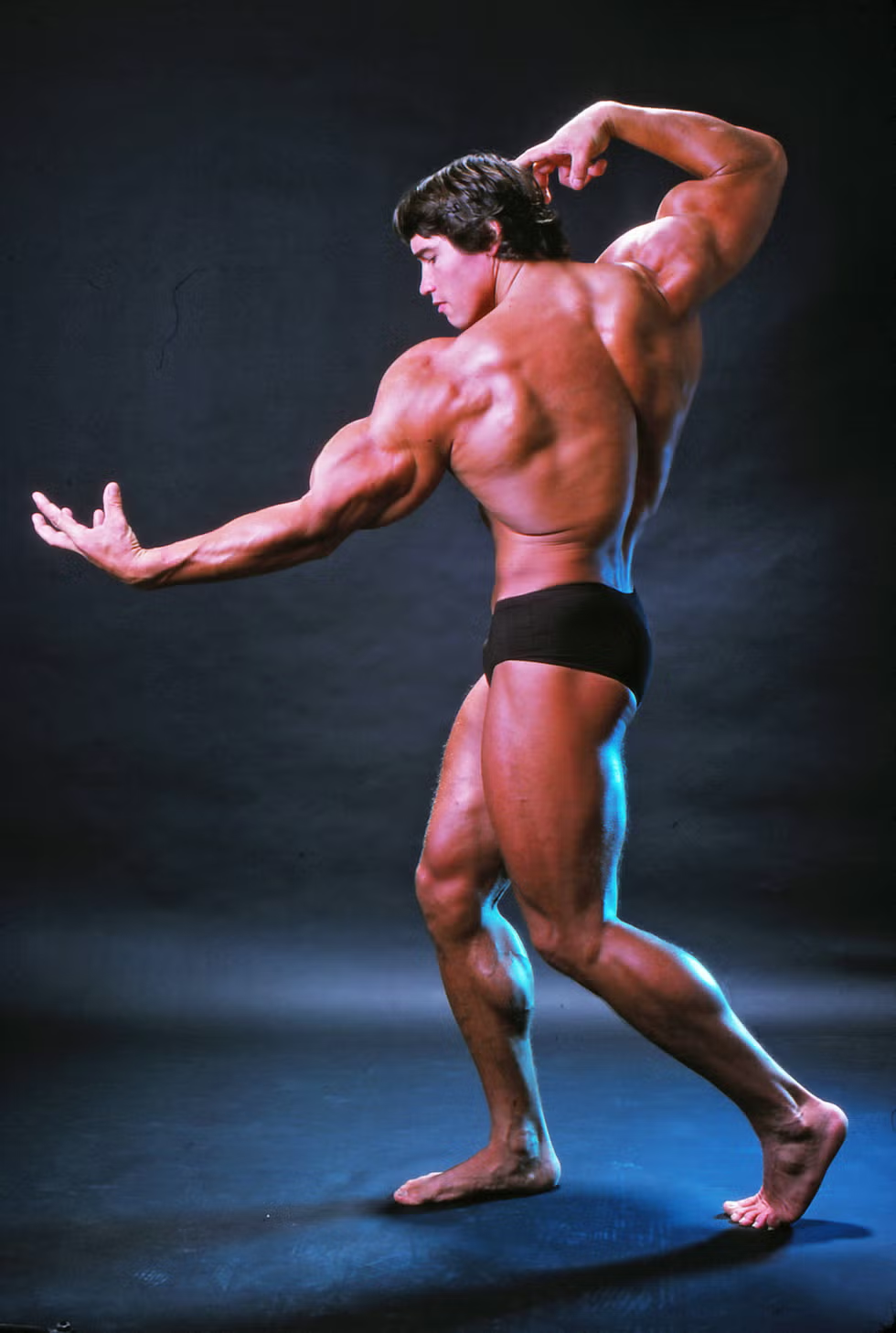
Schwarzenegger’s first leading role came in Hercules in New York, filmed in 1969 and released the following year.
The production exposed nearly every concern Hollywood had about him.
He was credited as Arnold Strong because his real surname was considered too difficult. His acting experience was limited, and his English was still developing. In some versions of the film, another performer dubbed his dialogue because producers believed his accent was too heavy for audiences.
The movie did not make him a star.
It became evidence for those who believed a bodybuilder could never become a convincing actor.
Schwarzenegger responded by treating performance as another discipline to master. He took acting classes, speech lessons, and English courses. He studied movement and worked to understand how film acting differed from posing on a competition stage.
He was willing to improve, but not to shrink himself into a conventional image.
Managers continued telling him that his body looked unnatural on camera. Leading men were expected to resemble actors such as Clint Eastwood or Paul Newman—not a 6-foot-2 bodybuilding champion with enormous shoulders and an unmistakably European voice.
Schwarzenegger later recalled being told that his size, accent, and name made a successful acting career nearly impossible. Netflix’s documentary profile of his life similarly notes that Hollywood representatives dismissed him because of his physique during his transition from bodybuilding.
The criticism contained a strange contradiction.
The industry wanted him to eliminate the very traits that made him memorable.
A Director Who Saw More Than Muscle
A meaningful breakthrough came when director Bob Rafelson cast Schwarzenegger in the 1976 film Stay Hungry.
He played Joe Santo, a bodybuilder preparing for competition while becoming involved in a conflict surrounding the gym where he trained. The part allowed Schwarzenegger to use his physical identity without being reduced entirely to it.
He brought warmth, humor, and an unexpected calmness to the role.
The performance earned him the Golden Globe for New Star of the Year—Actor.
The award did not immediately make him a conventional leading man, but it weakened the argument that he could not act.
Then came Pumping Iron.
Released in 1977, the documentary followed Schwarzenegger and other bodybuilders as they prepared for major competitions. On screen, he was not simply a muscular athlete. He was strategic, charming, mischievous, and completely aware of how to command attention.
Audiences saw a personality large enough to match the physique.
Hollywood began to understand that Schwarzenegger’s body was not the whole performance. His confidence, humor, and self-created mythology were equally important.
Still, he needed a role that could turn every supposed disadvantage into a necessity.
The Body Hollywood Suddenly Needed
That role arrived with Conan the Barbarian.
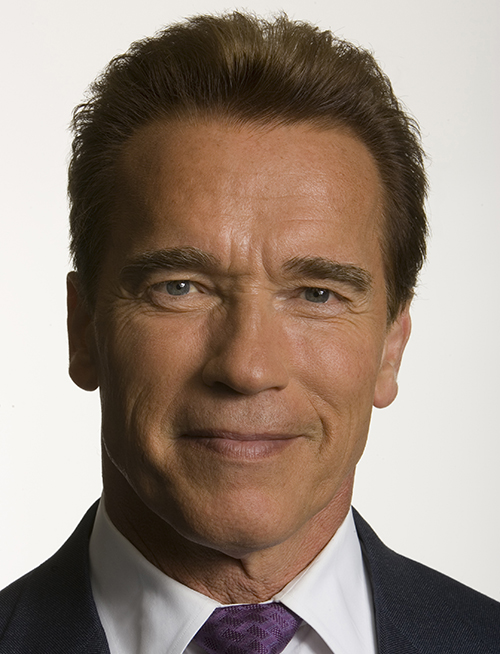
The film required someone who looked capable of surviving a brutal ancient world without lengthy explanations. Schwarzenegger’s massive physique, once treated as an obstacle, became the project’s visual foundation.
Released in 1982, Conan the Barbarian established him as a legitimate action star.
The character did not demand that Schwarzenegger resemble traditional Hollywood actors. Conan needed to appear physically extraordinary. His unusual presence no longer disrupted the movie—it defined it.
Yet the role that permanently transformed his career came two years later.
Director James Cameron cast Schwarzenegger in The Terminator, initially considering him for the human hero Kyle Reese. During discussions, however, Cameron became convinced that Schwarzenegger should play the machine sent from the future to kill Sarah Connor.
The casting was inspired partly by the qualities others had criticized.
Schwarzenegger’s size made the Terminator physically overwhelming. His accent and controlled delivery gave the character an unfamiliar, mechanical quality. His limited dialogue made every word more memorable.
The sentence “I’ll be back” became one of the most famous lines in movie history.
Schwarzenegger initially questioned the wording and suggested changing it to something he found easier to pronounce. Cameron insisted on the original line.
The accent stayed.
So did the line.
Becoming Larger Than the Limitation
After The Terminator, Schwarzenegger became one of the defining action stars of the 1980s and 1990s.
Films including Commando, Predator, The Running Man, Total Recall, and True Lies turned his physicality into a genre of its own. His characters were powerful, but Schwarzenegger also developed a sense of humor about his image.
He understood that audiences enjoyed the contrast between his intimidating appearance and his carefully timed one-liners.
That self-awareness allowed him to expand into comedy.
Twins paired him with Danny DeVito, using their physical difference as the central joke. In Kindergarten Cop, the hardened action hero was placed in a classroom filled with small children. Rather than hiding his accent or size, the films built comedy around them.
The strategy worked because Schwarzenegger had stopped trying to fit the existing definition of a movie star.
He had become his own category.
His return as a reprogrammed protector in Terminator 2: Judgment Day confirmed his place at the top of the industry. The film became the highest-grossing movie worldwide in 1991, while Schwarzenegger’s performance transformed a nearly emotionless killing machine into an unlikely source of humor and humanity.
A critic could still question his range. Audiences no longer questioned his presence.
He Improved Without Erasing Himself
The idea that Schwarzenegger simply ignored every criticism is not entirely accurate.
He worked relentlessly on the weaknesses people identified. He studied English, practiced pronunciation, took acting lessons, and learned how to use his body more subtly on camera.
Early in his career, he even tried to reduce his accent.
What he ultimately rejected was the belief that improvement required complete erasure.
He could speak more clearly without pretending he had been born in California. He could become a better actor without losing the physique that had taken years to build. He could keep the surname people considered unmarketable until audiences learned how to say it.
Eventually, the traits meant to exclude him became commercially valuable.
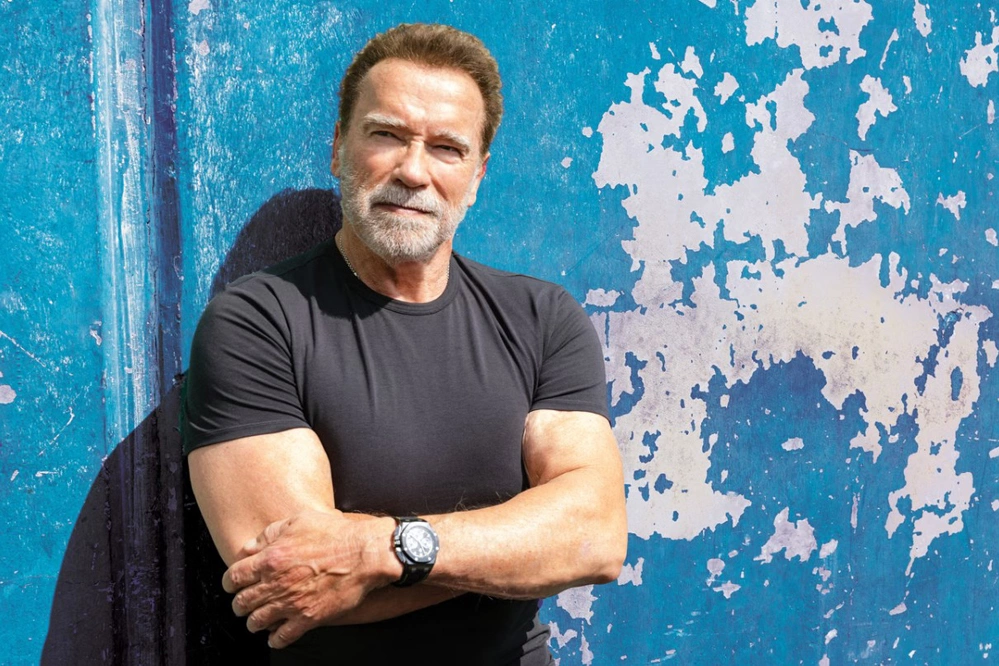
His accent made ordinary dialogue instantly recognizable. His body created an unmatched silhouette. His name became a global brand attached not only to films but also to fitness competitions, businesses, public service, and political office.
In 2003, the immigrant once told he could never sound American enough was elected governor of California. He served until 2011.
The transformation was remarkable, though not flawless. Schwarzenegger’s public life also included political controversy, personal failures, and the collapse of his marriage after he admitted fathering a child outside it.
His success did not make every decision admirable.
But the central contradiction of his career remained undeniable: Hollywood’s warnings had identified his greatest advantages without realizing it.
Refusing the Wrong Kind of Change
Schwarzenegger’s story is often told as a lesson in ignoring criticism.
A more accurate lesson is knowing which criticism to accept.
He accepted that ambition without training was not enough. He improved his language skills, learned the craft of acting, and studied how entertainment worked. He did not demand success while refusing to develop.
What he rejected were instructions to become forgettable.
Had he reduced his body to resemble every other actor, erased his accent completely, and replaced his surname, he might have seemed more acceptable to casting directors.
He also might have removed every reason audiences would remember him.
Arnold Schwarzenegger reached Hollywood carrying a physique considered grotesque, a voice considered unusable, and a name considered impossible.
He changed his skills, but he refused to surrender his identity.
In the end, Hollywood did not teach him how to fit in.
He taught Hollywood that the qualities separating someone from the crowd may be the very qualities capable of changing it.