Before CGI Dominated Hollywood, Terminator 2 Crashed Real Trucks, Blew Up Real Sets and Built the Future by Hand
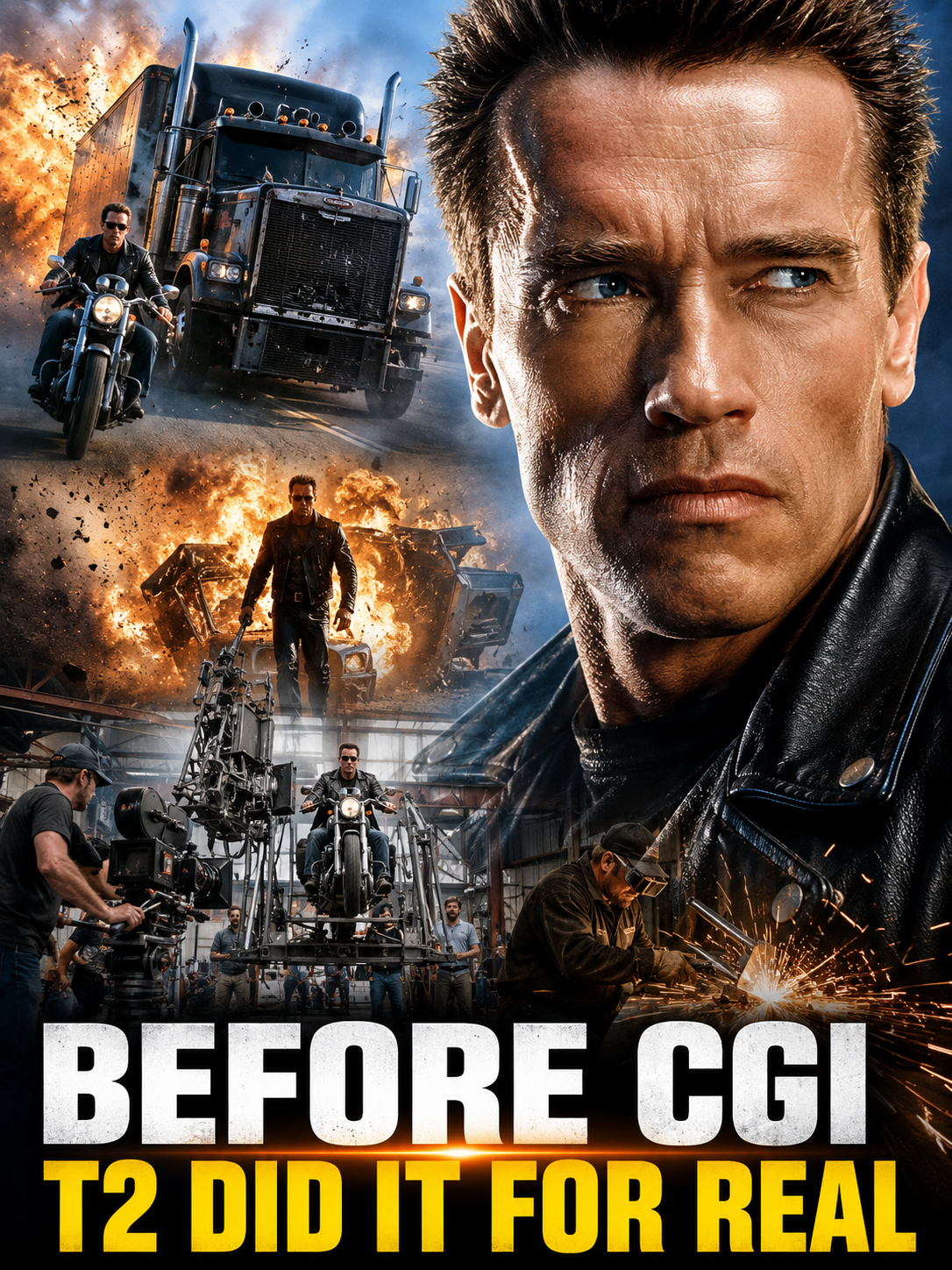
When a tanker truck explodes inside the steel mill at the end of Terminator 2: Judgment Day, the fireball is not merely a digital creation added after filming.
The production built the vehicle, placed it inside a real industrial location, and destroyed it with practical effects.
The same physical approach shaped much of the movie. Motorcycles jumped into concrete channels. Vehicles smashed through walls. Full-size robotic bodies were constructed and torn apart. Miniature cities were consumed by a nuclear blast, while stunt performers risked bruises, burns, and broken equipment to give the action genuine weight.
Terminator 2 is rightly remembered as a landmark in computer-generated imagery. Its liquid-metal villain helped introduce audiences to a new era of visual effects.
But CGI appears in only a relatively small portion of the finished film.
The movie’s power comes from the way James Cameron combined that emerging technology with traditional stunt work, prosthetics, animatronics, miniatures, pyrotechnics, and real machines moving through real spaces.
Hollywood’s digital future was arriving.
Cameron made sure it still felt physically dangerous.
Building a Sequel Larger Than the Original
The first Terminator, released in 1984, had been produced with limited resources.
Cameron used nighttime locations, stop-motion animation, rear projection, miniature effects, and Stan Winston’s robotic creations to tell the story of a cybernetic assassin hunting Sarah Connor.
By the time development began on the sequel, Arnold Schwarzenegger had become one of the world’s biggest action stars, and Cameron had directed Aliens and The Abyss.
The new film would reverse expectations.
Schwarzenegger’s T-800, the killing machine from the first movie, would return as the protector of Sarah’s son, John Connor. The villain would be the T-1000, an advanced Terminator capable of reshaping its liquid-metal body and imitating other people.
Cameron understood that the T-1000 could not be created entirely through the established techniques of the 1980s. He had already experimented with a computer-generated, water-like creature in The Abyss.
Industrial Light & Magic, led by visual-effects supervisor Dennis Muren, would push that technology further.
Yet Terminator 2 was never designed as a fully digital spectacle. Production materials described approximately 150 visual-effects shots, while CGI was reserved mainly for the T-1000’s transformations and injuries. Most of the film’s action remained rooted in physical filmmaking.
The Canal Chase Was Built Around Real Speed
One of the movie’s defining sequences begins when the T-1000 pursues John Connor through Los Angeles.
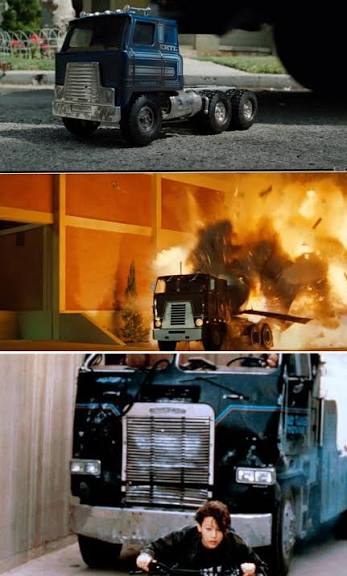
John escapes on a small dirt bike. The T-1000 commandeers a large truck and follows him into the concrete flood-control channels below the city. The T-800 arrives on a Harley-Davidson, launching from the street into the channel before racing after them.
The sequence depends on scale.
A child on a small motorcycle appears vulnerable beside the enormous truck. Schwarzenegger’s machine looks powerful, but even he must struggle to intercept the vehicle before it crushes John.
Much of the chase was performed practically.
Professional stunt riders handled the most dangerous motorcycle work. For the famous moment when the Harley jumps from the street into the channel, cables helped support the motorcycle and stunt performer so the impact would not destroy the bike—or seriously injure the rider.
The wires were removed later, but the motorcycle, landing, dust, and momentum were real.
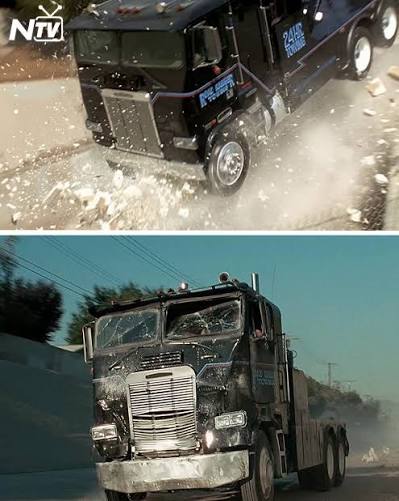
The truck also performed actual high-speed maneuvers through the channel. Camera crews used specially protected equipment and multiple angles to capture crashes that could not be repeated casually.
At one point, the truck smashes through a concrete barrier and falls into the drainage canal.
The barrier was specially constructed to break safely, but the truck still had to drive through it and drop onto the roadway below. Its suspension was modified to survive the impact.
The sequence ends when the truck collides with an overpass and explodes.
Rather than replacing the vehicle with a digital model, the filmmakers staged the destruction using a practical truck and pyrotechnics. The flames illuminate the concrete walls, reflect from nearby surfaces, and throw real heat and smoke into the environment.
That physical interaction is one reason the chase still feels immediate decades later.
A Helicopter Flew Beneath a Highway Overpass
The T-1000’s pursuit continues later when it commandeers a police helicopter and chases the heroes along a freeway.
In one remarkable shot, the helicopter passes beneath an overpass.
The maneuver looks too dangerous to be real.
It was real.
A stunt pilot flew the helicopter under the structure while camera crews captured the passage. For safety and control, the road was closed and the production carefully planned the flight path.
Cameron wanted the audience to feel that the T-1000 would use any machine with total disregard for normal human caution.
A digital helicopter might have communicated the same information. A physical aircraft passing through a confined space created something harder to imitate: genuine risk visible in the movement.
The rotor wash disturbed the air. The aircraft’s weight affected every adjustment. Its distance from the concrete could be felt without explanation.
The shot lasts only moments, but it reflects the philosophy behind the film.
Whenever something could be achieved physically, the production attempted to put it in front of the camera.
Stan Winston Built the Damage by Hand
CGI created the T-1000’s most impossible transformations, but practical effects handled many of the film’s damaged bodies.
Stan Winston and his crew constructed animatronic heads, articulated puppets, prosthetic appliances, false torsos, and full-scale Terminator components.
When the T-800 cuts open its arm to reveal the metal skeleton underneath, Schwarzenegger’s real arm is not simply replaced by a digital effect. The scene uses a detailed mechanical prop integrated with prosthetics and carefully positioned photography.
For the sequence in which Sarah and John remove and repair the T-800’s neural processor, the filmmakers used a mirror illusion, an animatronic Schwarzenegger head, and Linda Hamilton’s identical twin sister, Leslie Hamilton Gearren.
The set was duplicated across a mirror line. Schwarzenegger sat on one side while his mechanical double appeared on the other. Linda performed opposite her sister, allowing the scene to show Sarah’s apparent reflection without relying on a conventional mirror.
The Academy has highlighted the sequence as an example of practical movie magic using animatronics and twin performers.
The T-800’s late-stage damage was similarly physical.
As the character loses part of his face, prosthetic makeup exposes the red mechanical eye and chrome skull underneath. When he is crushed, torn apart, or dragged through machinery, puppets and mechanical components replace the actor.
These creations gave Schwarzenegger something tangible to perform with. Light struck the metal surfaces naturally. Blood, smoke, and debris collected on actual materials.
The machine appeared to exist because, in front of the camera, much of it did.
Even the Liquid-Metal Villain Was Not Always Digital
Robert Patrick’s T-1000 became famous for emerging from floors, passing through prison bars, and healing after being shot.
Those transformations depended on groundbreaking computer animation. ILM scanned Patrick’s body and developed digital methods for producing reflective, human-shaped metal.
At the time, such work was extraordinarily expensive and slow. A few seconds could require days of rendering, and the digital team had to develop new software and expand significantly to complete the shots.
That limitation encouraged the filmmakers to use CGI selectively.
Many of the T-1000’s wounds were practical appliances created by Winston’s team. When bullets strike his body and leave metallic craters, prosthetic pieces were triggered or swapped between cuts.
For the moment when the T-1000 walks through prison bars but his gun becomes caught, the performer passed through an opening designed into the practical bars. The digital work completed the illusion around him.
When the T-1000 imitates a security guard and stands beside his double, the production cast real-life twins Don and Dan Stanton.
Linda Hamilton and her twin were used again during the steel-mill climax, allowing Sarah and the T-1000 disguised as Sarah to appear together.
The film’s digital revolution was therefore supported by one of cinema’s oldest special effects: finding two people who looked the same.
Los Angeles Was Destroyed in Miniature
Sarah Connor’s nightmare of nuclear war contains one of the movie’s most horrifying sequences.
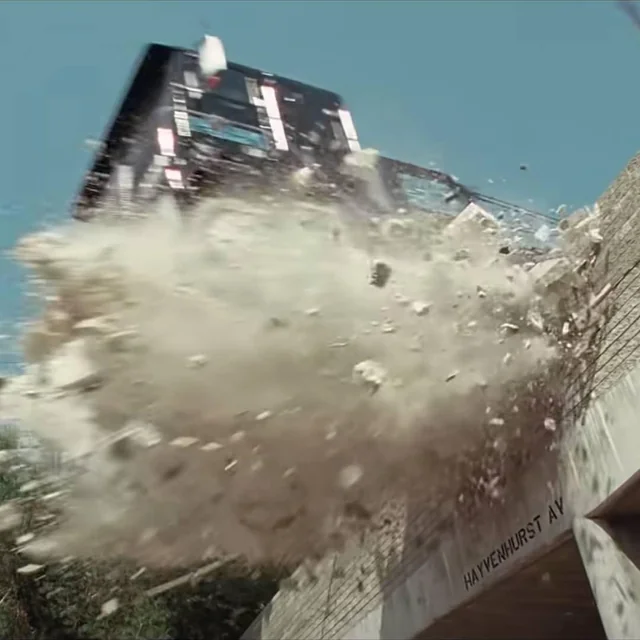
She watches helplessly as a nuclear explosion consumes Los Angeles. Buildings collapse, cars are thrown through the streets, and Sarah’s body is reduced to ash against a fence.
The production did not digitally generate an entire city.
Effects artists Robert and Dennis Skotak and their team used detailed miniatures, matte paintings, high-speed photography, air cannons, optical compositing, and limited computer assistance.
A miniature neighborhood was built with breakaway structures and carefully arranged furniture. Air blasts tore the models apart while the footage was recorded at high speed, making the destruction appear larger and heavier when played normally.
The filmmakers also photographed real sections of Los Angeles, created painted versions of the ruined city, and combined multiple elements into the final sequence.
Linda Hamilton’s nuclear destruction was represented through a specially constructed skeletal puppet.
The result remains disturbing because the destruction has texture. Walls bend, fragments scatter, and pressure appears to travel through physical space.
The sequence is not realistic in every scientific detail, but emotionally it transforms Judgment Day from an abstract future event into something Sarah—and the audience—can see.
The Steel Mill Became a Giant Practical Stage
The climax was filmed at an abandoned steel plant in Fontana, California.
The location appeared to contain pools of molten metal, but the glowing liquid was created through lighting and practical staging rather than exposing actors to an active industrial furnace.
The crew illuminated the plant with intense orange light, smoke, sparks, and controlled fire. The result gave the machinery a sense of heat and scale.
The tanker crash was staged physically. Vehicles collided, fuel ignited, and the explosion surrounded the T-1000.
When the frozen villain shatters, a full-scale figure was broken into pieces across the floor. Those fragments then melt and reassemble through digital animation.
The final destruction of the T-1000 combines nearly every method available in 1991: Robert Patrick’s performance, prosthetic distortions, mechanical effects, miniature elements, optical compositing, and CGI.
No single technique carries the scene.
The illusion works because each method is used only where it is strongest.
The Digital Landmark That Never Abandoned Reality
Terminator 2: Judgment Day opened on July 3, 1991, and became the year’s highest-grossing film worldwide.
At the 64th Academy Awards, it won four Oscars: Best Visual Effects, Best Makeup, Best Sound, and Best Sound Effects Editing.
Its liquid-metal imagery influenced the future of filmmaking. Two years later, ILM would use further advances to create the dinosaurs of Jurassic Park, accelerating Hollywood’s transition toward computer-generated creatures and environments.
But Terminator 2 did not demonstrate that computers should replace physical production.
It demonstrated how digital imagery could extend it.
The actors still ran through smoke. The vehicles still collided. The stunt performers still made the jumps. The robotic bodies still occupied space beside the cast.
CGI handled what could not exist.
Practical effects made everything around it feel real.
That balance explains why the movie’s action has aged so well. The technology behind the T-1000 was revolutionary, but the world chasing and fighting that machine had weight, friction, heat, and consequence.
Before digital effects allowed filmmakers to create almost anything, Terminator 2 demanded that much of its impossible future first be built, driven, shattered, and set on fire.
The computers created the liquid metal.
The danger surrounding it was already there.