From Christina Ricci’s Deadpan Icon to Jenna Ortega’s Gothic Detective: How Wednesday Addams Changed Across 31 Years
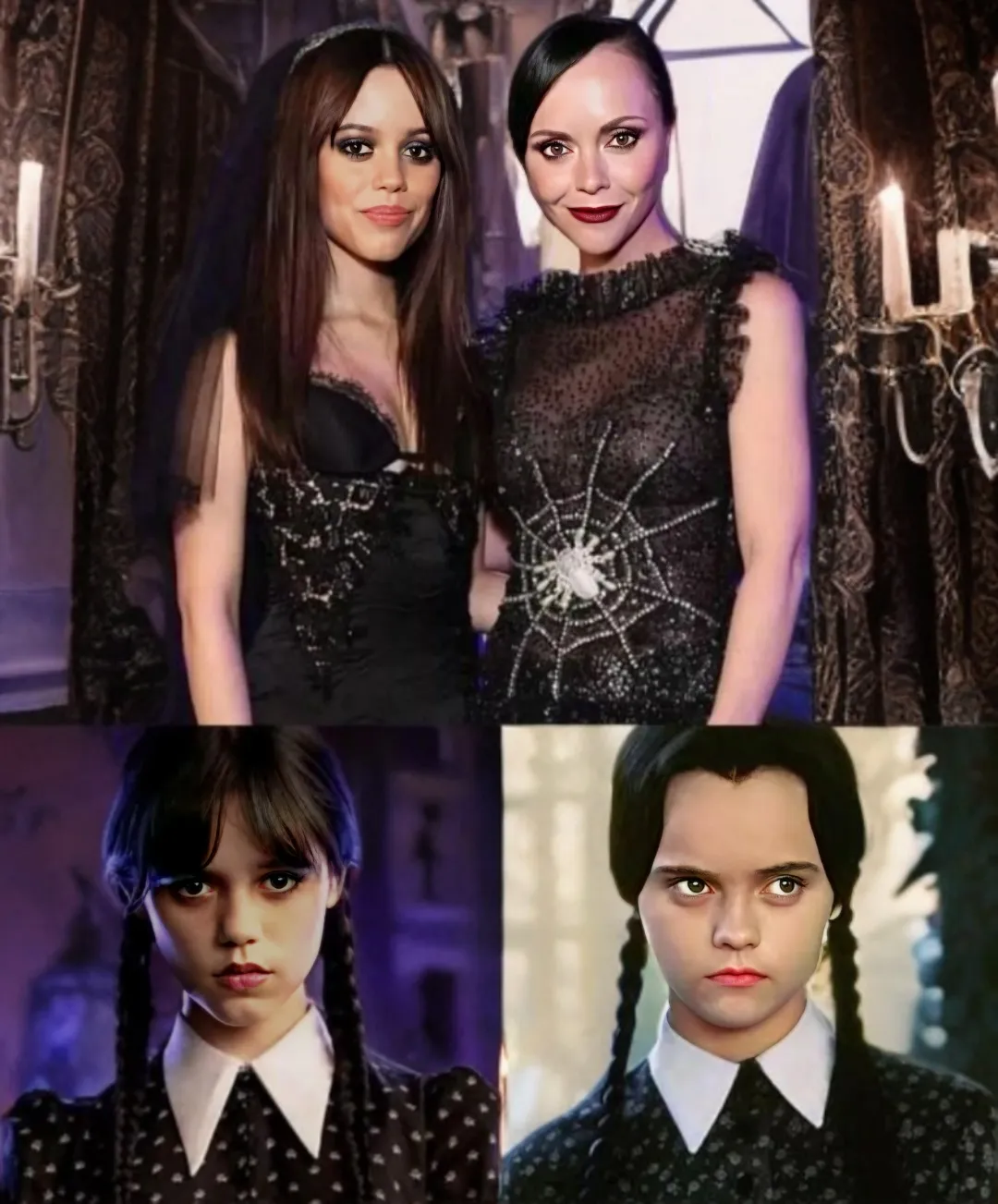
Thirty-one years separate two images that now seem inseparable from the name Wednesday Addams.
In 1991, Christina Ricci appeared with center-parted braids, a black dress and an expression so emotionless that even the darkest joke seemed to pass through her without effort. She was still a child, yet her Wednesday spoke about violence, death and misery with the calm certainty of someone discussing the weather.
Then, in 2022, Jenna Ortega stepped into the same cultural role and faced a difficult problem.
How do you play Wednesday Addams when another actress has already made the character iconic?
Ortega’s answer was not to imitate Ricci. Instead, she preserved the familiar stare, morbid humor and gothic silhouette while turning Wednesday into something the 1990s movies had never required her to be: the emotional and narrative center of her own story.
Christina Ricci Turned Wednesday Into a Scene-Stealer
Wednesday Addams existed long before Christina Ricci.
Cartoonist Charles Addams introduced the macabre Addams family in The New Yorker beginning in 1938. The daughter later received the name Wednesday when the characters were adapted for television in the 1960s.
But for an entire generation, Ricci became the face of the character.
Barry Sonnenfeld’s The Addams Family arrived in 1991, followed by Addams Family Values in 1993. Surrounded by larger-than-life performances from Anjelica Huston, Raul Julia and Christopher Lloyd, Ricci achieved something remarkable by doing less.
Her stillness became part of the joke.
While the adults around Wednesday behaved theatrically, she rarely appeared impressed by anything. Ricci delivered macabre observations without signaling that the audience was supposed to laugh. Her stare remained fixed. Her voice stayed controlled. The humor came from the collision between her childish appearance and the disturbing confidence of what she was saying.
She looked like an unusually serious little girl.
She talked like someone who had already accepted that the world was ridiculous.
By Addams Family Values, Wednesday had even more room to dominate.
The summer-camp storyline separated her from much of her family and placed her among relentlessly cheerful counselors and privileged campers — exactly the kind of environment designed to make Wednesday miserable.
Instead, it allowed her personality to shine.
The famous Thanksgiving pageant became one of the defining moments of Ricci’s performance. Wednesday refuses to play along with the sanitized story she has been given, turning the production into an attack on forced conformity.
It helped transform the character from a source of dark one-liners into something more interesting: a young outsider completely unwilling to pretend she agrees with everyone else.
Ricci had not invented Wednesday Addams, but she helped establish the cinematic version audiences would remember for decades — severe braids, controlled expression, merciless honesty and the sense that Wednesday might somehow become more frightening if she ever smiled.
Jenna Ortega Faced a Different Challenge
When Netflix’s Wednesday premiered in November 2022, Ortega was not playing a supporting child inside an ensemble comedy.
She was playing a teenager expected to carry an entire supernatural mystery.
Wednesday is sent to Nevermore Academy, a boarding school populated by outcasts with extraordinary abilities. Over the course of the story, she investigates murders, experiences psychic visions, clashes with her mother, develops friendships, faces romantic complications, plays cello, fences and repeatedly places herself in danger.
That required considerably more emotional machinery than the earlier films demanded from Ricci.
The biggest challenge was age.
A young child calmly saying something disturbing can be funny because of the contrast between innocence and darkness.
A teenager behaving the same way can simply appear cruel.
Ortega therefore had to find a version of Wednesday who remained abrasive, antisocial and emotionally guarded without making viewers lose interest in her completely.
That became one of the defining differences between the two performances.
Ricci’s Wednesday frequently functions like the perfect punchline.
Ortega’s Wednesday has to function like a protagonist.
She can care about Enid without suddenly becoming openly sentimental. She can love her family while resenting Morticia’s influence. She can experience fear, attachment, jealousy, guilt and vulnerability without expressing those emotions like a conventional teenage heroine.
The feelings are there.
Ortega simply compresses them.
The Same Deadpan, but a Different Physical Language
Visually, the connection between the two Wednesdays is impossible to miss.
Both use stillness.
Both rely on direct eye contact.
Both appear almost completely uninterested in receiving anyone’s approval.
Both treat many normal social rituals as strange inconveniences.
Yet Ortega expanded the physical language of the character.
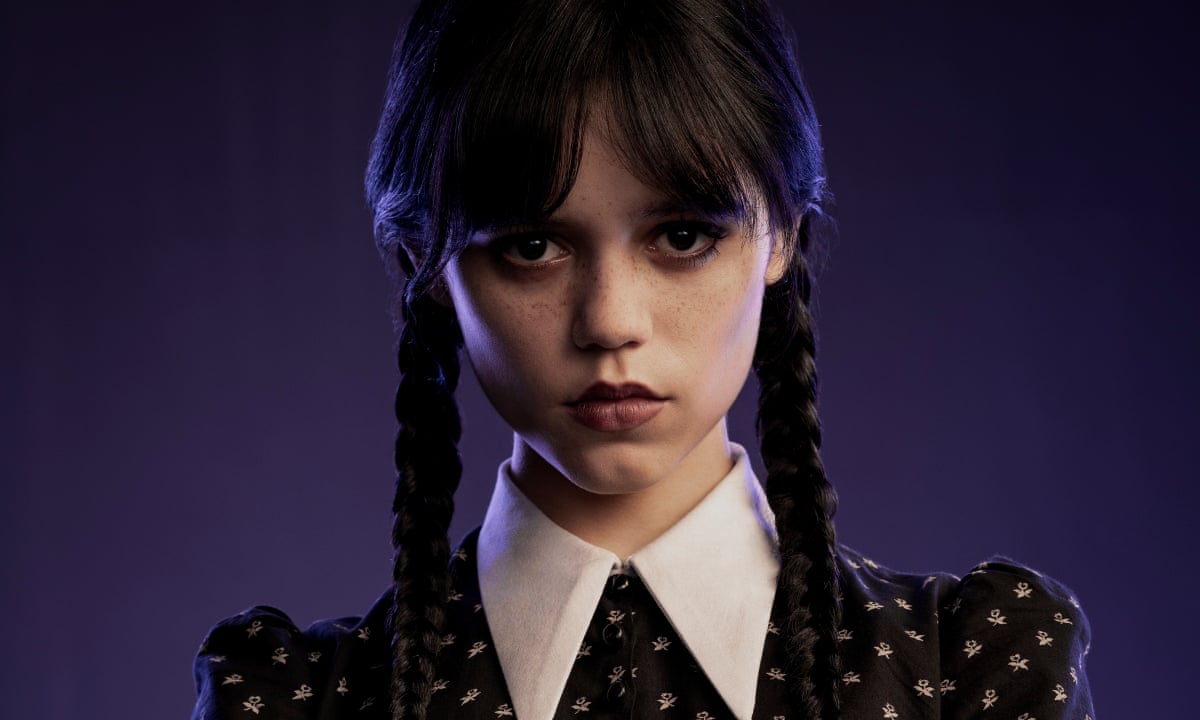
Her Wednesday became known for an unnervingly steady stare and extremely limited blinking. Under Tim Burton’s direction, even tiny movements of the eyes, mouth and head became important because the character rarely gives away what she is feeling.
That created an unusual acting challenge.
Wednesday must carry scenes without reacting in the obvious ways television characters usually do.
Instead of changing her expression dramatically, Ortega often lets the audience read meaning from tiny shifts in posture, timing or tone.
And then there is the dance.
The Rave’N sequence became one of the defining pop-culture moments of the series. Ortega choreographed much of Wednesday’s unusual movement herself, creating an angular, unpredictable routine that immediately separated the character from everyone around her.
The scene works because Wednesday does not suddenly become cheerful when she reaches the dance floor.
She remains Wednesday.
Her individuality simply becomes physical.
Ricci often found comedy by remaining almost impossibly still.
Ortega proved that Wednesday could be equally strange in motion.
Wednesday’s Gothic Style Changed With Her
The costumes reveal the same evolution.
Ricci’s version is remembered for an almost storybook simplicity: a black dress, white collar and tightly controlled braids.
That simplicity made the silhouette instantly recognizable.
Ortega’s Wednesday retains the monochrome identity but requires a much broader wardrobe because she exists inside a modern school environment.
At Nevermore Academy, even her uniform sets her apart. While purple is strongly associated with the school, Wednesday receives a customized gray-and-black version that immediately announces that she refuses to blend in — even among people who are already considered outsiders.
Her wardrobe expands into hoodies, trousers, heavy shoes, striped pieces and the now-famous black dress worn to the Rave’N.
Her hair changed as well.
The traditional braids remained, but softer bangs and a less rigid silhouette gave Ortega’s Wednesday a recognizable connection to previous versions without making her look like someone wearing a Christina Ricci costume.
That distinction was essential.
The Netflix series needed audiences to recognize Wednesday immediately while still believing that this was a different interpretation.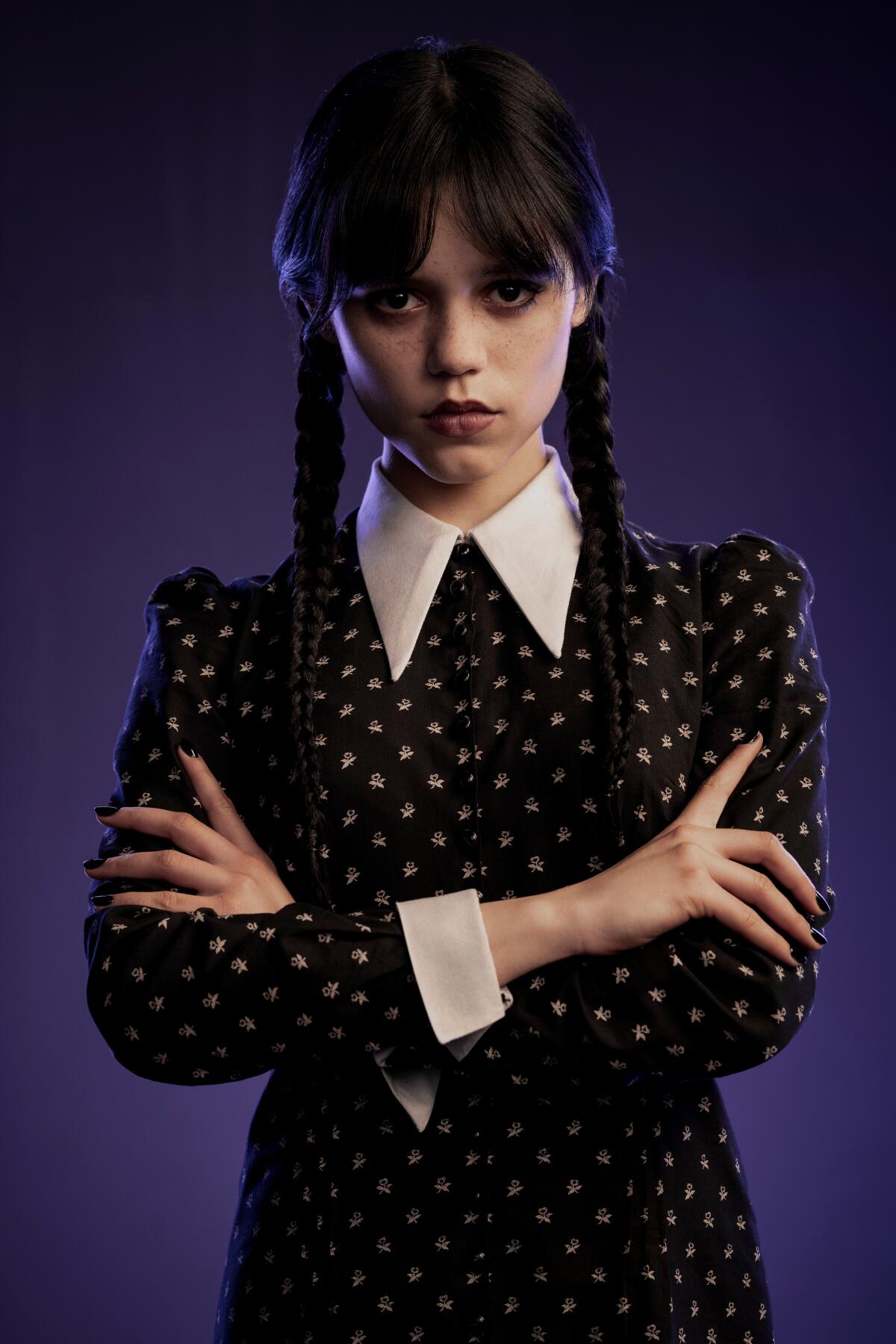
Why Ortega Was Never Meant to Be Ricci 2.0
One of the most interesting details behind the series is what did not happen.
Despite working together, Ortega did not turn to Ricci for instructions on how to play Wednesday.
The two actresses largely avoided comparing performances while filming.
That decision makes sense.
Trying to reproduce Ricci’s mannerisms exactly would have trapped Ortega before the series even began.
Ricci’s Wednesday had already become so recognizable that a direct imitation would almost inevitably feel like an impersonation.
Ortega instead needed to establish her own internal logic for the character.
That allowed the two performances to exist beside each other rather than competing for the same space.
Ricci is the devastatingly funny child who watches ordinary society as though everyone else is the strange one.
Ortega is the fiercely independent teenage investigator who gradually discovers that complete emotional isolation may be impossible.
The darkness remains.
The function of that darkness changes.
Ricci’s Wednesday often uses it to expose the absurdity around her.
Ortega’s Wednesday uses it almost like armor.
Christina Ricci’s Return Created the Perfect Generational Twist
The connection between the two eras became literal when Christina Ricci joined Netflix’s Wednesday.
But she did not appear as an older version of Wednesday.
She was not a relative.
She was not included merely for a nostalgic cameo.
Instead, Ricci played Marilyn Thornhill, Nevermore Academy’s apparently friendly botany teacher and dorm mother.
At first, the casting appeared almost playful.
The actress who had once been Wednesday was now standing across from the new Wednesday.
Even their visual presentation created a contrast. Thornhill appeared warm, approachable and colorful compared with Ortega’s rigidly monochrome student.
Then the series revealed that Thornhill was hiding something much darker.
Her true identity was Laurel Gates, and she had been manipulating Tyler Galpin’s Hyde as part of a revenge plot against Nevermore and its outcasts.
Suddenly, Ricci’s casting became more than nostalgia.
The actress who once embodied Wednesday had returned as one of the new Wednesday’s greatest enemies.
There was something fitting about the confrontation.
Ricci did not return to reclaim the character.
She returned to challenge her successor.
The symbolism was almost impossible to miss: one generation of Wednesday standing directly opposite another, not as copies of each other but as adversaries within the same story.
Ricci later made it clear that she did not see Ortega as someone competing with her version. She praised Ortega’s interpretation and treated the character as belonging to a new performer and a new era.
Ricci would return again as Thornhill in Wednesday Season 2, extending the connection between the franchise’s past and present while remaining firmly separated from the role that made her famous as a child.
Two Wednesdays, Two Generations
More than three decades after Ricci first stared coldly from beneath Wednesday’s braids, Ortega did not erase what came before her.
She built from it.
Ricci showed audiences how funny Wednesday could be without appearing to realize she was funny.
Ortega showed how much emotion could exist beneath a character determined not to display it.
Ricci’s Wednesday was sharper because she was a child who seemed completely unimpressed by adults.
Ortega’s Wednesday is more complicated because she is old enough to understand relationships but stubborn enough to resist them.
Their wardrobes are different.
Their movements are different.
Their stories ask different things from them.
Yet the essential DNA survives: intelligence, defiance, gothic elegance, brutal honesty and an absolute refusal to become more socially acceptable simply because other people would prefer it.
Perhaps that is why Wednesday Addams has survived so many reinventions.
The character does not need every generation to reproduce the last one.
She only needs someone willing to stare back at the world without blinking.
For the 1990s, that person was Christina Ricci.
Thirty-one years later, Jenna Ortega found her own way to do it.