“THE LOCKBOX LETTER” CLAIM: WHAT IS ACTUALLY KNOWN ABOUT THE ANN WIDDECOMBE MURDER INVESTIGATION?
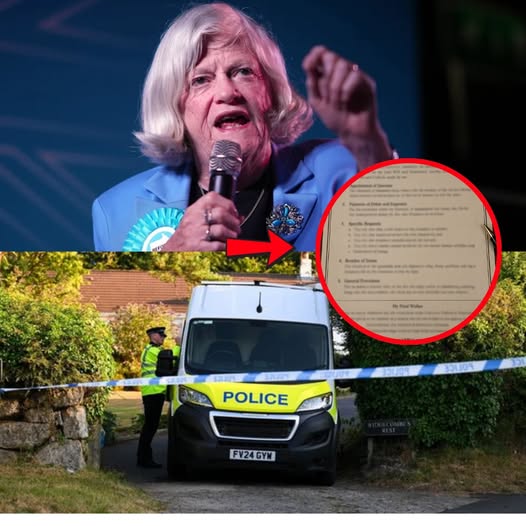
“THE LOCKBOX LETTER” CLAIM: WHAT IS ACTUALLY KNOWN ABOUT THE ANN WIDDECOMBE MURDER INVESTIGATION?
A dramatic claim circulating online alleges that investigators discovered a handwritten letter inside a locked box at Ann Widdecombe’s Devon home—supposedly naming a person who was tracking her movements. But there is currently no reliable public confirmation that such a letter exists. What is confirmed is that police are pursuing new lines of inquiry into the circumstances surrounding Widdecombe’s death, including a possible connection to an earlier incident involving Nigel Farage’s home.
 A MURDER INVESTIGATION THAT HAS TAKEN A NEW TURN
The death of former Conservative minister and Reform UK spokeswoman Ann Widdecombe has developed into a complex investigation involving specialist counter-terrorism officers.
Widdecombe, 78, was found dead at her home in Haytor, Devon, after suffering serious injuries.
Police later arrested and charged Joshua Kerry, 28, from Rotherham, with her murder.
The Crown Prosecution Service has stressed that the charge is not a finding of guilt and that Kerry remains entitled to a fair trial.
THE CLAIM ABOUT A SECRET LETTER
One of the most dramatic stories now circulating online alleges that investigators opened a metal lockbox recovered from Widdecombe’s home and discovered a handwritten letter.
According to the claim, the alleged letter supposedly described repeated security concerns and identified an individual who had been monitoring Widdecombe’s routine.
The most sensational version goes even further, alleging that a final sentence named the person responsible for the attack.
But there is a major problem:
No reliable public source currently confirms that such a letter was discovered.
There has also been no official announcement that investigators recovered a document naming an alleged mastermind.
Until such evidence is independently verified, the “lockbox letter” story should be regarded as an unverified online claim, not an established investigative finding.
 WHAT POLICE HAVE ACTUALLY CONFIRMED
There is, however, a genuine new development.
Counter Terrorism Policing has reopened an investigation into an earlier incident at a property connected to Nigel Farage.
The incident occurred in April 2025 and had previously been investigated without an arrest.
Police now believe that previously overlooked evidence may justify a fresh line of inquiry.
The renewed investigation includes examination of forensic evidence and CCTV material.
WHY FARAGE’S HOME HAS BECOME RELEVANT
The connection has attracted considerable attention because Widdecombe was a prominent figure within Reform UK and a supporter of Nigel Farage.
Police are now examining whether the person charged with Widdecombe’s murder may also have had some connection to the earlier incident.
That does not mean investigators have established that the two events were connected.
Nor does it establish a political motive.
The CPS has explicitly said that enquiries into Kerry’s motives—including a potential political or terrorist connection—are ongoing.
A POSSIBLE POLITICAL CONNECTION IS STILL BEING INVESTIGATED
The investigation was transferred to Counter Terrorism Policing after new information and evidence came to light.
Police have said the decision was made while they continued working to establish the full circumstances of Widdecombe’s death.
Importantly, authorities have not officially classified the killing as a terrorist incident.
That distinction matters.
Counter-terrorism officers can investigate potential political or ideological motives without the case necessarily being declared terrorism.
THE CASE AGAINST JOSHUA KERRY
Kerry has been charged with Widdecombe’s murder.
Prosecutors have alleged that the attack was planned and targeted and that Widdecombe was struck repeatedly with a hammer.
Those allegations form part of the prosecution case and have not been tested at trial.
Kerry has the right to a fair trial, and the court—not social media or online commentators—will ultimately determine the facts.
WHAT ABOUT THE “PERSON TRACKING HER”?
The alleged letter has generated another dramatic claim: that Widdecombe herself had identified someone who was monitoring her movements.
At present, there is no verified public evidence establishing that this happened.
That does not mean investigators have ruled out the possibility that Widdecombe had previously expressed concerns about her safety.
It simply means that the specific letter allegedly naming a tracker has not been publicly authenticated.
WHY THE RUMOR IS SPREADING
The story has all the ingredients of a viral true-crime narrative:
An elderly former politician
A secluded Devon home
An alleged locked box
A supposedly handwritten warning
An unnamed person allegedly following her routine
A murder investigation involving counter-terrorism police
And a separate investigation involving Nigel Farage’s home
But the existence of those ingredients does not prove that the most dramatic version of the story is true.
THE REAL MYSTERY
The genuinely unanswered question is not what an alleged secret letter supposedly revealed.
It is why Ann Widdecombe was killed and whether the attack was connected to any wider motive or previous incident.
Police are still investigating that question.
The reopened inquiry involving Farage’s home could eventually provide important context—but investigators have not publicly established a direct connection.
Likewise, the identity of any wider network or alleged “mastermind” remains unproven.
WHAT HAPPENS NEXT?
Investigators are expected to continue examining:
CCTV and doorbell footage
Forensic evidence
Digital information
Witness accounts
The circumstances surrounding the attack at Widdecombe’s home
And evidence from the earlier incident involving Farage’s property
Any genuine breakthrough will need to come through evidence that can withstand legal scrutiny.
For now, the alleged lockbox letter remains exactly that:
an allegation circulating online—not a confirmed discovery.
FACT OR FICTION?
The Ann Widdecombe investigation has already taken an extraordinary turn.
A murder investigation has expanded to include counter-terrorism officers.
A previously closed investigation involving Nigel Farage’s home has been reopened.
And a man has been charged with Widdecombe’s murder.
But the most sensational claim currently circulating—the alleged secret letter naming the person behind the attack—has not been independently verified.
What investigators eventually establish could be far more significant than any online rumor.
Was there really a letter?
Was anything important recovered from a locked box?
Was Widdecombe genuinely concerned about someone tracking her?
And is the earlier Farage incident connected to the murder—or merely another line of inquiry?
For now, those questions remain unanswered.
Independent commentary on a publicly reported criminal investigation. Not affiliated with the police, government, prosecution or any political organization. Allegations are presented as allegations unless officially established.