“THEY SHOULD HAVE STOPPED…” — A66 CRASH FAMILY BLAMES POLICE, BUT NEW EVIDENCE REVEALS WHAT HAPPENED IN THE FINAL SECONDS
“THEY SHOULD HAVE STOPPED…” — A66 CRASH FAMILY BLAMES POLICE, BUT NEW EVIDENCE REVEALS WHAT HAPPENED IN THE FINAL SECONDS
The families of the five young men who died in the horrific A66 crash have been left searching for answers — but investigators have now revealed crucial details about what happened in the seconds before the collision.
The tragedy near Middlesbrough has triggered grief, anger and fierce debate over whether police actions contributed to the disaster.
Seven people died in the early hours of August 22.
Five young men were travelling in a Volkswagen Passat.
Two Cleveland Police officers were inside a marked armed-response vehicle.
None of them survived.
But as emotions have intensified, one question has dominated the aftermath:
 Could the collision have been prevented?
Some relatives of the young men have questioned the police pursuit that preceded the crash.
Yet evidence examined by the Independent Office for Police Conduct paints a more complicated picture.
And one detail is particularly significant.
The police pursuit had already been abandoned before the fatal impact.
THE SEVEN-MINUTE PURSUIT
The chain of events began in the early hours of August 22, when Cleveland Police received intelligence concerning a Volkswagen Passat believed to be connected to several incidents.
The vehicle was later spotted by officers.
An armed-response vehicle began pursuing it.
According to the IOPC, analysis of police in-car footage shows that the pursuit lasted just under seven minutes.
Then the Passat entered the A66 at South Bank.
But it did so against the flow of traffic.
At that moment, the pursuing officers abandoned the chase.
They continued travelling on the correct side of the carriageway.
The pursuit was over.
But the danger was not.
 JUST 10 SECONDS LATER
The Passat continued travelling the wrong way along the dual carriageway.
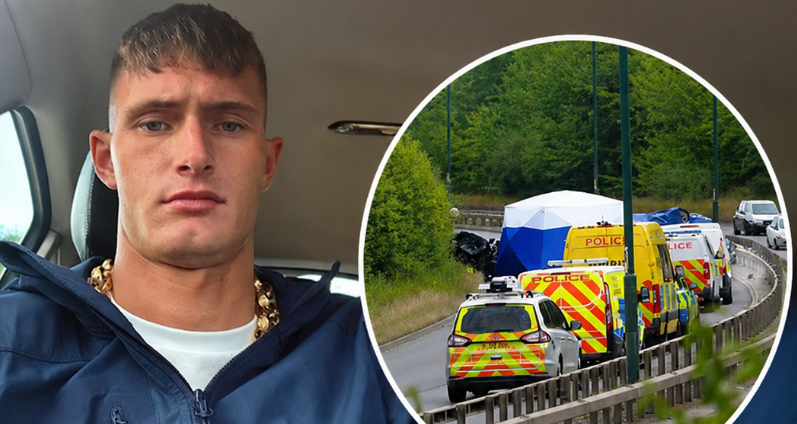
Approximately 10 seconds after the pursuit had ended, it collided with another police vehicle.
That marked vehicle was not involved in the pursuit.
PC Matthew Blades, 37, and PC Tom Clough, 38, were inside.
They had been sent to the area to assist officers searching for the Passat.
The collision occurred at approximately 3:39am.
All five people inside the Passat died.
So did both police officers.
The seven victims were later identified as Michael Robert Cahill, 23; Jakub Matusiak, 23; Theo Rae, 17; Makai Saddington, 18; Cole Robert Worthy, 17; PC Matthew Blades; and PC Tom Clough.
THE EVIDENCE THAT CHANGED THE TIMELINE
In the immediate aftermath, questions naturally focused on the police pursuit.
But investigators quickly began reconstructing the timeline using evidence including police vehicle footage, officer accounts and incident logs.
The IOPC confirmed that the pursuit was stopped when the Passat entered the A66 travelling in the wrong direction.
The officers pursuing it did not continue behind the vehicle.
Instead, they remained on the correct side of the road.
Around ten seconds later, the Passat struck the separate police vehicle.
That distinction has become one of the most important facts in the investigation.
It does not answer every question about the decisions made that night.
But it establishes a crucial sequence of events.
The fatal collision happened after the pursuit had been abandoned.
THEN ANOTHER CAR ENTERED THE STORY
Investigators have also been examining what happened before the Passat was pursued.
Police said they had received reports of two vehicles being driven dangerously in the Middlesbrough area.
One was believed to be a Volvo XC60.
That vehicle was reportedly seen ramming properties.
The second was the Passat.
Police said the two vehicles were believed to be associated with the same activity.
Both were believed to be operating with cloned registration plates, making them more difficult to identify.
The Volvo was subsequently traced and recovered in Middlesbrough.
This meant the fatal crash was not being investigated simply as an isolated road incident.
Police were examining a much wider chain of suspected criminal activity.
ORGANised CRIME LINKS EMERGE
Within days, the investigation expanded dramatically.
Cleveland Police said the events surrounding the crash had significant links to serious and organised criminal activity.
Multiple people were arrested.
Police investigated offences including suspected involvement in organised crime and firearm-related offences.
One man, Cameron George, 26, was charged with possession with intent to supply Class A and Class B drugs and possession of criminal property.
Further arrests followed.
By August 25, reports said five additional people had been arrested, bringing the number of arrests connected to the wider investigation to 17.
That development added another disturbing dimension to a tragedy that had initially been viewed primarily through the lens of a fatal police pursuit.
FOUR OF THE FIVE HAD PREVIOUS CONVICTIONS
Investigators also revealed that four of the five young men inside the Passat had previous criminal convictions.
That information intensified public debate around the crash and the circumstances leading up to it.
But it is important to distinguish between previous convictions and responsibility for the fatal collision itself.
The fact that someone has a criminal record does not, by itself, establish what they were doing at a particular moment.
Those circumstances remain part of the investigation.
A FAMILY HOME WAS ALSO RAMMED
Another disturbing detail emerged during the investigation.
A property belonging to the father of Cole Worthy, one of the teenagers who died, had reportedly been rammed shortly before the fatal crash.
The incident was linked to the earlier reports involving a Volvo XC60.
Worthy, 17, was later among the five people who died inside the Passat.
The connection between the property attack, the vehicles and the events that followed has been examined by investigators.
THE FAMILIES ARE LEFT WITH TWO VERY DIFFERENT QUESTIONS
For the families of the five young men, the grief is personal.
They lost sons, brothers and friends.
Tributes appeared around Middlesbrough, with balloons, flowers and messages left for the victims.
Some relatives and supporters have questioned the circumstances of the police response.
That debate is likely to continue.
But the police officers’ families are asking their own questions.
PC Matthew Blades was a devoted father of two.
His wife described him as her “beloved husband” and “best friend,” while his family remembered him as a devoted father.
PC Tom Clough’s family described him as their hero — a man who was always willing to help others.
Both officers had gone to work and never returned home.
THE INVESTIGATION IS NOT OVER
The IOPC has stressed that its investigation is independent.
Investigators have obtained initial accounts from officers involved in the pursuit, the incident log and in-car footage.
They are continuing to review additional evidence.
That means the final picture may still evolve.
The investigation must examine not only what happened in the final seconds, but also what led police to pursue the Passat, what officers knew at the time, what happened before the vehicle reached the A66 and whether any decisions made during the response require further scrutiny.
The IOPC has not suggested that the police officers who died were responsible for the crash.
In fact, its current account makes clear that Blades and Clough were not part of the original pursuit and were instead assisting in the search for the Passat.
SEVEN LIVES — AND A COMMUNITY DEMANDING ANSWERS
The A66 tragedy has become much larger than a single collision.
It has raised questions about dangerous driving, police pursuits, organised crime and the increasingly violent criminal environment surrounding parts of Middlesbrough.
It has also exposed the devastating consequences when a vehicle travels the wrong way onto a busy dual carriageway.
Seven people never made it home that morning.
Five families lost young men.
Two families lost police officers who were simply doing their jobs.
And now investigators must establish the full chain of events that led to those final ten seconds.
For the families, the most painful question may never disappear:
What could have been done differently?
But before that question can be answered, investigators have to establish exactly what happened — minute by minute, decision by decision, and ultimately, second by second.
Because the pursuit may have ended ten seconds before the crash. But the consequences of that night will last for years.