THE GENERAL PASSED THE GOLDEN SON AND STOPPED BEFORE THE FORGOTTEN DAUGHTER
PART 1 — THE NAME THE GENERAL DIDN’T CALL
For twenty years, Emily Carter had watched her brother Daniel receive nearly every proud smile their mother seemed capable of giving.
So when the family arrived at what everyone assumed was Daniel’s military ceremony, Emily already knew what role she was expected to play.
Sit quietly.
Stay out of the way.
And don’t make anything about herself.
Her mother leaned toward her before the ceremony began, still wearing a pleasant expression for the people around them.
“Please don’t embarrass us today.”
Emily said nothing.
She simply moved to the far end of the row.
A few seats away, her mother carefully adjusted Daniel’s sleeve, smoothing the fabric with the kind of attention she had always reserved for him.
As if he were the only soldier in the family worth being proud of.
Emily looked toward the stage.
Then the Major General stepped behind the podium.
The room gradually settled.
At first, the speech sounded like any other military recognition.
Years of service.
Deployments.
Leadership.
Sacrifice.
But then the details became more specific.
And much more serious.
The General described a service record involving multiple combat deployments.
A command structure that had collapsed under extreme pressure.
A mission where communications had failed.
And one decision, made in minutes, that brought forty-six American service members home alive.
The hall grew quieter with every sentence.
Emily’s mother leaned forward.
Then smiled proudly toward Daniel.
Of course she did.
She was completely convinced the General was describing her son.
Daniel, however, wasn’t smiling.
He sat rigidly in his chair.
His hands were locked together.
And for the first time that morning, Emily noticed how pale he looked.
The General continued.
He spoke about judgment under pressure.
About command responsibility.
About an officer who had been forced to act without complete information and had made the decision that prevented an entire operation from becoming a disaster.
Emily’s mother glanced around proudly, clearly waiting for the moment Daniel’s name would be announced.
Then the General finished reading.
He stepped away from the podium.
And began walking toward the front row.
Emily’s mother straightened immediately.
Daniel looked down.
The General approached them.
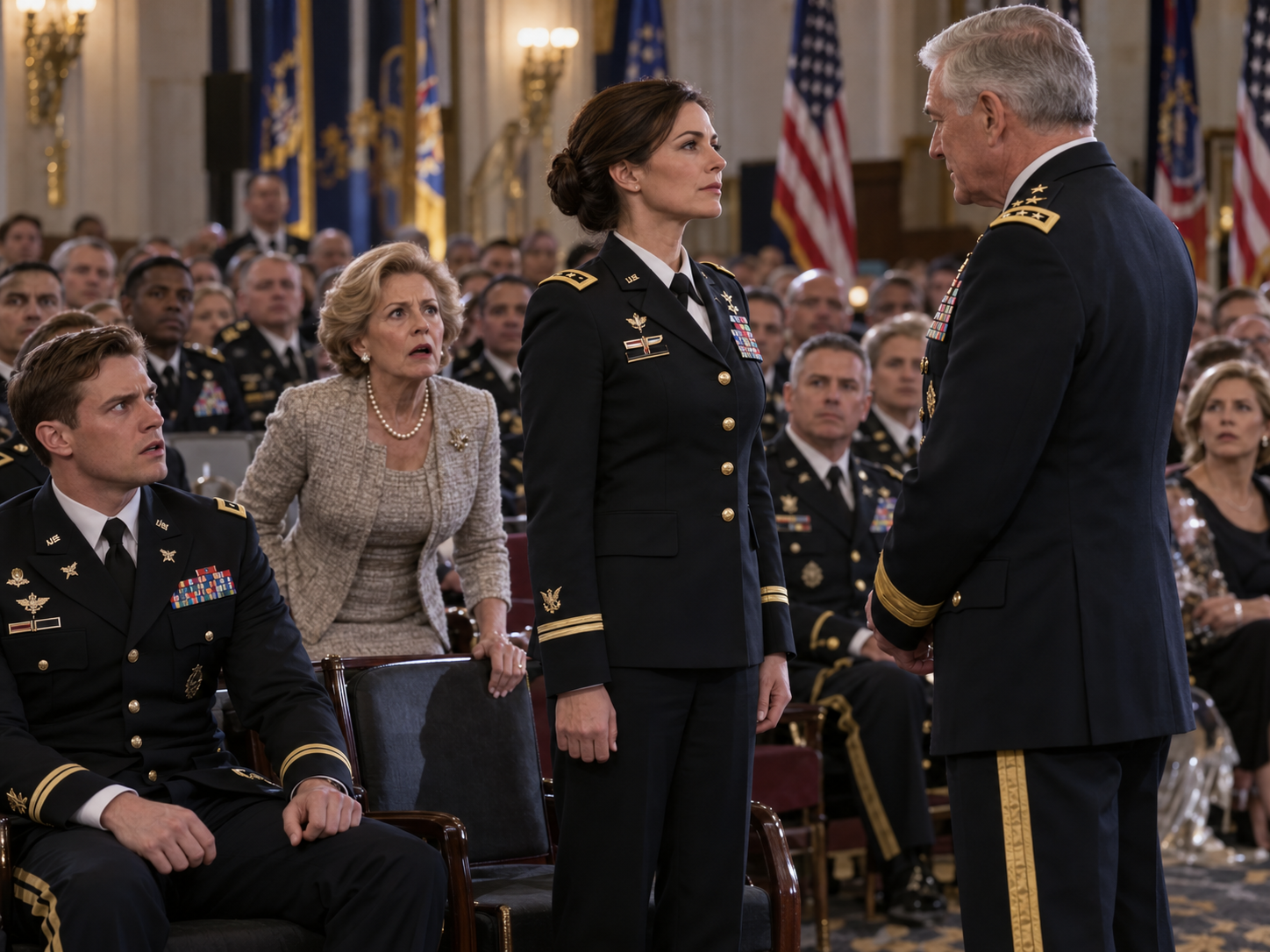
Then walked directly past Daniel.
He didn’t stop.
He didn’t even slow down.
A strange silence spread through the hall.
Emily’s mother’s smile disappeared.
The General took two more steps.
Then stopped directly in front of Emily.
She rose.
General Hale looked at her.
His voice was low, but everyone close enough could hear him.
“Colonel Carter.”
Emily’s mother half-stood from her seat.
Confusion crossed her face.
“Wait…”
She looked from the General to Emily.
“What did you say?”
Emily remained still.
But Daniel’s reaction was completely different.
The color drained from his face.
And it wasn’t because he was surprised.
He looked like a man who had known this day might eventually come.
And had been afraid of it for years.
General Hale turned slightly so the room could hear him.
Then he began explaining the truth behind Operation Glass Lantern.
A mission Emily had never been permitted to discuss with anyone outside authorized channels.
He described the chaos.
The collapsing command structure.
The convoy placed in danger.
The impossible choice.
Then he explained what Emily had done.
Her decision.
Her command.
Her responsibility.
And the forty-six American service members who came home because of it.
Emily’s mother stared at her.
The pride she had been saving for Daniel was gone.
In its place was confusion.
Then disbelief.
Then something closer to fear.
She slowly turned toward her son.
“Daniel…”
He wouldn’t look at her.
Her voice became sharper.
“What convoy are they talking about?”
Daniel swallowed.
“Mom…”
He stared at the floor.
“Please. Not here.”
That answer changed everything.
Because now she understood one thing.
Daniel knew.
Maybe he had always known.
Emily turned toward her brother.
For several seconds, she said nothing.
Then, calmly:
“Tell her the truth.”
Daniel finally looked up.
His face crumpled.
And that was the moment he broke.
“I knew.”
His voice was barely louder than a whisper.
Their mother stared at him.
Daniel drew a breath that shook on the way in.
“I knew it was Emily.”
Silence.
Not the ceremonial silence from moments earlier.
This was different.
This was the kind of silence that arrived when a family story that had survived for decades finally split down the middle.
Their mother shook her head.
“No.”
Daniel closed his eyes.
“Mom—”
“No. You told us you were involved in Glass Lantern.”
“I was.”
“You told us your team was decorated after it.”
“It was.”
“You told your father that you were the senior Carter attached to that operation.”
Daniel’s jaw tightened.
Emily’s eyes moved slowly toward him.
That last detail was new.
Daniel seemed to feel it.
He looked at his sister.
“I never said I commanded it.”
“You let them believe you did,” Emily said.
He flinched.
“I know.”
General Hale stood beside Emily without interrupting.
Around them, dozens of officers and families remained frozen.
Daniel looked as if he wanted the floor to open beneath him.
Their mother’s voice trembled.
“For years, every time we asked Emily what she was doing, she said she couldn’t tell us. You said she had some administrative assignment.”
Daniel nodded weakly.
“I know.”
“You told us she exaggerated her importance.”
“I know.”
“You said…”
Her voice cracked.
“You said she wasn’t even in the room when decisions were made.”
Daniel looked at Emily again.
This time, there was no defense left in his face.
Only shame.
“She was the room.”
The words struck harder than a shout.
Their mother sat down.
Emily didn’t.
Daniel wiped one hand across his mouth.
“When Glass Lantern happened, I was a captain attached to logistics coordination. Emily was already working at a level most of us didn’t understand. Her orders were compartmentalized. Her name wasn’t in the documents I could discuss.”
“That doesn’t explain why you lied,” Emily said.
Daniel stared at her.
“I didn’t start with a lie.”
Emily waited.
He gave a hollow laugh.
“Maybe that’s the worst part.”
He looked toward their mother.
“Dad asked if I knew anything about the operation. I said I’d been attached to it. He slapped me on the shoulder and told everyone at dinner that his son had saved lives overseas.”
Daniel’s eyes lowered.
“I should’ve corrected him.”
“But you didn’t,” Emily said.
“No.”
“Why?”
His answer came quietly.
“Because for once, I liked the way he looked at me.”
Something in Emily hardened.
Their father had been dead four years, but even now, the gravity of his approval still seemed to pull everyone around it.
Daniel continued.
“Then Mom repeated it. Relatives repeated it. People at the veterans’ association repeated it. And every time I could have corrected them…”
He stopped.
Emily finished for him.
“You chose not to.”
“Yes.”
Their mother looked horrified.
“But Emily never said anything.”
Emily turned to her.
“I couldn’t.”
“You could have told us Daniel was lying.”
“No. I couldn’t.”
“Why not?”
“Because saying what he wasn’t allowed to claim would have told you what I was doing.”
Their mother looked toward General Hale.
He gave a small, grave nod.
“Colonel Carter remained under disclosure restrictions for years after Glass Lantern.”
Emily’s mother looked back at her daughter.
The room seemed to disappear from her expression.
All that remained was a woman confronting twenty years of certainty.
“But later?” she asked. “After the restrictions changed?”
Emily’s answer was simple.
“You never asked.”
Her mother’s lips parted.
Emily continued.
“You asked Daniel about promotions. You asked Daniel about deployments. You asked Daniel what medals meant. You saved newspaper clippings about him. You made Dad’s retirement wall into a shrine to Daniel’s career.”
“Emily…”
“You asked me if I still worked ‘behind a desk.’”
Her mother looked down.
Emily remembered the Christmas dinners.
The family photographs in which Daniel’s uniform was centered.
The barbecue where her father introduced him to neighbors as “the one who made something of the Carter name.”
The birthday when Emily had returned from an assignment exhausted and ten pounds lighter, only to hear her mother say, “You should really find something stable like Daniel did.”
At the time, Emily had simply smiled.
Professional secrecy had trained her to live without recognition.
But secrecy and invisibility were not the same thing.
And her family had chosen the second long before the military required the first.
General Hale looked toward the stage.
“Colonel?”
Emily followed his gaze.
The ceremony wasn’t finished.
A citation still waited on a velvet-covered table.
So did a framed insignia and a folded document.
General Hale lowered his voice.
“You earned this long before anyone could say it publicly.”
Emily glanced at Daniel.
He was crying now, silently, without attempting to hide it.
For years she had imagined what she might feel if the truth ever came out.
Vindication.
Relief.
Maybe even triumph.
Instead, she felt tired.
General Hale extended his hand.
“Colonel Carter?”
Emily stepped away from her family and followed him toward the stage.
The hall rose.
Not all at once.
The first people standing were older officers who understood exactly what the citation meant.
Then younger soldiers followed.
Then families.
Soon the entire hall was on its feet.
Emily walked beneath the sound of applause she had never expected to hear.
But halfway toward the stage, she noticed something.
General Hale was carrying two folders.
The first held her commendation.
The second was gray, sealed with a red stripe.
Restricted review.
Emily’s pulse changed.
She recognized the classification format.
Hale noticed her looking.
His expression tightened.
“There’s another reason I asked you here.”
The applause continued around them.
“What reason?”
He waited until they reached the steps.
Then he spoke quietly enough that only Emily could hear.
“Glass Lantern has been reopened.”
Emily stopped.
Hale’s face had lost every trace of ceremony.
“One of the after-action records was altered.”
Emily felt the floor shift beneath her.
“That’s impossible.”
“We thought so too.”
“By whom?”
Hale glanced back toward Daniel.
“That,” he said, “is what we need you to help us determine.”
Emily looked at her brother.
Daniel was no longer staring at the floor.
He was staring at the gray folder.
And the expression on his face wasn’t merely shame anymore.
It was fear.
Deep, unmistakable fear.
Emily understood immediately.
Daniel knew something else.
Something he hadn’t confessed.
Not yet.
And suddenly the ceremony honoring the greatest decision of her career became something entirely different.
It became the first step toward discovering what had really happened after Operation Glass Lantern.
And why someone had spent nearly fifteen years making sure Colonel Emily Carter never received credit for it.
PART 2 — THE REPORT THAT SHOULDN’T EXIST
Two hours later, Emily sat in a secured conference room three floors below the ceremonial hall.
The applause was gone.
The flowers were gone.
Her mother was gone too.
General Hale had arranged for a driver to take her back to the hotel.
Daniel remained.
He sat across from Emily beneath fluorescent lights that made everyone look more tired than they were.
Between them lay the gray folder.
General Hale closed the door.
Another officer stood beside him, a silver-haired woman wearing civilian clothes.
“This is Dr. Rebecca Shaw,” Hale said. “Inspector General’s investigative division.”
Emily nodded once.
Shaw returned it.
“Colonel Carter.”
“Doctor.”
Hale opened the folder.
Inside was a copy of the original after-action report from Glass Lantern.
Emily recognized the first page instantly.
She had spent forty-seven hours contributing to that report after the operation.
Names.
Timelines.
Radio failures.
Vehicle locations.
Casualty projections.
Command decisions.
Everything had been examined.
Everything had been questioned.
That was how the military learned from disasters narrowly avoided.
Hale slid a second report beside it.
Emily looked at the two documents.
At first, they appeared identical.
Then she saw the signature page.
Her name was missing from one.
Not redacted.
Missing.
In its place was a line assigning tactical decision authority to Major Jonathan Reeves, the operations officer who had been unconscious for most of the critical window.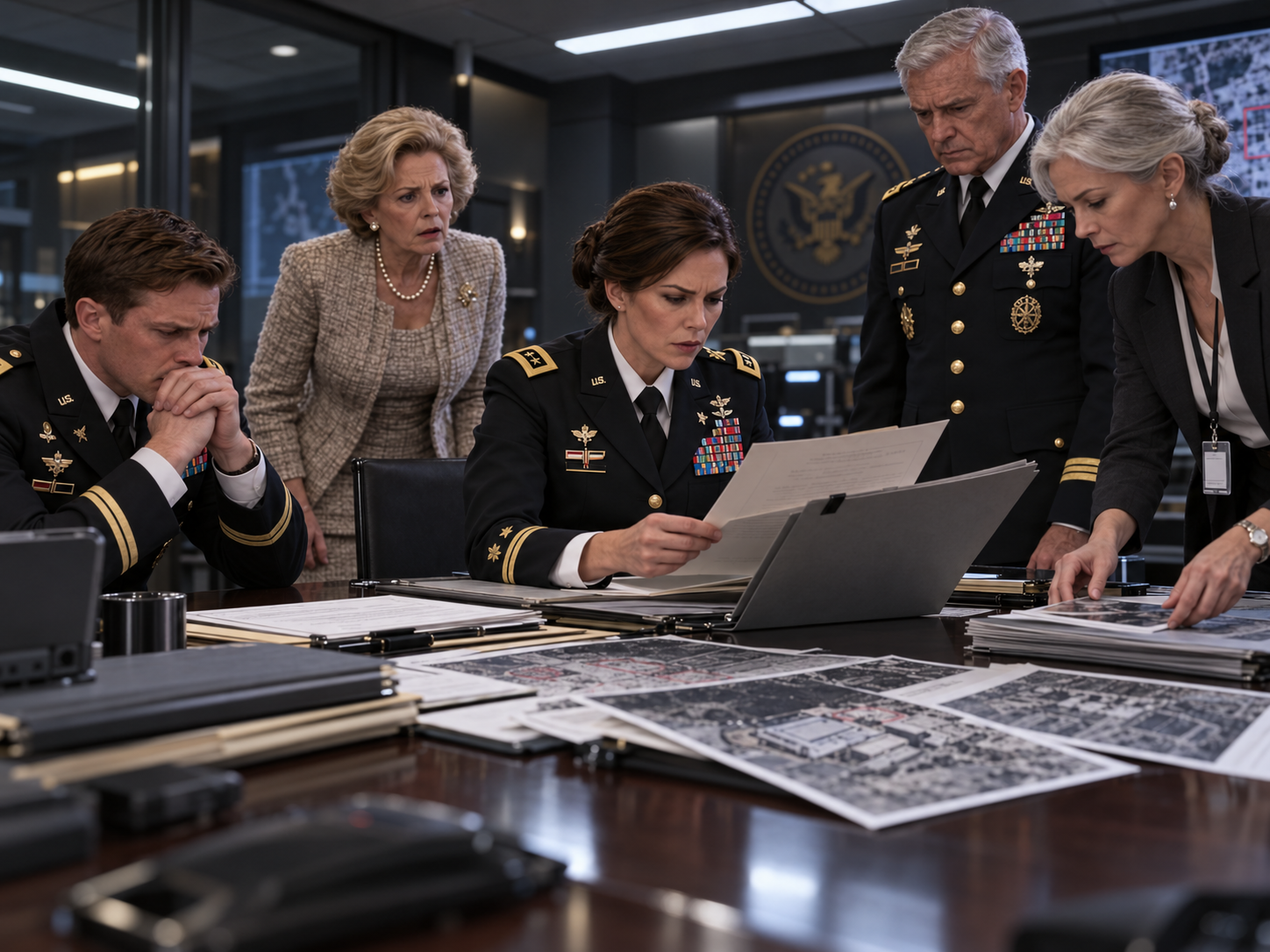
Emily’s eyes narrowed.
“That wasn’t in the original.”
“No,” Shaw said.
“Where did this version come from?”
“An archived personnel review.”
“Whose?”
Shaw looked toward Daniel.
Emily followed her gaze.
Daniel exhaled.
“Mine.”
Emily didn’t move.
Daniel rubbed both palms over his knees.
“When I was considered for battalion command six years ago, that version appeared in my packet.”
Emily stared at him.
“And you never reported it?”
“I didn’t understand what I was looking at.”
“You knew enough to recognize the operation.”
“Yes.”
“You knew enough to know I had been there.”
“Yes.”
“And you said nothing.”
Daniel’s voice rose.
“I didn’t know someone had erased you!”
Emily leaned toward him.
“You told Mom I wasn’t even in the room.”
His face tightened.
“That was years earlier.”
“So?”
“I was trying to protect myself.”
Emily almost laughed.
“From what?”
“From being compared to you.”
The answer stopped her.
Daniel looked at the table.
“You think being the favorite meant I never knew you were better at this.”
Emily’s expression hardened.
“This isn’t about who was better.”
“It was in our house.”
He looked up.
“For Dad, everything was a ranking. Grades. Running times. Promotions. Who called home more. Who looked sharper in uniform. Who impressed his friends.”
Emily remembered.
Daniel continued.
“You learned early not to compete for his approval.”
“No. I learned I couldn’t win it.”
Daniel nodded slowly.
“Exactly.”
He swallowed.
“But I kept trying.”
The silence lasted several seconds.
Then Shaw tapped the altered report.
“Family history is relevant only if it intersects with the document trail. Right now, we need facts.”
Emily turned back to her.
Shaw continued.
“The altered version first appeared eleven years ago.”
Emily frowned.
“That was four years after the operation.”
“Yes.”
“Who accessed the archive?”
“That’s where this becomes interesting.”
Shaw slid another sheet across the table.
A list of access credentials.
Emily scanned it.
Her own name.
Reeves.
Two records officers.
And—
She stopped.
Daniel Carter.
Her eyes lifted.
Daniel looked sick.
“I didn’t access it.”
“Your credentials did.”
“I was stationed in Germany on that date.”
Shaw nodded.
“We confirmed it.”
Emily examined the timestamp.
02:13 Eastern.
Two minutes later, Daniel’s credential accessed the Glass Lantern personnel annex.
At 02:19, a second credential opened Emily’s file.
At 02:27, the record was altered.
“Whose second credential?” Emily asked.
Shaw didn’t answer immediately.
Instead, she slid another page forward.
Emily read the name.
Colonel William Carter.
Their father.
For a second, she forgot how to breathe.
“That’s not possible.”
Hale’s voice was quiet.
“At the time, your father still had reserve access through his consulting position.”
Emily stared at the paper.
Her father had worked for a defense contractor after retirement.
She remembered him complaining constantly about security training and password changes.
But he had never mentioned access to historical operational records.
Daniel whispered, “Oh God.”
Emily looked at him.
“You knew?”
“No.”
His voice cracked.
“I swear to you, Emily. I didn’t know Dad was involved.”
She studied his face.
For once, she believed him immediately.
The horror was too raw.
Shaw folded her hands.
“We don’t yet know whether Colonel William Carter personally altered anything. Credentials can be copied. Sessions can be spoofed. But his access was active during the exact window when the unauthorized version was created.”
“What was the purpose?” Emily asked.
“That’s what we want to establish.”
Hale looked at her.
“Your career wasn’t damaged.”
“Not officially.”
“No. You continued advancing. Your classified evaluations remained intact.”
Emily understood.
“So someone wasn’t trying to stop my promotions.”
“Correct.”
“Then they were trying to change who got public credit.”
Shaw nodded.
“And who appeared responsible on records accessible outside your compartmented chain.”
Daniel lowered his head.
Emily looked at him.
It fit too well.
Her father’s obsession with legacy.
The endless pride in his son.
The disappointment that his daughter had disappeared into classified work he couldn’t brag about.
Could William Carter really have altered military records simply to make the family story match the one he preferred?
Emily wanted to reject the thought.
But memory kept supplying evidence.
Once, at a Christmas dinner, her father had raised a glass toward Daniel.
“A Carter man has been leading troops since Korea.”
Emily had been a lieutenant colonel at the time.
She had commanded more people than Daniel.
Her father knew that.
But he had said it anyway.
Dr. Shaw opened another envelope.
“There’s more.”
Inside was a photocopy of a handwritten note.
Emily recognized the blocky handwriting immediately.
Her father’s.
W.C. — Reeves wants this buried. Daniel’s name protects the family. E cannot be attached publicly. She’ll understand eventually.
Emily read it twice.
Then a third time.
Daniel stood abruptly.
“No.”
Hale watched him.
Daniel pointed at the note.
“No. He wouldn’t—”
Emily looked at him.
“He might.”
Daniel shook his head.
“No, you don’t understand. Dad was hard. He was obsessed with the family name. But altering records? Using me?”
His voice failed.
Emily said nothing.
Because she did understand.
Perhaps better than Daniel.
Their father had loved his children.
She had never doubted that.
But he had also loved the idea of what the Carter family should look like.
Daniel fit that picture.
Emily never had.
She remembered being seventeen and telling her father she wanted military intelligence rather than following his preferred command track.
He had stared at her over the dinner table.
“People respect what they can see.”
Emily had answered, “Then maybe I don’t need them to see it.”
He had smiled without warmth.
“You’ll change your mind when no one remembers you were there.”
Years later, his prediction had become something close to deliberate design.
Emily placed the note down.
“Who is Reeves?”
Hale and Shaw exchanged a look.
Emily noticed.
“What?”
Shaw spoke.
“Jonathan Reeves retired as a brigadier general three years ago.”
“I know that.”
“He was recently nominated to chair a defense advisory commission.”
Emily understood.
“And Glass Lantern could complicate that.”
“Potentially.”
“Why?”
Shaw took out another document.
This one contained a casualty projection.
Emily remembered the figures.
If Reeves’s original order had been followed, the convoy would have continued north through a corridor already compromised.
Estimated losses: thirty to fifty-two.
Her order had rerouted them west.
Forty-six had returned.
Three suffered injuries.
No fatalities.
Emily looked at Hale.
“Reeves issued the north-route order before he went down.”
“Yes.”
“He ignored the intelligence warning.”
“Yes.”
“So if the complete report becomes public—”
“It shows that the celebrated version of Glass Lantern is incomplete,” Hale said. “And that Colonel Carter’s decision was not simply heroic. It directly countermanded Reeves.”
Daniel whispered, “Dad protected him.”
Emily turned toward him.
“No.”
Daniel pointed toward the handwritten note.
“‘Reeves wants this buried.’ Dad protected him.”
Emily looked again.
Then something bothered her.
“Why?”
Nobody answered.
She leaned back.
“My father worshiped institutional reputation, but he wouldn’t risk prison to protect Reeves unless he got something in return.”
Daniel stared at her.
Emily continued.
“He also wouldn’t use your name just because you were his favorite.”
Daniel looked wounded.
She didn’t soften it.
“Dad was many things. Reckless wasn’t one of them.”
Shaw’s expression changed almost imperceptibly.
Emily caught it.
“You already found something.”
Shaw slowly opened the final section of the folder.
A financial disclosure.
Consulting payments.
Three months after the altered report appeared, William Carter’s consulting firm received a large subcontract from a corporation whose executive vice president was—
Jonathan Reeves’s brother-in-law.
Daniel sank back into his chair.
Emily felt cold.
“How much?”
“Eight hundred and forty thousand dollars over four years.”
Daniel stared at the table.
“Our house…”
Emily turned to him.
“What?”
“The lake house.”
He looked sick.
“Dad said he bought it with retirement investments.”
Emily remembered that house.
Their parents had hosted family gatherings there for a decade.
The wall in the den contained framed photographs of Daniel in uniform.
Emily appeared only twice.
One graduation.
One wedding she had attended alone.
Daniel pressed both hands to his face.
“We all stayed there. Mom still owns it.”
Emily looked at Shaw.
“Does she know?”
“We have no evidence that your mother knew anything about the contract or record alteration.”
Emily stood.
The room had become too small.
Hale said her name.
She ignored him and walked toward the wall.
For years, she had made peace with being overlooked.
That was different from discovering her father might have intentionally built her brother’s glory on top of something she had done.
And worse—
Daniel had helped maintain the lie.
Not the records.
But the family story.
The birthdays.
The speeches.
The comments.
Every time their mother had diminished Emily and elevated him, he had remained silent.
He had known enough to know the praise was misplaced.
He had accepted it anyway.
Emily turned.
“How long did you know I commanded the reroute?”
Daniel stared at her.
“Since the night it happened.”
The answer hurt more than she expected.
“How?”
“I was monitoring support channels.”
“You heard my call sign.”
“Yes.”
“You heard the reroute order.”
“Yes.”
“You knew forty-six people got out because of it.”
His eyes filled.
“Yes.”
“And then you came home and let Dad tell everyone it was you.”
Daniel’s voice broke.
“I was a coward.”
Emily walked to the table and picked up her coat.
Daniel stood.
“Emily, please.”
She faced him.
“What would you like me to say?”
“That I’m sorry.”
“You are sorry.”
She nodded.
“I believe that.”
Hope flickered in his face.
Then she continued.
“But sorry is not the same as repaired.”
His expression collapsed.
Emily turned to General Hale.
“What happens now?”
“We interview Reeves.”
“And the records?”
“If the investigation confirms tampering, the official archive will be corrected.”
Emily glanced toward Daniel.
“What about his record?”
Hale understood the question.
“Nothing currently indicates Major Carter committed official misconduct connected to the altered document.”
Daniel flinched at the formal phrasing.
Emily headed for the door.
Then Shaw spoke.
“Colonel Carter.”
Emily stopped.
“There’s one additional item.”
She turned.
Shaw held out a small sealed evidence sleeve.
Inside was an old flash drive.
“Recovered from your father’s locked desk after his death. Your mother turned the contents over this morning.”
Emily frowned.
“This morning?”
“She called General Hale immediately after leaving the ceremony.”
Emily stared.
Shaw continued.
“She said there was something in your father’s office she had never understood. After hearing Glass Lantern mentioned today, she realized the same name appeared on a label.”
The flash drive contained three handwritten words.
GLASS LANTERN — TRUTH.
Emily felt something shift inside her.
Maybe her father had hidden the truth.
Maybe he had also preserved it.
Those two possibilities were not mutually exclusive.
“What’s on it?”
Shaw shook her head.
“Encrypted.”
“Can you open it?”
“We’re trying.”
Emily looked at Daniel.
He looked back at her.
For the first time in years, neither of them had a role assigned by their parents.
No golden son.
No forgotten daughter.
Only two children standing in the wreckage of their father’s choices.
Then Shaw added one final detail.
“The encryption question is personal.”
Emily frowned.
“What question?”
Shaw slid a photograph across the table.
On the screen of the recovered laptop were the words:
WHAT DID EMILY SAY THE NIGHT SHE LEFT HOME?
Daniel stared at it.
Then slowly looked up.
“I know the answer.”
Emily went still.
“You weren’t there.”
Daniel swallowed.
“No.”
He looked terrified.
“But Dad told me.”
And suddenly Emily understood that the secrets of Operation Glass Lantern had begun long before the operation itself.
They had begun the night she left the Carter house at eighteen.
The night her father told her she would never become anything anyone remembered.
And apparently, there was one sentence from that night he had carried with him until the day he died.
PART 3 — WHAT THEIR FATHER LEFT BEHIND
The answer was six words.
Emily remembered them because she had spent half her life pretending they no longer mattered.
Daniel said them quietly.
“I’d rather matter than be remembered.”
Emily closed her eyes.
For an instant, she was eighteen again.
Standing in her parents’ kitchen.
Her duffel bag near the door.
Her father furious because she had declined the military academy track he wanted and accepted a university program tied to intelligence analysis instead.
He had accused her of wasting the Carter name.
She had told him she wasn’t joining the military to decorate the family wall.
He had answered:
“If nobody sees what you do, nobody will remember you did it.”
And Emily, shaking with anger, had said:
“I’d rather matter than be remembered.”
Then she left.
She had not slept in that house again for nearly two years.
Daniel couldn’t have heard the argument.
He had been away at school.
So their father had remembered the sentence.
And repeated it.
Shaw entered the words.
The drive unlocked.
No one spoke.
Folders appeared across the screen.
Contracts.
Emails.
Scanned notes.
Audio files.
Then one directory:
FOR EMILY.
Daniel stepped backward.
Emily stared at the screen.
“I need a minute.”
General Hale nodded.
Shaw and Daniel left the room.
Hale remained near the door.
Emily looked at him.
“You too.”
He hesitated.
Then left.
Emily opened the folder.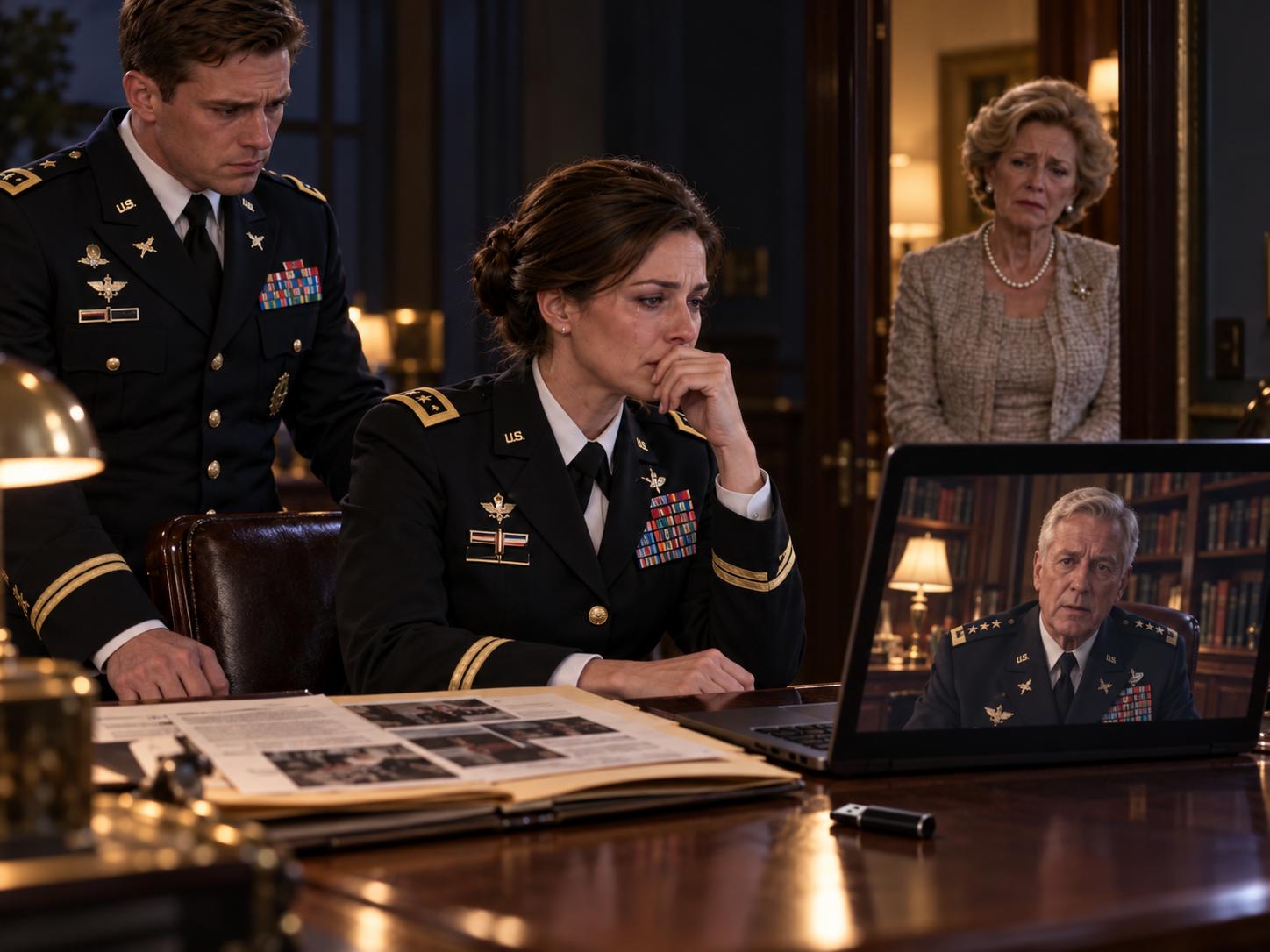
There was one video file.
Recorded eighteen months before her father died.
William Carter appeared on screen.
He looked older than she remembered him.
Smaller somehow.
The commanding presence that had filled every room during her childhood was gone.
He sat behind the desk Emily remembered from the lake house.
For several seconds, he said nothing.
Then:
“Emily, if you are watching this, then either I found the courage to give it to you, or I didn’t.”
Emily’s throat tightened.
Her father looked down.
“I suspect the second is more likely.”
She almost turned it off.
Then he continued.
“I did something years ago that I told myself was protection.”
Emily froze.
“Glass Lantern.”
Her father exhaled.
“Jonathan Reeves called me three days after the operation. He knew I had consulting access. He also knew my daughter had overridden his order.”
Emily’s hands curled into fists.
“He said your career would be destroyed if the report remained as written. He claimed you had exceeded authority, embarrassed command, and exposed the Army to political consequences.”
Her father gave a bitter smile.
“I believed him because part of me wanted to.”
Emily stared.
“Your success had become something I didn’t know how to understand. Daniel’s career made sense to me. Yours didn’t. He wore his accomplishments where I could see them. You disappeared for months and returned unable to talk about where you had been.”
He looked directly into the camera.
“I confused visibility with worth.”
Emily’s eyes burned.
Her father continued.
“Reeves told me he could ensure the event never harmed you. All he needed was for certain administrative copies to reflect a cleaner chain of command.”
Emily whispered, “You idiot.”
The man on the screen almost seemed to hear her.
“I agreed.”
No excuse.
No softening.
Just those two words.
“I used access I should not have used. I entered Daniel’s credentials because I believed his presence on the operation provided plausible administrative justification. I altered a secondary record. Reeves arranged the rest.”
Emily’s stomach turned.
Her father looked ashamed.
“Months later I learned the truth. You were never under investigation. Reeves was.”
Emily sat perfectly still.
“He had ignored intelligence. You had saved the convoy by countermanding him. He did not protect you. He protected himself.”
Emily wiped one tear angrily from her cheek.
“I confronted him. He reminded me that exposing the alteration would implicate me, damage Daniel, and possibly pull you into years of review.”
Her father paused.
“I chose cowardice again.”
Emily understood then.
The contract payments.
The consulting work.
Reeves hadn’t merely bribed William.
He had trapped him.
The money created a second reason for silence.
“I accepted his company’s work,” William said. “At first because I told myself refusing it would attract suspicion. Later because the money was useful. Eventually because I had become the kind of man who could build reasons faster than he could admit shame.”
Emily looked away.
That sounded exactly like her father.
Painfully so.
Then he said something she did not expect.
“Daniel does not know what I did.”
Emily looked back.
“He knows more about your role in Glass Lantern than he ever admitted to us. I know that now. But the records were my doing. Not his.”
Her father leaned forward.
“I also know what I did to you outside the military.”
Emily stopped breathing.
“I made Daniel the measure of success because he reflected choices I understood. When you chose differently, I treated your independence as rejection.”
He swallowed.
“I punished you for refusing to become the daughter I had designed.”
The room blurred.
Emily thought of her mother saying, Don’t embarrass us today.
She thought of every dinner spent at the far end of the table.
Every photograph.
Every question about Daniel followed by a polite, empty question about her.
Her father continued.
“You once told me you would rather matter than be remembered.”
He smiled faintly.
“You were right.”
Emily covered her mouth.
“I remembered Daniel because he stood where I expected to see him. You mattered in places I was never important enough to enter.”
For the first time since she was eighteen, Emily cried for her father.
Not because the apology erased anything.
It didn’t.
Not because death made him better.
It didn’t.
She cried because the man she had spent years trying not to need had finally understood her.
Too late.
But truly.
The video continued.
“There is evidence elsewhere on this drive proving Reeves directed the alteration. I kept it because I was afraid. I am leaving it because perhaps fear should not be the last thing I give my daughter.”
Emily breathed slowly.
“I am sorry.”
William Carter looked directly into the camera.
“I do not ask you to forgive me.”
That mattered.
More than Emily wanted it to.
“I only ask that you never mistake my failure to recognize you for evidence that there was anything in you that required recognition from me.”
The screen went black.
Emily remained alone for several minutes.
Then the door opened slowly.
Her mother stood there.
Emily wiped her face.
“I thought you went back to the hotel.”
“I did.”
Her mother looked exhausted.
Then she lifted her phone.
“General Hale called.”
Emily said nothing.
Her mother stepped inside.
“Was there a video?”
Emily looked at her.
“Yes.”
Her mother sat opposite her.
For once, she didn’t ask what William had said.
She waited.
Emily studied her mother.
Margaret Carter had always been easier to understand than William.
She followed the strongest certainty in the room.
When William praised Daniel, she praised Daniel.
When William dismissed Emily’s secretive assignments as “staff work,” Margaret accepted the explanation.
She had rarely been cruel deliberately.
But indifference did not need cruelty to leave damage.
“Did you know about the money?” Emily asked.
“No.”
“The files?”
“No.”
“Did you know Dad understood what I did?”
Margaret looked down.
“Not like this.”
Emily waited.
Her mother’s hands trembled.
“After he got sick, he sometimes tried to talk about you.”
Emily almost laughed.
“He had my number.”
“I know.”
“Then why didn’t he call?”
“Because he was ashamed.”
Emily’s voice hardened.
“That was his problem.”
“Yes.”
The immediate agreement surprised her.
Margaret looked up.
“Yes, Emily. It was.”
For years, her mother had defended William instinctively.
Not now.
“I spent most of our marriage believing your father’s certainty was the same thing as being right.”
Emily said nothing.
Margaret’s voice shook.
“When Daniel joined the military, your father understood every step. He understood infantry schools. Commands. Promotions. Every photograph had a story he could repeat to other people.”
“And me?”
“You frightened him.”
Emily blinked.
Margaret continued.
“You never needed his map.”
“That offended him.”
“Yes.”
“And you chose his side.”
Her mother closed her eyes.
“Yes.”
There was no defense.
No request for sympathy.
That made it harder to stay angry in the simple way Emily wanted.
Margaret looked toward the blank monitor.
“This morning, when the General walked past Daniel…”
She stopped.
“I realized I had been watching the wrong child for half my life.”
Emily’s jaw tightened.
“I wasn’t asking you to watch me.”
“I know.”
“I didn’t need applause.”
“I know.”
“I needed you not to make me feel like I had failed because you didn’t understand my life.”
Margaret cried then.
Quietly.
“I know.”
Emily looked toward the wall.
After a moment her mother whispered:
“I’m sorry.”
Emily did not say it was okay.
It wasn’t.
Instead:
“I hear you.”
Margaret nodded.
“That’s more than I deserve today.”
The door opened again.
Daniel stood outside.
His eyes were swollen.
He looked at their mother, then Emily.
“I can come back.”
Emily surprised herself.
“No.”
Daniel entered.
For the first time in decades, all three of them sat together without their father’s expectations defining the shape of the room.
Emily told them what the video contained.
Daniel listened until she reached the line clearing him of the record alteration.
Then he stood abruptly and walked away from the table.
His shoulders shook.
Margaret started to rise.
Emily stopped her with one look.
Daniel needed to feel it.
Not be rescued from it.
After a minute, he turned.
“I’m relieved Dad said I didn’t alter the files.”
Emily waited.
“But I hate that I’m relieved.”
“That’s because you still did something wrong.”
He nodded.
“I know.”
“You let people believe something about you that wasn’t true.”
“Yes.”
“For years.”
“Yes.”
Daniel looked at their mother.
“I let you be proud of me for something Emily did.”
Margaret whispered, “Why?”
Daniel laughed bitterly.
“Because I was weak.”
Then he looked at Emily.
“And because I was jealous.”
She frowned.
He continued.
“Everyone thinks I had everything.”
“You did.”
“At home.”
“Yes.”
“Not everywhere.”
Emily studied him.
Daniel sat again.
“When we were deployed, people who knew enough about you talked about Colonel Carter like you were…”
He searched for the word.
“Untouchable.”
Emily almost smiled.
“That’s exaggerated.”
“Maybe.”
He shook his head.
“But I heard your name. Senior officers trusted you. People stopped arguing when you entered briefings. I knew Dad thought I was the successful one, but outside our house, I knew the truth.”
“There was no competition.”
“I made it one.”
Daniel looked at her.
“I thought if Mom and Dad ever really understood who you were, there wouldn’t be anything left that belonged to me.”
Emily stared at him.
“So you let them keep thinking I was nothing.”
He winced.
“Yes.”
“That is extraordinarily selfish.”
“Yes.”
“You hurt me.”
“I know.”
“Stop saying you know.”
He fell silent.
Emily leaned forward.
“You don’t get to stand there, confess, cry, and turn remorse into another way for everyone to comfort you.”
Daniel nodded slowly.
“What do I do?”
Emily’s answer came immediately.
“Tell the truth when it costs you something.”
He absorbed that.
Then the door opened.
Dr. Shaw entered, carrying printed pages.
Her expression told Emily the personal reckoning was over.
The professional one had just escalated.
“We decrypted the emails.”
Emily stood.
Shaw placed three messages on the table.
The first was from Reeves to William Carter.
Clean the secondary report. Remove E. Keep J.R. as decision authority. Your son’s support assignment gives us cover.
The second:
If this surfaces, Daniel’s career becomes collateral. Think carefully.
And the third, dated six months later:
The subcontract will solve your financial problem. Consider the matter closed.
Margaret covered her mouth.
Daniel whispered, “He blackmailed Dad.”
Shaw nodded.
“And paid him.”
Emily read the messages twice.
“What happens to Reeves?”
“We’re notifying federal investigators.”
“Good.”
Shaw hesitated.
“There’s another issue.”
Emily looked up.
“Reeves has been informed that his commission appointment is on hold.”
“And?”
“He released a statement thirty minutes ago.”
Shaw handed Emily a tablet.
The headline contained Emily’s name.
RETIRED GENERAL DISPUTES “REVISIONIST” ACCOUNT OF CLASSIFIED OPERATION.
Emily read.
Reeves claimed that recent efforts to portray a subordinate officer as the “sole hero” of Glass Lantern were politically motivated.
He questioned Emily’s judgment.
He implied records had been manipulated after William Carter’s death.
And near the end, he wrote:
Major Daniel Carter’s distinguished service has unfortunately been caught in an internal family dispute.
Daniel’s face darkened.
“He’s using me.”
Emily looked at him.
“Yes.”
Shaw said, “There will be press outside within the hour.”
Margaret looked terrified.
“What do we do?”
Emily folded the statement.
For most of her career, she had survived by remaining silent.
Operational security demanded it.
Professionalism rewarded it.
Her family had mistaken that silence for emptiness.
Reeves was now counting on the same thing.
Emily turned toward Daniel.
“Earlier, you asked what you could do.”
He nodded.
She handed him the statement.
“Now we find out.”
PART 4 — THE GOLDEN SON GIVES IT BACK
By sunset, cameras lined the entrance to the installation.
No classified details could be discussed.
No operational maps could be released.
No sensitive names could be exposed.
Reeves knew that.
He was betting on the restrictions.
Emily could correct him only within narrow boundaries.
Daniel had no such problem regarding the lie he had personally allowed inside the Carter family.
He stood beside Emily in a small briefing room.
“You don’t have to do this publicly,” she said.
“Yes, I do.”
“You could give investigators a statement.”
“That would help the case.”
He looked at her.
“This is about something else.”
Emily said nothing.
Daniel adjusted his uniform.
His hands were shaking.
“I spent twenty years taking the easy version of the truth.”
He gave a nervous breath.
“If I only tell the truth in a room where nobody can see the cost, I’m doing it again.”
Emily studied her brother.
For the first time, she saw something unfamiliar in him.
Not confidence.
Courage.
The two were not the same.
General Hale stepped into the room.
“Ready?”
Daniel nodded.
The press conference was short.
Hale spoke first.
He confirmed that an official review of historical Glass Lantern records was underway and that Colonel Emily Carter had been formally recognized for documented command decisions during the operation.
Then Daniel approached the podium.
Reporters immediately began shouting questions.
“Major Carter, did you claim responsibility for the operation?”
“Did Colonel Carter accuse you of stealing credit?”
“Was your father involved in falsifying records?”
Daniel raised one hand.
The room settled.
“My sister has accused me of nothing.”
Emily watched from the side.
Daniel continued.
“She didn’t need to.”
Cameras clicked.
“For many years, members of my family believed that I was responsible for decisions during Operation Glass Lantern that were, in fact, made by Colonel Emily Carter.”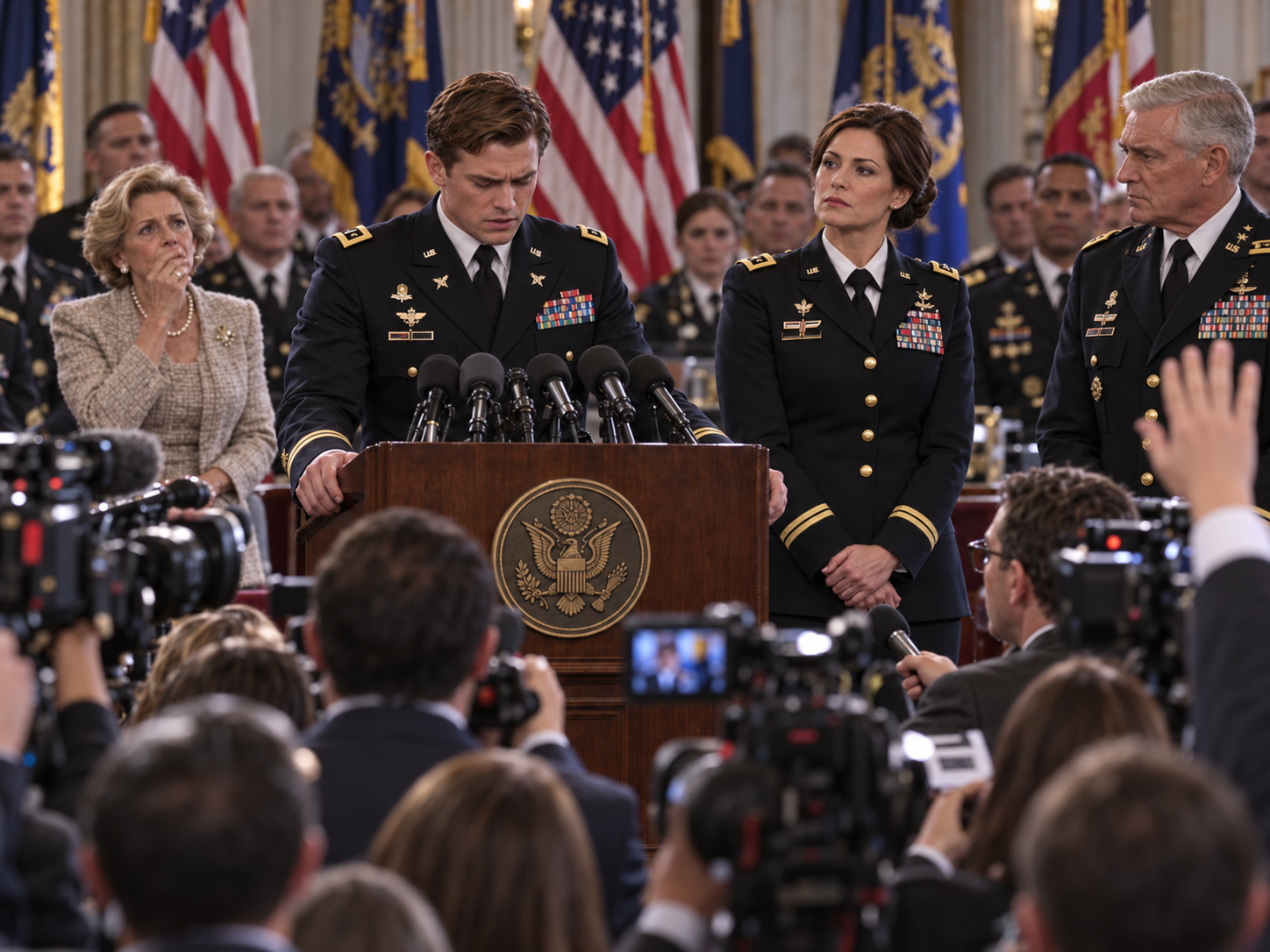
A reporter called out, “Did you tell them that?”
Daniel paused.
“No.”
The room changed.
He could have qualified it.
Explained.
Minimized.
He didn’t.
“I knew their understanding was wrong. I allowed it to continue.”
A dozen hands rose.
Daniel kept speaking.
“I did not alter military records. I did not know that records had been altered. But privately, inside my family, I accepted praise that belonged to my sister.”
His voice tightened.
“That was dishonest.”
Emily felt something deep in her chest shift.
“I was proud of my own service. I still am. But pride in what I did never required me to accept credit for what she did.”
He looked toward Emily.
“I did it anyway.”
The room was silent.
“I owe Colonel Carter an apology as a fellow officer.”
Then he swallowed.
“And I owe Emily one as her brother.”
He stepped away from the podium.
No dramatic embrace followed.
Emily appreciated that.
This was not television.
Repair did not happen because cameras were present.
But when Daniel walked past her, she touched his arm.
Once.
He looked at her.
She said quietly, “That cost you something.”
Daniel nodded.
“You told me it had to.”
That evening, the public narrative changed.
Reeves had attempted to frame the issue as sibling rivalry.
Daniel destroyed that strategy in ninety seconds.
Then the investigative evidence began catching up.
Federal agents searched Reeves’s consulting office.
Former staff members were interviewed.
Digital archives confirmed his communications with William Carter.
A retired records officer admitted Reeves had personally pressured him to replace references to Emily with phrases like “senior command authority.”
Another witness revealed that Reeves had spent years insisting Glass Lantern remain unavailable for public historical review.
Then one more name emerged.
Captain Marcus Bell.
Retired.
One of the forty-six people inside the endangered convoy.
Emily remembered him.
Young lieutenant at the time.
Twenty-four years old.
Broken radio.
Concussion.
Still trying to keep three vehicles moving.
Bell contacted investigators after seeing the ceremony footage.
He possessed something no archive had.
A recording.
During Glass Lantern, Bell had carried a personal voice recorder for after-action notes.
It had captured radio traffic from the critical minutes.
The audio was degraded.
But Emily’s voice was unmistakable.
“Lantern Three, ignore northern route. Repeat, ignore northern route. Turn west at marker seventeen.”
Then Reeves:
“Carter, hold your order.”
Emily:
“Negative. Intelligence confirms north corridor compromised.”
Reeves:
“You do not have authority to redirect.”
Emily:
“I have forty-six people about to enter a kill corridor. I’m assuming authority.”
A long burst of static.
Then Bell’s voice:
“Turning west.”
Seven minutes later, an explosion could be heard in the distance.
The northern road.
The route Reeves had ordered.
The room where investigators played the recording remained silent for several seconds afterward.
General Hale finally looked at Emily.
“You knew he could end your career.”
Emily nodded.
“At the time.”
“And you gave the order anyway.”
“There were forty-six people in those vehicles.”
Hale almost smiled.
Emily understood why her father had failed to understand her.
He had thought decisions were made for legacy.
Emily had never cared who remembered the order.
Only that the convoy turned.
Three weeks later, Jonathan Reeves was formally charged with offenses connected to falsified records, obstruction, and conspiracy involving government documentation.
The exact legal battle would take months.
Maybe years.
But his advisory nomination disappeared immediately.
The historical record was corrected.
William Carter’s role was included too.
Emily had been offered the chance to request that portions concerning her father remain sealed from public summaries.
She declined.
Daniel asked her why.
“Because he was wrong.”
“He was still Dad.”
“Exactly.”
Emily looked at her brother.
“He doesn’t become less our father because the truth is ugly.”
Daniel absorbed that.
“And he doesn’t become less wrong because we loved him.”
Their mother struggled most.
The lake house became unbearable for her.
Every framed photograph looked different now.
Every memory had acquired another interpretation.
One Saturday, Emily arrived to find dozens of frames removed from the den wall.
Daniel stood on a ladder.
Margaret sat on the floor surrounded by boxes.
Emily stopped.
“What are you doing?”
Her mother looked embarrassed.
“Fixing something.”
Emily’s eyes moved toward the bare wall.
“Mom.”
Margaret stood.
“I know photographs don’t repair twenty years.”
“No.”
“They don’t create memories we failed to make.”
“No.”
“I know.”
Emily looked around.
There were photographs on the table she had never seen displayed.
Emily graduating.
Emily at twenty-four, laughing beside Daniel.
Emily in uniform beside her grandfather.
Emily and Margaret at a beach when Emily was ten.
Her mother held one frame.
“I found these in storage.”
Emily stared at her.
“You don’t have to rebuild the wall around me.”
“I’m not.”
Margaret looked toward Daniel.
“We’re taking the wall down.”
Daniel climbed off the ladder.
“It was weird anyway.”
Emily raised an eyebrow.
“You loved that wall.”
“I loved being on it.”
He gave her a crooked smile.
“Different problem.”
Emily almost laughed.
Almost.
Margaret walked toward the fireplace.
Above it had hung their father’s favorite portrait: William standing between Daniel and a family flag.
Now the space was empty.
“What goes there?” Emily asked.
Margaret looked at her.
“Nothing.”
Emily frowned.
Her mother continued.
“I’m tired of turning family into a museum of who impressed your father.”
That sentence meant more than another photograph of Emily ever could.
So they left the wall mostly bare.
A few family pictures remained.
Ordinary ones.
No rank.
No medals.
No hierarchy.
Just people.
That afternoon Daniel found an old photograph of himself and Emily on bicycles.
He was nine.
Emily was eleven.
Both had grass stains on their knees.
“You remember this?”
Emily smiled.
“You rode into Mrs. Adler’s mailbox.”
“You pushed me.”
“You couldn’t steer.”
“You pushed me because I couldn’t steer.”
“That sounds responsible.”
Daniel laughed.
For a moment, they were not Colonel Carter and Major Carter.
Not the forgotten daughter and golden son.
Just siblings.
Then Daniel’s face became serious.
“I’ve been offered a command position.”
Emily looked at him.
“Congratulations.”
“I haven’t accepted.”
“Why?”
He hesitated.
“Part of me thinks I don’t deserve it.”
Emily studied him.
“Because you let Mom think you saved Glass Lantern?”
“Yes.”
“That was wrong.”
Daniel nodded.
“But?”
“But it doesn’t erase what you actually did in your own career.”
He looked surprised.
Emily continued.
“You want punishment because punishment is easier than becoming different.”
He frowned.
“Explain.”
“If you destroy everything you built, then you get to say the debt is paid.”
Emily folded her arms.
“But maybe the harder thing is to keep serving and become a man who doesn’t need borrowed credit.”
Daniel stared at her.
“You think I should accept?”
“I think you should decide whether you’re qualified.”
He smiled faintly.
“That sounds like you.”
“Unfortunately for you.”
Later that evening, Margaret brought Emily a wooden box.
“I found this behind your father’s files.”
Inside was a small bronze compass.
Emily recognized it immediately.
Her grandfather had given it to her father after his first command.
William had promised it would someday go to “the child who understood responsibility.”
Emily had always assumed Daniel received it.
“He left a note,” Margaret said.
Emily unfolded the paper.
Six words.
Not to the best officer.
To the truest one.
Emily stared.
Her mother said, “I think it was meant for you.”
Emily closed the box.
“Maybe.”
“You don’t want it?”
“I don’t know yet.”
That answer was enough.
Margaret nodded.
No pressure.
No attempt to force reconciliation through an object.
Progress.
Emily looked through the window toward the lake.
Then her phone rang.
General Hale.
She answered.
“Carter.”
“Colonel, I’m sorry to disturb your weekend.”
“What happened?”
A pause.
“The Secretary’s office has approved a public commendation ceremony for the Glass Lantern unit.”
Emily’s expression tightened.
“I already had a ceremony.”
“This is different.”
“How?”
“All surviving members of the convoy have been invited.”
Emily looked toward Daniel.
He was watching.
Hale continued.
“They requested you personally.”
Emily’s throat tightened.
“When?”
“Next month.”
She hesitated.
Then:
“I’ll be there.”
“One more thing.”
“Yes?”
“Captain Bell asked whether your family would attend.”
Emily looked at Margaret.
At Daniel.
At the half-empty wall.
For the first time in her life, Emily Carter realized she did not know what role her family would play when they entered a room built around her accomplishments.
She was no longer willing to sit at the far end.
But she also wasn’t sure she wanted them standing beside her.
Some wounds healed because people apologized.
Others required boundaries.
And Emily was still learning the difference.
PART 5 — THE SEAT BESIDE HER
A month later, forty-three of the forty-six surviving Glass Lantern convoy members gathered inside a military hall in Virginia.
Two had died in the years since the operation.
One was undergoing cancer treatment and watched by video from home.
Emily arrived early.
No press had been permitted inside until after the private reunion.
That had been her request.
For once, Glass Lantern would belong first to the people who had lived through it.
Not headlines.
Not careers.
Not the Carter family.
Marcus Bell was the first to see her.
He had gray in his beard now and walked with a slight limp.
For a second he stared.
Then he crossed the room.
“Lantern Actual.”
Emily smiled.
“Nobody’s called me that in years.”
“I have.”
Bell embraced her.
Not formal.
Not military.
Human.
When he stepped back, his eyes were wet.
“You know what I remember?”
Emily shook her head.
“The turn.”
She looked at him.
“Marker seventeen?”
“Yes.”
Bell laughed quietly.
“We were all screaming at each other. Radios were garbage. Reeves kept ordering us north.”
His smile faded.
“Then your voice came through.”
Emily remembered none of it as heroic.
Only noise.
Heat.
Bad information.
A map.
A decision.
Bell continued.
“You sounded like you were ordering coffee.”
“I was terrified.”
“Could’ve fooled us.”
Others gathered.
Sergeant First Class Ramon Ortiz.
Former medic Dana Whitaker.
Specialist Jerome Wells.
Names Emily remembered from reports became faces again.
People with spouses.
Children.
Grandchildren.
Careers that existed because one convoy had turned left instead of right.
Ortiz showed her a photograph of his granddaughter.
“She’s six.”
Emily smiled.
“Beautiful.”
“She exists because I came home.”
Emily looked at him.
Ortiz’s voice softened.
“I figured you should know.”
That broke through defenses medals never could.
Emily stepped away briefly and stood near the windows.
For fifteen years, Operation Glass Lantern had lived in her memory as a command problem.
Routes.
Signals.
Authority.
Risk.
Now she saw birthdays.
Marriages.
Children.
A granddaughter with two missing front teeth.
“I told you.”
Emily turned.
General Hale stood nearby.
“Told me what?”
“You earned this.”
Emily looked toward the room.
“No.”
Hale raised an eyebrow.
Emily smiled faintly.
“I did my job.”
“And sometimes doing your job changes forty-six families.”
Before Emily could answer, the doors opened.
Margaret entered.
Daniel followed.
They stopped near the entrance instead of searching for reserved seats.
Emily appreciated that too.
They were waiting to be invited.
She walked toward them.
Her mother looked nervous.
“Hi.”
“Hi.”
Daniel nodded.
“Colonel.”
Emily rolled her eyes.
“Don’t start.”
He smiled.
“I thought formal was safer.”
“It isn’t.”
Margaret held a small bouquet.
Then seemed suddenly uncertain.
“I brought these, but now they feel ridiculous.”
Emily took them.
“They’re flowers.”
“I know.”
“I like flowers.”
Her mother laughed through obvious nerves.
“Right.”
They stood there.
Three people relearning how to occupy the same space.
Daniel looked around.
“All these people were in the convoy?”
“Most of them.”
He exhaled.
“Wow.”
Emily followed his gaze.
“You heard the radio traffic that night.”
“I did.”
“You ever know their names?”
“Some.”
“Come meet them.”
Daniel looked at her sharply.
“You sure?”
“Yes.”
It was not forgiveness of everything.
But it was an invitation.
Those were different things.
Emily introduced Daniel simply.
“My brother.”
Not Major Carter.
Not the golden son.
Her brother.
Daniel shook hands with Bell.
Bell studied him briefly.
Daniel looked uncomfortable.
Then he said:
“I should tell you something.”
Emily almost stopped him.
Bell waited.
Daniel continued.
“For years my family believed I was responsible for getting your convoy out.”
Bell’s expression remained unreadable.
“I knew that wasn’t true.”
Daniel swallowed.
“I’m sorry.”
Bell looked at Emily.
Then back at Daniel.
“You correct it?”
“Yes.”
“Publicly?”
“Yes.”
Bell extended his hand again.
“Then spend the rest of your life being worth the correction.”
Daniel stared at him.
Then shook his hand.
“I will.”
That was all.
No humiliation.
No theatrical condemnation.
Emily realized Bell understood something their family had struggled to learn.
Accountability did not require permanent exile.
It required truth followed by action.
The formal ceremony began at noon.
This time, Emily did not sit at the far end.
Her seat was centered in the first row.
Her name was printed clearly.
COLONEL EMILY CARTER.
Margaret and Daniel sat several rows behind with other families.
Emily had arranged it that way.
Not as punishment.
As order.
This ceremony was not about them.
When General Hale approached the podium, Emily felt strangely calm.
He spoke briefly about Glass Lantern.
No exaggerated language.
No mythology.
A failure of communications.
A compromised route.
An officer willing to assume responsibility.
Forty-six people who came home.
Then he invited the surviving convoy members to stand.
They did.
Hale looked toward Emily.
“Colonel Carter, please join me.”
Emily walked onto the stage.
This time she didn’t hear her mother whispering warnings.
She didn’t wonder whether Daniel was being praised instead.
She didn’t carry the weight of her father’s disappointment.
She simply walked.
Hale presented the commendation.
Then, unexpectedly, Bell stepped forward.
He held something small in his hand.
A patch.
Faded.
Frayed.
The original unit patch from his uniform during Glass Lantern.
“We talked about what to give the person who made that call,” Bell said.
Emily shook her head.
“You don’t need to give me anything.”
“Too late.”
Laughter moved through the room.
Bell continued.
“Medals belong to institutions.”
He lifted the patch.
“This belonged to one of the forty-six.”
Emily’s eyes filled.
Bell handed it to her.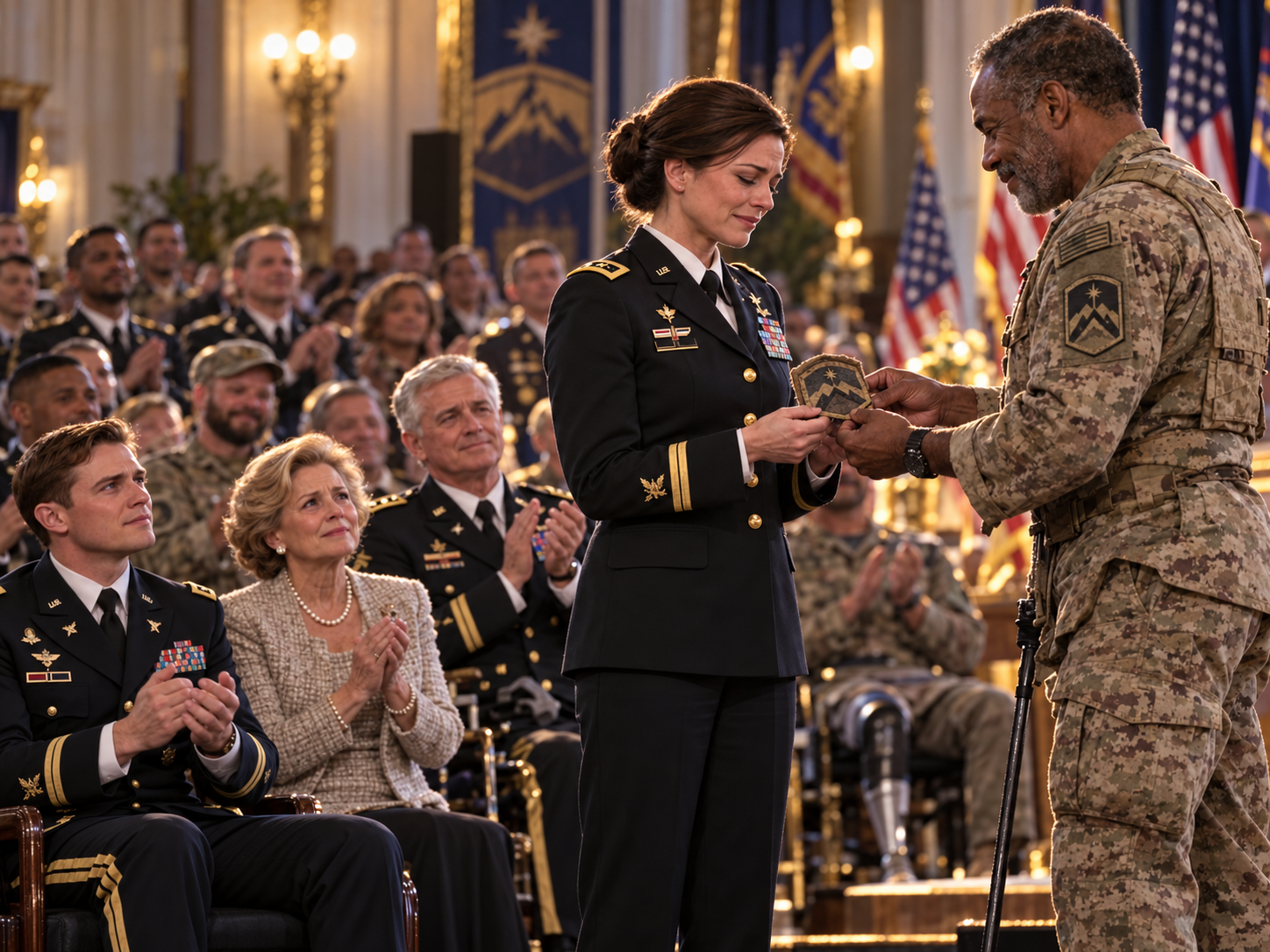
“Now it belongs to you.”
The room rose.
Emily looked toward her mother.
Margaret was crying.
But for once, the expression on her face held no shock.
No confusion.
No comparison.
Only pride.
Emily let herself see it.
And let herself decide it mattered.
Not because she needed it to know who she was.
But because rejecting every late kindness would make the past control her just as surely as craving approval once had.
After the ceremony, Margaret found her outside.
Daniel had deliberately wandered away with Hale.
Smart man.
Mother and daughter stood beneath a clear afternoon sky.
Margaret spoke first.
“I used to think good mothers knew everything about their children.”
Emily said nothing.
“I think maybe good mothers keep learning them.”
Emily looked at her.
“That would’ve been useful thirty years ago.”
Margaret smiled sadly.
“Yes.”
Then:
“I can’t ask you to give those years back.”
“No.”
“I can’t make the things I said disappear.”
“No.”
Margaret nodded.
“But I can stop asking you to make me feel better about them.”
Emily felt something loosen.
Her mother continued.
“So I’m not going to ask if you forgive me.”
Emily looked toward the trees.
“Good.”
“I’m only going to ask whether I can know you now.”
That was a harder question.
Because anger could answer the past.
It could not decide the future.
Emily thought of Christmas dinners.
The ceremony warning.
The wall of Daniel’s photographs.
Then she thought of her mother removing those photographs without replacing them with a shrine to Emily.
Turning over the flash drive.
Showing up today without demanding the front row.
Emily looked at her.
“Slowly.”
Margaret cried.
But she smiled.
“Slowly is good.”
Daniel joined Emily twenty minutes later.
He had accepted the command position.
Emily already knew.
He had called her before responding to the offer.
Not for permission.
For advice.
Another small change.
They walked toward the parking area together.
Daniel shoved his hands into his pockets.
“Mom told me what she asked you.”
Emily raised an eyebrow.
“She lasted twenty minutes before telling you?”
“Personal growth has limits.”
Emily laughed.
Daniel grinned.
Then his expression turned serious.
“I’ve been thinking about Dad.”
“That sounds dangerous.”
“He was proud of me for reasons that weren’t always healthy.”
“Yes.”
“And he failed you.”
“Yes.”
Daniel kicked lightly at a pebble.
“But you watched his video.”
“I did.”
“Do you forgive him?”
Emily thought about it.
“No.”
Daniel looked surprised.
“Not yet.”
She continued.
“Maybe someday. Maybe not.”
He nodded.
“I thought after everything—”
“That I’d discover he loved me and all the damage would disappear?”
Daniel winced.
“When you say it like that…”
“Love doesn’t erase damage.”
They reached the car.
Emily turned toward him.
“But damage doesn’t erase love either.”
Daniel considered that.
“That’s annoyingly complicated.”
“Welcome to adulthood.”
He smiled.
Then:
“Do you forgive me?”
Emily looked at him for a long time.
Daniel didn’t look away.
Months earlier, he might have.
Now he stood still and accepted whatever answer came.
“I’m getting there.”
His eyes filled.
“That’s fair.”
Emily opened the car door.
Daniel spoke again.
“One question.”
“What?”
“The compass.”
Emily smiled.
“What about it?”
“Mom said you still haven’t taken it.”
“I have it.”
Daniel looked surprised.
“When?”
“Yesterday.”
He smiled.
“Why?”
Emily reached into her bag and took out the small wooden box.
She opened it.
The bronze compass caught the afternoon light.
For years, William Carter had believed a family legacy was something handed down through rank, reputation, and recognition.
Emily understood it differently now.
A legacy was not what people said about you.
It was what remained in other people because you had been there.
Forty-six people had turned west.
A granddaughter had been born.
A frightened young officer named Daniel had finally learned to tell the truth when it cost him.
A mother in her seventies had learned that apology did not purchase forgiveness.
And a daughter who once believed she needed nothing from her family had learned that independence did not require loneliness.
Emily closed the box.
“Grandpa gave it to Dad for the child who understood responsibility.”
Daniel nodded.
“So it’s yours.”
Emily shook her head.
“No.”
She handed him the box.
Daniel stared.
“What are you doing?”
“Open it.”
He did.
Inside, beneath the compass, Emily had placed a new note.
Daniel read it.
Responsibility isn’t being right the first time.
It’s what you do after you learn you were wrong.
Daniel looked up.
“Emily…”
“I’m not giving it to you.”
He frowned.
“Then what—”
“We’re keeping it at Mom’s.”
She smiled.
“No more inheritance competitions.”
Daniel laughed.
“That sounds terrifyingly healthy.”
“Don’t get used to it.”
They placed the compass inside Margaret’s home a week later.
Not on the old military wall.
That wall remained gone.
Instead, the compass sat on a simple shelf beside family photographs.
Emily at eleven.
Daniel at nine.
William and Margaret dancing at an anniversary party.
The siblings on bicycles.
No uniforms.
No titles.
No medals.
On Thanksgiving, Emily returned to the lake house.
It was the first holiday she had voluntarily spent there in years.
Daniel arrived with his wife and children.
Margaret burned the rolls.
Everyone pretended they were edible.
At dinner, Margaret started to seat Daniel at the traditional place beside her.
Then she stopped.
Old habit.
She laughed awkwardly.
“Sit wherever.”
Daniel looked at Emily.
“There’s room here.”
He pulled out the chair beside him.
Emily sat.
No far end.
No favored position.
Just a seat.
Later, Daniel’s fourteen-year-old daughter, Sophie, asked Emily about the ceremony.
“Grandma says you saved forty-six soldiers.”
Emily glanced toward Margaret.
Her mother immediately raised both hands.
“I said she helped bring forty-six people home.”
Emily smiled.
Progress.
Sophie waited.
Emily thought carefully.
“A lot of people helped bring them home.”
“But you made the big decision.”
“I made one decision.”
“Were you scared?”
Emily looked at her niece.
“Yes.”
Sophie seemed surprised.
“But you’re a colonel.”
“Colonels get scared.”
Daniel said from across the table, “Frequently.”
Emily threw a napkin at him.
Sophie laughed.
Then asked:
“How did you know what to do?”
Emily thought of Glass Lantern.
The broken communications.
Reeves ordering north.
The intelligence warning.
Forty-six lives.
“You don’t always know.”
Sophie frowned.
“Then how do you decide?”
Emily leaned back.
“You ask yourself what you’re willing to be responsible for afterward.”
Across the table, Daniel became quiet.
So did Margaret.
Emily realized the answer applied to far more than combat.
It applied to fathers who changed records.
Brothers who accepted praise.
Mothers who looked away.
Daughters who had to choose whether to come home.
Sophie nodded as though storing the answer somewhere.
Dinner continued.
Nothing dramatic happened.
No secrets emerged.
No one confessed anything.
No general entered the room.
For the Carter family, that was almost miraculous.
Months passed.
Reeves eventually pleaded guilty to several charges connected to the falsification scheme rather than face the full prosecution.
William Carter’s actions were officially documented.
His military service remained what it had been—years of honorable work complicated by a serious failure late in his life.
Emily insisted on that distinction.
She refused both extremes.
Her father was not a monster.
He was not a saint.
He was a man who had loved his daughter badly, made a terrible decision, hidden from it, profited from it, regretted it, and finally left behind the evidence required to expose it.
Daniel served successfully in his new command.
The first time a young officer under him made an embarrassing mistake, Daniel nearly reacted the way William would have.
Then he stopped.
He asked what happened.
He listened.
Later, he called Emily.
“I hated hearing Dad’s voice come out of my mouth.”
Emily said, “Then use your own.”
He did.
Margaret began calling Emily every Sunday.
Not every call was good.
Sometimes she asked questions that revealed how little she knew about her daughter.
Sometimes Emily became irritated.
Sometimes Margaret became defensive.
But they kept calling.
Slowly.
The word Margaret had promised.
And Emily?
She kept serving.
Not because the public finally knew about Glass Lantern.
Not because her mother finally understood her rank.
Not because Daniel returned the borrowed glory.
She served because eighteen-year-old Emily Carter had understood something long before the rest of her family.
She would rather matter than be remembered.
Three years later, when Emily retired, the ceremony was intentionally small.
No grand auditorium.
No political guests.
No dramatic military band.
She had spent enough of her career in rooms where ceremony confused visibility with meaning.
General Hale attended.
So did Marcus Bell.
Thirty-one members of the Glass Lantern convoy came.
Daniel sat in the second row.
Margaret sat beside him.
This time there was an empty seat in the front row.
Emily noticed it immediately.
After the ceremony, she asked Hale why.
He smiled.
“That was yours.”
“I was onstage.”
“I know.”
She frowned.
Hale continued.
“You spent a lot of your life sitting where other people put you.”
He nodded toward the chair.
“Thought you should have one nobody else was allowed to take.”
Emily laughed.
Then she walked toward the seat.
On it rested the faded Glass Lantern patch Bell had given her years earlier.
Beside it was the bronze compass.
Daniel approached.
“I brought it from Mom’s.”
Emily lifted the compass.
“You stealing family property now?”
“Borrowing.”
“Sounds suspicious.”
He grinned.
Margaret joined them.
Her hair was almost entirely silver now.
She looked at Emily’s retirement insignia.
“I’m proud of you.”
Years ago, those words might have broken something open inside Emily.
Now they landed gently.
Warmly.
Not as proof.
Not as payment.
Simply as love.
Emily smiled.
“Thank you, Mom.”
Margaret hugged her.
Daniel waited.
Then Emily opened one arm.
“Oh, come on.”
He joined them.
For a brief, ridiculous moment, Colonel Emily Carter—the officer who had stared down collapsing operations, senior commanders, investigations, and a family legacy built around everyone except her—stood trapped in a three-person hug beside an empty chair.
She started laughing.
Daniel did too.
Margaret asked what was funny.
Emily couldn’t explain.
Maybe nothing was.
Maybe everything was.
Across the hall, Marcus Bell watched them.
When Emily finally stepped away, he raised two fingers in a small salute.
She returned it.
Outside, late-afternoon sunlight fell across the parade grounds.
Emily walked toward the doors with her family.
Then she stopped.
Daniel noticed.
“What?”
Emily looked back at the hall.
At the podium.
At the empty front-row seat.
At the people whose lives had continued because of a decision made years before any of them knew whether history would remember her name.
She thought of her father.
His warning.
If nobody sees what you do, nobody will remember you did it.
Emily had spent half her life believing she needed to prove him wrong.
She finally understood she didn’t.
Because forty-six people had come home.
Because children had grown up with fathers and mothers.
Because grandchildren existed.
Because Daniel had changed.
Because Margaret had learned to listen.
Because Emily herself had survived becoming invisible without becoming bitter enough to disappear.
She faced her family again.
Daniel smiled.
“Ready?”
Emily looked at the open doors ahead.
This time, nobody told her where to sit.
Nobody asked her to stay quiet.
Nobody warned her not to embarrass the family.
She no longer needed to stand behind her brother.
And Daniel no longer needed to stand in front of her.
Emily slipped the bronze compass into her pocket.
“Yeah,” she said.
“I’m ready.”
Then Colonel Emily Carter walked out beside her family—not as the forgotten daughter, not as the woman behind the golden son, and not even as the officer everyone had finally learned to applaud.
She walked out simply as herself.
And for the first time, that was enough.
THE END