THEY LOCKED ME IN A ROOM WITH FIVE LAWYERS—BUT MY FATHER HAD PREPARED ME FOR THIS
PART 1 — THE AMBUSH
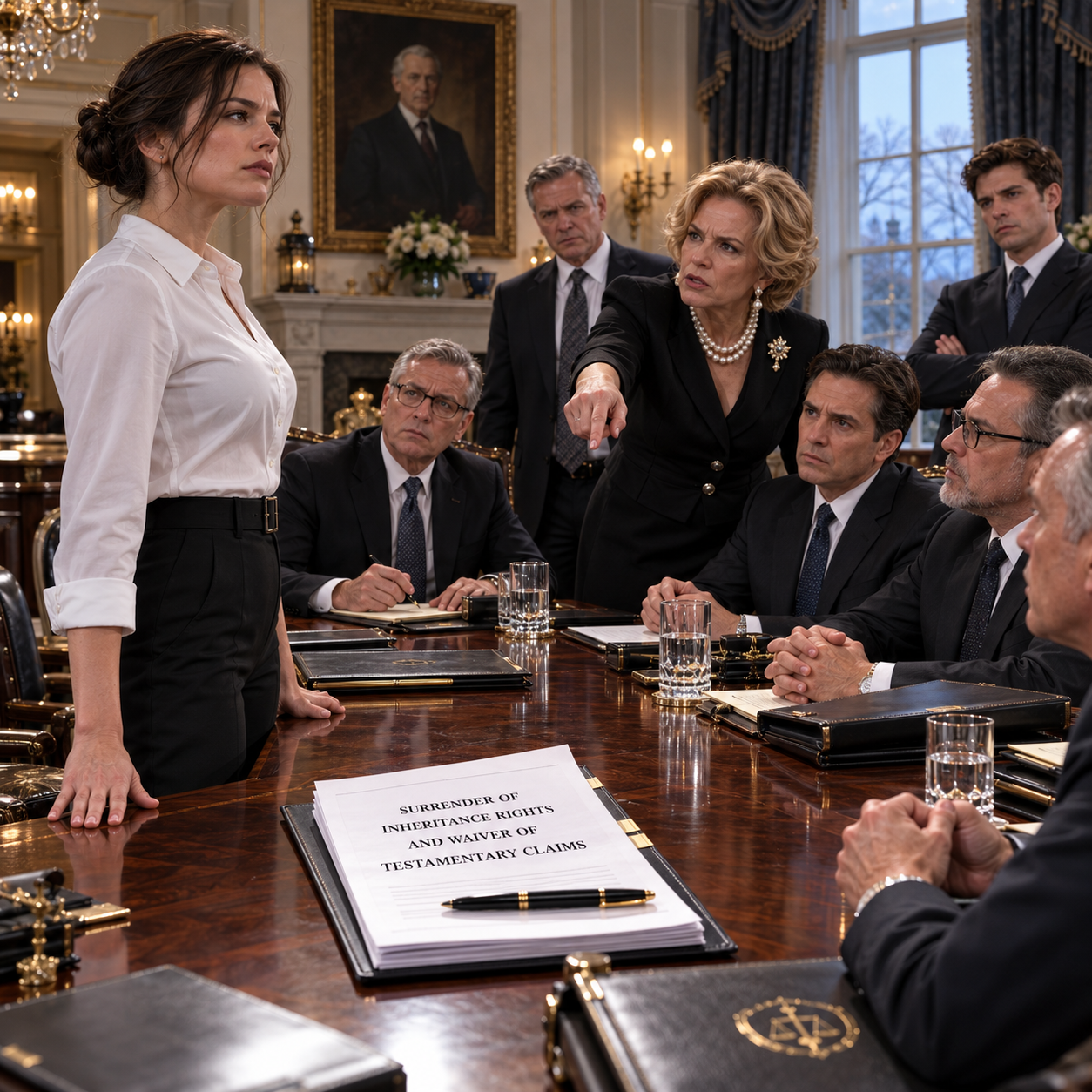
My mother locked me inside a room with five high-powered attorneys and expected me to sign away everything my father had left me.
She thought she had cornered a grieving daughter.
What she did not know was that the daughter she had spent years dismissing as an ordinary government employee was actually a Colonel in the United States military, commanding a specialized intelligence unit.
So while my mother waited for me to panic, I quietly counted the attorneys sitting around the table.
One.
Two.
Three.
Four.
Five.
And waited for them to realize that I had walked into that house prepared for an ambush of my own.
“Sign here and stop acting like your father loved you more than the rest of us.”
Those were the first words my mother, Eleanor Sterling, said to me when I entered our family estate in Greenwich, Connecticut, three weeks after my father’s funeral.
Not hello.
Not how are you holding up?
Not even thank you for coming.
Just sign.
That morning, her text had arrived while I was leaving a classified briefing at the Pentagon.
Come over tonight. Family meeting. We need to settle your father’s estate.
My father, Arthur Sterling, had died unexpectedly from a heart attack at sixty-seven.
Even now, thinking about the phone call made my chest tighten.
Dad had never looked like a man who possessed serious wealth.
He preferred old notebooks to expensive technology.
He wore the same watches for decades.
He could spend entire evenings reviewing accounting sheets at his desk without complaining.
He disliked extravagant parties and usually left them early.
Yet quietly and methodically, he had built a considerable fortune.
Two commercial properties.
A significant ownership stake in a regional construction company.
Investment portfolios accumulated over decades.
And my grandmother’s historic Boston home.
Dad rarely discussed exact numbers.
That was simply who he was.
But apparently, the moment he died, numbers were all anyone else wanted to discuss.
Especially my mother.
Since the funeral, Eleanor had repeated the same message in different forms.
“You don’t need that much, Maya.”
“Julian is trying to build something.”
“You have a stable career.”
“A good daughter thinks about the whole family.”
Translation:
Give Julian what Dad left you.
Julian was my half-brother.
My mother and Marcus, my stepfather, had spent years treating every new plan he announced as if it were the beginning of a business empire.
Restaurants.
Investments.
Expansion proposals.
Every failure somehow became evidence that he simply needed more capital.
Meanwhile, I remained the difficult daughter who had refused to follow the path my mother designed for me.
She wanted Manhattan society.
The correct marriage.
The correct social circle.
The correct surname attached to mine.
Instead, I joined the military.
That decision had never stopped disappointing her.
My family knew I was an officer.
Technically.
What they did not know was much more important.
They had never bothered asking what I actually did.
And when they did ask, I gave them exactly as much information as I was permitted to give.
Very little.
So in their minds, I had spent my adult life doing some vague government job.
Paperwork.
Meetings.
Reports.
Maybe logistics.
Nothing impressive enough to interest them.
They had no idea I had spent years in military intelligence.
No idea my work required me to sit across tables from generals, federal prosecutors, intelligence officers, and executives whose mistakes sometimes carried national consequences.
I had spent years learning how people behave when they are hiding something.
How they use silence.
How they position themselves in a room.
Who blocks the door.
Who speaks first.
Who stays quiet because they are waiting for someone else to make a mistake.
Those habits do not disappear because the people across the table happen to share your last name.
That evening, I arrived at the Greenwich estate wearing black trousers and a crisp white blouse.
My hair was pulled into a simple knot.
No medals.
No visible rank.
My dress uniform remained zipped inside a garment bag in the back of my car.
Waiting.
The moment I stepped through the front door, I knew something was wrong.
Three black SUVs were parked outside.
That alone was unusual.
Then I entered the dining room.
No relatives were waiting.
No cousins.
No family friends.
Instead, five strangers sat around the long mahogany table.
Expensive suits.
Leather briefcases.
Legal pads.
An open laptop.
Folders arranged in front of several chairs.
Five attorneys.
I stopped in the doorway.
My mother smiled.
“I’m so glad you came, sweetheart.”
The smile never reached her eyes.
I looked around the table.
“Who are these people?”
“Professionals.”
She gestured lightly.
“They’re here to help us settle everything like civilized adults.”
Civilized.
Interesting choice of word.
Marcus stood near the bay window.
He had positioned himself where he could watch the entire room.
Julian sat near the end of the table pretending to look at his phone.
Every few seconds, his eyes flicked toward me.
Nervous.
Not bored.
Nervous.
One of the attorneys stood.
He was perhaps in his late fifties, silver-haired, expensive watch, the kind of measured expression lawyers practice until it becomes permanent.
“Colonel Sterling, please have a seat.”
My mother’s head snapped toward him.
Her face tightened.
“She isn’t here as a colonel.”
The attorney paused.
Mom continued.
“She’s here as a daughter.”
I almost smiled.
That distinction apparently mattered very much to her.
I stayed standing.
“I’m not sitting down yet.”
Mother sighed.
“Maya, please don’t start.”
“I haven’t started anything.”
One of the other attorneys exchanged a quick look with the man beside her.
I noticed.
I noticed everything.
The silver-haired attorney slowly sat again.
Then a thick folder was pushed across the polished table toward me.
It stopped near the empty chair.
I looked down at the title.
SURRENDER OF INHERITANCE RIGHTS AND WAIVER OF TESTAMENTARY CLAIMS.
I actually had to suppress a laugh.
“That’s an impressive title.”
My mother crossed her arms.
“For what?”
“For ‘give away everything Dad left me.’”
Her expression sharpened.
“Your father wasn’t thinking clearly at the end.”
That was the first real move.
I looked at her.
“He signed his will in front of a licensed notary.”
“Notaries make mistakes.”
Marcus spoke from beside the window.
I turned toward him.
He shrugged.
“It happens.”
“Of course.”
Julian finally put his phone down.
“Maya, nobody is trying to steal anything.”
I glanced at the document.
“That’s reassuring.”
His jaw tightened.
“You know what I mean.”
“No. Explain it.”
He stood.
That surprised me slightly.
Not because he stood.
Because of where he moved.
He walked around the chair and stopped between me and the hallway.
There it was.
My mother at the head of the table.
Marcus near the side door.
Julian between me and the hall.
Five lawyers in front of me.
Nobody had technically locked anything.
They did not need to.
The message was obvious.
You’re staying until we finish this.
Julian started talking about his business.
An upscale restaurant chain.
Expansion costs.
Loans.
Employees depending on him.
A second location that had not performed as expected.
A third location that needed financing.
He spoke for several minutes as if presenting to investors.
Then finally came the point.
“You have a government salary.”
I said nothing.
“Benefits.”
Still nothing.
“A pension.”
He spread his hands.
“What do you even need commercial properties for?”
I looked at him.
“Because Dad left them to me.”
He blinked.
“That’s not an answer.”
“It’s the only answer necessary.”
Mom’s palm slammed against the mahogany table.
The sound cracked through the room.
Every attorney stopped moving.
“Don’t be selfish!”
There she was.
The real Eleanor.
Not the polished woman from charity dinners.
Not the grieving widow accepting condolences.
My mother.
Angry because I had failed to obey.
“Your father spoiled you your entire life,” she snapped. “It’s time you finally did something for this family.”
I stared at her.
Spoiled.
I thought of missed holidays because of deployments.
Hotel rooms before classified briefings.
Nights sleeping beside encrypted phones.
Years when even the people closest to me were not allowed to know where I had been.
But arguing with Eleanor using emotion had never worked.
So I did not.
Instead, I looked around the room again.
Five attorneys.
The first had spoken confidently but had not touched his water.
The second kept tapping a pen against his legal pad.
The third had been watching my mother more than me.
The fourth had a stack of estate documents with several colored tabs.
The fifth had said nothing at all.
That one interested me most.
Marcus remained near the bay window.
Close to the side exit.
Julian still stood between me and the hallway.
My mother stared directly at me.
Waiting.
She expected anger.
Or tears.
Maybe fear.
Something she could use.
Something that would turn me back into the teenager she remembered cornering during family arguments.
Instead, I began counting.
One.
Two.
Three.
Four.
Five.
Five attorneys.
My mother mistook the silence for hesitation.
Her voice softened.
That somehow made it worse.
“Maya, sweetheart.”
I looked at her.
“You don’t need to make this ugly.”
I almost admired the irony.
“You brought five attorneys.”
“They’re here to protect everyone.”
“From me?”
“From unnecessary complications.”
I glanced once more at the surrender document.
“Meaning my inheritance.”
“Meaning the family’s future.”
There it was again.
Family.
The word they used whenever they wanted my sacrifice to sound like love.
One of the attorneys cleared his throat.
“Colonel Sterling, perhaps we should review the agreement clause by clause.”
My mother shot him another irritated look at the rank.
I noticed that too.
He knew.
At least part of it.
Maybe Dad’s documents had listed my rank.
Maybe someone in his office had done basic research.
Either way, Mother clearly had not expected to hear it.
That told me something.
I moved toward the table.
For half a second, Julian smiled.
He thought I was finally going to sit.
Instead, I rested one hand on the back of the empty chair.
Then looked at each lawyer again.
They had spent three weeks preparing paperwork.
My mother had arranged the room.
Marcus had helped with positioning.
Julian had rehearsed the emotional argument.
It was meant to be overwhelming.
A grieving daughter.
Five attorneys.
Family pressure.
A stack of legal documents.
Sign and leave.
Simple.
Except they had made one enormous mistake.
They knew I wore a military uniform.
They just had no idea what that uniform actually represented.
They did not know what kind of unit I commanded.
They did not know what I had spent my professional life learning to recognize.
They did not know why I had left my dress uniform in the car.
And they certainly did not know what I had done before walking through the front door.
My fingers tightened slightly around the chair.
Then I smiled.
For the first time that evening, one of the five attorneys stopped looking confident.
Because while my mother thought I had walked directly into her ambush—
she had no idea I had already prepared one of my own.
PART 2 — MY FATHER’S SECOND ENVELOPE
I finally sat down.
That seemed to relax everyone except the fifth attorney.
His name, according to the folder in front of him, was Samuel Reed.
He looked to be in his early sixties, with iron-gray hair and a narrow, thoughtful face.
Unlike the others, he had not opened a laptop.
He had not pushed a document toward me.
He was watching.
So was I.
The silver-haired attorney introduced himself as Charles Wyndham.
He represented my mother.
The woman to his right represented Marcus.
Two younger attorneys had been retained for “estate restructuring.”
Samuel Reed, apparently, was there because he had once performed legal work for my father.
That was the part Mother rushed through.
I looked directly at him.
“You knew Arthur Sterling?”
His eyes held mine.
“For twenty-two years.”
Eleanor interrupted immediately.
“Samuel is here in a very limited capacity.”
“Interesting.”
“Maya.”
“I’m asking a question.”
Samuel folded his hands.
“I advised your father on several corporate and estate matters.”
“Including his will?”
A pause.
“Yes.”
That changed the room.
Mother reached for the waiver.
“We don’t need to get lost in ancient history.”
Dad had died three weeks ago.
Apparently, that qualified as ancient history now.
I turned to Charles.
“Before we discuss this document, I have a few questions.”
Charles gave a professional nod.
“Of course.”
“Who drafted it?”
“My firm.”
“At whose direction?”
“Mrs. Sterling and Mr. Hale.”
Marcus.
Interesting.
“Did you review my father’s final testament?”
“Yes.”
“Did you identify any legal defect?”
Charles’s jaw shifted almost imperceptibly.
“This is not a challenge to the will.”
“Then why am I surrendering rights granted by a valid will?”
“The family believes a redistribution would be more equitable.”
“The family meaning whom?”
“Your mother. Your brother. Mr. Hale.”
“So three people who would benefit financially from my signature.”
Nobody answered.
The second attorney stopped tapping his pen.
Good.
I continued.
“What consideration do I receive?”
Julian frowned.
“What?”
I looked at him.
“Contracts involve an exchange. What do I receive?”
“You receive peace in the family.”
I actually laughed.
Not loudly.
Just once.
Charles looked uncomfortable.
“I believe Mr. Sterling is speaking emotionally.”
“I assumed so.”
Mother leaned across the table.
“Enough.”
“No.”
The word came out quietly.
Everything stopped.
I had not raised my voice.
I did not need to.
Mother hated that more than shouting.
“This meeting is about me surrendering assets worth millions of dollars. We proceed at my pace.”
Marcus pushed himself away from the window.
“You don’t dictate terms in this house.”
I looked toward him.
“Then open the door.”
Silence.
His expression changed.
Only slightly.
But Samuel saw it too.
“Excuse me?” Marcus asked.
“You said I don’t dictate terms here. Fine. Open the dining-room door.”
Julian glanced behind himself.
Only then did the attorneys seem to notice that sometime during the conversation, the double doors had been closed.
Marcus smiled.
“Nobody is stopping you from leaving.”
“Then open it.”
He did not move.
That was mistake number one.
I turned to Charles.
“Are you comfortable participating in a meeting where a beneficiary is being pressured to sign a multimillion-dollar waiver while family members are physically restricting the exits?”
Charles’s face went pale.
“We are not restricting—”
“The hallway exit is blocked by Julian. Marcus is beside the side door. The main dining doors are closed. I have asked for one to be opened. Nobody has done it.”
Julian stepped aside immediately.
Marcus swore under his breath.
Charles turned sharply.
“Mrs. Sterling, open the doors.”
Mother looked furious.
“This is ridiculous.”
Samuel spoke for the first time in several minutes.
“Open them, Eleanor.”
She stared at him.
Something passed between them.
Fear.
Not anger.
Fear.
Marcus finally crossed the room and pulled the doors open.
I nodded.
“Thank you.”
Then I reached into my handbag.
Five attorneys straightened at once.
I removed a small digital recorder and placed it on the table.
Mother stared.
“You recorded us?”
“I informed you when I came in.”
Her face went blank.
I pointed toward the foyer.
“There is a sign beside the entry camera stating that audio and video recording are active on the property. Marcus installed the system two years ago after that jewelry theft scare.”
Marcus’s expression collapsed.
The irony was almost satisfying.
Their own surveillance system had announced the recording environment before I ever stepped inside.
But my recorder was not the important thing.
The important thing was what sat inside my bag beside it.
A sealed envelope.
I placed that on the table too.
Samuel Reed went completely still.
I noticed.
Mother did too.
“What is that?” she demanded.
I looked at Samuel.
“You know.”
He closed his eyes for half a second.
Then nodded.
“Yes.”
Julian turned toward him.
“What the hell is going on?”
Samuel exhaled.
“Arthur anticipated that there might be pressure after his death.”
My mother stood so quickly that her chair scraped the floor.
“You told her?”
“No.”
Samuel’s voice became firm.
“Arthur did.”
My father and I had met six months before his death at a small restaurant outside Alexandria, Virginia.
He had insisted on driving down alone.
That was unusual.
Dad disliked long drives.
We spent the first hour talking about nothing important.
My work.
His garden.
A leaking roof at the Boston house.
Then, while the waiter cleared our coffee, he had reached into his jacket.
He gave me a sealed envelope.
“Don’t open this unless something happens to me.”
I remembered staring at him.
“Dad.”
“I’m serious.”
“You’re healthy.”
“So was my father until the morning he wasn’t.”
I did not like the conversation.
I told him that.
He smiled.
“Maya, you spend your life planning for things you hope never happen.”
He pushed the envelope closer.
“Let an old man learn something from his daughter.”
I had kept it inside the locked safe in my Virginia home.
Three weeks after his death, I opened it.
Inside was a two-page letter.
And one instruction:
Before signing anything regarding my estate, contact Samuel Reed and ask him for the Hawthorne file.
I had called Samuel forty-eight hours before coming to Greenwich.
He had not explained.
He had simply said, “Come to the meeting. Bring Arthur’s letter. Say nothing until they produce a waiver.”
So I had.
Now Samuel reached down beside his chair and lifted a narrow black briefcase onto the table.
Mother’s face lost all color.
“Samuel.”
He entered a combination.
Click.
The case opened.
Inside was a red folder.
HAWTHORNE.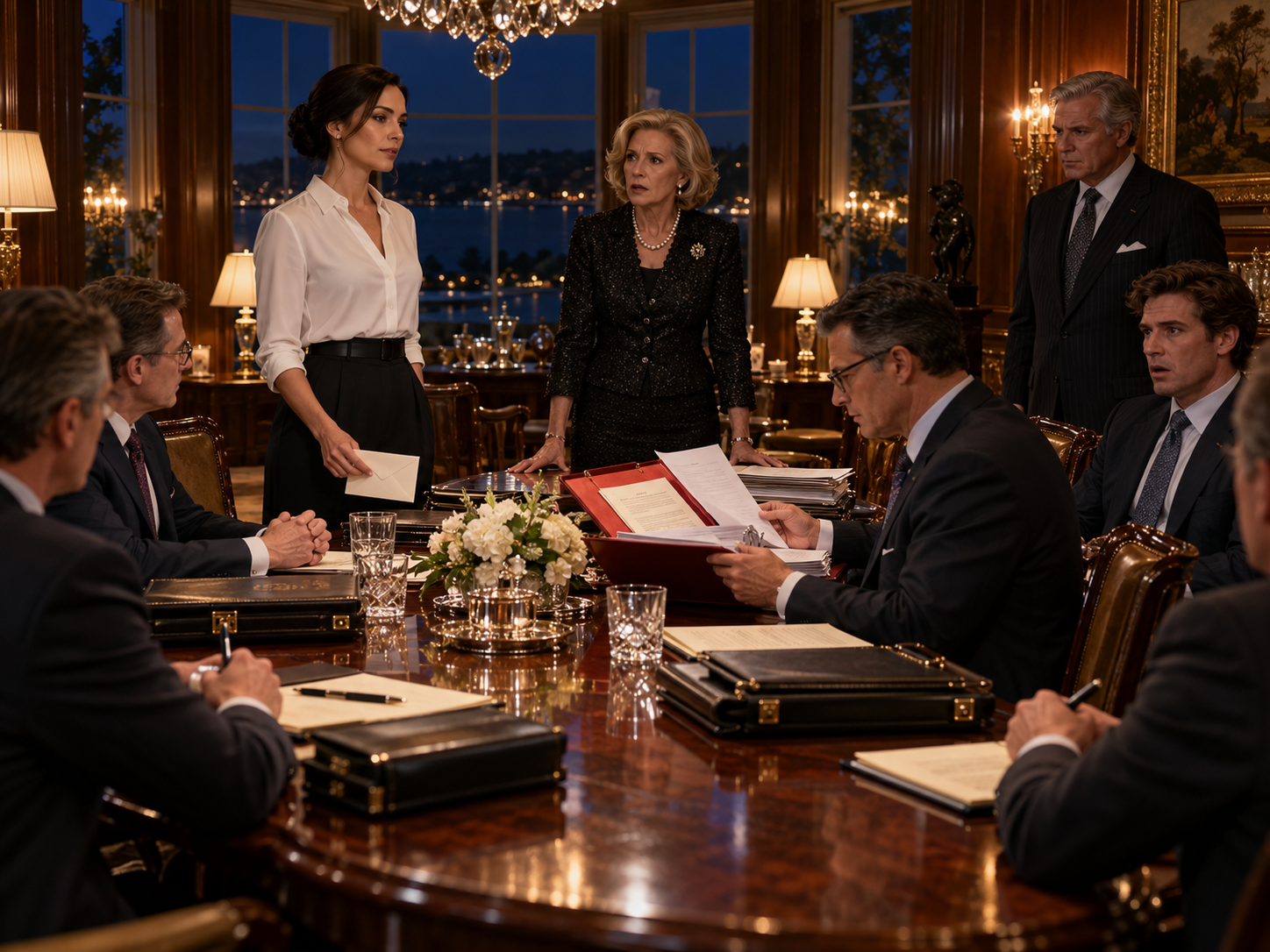
Julian stared at it.
“What is that?”
Samuel looked at me.
“Your father’s contingency file.”
Marcus began moving toward him.
“Give me that.”
I rose instantly.
“Don’t.”
Marcus stopped.
For the first time all night, he looked uncertain about me.
Not irritated.
Not dismissive.
Uncertain.
I held his gaze.
“Sit down.”
Maybe it was the tone.
Maybe it was something he finally understood in my expression.
Whatever the reason, Marcus sat.
Samuel opened the folder.
“The final will you have all reviewed,” he said, “is genuine. Properly executed. Properly witnessed. Arthur’s physicians also provided statements confirming he possessed full testamentary capacity.”
Charles Wyndham looked toward Mother.
“That was not disclosed to us.”
She ignored him.
Samuel continued.
“Additionally, Arthur established a separate trust instrument eight months before his death.”
My heartbeat changed.
I had not known about that.
Mother clearly had.
Samuel slid copies across the table.
“The trust includes controlling rights attached to the construction-company shares left to Maya, oversight provisions for both commercial properties, and restrictions preventing transfer of certain assets for five years.”
Julian stared at the pages.
“You said she could sign them over.”
Mother said nothing.
His head turned.
“Mom.”
She snapped, “Be quiet.”
That told me everything.
Julian had not known the full plan.
He was greedy.
Entitled.
Manipulated.
But he had not designed the machine.
Marcus had.
And my mother had helped him operate it.
Samuel pulled out another document.
“This is the part Arthur was especially concerned about.”
Mother whispered, “You have no right.”
Samuel looked at her sadly.
“I have every right. He was my client.”
The document was a set of financial statements.
Three companies.
Hale Strategic Holdings.
JRS Hospitality Development.
Sterling Family Advisory LLC.
The names looked unrelated.
The transfers were not.
Over eighteen months, money had moved from one of Dad’s business accounts into Sterling Family Advisory.
From there, portions had gone into Marcus’s holding company.
Other portions had been loaned to Julian’s restaurants.
At first glance, the transactions looked legitimate.
Management fees.
Consulting contracts.
Bridge financing.
But Dad had marked certain entries in red.
Then attached handwritten notes.
Unauthorized.
Duplicate invoice.
No board approval.
Never signed this.
My chest went cold.
I looked at Marcus.
He had stopped pretending to be calm.
Charles Wyndham stood.
“Mr. Hale, did you disclose these transactions to my firm?”
Marcus glared at him.
“You’re my lawyer.”
“That is not an answer.”
Mother slammed the folder shut.
“This is Arthur’s paranoia.”
Samuel immediately reopened it.
“No.”
His voice was sharper now.
“Arthur discovered approximately $3.8 million in questionable transfers.”
Julian stumbled backward.
“What?”
The number seemed to hit him harder than anyone.
Samuel continued.
“Your father began an internal audit. He believed someone had been using electronic approvals created in his name.”
I looked at the statements again.
Then at my mother.
“Digital signatures?”
She looked away.
There.
The first crack.
I suddenly understood why five lawyers had been summoned.
This had never been only about Julian’s restaurants.
They needed my assets.
Quickly.
Because Dad had structured the estate so I would inherit not only wealth—
but control.
Control meant records.
Control meant audits.
Control meant questions.
Mother had not summoned me because she thought my inheritance was unfair.
She summoned me because the moment probate finished, I would have access to documents she desperately needed kept closed.
I looked at Marcus.
“That’s why you need my shares.”
He said nothing.
“If I surrender them, who receives voting control?”
Still nothing.
I turned to Charles.
He reluctantly looked down at the waiver.
“The interests would be transferred into a family management entity.”
“Controlled by?”
Charles read another page.
Then his face hardened.
“Marcus Hale.”
Julian stared at his stepfather.
“You told me the shares would fund the restaurants.”
Marcus snapped, “Eventually.”
“Eventually?”
My brother laughed once in disbelief.
“You said this was about saving my company.”
Mother pointed at him.
“Sit down, Julian.”
“No.”
It was the first time in my life I remembered him saying that to her.
“No, Mom. You told me Maya was hoarding money Dad meant for all of us.”
“Maya is hoarding—”
“She hasn’t even received it yet!”
Another silence.
Samuel reached into the red folder one last time.
“There is one more provision.”
My mother whispered, “Don’t.”
Samuel looked at me.
“Arthur included an automatic trigger.”
I felt something tighten in my chest.
“What kind?”
“If any beneficiary was coerced, threatened, deceived, or materially pressured to surrender an inheritance interest, the independent trustee was instructed to suspend all discretionary distributions to the individuals responsible pending judicial review.”
Julian slowly turned toward Mother.
Marcus stood again.
“That’s unenforceable.”
Samuel’s gaze hardened.
“Perhaps you should explain that to the probate judge.”
Marcus lunged for the red folder.
He never touched it.
I caught his wrist before his fingers reached the table.
Not violently.
Not dramatically.
Just fast.
Years of training had made the movement almost automatic.
His face changed.
For the first time, he understood something about me that no résumé could have explained.
I released him.
“Don’t do that again.”
Nobody laughed.
Mother stared at me as if she were looking at a stranger.
And perhaps she was.
Then headlights swept across the bay windows.
One vehicle.
Then another.
Marcus looked outside.
His face went gray.
I picked up my phone.
“That,” I said, “would be the second half of my preparation.”
PART 3 — THE MAN MY FATHER TRUSTED
The first person through the front door was not a soldier.
Not military police.
Not some dramatic team my family apparently imagined followed me everywhere.
It was a seventy-one-year-old man carrying a worn leather briefcase.
Benjamin Cole had been my father’s accountant for thirty-four years.
Behind him walked Laura Bennett, a forensic accountant from Hartford, and Daniel Cho, an attorney I had retained personally after reading Dad’s letter.
Two ordinary cars.
Three very ordinary-looking people.
And more trouble for Marcus Hale than a convoy of uniforms could have created.
Mother looked at me.
“You brought accountants?”
“Among other things.”
Benjamin entered the dining room and stopped when he saw me.
For a moment, the entire legal battle disappeared from his expression.
He walked over and hugged me.
“I’m sorry, kiddo.”
That almost broke me.
Not five attorneys.
Not accusations.
Not millions of dollars.
Four words from a man who had known me since childhood.
I swallowed hard.
“Thank you, Ben.”
He stepped back.
“You look like Arthur when you’re angry.”
“I’m not angry.”
Benjamin glanced around the room.
“Then God help them when you are.”
Samuel almost smiled.
Mother did not.
Daniel Cho handed Charles his card.
“I represent Colonel Sterling personally regarding all estate and related civil matters.”
Charles accepted it.
Marcus scoffed.
“So now this becomes a circus.”
Daniel calmly replied, “Actually, Mr. Hale, my role is to prevent exactly that.”
Laura Bennett opened her laptop at the far end of the table.
Benjamin placed his briefcase beside her.
Mother looked around.
“You cannot just invade my home.”
I looked at her.
“You asked me here to discuss Dad’s estate. These are my advisers.”
“Five lawyers were reasonable when they belonged to you,” Daniel added. “Three advisers apparently feel excessive when they don’t.”
Julian covered his mouth.
I could not tell whether he was hiding a laugh.
Mother heard it anyway.
“Do you find this funny?”
“No.”
He lowered his hand.
“I’m starting to find it educational.”
That earned him a look of pure fury.
Benjamin opened his briefcase.
“I need to clarify something before we go further.”
Marcus groaned.
“Wonderful.”
Benjamin ignored him.
“Arthur did not discover these discrepancies shortly before his death. He first suspected them nearly a year ago.”
I turned.
“A year?”
“Yes.”
“Why didn’t he tell me?”
“Because he was protecting you.”
“From what?”
Benjamin hesitated.
That frightened me more than the documents.
He pulled out copies of emails.
The first was between Marcus and a man named Thomas Vale.
Vale had been chief financial officer of Sterling-Ross Construction.
Dad’s company.
I remembered him.
Tall.
Meticulous.
Always laughing too loudly at my father’s jokes.
The emails discussed vendor payments.
Nothing shocking at first.
Then Laura highlighted a pattern.
Shell vendors.
Construction consulting companies formed months before receiving payments.
Addresses connected to mailbox centers.
Invoices just below thresholds requiring secondary approval.
Classic fragmentation.
The sort of pattern designed to hide in plain sight.
My professional instincts took over.
“How much?”
Laura looked at Benjamin.
He nodded.
“We have verified $4.6 million.”
Samuel’s head snapped up.
“The Hawthorne file says 3.8.”
“That was Arthur’s estimate when the file was created.”
Marcus exploded.
“This is insane. You’re throwing accusations around based on accounting errors.”
Laura turned her screen.
“These are not accounting errors.”
She spoke without emotion.
“Forty-seven invoices from nine vendors share overlapping bank destinations. Six companies list registered agents connected to Thomas Vale’s brother-in-law. Three payments were approved using Arthur Sterling’s credentials during dates when he was documented to be outside the country.”
I remembered the trip.
Dad and I had spent four days together in Germany.
I had been attending meetings nearby, and he had arranged a ridiculous detour because he wanted to see the cathedral in Cologne.
He could not have approved those transactions from Connecticut.
Marcus pointed at the laptop.
“You could manufacture any spreadsheet you want.”
Benjamin looked genuinely offended.
“I reconciled Arthur Sterling’s books before you knew his middle name.”
Mother stepped between them.
“This is becoming abusive.”
I stared at her.
“Abusive?”
“Yes.”
Her voice shook now.
“You come into my house with strangers and accuse your family of crimes.”
“My father’s money is missing.”
“Your father made investments.”
“Then show us the contracts.”
She stopped.
“Show us the approvals.”
Nothing.
“The board minutes.”
Nothing.
“The emails where Dad authorized them.”
Still nothing.
Then I asked the question that mattered most.
“Did Dad confront you?”
Mother’s face tightened.
Not enough for anyone else.
Enough for me.
I stood.
“When?”
She looked toward the window.
“Maya—”
“When did he confront you?”
Marcus stepped in.
“Your father was under tremendous stress.”
I turned on him.
“I wasn’t asking you.”
His mouth closed.
Mother lowered herself into a chair.
Two weeks before he died.
That was when the argument happened.
She told the story reluctantly.
Dad had called her into his study.
Marcus was already there.
He had spreadsheets spread across the desk.
He accused Marcus of using corporate funds without authorization.
Mother defended her husband.
Dad threatened a forensic audit.
Marcus threatened to expose “family matters” if Dad embarrassed him.
“What family matters?” I asked.
Mother shook her head.
“Nothing.”
“Then why would Dad care?”
“It was an argument.”
“About what?”
“Maya, stop interrogating me.”
The room went still again.
I leaned forward.
“This isn’t an interrogation.”
My voice was quiet.
“If it were, you’d know the difference.”
She stared at me.
For perhaps the first time, she looked frightened not of my rank, but of the possibility that she had never known me at all.
Benjamin interrupted.
“Arthur called me the next morning.”
He removed another envelope.
“He said, ‘If something happens before I finish this, make sure Maya learns everything.’”
I could barely hear after that.
If something happens.
Dad had been worried.
And he never told me.
A hot, irrational anger rose inside me.
At Marcus.
At Mother.
At Dad.
Even at myself.
I had spent my adult life identifying threats for people I barely knew, and somehow I had missed the fear in my own father’s voice.
Benjamin must have seen it in my face.
“Maya.”
I looked at him.
“He did not believe he was in physical danger.”
“Then why say that?”
“Because he was sixty-seven and angry. He knew stress could do things to a man.”
Dad’s death had been ruled natural.
I forced myself to remember that.
A cardiac event.
Hospital confirmation.
No evidence of foul play.
This was financial betrayal, not murder.
It did not need to become something larger to hurt.
Benjamin handed me the envelope.
Inside was a letter in my father’s handwriting.
Maya,
If you are reading this, I either lost my nerve or lost my time.
Neither would surprise me.
I am sorry.
There are things I should have told you sooner.
I kept believing I could fix them before you had to carry them.
That was arrogance, not kindness.
Marcus has been moving money through company accounts. I believe Eleanor knows more than she admits.
Julian may have benefited without understanding where the funds originated.
Do not assume he is innocent.
Do not assume he is guilty.
Verify.
That word stopped me.
Verify.
Dad knew me too well.
The letter continued.
You will be tempted to treat this like an operation.
Please don’t.
These are still people you love, even if some of them have forgotten how to love you properly.
Protect yourself.
Protect the employees whose livelihoods depend on the company.
And if you can, protect Julian from becoming the worst version of himself.
As for your mother, I cannot tell you what to do.
I spent too many years excusing her because conflict exhausted me.
That was my weakness.
Do not inherit it.
I had to stop reading.
My eyes blurred.
I turned away from the table.
Nobody spoke.
Dad had always been gentle with Mother.
Too gentle.
When she insulted my career, he changed the subject.
When she compared me to Julian, he quietly called me later.
When she dismissed every promotion because it was “still government work,” Dad sent flowers.
He had loved me privately when he should sometimes have defended me publicly.
Apparently he knew it.
That made grief more complicated.
It also made him human.
I folded the letter carefully.
Julian was staring at the table.
“Let me see it.”
I hesitated.
Then handed it to him.
His eyes moved down the page.
When he reached the line about himself, his face crumpled.
“He thought I might not know.”
“Yes.”
Julian looked at Mother.
“Did you?”
She said nothing.
“Did you know where the money for my restaurants came from?”
“Your father never supported you properly.”
“That’s not what I asked.”
“Julian—”
“Did you know?”
Finally, she whispered, “Some of it.”
He recoiled as though she had struck him.
“How much?”
“We intended to repay it.”
“How much?”
Marcus shouted, “Stop acting like a child.”
Julian turned.
“You told me the investment came from your holding company.”
“It did.”
“With money taken from Dad’s business?”
Marcus’s jaw flexed.
“You benefited.”
That sentence changed my brother.
I watched it happen.
The entitlement did not vanish.
Neither did years of selfishness.
But something inside him cracked.
Because suddenly his failed empire was not merely an embarrassment.
People had been robbed to keep it alive.
Employees.
Shareholders.
Our father.
Possibly me.
Julian sat down.
“Oh my God.”
Mother reached for him.
He pulled away.
Then Laura Bennett’s laptop chimed.
She looked at the screen.
Her expression changed.
“Benjamin.”
He walked around the table.
“What?”
“I’m seeing a transfer request.”
Marcus went still.
Laura typed quickly.
“A wire instruction was initiated this afternoon from Sterling-Ross Construction.”
“How much?” I asked.
“Eight hundred and seventy-five thousand dollars.”
“To where?”
“An escrow company in Delaware.”
Marcus moved for the door.
Daniel Cho stepped sideways.
Not blocking him.
Just enough to make it clear that we saw him.
Marcus stopped.
Laura continued.
“The transfer has not cleared. It is scheduled for release tomorrow morning.”
Samuel stood.
“Who authorized it?”
Laura stared at the screen.
“Arthur Sterling.”
Nobody breathed.
My father had been dead for three weeks.
Marcus ran.
He shoved through the dining-room doors before anyone could stop him.
Julian shouted.
I followed.
Marcus crossed the foyer, grabbed his coat, and sprinted toward the side entrance.
I was ten feet behind him when he reached the driveway.
He spun around.
“Stay away from me.”
I stopped.
Rain had started.
Cold October rain striking the stone steps.
Marcus looked smaller outside the house.
For years, he had filled every room with confidence.
Now there was nowhere for it to echo.
“You used Dad’s credentials after he died,” I said.
“You don’t know what I did.”
“The bank logs will.”
“You think that uniform makes you untouchable?”
“I’m not wearing a uniform.”
“You know what I mean.”
“I do.”
His face twisted.
“You always thought you were better than us.”
There it was.
The excuse people use when accountability feels too much like humiliation.
“No, Marcus.”
I looked at him through the rain.
“I thought I was different from you.”
He laughed bitterly.
“Your father hated conflict. Everyone knew it. He would have settled this.”
“Maybe.”
I thought of Dad’s letter.
“But he finally stopped settling.”
Marcus moved toward one of the SUVs.
I did not chase him.
I did not need to.
A black sedan turned into the driveway.
Then another.
Two investigators stepped out.
Not military.
Not mine.
State financial-crimes investigators.
Daniel had contacted them earlier that afternoon after Laura verified enough of Dad’s records to establish probable financial misconduct.
Marcus froze.
One investigator approached.
“Marcus Hale?”
He said nothing.
“Sir, we need to speak with you regarding financial transactions connected to Sterling-Ross Construction.”
Marcus looked back at me.
For one strange second, I thought he might ask for help.
Instead, he whispered:
“You did this.”
I shook my head.
“No.”
Rain ran down my face.
“You did.”
PART 4 — THE UNIFORM IN THE CAR
Marcus was not arrested that night.
People always expect dramatic stories to end with handcuffs.
Real investigations are usually slower.
Documents.
Interviews.
Subpoenas.
Bank records.
Hours of professionals using words like authorization, fiduciary duty, and evidentiary preservation.
Marcus was instructed not to destroy records and not to interfere with the disputed accounts.
Daniel immediately filed for emergency restrictions on several estate-related transactions.
By midnight, the transfer had been frozen.
By two in the morning, all of us were exhausted.
The five lawyers had dwindled to three.
Two left after determining that the circumstances had materially changed from what their clients had disclosed.
Charles Wyndham stayed.
Not because he supported Mother.
Because now he needed to protect himself.
Samuel stayed because Dad had asked him to.
Daniel stayed because I paid him to.
Julian stayed because he did not know where else to go.
Mother sat alone at the end of the dining table.
For the first time in my life, Eleanor Sterling looked old.
Not polished.
Not powerful.
Old.
I should have felt victorious.
I felt empty.
I walked into Dad’s study.
Nothing had changed since the funeral.
His reading glasses rested on the desk.
Three sharpened pencils sat beside an unfinished crossword puzzle.
A wool cardigan hung over the back of his chair.
I touched it.
And suddenly I could smell him.
Cedar soap.
Coffee.
That faint paper smell from his office.
I sat in his chair.
Then I cried.
Not neatly.
Not silently.
Not like a colonel.
Like a daughter.
I cried because he was dead.
Because he had known something was wrong.
Because he had been frightened enough to build contingency plans but too protective—or too stubborn—to call me.
Because I had spent three weeks focusing on probate documents when all I really wanted was five more minutes with him.
A knock came at the open door.
Julian.
His hair was wet from standing outside.
“Can I come in?”
I wiped my face.
“You already did.”
He entered slowly.
Then looked around.
“Dad never let me sit in that chair.”
“He barely let me.”
Julian smiled.
For once, it did not contain arrogance.
He sat opposite me.
For a long time, neither of us spoke.
Then he said, “I’m sorry.”
I looked at him.
“For which part?”
“All of it.”
“That’s broad.”
“I know.”
He rubbed both hands over his face.
“I thought you were trying to punish me.”
“By accepting property Dad left me?”
“When Mom explains things enough times, they start sounding reasonable.”
“That’s not a defense.”
“I know.”
The answer surprised me.
Julian looked around the office.
“I hated you.”
I leaned back.
“That’s encouraging.”
“I’m serious.”
“So am I.”
He laughed faintly.
Then his eyes filled.
“I hated you because Dad respected you.”
That hurt.
“He loved you.”
“Yeah. But he respected you.”
Julian swallowed.
“There’s a difference.”
I said nothing.
“You would come home after disappearing for six months or a year. You’d barely talk about work. Dad would sit with you for hours anyway.”
“He sat with you.”
“To fix things.”
His voice cracked.
“Always because I needed money or advice or rescue.”
He stared at the floor.
“With you, he just wanted to hear what you thought.”
I had never seen it that way.
Julian had received the money.
The attention.
The excuses.
I had received something quieter.
Trust.
Maybe we had spent years envying the wrong things.
Julian continued.
“I knew the restaurants were in trouble. I knew Marcus’s money was too easy. But I didn’t ask questions because I didn’t want the answer.”
I nodded.
“That part is yours to own.”
“I know.”
“Employees could lose jobs.”
“I know.”
“Dad’s company could have been damaged.”
“I know.”
“And you stood in that room tonight and tried to pressure me into signing away everything.”
His eyes closed.
“I know.”
I watched him for a long time.
Forgiveness is easier in stories when the guilty person says one beautiful sentence and suddenly becomes new.
Life rarely works that way.
“I don’t forgive you yet.”
He nodded.
“I didn’t expect you to.”
“But I believe you didn’t understand the whole scheme.”
His eyes lifted.
“That matters.”
“Not as much as you want it to.”
“No.”
He stood.
At the doorway, he stopped.
“Maya?”
“Yes?”
“Dad was proud of you.”
My throat tightened.
“I know.”
He shook his head.
“No. I don’t think you do.”
Then he left.
The next morning, Mother asked to speak with me alone.
We sat in the sunroom.
Rain had cleared.
Beyond the windows, Dad’s garden glittered with water.
Mother wore yesterday’s clothes.
I had never seen her do that.
“Maya, Marcus says this is all a misunderstanding.”
“I’m sure he does.”
“He made transfers to protect family investments.”
“Using Dad’s credentials after he died?”
Her jaw tightened.
“He says someone else may have done that.”
“Then the forensic review will show it.”
“Maya.”
“What?”
“Can you stop?”
I stared at her.
She clasped her hands together.
“If you continue pushing this, everything becomes public.”
There it was.
Not innocence.
Reputation.
“What will people think?” she whispered.
I almost smiled.
Of course.
After all these years.
That was still the thing she feared most.
“What will people think of whom?”
“Our family.”
“You mean you.”
“That’s cruel.”
“No.”
I stood.
“It’s specific.”
Mother looked toward the garden.
“I spent my entire life building something.”
“A reputation.”
“A life.”
“And what did Dad spend his building?”
She did not answer.
“Companies. Homes. Investments. A family.”
Her eyes flashed.
“I was his family.”
“So was I.”
“You left!”
The word exploded from her.
“You left for college, then the Army, then Washington, then wherever else you disappeared to. You were never here.”
I absorbed it.
For years, I had assumed my mother resented my military career because she found it socially unimpressive.
Maybe that was only part of it.
“You think I abandoned you.”
“You chose strangers over this family.”
“I chose my life.”
“You could have had everything here.”
“Your version of everything.”
“Yes!”
She stood.
“What was so terrible about it? Good schools? A beautiful home? Connections? A husband who could provide for you? Children? Stability?”
I stared at her.
“Nothing.”
She blinked.
“Nothing is wrong with that life.”
I stepped closer.
“It just wasn’t mine.”
Her expression broke.
For one second, the angry woman vanished and I saw something wounded underneath.
Then she hardened again.
“Your father encouraged you.”
“Yes.”
“He always encouraged you.”
“Yes.”
“And whenever I tried to make you understand reality, he made me the villain.”
“No, Mom.”
I shook my head.
“You did that yourself.”
She slapped me.
The sound cracked through the sunroom.
We both froze.
Her hand remained suspended between us.
I tasted blood where my teeth had caught the inside of my cheek.
Mother stared at her palm.
Then at me.
Horror appeared on her face.
Not because she had hurt me badly.
Because something invisible between us had finally become visible.
I did not touch my cheek.
I simply looked at her.
“That,” I said quietly, “is why Dad stopped arguing with you.”
She sank into the chair.
“I’m sorry.”
I believed she meant it.
But apologies are not erasers.
I walked out.
Upstairs, I found Julian sitting on the landing.
He had heard.
His face was pale.
I continued past him.
“Maya.”
I stopped.
“You’re bleeding.”
“I’m fine.”
“You always say that.”
I looked back.
He was right.
Maybe that was something else I had inherited from Dad.
I went outside.
My car remained near the side drive.
The garment bag was still hanging in the back.
For twenty-four hours, I had forgotten about it.
I opened the door.
My dress uniform was inside.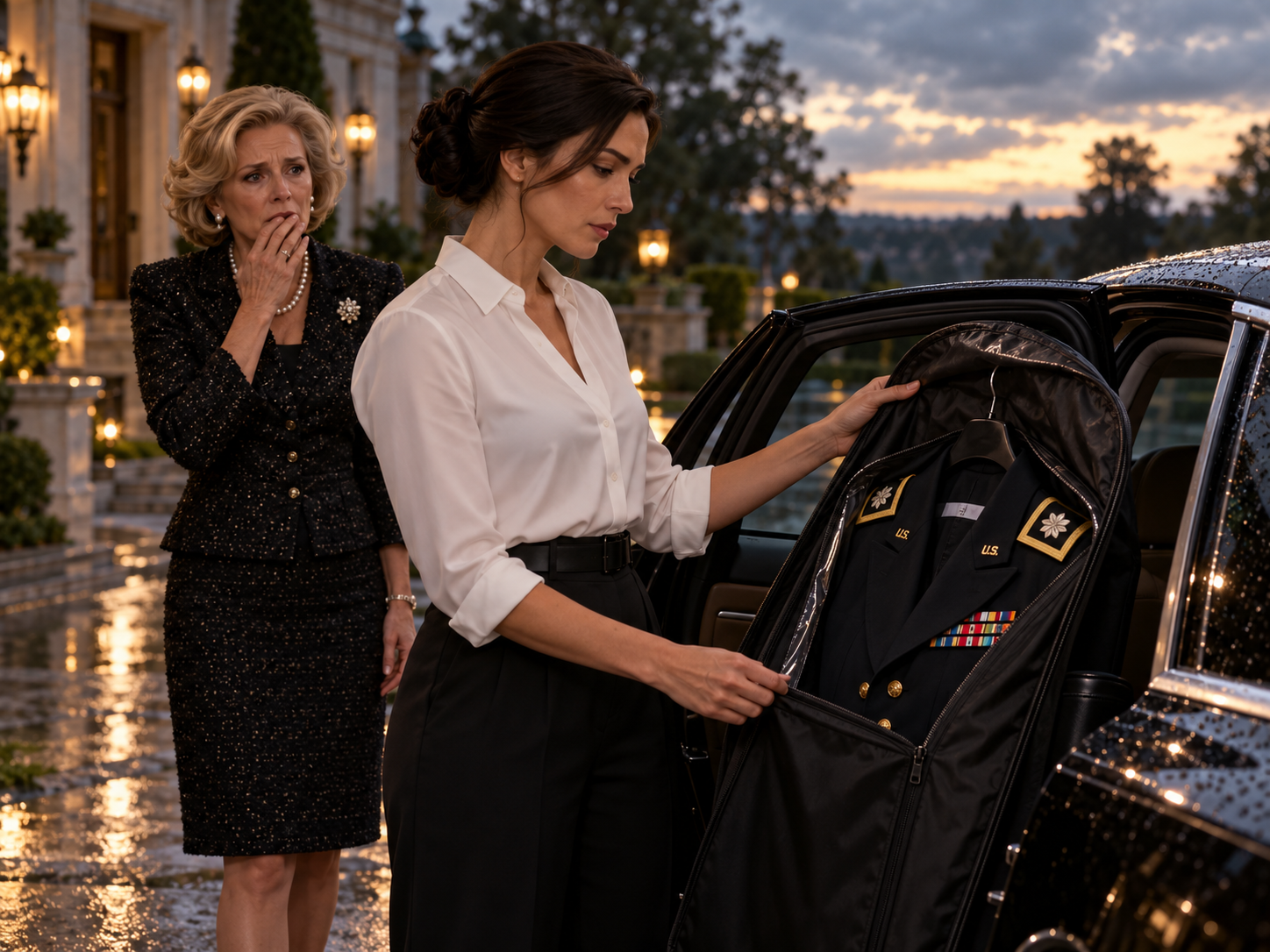
Dark fabric.
Colonel’s eagles.
Ribbons earned across a career my mother had never cared enough to understand.
I had brought it because I had expected to leave Greenwich and drive directly to Fort Hamilton for a formal ceremony honoring one of my former commanders.
The ceremony had been postponed after I told my aide I might be occupied with family matters.
Now I simply stared at the uniform.
Dad had loved seeing me in it.
The last photograph we ever took together showed him beside me after a promotion ceremony.
His hand rested on my shoulder.
He looked happier than I did.
Behind me, the gravel shifted.
Mother had followed.
She stared into the car.
At the uniform.
At the rank.
For once, she did not say anything dismissive.
I reached for the garment bag.
She whispered, “Colonel?”
I looked at her.
“You knew that.”
“I knew the title.”
“No.”
She shook her head.
“I knew people called you Colonel.”
Her eyes remained on the uniform.
“I didn’t understand.”
The sentence landed strangely.
“What didn’t you understand?”
“What it meant.”
I almost laughed.
“Because you never asked.”
She flinched.
I zipped the garment bag closed again.
Mother looked toward the house.
“Your father knew?”
“He knew enough.”
“He never told me.”
“He wasn’t allowed to tell you much.”
“No. I mean…”
Her voice faded.
Then she looked at me.
“He knew how important you were?”
For a moment, I could not speak.
There were a hundred answers I could have given.
Angry ones.
Cruel ones.
Clever ones.
Instead, I chose the true one.
“Dad never needed me to be important.”
Mother’s eyes filled.
“He was proud because I was his daughter.”
She looked away.
And I realized that was the thing she had never understood.
Love did not need a résumé.
It did not need status.
It did not need money.
And if you required those things before someone became worthy of your attention, you had already missed the point.
My phone rang.
Daniel.
His voice was serious.
“Maya, we found something else.”
“What?”
“The Boston property.”
My grandmother’s historic home.
“What about it?”
“Someone tried to collateralize it six months ago.”
My entire body went still.
“Who?”
“That’s the problem.”
A pause.
“The documents carry your signature.”
I looked down at my hand.
“I never signed anything.”
“I know.”
My mother heard enough to understand.
Her face changed.
And this time, when she whispered Marcus’s name—
it sounded like fear.
PART 5 — WHAT MY FATHER ACTUALLY LEFT ME
The forged signature changed everything.
Until then, Marcus could argue about misunderstood authority.
Informal approval.
Messy corporate governance.
Family loans.
Bad bookkeeping.
A signature attributed to me on a loan application was different.
Especially because six months earlier I had been overseas on official travel during the week the document was supposedly signed in Connecticut.
Daniel obtained an emergency order that afternoon.
By the next morning, the Boston property was protected from transfer or encumbrance.
The lender opened an internal investigation.
The construction company’s board suspended Thomas Vale.
Marcus’s financial access was revoked.
And one week later, investigators formally charged both men with multiple counts related to fraud, forgery, and unlawful transfers.
The legal process did not move quickly after that.
Nothing important ever does.
Months passed.
Experts analyzed digital signatures.
Banks produced records.
Attorneys filed motions.
Thomas Vale eventually agreed to cooperate.
Marcus did not.
His defense was simple.
Arthur knew.
Arthur approved.
Arthur changed his mind.
Arthur forgot.
The dead make convenient witnesses because they cannot contradict you.
Except Dad had planned for that.
Benjamin found the most important evidence inside one of Dad’s old notebooks.
A habit everyone had mocked.
Dad did not trust digital systems completely.
For thirty years, he kept a handwritten daily ledger.
Date.
Meeting.
Major decision.
Call.
Signature.
Payment.
On the dates several disputed documents were supposedly signed, his notebook told a different story.
One entry read:
Marcus again requesting authority for JRS bridge loan. Refused. Eleanor angry. Must lock electronic approvals tomorrow.
Another:
Tom claims invoice duplication accidental. I do not believe him.
And finally, five days before his death:
Met Samuel. Hawthorne complete. If pressure placed on Maya, freeze everything. She will know what to do.
I read that sentence perhaps fifty times.
She will know what to do.
I wanted to be proud.
Instead, the first time I read it, I cried.
Dad trusted me.
But more importantly, he had known me.
There is a difference.
Six months after the night of the five attorneys, I stood in probate court beside Daniel Cho.
Mother sat on the opposite side.
Julian sat behind her.
Marcus was not present.
His criminal attorney had advised him to remain away from the civil hearing.
The judge reviewed the Hawthorne provisions.
The will.
The trust.
The medical attestations.
The documentation surrounding Dad’s mental capacity.
Then she rejected every suggestion that Arthur Sterling had been confused or improperly influenced when he completed his estate plan.
My inheritance remained intact.
The two commercial properties.
My grandmother’s Boston home.
The investment portfolio.
And, most importantly, the controlling interest Dad had designated to me inside the family trust.
The judge also upheld the temporary suspension of certain distributions pending resolution of the misconduct findings.
Mother received what Dad had explicitly left her.
The Greenwich estate for life.
A substantial investment account.
Income from a trust.
She was not left destitute.
Not remotely.
Dad had never tried to punish her.
He had simply prevented her from controlling everyone else.
Outside the courthouse, reporters waited.
The case had attracted local business attention once Sterling-Ross Construction became involved.
Daniel asked whether I wanted to use another exit.
I shook my head.
“No.”
He looked surprised.
“You sure?”
“Yes.”
For most of my life, my mother had been obsessed with appearances.
I no longer wanted to organize my decisions around her fear.
But I did not give the reporters a scandal either.
When they asked whether I believed my mother had attempted to steal my inheritance, I simply said:
“This is a family and legal matter. The court has ruled. My priority now is protecting the company’s employees and carrying out my father’s wishes.”
That was all.
No revenge.
No humiliation.
No speech about winning.
Because by then, I understood something.
Victory did not look the way I had expected.
It was not seeing Mother embarrassed.
It was not watching Marcus charged.
It was not keeping every dollar.
Victory was no longer needing their approval to know what I deserved.
Julian caught up with me near the courthouse steps.
“Maya.”
I turned.
He looked different.
Not physically.
Internally.
Six months of consequences had stripped away some of the performance.
His third restaurant location had closed.
The second was sold.
The original location survived only after he brought in an experienced operating partner and stopped pretending confidence was a substitute for competence.
He had also begun repaying money.
Slowly.
Painfully.
Voluntarily.
“I wanted to tell you something,” he said.
“I have a meeting.”
“It’ll take a minute.”
I waited.
He pulled an envelope from his jacket.
I looked at it suspiciously.
“Apparently envelopes are a family disease.”
He laughed.
“Open it later.”
“What is it?”
“First repayment.”
“For what?”
“For Dad.”
I frowned.
“Julian—”
“I know legally I don’t have to pay you personally.”
“Then why—”
“I’m not paying you.”
He nodded toward the envelope.
“It’s a check to the employee pension reserve.”
That silenced me.
Sterling-Ross had not lost retirement funds in Marcus’s scheme, but several planned contributions had been delayed during the financial freeze.
Julian had apparently sold his sports car.
I knew because Mother had complained about it.
“How much?”
“Enough to hurt.”
Despite myself, I smiled.
“That sounds appropriate.”
He smiled too.
Then grew serious.
“I’m trying, Maya.”
“I know.”
“Does that count for anything?”
“Yes.”
He swallowed.
“Enough for you to forgive me?”
“Not yet.”
He nodded.
“Fair.”
I touched his arm before he could leave.
“But enough for lunch.”
He looked at me.
“What?”
“Tuesday. Noon.”
A smile spread across his face.
“I’ll be there.”
“Don’t make me wait.”
“Yes, Colonel.”
I raised an eyebrow.
He laughed and walked away.
I watched him go.
Maybe Dad had been right.
Maybe Julian did not need protection from consequences.
Maybe he needed consequences before he could finally protect himself.
Mother was harder.
For nearly three months after the hearing, we did not speak.
She sent messages occasionally.
Some angry.
Some defensive.
Some painfully ordinary.
Your aunt wants to know whether you still have Grandma’s silver serving tray.
The gardener says the Boston roses need pruning.
Happy birthday.
I answered the practical ones.
Ignored the rest.
Then one Sunday afternoon, I drove to Greenwich.
No lawyers.
No Daniel.
No uniform.
Just me.
Mother was in Dad’s garden.
She looked thinner.
She was kneeling beside the roses wearing old gloves I recognized as his.
She stood when she saw me.
“Maya.”
“Hi.”
“You didn’t call.”
“I know.”
A dozen emotions crossed her face.
Then she nodded toward the house.
“Would you like coffee?”
“No.”
Her disappointment was immediate.
“But I’ll walk.”
So we walked.
Across the lawn.
Past Dad’s empty greenhouse.
Along the stone path near the lake.
For ten minutes, we barely spoke.
Finally, Mother said, “Marcus and I are divorcing.”
I stopped.
She stared ahead.
“I should have done it years ago.”
“Maybe.”
She gave a weak laugh.
“You’re not going to make this easy, are you?”
“No.”
“I suppose I deserve that.”
“That sentence doesn’t fix anything either.”
“I know.”
We continued.
Then she said something I did not expect.
“I was jealous of you.”
I looked at her.
Mother stared at the lake.
“All these years, I told myself you were rejecting me.”
“By joining the Army?”
“By not wanting the life I wanted.”
“That isn’t the same thing.”
“I know that now.”
She rubbed her hands together.
“You walked away from expectations I was never brave enough to challenge.”
I did not interrupt.
“I married your father because I loved him. But I also loved what being Mrs. Arthur Sterling meant.”
At least she was telling the truth.
“I liked the houses. The invitations. The certainty.”
She looked at me.
“And then you were offered all of it.”
“You wanted me to marry Preston Caldwell.”
A grimace crossed her face.
“That was a terrible suggestion.”
I laughed.
The sound surprised both of us.
Preston had once spent an entire dinner describing his wine cellar without asking me a single question.
Mother almost smiled.
Then her expression crumbled.
“When you joined the military, I kept waiting for you to regret it.”
“I know.”
“And every year you didn’t, it felt like you were proving my life wrong.”
My anger softened, but it did not disappear.
“My life was never a judgment of yours.”
“I know.”
“You punished me for being different.”
“Yes.”
That answer mattered.
No excuses.
No “but.”
Just yes.
“And the inheritance?”
Her eyes filled.
“I was afraid.”
“Of losing money?”
“Of losing control.”
Another honest answer.
“Arthur had always cleaned up everything.”
She looked toward the house.
“Marcus made problems disappear. Or I thought he did. Julian needed money. The company issues were getting worse. Then Arthur died.”
She swallowed.
“And suddenly you were going to have authority over things I didn’t understand.”
“So you tried to make me surrender it.”
“Yes.”
“Did you know about the forged signature?”
“No.”
I watched her carefully.
For years, I had been paid to detect deception.
Yet sitting across from my mother had always been harder than interrogating strangers.
This time, I believed her.
She had enabled Marcus.
Ignored warning signs.
Participated in coercion.
But the forged documents had been his.
“I should have stopped him earlier,” she said.
“Yes.”
“I should have defended you more.”
“Yes.”
“I should never have slapped you.”
“Yes.”
Her eyes spilled over.
“And I should have asked what you did.”
That one hurt the most.
I looked at the water.
She whispered, “What do you do, Maya?”
I almost laughed.
After thirty-nine years, my mother had finally asked.
“I can’t tell you most of it.”
She nodded.
“What can you tell me?”
I thought about that.
“I lead people.”
“How many?”
“Enough to keep me awake.”
She smiled faintly.
“What else?”
“I analyze problems. I advise people. I make decisions.”
“Difficult ones?”
“Sometimes.”
“Do people trust you?”
My throat tightened.
“I hope so.”
She nodded slowly.
“Your father did.”
We stood quietly beside the lake.
Then Mother said:
“I’m proud of you.”
I closed my eyes.
For years, I had imagined hearing those words.
Sometimes in anger.
Sometimes triumphantly.
Sometimes after promotions, when I still carried some childish hope that a new rank might finally make me impressive enough.
Now that they had arrived, they did not fix the past.
But they did not mean nothing either.
I looked at her.
“Thank you.”
She seemed surprised.
Perhaps she expected punishment.
Perhaps part of me wanted to give it.
Instead, I said:
“But if we’re going to have a relationship, it has to be different.”
She nodded.
“No using Julian to reach me.”
“Yes.”
“No discussing my money.”
“All right.”
“No surprise lawyers.”
A tiny smile appeared.
“I think I’ve learned that one.”
“And no pretending this never happened.”
Her smile vanished.
“I understand.”
I believed she did.
Not perfectly.
Maybe not permanently.
But enough to begin.
A year after Dad’s death, we held a small gathering at the Boston house.
Not a memorial exactly.
Dad would have hated anything that sounded too ceremonial.
Benjamin came.
Samuel Reed came.
Several longtime Sterling-Ross employees brought their families.
Julian arrived early and spent an hour carrying folding chairs because I refused to hire a catering crew large enough to do everything.
Mother brought Dad’s favorite lemon cake.
At sunset, I stood on the back porch looking over the garden my grandmother had planted decades earlier.
Julian joined me.
“You keeping this place?”
“Yes.”
“No luxury hotel?”
“No.”
“No high-end restaurant?”
“Absolutely not.”
He pretended to be offended.
“I’ve improved.”
“So has food poisoning treatment. I still try to avoid it.”
He laughed.
For the first time in years, being his sister did not feel like standing on opposite sides of a courtroom.
He pointed toward the lawn.
“Mom’s talking to Samuel.”
“That’s brave.”
“She apologized to him.”
I turned.
“You’re joking.”
“Nope.”
“Did anyone record it?”
“Maya.”
“For historical preservation.”
Julian laughed again.
Then we grew quiet.
“Marcus took a plea,” he said.
“I heard.”
Restitution.
Probation following a custodial sentence.
Permanent restrictions on serving in certain fiduciary corporate roles.
Thomas Vale had cooperated and received a reduced sentence.
No dramatic ending.
No one vanished into a prison for life.
Just consequences.
The kind that arrive slowly and stay longer than headlines.
Julian leaned against the railing.
“Do you ever think about what would’ve happened if you signed?”
“Yes.”
The answer came immediately.
“What?”
“I think the company would’ve eventually discovered the fraud. But later.”
“How much later?”
“Long enough to hurt more people.”
He nodded.
“And Mom?”
“I don’t know.”
“And me?”
I looked at him.
“You would’ve spent the money.”
He winced.
“Probably.”
“And asked for more.”
“Okay, Colonel. No need to enjoy this.”
“I’m not enjoying it.”
“You’re definitely enjoying some of it.”
Maybe I was.
A little.
The back door opened.
Benjamin stepped outside holding a small wooden box.
“Maya.”
“What is that?”
He smiled.
“Your father left one more instruction.”
Julian groaned.
“Seriously?”
Benjamin laughed.
“This one isn’t legal.”
He handed me the box.
Inside was Dad’s watch.
The old stainless-steel one he had worn for nearly twenty-five years.
Underneath it was a folded note.
I opened it.
Maya,
If Benjamin remembered to give you this, then either he is becoming organized in old age or you threatened him.
I laughed through the tears already forming.
Benjamin looked offended.
“I resent that.”
The letter continued.
You once asked why I kept wearing this old thing when I could afford a better one.
The answer was simple.
It still worked.
People waste too much of life replacing things that are still good because they want something shinier.
Do not make that mistake with people.
But do not confuse repairable with safe.
Some relationships need patience.
Some need distance.
Wisdom is knowing which is which.
I hope you keep the house.
I hope Julian grows up.
I hope your mother learns to see you.
Mostly, I hope you build a life that does not require you to prove anything to anyone.
I was proud of you before the uniform.
I was proud of you before the rank.
I was proud of you before you understood why.
Love,
Dad
For several seconds, I could not move.
Then Julian read over my shoulder.
“He got one insult in.”
I laughed through my tears.
“You do need to grow up.”
“Apparently from beyond the grave.”
I fastened Dad’s watch around my wrist.
It was too loose.
It had always been too loose.
Mother appeared in the doorway.
Her eyes went immediately to the watch.
“Oh.”
She pressed a hand to her mouth.
I walked toward her.
For a moment, both of us simply looked at it.
Then she touched the metal gently.
“He wore that everywhere.”
“I know.”
“He wore it at our wedding.”
“I know.”
She looked at me.
“It suits you.”
That meant more than she understood.
Later that evening, everyone left.
I remained alone at the Boston house.
The rooms were quiet.
The inheritance papers were finally settled.
The corporate audit was finished.
Most of the stolen money had either been recovered or placed under restitution orders.
Sterling-Ross had elected a new CFO.
I had appointed an independent board member rather than trying to run a construction company between military assignments.
Julian had become, remarkably, a responsible minority shareholder.
Mother and I spoke once a week.
Sometimes the conversations went badly.
Sometimes they went well.
Real healing was less cinematic than confrontation.
But it was real.
I stepped onto the porch.
Dad’s watch ticked against my wrist.
For months, everyone had talked about what Arthur Sterling left behind.
Properties.
Shares.
Money.
Trusts.
Control.
They had measured his legacy in numbers.
Even I had done it at first.
But standing there in the fading light, I finally understood that the most important things my father left me would never appear in probate court.
He left me the certainty that quiet people are not weak.
That preparation is not paranoia when something matters.
That love without courage can become silence.
That family does not earn the right to hurt you simply because they are family.
And that strength does not always mean destroying the people who tried to corner you.
Sometimes strength means protecting yourself without becoming cruel.
Sometimes it means letting consequences do their work.
Sometimes it means giving someone a path back—but refusing to carry them down it.
Three weeks after my father died, my mother had locked me in a room with five attorneys because she believed pressure would make me surrender.
She believed the quiet daughter would eventually obey.
She believed my career was ordinary.
My judgment unimportant.
My father’s trust in me excessive.
She had been wrong about all of it.
But the greatest surprise was not that I defeated five lawyers.
It was not that Marcus’s scheme collapsed.
It was not even that I kept the inheritance.
The greatest surprise was that after all the fighting was finished, I no longer needed to defeat my family.
I only needed to stop surrendering myself to them.
I looked down at Dad’s watch.
Still ticking.
Still working.
And for the first time since his funeral, thinking about him did not feel only like losing something.
It felt like carrying something forward.
I smiled into the quiet house.
“Good night, Dad.”
Then I turned off the porch light and went inside.
For once, there was no ambush waiting for me.
Only home.
THE END