The SEAL Admiral Mocked My Silver Oak Leaf—Until Two Words Made His Confidence Disappear
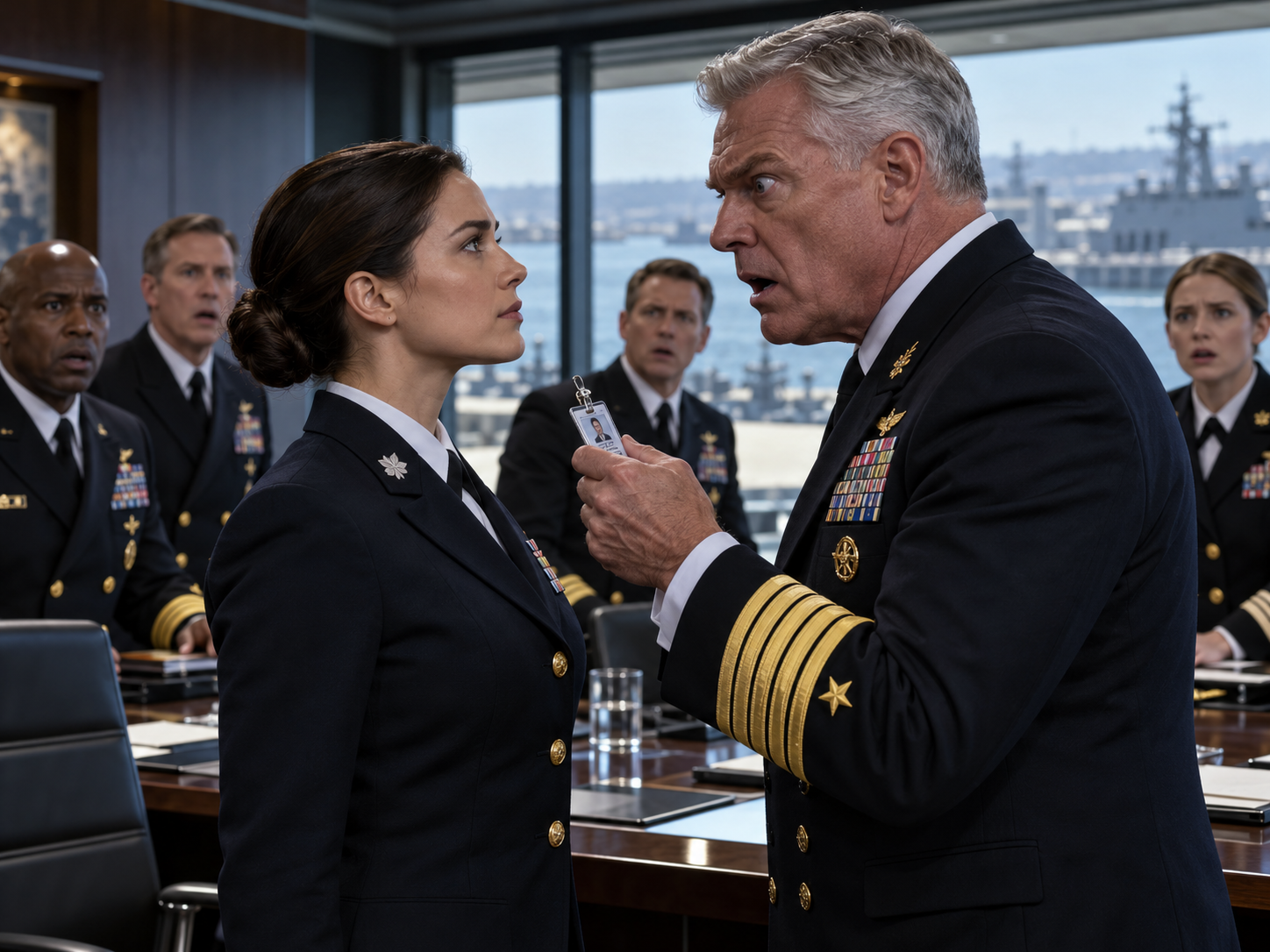
The first thing Admiral Knox Harlan did was ridicule the silver oak leaf on my uniform.
The second was make the senior officers surrounding us laugh at my expense.
Then he lifted my identification badge between two fingers, as though touching it disgusted him.
“Sweetheart, go back to whichever office sent you. Navy SEALs don’t take orders from decorative little officers.”
Nobody intervened.
Not the captains lined up against the wall.
Not the Marine colonel standing beside the coffee station.
Not even the young lieutenant whose face had gone pale the moment Harlan grabbed my badge.
But the admiral didn’t know why I had traveled across three oceans to stand in that room.
He didn’t know what I’d discovered about the helicopter that vanished near Guam.
And he certainly didn’t understand why I’d come looking for him.
So when he leaned toward me, smiling as though he’d already won, I looked directly into his eyes and said two words.
“Fleet Commander.”
His smile disappeared.
His fingers stopped moving.
And the badge suspended between them trembled.
For the first time, the legendary admiral looked genuinely afraid.
The conference room at Naval Amphibious Base Coronado had fallen almost completely silent.
The air-conditioning clicked somewhere beyond the flags displayed along the wall.
Admiral Knox Harlan stood inches from me, holding my identification badge in his broad hand.
He wore an expensive gold ring.
His knuckles bore old scars.
Everything about him suggested a man accustomed to having his orders obeyed without question.
I lowered my gaze toward the badge.
My name was clearly visible.
Commander Evelyn Hart.
Beneath it appeared my official assignment.
Special Advisor, Maritime Readiness Review.
It was a deliberately unremarkable title.
The sort of designation that made powerful men assume they were dealing with a routine administrative visitor.
Someone who reviewed documents.
Someone who wrote reports.
Someone who could be dismissed without consequences.
That assumption was useful.
And Harlan had accepted it immediately.
He looked at the badge again.
Then smiled even wider.
The admiral was sixty-two years old.
Broad shoulders.
Silver hair.
A chest crowded with military decorations.
His voice carried the kind of authority that could silence an entire room without effort.
Throughout his career, he’d become something of a legend.
Younger officers repeated stories about his accomplishments.
His photograph appeared in magazines.
His reputation followed him into every briefing.
People had become so accustomed to respecting him that many laughed at his jokes before deciding whether they were actually funny.
But behind that celebrated reputation was a problem.
For six months, Admiral Harlan had been disregarding lawful orders.
And I had traveled across three oceans to understand why.
He tilted his head toward me.
“Commander Hart.”
He exaggerated my rank, pronouncing it as though he were speaking to a child pretending to be a naval officer.
“Do you understand where you are?”
I met his gaze.
“Yes, Admiral.”
“And do you understand who you’re addressing?”
“Yes, Admiral.”
His expression became smug.
“Then you should know better than to walk into my command center during a restricted operational review and demand sealed records.”
I kept my voice even.
“I didn’t demand anything, Admiral.”
The laughter around us began to fade.
Not completely.
But enough that I noticed the change.
Harlan’s smile shifted.
“What did you say?”
I didn’t look away.
“I said I made no demand.”
I paused.
“I requested compliance with an order authorized at fleet level.”
That changed the atmosphere.
Several officers exchanged quick glances.
Inside a Navy command center, a reference to fleet-level authority wasn’t something people casually ignored.
Harlan stepped closer.
I caught the scent of expensive aftershave mixed with coffee.
His smile disappeared behind an expression of practiced intimidation.
“Listen carefully, little lady.”
He leaned toward me.
“I’ve buried officers better than you before most men finish breakfast.”
Near the doorway, the young lieutenant swallowed.
I noticed the nervous movement in his throat.
But I didn’t react.
I didn’t reach for my badge.
I didn’t step backward.
And I didn’t allow my expression to change.
Harlan wanted me frightened.
He wanted everyone watching to see me lose control.
I had no intention of giving him either satisfaction.
My assignment had never been about winning an argument with an admiral.
It was about what had happened near Guam.
About a helicopter that had disappeared beneath dark ocean water.
And about the final transmission of Captain Jonah Pierce.
I still remembered that message.
Even now, standing inside the Coronado conference room, I could hear the urgency of those final moments in my memory.
Then I remembered the ceremony afterward.
Captain Pierce’s wife standing beside a folded American flag.
Their two children close to her.
Children young enough to believe their father might somehow walk through the door again.
There were details I hadn’t been able to forget.
Maintenance records that vanished without explanation.
A rescue-channel frequency that abruptly went silent.
And a damaged file containing one name.
A name that appeared only once.
Hidden deep enough that someone might reasonably have expected it to remain unnoticed.
HARLAN.
I had examined that fragment more times than I cared to remember.
It was one reason I was now standing in front of the admiral.
Another was his repeated refusal to comply with lawful orders.
The two issues demanded answers.
And I wasn’t leaving simply because Knox Harlan considered himself too important to be questioned.
The admiral still held my badge between his fingers.
Around us, the officers remained silent.
His decorations caught the conference-room lighting.
His reputation filled the room almost as completely as his voice.
But I had not traveled across three oceans to be intimidated by someone’s reputation.
I thought again about Captain Pierce.
About the empty place he’d left in his children’s lives.
About the records that should have existed but didn’t.
About the communications channel that had fallen silent at the worst possible moment.
And about the admiral who’d spent six months resisting orders that might have helped explain what happened.
I lifted my chin slightly.
Then looked straight into Harlan’s eyes.
“Fleet Commander.”
Two words.
Nothing more.
But their effect was immediate.
Harlan’s fingers froze around my identification badge.
For a fraction of a second, the card trembled.
The movement was so slight that someone standing farther away might have missed it.
I didn’t.
And neither did the officers closest to us.
A captain beside the projection screen straightened immediately.
The Marine colonel near the coffee station withdrew his hand from his cup.
Somewhere behind me, a voice murmured:
“Oh, hell.”
I kept my eyes on Harlan.
Something had changed in his expression.
Only moments earlier, he’d been enjoying himself.
He’d mocked my rank.
Humiliated me in front of fellow officers.
And treated my request for sealed records as though it were an amusing inconvenience.
Now he stood perfectly still.
His famous confidence had faltered.
The man who normally controlled every room he entered suddenly appeared uncertain of what came next.
For one brief moment, I could almost see the public image falling away.
The decorated admiral.
The legendary warrior.
The intimidating commander whose stories younger officers repeated with admiration.
None of those things seemed to matter anymore.
He was simply Knox Harlan.
A man who had just heard two words he clearly hadn’t expected from a woman he believed was an insignificant administrative officer.
Fleet Commander.
I hadn’t raised my voice.
I hadn’t threatened him.
I hadn’t even taken my identification badge out of his hand.
Yet the tension in the room had shifted completely.
Harlan stared at me as though he were trying to determine how much I knew.
The young lieutenant remained silent.
The captains were watching.
And nobody was laughing anymore.
Finally, Harlan found his voice.
It was quieter than before.
More careful.
“What did you just say?”
I held his gaze.
The missing records.
Captain Pierce’s final transmission.
The rescue frequency that went silent.
The damaged file carrying Harlan’s name.
All of it had brought me to that moment.
And as the admiral stood before me, still gripping my badge, I knew one thing for certain.
He had recognized something in those two words that he desperately wished I hadn’t known.
PART 2 — THE ORDER HE COULDN’T DESTROY
“Fleet Commander,” I repeated. “Those were the words Captain Pierce transmitted nineteen seconds before his helicopter disappeared.”
Admiral Harlan’s expression changed again.
This time, there was no mistaking it.
Fear.
Not the dramatic kind people imagined in movies. No widened eyes or backward stumble. Just a small tightening around his mouth and the sudden stillness of a man who had spent decades training himself never to reveal uncertainty.
He finally released my identification badge.
It struck the conference table with a sharp plastic click.
“Clear the room,” he ordered.
Nobody moved.
Harlan’s jaw tightened.
“I said clear the damn room.”
“Not yet,” I said.
His eyes snapped toward mine.
“Commander, you are standing in a secure operational facility under my authority.”
“And you are obstructing an investigation authorized by the Commander, U.S. Pacific Fleet.”
I opened the leather portfolio beneath my arm.
Inside were three documents.
The first established my temporary assignment.
The second directed the preservation of records associated with the disappearance of helicopter Raven Six.
The third was signed by Admiral Thomas Whitaker, the fleet commander.
Harlan recognized the signature immediately.
I could tell because he stopped breathing for a moment.
He hadn’t expected me to possess that document.
And more importantly, he hadn’t expected me to bring it into a room full of witnesses.
I placed the papers on the table.
“Read the final paragraph, Admiral.”
He didn’t touch them.
Instead, his gaze moved toward Captain Marcus Vale, the operations officer standing near the projection screen.
Vale was a narrow-faced man in his late forties, with perfectly combed hair and an expression so carefully neutral it seemed rehearsed.
Their eyes met.
Something passed between them.
Something I couldn’t yet identify.
Harlan finally looked down.
His lips moved silently as he read.
The order directed every command involved in Raven Six’s final mission to preserve and produce the relevant records. It specifically prohibited informal destruction, unauthorized alteration, or additional restrictions on access.
“Whitaker never mentioned this,” Harlan muttered.
“He did, Admiral. Six months ago. Then again four months ago. And once more last Thursday.”
Harlan looked up sharply.
“You’ve been communicating directly with him?”
“Yes.”
“Without notifying my command?”
“The order notified your command.”
I let that answer stand.
Behind me, someone shifted a chair.
The young lieutenant near the door looked as if he wanted to disappear through the wall.
Harlan studied me for several seconds.
Then his expression hardened.
“You don’t understand the sensitivity of what you’re investigating.”
“That is precisely why I’m here.”
“You have no idea what happened near Guam.”
“Then explain it.”
His mouth closed.
For a long moment, neither of us spoke.
Finally, he turned to the other officers.
“Everyone except Captain Vale and Commander Hart is dismissed.”
I glanced toward the lieutenant.
“No. Lieutenant Bennett stays.”
Harlan stared at me.
“Excuse me?”
“Lieutenant Daniel Bennett accompanied the original records request. He’s an authorized member of the review team, and he’ll remain.”
Bennett looked startled.
Vale’s expression changed almost imperceptibly.
Harlan’s voice became dangerously quiet.
“Commander Hart, don’t mistake your paperwork for command authority.”
“I won’t. And I suggest you don’t mistake your rank for immunity from lawful oversight.”
The room went silent again.
I knew I had crossed a line in the admiral’s mind.
Not a professional line.
A personal one.
Men like Knox Harlan could tolerate disagreement if they believed they would eventually win.
What they could not tolerate was being contradicted in front of people whose admiration they considered their property.
Harlan stepped away from the table.
“Very well,” he said. “Everyone stays.”
He forced a smile.
“Let’s hear the commander’s theory.”
I disliked the word immediately.
Theory.
As though the deaths of five service members were a classroom exercise.
I activated the presentation system and inserted an authorized evidence drive.
A satellite map of the western Pacific appeared on the screen.
A red marker identified a location eighty-three nautical miles southwest of Guam.
“On April seventeenth,” I began, “Raven Six departed a naval staging facility shortly after 0200 local time. The aircraft was carrying five personnel.”
I changed the slide.
Their photographs appeared.
Captain Jonah Pierce.
Lieutenant Sarah Mendoza.
Chief Petty Officer Benjamin Ortiz.
Petty Officer First Class Lucas Reed.
Aircrewman Second Class Aaron Collins.
Five faces.
Five service records.
Five families.
“According to the final accident summary, Raven Six encountered severe weather, lost communications, and crashed into the Philippine Sea. No survivors were recovered.”
Harlan folded his arms.
“That’s correct.”
“It’s also incomplete.”
I brought up another document.
“Three hours before departure, a maintenance technician reported an intermittent fault in the aircraft’s primary navigation interface.”
Captain Vale shifted.
“The issue was cleared,” he said.
“According to the official record, yes.”
“Because it was repaired.”
“Then perhaps you can explain why the repair authorization was entered twelve minutes after the helicopter departed.”
Vale said nothing.
I continued.
“The signature belongs to a technician who was on medical leave in Hawaii.”
Harlan’s eyes flickered toward Vale.
I noticed.
So did Lieutenant Bennett.
“That’s an administrative error,” Harlan said.
“Possibly.”
I changed the image again.
This one showed a communications timeline.
“At 0217, Raven Six contacted its assigned controller. At 0223, the aircraft reported unexplained navigation discrepancies. At 0226, Captain Pierce requested confirmation of a route change.”
“And?” Harlan asked.
“At 0228, an encrypted instruction was transmitted from a command relay assigned to your operational staff.”
Vale’s hands disappeared beneath the table.
“The instruction directed Raven Six away from its filed route.”
Harlan’s face remained blank.
I continued.
“Nineteen minutes later, Captain Pierce transmitted two words.”
I looked directly at the admiral.
“Fleet Commander.”
Nobody moved.
“The accident report omits that transmission entirely.”
Harlan’s voice sounded strained.
“Because it never occurred.”
I reached into my portfolio and removed a small evidence envelope.
Inside was a photograph of a damaged data module.
“The transmission was recovered from a secondary recorder that survived long enough to store a fragment of the final exchange.”
Vale leaned forward.
“Where did you get that?”
It was the first genuinely spontaneous thing he’d said.
I turned toward him.
“Why?”
“Because that equipment was never recovered.”
“According to the accident report,” I said, “it wasn’t.”
His face drained slightly.
And I knew.
He had recognized the module.
I allowed the silence to lengthen.
Then I played the recording.
Static filled the room.
A faint mechanical alarm sounded beneath overlapping voices.
A male voice came through.
Jonah Pierce.
I had listened to that voice hundreds of times.
It still made my throat tighten.
“Control, Raven Six. Our assigned navigation references are inconsistent. Confirm authority for the revised corridor.”
Static.
Then a second voice.
Distorted.
Unidentifiable.
“Maintain heading. Authorization confirmed.”
Pierce answered.
“Negative. Request authentication.”
More interference.
Then his voice again.
Louder this time.
“Fleet Commander.”
A burst of static.
An alarm.
And finally:
“We are not where they’re telling us we are.”
The recording ended.
The conference room seemed colder afterward.
Lieutenant Bennett stared at the screen.
Harlan remained motionless.
Captain Vale looked down at his hands.
I turned off the recording.
“That last sentence,” I said, “was also excluded from the accident report.”
Harlan took a slow breath.
“Audio fragments can be misinterpreted.”
“Certainly.”
“Interference can distort meaning.”
“Yes.”
“Then you have nothing conclusive.”
“Not yet.”
He smiled.
It was a small, ugly smile.
“There we are.”
I met his gaze.
“But I have enough to know someone altered the official account.”
His smile disappeared.
Before he could respond, the conference-room door opened.
A security officer stepped inside.
“Admiral, sir. We have an issue at the records facility.”
Harlan turned sharply.
“What issue?”
The officer hesitated.
“There’s been an electrical failure.”
Vale stood.
“Which facility?”
“Building Twelve, sir.”
I looked toward Lieutenant Bennett.
He looked back at me.
Building Twelve.
The secure archive where the original Raven Six mission records were stored.
The same records my authorization required Harlan’s command to preserve.
The security officer continued.
“Fire suppression activated in the server room. Technicians are reporting extensive damage.”
Harlan stared at him.
For a moment, the admiral’s expression was unreadable.
Then he turned toward me.
“What an unfortunate coincidence, Commander.”
I picked up my portfolio.
“Very unfortunate.”
He narrowed his eyes.
“Where are you going?”
“To Building Twelve.”
“That facility is restricted.”
“So were the records you were ordered to preserve.”
I stepped toward the door.
Harlan moved into my path.
“Commander Hart, I am ordering you to remain here.”
I stopped.
Then I spoke quietly enough that only he could hear.
“Captain Pierce left something behind, Admiral.”
His expression shifted.
I leaned closer.
“And I don’t believe the records in Building Twelve were the only copies.”
For the first time, I saw something beyond fear in Knox Harlan’s eyes.
I saw calculation.
The kind of calculation made by a man deciding whether the person standing in front of him had become too dangerous to ignore.
He stepped aside.
I walked past him.
Lieutenant Bennett followed.
We reached the corridor before he spoke.
“Ma’am?”
“Yes, Lieutenant?”
“There’s something you need to know.”
I stopped walking.
His face was pale.
“I was assigned to Building Twelve six months ago. Before my transfer.”
“What happened?”
He glanced behind us.
Then lowered his voice.
“Captain Pierce’s records weren’t the first ones they altered.”
I felt my heartbeat change.
“Explain.”
Bennett swallowed.
“There were three other aircraft incidents.”
“Where?”
“Different locations. Different years.”
He looked directly at me.
“But every one of them had the same authorization code.”
“What code?”
His voice dropped almost to a whisper.
“HARLAN-ONE.”
And suddenly, the missing helicopter near Guam no longer looked like an isolated tragedy.
It looked like part of something much larger.
Something that had been happening for years.
Something powerful people had worked very hard to keep buried.
PART 3 — THE GHOSTS BENEATH THE PACIFIC
By the time we reached Building Twelve, the parking lot was full of emergency vehicles.
Red lights flashed against concrete walls.
A fire crew was hauling equipment through the entrance.
Two military police officers stood beside a security barrier, directing personnel away from the east wing.
The smell hit me before I entered.
Burned plastic.
Electrical insulation.
And something sharper beneath it.
Chemical suppressant.
Lieutenant Bennett walked beside me, his shoulders rigid.
“Ma’am, there’s something else.”
I slowed.
“Go on.”
“Building Twelve has independent backup power.”
“I know.”
“And its fire-suppression system is designed to protect the records.”
I turned toward him.
“So how does a power failure destroy the archive?”
He didn’t answer.
He didn’t need to.
Inside the building, a civilian technician approached us.
Her identification badge read DR. MAYA CHEN — SYSTEMS ENGINEERING.
She looked exhausted.
“Commander Hart?”
“Yes.”
“I’m Dr. Chen. I was told to meet you.”
“What’s the damage?”
She hesitated.
“The primary server array is offline. Several storage units were physically damaged.”
“By the fire?”
“There wasn’t a fire.”
I stopped.
Chen glanced toward a nearby security officer.
Then lowered her voice.
“The sensors registered smoke, but nobody has found evidence of combustion. The suppression system activated after a deliberate shutdown sequence.”
“Deliberate?”
“Someone accessed the maintenance control panel and forced the servers into an unsafe power state. The suppression system activated during the resulting fault.”
Bennett stared at her.
“Who authorized that?”
Chen’s expression tightened.
“The access record identifies Captain Marcus Vale.”
I felt the pieces move into place.
The altered maintenance authorization.
The missing communications record.
The admiral’s reaction to the words Fleet Commander.
Vale’s interest in the recovered data module.
And now this.
“Has Captain Vale been informed?” I asked.
Chen shook her head.
“Not by me.”
“Good.”
I took out my phone and contacted the fleet investigative liaison.
I gave him the essential facts, requested immediate preservation of all access records, and asked that Captain Vale’s credentials be temporarily suspended pending verification.
Then I contacted Admiral Whitaker’s office.
His chief of staff answered.
“Commander Hart, the admiral is expecting your update.”
“Tell him we have an attempted destruction of evidence.”
A pause.
“Are you certain?”
“The engineering logs identify deliberate interference. The incident occurred minutes after I confronted Admiral Harlan.”
“Understood.”
“And tell Admiral Whitaker I need independent investigative personnel on site. Not people assigned through Harlan’s staff.”
“Consider the request transmitted.”
I ended the call.
Bennett looked at me.
“Ma’am, if Harlan controls the command, won’t he know everything we’re doing?”
“Probably.”
“Then how do we stop him?”
I looked toward the damaged server room.
“By finding something he doesn’t know exists.”
Two hours later, we had our first answer.
Dr. Chen led us into a secondary equipment room.
Most of the racks stood dark, but one narrow cabinet remained powered by a separate electrical circuit.
Inside were three small storage units.
Chen pointed to the middle one.
“This is a diagnostic backup. It wasn’t included in the standard archive inventory.”
“Why not?”
“It was installed during an engineering upgrade and never formally transferred to the operations staff.”
Bennett leaned forward.
“Does it contain Raven Six records?”
“Fragments. System transactions, metadata, limited communications routing information.”
“Can you recover them?”
Chen looked at me.
“If I can work without someone interrupting me.”
“You can.”
She nodded once.
Then began typing.
For nearly forty minutes, the room contained only the hum of cooling fans and the quiet tapping of keys.
I stood behind her, watching lines of information appear.
There were timestamps.
Equipment identifiers.
Transfer requests.
Access records.
Then Chen stopped.
“Oh.”
Something in her voice made me step closer.
“What?”
She enlarged a set of entries.
“Commander, this wasn’t just an archive.”
“What do you mean?”
“Someone was using the facility to maintain an unofficial routing index.”
Bennett frowned.
“For aircraft?”
“For mission communications. Specifically, changes made after the original mission packages were approved.”
She opened another file.
A list appeared.
Four operations.
Four dates.
Four locations.
And beside each one, the same authorization identifier.
HARLAN-ONE.
The oldest dated back almost three years.
An aircraft off Okinawa had reported instrument inconsistencies before making an emergency landing.
A reconnaissance helicopter in the Indian Ocean had experienced an unexplained route deviation, forcing its crew to ditch at sea. They were rescued.
A training aircraft operating near Hawaii had reported communications anomalies shortly before a serious accident.
And Raven Six.
The final entry.
The only one with all five crew members officially presumed dead.
I stared at the screen.
“Were these incidents investigated together?”
Chen shook her head.
“The index appears designed to connect them. But I can’t tell who created it.”
Bennett pointed at a column.
“What’s this?”
A sequence of numbers appeared beside each operation.
Chen examined them.
“Financial reference identifiers.”
My stomach tightened.
“Associated with what?”
“I don’t know yet.”
She opened a related directory.
Inside were invoices issued to a private defense contractor.
Triton Maritime Systems.
The company provided communications equipment, software integration, and technical support for classified maritime programs.
I recognized the name.
Triton had appeared in two congressional procurement reviews.
It was also the company that maintained several components installed aboard Raven Six.
Chen opened the oldest transaction.
Then the second.
Then the third.
Each referenced a software modification package.
Each had received certification after the associated aircraft incident.
Bennett stared.
“They were using operational incidents to justify upgrades.”
“Maybe,” Chen replied. “But that’s not all.”
She opened a fourth entry.
The payment amount was larger.
Much larger.
A supplemental contract worth nearly forty million dollars.
Approved eleven days after Raven Six disappeared.
I felt something cold settle in my chest.
Five lives.
Forty million dollars.
An admiral who refused to surrender records.
And a contractor whose equipment had appeared in multiple unexplained incidents.
I had spent months looking for a concealed operational failure.
Now I wondered whether I had been looking at deliberate misconduct.
At 1530, I received a call from Admiral Whitaker.
“Evelyn.”
His voice was steady, but I knew him well enough to hear the concern beneath it.
“Sir.”
“How bad?”
“Potentially worse than we anticipated.”
“Explain.”
I described the damaged archive, the recovered index, the contractor records, and Captain Vale’s apparent connection to the server shutdown.
Whitaker listened without interrupting.
When I finished, he remained silent for several seconds.
“Do you have the original data secured?”
“The surviving devices are being preserved. Dr. Chen is documenting the recovery process with independent witnesses.”
“Good.”
“Sir, I need to ask you something.”
“Go ahead.”
“Why did you choose me?”
He sighed.
“I assumed you knew.”
“I know you trusted my previous work. That isn’t the same thing.”
Another silence.
Then he said something that changed the entire investigation.
“Because Jonah Pierce asked for you.”
I gripped the phone.
“What?”
“Three days before his final flight, Captain Pierce requested a private communication with my staff. He reported concerns about mission modifications and possible interference from outside his chain of command.”
I felt the room tilt slightly.
“He spoke to you?”
“Not directly. His message was routed to my office, but the secure appointment never took place.”
“Why?”
“His mission schedule was advanced.”
I closed my eyes.
“Who advanced it?”
“We haven’t established that.”
“Why wasn’t I told?”
“Because the message was discovered during the preliminary review. And because I wanted to confirm it before adding another uncertainty to your case.”
I looked through the glass toward Bennett and Chen.
They were still working.
“Did Jonah mention my name?”
“Yes.”
I waited.
Whitaker’s voice softened.
“He said Commander Evelyn Hart was the one person he trusted to recognize when a mission record didn’t tell the truth.”
For a moment, I couldn’t speak.
Jonah Pierce had been my closest friend for nearly fifteen years.
We met during a joint maritime planning course.
He was quick to laugh, impossible to discourage, and stubborn about doing the right thing even when it made his life harder.
I was the more cautious one.
He used to call me his human emergency checklist.
I called him a walking disciplinary hearing.
When my father died, Jonah flew across the country to stand beside me at the funeral.
When Jonah married Rebecca, I was there.
When their daughter was born, he called me from the hospital before he called half his relatives.
And when he disappeared near Guam, I was attending a readiness conference in Singapore.
I remembered seeing the notification.
I remembered rereading it.
I remembered how the words failed to make sense.
Now I learned that Jonah had been trying to reach me before his last mission.
Trying to warn someone.
Trying to stop whatever was happening.
“Evelyn?” Whitaker asked.
“I’m here, sir.”
“Do not make this personal.”
I swallowed.
“It already is.”
“I know.”
His voice hardened.
“But personal grief cannot be allowed to compromise the evidence.”
“It won’t.”
“Good. Because I have another problem.”
I waited.
“Someone has contacted the Pentagon claiming you’re conducting an unauthorized investigation.”
I almost laughed.
“Let me guess.”
“Harlan.”
“He’s getting desperate.”
“Perhaps. But desperation makes people unpredictable. I’ve ordered additional oversight and requested an independent criminal investigation. Until those personnel arrive, keep your team together.”
“Yes, sir.”
“And Evelyn?”
“Sir?”
“Don’t underestimate him.”
I looked at the recovered authorization records.
“I haven’t.”
At 1900, we returned to the temporary review office.
An armed security detail had been assigned to the corridor.
Dr. Chen worked at one end of the table.
Lieutenant Bennett sat opposite her, reviewing personnel rosters from the four incidents.
I had not eaten since morning.
My coffee was cold.
And every time I closed my eyes, I heard Jonah’s final words.
We are not where they’re telling us we are.
At 1936, Bennett suddenly stopped typing.
“Ma’am?”
I looked up.
“I found something.”
He rotated his screen.
It showed a personnel transfer record.
A senior avionics specialist named Chief Petty Officer Nathan Brooks had been reassigned from Coronado to a remote shore facility shortly after Raven Six disappeared.
“That isn’t unusual,” I said.
“No, ma’am. But his transfer happened forty-eight hours after he filed a formal maintenance discrepancy.”
“What discrepancy?”
Bennett opened the document.
The final entry had been flagged as resolved.
The technician’s comments were unavailable.
But a scanned attachment remained.
The attachment contained six words.
DO NOT RELEASE AIRCRAFT FOR FLIGHT.
I leaned closer.
“Who overrode the discrepancy?”
Bennett scrolled down.
The approving officer was Captain Marcus Vale.
The same man whose credentials had been used to initiate the server shutdown.
Bennett continued.
“Brooks filed a complaint after the flight. He said the original discrepancy had been changed without his authorization.”
“What happened to the complaint?”
“Withdrawn.”
“By Brooks?”
“According to the system.”
I looked at the date.
Three days after the helicopter disappeared.
“Where is he now?”
Bennett hesitated.
“That’s the strange part.”
He brought up another record.
Chief Brooks had separated from active duty four months earlier.
His forwarding address was listed in Oregon.
But a note attached to his final personnel review caught my attention.
UNFIT FOR CONTINUED ACCESS — RELIABILITY CONCERNS.
I knew that phrase.
It could describe legitimate security concerns.
It could also be used to destroy a person’s credibility.
“Find his contact information,” I said.
Bennett nodded.
Then Dr. Chen spoke.
“Commander?”
Her voice sounded different.
I turned.
She was staring at a recovered audio file.
“I think you need to hear this.”
I walked to her workstation.
The file had no title.
Only a timestamp.
April seventeenth.
Twenty minutes before Raven Six disappeared.
Chen pressed play.
A burst of static filled the room.
Then a familiar voice.
Jonah.
“This is Captain Pierce. If this recording is recovered, I need it documented that our mission package was changed after authorization.”
My breath caught.
His voice continued.
“We’ve been instructed to enter a corridor that does not match our approved coordinates. I’ve requested confirmation twice.”
A pause.
In the background, someone spoke.
A woman’s voice.
Lieutenant Mendoza.
“Sir, the authentication code is wrong.”
Jonah answered.
“I know.”
Then he spoke directly into the recorder.
“If something happens to us, ask why the command relay used the designation Fleet Commander.”
He paused.
The next words were almost drowned out by interference.
But I heard them.
“Because Admiral Harlan isn’t the one giving these orders.”
I stared at the speaker.
The room seemed to shrink around me.
Bennett slowly stood.
Chen looked from the audio file to my face.
Nobody spoke.
I played the sentence again.
And again.
It did not change.
Admiral Harlan wasn’t the one giving the orders.
Which meant something I had never seriously considered.
The man who had mocked me in Coronado might be hiding the truth.
He might have helped cover it up.
He might be guilty of terrible decisions.
But someone else had been using the authority associated with his command.
Someone who wanted us to believe Harlan was responsible for everything.
And suddenly, Captain Marcus Vale became far more important than I had imagined.
My phone vibrated.
An unknown number.
A text message appeared.
STOP LOOKING AT THE DEAD. FIND THE MAN WHO CAME BACK.
Beneath it was an attachment.
A photograph.
Grainy.
Taken at night.
It showed a man standing beside a hospital window.
His face was partially turned away.
A thick scar ran along his jaw.
But I recognized the tattoo on his left forearm.
A small black compass.
I had seen it before.
On the arm of a man whose memorial service I’d attended.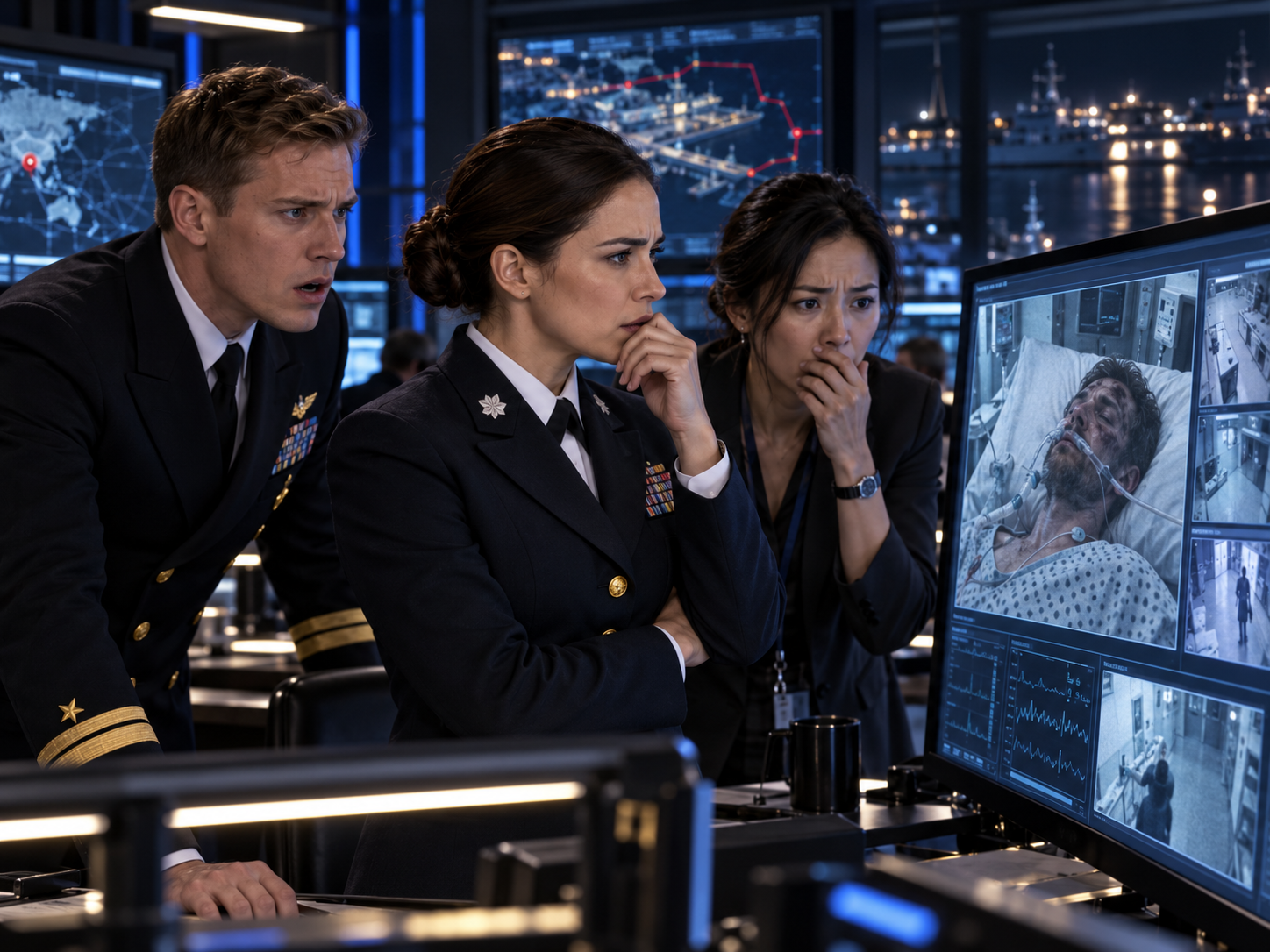
My hands went cold.
The photograph showed Petty Officer Lucas Reed.
One of Raven Six’s five missing crew members.
A man the Navy had declared dead.
And according to the timestamp, the photograph had been taken seventeen days earlier.
PART 4 — THE MAN WHO RETURNED FROM THE DEAD
For nearly a minute, nobody in the review office spoke.
The photograph remained open on my phone.
I enlarged it until the image began to blur.
The scar.
The forearm.
The compass tattoo.
I remembered Lucas Reed from Jonah’s wedding.
He had been twenty-seven then, with a crooked smile and a terrible habit of telling jokes during serious conversations.
He’d once explained the tattoo while everyone waited for the wedding photographer to finish.
“Compass always points somewhere,” he’d said. “Even when you don’t know where you’re going.”
Jonah had laughed and told him that was not how compasses worked.
Lucas insisted it was.
Now I was staring at a photograph suggesting he had survived an accident that supposedly killed everyone aboard Raven Six.
“Could it be old?” Bennett asked.
“The timestamp could be altered,” Chen said.
I nodded.
“We verify before assuming anything.”
My voice sounded more controlled than I felt.
I forwarded the image through the approved investigative channel and requested a forensic review.
Then I called the number that had sent it.
Disconnected.
I tried again.
The same result.
Bennett examined the photograph.
“There’s a sign behind him.”
He pointed toward the upper corner.
A blurred green symbol appeared on the wall.
Chen enlarged it.
“Medical facility,” she said.
“Military?”
“Not necessarily.”
She studied the shape.
“Could be a private rehabilitation center.”
I moved closer.
“Look at the reflection.”
The window behind Lucas reflected part of a building across the street.
A pharmacy sign.
Three letters were visible.
MAR.
Bennett frowned.
“That could be anywhere.”
“It could.”
Chen opened a separate image-analysis program.
“I can’t identify the location from this alone. But there’s something unusual about the file.”
“What?”
“It contains a partial location record.”
She examined the metadata.
“It’s incomplete. But the region appears to be Northern California.”
I stared at her.
“Are you certain?”
“Only about the approximate region.”
Northern California.
A long way from Guam.
A long way from the place where Lucas Reed had supposedly died.
I turned toward Bennett.
“Contact the investigative liaison. Ask them to discreetly check the photograph against medical facilities and missing-person records.”
He nodded.
“And Lieutenant?”
“Yes, ma’am?”
“No unauthorized inquiries. Whoever sent this may have put that man at risk.”
“Understood.”
At 2200, I received another message.
This one came from Admiral Whitaker.
He had reviewed the recovered recording.
He had also confirmed that the phrase Fleet Commander had been used within a legacy authorization process associated with Harlan’s command.
The phrase wasn’t proof that the fleet commander had issued a particular order.
It was a designation embedded in an older communications procedure.
A procedure that should no longer have been active.
That mattered.
Because someone had used the designation to authenticate a route change.
Someone with access to historical command systems.
Someone who understood exactly how the aviation crews would interpret it.
Whitaker had one additional finding.
The legacy procedure was supposed to have been retired two years earlier.
Captain Marcus Vale had signed the retirement certification.
I read the message twice.
Then called Whitaker.
“Sir, I think Vale kept the system active.”
“That’s one possibility.”
“He signed the certification. He oversaw the command relay. He approved the aircraft’s maintenance release. And his credentials were used at the damaged archive.”
“All of which investigators will examine.”
“Sir, Harlan may not know the full extent of it.”
Whitaker was silent.
“I’ve been considering that,” he finally said.
“Then why is Harlan refusing to cooperate?”
“That’s what troubles me.”
I looked out toward the dark corridor.
“Maybe he’s protecting someone.”
“Or something.”
“Yes, sir.”
“Evelyn, I need you to do something difficult.”
“What?”
“Speak to him again.”
I frowned.
“After everything?”
“Especially after everything.”
“He humiliated me in front of his entire staff.”
“I know.”
“He’s ignored lawful orders for six months.”
“I know that too.”
“And he may have concealed evidence connected to five deaths.”
“Then find out why.”
I looked down at the recovered transcript.
Jonah’s voice seemed to rise from the words.
Admiral Harlan isn’t the one giving these orders.
“Understood, sir.”
I found Admiral Harlan in his office shortly after midnight.
The building was nearly empty.
A single lamp illuminated the photographs lining the walls.
Harlan stood beside a window overlooking the darkened base.
His uniform jacket lay across a chair.
Without it, he looked older.
Less like the heroic portrait hanging outside his office.
More like a tired man who had been carrying something heavy for too long.
He turned when I entered.
“You’ve made quite a mess of my command, Hart.”
I closed the door.
“No, Admiral. I think someone else did that.”
He studied me.
“Come to celebrate?”
“No.”
“Then what?”
“To give you one opportunity to tell the truth.”
He laughed bitterly.
“You don’t lack confidence.”
“Neither do you. That’s part of the problem.”
His smile disappeared.
I stepped forward.
“Captain Vale approved the release of Raven Six despite an unresolved maintenance discrepancy.”
Harlan said nothing.
“His credentials were used during the attempted destruction of records.”
Still nothing.
“And a command authorization process he certified as retired was used to redirect the aircraft.”
Harlan looked away.
I continued.
“I’ve recovered Captain Pierce’s final recording.”
His shoulders stiffened.
“He said something I think you need to hear.”
I placed the approved transcript on his desk.
Harlan stared at it without moving.
Finally, he picked it up.
I watched his eyes travel down the page.
When he reached Jonah’s final sentence, his expression changed.
He sat slowly.
For the first time since arriving at Coronado, I saw genuine sorrow on his face.
“Jonah knew,” he whispered.
I felt my pulse quicken.
“Knew what?”
Harlan rubbed his forehead.
“That someone was using my authorization.”
“Who?”
He shook his head.
“It’s more complicated than that.”
“Five people disappeared, Admiral. One may still be alive. You do not get to tell me it’s complicated.”
His head snapped up.
“What did you say?”
I held his gaze.
“One of Raven Six’s crew may have survived.”
Harlan stared at me.
Then rose so quickly his chair struck the wall.
“Who?”
“I won’t identify him until his safety is confirmed.”
“Commander—”
“No.”
He stopped.
“You have obstructed this investigation for six months,” I said. “You have intimidated officers, delayed lawful requests, and allowed questionable records to remain sealed. Whatever you know, your rank won’t protect you from responsibility.”
His face tightened.
“I was trying to protect my people.”
“From what?”
He looked at the photographs along the wall.
Finally, he said:
“From a man I trusted like a son.”
Captain Marcus Vale.
The name hung between us without being spoken.
Harlan lowered himself into the chair.
“Marcus served under me for eighteen years. I knew his wife. His children. I recommended him for promotion.”
“Did you know about the unauthorized communications system?”
“I knew he was maintaining contingency access for certain missions.”
“Did you authorize it?”
“Not in the form it appears to have been used.”
“That isn’t an answer.”
Harlan looked at me.
“No. I did not authorize the redirection of Raven Six.”
“Did you learn about it afterward?”
His silence answered before he did.
“Yes.”
I felt anger rise.
“When?”
“Four days after the aircraft disappeared.”
I stared at him.
“Four days.”
He nodded.
“Vale came to me with a preliminary assessment. He claimed an equipment failure had triggered a false route instruction. He said the crew’s confusion was unrelated to the crash.”
“And you believed him?”
“At first.”
“Then?”
“Then I discovered he had made changes to the report.”
I waited.
Harlan’s hands tightened.
“I confronted him. He told me those changes were necessary to protect sensitive operational details.”
“You accepted that?”
“No.”
He looked away.
“Not entirely.”
“What did you do?”
“I ordered an internal review.”
“And?”
“Vale gave me documents suggesting senior civilian contractors had interfered with the communications systems. He claimed releasing the information would expose classified capabilities and compromise people overseas.”
“Were the documents genuine?”
“I don’t know.”
“Did you verify them?”
Harlan said nothing.
I shook my head.
“You were willing to intimidate everyone who asked questions, but not willing to investigate the man sitting beside you.”
His expression hardened.
“Watch yourself.”
“No, Admiral. You watch yourself.”
I stepped closer.
“You had the authority to preserve those records. You had the ability to protect witnesses. You could have gone to the fleet commander the moment you discovered the report had been altered.”
He looked down.
“Instead,” I continued, “you protected your reputation.”
The silence lasted a long time.
Finally, Harlan whispered:
“Yes.”
That one word surprised me more than another argument would have.
He looked exhausted.
“I thought if the truth came out, everything we’d built would be destroyed.”
I felt no satisfaction.
Only sadness.
“Everything you built wasn’t worth five lives.”
He closed his eyes.
“No.”
I waited.
When he looked up again, his voice was different.
“There’s a private storage facility north of San Diego.”
I held still.
“What facility?”
“Vale leased space there through a company associated with Triton Maritime Systems. Three weeks after Raven Six disappeared, I confronted him about the altered mission records. He showed me a document he claimed proved the aircraft had been diverted for a classified recovery operation.”
“Did you keep a copy?”
“Yes.”
“Where?”
“Not here.”
He reached toward a drawer.
I stopped him.
“Keep your hands visible, Admiral.”
His eyes narrowed.
Then he slowly withdrew his hand.
“You think I’d hurt you?”
“I think you’re a man under enormous pressure whose judgment has already failed.”
He stared at me.
Then nodded once.
“Fair.”
He dictated the location of a sealed evidence packet held by his civilian attorney, with instructions that it be released if he formally requested it.
I documented the information and transmitted it to the investigative team.
Then I stood.
“One more question.”
Harlan looked up.
“Why did you react when I said Fleet Commander?”
His face tightened.
“Because I’d heard those words before.”
“When?”
He looked toward the window.
“Three nights after Raven Six vanished.”
My heart pounded.
“From whom?”
“Vale.”
I waited.
“He came to my house,” Harlan said. “It was after midnight. He was terrified. He said someone had accessed the old relay system, and if anyone discovered the designation, they would trace it back to me.”
“Did he say who accessed it?”
“No.”
“Anything else?”
Harlan hesitated.
“He said the fleet commander’s office had to be kept out of it.”
I frowned.
“Why?”
His voice dropped.
“Because someone had already forged an authorization bearing Whitaker’s name.”
Before I could respond, my phone rang.
Lieutenant Bennett.
I answered.
“Go ahead.”
His voice was urgent.
“Ma’am, we have a serious problem.”
“What happened?”
“Captain Vale left the base forty minutes ago.”
I glanced at Harlan.
“Was he authorized to leave?”
“His credentials were suspended, but he departed before security received the notification.”
“Where did he go?”
“We believe he was headed toward the civilian airfield.”
My stomach tightened.
Then Bennett said:
“Commander, the investigators located the medical facility in the photograph.”
I stopped breathing for a moment.
“Lucas Reed?”
“Yes, ma’am.”
“Is he there?”
“He was.”
I gripped the phone.
“What do you mean, was?”
Bennett swallowed.
“He disappeared from the facility this evening.”
I closed my eyes.
“Any indication where he went?”
“Security footage shows two men escorting him through a rear exit.”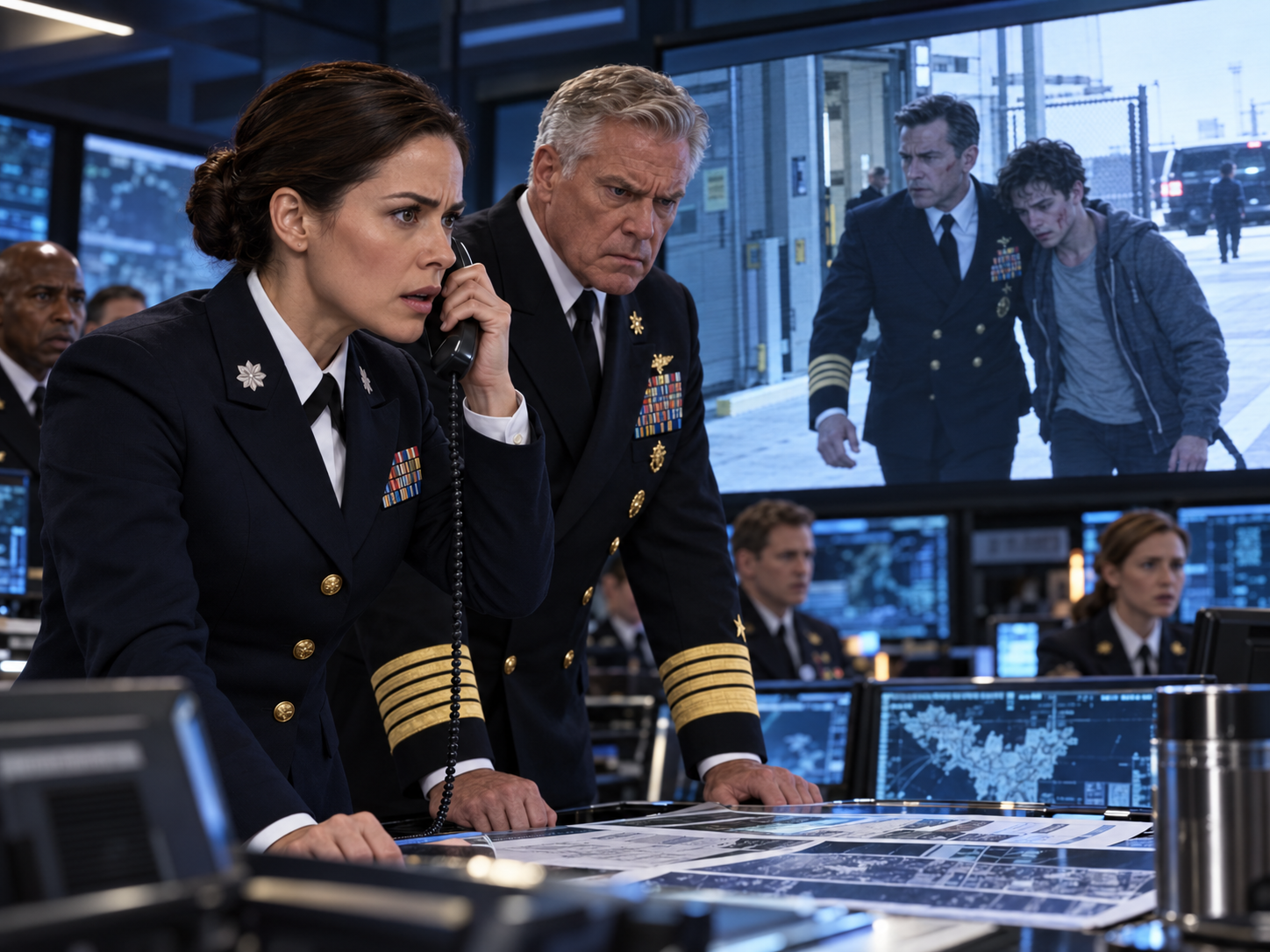
“Identify them.”
“We have one positive match.”
“Who?”
Bennett’s voice lowered.
“Captain Marcus Vale.”
The next six hours were the longest of my career.
Independent investigators obtained emergency authority to pursue the suspected abduction.
Local authorities were notified.
The medical facility confirmed that Lucas Reed had been receiving treatment under an assumed name.
He had arrived months earlier with serious injuries, memory disturbances, and incomplete identification documents.
A private medical contractor had arranged his admission.
That contractor was connected to Triton Maritime Systems.
Lucas had slowly recovered portions of his memory.
He had begun asking questions.
Then someone had moved him.
Not to protect him.
To keep him quiet.
At 0430, the investigators located a vehicle associated with Vale at a private hangar north of San Diego.
By then, I was sitting in an operations room with Admiral Whitaker connected by secure video.
Harlan sat across from me.
He had voluntarily surrendered his access credentials and agreed to cooperate.
But he wasn’t under any illusion that cooperation erased what he’d done.
Neither was I.
A federal investigator entered the room.
“We have surveillance from the hangar,” she said.
She placed a photograph on the table.
Vale stood beside a small aircraft.
Two men were loading equipment.
And between them was Lucas Reed.
Alive.
Unsteady.
But unmistakably alive.
My eyes filled before I could stop them.
I turned away briefly.
Then forced myself to focus.
“Is he safe?”
“Not yet.”
“What are your options?”
“We’re coordinating with local authorities. We believe Vale intends to move him before sunrise.”
Harlan leaned forward.
“Vale isn’t going to let that man testify.”
The investigator studied him.
“Why are you so certain?”
“Because Lucas must know what happened.”
I looked at Harlan.
“And Vale knows it too.”
A few minutes later, the operations room received a call.
An unfamiliar voice came through the speaker.
“Commander Evelyn Hart.”
I recognized it immediately.
Marcus Vale.
His tone was almost pleasant.
“Captain Vale,” I said.
“Quite a dramatic evening.”
“Where is Lucas Reed?”
“Safe enough.”
“Let me speak to him.”
Vale laughed softly.
“Still giving orders.”
“Lucas has a right to medical care and protection.”
“And I have a right not to be blamed for an accident I didn’t cause.”
“Then cooperate with the investigators.”
Silence.
Then:
“You don’t understand what you’re interfering with.”
“I understand that five people were declared dead and one is now missing from a medical facility.”
“Declared dead,” Vale repeated.
His voice changed.
“You really haven’t figured it out.”
I felt every muscle tighten.
“Figured out what?”
He didn’t answer immediately.
Then he spoke six words that struck me like a physical blow.
“Raven Six never crashed where reported.”
The operations room went silent.
I gripped the table.
“Where did it go?”
Vale exhaled.
“Ask Harlan about Operation Nightglass.”
Then the call ended.
Across from me, Admiral Harlan closed his eyes.
And I knew from the expression on his face that Operation Nightglass was not a name he’d heard for the first time.
PART 5 — THE TRUTH THAT FINALLY CAME HOME
“Operation Nightglass,” I repeated.
Admiral Harlan opened his eyes.
The operations room was silent except for the low mechanical hum of the ventilation system.
He looked older than he had twelve hours earlier.
A lifetime of command had taught him how to conceal uncertainty.
But exhaustion had stripped away much of that discipline.
“Nightglass was a restricted maritime technology evaluation,” he said.
I leaned forward.
“Authorized by whom?”
“Originally, a joint program office. Several years ago.”
“Was Raven Six part of it?”
“Not officially.”
The investigator beside me made a note.
Harlan continued.
“The program evaluated a prototype communications and navigation integration system intended to improve coordination in difficult operating conditions. Triton Maritime Systems was one of the contractors.”
I felt my pulse quicken.
“The same company linked to the altered records.”
“Yes.”
“Why was Nightglass discontinued?”
Harlan hesitated.
“Repeated reliability problems.”
I stared at him.
“You knew the system had problems?”
“I knew the earlier version did.”
“And you continued allowing its use?”
“I was told the system had been corrected.”
“By Vale?”
He nodded.
I looked toward the investigator.
She had stopped writing.
Harlan continued.
“Marcus became the program’s principal military liaison. He had technical authority over certain evaluations and access to contractor reports.”
“Did he have the authority to change Raven Six’s route?”
“No.”
“Then why did he?”
Harlan looked down.
“I believe he was trying to demonstrate that the system could safely redirect aircraft through a new communications architecture.”
“During an operational flight?”
“Yes.”
I felt anger rise.
“Without telling the crew?”
He said nothing.
The answer was obvious.
I stood and walked toward the wall.
For months, I had imagined Raven Six encountering terrible weather.
I had imagined Jonah fighting to keep the helicopter level.
I had imagined the crew calling for help while the ocean rose toward them.
Now I understood that something else had happened first.
Someone had placed them in danger for the sake of a demonstration.
A demonstration they had not agreed to participate in.
I turned back.
“Tell me everything.”
The investigators were already moving toward the hangar when Harlan began explaining Nightglass.
He described an ambitious program launched under intense pressure to produce results.
Early tests had failed.
Contractor executives feared cancellation.
Program managers feared congressional scrutiny.
Careers had become tied to the idea that the technology worked.
And Captain Marcus Vale had built his reputation around it.
“He believed Nightglass would revolutionize maritime operations,” Harlan said.
“Belief doesn’t justify falsifying test results.”
“No.”
“Or using crews who haven’t consented to a test.”
“No.”
He rubbed his hands together.
“After the Okinawa incident, I ordered additional restrictions.”
“But Vale continued.”
“Yes.”
“And you didn’t stop him.”
Harlan looked directly at me.
“I failed to stop him.”
The admission hung in the room.
There was no dramatic music.
No applause.
Just a tired admiral finally saying something he should have said months earlier.
The investigator asked:
“Did you receive any financial benefit from Triton?”
Harlan’s expression hardened.
“No.”
“Any gifts? Travel? Payments to family members?”
“No.”
“Were you aware of the supplemental contract after Raven Six disappeared?”
“Yes.”
“Did you question it?”
“I did.”
“And?”
“Vale told me it funded emergency corrections to prevent another accident.”
I shook my head.
“You kept accepting explanations from the same man.”
Harlan didn’t defend himself.
That silence was more revealing than anything he could have said.
The investigator continued questioning him.
I stepped into the corridor.
My phone showed three missed calls.
All from Rebecca Pierce.
Jonah’s widow.
I had promised myself I wouldn’t contact her until we had something certain.
But someone had leaked information about a possible survivor.
And now rumors were spreading.
I called her.
She answered immediately.
“Evelyn?”
“Rebecca.”
“Tell me it’s true.”
I closed my eyes.
“What have you heard?”
“That someone from Jonah’s helicopter is alive.”
I leaned against the wall.
“We have credible evidence that one crew member survived.”
She inhaled sharply.
“Jonah?”
Her voice was barely audible.
I felt my throat tighten.
“Rebecca, I don’t know.”
A long silence followed.
Then:
“Please don’t give me hope if you aren’t sure.”
“I won’t.”
I meant it.
Hope could be a beautiful thing.
It could also be devastating when someone used it carelessly.
Rebecca began crying quietly.
“I buried an empty coffin, Evelyn.”
“I know.”
“I told the children their father wasn’t coming home.”
I pressed my hand against my eyes.
“I remember.”
“Emily still sets a place for him on his birthday.”
The words broke something inside me.
Emily Pierce was eight years old.
Her younger brother, Caleb, was six.
Both had inherited Jonah’s bright eyes.
Both had spent months learning how to live with an absence they couldn’t understand.
“I’ll find out what happened,” I whispered.
Rebecca was quiet.
Then she said:
“Bring us the truth. Whatever it is.”
I promised I would.
At 0612, the investigators reported that Lucas Reed had been recovered.
The private aircraft never departed.
Local law enforcement and federal agents had secured the hangar after obtaining the necessary authorization.
Two men employed by a contractor connected to Triton were detained.
Marcus Vale was taken into custody.
Lucas Reed was transferred to a hospital under protective supervision.
I received confirmation while standing beside the operations-room window.
For a few seconds, I simply stared at the message.
Alive.
Safe.
Receiving treatment.
I had spent months reading the names of five dead service members.
Now one of those names belonged to a living man.
I wanted to celebrate.
Instead, I felt a terrible question rising.
What about the others?
I met Lucas Reed two days later.
He lay in a hospital bed with a blanket pulled to his waist.
His face was thinner than in the photographs I remembered.
A pale scar crossed his jaw.
His left hand trembled slightly when he reached for a cup of water.
But the compass tattoo remained.
The same black compass.
I stopped in the doorway.
Lucas looked at me.
For a moment, he appeared uncertain.
Then his eyes widened.
“Commander Hart?”
I managed a smile.
“Hello, Lucas.”
His mouth trembled.
“Jonah told me you’d come.”
My eyes filled.
I pulled a chair beside the bed.
“Did he?”
Lucas nodded.
“He said if anyone could figure this out, it would be you.”
I swallowed.
“Tell me what happened.”
He looked toward the window.
The silence lasted so long I wondered whether he would speak.
Finally, he began.
Raven Six had departed shortly after two in the morning.
The weather was difficult but manageable.
Everything remained normal until the navigation system began displaying conflicting information.
Lieutenant Mendoza noticed the first discrepancy.
Captain Pierce contacted control.
A revised route arrived.
The authentication sequence appeared legitimate.
But Pierce became suspicious.
“He said the coordinates didn’t match the mission briefing,” Lucas whispered.
“What happened next?”
“We tried to verify them.”
He closed his eyes.
“Then the system changed again.”
I waited.
“We were over water. Dark water. No landmarks. The cockpit displays were giving us different positions.”
His breathing quickened.
I reached for the nurse-call button, but Lucas shook his head.
“I’m okay.”
I waited until he settled.
Then he continued.
“Jonah told us to disregard the automated route and return to the last confirmed position.”
“Did you?”
“We tried.”
He stared at the blanket.
“Then a warning came on. We had another equipment problem. We lost confidence in where we were and how much time we had.”
He paused.
“We attempted an emergency landing on an island.”
My heart stopped.
“An island?”
“A small one. I don’t know its name.”
He swallowed.
“We made it close to shore. The helicopter struck hard. I remember metal tearing. Water coming in.”
I leaned forward.
“What happened to the crew?”
Lucas began crying.
The sound was quiet.
Exhausted.
The grief of a man who had been carrying something unbearable alone.
“Chief Ortiz helped me out. He was injured, but he kept moving. Aaron was trapped. Mendoza was trying to get him free.”
He struggled for breath.
“And Jonah?”
Lucas stared at me.
“He stayed.”
I gripped the chair.
“He stayed with the aircraft?”
Lucas nodded.
“He was helping Aaron.”
Tears ran down his cheeks.
“I got thrown against the wreckage. Everything went black.”
“What happened when you woke up?”
“I was on the beach. Ben was beside me.”
“Chief Ortiz?”
“Yes.”
My heart pounded.
“Was he alive?”
Lucas nodded.
I nearly stood.
“Where is he?”
Lucas began shaking his head.
“I don’t know.”
“Lucas—”
“Ben was alive when I woke up. He had a broken arm. We found some emergency supplies. We stayed near the wreckage for two days.”
“Two days?”
He nodded.
“Nobody came.”
I thought of the silenced rescue frequency.
The falsified coordinates.
The official search area.
They had been looking in the wrong place.
“Then what happened?”
“A boat arrived.”
“What kind?”
“Small. Civilian. Four men aboard.”
“Did they help you?”
“At first.”
Lucas looked away.
“They took us to another vessel. Someone gave us water. A man asked questions about the helicopter and its equipment.”
“Who?”
“I don’t know his name.”
“Was Vale there?”
“No.”
Lucas hesitated.
“But I heard someone mention him.”
I held still.
“What did they say?”
“One of the men said they had to contact Captain Vale before deciding what to do with us.”
The room felt suddenly cold.
Lucas continued.
“Ben argued. He said we needed to contact the Navy immediately.”
“What happened?”
“They separated us.”
His hands began trembling again.
“I never saw Ben after that.”
I looked at the nurse, who stood discreetly near the door.
She gave a small warning shake of her head.
Lucas was becoming exhausted.
I wanted answers.
But I would not sacrifice his recovery to get them.
“One last question,” I said gently.
Lucas looked at me.
“Do you remember where the helicopter came down?”
He closed his eyes.
Then nodded.
“Jonah wrote something before we lost control.”
“What?”
“Coordinates.”
My heartbeat quickened.
“He wrote them on his flight kneeboard. He said if the electronics were wrong, we’d trust the last position we could confirm independently.”
“Do you remember the numbers?”
Lucas shook his head.
“But I remember what happened next.”
I leaned closer.
“He gave the kneeboard to Mendoza.”
“And?”
Lucas looked directly at me.
“She put it inside the emergency survival case.”
I sat very still.
“Did the case leave the aircraft?”
“Yes.”
“Who took it?”
His voice broke.
“Jonah.”
That afternoon, I returned to Coronado.
The investigation had expanded beyond anything I had imagined.
Triton’s relevant contracts were under review.
Additional records were being secured.
Independent investigators had interviewed Harlan, Vale, Chen, Bennett, and several technicians.
Vale had obtained legal counsel and was no longer answering substantive questions.
But the documentary evidence continued to grow.
And Lucas’s testimony gave us a new location to investigate.
Not the reported crash site.
A small island beyond the original search area.
We could not simply dispatch a team based on uncertain memories. The location required verification, coordination with the appropriate governments, and a properly authorized search.
But we had a lead.
For the first time in six months, we had a lead grounded in a survivor’s account.
And I intended to follow it.
Four days later, we identified the island.
A combination of archived maritime imagery, weather records, vessel traffic information, and Lucas’s recollections narrowed the possibilities.
One location stood out.
A remote island with a narrow beach and a rocky inland slope.
A place where a damaged aircraft might have gone unnoticed after a search was directed elsewhere.
The investigators obtained updated imagery.
A faint metallic shape appeared near the treeline.
Almost invisible beneath the vegetation.
I stared at the screen.
“Could that be wreckage?”
The analyst beside me nodded cautiously.
“It could be. We need people on site to confirm.”
The search was authorized.
A coordinated recovery team prepared to travel.
I requested permission to accompany the investigators.
Admiral Whitaker approved my participation as an observer and liaison.
Before departure, I visited Admiral Harlan.
He was no longer exercising command authority.
An interim commander had assumed responsibility for his duties.
Harlan was cooperating with the investigation while facing a formal review of his conduct.
He stood beside the window when I entered.
For a moment, neither of us spoke.
Then he turned.
“Commander Hart.”
“Admiral.”
“I heard you found the island.”
“We have a promising location.”
He nodded.
“Jonah?”
“We don’t know.”
His face tightened.
I saw how badly he wanted a better answer.
But uncertainty was not something I could remove simply because it hurt.
He walked toward his desk.
On it lay a framed photograph of a younger Knox Harlan standing beside several naval officers.
Marcus Vale was among them.
Harlan picked up the frame.
“I trusted him.”
“I know.”
“He served with me for years.”
“I know that too.”
Harlan looked down.
“I thought loyalty meant protecting your people.”
I said nothing.
He set the photograph facedown.
“But I protected the wrong thing.”
I studied him.
There was a time when that admission would have satisfied me.
Before Jonah.
Before the false report.
Before I saw Rebecca holding a folded flag.
Now words alone were insufficient.
“Loyalty doesn’t mean hiding the truth,” I said.
He nodded slowly.
“I understand that now.”
I looked toward the door.
Then Harlan spoke again.
“Commander.”
I stopped.
“When you find them, tell their families I’m sorry.”
I turned back.
“Admiral, you can tell them yourself when the appropriate time comes.”
His eyes filled.
“And you should be prepared for them not to forgive you.”
He nodded.
“I know.”
We reached the island three days later.
The morning sky was pale.
A warm wind moved through the trees.
From the water, the island looked ordinary.
Beautiful, even.
White sand.
Dark rocks.
Dense green vegetation.
I hated that.
Somehow, I wanted the place that had swallowed five lives to look cruel.
Instead, it looked peaceful.
The recovery team established a safe access point and began a systematic examination of the shoreline.
I remained with the authorized personnel.
For nearly two hours, they found little.
Broken branches.
Weathered debris.
Fragments that could have come from fishing vessels or storms.
Then a recovery specialist called from the treeline.
“We have aircraft material.”
I felt my heart slam against my ribs.
We approached.
Partially concealed beneath vegetation was a section of damaged fuselage.
Its identification markings were weathered but visible.
RAVEN SIX.
I stopped walking.
For six months, those words had existed only on screens.
On reports.
On memorial programs.
Now they were in front of me.
Real.
Broken.
The recovery team photographed and documented the scene before disturbing anything.
Investigators found evidence consistent with a violent emergency landing.
More importantly, they found signs that some occupants had survived long enough to move away from the aircraft.
A sheltered area behind the beach contained remnants of emergency supplies.
A damaged signaling mirror.
Fragments of survival packaging.
And carefully arranged stones near a faded piece of fabric.
Lucas had told the truth.
They had been here.
They had waited.
And nobody had come.
I knelt beside the stones.
My eyes burned.
“I’m sorry,” I whispered.
Not because I believed I could have prevented what happened.
But because sometimes grief needed words even when those words could change nothing.
A recovery specialist approached.
“Commander?”
I looked up.
“We found something you should see.”
He led me toward a section of the wreckage.
A sealed emergency container had become lodged beneath a collapsed metal support.
The team carefully documented its position.
Inside were water-damaged survival materials.
A signal panel.
A medical kit.
And a kneeboard.
Jonah’s kneeboard.
My breath caught.
The investigator placed it in a protective evidence container.
I could see markings beneath the transparent cover.
Handwritten coordinates.
A series of times.
And a short message.
The writing was smeared, but portions remained legible.
IF FOUND — REPORT ACTUAL POSITION.
Beneath it were five names.
The crew.
And beside each name, Jonah had made a small mark.
I stared at the final line.
There was one more sentence.
Written in block letters.
WE WERE ALIVE AFTER THE LANDING.
I closed my eyes.
For months, the Navy’s official account had implied that all five died during an aircraft crash.
Jonah had left proof that the story was wrong.
But the discovery also deepened our questions.
Because there were no confirmed remains at the initial recovery site.
No definitive evidence establishing what had happened to the other three personnel after Lucas and Ortiz were taken away.
And that uncertainty mattered.
It meant we couldn’t stop.
The turning point came from a different source.
A maritime investigator reviewing historical vessel movements identified a civilian support ship that had operated near the island during the relevant period.
The ship was registered through a chain of commercial companies.
One of those companies had business ties to Triton.
The vessel’s reported route contained unexplained gaps.
Several crew members had left its employment shortly after Raven Six disappeared.
Investigators located one of them.
His name was Daniel Mercer.
A fifty-six-year-old marine mechanic living in Florida.
Mercer initially refused to speak.
Then investigators informed him that a surviving aircrew member had identified the vessel as possibly connected to his rescue.
Mercer asked for legal counsel.
After receiving advice, he agreed to provide a statement.
What he revealed changed everything.
The vessel had been instructed to collect equipment from a remote island.
Its crew had expected abandoned technical material.
Instead, they found survivors.
Lucas Reed.
Benjamin Ortiz.
And three other injured military personnel.
I read the statement three times before I believed it.
Three others.
Jonah.
Sarah Mendoza.
Aaron Collins.
All five had survived the initial landing.
Mercer said the injured personnel were brought aboard in stages.
They were provided food, water, and first aid.
Then a senior contractor representative ordered the ship to proceed to a private maritime facility rather than contact the nearest rescue coordination authority.
Mercer objected.
He was told the matter involved a classified government recovery operation.
The crew was warned not to discuss what they had seen.
When Mercer later asked what happened to the service members, he was told they had been transferred to military custody.
He believed it.
Until he learned they had been declared dead.
Then he became afraid.
And for six months, he said nothing.
But Mercer remembered something critical.
The name of the facility.
It was located on a privately operated island in the western Pacific.
A former industrial site that had been converted into a maritime testing center.
The investigators immediately began tracing its ownership and operations.
What they found was disturbing.
Triton had leased portions of the facility through an affiliated company.
Medical supplies had been delivered there.
Security personnel had been contracted.
And a small aircraft had traveled between the facility and Northern California several times during the months following Raven Six’s disappearance.
One of those flights corresponded with Lucas Reed’s arrival at the rehabilitation center.
The implication was staggering.
Lucas might not have been the only survivor.
The search that followed required international coordination, lawful investigative authority, and a rescue plan built around the possibility of vulnerable survivors.
I was not placed in tactical command.
That responsibility belonged to the authorized operational team.
My role was to provide the case history, identify the missing personnel, and help investigators evaluate the evidence.
For once, I was grateful not to be the person making every decision.
Because I was too close to this.
I knew it.
Every briefing felt personal.
Every delay felt unbearable.
Every hour without an answer made Rebecca’s words echo through my mind.
Bring us the truth.
The operation began before dawn.
The facility’s operators were notified of the lawful investigation through the appropriate authorities.
Security personnel initially resisted access.
Then they were presented with the necessary orders.
The investigators secured the records and began checking the buildings.
At 0748, the first report came through.
One survivor located.
Male.
Receiving medical treatment.
Possible match to Chief Petty Officer Benjamin Ortiz.
I gripped the edge of the table.
At 0806, a second report.
Female.
Possible match to Lieutenant Sarah Mendoza.
My eyes filled.
At 0819, another.
Male.
Possible match to Aircrewman Aaron Collins.
I could barely breathe.
Three.
Three more.
That left one.
Jonah.
At 0841, communications from the site became briefly confused.
An investigator requested medical assistance.
I heard hurried voices in the background.
Then silence.
I stood.
“What’s happening?”
Nobody answered immediately.
I looked toward the operations lead.
“Please.”
He held up one hand, listening to his headset.
Then he turned.
“Commander Hart.”
I felt something inside me go still.
“We have located a fourth individual.”
My mouth went dry.
“Identity?”
“Not yet confirmed.”
I gripped the chair.
“Condition?”
He hesitated.
“Alive.”
I covered my mouth.
“Is it Jonah?”
The officer looked at me.
“We believe so.”
I began crying before I could stop myself.
Not loudly.
Not dramatically.
Just tears I had held back for six months.
I sat down because my legs no longer trusted me.
And for the first time since the day I saw the casualty notification, I allowed myself to imagine Jonah Pierce coming home.
The medical recovery took time.
The survivors required careful examination and treatment.
Investigators also needed to determine what had happened during their confinement.
The emerging evidence suggested that contractor personnel had withheld the survivors’ identities while attempting to conceal the unauthorized test and its consequences.
Not every person working at the facility knew who the patients were.
Some medical workers had been told they were civilians evacuated from a sensitive maritime incident.
Others had been instructed to avoid questions about their identities.
The survivors had experienced varying degrees of injury and restricted communication.
Jonah’s injuries were severe enough that he had undergone multiple procedures.
He had survived.
But survival had come at a terrible cost.
When I finally saw him, he was lying in a hospital bed beneath a white sheet.
His hair had been cut short.
There was a scar near his temple.
One arm rested in a brace.
He looked thinner.
Older.
But when he opened his eyes, I knew immediately that it was him.
“Evelyn?”
His voice was hoarse.
I stepped closer.
“Hello, Jonah.”
He stared at me.
Then a weak smile appeared.
“You took your time.”
I laughed through tears.
“You always were terrible at giving directions.”
He tried to laugh.
Then winced.
I sat beside him.
For several minutes, neither of us spoke.
I held his hand.
He looked toward the ceiling.
Finally, he whispered:
“Did everyone make it?”
My throat tightened.
“Yes.”
His eyes moved toward mine.
“Everyone?”
I nodded.
“Lucas. Ben. Sarah. Aaron. All alive.”
He closed his eyes.
A tear slipped down his cheek.
“Thank God.”
I squeezed his hand.
“Jonah, I need you to know something.”
He looked at me.
“They told everyone you were gone.”
His expression changed.
I continued carefully.
“There was a memorial service.”
He stared.
“Rebecca?”
“She was there.”
His mouth trembled.
“The kids?”
I nodded.
Jonah covered his face with his good hand.
For the first time since entering the room, he looked completely broken.
Not by pain.
Not by fear.
But by the knowledge of what his family had endured.
He began to cry.
I sat beside him until he could breathe normally again.
Then he looked at me.
“Do they know?”
“Not yet. We wanted to confirm you were safe and medically stable enough before arranging the call.”
He nodded.
“Please.”
His voice broke.
“Please let me talk to my wife.”
Rebecca answered the video call on the second ring.
She was sitting at her kitchen table.
I recognized the blue curtains behind her.
Jonah had helped install them years earlier.
She smiled uncertainly when she saw me.
“Evelyn?”
“Rebecca, I have someone here.”
Her expression changed.
I moved the camera.
Jonah appeared on the screen.
For a moment, she didn’t move.
Didn’t blink.
Didn’t speak.
Then she lifted both hands to her mouth.
“Jonah?”
He smiled through tears.
“Hey, Beck.”
A sound escaped her that I will never forget.
It wasn’t quite a scream.
It wasn’t quite a sob.
It was the sound of six months of grief suddenly colliding with impossible joy.
She stood so quickly the chair fell backward.
“Jonah!”
“I’m here.”
She cried his name again.
He reached toward the screen.
“I love you.”
Rebecca was crying too hard to answer.
Finally, she managed:
“You were supposed to be dead.”
“I know.”
“They told me—”
“I know, sweetheart.”
She covered her face.
“I thought I’d never hear your voice again.”
Jonah’s eyes filled.
“You’re going to hear it every day.”
Behind Rebecca, a small voice called:
“Mommy?”
Emily appeared in the doorway.
She stopped when she saw her mother crying.
Then she noticed the screen.
For one extraordinary second, she stared.
“Daddy?”
Jonah’s entire face changed.
“Hey, Em.”
Emily screamed.
“DADDY!”
She ran toward the phone.
Caleb followed a moment later.
And suddenly all four of them were crying and talking at once.
Jonah kept repeating their names.
Rebecca kept touching the screen.
Emily wanted to know whether he was really coming home.
Caleb asked if he could still take him fishing.
Jonah promised he would.
I turned away.
There are moments in life when words become unnecessary.
When everything important is visible in the faces of people who thought they had lost each other forever.
I had spent months trying to prove that a report was wrong.
Now I was watching a family become whole again.
The legal proceedings began in the months that followed.
The evidence collected during the investigation led to criminal charges against Marcus Vale and several individuals associated with Triton Maritime Systems.
Prosecutors alleged conspiracy, obstruction, falsification of records, unlawful confinement, and other offenses arising from the unauthorized test and subsequent concealment.
The precise responsibility of each defendant would be determined through the courts.
Investigators continued examining the earlier incidents connected to the same communications system.
Former employees testified.
Technical records were authenticated.
Financial transactions were traced.
Witnesses who had been afraid to speak finally came forward.
Chief Nathan Brooks, the maintenance specialist whose complaint had been withdrawn, provided his original notes and explained how he had been pressured to abandon the discrepancy report.
Dr. Maya Chen testified about the attempted destruction of the archive.
Lieutenant Daniel Bennett explained how he had identified the links between the incidents.
And Lucas Reed described the days he spent believing no one would ever find him.
Admiral Knox Harlan faced his own reckoning.
The inquiry established that he had failed to exercise appropriate oversight, withheld relevant information, and obstructed lawful requests after learning of serious irregularities.
His later cooperation was considered.
So was the damage caused by his earlier decisions.
He was relieved of his remaining duties and retired under circumstances that permanently altered his once-celebrated reputation.
For a man who had spent decades building a legend around his name, the consequences were profound.
But I never believed humiliation was the point.
Accountability was.
And accountability mattered most when the person being held responsible was powerful enough to believe the rules no longer applied.
Seven months after Raven Six was recovered, I returned to Naval Amphibious Base Coronado.
The same base where Admiral Harlan had mocked my uniform.
The same place where senior officers had laughed while he held my identification badge between two fingers.
This time, I had been invited to a formal recognition ceremony.
The five Raven Six crew members sat together in the front row.
Jonah Pierce wore his dress uniform.
He still walked with a slight limp.
Sarah Mendoza sat beside him, smiling at something Aaron Collins whispered.
Benjamin Ortiz was arguing quietly with Lucas Reed about who had told the worst jokes during their recovery.
They looked different.
All of them.
Survival had changed their faces.
Their movements.
The way they watched doors and reacted to sudden noises.
There would be difficult days ahead.
Medical appointments.
Rehabilitation.
Nightmares.
Questions that might never have complete answers.
But they were alive.
And they were together.
Rebecca sat with Emily and Caleb in the first row.
Emily wore a blue dress.
Caleb had brought a small toy helicopter.
Jonah saw it and smiled.
I stood near the side entrance, adjusting the cuffs of my uniform.
Lieutenant Bennett approached.
“Ma’am?”
“Yes?”
“Admiral Whitaker is ready.”
I nodded.
Bennett hesitated.
“Commander, may I say something?”
“Of course.”
He smiled.
“When I saw Admiral Harlan take your badge that first morning, I thought your career was over.”
I laughed softly.
“So did several people.”
“I wanted to intervene.”
“Why didn’t you?”
He looked embarrassed.
“I was afraid.”
I studied him.
He seemed to expect criticism.
Instead, I placed a hand on his shoulder.
“Fear doesn’t make you dishonorable, Lieutenant. What matters is what you choose to do next.”
He nodded.
“You gave me a chance to help.”
“You earned it.”
He smiled.
Then the ceremony began.
Admiral Whitaker stood at the podium beneath the American flag.
His voice carried across the auditorium.
“Today, we recognize five service members whose courage endured under extraordinary circumstances.”
He described the recovery.
The investigation.
The importance of refusing to abandon unanswered questions.
He acknowledged the medical teams, investigators, engineers, and international partners whose work had brought the crew home.
He also spoke about responsibility.
About the obligation of senior leaders to remain accountable.
About the danger of confusing authority with infallibility.
Then he called the Raven Six crew members forward.
The audience rose.
The applause began slowly.
Then grew.
Jonah walked onto the stage with the others.
He glanced toward Rebecca.
She was crying.
Emily waved both hands.
Caleb stood on his chair until his mother gently pulled him down.
The sight made Jonah laugh.
And hearing that laugh in a room full of people nearly undid me.
One by one, the crew members received recognition for their conduct.
Then Whitaker returned to the microphone.
“There’s one more officer I would like to acknowledge.”
I felt Bennett look toward me.
“Commander Evelyn Hart.”
I froze.
I hadn’t expected this.
Whitaker smiled.
“Commander, please join us.”
I walked toward the stage.
The applause was warm, but I barely heard it.
My attention remained on Jonah.
He was smiling.
That familiar, infuriating smile.
The expression of a man who knew something I didn’t.
When I reached the podium, Whitaker shook my hand.
“Commander Hart conducted her assignment with professional discipline under unusual pressure,” he said.
“She followed evidence others had dismissed, preserved the integrity of the investigation, and refused to allow rank or reputation to substitute for truth.”
He paused.
“Most importantly, she understood that every missing service member represents a family waiting for an answer.”
I swallowed.
Whitaker turned toward me.
“Commander, on behalf of a grateful Navy, thank you.”
The audience stood again.
I looked down at my uniform.
At the silver oak leaf.
The same insignia Knox Harlan had ridiculed.
It looked exactly as it had months earlier.
Small.
Silver.
Unremarkable.
And yet it represented years of service.
Years of responsibility.
Years of decisions made when nobody was watching.
I realized something in that moment.
The insignia had never needed Harlan’s approval.
Neither had I.
After the ceremony, I found Jonah standing outside near a quiet garden.
He was looking at a small memorial plaque installed for personnel lost during maritime operations.
I approached slowly.
“Trying to escape the crowd?”
He smiled.
“Five minutes of peace.”
“You’ve always been terrible at that.”
He laughed.
Then grew serious.
“Evelyn.”
“Yes?”
“I remember hearing your name before we lost contact with everyone.”
I looked at him.
“What do you mean?”
“Lucas told me we might not make it home. I told him if we could preserve anything, even a fragment, someone would find it.”
He looked toward the sky.
“And I said you’d be the person who wouldn’t stop asking questions.”
My throat tightened.
“You put an awful lot of faith in me.”
“I knew you.”
We stood in silence.
Then Jonah reached into his pocket.
“I have something for you.”
He held out a small object.
A silver compass.
Old.
Scratched.
The glass slightly clouded.
I recognized it.
It had belonged to his grandfather.
Jonah carried it during nearly every deployment.
I stared.
“You should keep that.”
He shook his head.
“I carried it because it reminded me that even when the instruments fail, you still have to figure out where you are.”
He placed it in my hand.
“You did that for us.”
I looked down at the compass.
The needle settled.
Pointing north.
My eyes filled.
“Jonah—”
He pulled me into a careful embrace.
“Thank you for bringing me home.”
I held him tightly.
For a long moment, I couldn’t speak.
Then I whispered:
“Don’t ever make me do that again.”
He laughed against my shoulder.
“Deal.”
Three weeks later, I received a letter.
It arrived in a plain white envelope.
No official seal.
No elaborate stationery.
Just my name written in careful black ink.
The return address belonged to Knox Harlan.
I opened it at my kitchen table.
The letter was short.
Commander Hart,
I have spent most of my adult life believing that leadership meant strength, decisiveness, and the willingness to carry responsibility.
I now understand that I spent too much time demanding respect and too little time earning it.
When you entered my conference room, I saw your rank before I saw your purpose. I treated your lawful questions as a personal insult. I used the authority entrusted to me to make another officer feel small.
That was disgraceful.
You were right about my failures. I allowed loyalty to become an excuse for avoiding difficult truths. I protected a reputation when I should have protected people.
I cannot undo the suffering my decisions helped prolong.
I will not ask for forgiveness.
I only want you to know that I have begun telling the truth without waiting for someone to force me.
Your silver oak leaf deserved respect from the moment you entered that room.
So did you.
Knox Harlan
I read the letter twice.
Then folded it.
I didn’t feel triumph.
I didn’t feel vindicated in the dramatic way I once might have imagined.
I felt something quieter.
Relief, perhaps.
That a man who had built his life around being untouchable had finally accepted that he was not.
I placed the letter in a drawer beside the silver compass.
Then I went outside.
A year after the rescue, Rebecca Pierce invited me to a backyard celebration.
Nothing formal.
Nothing military.
Just family.
The smell of barbecue drifted across the lawn.
Children chased one another beneath strings of lights.
Music played from a small speaker near the porch.
Jonah stood beside the grill, arguing with Benjamin Ortiz about the correct way to cook hamburgers.
Sarah Mendoza sat at a picnic table with her husband.
Aaron Collins was teaching Caleb how to throw a baseball.
Lucas Reed had brought a cake.
Across the top, in bright blue frosting, he’d written:
WELCOME HOME, RAVEN SIX.
Underneath, in smaller letters:
PLEASE STOP GETTING LOST.
Jonah laughed so hard he nearly dropped the grilling tongs.
I stood near the porch watching them.
Five people.
Five lives that had nearly been erased by a falsified report.
Five families given another chance.
Rebecca stepped beside me.
She handed me a glass of lemonade.
“Thinking about work?”
I smiled.
“Trying not to.”
She looked toward Jonah.
“He has bad days.”
“I know.”
“Sometimes he wakes up in the middle of the night. Sometimes he can’t stand being in a room without knowing where the exits are.”
I nodded.
“But he’s getting better,” she said.
She smiled through tears.
“And every morning, I get to hear him complain about how I make coffee.”
I laughed.
“That sounds like Jonah.”
Rebecca turned toward me.
“I never properly thanked you.”
“You don’t have to.”
“Yes, I do.”
She took my hand.
“When they told me Jonah was dead, people said things they thought would help. They said he was a hero. They said I had to be strong. They said eventually the pain would become easier.”
Her voice trembled.
“But nobody could tell me why it happened.”
I squeezed her hand.
“You deserved an answer.”
“We all did.”
She looked toward the yard.
“Emily asked me something last night.”
“What?”
“She asked whether heroes always wear medals.”
I smiled faintly.
“What did you tell her?”
Rebecca looked at me.
“I told her sometimes heroes wear a silver oak leaf and refuse to walk away.”
I shook my head.
“Rebecca—”
She hugged me before I could finish.
For a few seconds, I stood perfectly still.
Then I hugged her back.
When we separated, Emily came running toward us.
“Aunt Evelyn!”
I crouched.
“Hey, sweetheart.”
She held out a folded piece of paper.
“I made this for you.”
I opened it.
A child’s drawing.
Five people standing beside a helicopter.
A woman in uniform stood nearby.
Above them was a bright yellow sun.
Underneath, Emily had written in uneven letters:
THANK YOU FOR FINDING MY DADDY.
My vision blurred.
I looked at her.
“This is beautiful.”
She smiled.
“Daddy says you never gave up.”
I held the drawing carefully.
“No,” I whispered. “I didn’t.”
Emily threw her arms around my neck.
I held her close.
And I thought about that first morning in Coronado.
The conference room.
The laughter.
The admiral holding my badge as though my service meant nothing.
The silence after I spoke two words.
Fleet Commander.
Back then, I believed those words were the key to an investigation.
And they were.
But I understood their meaning differently now.
They weren’t powerful because they frightened Knox Harlan.
They were powerful because they led us toward a truth someone had tried to bury.
A truth that restored five people to their families.
A truth that forced senior officers to confront the difference between protecting an institution and protecting the people who served it.
Jonah called from the grill.
“Evelyn! You’re wanted over here.”
I stood.
“For what?”
He grinned.
“Official taste-testing duties.”
“Is that a lawful order?”
He pointed his spatula at me.
“Absolutely.”
I laughed and walked toward him.
The evening sun was beginning to set.
Rebecca was smiling.
Emily and Caleb were running across the grass.
The other Raven Six survivors were gathered around the picnic table, teasing one another like people who had known each other forever.
For the first time in a long time, nobody was missing.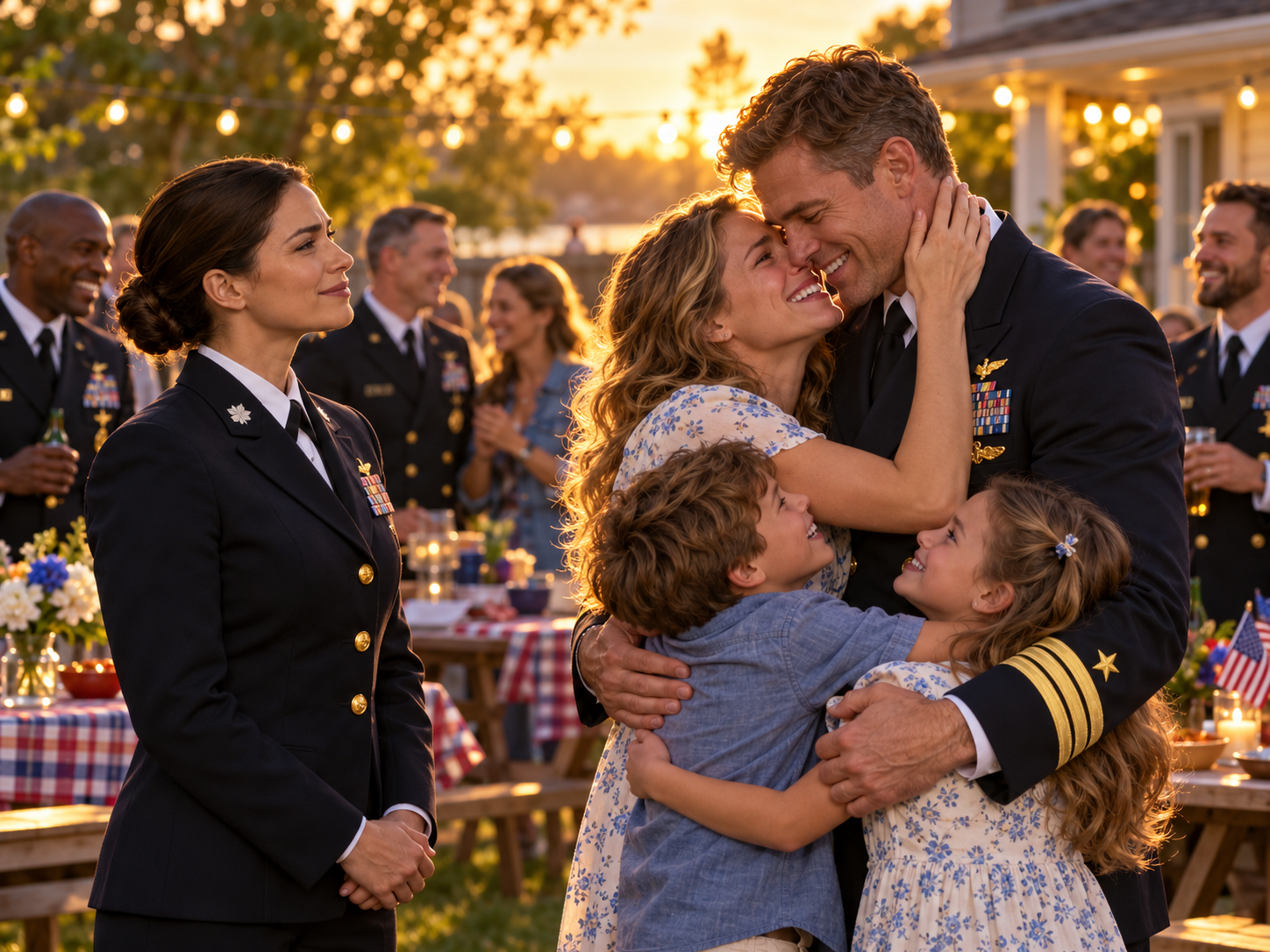
I looked down at the silver oak leaf on my uniform.
It caught the last warm light of the evening.
I remembered Harlan’s voice.
Decorative little officers.
I remembered the laughter.
The arrogance.
The way he had believed authority belonged to whoever could speak the loudest.
Then I looked at Jonah.
At Rebecca.
At the children.
At five survivors whose names would never again be reduced to unanswered questions in a forgotten file.
And I understood something no admiral could ever take from me.
Rank may give someone authority.
Character determines what they do with it.
And sometimes, the greatest victory isn’t watching a powerful man lose everything.
It’s watching the people he failed finally get their lives back.
That evening, beneath a sky turning gold over the Pacific, I watched Captain Jonah Pierce lift his daughter into his arms.
She laughed.
He kissed her forehead.
His wife wrapped an arm around them both.
And I smiled.
Because after six months of searching, thousands of pages of evidence, and a battle against people who believed the truth could be buried forever, the most important thing I had brought home wasn’t a classified document.
It wasn’t a confession.
It wasn’t an admiral’s apology.
It was a father.
A husband.
A friend.
A man whose children could finally stop waiting at the window.
And as Jonah turned toward me, smiling with his daughter in his arms, I knew that every sleepless night, every difficult question, and every moment of fear had been worth it.
Because the real measure of our service was never the silver on our uniforms.
It was the lives we refused to leave behind.
THE END.