My Mother Praised My Brother as a Real Officer—Then Hundreds of Soldiers Stood When They Called My Name
PART 1 — THE OFFICER THEY NEVER BELIEVED IN
“Don’t you dare embarrass your brother on his big day.”
My mother’s warning came from directly behind me, sharp enough to cut through the silence of the military ceremony.
I didn’t turn around.
I didn’t argue.
I simply kept my eyes forward.
Across the grand hall, my brother stood proudly at the podium while our mother personally pinned another ribbon to his uniform.
She smiled at him with the kind of pride I’d spent years wishing she would show me.
Then she looked in my direction and said:
“That is what a real officer is supposed to look like.”
I remained silent.
My brother approached me moments later, wearing a smug expression.
“Mom says they’re transferring you.”
I looked at him calmly.
“She doesn’t know why I’m here.”
Then the microphone clicked.
A commanding voice filled the hall.
“There is one officer whose identity has remained confidential until this morning.”
A pause followed.
“Major Emily Carter.”
My mother’s smile vanished.
My brother froze.
And when hundreds of officers rose to their feet, my family finally began to understand.
I wasn’t the officer being sent away.
I was the reason everyone had gathered.
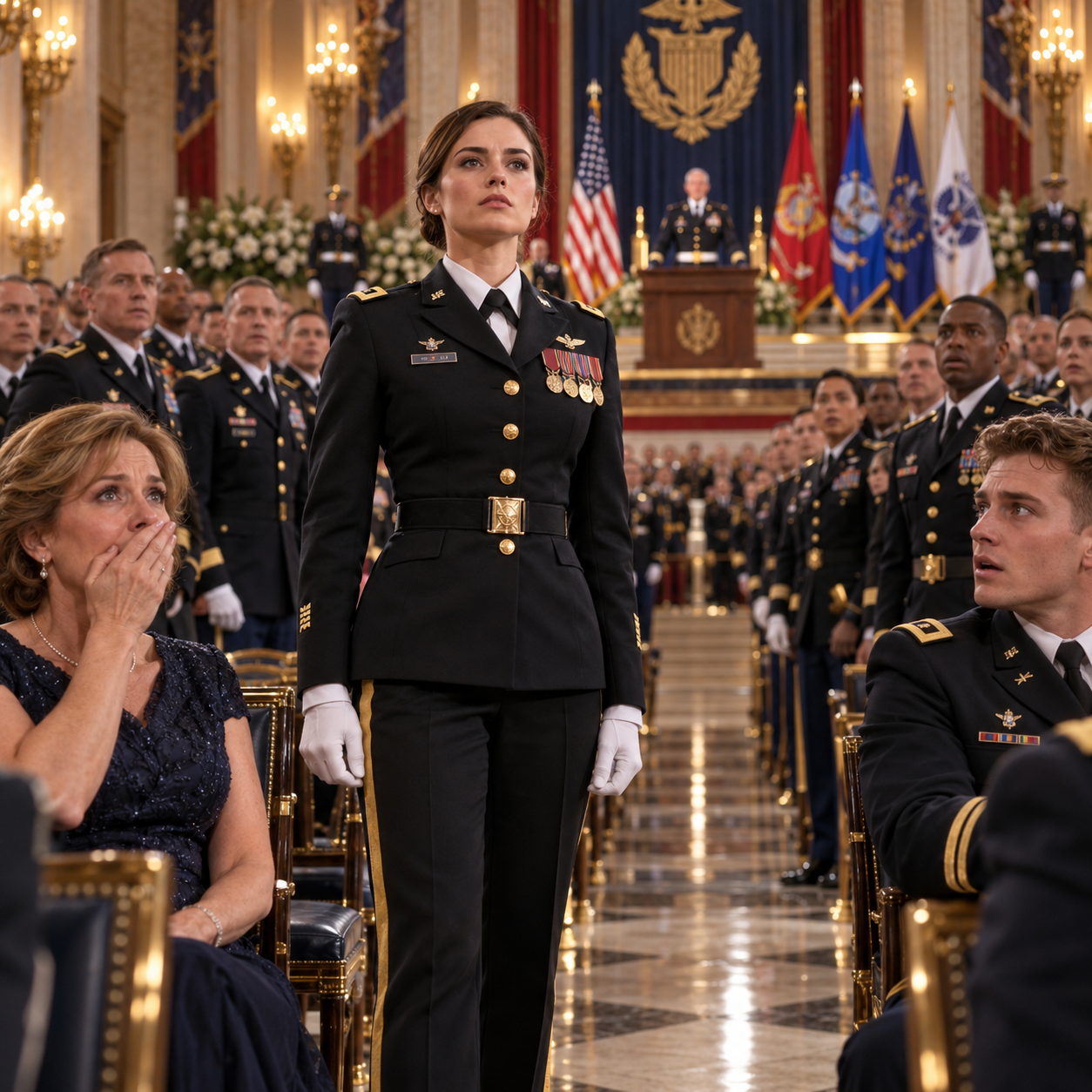
The grand hall was filled with military personnel.
Rows of immaculate dress uniforms stretched toward the far walls.
Gold buttons reflected the overhead lighting.
Medals and ribbons gleamed against carefully pressed fabric.
Everything about the setting conveyed discipline and tradition.
Officers occupied the seats in orderly rows.
The atmosphere was formal.
Conversations remained quiet.
Even small movements seemed unusually noticeable.
I sat in the center section, maintaining my composure despite the tension building inside me.
My jaw was tight.
My eyes remained directed toward the front of the room.
I’d attended military ceremonies before.
I understood the importance of protocol.
But this one was different.
Not because of the uniforms.
Not because of the dignitaries.
And certainly not because of the decorations being presented.
This was the first time my family had been so close to discovering something about my career that they had never imagined.
My mother leaned toward me from behind.
Her voice was barely louder than a whisper.
“Don’t make your brother’s day embarrassing.”
I didn’t blink.
She seemed to take my silence as agreement.
That was familiar.
Throughout my life, my mother had expected me to step aside whenever my brother was being celebrated.
His accomplishments deserved attention.
His promotions deserved admiration.
His successes were family victories.
Mine rarely received the same enthusiasm.
So I had learned to remain composed.
To avoid arguments.
And to stop searching her face for approval that never seemed to arrive.
Today, she was determined to make the ceremony about him.
I kept my hands still.
And looked toward the podium.
My brother stood beneath the bright lights as another ribbon was presented.
He looked proud.
Confident.
Completely comfortable with the attention directed toward him.
Then our mother stepped forward.
Her face lit up.
She carefully pinned the new decoration onto his uniform.
Her fingertips lingered against his chest as she admired the result.
She looked at him as though he embodied everything she believed military service should represent.
Then she said the words I had grown accustomed to hearing in one form or another.
“That’s what a real officer should look like.”
A soft ripple of approval passed through the nearby audience.
I watched without reacting.
The words hurt.
Of course they did.
But not enough to make me lose control in front of a room full of officers.
I kept my expression neutral.
My mother seemed satisfied.
She had praised her son.
And, without directly naming me, reminded everyone within earshot which child she considered worthy of pride.
My brother eventually turned away from the podium.
His eyes moved across the room.
Then he spotted me.
He approached until he was close enough to speak without drawing attention.
There was confidence in his expression.
The kind that came from believing you already understood another person’s place.
He leaned slightly toward me.
“Mom says you’re being transferred.”
I turned my eyes toward him.
My voice remained steady.
“She doesn’t know why I’m here.”
His expression shifted.
Only slightly.
For a moment, he seemed unsure how to interpret my response.
But before he could question me, a sharp sound echoed through the hall.
Click.
The microphone had been activated.
A formal voice came through the speakers.
It was controlled.
Authoritative.
And carried the weight of an announcement that had been carefully prepared.
“There is one officer whose identity has remained confidential until this morning.”
The hall grew quiet.
Heads turned toward the podium.
Officers who had been exchanging brief remarks stopped speaking.
Even the faint sounds of movement seemed to disappear.
I remained seated.
My white-gloved hands rested neatly in my lap.
I looked toward the front.
I knew what was coming.
My family did not.
Then the voice continued.
“Major Emily Carter.”
The name seemed to hang in the air.
For a moment, the entire room was still.
My mother stopped moving.
The proud smile she’d worn while pinning my brother’s ribbon disappeared.
Her face lost its color.
She stared toward the podium.
Then toward me.
My brother looked equally stunned.
Only seconds earlier, he’d been standing before me as the celebrated officer of the family.
Now he was looking at me as though he had heard something impossible.
His eyes widened.
His confidence faltered.
I didn’t offer either of them an explanation.
I simply remained composed.
My gloves were folded together in my lap.
My shoulders were straight.
My gaze stayed focused on the front of the hall.
The voice returned over the microphone.
This time, it was quieter.
But its authority seemed even greater.
“Please stand.”
Chairs scraped across the polished floor.
One after another, officers rose.
Then the movement spread through the hall.
Hundreds of uniformed personnel stood together.
The sound was unmistakable.
A roomful of military professionals responding to a formal command.
For one brief moment, I remained seated.
I could sense my mother’s attention fixed on me.
My brother was still close enough for me to hear him breathe.
Neither seemed to understand what was unfolding.
Then I placed my hands carefully and rose to my feet.
Major Emily Carter.
The name the announcer had just spoken was mine.
And the officers standing throughout the hall were not responding to a routine transfer announcement.
They were acknowledging something far more significant.
My mother had arrived believing I was there to watch my brother’s achievement.
My brother had approached me believing my career was about to be moved elsewhere.
But as I stood, the truth became impossible to ignore.
I wasn’t there because I was being transferred away.
The ceremony had been assembled because of me.
My mother took an uncertain step forward.
I could see her movement from the corner of my eye.
My brother whispered my name.
“Emily?”
It sounded less like a greeting than a question he was afraid to finish.
I didn’t turn toward him.
I didn’t look at my mother.
There was nothing I needed to explain to them in that moment.
For years, they’d decided what my service meant.
They’d measured my achievements against my brother’s.
They’d spoken about my future as though they knew everything about it.
And just minutes earlier, my mother had told me not to embarrass the son she considered a real officer.
Now she stood in a hall filled with hundreds of military personnel, watching them rise after hearing my name.
The certainty she’d carried into the ceremony was gone.
I kept my eyes straight ahead.
Toward the flag.
Toward the podium.
Toward the people who understood why I had been invited.
I waited calmly.
Because the announcement of my name wasn’t the end of the ceremony’s surprise.
It was only the beginning.
And the next order would change everything my mother and brother believed they knew about Major Emily Carter.
PART 2 — THE SECRET BEHIND MY NAME
“Color guard, present the colors.”
The command echoed through the hall.
At the front of the room, six soldiers moved with immaculate precision. Their boots struck the polished floor in perfect rhythm, and the American flag advanced beneath the warm lights.
For a moment, every personal thought disappeared.
I stood at attention with everyone else.
Then the commanding general approached the microphone.
Lieutenant General Richard Whitmore was a tall man in his late fifties, with silver hair, deeply lined features, and the kind of quiet authority that made people listen without his ever needing to raise his voice.
I had known him for almost three years.
My family had never heard his name.
“Ladies and gentlemen,” he began, “today’s ceremony recognizes achievements that could not previously be discussed publicly. Some portions of the work remain protected. Other portions have been reviewed and cleared for acknowledgment.”
A strange pressure formed beneath my ribs.
Even though I had read the approved citation the previous evening, hearing those words spoken aloud felt different.
It meant something that had lived in silence was about to become real.
“In September of last year, during a multinational humanitarian evacuation operation, a communications failure and rapidly deteriorating security situation placed hundreds of American personnel and civilians at risk.”
A photograph appeared on the screen behind him.
A damaged airfield.
Broken concrete.
Smoke rising beyond a row of abandoned vehicles.
My fingers tightened inside my gloves.
I knew that airfield.
I could still remember its smell.
Diesel fuel. Burning insulation. Wet concrete.
And blood.
General Whitmore continued.
“Enemy interference disrupted the evacuation network. Aircraft were unable to receive reliable instructions. Convoys became separated, and medical teams found themselves trapped without direct communication with the evacuation command.”
The photograph changed.
A temporary medical station stood beneath a shattered aircraft shelter.
I recognized the edge of a blue tarp.
For a brief second, I was no longer standing in that magnificent hall.
I was back beneath that tarp, kneeling beside a wounded medic while someone screamed for help.
“Major Emily Carter,” the general said, “was the officer who restored coordination between the separated elements, organized an improvised evacuation control point, and personally helped lead trapped personnel to safety.”
My mother made a small sound behind me.
My brother said nothing.
The general turned a page.
“Her actions contributed directly to the successful evacuation of more than three hundred personnel and civilians, including forty-seven wounded individuals, under extraordinarily dangerous conditions.”
A murmur moved through the audience.
I lowered my eyes for a fraction of a second.
Three hundred and eighteen.
That was the final number.
I remembered every digit.
But what I remembered more clearly was the eleven-year-old girl who had refused to board the last medical aircraft without her grandmother.
I remembered the young corporal whose radio had melted against his vest.
And I remembered Captain Daniel Mercer telling me, with a broken leg and blood running into his boots, that he was staying behind because someone had to guide the final group through the service tunnel.
Daniel had nearly died that night.
He was sitting somewhere in the third row now.
Alive.
That mattered more to me than any citation.
“Major Carter’s actions demonstrated exceptional leadership, courage, and devotion to duty,” General Whitmore concluded. “Her approved recognition also reflects the collective bravery of the soldiers, aircrews, medical personnel, and allied partners who served alongside her.”
Then he lifted his gaze.
“Major Carter, front and center.”
My body responded before my mind could catch up.
I stepped into the aisle.
The officers nearest me straightened.
As I passed the second row, a familiar voice whispered, “About time, boss.”
Captain Mercer.
I almost smiled.
Almost.
At the front of the hall, General Whitmore waited beside a display case containing a Bronze Star Medal with a combat distinguishing device.
I approached, halted, and saluted.
He returned the salute.
For a moment, neither of us spoke.
Then he leaned just close enough for me to hear.
“You earned this, Emily. Don’t argue with me about it today.”
I swallowed.
“Yes, sir.”
A faint smile appeared beneath his stern expression.
“Good. That’s an order.”
He turned toward the audience.
“Before presenting this award, there is something I believe deserves to be understood.”
My stomach tightened.
That sentence had not been in the approved rehearsal script.
General Whitmore gestured toward the large screen.
“Many of you have seen portions of the evacuation footage during training briefings. Until this week, the officer coordinating those actions was not publicly identified.”
The lights dimmed.
A video began.
The image was grainy.
A camera mounted inside a transport aircraft showed soldiers rushing across an airfield. Emergency lights flashed through thick smoke.
Someone shouted that the communications relay had gone down.
Then a woman’s voice emerged through the distortion.
My voice.
“Ground teams, this is Carter. We are establishing a secondary control point. Medical evacuation moves first. Nobody advances without confirming accountability.”
The recording crackled.
A man shouted that the western access route was blocked.
My recorded voice answered.
“Then we use the service corridor. Keep the wounded moving. I’ll meet the last team at the junction.”
The footage cut to a second camera.
A woman in a dust-covered helmet was helping two soldiers carry a wounded civilian onto a transport vehicle.
Her face was partially obscured.
But I knew the way she moved.
I knew the bloodstain on the left sleeve.
I knew the torn strap hanging from her vest.
I remembered the moment so vividly that my throat closed.
Behind me, my mother whispered, “Oh, my God.”
The footage ended.
The lights returned.
No one applauded immediately.
There was a silence heavier than applause.
Then General Whitmore faced me.
“Major Carter, on behalf of a grateful nation and your fellow service members, it is my honor to recognize your actions.”
He fastened the medal to my uniform.
The room erupted.
Hundreds of people applauded.
Some stood again.
I heard boots strike the floor and voices rising above the applause.
But I barely noticed.
Because I had just seen Daniel Mercer standing in the third row.
His right leg was supported by a discreet orthopedic brace beneath his dress trousers.
He was saluting.
Beside him stood Staff Sergeant Elena Ruiz, who had lost part of her hearing that night.
And beside her was Specialist Noah Brooks, whose final radio transmission I had once believed would be the last words he ever spoke.
They were alive.
They were standing.
That was what nearly broke me.
I returned their salute.
And for the first time since entering the hall, my eyes filled with tears.
Not because my mother was watching.
Not because my brother was embarrassed.
But because the men and women I had feared losing were standing in front of me.
When the applause finally quieted, General Whitmore handed me the citation.
“Major,” he said, “the floor is yours.”
I stepped toward the microphone.
For several seconds, I looked out at the sea of uniforms.
I had spoken during operational briefings with far more at stake than a crowded auditorium.
Yet suddenly, words seemed difficult.
“Thank you, sir.”
My voice carried across the hall.
“I accept this recognition with gratitude. But I cannot accept the idea that any one person accomplished what happened that night.”
I glanced toward Daniel.
“Captain Mercer carried wounded personnel after sustaining an injury that should have made walking impossible. Staff Sergeant Ruiz maintained our medical coordination after losing her primary communications equipment. Specialist Brooks remained at his station until every person in his sector was accounted for.”
I paused.
“There were dozens of others whose actions mattered just as much.”
The room became perfectly still.
“I once believed that courage meant never admitting you were afraid.”
A few faces softened.
“I was wrong.”
I looked toward the screen where the damaged airfield had appeared.
“Courage is being afraid and choosing to protect the person beside you anyway.”
I inhaled slowly.
“There were moments that night when I didn’t know whether any of us would make it home.”
My voice almost faltered.
“But we kept moving because nobody was expendable. Not the injured. Not the frightened. Not the people whose names never appeared in a report.”
Then I said the words I had carried inside me for more than a year.
“A uniform does not make someone important. What matters is what we do for the people who depend on us.”
The applause began slowly.
Then grew.
I stepped back and saluted the general.
Only after he dismissed me did I return toward my seat.
That was when I saw my mother’s face clearly.
She was crying.
My brother was not.
He looked pale and rigid, his eyes following the medal on my uniform.
As I approached, my mother reached for my arm.
“Emily, sweetheart—”
I stopped.
Not because of the word.
Because of how unfamiliar it sounded.
Sweetheart.
She had not called me that in years.
“We had no idea,” she whispered.
I looked at her.
“No,” I said quietly. “You didn’t.”
Her lips trembled.
“Why didn’t you tell us?”
Before I could answer, my brother stepped closer.
“You told us you were working in logistics.”
“I told you I was serving in operational planning.”
“That’s not the same thing!”
His voice was louder than he intended.
Several officers turned.
I kept mine low.
“Parts of my assignment were classified, Jason. I couldn’t discuss them.”
He shook his head.
“But you could have told us something.”
“I tried.”
He opened his mouth.
I continued.
“Do you remember Thanksgiving two years ago?”
His expression changed.
“You spent the entire dinner talking about how desk officers weren’t real soldiers.”
“That’s not what I meant.”
“You said my career was a convenient way to collect a paycheck without doing anything difficult.”
He looked away.
“And Mom agreed with you.”
My mother covered her mouth.
I turned toward her.
“Last Christmas, I told you I couldn’t come home because I was preparing for an important assignment. You said Jason had real responsibilities and I was making excuses.”
“Emily—”
“And when I called you from the hospital after the evacuation, you told me you couldn’t talk because Jason was receiving an award.”
She stared at me.
I remembered that call.
I had been sitting on a narrow hospital bed in Germany.
A medic had removed a fragment of metal from my shoulder.
My left hand shook so badly that I could barely hold the phone.
I had wanted to hear my mother’s voice.
Only for a minute.
She had answered on the fourth ring.
“Emily, this isn’t a good time. Your brother’s ceremony is starting.”
Then she hung up.
I still remembered staring at the dark phone screen.
Wondering why I had called at all.
Now she stood before me in a crowded hall, unable to find an answer.
“I didn’t keep my career secret to punish you,” I said.
“I kept the protected parts secret because it was my duty. The rest of the time, I simply stopped volunteering information to people who never seemed interested.”
Jason’s face hardened.
“So now you’re going to humiliate us in front of everyone?”
I looked at him for a long moment.
“Jason, I didn’t mention either of you in my speech.”
“That doesn’t mean—”
“This isn’t about you.”
He flinched.
The words were not cruel.
They were true.
For most of my life, every important event had somehow become about Jason.
His accomplishments.
His disappointments.
His ambitions.
His need to be reassured that he mattered more.
But not this time.
Before he could respond, Captain Mercer approached.
“Major Carter?”
I turned.
“Captain.”
He smiled.
“General Whitmore would like you in the reception room.”
I nodded.
“I’ll be there.”
Daniel glanced toward my family.
His smile faded slightly.
“Everything all right?”
“Yes.”
He hesitated.
Then said, “Ma’am, Colonel Bennett is asking about the personnel review documents.”
Those five words changed the atmosphere.
My brother’s head snapped toward him.
“What personnel review?”
Daniel looked at Jason, then at me.
“I thought Major Carter had been briefed.”
“I have,” I answered.
Daniel’s eyes narrowed.
“Then you know the preliminary findings?”
I nodded once.
“Yes.”
My brother took a step forward.
“What findings?”
I looked at him.
For the first time that morning, I saw something other than arrogance in his face.
Fear.
“Jason,” I said carefully, “we need to talk somewhere private.”
He stared at me.
“What did you do?”
The question landed like a slap.
Even now, after everything he had heard, his first instinct was to assume I had caused a problem.
I held his gaze.
“I haven’t done anything to you.”
“Then why is someone reviewing my personnel file?”
Daniel shifted beside us.
I lowered my voice.
“Because your name appeared in a report connected to the evacuation.”
Jason went absolutely still.
My mother looked between us.
“What does that mean?”
I didn’t answer her.
I watched my brother.
He was no longer looking at my medal.
He was looking toward the side doors.
And suddenly, I remembered something that had bothered me for months.
Three weeks after the evacuation, while I was recovering in Germany, Jason had called me unexpectedly.
It was the first time he’d initiated a conversation in nearly a year.
He’d asked which unit had controlled the medical extraction route.
He’d asked whether our communications failure had been officially documented.
He’d even asked if an officer named Thomas Vale had been involved.
At the time, I had refused to discuss operational details.
Jason had laughed and said he was only curious.
Now, standing beside him in the grand hall, I realized he had not been curious at all.
He had known something.
Something he had never told me.
“Jason,” I whispered, “why did you ask me about Colonel Vale?”
His face drained of color.
My mother looked confused.
“Who’s Colonel Vale?”
Jason didn’t answer.
Instead, he looked directly at Daniel.
“Does she know about the file?”
Daniel’s expression turned cold.
“What file?”
Jason took another step backward.
Then he said something that made my blood run cold.
“Emily, I swear I didn’t know they were going to use your name.”
PART 3 — THE LIE BURIED INSIDE THE REPORT
For a moment, I thought I had misunderstood him.
The noise of the reception seemed to recede, leaving only the faint hum of the ventilation system and the pounding of my heart.
“What did you just say?”
Jason looked at Daniel, then at the doors.
“Not here.”
“Then start explaining.”
“Emily, please.”
It was the first time I had heard my brother say that word without sounding annoyed.
Daniel moved closer.
“Major, perhaps we should continue this conversation in the conference room.”
I nodded.
“Agreed.”
My mother followed us, clutching her handbag against her chest.
For once, she wasn’t talking.
That worried me almost as much as Jason’s expression.
We crossed a narrow corridor lined with photographs of former commanding officers. Beneath each portrait was a small brass plaque identifying the officer’s name, rank, and years of service.
I had walked through hundreds of corridors like this.
Today, however, every step seemed to carry me closer to a truth I had unknowingly been living beside.
At the end of the hallway, Daniel opened a conference room.
Inside stood Colonel Sarah Bennett, an Army attorney with whom I had worked during the post-operation review. Beside her were an investigator from the Criminal Investigation Division and an administrative officer I recognized from headquarters.
A thick folder rested on the table.
Jason stopped in the doorway.
“Oh, no.”
Colonel Bennett turned.
“Captain Carter.”
He straightened automatically.
“Ma’am.”
“Thank you for coming.”
“I didn’t agree to anything.”
Her expression remained professional.
“You are not being detained, Captain. You’re being given an opportunity to clarify information in an ongoing administrative inquiry. You may consult counsel before making a statement.”
My mother looked horrified.
“An inquiry? Into what?”
Bennett glanced toward me.
“Major Carter, I appreciate your willingness to attend, but you should understand that portions of this matter may require you to recuse yourself from further involvement.”
“I understand, ma’am.”
She nodded.
Then she addressed my brother.
“Captain Carter, have you ever worked with Colonel Thomas Vale?”
Jason swallowed.
“Yes.”
“In what capacity?”
“He supervised the strategic readiness evaluation team attached to our command.”
“And did he ask you to provide information about Operation Harbor Lantern?”
The room became completely silent.
Harbor Lantern.
That was the official name of the evacuation.
I had not heard Jason use it before.
“Yes,” he said eventually.
“When?”
“Several weeks after the operation.”
“What information did you provide?”
Jason stared at the folder.
“Nothing classified.”
“That wasn’t the question.”
He rubbed his forehead.
“I forwarded an internal memorandum.”
Bennett opened the folder.
“Which memorandum?”
“One describing communications failures and command responsibility.”
“Did you prepare it?”
Jason hesitated.
“Not entirely.”
The investigator spoke for the first time.
“Who drafted it, Captain?”
Jason looked at me.
And that was when I realized he was afraid of something much worse than a reprimand.
“Colonel Vale gave me a draft.”
Bennett turned another page.
“Did you read the draft before forwarding it?”
“Yes.”
“Did you know it identified Major Emily Carter as the officer whose decisions caused the failure of the evacuation communications network?”
My mother inhaled sharply.
My stomach seemed to drop.
I stared at Jason.
“What?”
He closed his eyes.
“Emily, listen—”
“No.”
My voice was calm.
Too calm.
“Tell me exactly what that report said.”
Bennett intervened.
“Major, you are entitled to understand the allegations affecting your own record, but the investigation is ongoing. We should keep the accounts separate.”
I nodded, forcing myself to look at her.
“Understood.”
She continued.
“The memorandum alleged that the secondary control point established during Harbor Lantern had not been properly authorized. It further claimed that Major Carter bypassed established procedures, creating confusion that contributed to delayed casualty movement.”
I felt my jaw tighten.
“That is false.”
“We know substantial portions conflict with the contemporaneous operational record.”
“Then why was the report circulated?”
Bennett glanced toward Jason.
“That’s one of the questions we’re investigating.”
I turned toward my brother.
“Did you know it accused me of negligence?”
Jason’s mouth opened.
Then closed.
“Jason.”
“Yes.”
My mother whispered his name.
He looked miserable.
“I knew it mentioned you.”
“Mentioned me?”
My composure cracked.
“Jason, that report could have ended my career.”
“I didn’t think anyone would take it that seriously.”
The words were so absurd that for a second I could only stare.
“You forwarded an accusation of operational negligence during a mission that cost people their lives, and you didn’t think anyone would take it seriously?”
He looked away.
Bennett raised a hand.
“Major, I understand your reaction, but we need to avoid compromising the interview.”
I took a breath.
Then another.
“You’re right, ma’am.”
I stepped away from the table.
Daniel quietly pulled out a chair for me.
I sat.
It was the first time that day I felt genuinely exhausted.
Colonel Bennett turned back toward Jason.
“Captain Carter, why did Colonel Vale involve you?”
Jason glanced at our mother.
“Because I knew Emily.”
“That much is obvious.”
“He said he was conducting an independent assessment. He wanted background information about her judgment, her temperament, whether she had a history of acting without authorization.”
My mother slowly lowered herself into a chair.
“And what did you tell him?” she asked.
Jason stared at the floor.
I already knew.
Still, I needed to hear it.
“I told him she could be stubborn.”
He paused.
“That she had always been competitive.”
My hands turned cold.
“That she sometimes resented being overlooked.”
I looked at him.
“Overlooked by whom?”
Jason didn’t answer.
He didn’t need to.
Bennett consulted her notes.
“Your signed statement also described Major Carter as emotionally volatile when her professional recognition was questioned.”
A bitter laugh escaped me.
“Emotionally volatile.”
I remembered the Christmas when I’d sat alone in my apartment after my mother forgot to call.
The birthdays spent overseas.
The promotion announcement Jason had mocked in our family group chat.
I remembered learning not to cry in front of them because any display of hurt became evidence that I was too sensitive.
And now those years of silence had been transformed into a personality defect.
By my own brother.
“You used our family history to discredit me,” I said.
Jason shook his head.
“I didn’t understand what Vale was doing.”
“You understood enough to sign your name.”
He looked at me then.
Really looked.
And for one moment, I saw the boy who had once followed me around our backyard carrying a plastic toy rifle.
The little brother who had cried when he couldn’t keep up with me on our bicycles.
That boy had disappeared somewhere along the way.
I wasn’t sure when.
Perhaps it happened when our father died.
Perhaps it happened when our mother decided that Jason was the child who would carry his legacy.
Or perhaps I had simply refused to notice the change because loving someone made it easier to excuse them.
Colonel Bennett closed the folder.
“Captain Carter, there are additional matters we need to discuss. You have the right to seek legal advice before responding to further questions.”
Jason nodded weakly.
“I want counsel.”
“That’s appropriate,” Bennett said.
The investigator made a note.
The interview ended there.
For the moment.
But the damage had already been done.
The Father We Remembered Differently
My father had been a career Army officer.
Colonel Michael Carter.
To the people who served under him, he was a disciplined and respected leader.
To my brother, he was a hero whose footsteps had to be followed.
To my mother, he became almost sacred after his death.
To me, he had been something simpler.
He was the man who taught me to change a tire, fix a broken fence, and stand up for someone being bullied.
He used to say that leadership was not measured by the number of people who obeyed you.
It was measured by the number of people who trusted you when things went wrong.
I was seventeen when he died from complications following a long illness.
Jason was fourteen.
After the funeral, our house changed.
My mother stopped laughing.
My brother began wearing Father’s old academy sweatshirt.
And I became the person expected to make life easier for everyone.
I cooked.
I cleaned.
I helped Jason with his schoolwork.
I drove him to appointments and sports practices.
When he received his first military scholarship offer, my mother cried with joy.
When I received mine, she said, “That’s nice, Emily. Just don’t let it distract you from helping your brother.”
I told myself she was grieving.
I told myself it would pass.
It never did.
When Jason graduated from his officer commissioning program, she organized a party with more than eighty guests.
When I commissioned, she sent a congratulatory text.
When Jason became a captain, she framed his promotion photograph and hung it in the living room.
When I became a major, she asked whether the promotion meant I would finally earn enough money to help Jason purchase a house.
That was when I stopped expecting anything different.
But there was something I had never understood.
Father had encouraged both of us.
He had never suggested that Jason mattered more.
Yet after his death, our mother began speaking as though Father had left behind a single unfinished dream.
A son in uniform.
Not a daughter.
A son.
And she would protect that dream even if doing so meant sacrificing mine.
I looked through the conference room window at Jason sitting farther down the corridor.
He had his phone pressed to his ear.
Probably calling an attorney.
For the first time, I wondered whether he even remembered our father accurately.
Or whether he’d spent his entire adult life trying to become the version Mother had created.
Daniel interrupted my thoughts.
“Emily?”
I turned.
He stood beside the window holding two paper cups of coffee.
“You look like you could use this.”
I accepted one.
“Thank you.”
He sat across from me.
For several minutes, neither of us spoke.
Then I asked, “How long have you known about Jason?”
“Not as long as you’re thinking.”
“How long?”
“About six weeks.”
I looked at him sharply.
“Six weeks?”
“Before that, investigators were examining inconsistent reports about the evacuation. The original command logs didn’t match a later assessment memorandum.”
I set the coffee down.
“Why wasn’t I told?”
“Because they were still determining whether the discrepancy was an administrative error, misconduct, or something more serious.”
He paused.
“And because your name was directly involved.”
I stared at him.
Daniel leaned forward.
“Emily, there’s something else.”
I almost laughed.
“Of course there is.”
He didn’t smile.
“Colonel Vale was on the operational assessment team before Harbor Lantern. He had responsibilities connected to the communications readiness review.”
I frowned.
“I know. His team signed off on the redundancy systems.”
“Exactly.”
My fingers went still.
During the evacuation, our communications network had failed much faster than anyone expected.
At the time, we believed interference and infrastructure damage had overwhelmed the system.
But some of the backup failures had never made sense.
A redundant link that should have survived had gone down almost immediately.
A secondary relay was configured incorrectly.
And one emergency channel had been listed as functional despite producing no usable signal.
I had raised those questions in my initial report.
“Vale approved the system?” I asked.
“His office endorsed its readiness assessment.”
I stared at Daniel.
“And then he wrote a report blaming me for improvising when it failed.”
“That’s what the investigators are examining.”
The implications unfolded slowly.
Colonel Vale hadn’t necessarily caused the failure.
But he had an obvious reason to fear what an independent review might uncover.
If his office had failed to identify critical weaknesses, the questions would reach beyond one officer.
They could affect contracts.
Evaluations.
Careers.
And possibly the safety of future operations.
“Why Jason?” I asked.
Daniel studied me.
“Because he was family. His testimony could make the allegations appear more credible.”
I felt sick.
“And because he was willing.”
Daniel didn’t answer.
There was nothing to say.
The Woman Who Could Have Spoken Up
My mother appeared in the doorway twenty minutes later.
She looked older than she had that morning.
The bright pride had vanished from her face, replaced by an exhaustion I recognized.
I had seen it after Father’s funeral.
“Emily?”
I nodded toward the empty chair.
She sat carefully.
Daniel rose.
“I’ll give you some privacy.”
After he left, silence settled between us.
My mother looked at the medal on my uniform.
“I had no idea you went through something like that.”
I didn’t respond.
“I keep thinking about that video.”
She touched her throat.
“You could have died.”
“Yes.”
The word seemed to frighten her.
“Why didn’t you call me?”
I looked directly at her.
“I did.”
She closed her eyes.
“Oh.”
For a long moment, she said nothing.
Then she whispered, “I remember being at Jason’s ceremony.”
“So do I.”
“Emily, if I’d known—”
I interrupted her gently.
“You knew I was calling from a hospital.”
She lowered her head.
“I didn’t know how badly you were hurt.”
“You didn’t ask.”
Her shoulders began to shake.
I had imagined this conversation many times.
In my angrier moments, I had imagined delivering a devastating speech.
Telling her every selfish thing she’d ever done.
Watching her realize what she’d lost.
But sitting across from her now, I felt mostly tired.
“I don’t need you to be proud of my medal,” I said.
She looked up.
“I don’t need you to tell people I’m a hero.”
“Emily—”
“I needed you to believe I mattered before any of this happened.”
She began crying harder.
I let her.
For once, I didn’t rush to make her feel better.
After a while, she said, “Your father would have been so proud.”
Something inside me tightened.
“Don’t.”
She blinked.
“What?”
“Please don’t use Dad to explain how you feel about me today.”
Her face changed.
“I wasn’t—”
“For years, you told me he would have wanted Jason to carry on the family tradition. You told me my career wasn’t what he’d imagined.”
“That’s not exactly what I said.”
“It is.”
She looked away.
I continued.
“Dad taught me how to read maps when I was ten. He helped me train for my first long-distance run. He took me to military museums and explained the history behind every exhibit.”
My voice shook.
“He never made me feel like I was less capable because I was his daughter.”
My mother wiped her cheeks.
“I know.”
“Then why did you?”
She didn’t answer.
And the silence was answer enough.
Eventually, she whispered, “I was afraid of losing Jason too.”
I frowned.
“What?”
“After your father died, Jason was so angry. He stopped talking. He got into fights. I thought if I could give him something to believe in, something that connected him to his father, I could keep him from falling apart.”
I stared at her.
“So you built your entire life around proving he was special.”
She nodded faintly.
“And what did you think would happen to me?”
Her lips parted.
Nothing came out.
I leaned back.
“That was the part you never considered.”
She reached across the table.
I moved my hand away.
Not dramatically.
Not angrily.
I simply wasn’t ready.
She stared at the empty space between us.
“I’m sorry,” she whispered.
I wanted to believe her.
But apologies spoken in the aftermath of public humiliation were complicated things.
Was she sorry because she’d hurt me?
Or because she’d finally been forced to see how badly she’d misjudged me?
I didn’t know.
Before I could respond, the door opened.
Colonel Bennett stood outside.
“Major Carter, could I speak with you?”
I rose.
My mother looked frightened.
“Is Jason in trouble?”
Bennett’s expression did not change.
“The inquiry is continuing, ma’am.”
I stepped into the corridor.
Bennett waited until we were out of earshot.
“We have a development.”
“What kind?”
“The records custodian has recovered an earlier version of the memorandum Captain Carter forwarded.”
I held my breath.
“It contains tracked revisions.”
“And?”
She studied my face.
“Several statements blaming you were inserted after the initial technical assessment.”
My stomach tightened.
“By Vale?”
“We’re still authenticating the document history.”
I nodded.
Then she said something I would remember for the rest of my life.
“Major, one of the revisions was made under your brother’s authenticated account.”
I stared at her.
“No.”
“We are not treating the account record as proof of who physically made the changes. But we have to establish who had access.”
I shook my head.
“Jason said he only forwarded the memorandum.”
“That’s what he told us.”
I looked toward the corridor where he’d been sitting.
His chair was empty.
Bennett followed my gaze.
“He’s with counsel now.”
I felt a sharp, cold certainty settle over me.
My brother hadn’t simply repeated something someone else told him.
His account had been used to help create the accusation.
And whether he had typed those words himself or allowed someone else to do it, he had concealed that fact from the investigators.
“There’s another issue,” Bennett continued.
I looked at her.
“What?”
“We found a reference to a personal letter allegedly written by your father.”
My breath caught.
“My father?”
She nodded.
“According to the memorandum’s supporting notes, Captain Carter provided a document claiming Colonel Michael Carter had expressed serious doubts about your suitability for command.”
For a moment, I couldn’t speak.
Then I whispered, “That’s impossible.”
“Why?”
“Because Dad never wrote anything like that.”
Bennett hesitated.
“Do you have a reason to be certain?”
I did.
And suddenly, a memory surfaced.
A rainy Sunday afternoon.
My father sitting at his old wooden desk.
A blue envelope.
His handwriting.
And the words he’d said as he handed it to me.
“Emily, if anyone ever makes you doubt the kind of leader you can become, read this.”
I looked at Colonel Bennett.
“Ma’am, I think I know exactly where we need to look.”
PART 4 — THE LETTER MY FATHER LEFT BEHIND
The envelope was in a wooden box beneath my bed.
At least, that was where I had kept it for eleven years.
I had moved that box through seven duty stations, three overseas assignments, and more apartments than I cared to remember.
There were very few things inside.
My father’s academy ring.
A photograph of him standing beside me at my high school graduation.
An old compass with a cracked leather case.
And the letter.
The letter I had never shown my mother or brother.
Colonel Bennett accompanied me to the temporary quarters assigned for the ceremony, while Daniel waited outside.
I unlocked the door and crossed the room.
For the first time in years, my hands were shaking.
I pulled my suitcase onto the bed, unzipped the inner compartment, and removed a small wooden box wrapped in a navy-blue sweatshirt.
My father’s initials were carved into the lid.
M.C.
I opened it.
The envelope was exactly where I remembered.
Blue paper.
My name written across the front.
I stared at it for several seconds before handing it to Bennett.
“May I?” she asked.
I nodded.
She carefully unfolded the letter.
As she read, I watched her expression change.
Then she passed it back.
“Emily, would you read this aloud?”
I swallowed.
The handwriting was unmistakable.
My father’s letters had always tilted slightly to the right.
He pressed too hard with his pen, leaving faint indentations on the reverse side of every page.
I began.
My dearest Emily,
If you are reading this because someone has made you question whether you belong in the military, I want you to remember something.
You do not need to become me.
You do not need to become your brother.
You do not need anyone else’s permission to become the person you are capable of being.
My vision blurred.
I continued.
I have watched you protect people who could offer you nothing in return. I have watched you admit mistakes when hiding them would have been easier. And I have watched you stand alone when following the crowd would have brought you praise.
Those things matter more to me than rank.
If you choose to serve, serve honorably. If you choose another path, follow it without shame.
Whatever uniform you wear, or never wear, you will always be my daughter.
And I will always be proud of you.
Love, Dad.
When I finished, the room was silent.
Colonel Bennett looked toward the window.
Then she said, “I wish I could have met him.”
I folded the paper carefully.
“He was a good man.”
She nodded.
“Do you know whether he wrote anything similar to Jason?”
“Yes. He wrote letters to both of us when he became ill.”
“Have you seen Jason’s?”
“No.”
I placed the letter back inside its envelope.
“But I know what mine says.”
Bennett closed her notebook.
“May I arrange for the document to be examined and copied?”
“Yes.”
She hesitated.
“Emily, I need to make something clear. The existence of this letter doesn’t automatically establish that the other document was fabricated. We still need to verify its origin.”
“I understand.”
“But it gives us something important to compare against.”
I nodded.
At last, there was something tangible.
Something beyond memory, pain, and accusations.
My father had left behind words that no one could rewrite without leaving a trace.
Or so I believed.
The Last Thing Jason Expected Me to Find
That evening, I received a message from an unfamiliar number.
Major Carter. This is Rebecca Sloan. I used to work in Colonel Vale’s office. We need to speak.
I stared at the screen.
A second message followed.
It’s about the letter. And what happened before the evacuation.
I immediately forwarded the messages to Colonel Bennett.
Within an hour, the investigators had contacted Sloan through official channels.
By the next morning, they had confirmed her identity and arranged a formal interview.
Rebecca Sloan was a civilian analyst in her early forties.
She had worked for Colonel Vale during the readiness evaluation period, then transferred to another office after raising concerns about documentation practices.
Her statement changed the direction of the inquiry.
She described repeated pressure to revise technical findings so that the communications system would appear fully prepared for deployment.
Some deficiencies had been identified during testing.
They had not all been corrected.
When Harbor Lantern exposed those weaknesses, Vale’s office faced an uncomfortable question.
Had the communication network failed because of unpredictable conditions alone?
Or had known vulnerabilities made the operation more dangerous than necessary?
According to Sloan, Vale became increasingly concerned after learning that my official report documented the failure of several supposedly independent backup channels.
“He said the public would only see a disaster if the review wasn’t controlled,” she told the investigators.
Sloan also described a later meeting involving Jason.
I was not present for the interview.
Colonel Bennett eventually briefed me only on the information I was authorized to receive.
But one detail changed everything.
Sloan had preserved a copy of an email sent from Vale’s office requesting character information about me.
The message specifically asked for documentation that could demonstrate a history of poor judgment.
And attached to a later response was the alleged letter from my father.
It was not a letter at all.
It was a selectively edited combination of sentences from his military notebooks, paired with statements he had never written.
My father’s name had been placed beneath it.
My brother had supplied the notebooks.
I learned that fact while sitting alone in a small briefing room.
For several seconds, I felt nothing.
Then the grief arrived.
Not anger.
Not even surprise.
Grief.
Because Jason had taken the memory of a dead man and turned it into a weapon against his own sister.
I thought about Father’s final days.
How Jason and I had sat beside his hospital bed.
How we’d promised to take care of each other.
And how I’d believed that promise mattered to both of us.
I lowered my forehead into my hands.
Daniel was sitting across the room.
He waited.
After a while, I whispered, “How could he do that?”
Daniel didn’t offer an easy answer.
Instead, he said, “I don’t know.”
I appreciated that.
Some things shouldn’t be softened simply because the truth is difficult.
My Brother Finally Told the Truth
Jason requested to speak with me two days later.
His attorney had advised him against discussing the investigation, but he wanted to apologize personally.
I agreed to meet in a private room at the installation’s family support center.
There would be no recording.
No investigators.
No official questions.
Only my brother and me.
When I entered, he stood immediately.
He looked different.
Not physically.
His uniform was still perfectly pressed.
His haircut was still immaculate.
But he no longer seemed to occupy every room with the assumption that he belonged at its center.
“Emily.”
I sat opposite him.
“Jason.”
He looked down.
“I don’t know where to begin.”
“Try the truth.”
He nodded slowly.
For a long time, he studied his hands.
Then he said, “I was jealous of you.”
I didn’t react.
“I know how pathetic that sounds.”
“It sounds like something you should have admitted to yourself years ago.”
He winced.
“I always thought Dad expected me to be the better officer.”
“Dad never said that.”
“I know.”
He swallowed.
“But Mom kept telling me I was supposed to carry his legacy. Every achievement had to be bigger than the last. Every promotion had to prove something.”
He stared toward the wall.
“And then you kept succeeding.”
I frowned.
“Jason, we were in different assignments. We weren’t competing.”
“You weren’t.”
His voice broke.
“I was.”
That answer hurt more than I expected.
He continued.
“When I learned you were involved in Harbor Lantern, I thought you were just another planning officer. But then I heard people talking about an unnamed major who had saved the evacuation.”
He looked at me.
“I was afraid it was you.”
I stared.
“Afraid?”
“Yes.”
“Why?”
“Because I knew Mom would finally see you differently.”
For a moment, I couldn’t comprehend what he’d said.
Then I understood.
His greatest fear had not been that I would fail.
It had been that I would succeed so visibly that our mother could no longer ignore me.
Jason wiped his face.
“Vale told me your report was exaggerated. He said officers sometimes made themselves look like heroes to cover mistakes. I wanted to believe him.”
“So you did.”
“Yes.”
“And the letter?”
He closed his eyes.
“I gave him Dad’s notebooks. I thought he wanted examples of Dad’s leadership philosophy.”
I leaned forward.
“Did you know the document was altered?”
His silence answered before he spoke.
“Not at first.”
My heart sank.
“But later?”
He began crying.
“Yes.”
I looked away.
The room felt too small.
“I found out before the ceremony,” he whispered. “Vale sent me a draft of the final assessment. I saw Dad’s name. I saw the words they had added.”
“And you said nothing.”
“I panicked.”
“You could have called the investigators.”
“I know.”
“You could have called me.”
“I know.”
“You could have refused to let our father’s memory be used that way.”
His voice cracked.
“I know, Emily.”
I stood.
He stood too.
“Please don’t leave.”
I faced him.
“Jason, do you understand what you did?”
He nodded through tears.
“No,” I said. “I don’t think you do.”
I stepped closer.
“You didn’t just sign a false statement. You tried to make people question whether I was fit to lead. You put your career, my career, and the truth about a dangerous operation at risk because you couldn’t bear the idea that I had done something important.”
He covered his face.
I continued.
“People were hurt during Harbor Lantern. Some of them will live with those injuries forever. The purpose of reviewing that operation was to make sure we didn’t repeat the same mistakes.”
He looked up.
“And you helped someone interfere with that.”
The words settled between us.
He sat down heavily.
“I deserve whatever happens.”
I shook my head.
“This isn’t about what you deserve. It’s about what you’re willing to take responsibility for.”
He stared at me.
Then he asked the question I’d been expecting.
“Can you forgive me?”
My throat tightened.
I wanted to say yes.
I wanted to return to the childhood when we had shared secrets beneath the kitchen table and believed our family would always protect us.
But that childhood was gone.
“I don’t know,” I said.
He lowered his head.
“I understand.”
I walked toward the door.
Then I stopped.
“There is something I need you to hear.”
He looked up.
“I never wanted to take your place.”
His eyes filled again.
“I know.”
“No, Jason. You don’t.”
I turned fully toward him.
“I spent years trying to convince Mom that there was enough love for both of us.”
He began to sob.
“And you spent those same years making sure there wasn’t.”
I opened the door.
Behind me, he whispered, “I’m sorry, Em.”
It was the first time he’d called me Em since we were children.
I stopped for one breath.
Then I left.
The Decision That Could Have Cost Me Everything
Three days later, General Whitmore called me into his office.
He did not offer coffee.
That alone told me the meeting was serious.
“Major Carter, please sit.”
I obeyed.
He studied me for several seconds.
“The preliminary investigation has established significant concerns about the accuracy of the readiness evaluation records.”
“Yes, sir.”
“The command is also reviewing possible misconduct involving Colonel Vale and other personnel. The investigation has not concluded.”
I nodded.
“Understood.”
He folded his hands.
“There’s an opportunity for you to take an assignment at the Defense Personnel Readiness Center. It would be professionally valuable, and it would remove you from unnecessary exposure while this matter continues.”
I understood what he was offering.
A prestigious position.
A chance to move on.
Distance from the scandal.
Protection from its consequences.
It would have been easy to accept.
But something bothered me.
“Sir, who will oversee implementation of the communication-system corrections identified in the Harbor Lantern review?”
“An independent team.”
“Will the soldiers who reported the original deficiencies be included?”
“We’re considering that.”
I hesitated.
Then said, “Respectfully, sir, I would prefer to remain available to the safety review in whatever independent capacity command considers appropriate.”
Whitmore leaned back.
“Emily, you have already done your part.”
“With respect, sir, I don’t think any of us are finished.”
He studied me.
I continued.
“The problem wasn’t only that a report about me was altered. The larger problem is that people may have ignored weaknesses that put service members at risk.”
He said nothing.
“If the review becomes primarily about my family, we’ll miss what matters.”
Whitmore looked toward the window.
Then back at me.
“You understand that continuing to participate as a witness may prolong a difficult process?”
“Yes, sir.”
“And that you cannot direct the investigation involving your brother?”
“Absolutely.”
He nodded slowly.
“Good.”
He opened a folder.
“Because I was hoping you would say that.”
I blinked.
He turned the document toward me.
It was a proposal for a new operational readiness initiative.
A training and evaluation program designed to improve emergency communications, medical evacuation coordination, and accountability procedures across multiple units.
The proposed director was an experienced colonel I respected.
Beneath the director’s name was a vacant position.
Deputy for Operational Integration.
Whitmore tapped the page.
“This position would be separate from the misconduct investigation. The team would work with personnel who experienced the failures directly.”
I stared at the document.
“Sir, are you offering me the assignment?”
“I am offering you an interview for it.”
For the first time in days, I smiled.
“Fair enough, sir.”
He smiled back.
“And Major?”
“Yes, sir?”
“Your father’s name came up during the ceremonial planning.”
My breath caught.
Whitmore opened a drawer and removed an old photograph.
I recognized my father immediately.
He was younger.
Standing beside a group of officers in front of a field command post.
Whitmore stood near him.
“You knew my father?”
“We served together early in our careers.”
He handed me the photograph.
“Your father once told me that he had two children who were determined to outrun him.”
I laughed softly through sudden tears.
“He actually said that?”
“He did.”
Whitmore’s expression softened.
“He didn’t say one of them mattered more.”
I looked down at the photograph.
Then Whitmore added something I would never forget.
“Emily, your father would have been proud of the officer you became. But I think he would have been even prouder that you refused to let bitterness decide who you would become next.”
I held the photograph carefully.
For the first time since the ceremony, I felt something other than pain.
Hope.
But that hope would soon face one final test.
Because that evening, my mother called.
And for the first time in my life, she wasn’t calling to ask me to do something for Jason.
She was calling to tell me what she’d discovered in our father’s study.
PART 5 — THE DAY I FINALLY CAME HOME
My mother had not entered my father’s study in eleven years.
Not properly.
She dusted the shelves and occasionally opened the curtains, but the room had remained almost exactly as he’d left it.
His military books lined the walls.
His old desk faced the backyard.
A framed photograph from his final command rested beside a small brass lamp.
And in the bottom drawer, beneath a stack of insurance papers, my mother found a folder.
Its label was written in Father’s handwriting.
FOR EMILY AND JASON.
She called me at eight seventeen that evening.
I remember the time because I stared at my phone for almost a full minute before answering.
“Mom?”
Her voice was unsteady.
“Emily, I found something.”
I closed my eyes.
“What?”
“Something your father left.”
I sat on the edge of my bed.
“Okay.”
“He wrote instructions for me. About both of you.”
My chest tightened.
“What kind of instructions?”
She began crying.
Then she told me.
My father had apparently suspected that our family might struggle after his death.
In the folder were financial documents, practical advice, and several handwritten pages addressed to my mother.
One passage concerned Jason.
Father wrote that our younger brother was bright, ambitious, and deeply sensitive to criticism.
He warned that Jason might confuse achievement with worth.
He encouraged our mother to praise his honesty as much as his success.
Another passage concerned me.
Father described me as independent and stubborn, but also unusually quick to assume responsibility for other people’s problems.
He worried that I would grow accustomed to being the strong one and forget that I needed care too.
Then he wrote something that stopped my mother in the middle of reading.
Please don’t ask Emily to become another parent to Jason.
She is his sister.
Let her have a childhood. Let her build a life. And please, never make either child believe love must be earned by outperforming the other.
I could hear my mother crying over the phone.
“He knew,” she whispered.
I couldn’t speak.
“He knew what I might do, and I did it anyway.”
For a long time, we sat in silence.
Finally, she said, “Emily, I want you to come home.”
My first instinct was to refuse.
Home had become a place where I was expected to shrink.
Where every conversation became a comparison.
Where my accomplishments were either ignored or interpreted as threats to Jason.
“I don’t know if that’s a good idea,” I said.
“I understand.”
The words surprised me.
She had never responded to a refusal that way before.
“I won’t ask you to pretend everything is all right,” she continued. “I won’t ask you to forgive Jason. I only want to give you the folder. You should have it.”
I stared at the wall.
Then I said, “Send me a copy first.”
“Of course.”
“And Mom?”
“Yes?”
“If I come home, we talk honestly. No pretending this was one misunderstanding.”
She inhaled shakily.
“Okay.”
“No blaming everything on grief. No saying Jason didn’t mean it. No asking me to make him feel better.”
Her voice trembled.
“I promise.”
I didn’t know whether she could keep that promise.
But for the first time, she seemed to understand that making one was not enough.
She would have to prove it.
Six Months Later
The investigation took longer than any of us expected.
Colonel Vale’s actions came under formal review after investigators identified serious irregularities in the readiness documentation.
The command’s independent technical assessment confirmed that several communications deficiencies had been documented before Harbor Lantern and inadequately addressed.
The assessment also found that later reports had misrepresented portions of the operation.
The findings led to corrective action, changes in oversight procedures, and personnel accountability proceedings.
Because those proceedings involved multiple individuals and different standards of evidence, their outcomes did not all arrive at once.
Vale was relieved of his assigned supervisory responsibilities while the appropriate processes continued.
Jason faced an administrative investigation and disciplinary review for his role in supplying and endorsing misleading information.
He accepted responsibility for the false character statement and his failure to correct the altered document once he learned what it contained.
His career suffered serious consequences.
He lost his favorable assignment recommendation.
His advancement prospects were suspended pending review.
And he was reassigned away from duties connected with the disputed evaluation work.
I did not celebrate.
I did not attend his hearings.
I did not contact anyone asking for harsher punishment.
Nor did I ask anyone to protect him.
That mattered to me.
I wanted the truth established through proper procedures.
Whatever consequences followed needed to be based on evidence.
Not revenge.
Not family loyalty.
Evidence.
During those months, I accepted the position of Deputy for Operational Integration.
Our team began redesigning emergency coordination exercises based on the lessons of Harbor Lantern.
Daniel joined a working group after completing his rehabilitation.
Elena Ruiz helped develop communication procedures that could be used when normal audio channels failed.
Noah Brooks became one of our most effective instructors.
Whenever a training exercise became chaotic, he would look at the room full of frustrated officers and say, “Good. Now we’re finally learning something.”
We laughed every time.
But he was right.
The goal wasn’t to produce perfect rehearsals.
The goal was to prepare people for the moments when nothing went according to plan.
I loved the work.
For the first time in years, I could imagine a future that didn’t revolve around proving anyone wrong.
I had a job I believed in.
People I trusted.
And the quiet knowledge that I had earned my place.
Then, on a chilly Saturday morning in April, I returned to my childhood home.
The Empty Wall
My mother opened the front door before I reached the porch.
She looked nervous.
Her hair had more gray than I remembered.
She was wearing the faded green sweater Father used to tease her about.
“Emily.”
“Hi, Mom.”
For a moment, neither of us moved.
Then she asked, “May I hug you?”
I had not expected her to ask permission.
That small difference mattered.
I nodded.
She wrapped her arms around me.
I hugged her back.
It wasn’t the kind of embrace that erased eleven years.
But it was real.
Inside, the house smelled of cinnamon and fresh coffee.
The living room furniture was the same.
The curtains were different.
And the wall above the fireplace had changed.
For years, that wall had displayed an enormous photograph of Jason receiving his commission.
Beside it hung portraits from his promotions.
His awards.
His ceremonies.
I used to joke privately that the living room resembled a museum dedicated to a single officer.
Now those photographs were gone.
In their place hung three pictures.
One of Father in uniform.
One of Jason smiling awkwardly at his commissioning ceremony.
And one of me standing beside my father on the day I received my first military scholarship.
I stared at it.
I had forgotten the photograph existed.
Father’s arm was around my shoulders.
I was grinning so widely that my eyes were nearly closed.
Underneath the photographs was a small brass plaque.
The Carter Family.
Nothing else.
No ranks.
No achievements.
No comparison.
My mother stood beside me.
“I realized I had turned our living room into a scoreboard,” she said.
I glanced toward her.
She looked down.
“Your father never would have wanted that.”
I studied the photographs again.
“No,” I said softly. “He wouldn’t.”
She took a breath.
“Would you like to see the study?”
I nodded.
We walked down the hallway.
Father’s office door stood open.
Sunlight fell across the desk.
The room looked almost exactly as I remembered.
My mother handed me the folder.
“I made copies of everything. These are the originals.”
I sat in Father’s old chair.
The leather creaked beneath me.
For several minutes, I turned the pages.
There were notes about our education funds.
A list of household repairs.
A letter to Jason encouraging him to ask for help when he needed it.
A letter to me reminding me that independence did not mean isolation.
And then there was a page addressed to all three of us.
Its final paragraph made my eyes fill.
There will be days when this family disagrees, disappoints one another, and makes mistakes. When that happens, remember that being right is not the same as being kind, and being kind does not mean hiding the truth.
Tell the truth.
Take responsibility.
And never make the people you love compete for a place at your table.
I pressed my fingers against the paper.
Mother sat across from me.
“I failed at that,” she whispered.
I looked up.
“Yes.”
She nodded, accepting the answer.
“I know.”
It was the first time she had allowed me to tell her the truth without defending herself.
“I started counseling,” she said quietly.
I blinked.
“What?”
“Three months ago. A counselor who works with military families and grief.”
I watched her.
“I should have done it years ago.”
She folded her hands.
“I thought loving Jason meant protecting him from every disappointment. And I thought because you were strong, you didn’t need the same things.”
Her eyes filled.
“I was wrong about both of you.”
I glanced at Father’s letter.
Then back at her.
“I’m glad you’re getting help.”
She nodded.
“I don’t expect you to trust me immediately.”
“Good.”
A small, sad smile crossed her face.
“I know.”
I looked through the window toward the backyard.
The old oak tree still stood beside the fence.
Its branches were larger now.
Everything else seemed smaller.
“Mom,” I said, “I want us to have a relationship.”
Her eyes widened.
“But it has to be different.”
“Yes.”
“I can’t be responsible for Jason’s feelings anymore.”
“I know.”
“And I won’t pretend the things that happened didn’t happen.”
She nodded again.
“I wouldn’t ask you to.”
I hoped she meant it.
For the first time, I thought perhaps she did.
The Conversation at the Front Door
I was preparing to leave when a car pulled into the driveway.
I recognized it immediately.
Jason’s dark blue sedan.
My mother looked toward the window.
“He said he might stop by.”
I turned to her.
“Did you invite him because you knew I was coming?”
“No.”
She shook her head quickly.
“I told him you might be here, but I also told him I wouldn’t force you to speak.”
I studied her.
Then nodded.
“All right.”
A moment later, the front door opened.
Jason stepped inside carrying a small cardboard box.
He stopped when he saw me.
“Emily.”
“Jason.”
He looked thinner.
There were shadows beneath his eyes.
He no longer wore the polished confidence I’d always associated with him.
But he was still my brother.
That complicated everything.
He glanced toward our mother.
“Can I talk to her?”
She looked at me.
I appreciated that.
My choice.
Finally.
I nodded.
“For a few minutes.”
We stepped onto the porch.
The afternoon air was cool.
Somewhere down the street, a lawn mower hummed.
Jason set the box on the railing.
“I brought something.”
He opened it.
Inside was Father’s old compass.
The same cracked leather case.
The same brass hinge that never closed properly.
I frowned.
“I thought that was in my box.”
“You gave it to me when I went to basic training.”
I stared at him.
Then remembered.
Of course.
He’d been nineteen.
Terrified, though he’d never admitted it.
I’d pressed the compass into his hand and told him to remember which direction home was.
“I kept it,” he said.
He looked down.
“I don’t deserve to keep it now.”
I shook my head.
“Jason, Dad gave that to both of us.”
He swallowed.
“I know.”
He closed the box.
“I started counseling too.”
I glanced at him.
He continued.
“I don’t know whether I’ll stay in the Army. The review is still affecting my career. I have decisions to make.”
I didn’t say anything.
“I spent so many years trying to look like Dad that I never stopped to ask what kind of man he actually was.”
His eyes glistened.
“I thought his rank was what made him important.”
I looked toward the oak tree.
“Dad never thought that.”
“I know that now.”
He drew a long breath.
“I’m not asking you to forgive me.”
I turned back.
“Then what are you asking?”
“Nothing.”
He wiped his eyes.
“I wanted you to know I’ve stopped telling people that Vale tricked me into everything.”
I studied him.
“He did manipulate you.”
“Yes.”
Jason nodded.
“But I let him. And when I found out what was happening, I protected myself instead of telling the truth.”
For the first time, he said the entire thing without an excuse.
I felt something in my chest loosen.
Not forgiveness.
Not yet.
But perhaps the first inch of space in a room that had been locked for years.
He pushed the box toward me.
“Take it.”
I looked at the compass.
Then at my brother.
“No.”
His expression collapsed.
“Emily—”
“Keep it.”
He blinked.
“What?”
I touched the worn leather case.
“Dad didn’t give us that compass so we’d spend our lives deciding who deserved it more.”
Jason began crying.
I continued.
“Keep it. And when you’re trying to figure out who you want to become, remember what he actually taught us.”
He nodded, unable to speak.
I turned toward the door.
Then stopped.
“Jason?”
“Yeah?”
“I loved having a little brother.”
His face crumpled.
“I know.”
“I’d like to have one again someday.”
He covered his mouth.
I looked at him for a moment longer.
“But you’re going to have to show me that I can trust you.”
He nodded through tears.
“I will.”
I believed he wanted to.
Whether he could was a question only time would answer.
And for once, I was willing to let time do its work.
One Year After the Ceremony
The next ceremony took place on a smaller parade ground beneath a clear Virginia sky.
It was not an awards event.
There were no grand surprises.
No secret announcements.
No hundreds of officers rising to acknowledge a concealed identity.
Instead, we had gathered to dedicate a new emergency communications training center.
The program was the result of fourteen months of work.
Multiple units had contributed.
New procedures had been tested.
Equipment weaknesses had been identified and corrected.
And lessons from Harbor Lantern had been incorporated into training designed to help future teams operate when normal systems failed.
At the entrance stood a simple bronze plaque.
It did not contain my name.
That had been my choice.
Instead, it read:
In honor of those who serve with courage, protect one another, and refuse to leave anyone behind.
I stood near the front beside Daniel, Elena, and Noah.
General Whitmore approached.
“Ready, Major?”
I smiled.
“Yes, sir.”
He glanced toward the chairs.
“Your guests are here.”
My breath caught.
I turned.
My mother sat in the second row.
She wore a blue dress and held a small program carefully in her lap.
Beside her sat Jason.
He had driven nearly four hours to attend.
He wasn’t in uniform.
His service status had changed during the months following the investigation, and he was working to rebuild his life outside the assignment he’d once believed defined him.
He looked nervous.
When he noticed me watching, he raised one hand.
A small gesture.
No performance.
No competition.
I raised mine in return.
Then my mother stood.
She smiled.
Not the exaggerated smile she’d once worn while presenting Jason to an audience.
Something quieter.
Something warmer.
She placed one hand over her heart.
And mouthed three words.
I’m proud of you.
For a moment, the old ache returned.
The girl who had waited through so many birthdays and graduations wanted to rush toward those words.
To gather them up before they disappeared.
But I was no longer that girl.
I smiled back.
Then turned toward the people standing beside me.
The ones who had walked through smoke.
The ones who had carried the wounded.
The ones who understood that the purpose of recognition was not to place one person above another.
It was to remember what people could accomplish together.
General Whitmore approached the podium.
He welcomed the audience and spoke about the importance of learning from failure.
Then he invited me forward.
I walked to the microphone.
The wind moved gently across the parade ground.
For a moment, I looked at the flag.
Then I began.
“A little more than a year ago, I stood in a room where my name was announced for an honor I never expected to receive.”
The audience grew quiet.
“I was grateful that day. But I was also carrying something I had never talked about publicly.”
I paused.
“For a long time, I believed that if I worked hard enough, succeeded often enough, and never disappointed anyone, I could finally earn the approval of the people I loved.”
I glanced toward my mother.
She lowered her eyes.
“I eventually learned that no achievement can create a healthy relationship where honesty and respect are missing.”
The wind stirred the papers on the podium.
I placed one hand over them.
“I also learned something else.”
I looked toward Daniel.
Elena.
Noah.
“My greatest achievements were never mine alone.”
I smiled.
“They belonged to people who refused to abandon one another when the situation became difficult.”
Several heads nodded.
“And this center exists because people were willing to tell uncomfortable truths, acknowledge mistakes, and turn those lessons into something that might save lives.”
I took a breath.
“My father was an Army colonel. When I was young, I thought the most important thing about him was his uniform.”
A faint smile crossed my face.
“Then I grew older.”
I looked out across the audience.
“And I realized that what made him extraordinary was how he treated people when nobody important was watching.”
My voice softened.
“He taught me that leadership begins with responsibility. That courage includes admitting when you’re wrong. And that no person should have to prove their worth by making someone else feel small.”
In the second row, Jason lowered his head.
I continued.
“So today, I hope every person who trains here remembers one thing.”
I allowed the words to settle.
“You don’t become a real officer when someone praises your uniform. You become a worthy leader when the people depending on you know they will not be abandoned.”
The applause came gently at first.
Then spread.
I stepped away from the microphone.
And in that moment, I finally understood something that had taken me most of my life to learn.
The applause was wonderful.
But I no longer needed it to know who I was.
The Last Conversation
After the dedication, my mother approached with Jason beside her.
She carried a small wrapped package.
“I brought you something,” she said.
I laughed softly.
“Mom, you didn’t need to.”
“I know.”
She handed it to me.
Inside was a photograph in a simple wooden frame.
Father and I were standing beside an old pickup truck.
I was fifteen.
My hair was windblown.
There was grease on my cheek.
Father had one arm around my shoulders.
We were both laughing.
I remembered the day.
We’d spent the entire afternoon trying to repair the truck’s engine.
I had accidentally dropped a wrench into the wrong place.
Father had pretended to be furious.
Then laughed so hard he had to sit down.
On the back of the frame, in his handwriting, were four words.
My brave girl, Emily.
I stared.
“I’ve never seen this.”
Mother smiled through tears.
“Your father kept it on the shelf in his workshop. I found it while cleaning.”
I turned the frame over again.
My brave girl.
Not his successful daughter.
Not his decorated officer.
Not the child who had earned enough medals to deserve love.
Just his girl.
I looked up.
My mother was crying quietly.
“I should have given you that photograph years ago,” she whispered.
I nodded.
“Yes.”
She managed a small smile.
“But I’m glad you gave it to me now,” I added.
She reached for my hand.
This time, I let her take it.
Jason stood a few feet away, watching us.
I looked at him.
“You coming to dinner?”
He blinked.
“What?”
“Daniel knows a place nearby. Elena and Noah are going too.”
He glanced at our mother.
Then back at me.
“You’re inviting me?”
I smiled faintly.
“I’m inviting you to dinner, Jason. Not erasing the past.”
He nodded.
“Right.”
His eyes filled.
“I’d like that.”
We walked toward the parking lot together.
Not as the perfect family we’d once pretended to be.
Not as people who had magically forgotten every hurt.
But as three adults who finally understood that love without accountability was not enough.
We still had difficult conversations ahead.
There would be awkward holidays.
Old habits.
Occasional disappointments.
Trust would return slowly, if it returned at all.
But there was a difference now.
I no longer needed to sacrifice myself to keep the peace.
My mother no longer expected me to disappear so Jason could shine.
And Jason was beginning to learn that another person’s success did not diminish his own worth.
As we reached the car, Daniel called my name.
“Emily!”
I turned.
He was standing beside Elena and Noah.
All three were smiling.
“Hurry up, Major. We’re hungry.”
I laughed.
For once, the sound came easily.
I looked back at my family.
“Come on.”
My mother linked her arm through Jason’s.
Then, after a moment, she offered her other arm to me.
I took it.
And together, we walked toward the people waiting for us.
I thought about the ceremony one year earlier.
The hundreds of soldiers rising.
My brother’s stunned expression.
My mother’s shattered certainty.
For a long time, I had believed that moment would be the defining victory of my life.
The moment my family finally saw me.
But I was wrong.
The real victory came later.
When I stopped asking them to decide my worth.
When I chose truth instead of revenge.
When I learned that forgiveness could be considered without surrendering boundaries.
And when I finally understood the lesson my father had tried to teach me all those years ago.
You are not valuable because someone stands when your name is called.
You are valuable even when nobody stands.
I climbed into the car with Father’s photograph resting safely in my lap.
The afternoon sun stretched across the windshield.
Somewhere behind us, the American flag moved gently in the breeze.
My mother was laughing at something Jason had said.
Daniel was already arguing with Noah about which restaurant served the best barbecue.
And for the first time in longer than I could remember, I wasn’t waiting for someone to give me permission to be happy.
I was already happy.
Not because my life was perfect.
Not because every wound had healed.
But because I had finally stopped living in the shadow of someone else’s expectations.
My name was Major Emily Carter.
I was a daughter.
A sister.
A soldier.
A leader.
And I had nothing left to prove.
Because the greatest honor of my life wasn’t the medal pinned to my uniform.
It was knowing that, when everything I believed about my family fell apart, I had finally found the courage to stand for myself.
THE END.