THE ADMIRAL ORDERED ME OFF THE BASE LIKE I WAS NOBODY—THEN FROZE WHEN MY F-22 CALL SIGN MADE EVERY SEAL IN THE COURTYARD SNAP TO ATTENTION AND SALUTE
PART 1
The first thing that struck me when I arrived at Naval Special Warfare Command wasn’t the uniforms.
It was the smell.
Salt carried inland from the San Diego coastline. Freshly cut grass surrounding the parade ground. Burnt coffee rising from a paper cup someone had probably forgotten to finish. Beneath all of it was a scent I recognized instantly, one that never failed to bring me back to the flight line: jet fuel warming under the early morning sun.
I had always loved that smell.
Most of the time, it meant somebody was about to discover that the official paperwork and the actual situation weren’t telling the same story.
I passed through the main gate wearing faded jeans, scuffed boots, a plain gray T-shirt, and an old leather flight jacket that had seen more runways than many officers had ever seen conference rooms. My contractor identification hung against my chest, partially hidden beneath the jacket’s zipper.
To anyone who happened to glance at me, I probably looked like an aircraft mechanic, a civilian technician, or perhaps a specialist who had taken a wrong turn and wandered into the wrong section of the base before finishing her morning coffee.
Nothing about my appearance suggested that I belonged anywhere near a high-level military operation.
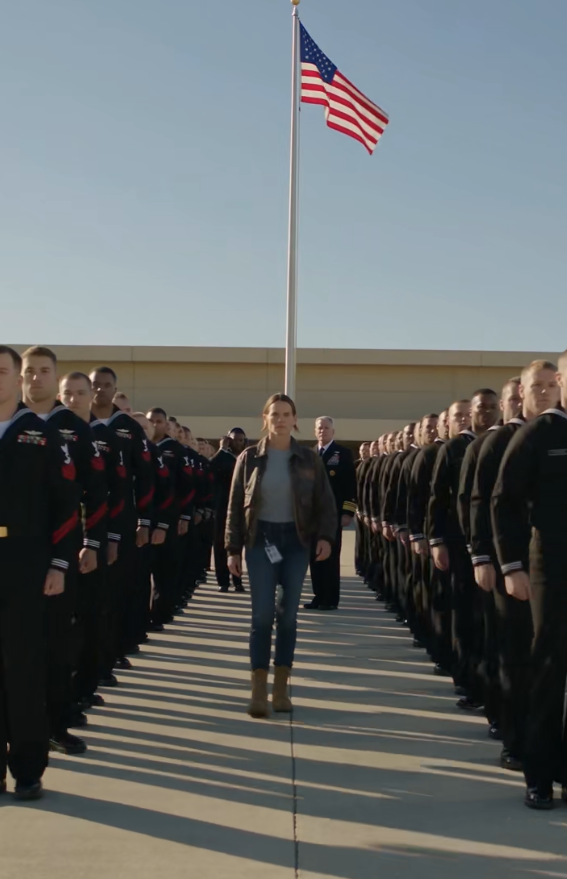
Across the courtyard, the morning inspection was already underway.
Lines of Navy SEALs stood in perfect formation, their dress uniforms pressed so sharply they seemed capable of slicing through the sunlight. Their faces remained forward, their shoulders squared, and their bodies completely still. Above them, the American flag snapped in the strong coastal breeze.
I continued walking.
Then I caught sight of two F-22 Raptors parked beyond the operations building.
That was when the morning stopped feeling ordinary.
I slowed just enough to examine the aircraft more carefully.
The first Raptor was carrying the wrong external tank configuration for the mission schedule I had received the previous evening. The second had a distinct scuff near its starboard pylon mount, a mark I remembered from a depot report dated three months earlier.
I knew that damage.
I remembered the report.
And neither aircraft should have been sitting there in that condition.
Not unless the tactical briefing scheduled for 0900 concerned an operation considerably more serious than anything described in the documents I had been given.
I continued across the courtyard, mentally reviewing what I had noticed.
Someone had either failed to update the operational records or had deliberately kept important information out of them.
Neither possibility made me comfortable.
I was halfway across the open space when Admiral Richardson noticed me.
He descended from the reviewing platform with the confidence of a man who had spent decades expecting people to move the moment he entered a room. His silver hair caught the morning light. His face bore the weathered look of someone who had spent years beneath the sun, and his squared shoulders projected the kind of authority that made younger officers respond before they had even processed his presence.
He walked directly toward me.
Then he stopped beside the flagpole, placing himself squarely in my path.
In front of the entire formation.
“What is that woman doing here?” he demanded.
He wasn’t asking me.
He was asking the people around him, as though I were an object someone had mistakenly left in the wrong place.
I lifted my identification badge where he could see it.
“Sir, I’m here for the 0900 tactical briefing. My access has been authorized.”
Richardson barely glanced at the badge.
His attention moved from my jeans to my worn boots, then to the leather jacket and my uncovered hair. His expression suggested that my appearance alone had already settled the question of whether I deserved to be there.
“Ma’am,” he announced loudly, “you need to leave this area immediately. This is a restricted military ceremony. Civilians are not permitted in an active operational zone.”
A subtle movement passed through the formation.
It wasn’t enough to disrupt the inspection or cause anyone to break position. The SEALs remained disciplined and still.
But I knew they had heard him.
Every one of them.
I could have corrected the admiral on the spot.
I could have told him my actual rank and explained why my presence had been requested. I could have shown him the authorization that had brought me onto the installation and identified the officers expecting me at the briefing.
I could even have given him the call sign that had a way of silencing entire rooms whenever it was spoken among certain fighter pilots.
But I did none of those things.
I simply stood there, looking at him without changing my expression.
Over the years, I had learned that there were moments when defending yourself only gave the wrong person more opportunities to enjoy the humiliation they were trying to create.
Richardson seemed to interpret my silence as proof that he had already won.
“Security!” he barked.
Two guards immediately broke away from their positions.
“Escort this woman to the main gate.”
The guards approached with professional restraint. Both appeared uncomfortable, displaying the quiet hesitation of decent people ordered to carry out an action they suspected was unfair.
One stopped a respectful distance from me.
“Ma’am,” he said quietly, “please come with us.”
I looked at him, then nodded.
“All right.”
I didn’t argue.
I didn’t raise my voice.
And I didn’t give Admiral Richardson the confrontation he seemed so eager to have.
I allowed the guards to escort me away from the inspection area.
As we crossed the courtyard, however, my attention remained fixed on everything around me.
The new directional array mounted on the operations building caught my eye first. It looked recently installed, with temporary equipment positioned near its base. I made a mental note of its placement.
Next, I noticed an armored SUV parked outside the motor pool. Dried mud covered its lower panels, suggesting it had recently returned from somewhere far less clean than the paved roads surrounding the installation.
Then two corpsmen hurried past us, carrying trauma kits that looked far too heavy for an ordinary military ceremony.
They weren’t walking casually. They moved with purpose, their expressions tense and their attention focused on whatever lay ahead.
I watched them disappear around the corner of the operations building.
Something was happening at Naval Special Warfare Command.
Something that had nothing to do with a parade, a routine inspection, or a ceremonial gathering.
The aircraft configuration, the fresh equipment, the mud-covered vehicle, and the medical personnel all pointed toward an operation that was either already underway or about to begin.
And the information I had received the previous night clearly didn’t tell the whole story.
The guards continued guiding me toward the gate.
I kept my pace steady.
Behind us, Admiral Richardson returned his attention to the formation, apparently satisfied that he had removed an inconvenient civilian from his carefully controlled morning.
Then his voice suddenly boomed through the base intercom.
“All personnel be advised: any unauthorized civilians attempting to enter restricted areas during military operations will face immediate prosecution under federal law.”
The announcement echoed across the courtyard and through the surrounding buildings.
I heard a younger SEAL mutter something to the man standing beside him.
“Contractor thinks she’s somebody important.”
His companion didn’t respond.
I lowered my eyes for a moment, fighting the urge to smile.
Not because the remark was particularly clever.
But because the young man had no idea how close he was to learning just how wrong his assumption had been.
I had spent enough time around military installations to recognize the difference between a routine security announcement and an order delivered because someone wanted to make an example of another person.
Richardson had made his decision publicly.
He had humiliated me in front of an entire formation, ordered guards to remove me, and announced to the base that civilians who crossed the wrong boundary would face prosecution.
He was convinced that the matter was finished.
He believed the only thing left to do was return to his inspection and forget about the woman in the old flight jacket.
He was about to discover otherwise.
We were nearly at the far side of the courtyard when a sudden commotion erupted behind us.
The doors of the operations building flew open.
A communications officer came rushing outside, moving so quickly that he nearly collided with the doorway. He had a headset pressed tightly against one ear, and his face had turned so pale that even from a distance, I could see something was seriously wrong.
He stopped just long enough to scan the courtyard.
His eyes found Admiral Richardson first.
Then they shifted toward the two guards escorting me away.
For a split second, his expression changed.
He looked as though he had just realized that something important had gone terribly wrong.
“Admiral!” he shouted.
Richardson turned sharply toward him, clearly irritated by the interruption.
The communications officer didn’t stop to explain himself. He hurried farther into the open, still holding the headset against his ear, his gaze moving between the admiral and me.
Then he drew a breath and shouted a name across the courtyard.
Not my civilian name.
Not the title printed on my contractor badge.
He called out my F-22 call sign.
The sound carried across the parade ground, cutting through the morning breeze and the silence that had followed the intercom announcement.
Every SEAL in the courtyard turned at precisely the same moment.
The formation’s attention shifted as one.
The younger man who had mocked me moments earlier went rigid. The guard beside me abruptly stopped walking. Across the courtyard, officers who had barely acknowledged my existence now stared in my direction.
Admiral Richardson froze.
His expression changed so quickly that it was almost impossible to miss. The irritation disappeared from his face, replaced by a look of disbelief.
He turned toward the communications officer, then slowly looked back at me.
The officer shouted my call sign again, his voice carrying a sense of urgency that made the atmosphere feel suddenly electric.
I stopped beside the guards.
For the first time since arriving at the base, I allowed myself to turn fully toward the formation.
The F-22 Raptors remained parked beyond the operations building, their silhouettes unmistakable beneath the morning sky. The new directional array stood on the roof. The corpsmen had disappeared around the corner, and the armored SUV remained outside the motor pool.
Whatever was happening, the people on this base clearly needed someone whose identity mattered far more than the clothes she wore.
And now they knew exactly who that person was.
The SEALs began to straighten even further, their movements precise and immediate.
Then, one after another, they raised their hands in salute.
The gesture spread through the courtyard like a wave.
The very men who had watched me being escorted away now stood at attention, their expressions transformed by recognition and respect.
Admiral Richardson remained motionless beside the flagpole.
His eyes were fixed on me.
Only moments earlier, he had ordered me off the installation without giving my credentials a second glance. He had dismissed my explanation, judged my importance by my appearance, and made certain that the entire formation witnessed his decision.
Now his own personnel were saluting the woman he had treated like an intruder.
I met his gaze without saying a word.
The communications officer hurried toward us, still clutching his headset.
The guards who had been escorting me quietly stepped aside.
And Admiral Richardson, who had appeared so certain of his authority only moments before, looked as though he had suddenly realized that he had made a mistake he could not simply order away.
The entire courtyard was silent.
Every SEAL stood at attention.
Every eye was on me.
And the admiral who had commanded me to leave the base could do nothing but stare as my call sign continued to echo in his mind.
Because whatever he had assumed about the woman in the old leather flight jacket, one thing was now impossible to ignore:
He had just ordered the wrong person off his base.
And the real reason I had been summoned to Naval Special Warfare Command was only beginning to come to light.
PART 2 — THE CALL SIGN THAT CHANGED EVERYTHING
“RAVEN ONE.”
The communications officer said it a third time, but the words came out differently now. The urgency remained. So did the fear. Yet beneath both was something resembling relief.
“Commander,” he continued, stopping several feet from me, “the operations center needs you immediately. We have a confirmed communications failure on the western approach, and the aircrew has lost contact with the forward team.”
Admiral Richardson’s face tightened.
“Commander?” he repeated.
The communications officer glanced at him, then back at me.
“Commander Elena Ward, sir. Callsign Raven One. The lead tactical aviation liaison assigned to Operation Iron Lantern.”
A strange stillness settled over the courtyard.
I watched Richardson absorb the information.
His eyes dropped toward the contractor identification badge hanging against my chest. He read my name again, as though the printed letters might somehow contradict what he had just heard.
“Commander Ward,” he said slowly. “You’re the aviation specialist?”
“I am.”
“You were supposed to arrive in uniform.”
“No, Admiral. I was instructed to arrive in civilian clothing and report directly to the operations center.”
“By whom?”
“Rear Admiral Thomas Mercer. The task force commander.”
Richardson’s jaw moved slightly.
Mercer was not a man whose instructions could be casually dismissed. His authority over the joint operation extended across multiple commands, and his reputation for tolerating administrative interference was practically nonexistent.
Richardson looked toward the communications officer.
“Why wasn’t I informed?”
The officer hesitated.
“Sir, your office received the operational notification at 0615. The acknowledgment was recorded at 0622.”
The answer landed harder than an accusation.
Richardson’s expression darkened.
I could have helped him recover his dignity. I could have said there had been a misunderstanding or that the morning had been unusually busy.
But he had made a deliberate decision before asking a single meaningful question.
I wasn’t interested in helping him pretend otherwise.
“Commander Ward,” he said, forcing his voice into a more controlled register, “I believe there’s been a regrettable misunderstanding.”
“An escort to the gate isn’t usually considered a misunderstanding, Admiral.”
The younger SEAL who had mocked me earlier lowered his eyes.
Richardson noticed.
So did I.
“Your clothing was inconsistent with the requirements of a restricted military ceremony,” he said.
“I wasn’t attending your ceremony.”
A murmur moved through the formation before discipline swallowed it.
I continued.
“I was reporting for an operational briefing. My credentials were valid. My authorization was on file. The instructions were explicit.”
“Then why didn’t you identify yourself?”
“I did. You didn’t look.”
For the first time that morning, the admiral had no immediate answer.
The communications officer shifted impatiently.
“Commander, we really need to move.”
I nodded.
“Lead the way.”
We had taken only three steps when Richardson spoke again.
“Commander Ward, I expect you to report to my office after the briefing.”
I stopped.
“Why?”
His eyebrows rose.
“Because I’m the senior officer responsible for this installation.”
“Then you should be interested in why your tactical records don’t match the aircraft outside.”
The color drained slightly from his face.
It was subtle, but I caught it.
“What aircraft records?”
“The external tank configuration on the first Raptor doesn’t match the authorized mission profile. The second aircraft has a pylon discrepancy that should have triggered a maintenance hold. Neither condition appears in the documentation I received.”
Richardson stared at me.
“You inspected those aircraft?”
“I looked at them while walking across your courtyard.”
“That is not a technical inspection.”
“No, sir. It’s an observation. One that your maintenance officers should already have documented.”
The communications officer looked between us.
“Commander, the forward team is still waiting.”
That ended the discussion.
I followed him toward the operations building, leaving Richardson beside the flagpole and a formation of SEALs who had just witnessed their admiral make a mistake in public.
Inside, the atmosphere was completely different.
Technicians sat at crowded consoles. Communications specialists spoke into headsets. Large displays showed maps of the Pacific coast, aviation tracks, weather patterns, and a coastal training area marked with red and amber symbols.
At the center of the room, Rear Admiral Thomas Mercer stood over a digital chart.
He was in his late fifties, broad-shouldered, with silver at his temples and a face that seemed permanently shaped by difficult decisions. Unlike Richardson, Mercer rarely raised his voice. He had learned that the most important orders were often delivered quietly.
He looked up when I entered.
“Raven One.”
“Admiral.”
He extended his hand.
“You’re late.”
“Your installation security team had other plans.”
His gaze moved past me toward the entrance.
Richardson had followed us.
“I’d like to clarify what happened outside,” Richardson began.
Mercer raised one hand.
“Later.”
“Admiral, I was not informed that Commander Ward would be arriving in civilian clothing.”
“Your office received the instructions,” Mercer replied. “We’ll examine the acknowledgment after we address the operation.”
Richardson’s expression hardened, but he said nothing.
Mercer turned toward the main display.
“Commander, here’s the situation.”
A map filled the wall.
A small marker blinked along a rugged stretch of coastline north of San Diego. Several additional symbols represented a maritime training team, a support vessel, and a temporary communications relay.
“An exercise team deployed before dawn,” Mercer explained. “Their assignment was to evaluate a new maritime surveillance system under degraded communications conditions. At 0736, the forward element reported a discrepancy in the data feed. At 0741, we lost its primary link.”
“How many personnel?”
“Six SEALs, two communications specialists, and a Navy corpsman.”
“Last confirmed position?”
He pointed to the map.
I studied the terrain.
A narrow coastal channel ran between steep rock formations. Offshore, a series of underwater ridges complicated navigation. Weather conditions were deteriorating faster than the morning forecast had predicted.
“Was there a secondary relay?”
“Installed yesterday.”
“By whom?”
Richardson answered before Mercer could.
“An approved technical team. The equipment was inspected and cleared.”
I looked at the display again.
“Then why is the relay transmitting a timing signature that doesn’t match the authorized configuration?”
The room went quiet.
A young communications specialist turned toward his console.
“What timing signature?”
I stepped closer.
“Bring up the relay’s last recorded handshake.”
He did.
The data appeared as a sequence of time stamps, signal intervals, and equipment identifiers.
I examined it for several seconds.
Then I pointed to a cluster of irregular transmissions.
“Here. And here.”
The specialist leaned forward.
“Those are packet retransmissions.”
“No. They’re scheduled acknowledgments arriving out of sequence. The relay is either using a mismatched clock profile or receiving a signal that doesn’t belong to the network.”
Richardson folded his arms.
“Could it simply be equipment drift?”
“It could,” I replied. “But equipment drift doesn’t explain why the aircraft records were altered.”
The words changed the room.
Mercer looked at me.
“Altered how?”
I explained the discrepancies I’d noticed outside: the mismatched external configuration, the unresolved pylon report, and the apparent gap between the approved mission documentation and the aircraft actually parked on the apron.
Then I described the relay.
“Individually, each issue might be a clerical mistake. Together, they suggest the operational picture we’re working from may not be reliable.”
Mercer turned toward the communications specialist.
“Can you establish a clean connection to the forward team?”
“We’re attempting to establish a secondary path, sir.”
“Attempting isn’t an answer.”
The specialist swallowed.
“Not yet, sir.”
I leaned over the console.
“Give me the last confirmed voice transmission.”
The room went quiet as a recording began.
Static filled the speakers.
Then a man’s voice emerged.
“—control, this is Sierra Two. We have an unexpected indicator on the northern ridge. Repeat, the equipment is showing a contact that isn’t present on the visual feed.”
A pause.
“Request confirmation before proceeding.”
More static.
Then a second voice.
“Control, we’re receiving an unidentified authentication request through the temporary relay. We’re not accepting it. Please advise.”
The recording ended.
I felt a familiar coldness settle in my stomach.
“Who authorized that relay’s installation?”
Richardson answered quickly.
“Lieutenant Commander Daniel Shaw supervised the equipment team.”
“Where is he?”
“Presently assigned to communications integration.”
“Bring him here.”
Mercer issued the order.
A few minutes later, a lean officer in his early forties entered the operations room. His uniform was immaculate, and his expression was composed enough to appear rehearsed.
“Admiral,” he said.
“Commander Ward has identified a discrepancy in the relay configuration,” Mercer told him. “Explain it.”
Shaw glanced at me.
His eyes lingered briefly on my worn jacket before returning to Mercer.
“The system was tested and certified yesterday. We experienced some environmental interference after deployment, but nothing outside the expected parameters.”
“Then why was an unidentified authentication request received?” I asked.
“Probably a corrupted handshake.”
“Probably?”
“These systems occasionally produce false positives.”
“Did you authorize the relay’s software update?”
Shaw hesitated.
“I approved the installation package.”
“That wasn’t my question.”
His expression tightened.
“The package came through the approved technical channel.”
“Which channel?”
“The joint integration office.”
I looked toward Mercer.
“Admiral, I’d like the original package, its digital signature, the installation logs, and every configuration change made after certification.”
Shaw shifted his weight.
“That information is already in the system.”
“Then retrieving it shouldn’t be difficult.”
Mercer gave the communications chief a nod.
“Preserve the logs. Make read-only copies. No one modifies the relay records until the review is complete.”
Shaw’s face remained neutral, but his fingers had curled slightly against his trouser seam.
I had seen that reaction before.
It didn’t prove guilt.
It did mean someone in the room understood that the next few minutes mattered.
Before the technician could retrieve the files, a new alert appeared on the main display.
The forward team’s emergency beacon had transmitted a brief signal.
Then disappeared.
A corpsman hurried to the console.
“We have a medical emergency indicator, sir.”
Mercer turned sharply.
“From which member?”
“Identity not confirmed.”
The room seemed to contract around the display.
Eight people were out there, cut off from reliable communications in worsening weather. Their last transmission suggested that their equipment was reporting something they could not verify visually.
And now someone might be injured.
Mercer looked at me.
“Raven One, can you get eyes on the area?”
“Not until we establish what the aircraft can safely support.”
“Then establish it.”
I nodded.
The admiral turned toward the operations staff.
“Activate the contingency response. Prepare the search-and-rescue coordination team. We are not treating this as a routine exercise failure.”
Then he looked directly at Richardson.
“And nobody leaves this building with an unreviewed copy of those records.”
Richardson stiffened.
“Are you suggesting someone here is compromised?”
“I’m suggesting that eight people are waiting for help, and we don’t yet know why our communications failed.”
Mercer paused.
“Until we know more, every assumption is a liability.”
For the first time since I had entered the base, the admiral who had summoned me seemed genuinely concerned.
Not about his reputation.
Not about the ceremony.
About the people outside the wire.
I understood that concern.
I’d built my career around the principle that the lives depending on a mission mattered more than the people receiving credit for it.
I removed my old leather jacket and laid it over an empty chair.
Underneath, I wore a simple dark shirt with my identification clipped to the collar.
Then I pulled a chair toward the console.
“Let’s find our people.”
And somewhere in the operations room, beneath the static and the blinking warning indicators, a second problem was quietly taking shape.
The failure might not have been an accident.
But before I could prove that, I had to bring eight people home.
PART 3 — THE GHOST IN THE FLIGHT RECORDS
By 0830, the operations room had stopped pretending that the situation was manageable.
The first search-and-rescue aircraft had been placed on standby. Weather reports showed a low cloud ceiling forming along the coastline, and the temporary relay continued to generate intermittent authentication requests.
Every few minutes, the forward team’s emergency beacon appeared on the display.
Every few minutes, it vanished.
Commander Daniel Shaw remained beside the communications station, answering questions with the careful precision of someone who knew that a single inaccurate statement could become an official record.
I didn’t accuse him of anything.
Accusations were easy.
Evidence took longer.
I preferred evidence.
“Commander Ward,” Mercer said, joining me at the console, “the air operations chief has confirmed that the two Raptors are available. One has a maintenance restriction that prevents it from being assigned to the planned mission profile. The other can fly, but its data link requires a separate certification check.”
“Then neither should launch until the discrepancy is resolved.”
Richardson, standing several feet away, frowned.
“We don’t have the luxury of delaying an emergency response over paperwork.”
“It’s not paperwork, Admiral. It’s aircraft safety.”
“We have personnel in danger.”
“And sending an aircraft into uncertain conditions with an unresolved equipment issue could create another emergency.”
Mercer watched us for a moment.
Then he nodded.
“Proceed with the checks. I want a safe aircraft, a verified mission profile, and a backup recovery plan.”
The air operations chief moved immediately.
Richardson said nothing more, but I could feel his frustration.
He had spent years in command, and he understood urgency. What he seemed less comfortable accepting was that urgency did not automatically make every decision wise.
I opened the preliminary maintenance report.
The damaged pylon mount had been documented three months earlier following an inspection at a maintenance facility. The report recommended additional testing before the aircraft returned to certain operational configurations.
A subsequent entry marked the issue resolved.
The sign-off belonged to a technician whose name I recognized from an unrelated aviation safety review.
That was strange.
The technician had transferred to another command before the sign-off date.
I checked the digital signature.
It had been generated from an account that should have been inactive.
“Admiral Mercer.”
He stepped beside me.
“Show me.”
I pointed to the signature history.
“Someone used an inactive account to certify this aircraft’s maintenance status. I don’t know yet whether the aircraft itself is unsafe, but the record is unreliable.”
Mercer leaned closer.
“Can we determine who entered the certification?”
“Not from this screen. We need the original audit trail.”
He turned toward the cyber operations specialist.
“Get it.”
The specialist began working.
I moved to the next report.
The external tank configuration had also been changed in the records. A mission planning file showed one arrangement, while the aircraft’s actual configuration differed.
The change had been approved under an emergency modification request.
But the request lacked the required engineering attachment.
“Who approved this modification?” I asked.
The air operations chief checked the screen.
“Lieutenant Commander Shaw’s integration office.”
The room went quiet again.
Shaw lifted his chin.
“My office processes technical coordination requests. We don’t independently certify aircraft modifications.”
“Who does?”
“Engineering and airworthiness.”
“Then why does your authorization appear here?”
“Because the system requires an administrative routing approval.”
I studied the document.
It was a plausible explanation.
It was also incomplete.
“Who uploaded the supporting engineering file?”
Shaw hesitated.
“I’d have to check.”
“Please do.”
He turned toward the communications station.
I watched him leave the main group.
Mercer lowered his voice.
“What do you think?”
“I think the records have been altered or mishandled. I don’t know whether Shaw is responsible.”
“And the relay?”
“Someone introduced a configuration that doesn’t match the approved profile. We need the original installation package before we can tell whether that was an error, an unauthorized change, or something deliberate.”
Mercer nodded.
“You’re being careful.”
“I’ve learned that being certain too early can be more dangerous than being uncertain.”
His expression softened.
“Your father used to say something similar.”
I looked at him.
“My father said a lot of things.”
“Ethan Ward was one of the finest maintenance officers I ever served with.”
For a moment, the room seemed to fade.
My father had died eleven years earlier after a civilian aircraft suffered a catastrophic mechanical failure during a test flight. He had been the senior engineer responsible for a review of the aircraft’s maintenance history.
The official investigation concluded that a combination of component fatigue and incomplete documentation had contributed to the accident.
My father had spent the final months of his life arguing that the records did not match the physical evidence.
He never got the chance to finish proving it.
“Did you know him well?” I asked.
“Not as well as I should have,” Mercer replied. “I reviewed his findings after the accident. He was right about several inconsistencies.”
“Several?”
Mercer looked away briefly.
“There were records he wanted examined more thoroughly. The investigation had already been transferred between offices, and the original digital archive was incomplete.”
I felt a familiar ache behind my ribs.
“Why are you telling me this now?”
“Because the pattern you’re seeing today reminds me of the concerns he raised.”
Before I could answer, a sharp tone sounded from the communications station.
“New transmission!”
The room turned toward the speakers.
Static.
Then a strained voice.
“Control, this is Sierra Two. We have one injured. Repeat, one injured. We are moving toward higher ground. The relay is transmitting a position that doesn’t match our location.”
The signal crackled.
Another voice came through.
“Someone is answering our authentication requests.”
Then silence.
I leaned toward the console.
“Replay that last section.”
The technician played it again.
Someone was answering the team’s authentication requests.
Not merely interfering with the relay.
Responding.
“Can you isolate the source?” I asked.
“Not yet.”
“Could it be an authorized training simulation?”
The technician checked the exercise schedule.
“No simulation was scheduled to generate live authentication responses.”
Mercer looked toward Shaw.
“Your team installed this system?”
“Yes, sir.”
“Then I want the original configuration files and every change made since certification.”
“Of course.”
Shaw’s answer came too quickly.
The technician brought up the latest network log.
A sequence of requests had been sent from the forward team’s equipment. Several were rejected. Others received responses that appeared to originate from the temporary relay, but the signatures were inconsistent.
I examined the timestamps.
Then I noticed something.
The relay’s internal clock was drifting backward in irregular intervals.
“That isn’t ordinary environmental interference,” I said.
“Could a faulty clock create this?” Mercer asked.
“Possibly. But the authentication sequence is too structured to dismiss as random noise. Someone needs to examine whether the relay is replaying previously recorded responses.”
The cyber specialist looked up.
“That’s consistent with what we’re seeing.”
Richardson approached the display.
“Are you telling us someone is impersonating the network?”
“I’m telling you that the evidence suggests the relay may be accepting or replaying messages it shouldn’t trust.”
“Can it affect aircraft?”
“Not without additional access and a compatible system. We have no evidence of that yet.”
I emphasized the last sentence because I wanted it entered into the record.
Speculation could spread faster than any technical failure.
A moment later, the maintenance chief returned with an update.
“The second Raptor has passed the physical inspection, but the data-link discrepancy remains unresolved. The first aircraft is grounded pending a full review.”
I considered the weather map.
“Can we establish a voice-only coordination plan with the forward team using a verified independent communications channel?”
“We’re preparing one.”
“Good. Keep the aircraft out of the network until its systems are independently cleared. We can still coordinate a search-and-rescue response without connecting every system to the compromised relay.”
Mercer nodded.
“Make it happen.”
The next twenty minutes passed in a blur of controlled activity.
A rescue helicopter was prepared. The search-and-rescue team assembled its equipment. Medical personnel received the limited information available about the injured SEAL.
The operation moved forward, but the technical investigation continued in parallel.
At 0912, the cyber specialist called me over.
“I found something.”
A list of installation packages appeared on the screen.
Three versions had been uploaded to the relay’s management system within a twelve-hour period.
The first carried a valid certification.
The second contained a minor configuration change.
The third had been uploaded shortly before the exercise began.
Its signature appeared valid at first glance.
But when the specialist compared it against the original certificate, the cryptographic fingerprints did not match.
“This package was modified after it was signed,” he said.
“Can you identify the modification?”
“We’re working on it.”
“Preserve the file exactly as received. No repairs, no normalization, no automatic updates.”
He nodded.
I opened the package metadata.
The uploader’s account was listed as an integration service rather than an individual user.
That didn’t identify a person.
It did tell us where to look.
“Trace the service account’s authorization history.”
The specialist worked for several minutes.
Then he stopped.
“Commander, the authorization came through a legacy gateway associated with the aviation systems maintenance archive.”
My hands went cold.
“Which archive?”
He displayed the identifier.
I knew it.
It was part of the same historical system that had held my father’s maintenance records.
The archive had been partially retired years earlier. It was supposed to be isolated from operational networks, accessible only through tightly controlled review procedures.
It had no legitimate reason to be involved in the configuration of a temporary maritime communications relay.
“That’s impossible,” Richardson said.
I turned toward him.
“Impossible is a conclusion. Right now, it’s a connection.”
Mercer studied the display.
“Can someone access the old archive without authorization?”
“Yes. If the gateway permissions are misconfigured or if someone has retained credentials they shouldn’t have.”
“Who has those credentials?”
“We need the access logs.”
The cyber specialist brought them up.
Several access attempts had been recorded during the previous week.
Most had been rejected.
One had succeeded.
The account belonged to a former contractor who had worked on aviation maintenance data integration.
His name was Marcus Vale.
I recognized it immediately.
Vale had been a technical auditor during the final year of my father’s investigation. He had reviewed several of the disputed maintenance records before resigning from government service.
I hadn’t heard his name in eleven years.
“Who is he working for now?” Mercer asked.
The specialist searched the personnel database.
“His current employer is listed as Northstar Technical Solutions. They provide data integration support under several defense contracts.”
Richardson’s expression hardened.
“Northstar installed the relay.”
Shaw spoke from the other side of the room.
“Northstar supplied one component of the integration package. They did not control the installation.”
“Who did?” Mercer asked.
“My office coordinated the work.”
The answer was technically correct.
It was also becoming increasingly uncomfortable.
Before anyone could continue, the communications station erupted with a new transmission.
“Control, Sierra Two. We have movement on the eastern approach. We cannot verify identity.”
A pause.
“Request instructions.”
Then another voice, weaker than the first.
“Medic is treating an injury. We need extraction.”
Mercer looked at the search-and-rescue coordinator.
“Proceed under the independent response plan. No reliance on the suspect relay.”
The coordinator acknowledged.
The rescue helicopter lifted into the morning sky shortly afterward.
I watched its track appear on the display.
The aircraft was flying a carefully planned search pattern while the ground team moved toward a safer extraction point. We had no guarantee that communications would remain stable, and the weather continued to deteriorate.
But at least the response was now operating on verified information.
For the first time that morning, I felt a measure of relief.
Then the cyber specialist opened another file.
It was an archived technical memorandum, dated eleven years earlier.
The author was my father.
The subject line read:
UNAUTHORIZED MODIFICATION OF MAINTENANCE RECORDS — REQUEST FOR INDEPENDENT REVIEW.
I stared at the screen.
The final paragraph contained a sentence I had heard him say countless times.
If the record and the machine disagree, do not repair the record to make the machine look correct.
Below it was a note indicating that the review had been suspended pending an administrative investigation.
The approval field contained a name.
Thomas Mercer.
I turned toward the admiral.
“You signed this?”
He looked at the document for a long moment.
“Yes.”
“Why was the investigation suspended?”
Mercer did not answer immediately.
“Because I was instructed to transfer the review to another office. I was told the discrepancy had already been resolved.”
“Did you verify that?”
“No.”
The honesty of the answer hurt more than a denial would have.
“My father believed someone was altering records.”
“I know.”
“And you allowed the investigation to stop.”
“I followed an order based on information I believed was accurate. That doesn’t excuse failing to verify it.”
I searched his face for defensiveness.
I found none.
“I’ve thought about that decision for eleven years,” he continued. “When your name appeared on the task force assignment, I wanted you to have the opportunity to review the system independently. I didn’t tell you about the old investigation because I didn’t want to influence your findings.”
“You could have told me the archive was connected to a previous case.”
“Yes,” he said quietly. “I should have.”
For a moment, neither of us spoke.
Then the search-and-rescue coordinator called out.
“Visual contact established with the forward team!”
The room turned toward the display.
The helicopter had located the group near a rocky shelf above the shoreline. One SEAL was injured, but the team remained together.
The extraction was difficult. Wind gusts forced the aircraft to reposition, and the ground team had to move away from an unstable section of the slope.
But they were alive.
At 0951, the first personnel reached the medical transfer point.
At 1003, the final member of the forward team was accounted for.
The room exhaled.
Several technicians leaned back in their chairs. The corpsman gave a brief nod to the medical coordinator. Mercer closed his eyes for a second, allowing himself the smallest possible acknowledgment of relief.
I felt the tension leave my shoulders.
We had brought them home.
Now we had to determine why they had needed rescuing.
Mercer turned toward the cyber specialist.
“Secure the relay and preserve every associated record. Notify the appropriate investigative authority. Nobody conducts an independent search or contacts outside personnel about the suspected tampering.”
The specialist acknowledged.
Richardson looked toward Shaw.
“Lieutenant Commander, surrender your access credentials pending review.”
Shaw’s face changed.
“Admiral, I have followed every instruction given to me.”
“That will be determined through the investigation.”
“This is a technical problem. It doesn’t establish misconduct.”
“No one has made a final finding,” Mercer said. “But the records will be examined.”
Shaw reluctantly handed over his credentials.
Then he looked directly at me.
“You’re making a mistake, Commander.”
I held his gaze.
“Then the evidence should clear you.”
He left the room under escort.
For a few seconds, I thought that might be the end of the immediate confrontation.
Then the cyber specialist opened the original package’s revision history.
A previously hidden attachment appeared in the metadata.
It had been created eleven years earlier.
Its filename was short.
WARD_FINAL_REVIEW.
My father’s name was nowhere in the title.
It didn’t need to be.
I knew, before the file was even opened, that the operation had become something much larger than a failed communications exercise.
Someone had reached back into a buried investigation.
Someone had used the same legacy archive.
And someone had decided that a problem my father had died trying to expose was worth hiding again.
PART 4 — THE ADMIRAL’S DARKEST SECRET
The attachment could not be opened on the operations network.
That was the first thing the cyber specialist discovered.
The file had been stored in a legacy format and marked for offline review. Its metadata showed that it had been accessed shortly before the relay’s configuration was modified.
The system had also recorded an attempt to delete the access history.
That attempt had failed.
“Whoever created this understood the archive,” the specialist said. “They knew where the file was stored, how the gateway worked, and which permissions would allow the integration service to reach it.”
“Can you recover the original?” Mercer asked.
“Yes, sir. But I recommend a forensic copy on an isolated workstation.”
“Do it.”
I remained beside the console, watching the extraction process.
My father had taught me to respect evidence before emotion. He had also taught me that evidence could be incomplete, misunderstood, or deliberately arranged to tell the wrong story.
I kept reminding myself of that as the file loaded.
The first pages contained technical notes about maintenance record discrepancies. Several entries showed differences between the physical inspection results and the information recorded in the aviation database.
One aircraft had been certified as serviceable despite an unresolved component issue.
Another had undergone an inspection whose supporting documentation could not be located.
A third had been removed from an active maintenance schedule, then reintroduced without a corresponding engineering approval.
The details were familiar.
Not because I had memorized every line of my father’s investigation, but because I had spent much of my adult life learning to recognize the same failures in different forms.
A system could tolerate an honest mistake.
It could not safely tolerate a process that concealed mistakes to protect the people responsible for them.
The attachment continued.
My father had identified a common administrative pathway used to update multiple maintenance records. The pathway had been designed for efficiency, allowing authorized technical personnel to process corrections without repeating every approval step.
Under normal conditions, it was useful.
Under the wrong conditions, it created a dangerous blind spot.
If someone gained access to the pathway, they could alter the digital history of a record without changing the physical condition of the equipment it described.
The system was supposed to prevent that through independent verification.
But several verification records had been generated through the same pathway they were meant to audit.
In other words, the system was sometimes confirming its own work.
I leaned closer to the screen.
“That’s the weakness.”
The cyber specialist nodded.
“Your father identified it. The independent verification process wasn’t truly independent.”
Mercer stood behind us.
“Was it corrected?”
“The documentation says it was,” I replied. “But the implementation history suggests the correction may never have been fully deployed.”
The room went silent.
Richardson looked at the screen.
“Are you saying the entire maintenance archive is unreliable?”
“No. I’m saying certain records require independent verification, particularly those that passed through the legacy gateway.”
“That’s still a serious problem.”
“Yes, sir.”
He looked away.
For the first time, I saw something in his expression that had nothing to do with authority or embarrassment.
He was beginning to understand the possible scale of the failure.
The file contained one final section.
It was a memorandum addressed to an internal review board, dated three days before my father died.
The memorandum stated that he had identified evidence suggesting that several unauthorized changes were being made to technical records after certification.
He had requested that the affected records be compared with original inspection documents and physical maintenance logs.
The request was denied.
The denial bore the signature of a senior administrative official.
Beneath that signature was a second approval.
Thomas Mercer.
I turned toward him.
He didn’t look away.
“I remember this,” he said.
“You signed it.”
“Yes.”
“Why?”
Mercer took a slow breath.
“At the time, I was told the independent review had already been completed. The memorandum was presented to me as a request to reopen a matter that had been resolved.”
“Did you read the supporting evidence?”
“I read the summary.”
“Not the evidence.”
“No.”
I looked back at the screen.
“My father asked for an independent investigation, and you denied it based on a summary written by the people whose records he questioned.”
“Yes.”
The word came quietly.
I felt anger rise, but beneath it was something worse: the knowledge that a single decision could follow a person for years, long after the person making it had moved on to other responsibilities.
“Did you know he was still pursuing the issue?”
Mercer shook his head.
“I knew he was dissatisfied with the findings. I did not know he had identified this specific weakness.”
“Did you ever speak to him?”
“Once. He asked me whether I believed a clean audit trail was the same thing as a correct maintenance record.”
My throat tightened.
“That sounds like him.”
“He told me that if the record could be changed without the physical evidence being checked, the audit trail was only a story the system told about itself.”
I stared at the memorandum.
It was almost exactly the principle he had repeated throughout my childhood.
“Why didn’t you follow up?”
Mercer did not offer an excuse.
“I should have.”
His answer was not enough to erase what had happened.
But it was enough to keep me listening.
Before I could ask another question, an investigator from the command’s independent oversight office arrived. She introduced herself as Captain Rebecca Ellis, though she was serving in an investigative capacity rather than an operational role.
She was in her late forties, with a direct manner and a folder tucked under one arm.
“Admiral Mercer,” she said, “I’ve received the initial incident notification. I understand you have evidence of possible unauthorized system access.”
“We do,” Mercer replied. “And a historical memorandum related to the same archive.”
Ellis examined the document.
When she reached the signature page, she looked up.
“This requires an independent review outside the command.”
“Agreed,” Mercer said.
She turned toward me.
“Commander Ward, I understand you identified the discrepancies.”
“I did.”
“Have you had any prior involvement with the archived investigation?”
“My father was the engineer who originally raised the concerns.”
Ellis paused.
“Then I need to document that relationship. You’ll be treated as a technical witness, and any conclusions involving the historical investigation will be reviewed by personnel who have no connection to your family.”
“I understand.”
“I also want to be clear that we haven’t established who modified the relay or why. The historical connection is significant, but it does not prove that the same person was responsible for the current incident.”
“Agreed.”
Ellis nodded.
“Good. We will preserve the evidence and establish the chain of custody.”
For the next hour, the room became a forensic workspace.
The original relay package was copied and sealed. The installation logs were preserved. The aviation maintenance records were compared against their original source documents. Every relevant access attempt was recorded, and personnel who had handled the equipment were asked to provide statements.
The process was slow.
It was supposed to be.
A dramatic theory could be assembled in minutes. A reliable finding required something more durable.
At 1205, the cyber specialist found the first direct link between the historical archive and the current relay.
An access request had been generated using a credential associated with Northstar Technical Solutions.
The credential had been used to retrieve an old configuration template from the aviation archive.
That template had then been incorporated into the relay’s installation package.
However, the specialist could not determine whether the access had been made by an individual using the account, an automated process, or someone who had obtained the credential without authorization.
Northstar’s account records would have to be examined.
Captain Ellis made a note.
“That’s our first traceable connection. It’s not yet a finding of responsibility.”
I nodded.
“Can you compare the template against the current package?”
“Yes,” the specialist replied.
He displayed two sets of configuration data.
Most of the information matched.
One section did not.
The current package contained a timing rule that had not existed in the certified version. It was configured to accept a limited sequence of previously recorded authentication responses under circumstances that should have required fresh verification.
The rule did not provide unrestricted access to the network. It was narrower than that.
But in a system designed to authenticate the identity and location of deployed personnel, even a narrow exception could create confusion.
The forward team’s equipment had reported a position inconsistent with its visual surroundings. The relay had answered requests it should have rejected. Those failures had contributed to the team’s loss of reliable communications.
The exact cause of the emergency still required confirmation, but the technical evidence was no longer consistent with a simple weather-related outage.
“Can you tell whether the rule was deliberately added?” Richardson asked.
The specialist shook his head.
“The change was made manually, but intent cannot be determined from the configuration alone.”
“Who had access?”
“Three accounts had sufficient permissions. One belonged to the integration service. One belonged to Lieutenant Commander Shaw’s office. The third was associated with an administrative maintenance account.”
Ellis wrote down the account identifiers.
“Who controls the administrative account?”
The specialist checked.
“It was originally assigned to the program management office. The account should have been disabled two years ago.”
“Was it?”
“No, ma’am. It remained active.”
Richardson closed his eyes briefly.
Another oversight.
Another access path that should not have existed.
At 1240, Shaw returned for a formal interview under the investigative process. He was accompanied by counsel and was no longer permitted to access operational systems.
He denied knowingly authorizing the questionable configuration.
He admitted that his office had approved the installation schedule and that he had signed an administrative routing document. He said the technical package had been presented as a certified update.
When Ellis asked about the legacy archive, he claimed he had not known it was involved.
His statement could be verified.
Or disproved.
For now, it remained a statement.
Then the investigators discovered something that changed the direction of the inquiry.
The administrative maintenance account had been accessed from a terminal in a building scheduled for renovation. The terminal was supposed to have been disconnected from the network several months earlier.
Yet its access logs showed activity during the previous week.
The person responsible had not merely used an old account.
Someone had preserved an obsolete workstation and maintained a route into the archive.
Captain Ellis ordered the terminal secured.
Before she left, she turned to me.
“Commander, I need you to understand something. We may uncover evidence that confirms your father’s concerns. We may also find that some of his conclusions were incomplete. We have to follow the records wherever they lead.”
“I wouldn’t want it any other way.”
She studied me for a moment.
“You sound like him.”
“Everyone keeps saying that today.”
“Perhaps because he was right about the importance of independent verification.”
After she left, Mercer asked me to join him in a smaller conference room.
Richardson came with us.
The three of us sat around a table with no screens, no operational map, and no audience.
For the first time, the admiral looked less like a man defending his authority and more like someone confronting the consequences of a decision he had made long ago.
“Commander Ward,” he began, “I owe you an apology.”
I waited.
“I judged your fitness to be on this installation by your appearance. I did so without verifying your credentials, despite your explanation. I then ordered you removed in front of personnel who had every reason to believe I had acted on complete information.”
“Yes, sir.”
“I also made the situation worse by announcing a warning over the intercom. I used the authority of my office to reinforce a decision I had not properly examined.”
He paused.
“That was unacceptable.”
I looked at him carefully.
An apology did not undo the humiliation.
It did not restore the minutes lost before I entered the operations center.
And it certainly did not repair the larger failures we had uncovered.
But it was an acknowledgment.
“I accept your apology, Admiral,” I said. “I also expect the incident to be documented accurately.”
“It will be.”
“And I expect the review of the aircraft records to continue, regardless of whether it becomes uncomfortable for anyone in this command.”
Richardson nodded.
“Agreed.”
Mercer folded his hands.
“There is another matter. Your father’s case.”
I felt my shoulders stiffen.
“I won’t ask you to forgive decisions you had no part in making,” he continued. “But I will cooperate fully with the independent investigation. If my approval contributed to an incomplete review, that fact belongs in the record.”
“Why now?”
“Because I don’t intend to make the same mistake twice.”
He held my gaze.
“I cannot change what happened eleven years ago. I can make certain that this investigation isn’t stopped because its findings inconvenience someone.”
For several seconds, I said nothing.
Then I nodded.
“That is all I can ask of you.”
When the meeting ended, I returned to the operations room.
The rescued SEALs had been transported to medical facilities. The injured corpsman was receiving treatment, and the remaining personnel were undergoing debriefing.
The immediate emergency was over.
The larger problem was only beginning.
At 1430, Captain Ellis called with an update.
The investigators had located the obsolete workstation. Its storage device had been removed, but the system’s network interface contained a configuration that matched the access pattern associated with the legacy archive.
They had also identified a recent access attempt linked to an employee of Northstar Technical Solutions.
The employee’s identity was not yet confirmed.
But the company had been asked to preserve its records and cooperate with the inquiry.
Then Ellis told us about the file recovered from the workstation’s temporary directory.
It was a scanned copy of a handwritten note.
The note had been created eleven years earlier.
It was signed by my father.
The final sentence read:
If they cannot explain why the numbers changed, someone needs to ask who benefits from leaving them changed.
I read the sentence twice.
Then I closed my eyes.
For eleven years, I had carried the belief that my father had died with an unfinished investigation.
Now, for the first time, I had proof that his concerns had never truly disappeared.
They had been buried.
And someone had recently reached into that burial place to retrieve the very mechanism he had warned us about.
The question was no longer whether my father had been mistaken.
The question was who had been so determined to keep his questions unanswered.
PART 5 — RAVEN ONE COMES HOME
By the following morning, Naval Special Warfare Command had become the center of an investigation involving aviation safety, communications security, maintenance records, and possible unauthorized access to a restricted archive.
The rescue itself had ended successfully, but the command could not simply resume normal operations.
The two Raptors remained subject to separate reviews. The temporary relay had been isolated. The legacy archive was under forensic examination, and personnel connected to the installation were being interviewed.
For the first time in years, the records my father had questioned were being examined by people who had no reason to protect the conclusions of the original investigation.
That mattered.
It also meant that every conclusion would have to be earned.
At 0700, I stood outside the operations building, looking toward the aircraft apron.
The morning air carried the familiar smell of salt, grass, and jet fuel.
I had slept for perhaps three hours.
My phone contained several missed calls from people who had heard fragments of the previous day’s events. I ignored them and focused on the flight line.
A maintenance crew was inspecting the grounded Raptor. Another team was reviewing the second aircraft’s configuration against the approved engineering documentation.
Neither aircraft would return to the planned operation until the appropriate officials certified it safe.
I was satisfied with that decision.
A mission delayed for the right reason could be rescheduled.
A mission conducted with unreliable information could cost lives.
Behind me, footsteps approached.
It was the younger SEAL who had made the comment about the contractor thinking she was important.
He stopped several feet away.
“Commander Ward?”
I turned.
He stood at attention, his expression serious.
“Petty Officer First Class Daniel Brooks, ma’am. I was in the formation yesterday morning.”
“I remember.”
He swallowed.
“I owe you an apology.”
I waited.
“I made a comment about you being a contractor who thought she was somebody important. I didn’t know who you were, and I assumed your appearance meant you didn’t belong there.”
“Did you need to know my call sign to understand that was wrong?”
His face reddened.
“No, ma’am.”
“Then what did you learn?”
“That I shouldn’t decide what someone deserves based on what they look like.”
I studied him for a moment.
He was young enough to believe that one mistake might define his entire career, but experienced enough to understand that an apology did not erase the consequences of his behavior.
“Good,” I said. “Remember it when the next person walks through that gate wearing something you don’t expect.”
“Yes, ma’am.”
He saluted.
I returned it.
When he left, I felt a small measure of peace.
Not because the incident had been dramatic or because the entire courtyard had witnessed the reversal.
Because the point of the experience was not that people should recognize my importance.
It was that they should not need to.
At 0830, Admiral Richardson requested my presence in the command conference room.
This time, the invitation had arrived through the proper channels.
I entered wearing a clean flight suit, my rank displayed clearly, and my old leather jacket folded over one arm.
Richardson stood beside the table.
Mercer was seated near the window, and Captain Ellis had joined by secure video link.
The admiral began without ceremony.
“Commander Ward, the command has completed its initial review of the events leading to your removal from the courtyard. The security personnel followed the instructions they were given. Their conduct is not the focus of this review.”
He opened a folder.
“My decision was based on an assumption rather than a proper examination of your credentials and authorization. I also failed to verify information that was available to my office.”
He paused.
“The command will document the incident, review its visitor verification procedures, and ensure that personnel receive clear guidance on how operational access is confirmed.”
I nodded.
“Thank you, Admiral.”
He continued.
“The technical review is also expanding. The maintenance discrepancies, the relay configuration, and the legacy archive will be investigated independently. We have identified enough irregularities to justify a comprehensive examination of related records.”
Captain Ellis spoke through the screen.
“Commander Ward, our preliminary findings confirm that the relay’s installed configuration differed from the certified package. We have also verified that a credential associated with a former contractor accessed the legacy archive shortly before the configuration was changed.”
“Do we know who used the credential?”
“Not conclusively. The access originated through a service pathway associated with Northstar Technical Solutions. The company is cooperating with the investigation, and the relevant records have been preserved.”
“Does the evidence connect the former contractor to the aircraft maintenance changes?”
“Not yet. The historical records show overlapping access permissions, but we have not established that the same individual made the current and historical changes.”
That was the right answer.
I didn’t need a convenient villain.
I needed the truth.
Ellis continued.
“We also found evidence that the independent verification controls described in the original corrective action plan were not fully implemented. That finding is significant regardless of who altered the relay.”
I looked toward Mercer.
“Then my father’s concern was valid.”
“His concern about the verification process was supported by the evidence,” Ellis replied. “Whether every conclusion he reached about individual responsibility was correct remains under review.”
I appreciated the distinction.
It respected my father without turning his memory into an excuse to stop asking questions.
Richardson closed the folder.
“There is one additional issue. Your temporary assignment was intended to include a broader assessment of aviation support procedures and joint operational data integrity. Given what we’ve discovered, Admiral Mercer has requested that you remain with the review team.”
Mercer nodded.
“If you’re willing.”
I considered the offer.
My original assignment had been limited. I was supposed to examine the coordination between aviation units and special operations personnel, identify weaknesses in mission planning, and provide recommendations before a larger joint exercise.
Instead, I had uncovered a potential failure in a legacy technical system linked to a long-buried investigation.
The work would be complicated.
It would be emotionally difficult.
And it would require me to separate the daughter who wanted answers from the officer responsible for evaluating evidence.
“I’ll stay,” I said. “But I want the scope of my role documented, and I want the investigative findings kept independent of my technical recommendations.”
Ellis nodded.
“That is appropriate.”
“Also, I don’t want the command treating this as a problem solved by disciplining one officer. The process allowed questionable records to survive for years. If the process isn’t corrected, the same failure can happen again.”
Richardson’s expression was solemn.
“Agreed.”
The meeting ended with a series of assignments, deadlines, and requests for additional documentation.
There was no dramatic announcement.
No public declaration that the entire mystery had been solved.
Just the beginning of a process that should have started eleven years earlier.
Over the following week, the investigation produced several important findings.
The first concerned the relay.
Forensic examination confirmed that the questionable timing rule had been introduced after the certified installation package was created. The change had been routed through a legacy integration service that should no longer have possessed the necessary permissions.
The second concerned the aircraft maintenance records.
Investigators discovered that several digital approvals could not be matched to the original inspection documents. Those records were removed from automatic clearance procedures pending independent verification.
The aircraft themselves underwent additional inspections. The grounded Raptor remained out of service until its discrepancies were resolved. The second aircraft returned to flight status only after the required engineering and maintenance reviews were completed.
The third finding concerned the historical archive.
The corrective action plan developed after my father’s investigation had been marked complete, but several critical controls had never been fully implemented.
The paperwork indicated that the problem had been solved.
The technical evidence indicated otherwise.
No single discovery explained everything.
But together, they showed how a dangerous weakness could survive: one incomplete review, one unchecked approval, one obsolete account left active, and one system that trusted its own records more than the physical evidence.
The investigation also revealed that the original review had been closed under pressure to meet a deadline. The available documentation did not establish that every official involved had acted dishonestly. Some had relied on summaries. Others had accepted approvals from offices they believed were independent.
Their decisions still mattered.
But responsibility would have to be assessed individually, based on evidence rather than assumption.
That was what my father had wanted.
Not revenge.
Not a public spectacle.
A system in which the truth could not be dismissed simply because it was inconvenient.
On the eighth day, Captain Ellis contacted me with a more personal update.
The investigators had located an archived letter my father had written to the independent review board.
It had never been entered into the final case file.
The letter contained no accusations against a particular person. Instead, he had listed the specific records he believed needed independent examination and explained why the existing verification process was inadequate.
At the end, he had written:
I understand that reopening this matter may delay the program and create difficult questions. But the cost of uncertainty cannot be measured only in time or money. If we certify something we have not truly verified, we transfer the risk to the people who trust us.
I sat alone in the conference room after reading it.
For eleven years, I had wondered whether my father had known how close he was to proving his case.
Now I understood that he had not been trying to win an argument.
He had been trying to protect people who might never know his name.
That was why he had become an engineer.
That was why I had become a pilot.
And that was why I could not allow the investigation to become a contest over whose reputation would survive.
A few days later, I received permission to visit the maintenance facility where my father had worked during the final year of his career.
The building had changed.
The old inspection desks were gone, replaced by modern workstations. The filing cabinets had been removed, and the walls carried new safety notices.
But the smell was familiar.
Metal, machine oil, cleaning solvent, and the faint scent of coffee that had been sitting too long.
An older technician named Samuel Price met me near the entrance.
He had worked with my father for almost fifteen years.
“I heard you were coming,” he said.
“I hope that isn’t a problem.”
“Not at all.”
He led me to a small office overlooking the hangar.
For a while, we spoke about ordinary things. The weather. The changes to the facility. The younger technicians who now occupied the workstations where my father had once spent his mornings.
Eventually, Price opened a drawer and removed a small notebook.
“Your father left this with me,” he said. “He asked me to keep it until he was certain the investigation was complete.”
My throat tightened.
“Why didn’t you give it to the review board?”
“Because he told me not to release it unless the original records were independently examined. He believed the notebook contained observations that might be misunderstood without the underlying documents.”
He placed it on the desk.
“I’ve waited a long time to find out whether I was right to keep it.”
I opened the cover.
The pages contained handwritten notes about inspection discrepancies, dates, component identifiers, and questions my father had intended to pursue.
There were no dramatic revelations.
No secret confession.
No single page that named the person responsible for everything.
Instead, the notebook showed the patient work of an engineer trying to reconcile a system’s claims with the reality in front of him.
On the final page, he had written a reminder to himself.
Never let the pressure to finish become an excuse to stop checking.
I closed the notebook.
For the first time since the investigation began, I felt that I had received something more valuable than an answer.
I had received a piece of my father that no administrative decision could erase.
“Thank you,” I said.
Price nodded.
“He was proud of you.”
I looked up.
“He never told me that.”
“He didn’t need to say it every day. But he talked about you whenever he had the chance.”
I laughed softly, despite the tears gathering in my eyes.
“What did he say?”
“That you were stubborn enough to keep asking questions and sensible enough to know when you needed better evidence.”
“That sounds like him.”
Price smiled.
“He said the sky would be a good place for you, because it would teach you that confidence and certainty weren’t the same thing.”
I looked through the window toward the hangar.
For years, I had carried my father’s unfinished investigation like a weight I was afraid to set down.
Now I understood that honoring him did not require me to finish every question he had asked.
It required me to preserve the principle behind those questions.
Verify what matters.
Protect the people who depend on you.
And never confuse authority with truth.
Three weeks after the incident, Naval Special Warfare Command held a formal review of the emergency response.
The rescued team had recovered fully enough to participate, and the injured SEAL was expected to return to duty after completing rehabilitation.
The review acknowledged that the initial communications failure had exposed serious weaknesses in the relay’s verification process and the command’s contingency planning.
The search-and-rescue response had succeeded because personnel switched to independently verified procedures and coordinated their actions without waiting for every technical question to be answered.
That distinction became central to the corrective plan.
The command introduced new requirements for legacy system access, independent verification of maintenance approvals, and documented confirmation of operational credentials.
Temporary equipment could no longer inherit permissions from retired systems without a separate security review.
The changes were not glamorous.
They would not make a dramatic headline.
But they would make it harder for the same failure to happen again.
Richardson attended the review in person.
When it was his turn to speak, he stood before the assembled officers and acknowledged his decision to remove me from the courtyard.
He did not describe it as a misunderstanding.
He did not blame the guards or the ceremony.
He said he had judged too quickly, failed to verify available information, and used his position to reinforce a decision he should never have made.
Then he announced that the command would review its procedures for confirming authorization and handling personnel whose appearance or assignment differed from expectations.
The apology was brief.
It was also public.
Afterward, he approached me near the exit.
“I’ve been thinking about something you said,” he told me.
“Which part, Admiral?”
“That the people who need to be respected shouldn’t have to prove they deserve basic professional courtesy.”
I nodded.
“I believe that.”
“I spent years believing that discipline meant maintaining control over every situation. I’m beginning to understand that discipline also means being willing to correct yourself when you’re wrong.”
“That’s a difficult lesson.”
“Yes,” he said. “It is.”
He looked toward the courtyard.
“I cannot undo the way I treated you that morning. I can make sure the command learns from it.”
“Then start there.”
He extended his hand.
I shook it.
This time, neither of us needed an audience.
The final investigative report would take months to complete. Some questions would remain unresolved, and the authorities would determine whether individual conduct warranted administrative or legal action.
I accepted that.
A responsible investigation did not promise the ending anyone wanted.
It promised to follow the evidence as far as it could go.
And sometimes, that was the only honest promise available.
Six weeks after the original incident, I returned to the base for the first flight under the revised aviation coordination procedures.
The sky was clear, the wind moderate, and the flight line busy with ordinary activity.
The Raptor whose maintenance record had been questioned had completed its independent inspections and been cleared for the approved training profile. Its maintenance history had been reconstructed from original records, physical inspections, and verified technical documentation.
The aircraft was safe to fly.
That was the only result that mattered.
I walked across the apron in my flight suit, carrying my helmet beneath one arm.
The smell of jet fuel brought back memories of my father standing beside an aircraft with a clipboard in his hand, checking a final entry before allowing a crew to proceed.
He had always insisted that the last check mattered as much as the first.
I stopped beside the Raptor and placed my hand against its fuselage.
“Let’s do this right,” I murmured.
The ground crew completed the final preparations.
The flight proceeded without incident.
During the post-flight review, the new coordination process revealed a minor discrepancy between a planning document and an updated weather report. The issue was corrected before it affected the next scheduled activity.
It was an ordinary problem.
That was the point.
Safety did not always depend on discovering a conspiracy or exposing a major failure.
Sometimes it depended on noticing one small inconsistency and refusing to wave it away.
When I returned to the operations building, Petty Officer Brooks was waiting near the entrance.
“Commander Ward,” he said, offering a crisp salute.
I returned it.
“How is the team?”
“Doing well, ma’am. The injured corpsman is recovering. He sent a message thanking the search-and-rescue crew.”
“Good.”
Brooks hesitated.
“Ma’am, I wanted to ask you something.”
“Go ahead.”
“Does everyone eventually learn to recognize a person like you?”
I frowned slightly.
“A person like me?”
“Someone who knows what they’re doing but doesn’t look the way people expect.”
I considered the question.
“I hope they learn not to make that distinction.”
He nodded slowly.
“I’ll remember that.”
As he walked away, I looked toward the courtyard where the entire story had begun.
The flag was moving in the coastal breeze.
The grass had been cut again.
The operations building stood exactly where it had stood on the morning Richardson ordered me off the base.
But I was no longer thinking about the admiral’s expression when the SEALs saluted.
I was thinking about the people who had been stranded along the coast, the maintenance technicians who had been asked to trust incomplete records, and the engineers whose warnings might never be heard if the people in charge cared more about preserving authority than discovering the truth.
The salute had been memorable.
It had also been the least important part of the story.
Respect was not a reward reserved for people with impressive ranks, celebrated call signs, or reputations that made others stand straighter.
It was the starting point of professional conduct.
And it meant very little if it appeared only after someone discovered that the person they had dismissed was important.
I adjusted the strap on my helmet and started toward the briefing room.
There was another review to complete.
Another team to support.
Another set of records that needed to be checked before anyone trusted them.
The work would continue long after the courtyard forgot what had happened that morning.
I intended to be there for it.
EPILOGUE — THE SALUTE THAT MATTERED
Three months later, the independent review board released its findings on the initial technical failures.
The report confirmed that the temporary relay had been deployed with an unauthorized configuration change, that legacy access controls had failed to prevent improper use of a retired system, and that the command’s verification procedures had not adequately separated technical approval from administrative recordkeeping.
Investigators also confirmed that portions of the earlier aviation maintenance review had been closed without completing all the independent checks required by the corrective plan.
The report did not assign every historical discrepancy to a single person. Some records had been altered through identifiable accounts, while others could not be attributed conclusively. The authorities referred specific conduct for further review and required the affected maintenance records to be independently reconstructed.
It was not the simple ending that television audiences might have expected.
There was no single villain standing in the middle of a room, confessing to every failure.
There was something more useful.
A documented explanation of how the system had failed, which controls had been missing, and what had to change.
The command implemented the required safeguards. The legacy gateway was permanently isolated from operational networks. Retired accounts were disabled, independent verification became mandatory for designated maintenance approvals, and the temporary equipment certification process was redesigned.
The rescued SEAL team eventually returned to duty.
At a small gathering held to recognize the search-and-rescue personnel, the injured corpsman approached me with a carefully folded note.
“Ma’am, I wanted you to have this.”
“What is it?”
“A message from the team.”
I opened it.
The note contained eight signatures.
Below them was a single sentence:
Thank you for making sure the people behind the signals were never forgotten.
I read it twice.
Then I folded it carefully and placed it inside my flight jacket.
That evening, I called my mother.
She had followed the investigation from a distance, listening to my updates and asking the questions that mattered most.
“Did you find what you were looking for?” she asked.
I looked out at the darkening sky beyond the window.
“Some of it.”
“And the rest?”
“I think Dad would have wanted us to keep checking.”
She was quiet for a moment.
Then she laughed softly.
“He would have told you that himself.”
“I know.”
We talked about ordinary things after that. Family plans. The weather. A recipe she wanted to try. The kind of conversation that had once felt impossible during the long years when my father’s death seemed inseparable from the questions he had left behind.
When we hung up, I sat for a while without turning on the television or opening my laptop.
For the first time in a long time, I did not feel as though I was racing to catch up with a past that had already escaped me.
My father had not received the investigation he deserved while he was alive.
I could not change that.
But his work had mattered.
His questions had mattered.
And because someone had finally taken the time to examine the evidence independently, his warnings had helped expose a weakness that could have placed more people at risk.
That was not a perfect ending.
It was a meaningful one.
The next morning, I returned to the base.
The gate guard checked my identification, confirmed my authorization, and waved me through.
There was no confusion.
No public announcement.
No officer demanding to know why a woman in a worn leather jacket was walking across a restricted installation.
I passed the flagpole and continued toward the operations building.
A group of SEALs was crossing the courtyard in the opposite direction.
Petty Officer Brooks recognized me first.
He stopped, straightened, and saluted.
The others followed.
I returned the salute and continued walking.
Behind me, the courtyard returned to its ordinary rhythm.
No one needed to shout my call sign.
No one needed to explain my record.
No one needed to discover that I had once flown an F-22 or that my name had appeared in reports read by senior officers across multiple commands.
They were simply acknowledging a fellow professional.
And that was enough.
I had arrived at Naval Special Warfare Command as a woman in faded jeans and an old leather jacket, carrying questions that did not fit neatly into the briefing I had been given.
I left the first morning without reaching the operations center.
But I returned with a mission that mattered more than proving an admiral wrong.
The real victory was not that the SEALs had saluted me.
It was that the people responsible for the command had begun to understand why no one should have needed to.
Because rank could identify authority.
A call sign could identify experience.
And a uniform could identify service.
But none of them should have been required before someone earned the basic respect of being heard.
I pulled my father’s old notebook from the inside pocket of my jacket and checked the final page one more time.
Never let the pressure to finish become an excuse to stop checking.
I closed it and stepped into the sunlight.
The flight line was waiting.
So was the work.
And for the first time in eleven years, I knew exactly how to carry my father’s legacy forward—not by living in the shadow of what had happened to him, but by making certain that the people who came after us would have a better chance of getting home.
THE END